Electrical Engineering Dictionary - part 140
 

  Index      Production     Electrical Engineering Dictionary


Search            


Content   ..  138  139  140  141   ..


Electrical Engineering Dictionary - part 140


propagating wave

a wave that exhibits a

spatial shift as time advances. Mathemat-
ically, a propagating wave is described by
f (t − r/v

p

), where is some function, t

is the temporal variable,

is the spatial vari-

able, and

v

p

is the phase velocity of the wave.

propagation

the motion of electromag-

netic waves through a medium or free space.

propagation constant

a complex con-

stant whose real part is the wave attenuation
constant (nepers attenuation per unit length)
and whose imaginary part is the wave phase
constant (radian phase shift per unit length).
See also

phase constant

.

propagation delay

(1) the delay be-

tween transmission and reception of a signal.
Caused by the finite velocity of electromag-
netic propagation.

(2) the delay time between the applica-

tion of an input signal to a chain of circuit
elements and the appearance of the resulting
output signal.

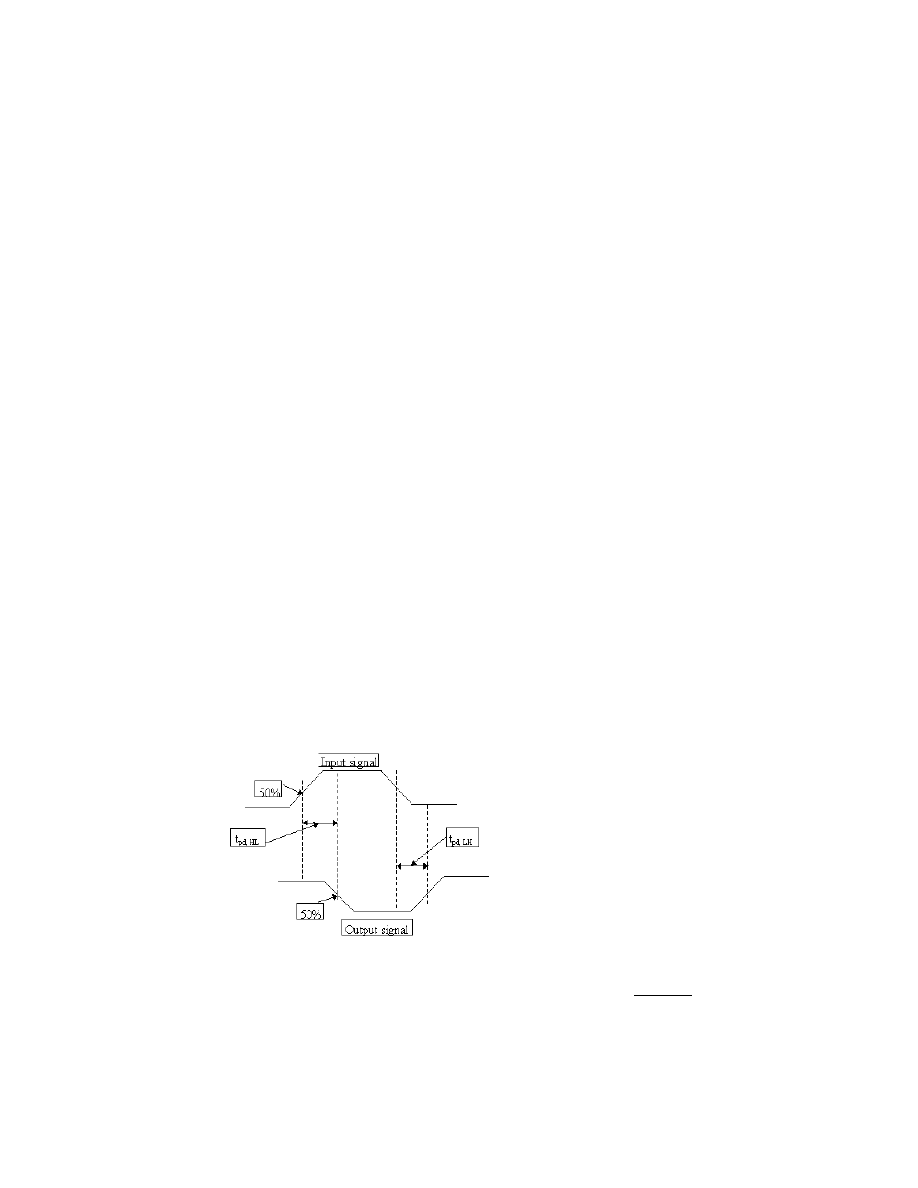
(3) the time it takes for a transistor switch

to respond to an input signal, symbolized

t

pd

.

It is calculated between the 50% rise point to
the 50% fall point or vice-versa (see graph of
typical inverter gate).

Propagation delay for a typical inverter gate.

The time from when the input logic level

to a device is changed until the resultant out-
put change is produced by that device.

propagation delay time

See

propagation

delay

.

propagation factor

the ratio of the elec-

tric field intensity in a medium to its value if
the propagation took place in free space.

propagation mode

(1) in radio commu-

nication, refers to the manner in which ra-
dio signals propagate from the transmitting
antenna to the receiving antenna.

Radio

waves can be reflected from the ionized lay-
ers within the ionosphere. Scatter modes of
propagation also exist, and in these modes,
propagation from the transmitting to receiv-
ing antennas is largely the result of scattering
of the radio waves by dust and other particles
in the troposphere. The ionized trails of me-
teors can also act as scatterers.

(2) in waveguides, used at microwave fre-

quencies, propagation mode refers to the ar-
rangement of electrical and magnetic fields
within the waveguide. Modes can be classi-
fied as being transverse electric (TE) or trans-
verse magnetic (TM), depending on whether
the electric field or magnetic field is trans-
verse to the direction of wave propagation
within the waveguide. The mode that exists
for the lowest frequency that can be transmit-
ted by the waveguide is known as the domi-
nant mode of the waveguide.

propagation path

the route along which

a radio wave propagates from the transmit-
ting antenna to the receiving antenna. If this
is a straight line, the path is a line of sight
path. Otherwise, reflection, diffraction, and
other phenomena may change the direction
of propagation so that the path can be en-
visioned as made up of several straight-line
segments. See also

line of sight

,

multipath

propagation

.

proper 2-D transfer matrix

the 2-D

transfer matrix

T (z

1

, z

2

=

N(z

1

, z

2

)

d(z

1

, z

2

)

N(z

1

, z

2

∈ R

p×m

[

z

1

, z

2

]

c

2000 by CRC Press LLC

d

z

1

,z

2

=

n

1

X

i=0

n

2

X

j=0

d

ij

z

i

1

z

j
2

is called proper if

d

n

1

,n

2

6= 0 (d(z

1

, z

2

is

acceptable) and

deg

z

1

n

ij

(z

1

, z

2

≤ n

1

deg

z

2

n

ij

(z

1

, z

2

≤ n

2

for

= 1, . . . , p= 1, . . . , m ;

where

n

ij

(z

1

, z

2

are the entries of N(z

1

, z

2

)

and deg

z

1

(deg

z

2

denotes the degree with re-

spect to

z

1

(

z

2

).

proper mode

a mode as obtained from a

boundary value problem defined over a finite
interval and relative to a second-order dif-
ferential equation with real coefficients. See
also

improper modes

.

proper subgraph

a subgraph that does not

contain all of the edges of the given graph.

proportional control

control scheme

whereby the actuator drive signal is pro-
portional to the difference between the in-
put/desired output and measured actual out-
put.

proportional-integral-derivative (PID) con-
trol

a control scheme whereby the signal

that drives the actuator equals the weighted
sum of

1. the difference,
2. time integral of the difference, and
3. time derivative of the difference be-

tween the input and the measured actual out-
put.

It is a widely used control scheme in in-

dustry that can be tuned to give satisfactory
performance based on knowledge of domi-
nant system time constant.

protection

control access to information

in a computer’s memory, consistent with a
particular policy or mechanism. Ring num-
bering was introduced in the Multics system
as one basis for limiting access and protect-
ing information. The term “security” is used

when the constraints and policies are very re-
strictive.

protection fault

an error condition de-

tected by the address mapper when the type
of request is not permitted by the object’s ac-
cess code.

protective relay

a device that monitors

the condition of the electric power system
and determines the presence of faults or other
system anomalies. The protective relay mon-
itors current flow, voltage level, or other pa-
rameter. When it operates due to a fault or
other event, it initiates a trip signal intended
to open the appropriate circuit breaker(s) or
other protective devices.

protective relaying

a unit for discriminat-

ing normal operating condition from faulted
conditions in power systems.

protocol

See

bus protocol

.

protocol data unit (PDU)

the unit of ex-

change of protocol information between en-
tities. Typically, a PDU is analogous to a
structure in C or a record in Pascal; the pro-
tocol in executed by processing a sequence
of PDUs.

protocol spoofing

a technique used by

VSAT networks to reduce the network de-
lay. The satellite network emulates the host
computer front-end processor at the VSAT
locations and emulates the multiple cluster
controllers at the hub location.

prototype filter

a low-pass filter that is

modulated to form a modulated filter bank.

prototyping

building an engineering

model of all or part of a system to prove that
the concept works.

proximity effect

a variation in the size of

a printed feature as a function of the sizes and
positions of nearby features.

c

2000 by CRC Press LLC

proximity printing

a lithographic method

whereby a photomask is placed in close prox-
imity (but not in contact) with a photoresist
coated wafer and the pattern is transferred by
exposing light through the photomask into
the photoresist.

pruning self-generating neural network
a methodology for reducing the size of self-
generating neural network (SGNN).

During SGGN training, the network may

grow very quickly, and some parts of the net-
work may become useful in neither train-
ing nor classification, and the weights of
these parts of the neurons of the network
never change after some training stage. We
call these parts of the network dead sub-
nets. It is obvious that the dead subnets of
the network should be pruned away to re-
duce the network size and improve the net-
work performance. One way to achieve this
is to check the weights of each neuron in
the network to see whether they have been
changed since last training epoch (or dur-
ing the last few epochs).

If they are un-

changed, the neuron may be evidently dead
and should be removed from the network. If
a neuron is removed from an SGNN, all of
its offspring should also be removed. See
also

self-generating neural network

,

training

algorithm of self-generating neural network

.

PS

See

product of sums

.

PSC

See

permanent split-capacitor motor

.

PSC motor

See

permanent split-capacitor

motor

.

pseudo code

a technique for specifying

the logic of a program in an English-like lan-
guage. Pseudo code does not have to follow
any syntax rules and can be read by anyone
who understands programming logic.

pseudo color

the display in color of gray-

level pixels to make certain gray-level pixels

or gray level patterns more visible. Typical
pseudocoloring schemes are

1. displaying all pixels in a range of gray

levels in one color;

2. displaying each gray level at a fixed in-

terval in a different color to produce colored
contour lines;

3. displaying the entire gray-level range as

a rainbow. Pseudocoloring is usually carried
out by look-up tables. See also

false color

,

look-up table

model

 (LUT).

pseudo-exhaustive testing

a testing tech-

nique that relies on various forms of circuit
segmentation and application of exhaustive
test patterns to these segments.

pseudo-noise (PN)

describes a class of

pseudo-randomly generated processes that
exhibit the statistical properties of noise.

pseudo-noise code phase

the starting

symbol of a pseudo-noise (PN) code with re-
spect to some time reference in the system.
In the IS-95 CDMA system, the same PN
code with different PN code phases (typically
multiples of 64 code symbols, or chips) is as-
signed as the pilot sequence for different base
stations. See also

spreading code

.

pseudo-noise code tracking

the act of

accurately generating a local pseudo-noise
(PN) code signal whose phase (timing rela-
tive to some reference time) accurately tracks
the phase of an incoming PN code signal.

pseudo-noise sequence

See

spreading

sequence

.

pseudo-operation

in assembly language,

an operation code that is an instruction to the
assembler rather than a machine-language in-
struction.

pseudo-QMF

a cosine-modulated filter

bank with the prototype filter being even-
length symmetric spectral factor of an

M-

th band filter. The aliasing of the adjacent

c

2000 by CRC Press LLC

bands is cancelled while the aliasing of non-
adjacent bands is very small.

pseudo-random

describes a process that

has the statistical properties of being ran-
dom, but is deterministic and can be recreated
given the requisite properties of its generator.

pseudo-random pattern generator

de-

vice that generates a binary sequence of pat-
terns where the bits appear to be random in
the local sense (1 and 0 are equally likely),
but they are repeatable (hence only pseudo-
random).

pseudo-random skewing

See

interleaved

memory

.

pseudo-random testing

(1) a testing

technique (often used in BISTs) that bases
on pseudo-randomly generated test patterns.
Test length is adapted to the required level of
fault coverage.

(2) a technique that uses a linear feed-

back shift register (LFSR) or similar structure
to generate binary test patterns with statisti-
cal distribution of values (0 and 1), across
the bits; these patterns are generated without
considering the implementation structure of
the circuit to which they will be applied.

PSK

See

phase-shift keying

.

PSNR

See

peak signal to noise ratio

.

PSU

power supply unit.

See

power

supply

.

PSW

See

program status word

.

psychovisual redundancy

the tendency

of certain kinds of information to be rel-
atively unimportant to the human visual
system.

This information can be elimi-

nated without significantly degrading im-
age quality, and doing so is the basis for
some types of image compression.

See

also

image compression

,

Joint Photographic

Experts Group (JPEG)

,

quantization matrix

.

PT

potential transformer.

See

voltage

transformer

.

PU-239

a man-made, fissile element suit-

able for use in nuclear weapons as well as
power reactors.

public key cryptography

two different

keys are used for the encryption of the plain-
text and decryption of the ciphertext. When-
ever a transmitter intends sending a receiver
a sensitive message that requires encryption,
the transmitter will encrypt the message us-
ing a key that the receiver makes available
publically to anyone wanting to send them
encrypted messages. On receiving the en-
crypted message, the receiver applies a secret
key and recovers the original plaintext infor-
mation sent by the transmitter. In contrast
to secret key cryptography, public key cryp-
tography does not suffer from the problem of
having to ensure the secrecy of a key. See
also

private key cryptography

.

public key cryptosystem

system that uses

a pair of keys, one public and one private, to
simplify the key distribution problem.

pull-in time

the time required by an au-

tomatic frequency control (AFC) system to
lock or stabilize after a frequency change.

pull-in torque

the amount of torque

needed to change a synchronous motor’s op-
eration from induction to synchronous when
self-started.

pull-out torque

the maximum value of

torque that an AC motor can deliver. An in-
duction motor operating at the pull-out torque
will operate at maximum slip, and load-
ing it beyond the pull-out torque will cause
the motor to stall. Synchronous motors re-
main at synchronous speed up to the pull-out
torque. Exceeding the pull-out torque for a
synchronous machine will lead to pole slip-
ping and destruction of the machine.

c

2000 by CRC Press LLC


Content   ..  138  139  140  141   ..