Volvo S60 Twin Engine (2020 year). Manual in english - page 3
 

  Index      Manuals     Volvo S60 Twin Engine (2020 year). Manual in english


Search            copyright infringement  


Content      ..     1      2      3      4      ..


Volvo S60 Twin Engine (2020 year). Manual in english - page 3


SAFETY

}}

53

Airbags

The car is equipped with airbags and inflat-
able curtains for driver and passengers.

NOTE

The detectors react differently depending
on the nature of the collision and whether
or not the seatbelts are fastened. Applies
to all belt positions.

It is therefore possible that only one (or
none) of the airbags may inflate in a colli-
sion. The detectors sense the force of the
collision on the vehicle and the action is
adapted accordingly so that none, one or
more airbags are deployed.

WARNING

The airbag system's control module is

located in the centre console. If the centre

console is drenched with water or other liq-

uid, disconnect the cables to the starter

battery. Do not attempt to start the car

since the airbags may deploy. Recovering

the car. Volvo recommends that it is trans-

ported to an authorised Volvo workshop.

Deployed airbags

If any of the airbags have deployed, the follow-
ing is recommended:

Recovering the car. Volvo recommends
that it is transported to an authorised

Volvo workshop. Do not drive with
deployed airbags.

Volvo recommends engaging an author-
ised Volvo workshop to handle the
replacement of components in the car's
safety systems.

Always contact a doctor.

WARNING

Never drive with deployed airbags. They

can make steering difficult. Other safety

systems may also be damaged. The smoke

and dust created when the airbags are

deployed can cause skin and eye irritation/

injury after intensive exposure. In case of

irritation, wash with cold water. The rapid

deployment sequence and airbag fabric

may cause friction and skin burns.

Related information

Safety (p. 44)

Driver airbags (p. 53)

Passenger airbag (p. 54)

Side airbags (p. 58)

Inflatable curtains (p. 59)

Driver airbags

As a supplement to the seatbelts, the car is
equipped with steering wheel airbag and
knee airbag

1

 on the driver's side.

Steering wheel airbag and knee airbag

1

 on the driv-

er's side in the front seat.

In the event of a frontal collision, the airbags
help to protect the head, neck, face and chest
of the driver as well as the knees and legs.

A sufficiently violent collision trips the sensors
and the airbag/airbags is inflated. The airbag
cushions the initial collision impact for the
occupant. The airbag deflates when com-
pressed by the collision. When this occurs,
smoke escapes into the car. This is completely
normal. The entire process, including inflation
and deflation of the airbag, occurs within
tenths of a second.

-------------------------------------------------------------------------------------------------------------------------------------------------------------

||

SAFETY

54

WARNING

The seatbelts and airbags interact. If the

belt is not used or is used incorrectly, this

may diminish the protection provided by

the airbag in the event of a collision.
To minimise the risk of injury if the airbag

deploys, passengers must sit as upright as

possible with their feet on the floor and

backs against the backrest.

WARNING

Volvo recommends that an authorised

Volvo workshop should be contacted for

repair. Defective work in the airbag system

could cause malfunction and result in seri-

ous personal injury.

Steering wheel airbag location

This airbag is fitted into the centre of the
steering wheel. The steering wheel is marked

AIRBAG

.

Knee airbag

1

 location

The airbag is folded up in the lower part of the
instrument panel on the driver's side. Its cover
panel is marked 

AIRBAG

.

WARNING

Do not place or attach any object on the

top or front of the panel where the knee

airbag is stowed.

Related information

Airbags (p. 53)

Passenger airbag (p. 54)

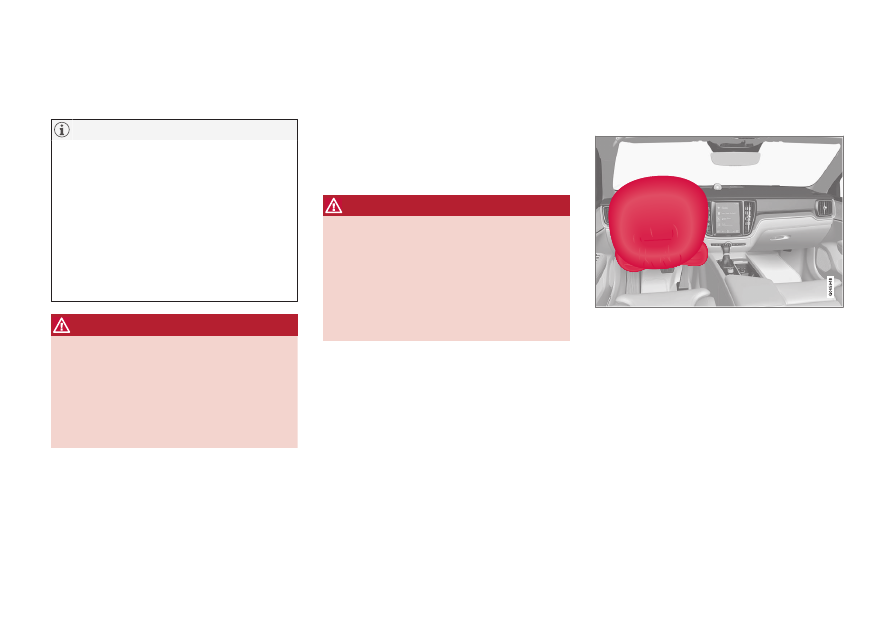
Passenger airbag

As a supplement to the seatbelts, the vehicle
is equipped with an airbag on the passenger
side in the front seat.

Front passenger airbag in front seat.

In the event of a frontal collision, the airbag
helps to protect the head, neck, face and
chest of the passenger as well as the knees
and legs.

A sufficiently violent collision trips the sensors
and the airbag is inflated. The airbag cushions
the initial collision impact for the occupant.
The airbag deflates when compressed by the
collision. When this occurs, smoke escapes
into the car. This is completely normal. The
entire process, including inflation and deflation

1

The car is only equipped with knee airbag in certain markets.

-------------------------------------------------------------------------------------------------------------------------------------------------------------

SAFETY

* Option/accessory.

55

of the airbag, occurs within tenths of a sec-
ond.

WARNING

The seatbelts and airbags interact. If the

belt is not used or is used incorrectly, this

may diminish the protection provided by

the airbag in the event of a collision.
To minimise the risk of injury if the airbag

deploys, passengers must sit as upright as

possible with their feet on the floor and

backs against the backrest.

WARNING

Volvo recommends that an authorised

Volvo workshop should be contacted for

repair. Defective work in the airbag system

could cause malfunction and result in seri-

ous personal injury.

Passenger airbag location

The airbag is folded up into a compartment
above the glovebox. Its cover panel is marked

AIRBAG

.

WARNING

Do not put objects in front of or above the

dashboard where the passenger airbag is

located.

Label for passenger airbag

Label on the passenger side's sun visor.

The warning label for the passenger airbag is
positioned as shown above.

WARNING

If the car is not equipped with a switch to

activate/deactivate the passenger airbag,

the airbag will always be activated.

WARNING

Never allow anybody to stand or sit in front

of the front passenger seat.
Never use a rear-facing child seat on the

front passenger seat if the airbag is acti-

vated.
Front-facing passengers (children and

adults) must never sit on the front passen-

ger seat if the passenger airbag is deacti-

vated.
Failure to follow the advice given above

can endanger life or lead to serious per-

sonal injury.

Related information

Airbags (p. 53)

Driver airbags (p. 53)

Activating and deactivating passenger air-
bag

*

 (p. 56)

-------------------------------------------------------------------------------------------------------------------------------------------------------------

SAFETY

* Option/accessory.

56

Activating and deactivating

passenger airbag

*

The passenger airbag can be deactivated if
the car is equipped with a switch, Passenger
Airbag Cut Off Switch (PACOS).

The switch for the passenger airbag is located
on the passenger end of the instrument panel
and is accessible when the passenger door is
open.

Check that the switch is in the required posi-
tion.

ON

 - The airbag is activated and all front-

facing passengers (children and adults)
can sit safely on the passenger seat.

OFF

 - The airbag is deactivated and chil-

dren in rear-facing child seats can sit
safely on the passenger seat.

WARNING

If the car is not equipped with a switch to

activate/deactivate the passenger airbag,

the airbag will always be activated.

Activating passenger airbag

Pull the switch outward and turn from

OFF

 to 

ON

.

> The driver display shows the message

Passenger airbag on


Please

acknowledge

.

NOTE

If the passenger airbag has been activated/
deactivated with the car in ignition position

I

 or lower, a message is shown in the driver

display and the following indicator in the
roof console approx. 6 seconds after the
car's electrical system has been set in igni-
tion position 

II

.

-------------------------------------------------------------------------------------------------------------------------------------------------------------

SAFETY

}}

57

2. Confirm the message by pressing the

right-hand steering wheel keypad's 

O

 but-

ton.

> A text message and a warning symbol

in the roof console indicate that the air-
bag for the front passenger seat is acti-
vated.

WARNING

Never use a rear-facing child seat on the

front passenger seat when the airbag is

activated.
The passenger airbag must always be acti-

vated when front-facing passengers (chil-

dren and adults) are sitting in the front pas-

senger seat.
Failure to follow the advice given above

can endanger life or lead to serious per-

sonal injury.

Deactivating passenger airbag

Pull the switch outward and turn from 

ON

to 

OFF

.

> The driver display shows the message

Passenger airbag off


Please

acknowledge

.

NOTE

If the passenger airbag has been activated/
deactivated with the car in ignition position

I

 or lower, a message is shown in the driver

display and the following indicator in the
roof console approx. 6 seconds after the
car's electrical system has been set in igni-
tion position 

II

.

2. Confirm the message by pressing the

right-hand steering wheel keypad's 

O

 but-

ton.

> A text message and a symbol in the roof

console indicate that the airbag for the
front passenger seat is deactivated.

WARNING

Front-facing passengers (children and

adults) must never sit on the passenger

seat when the airbag is deactivated.
Failure to follow the advice given above

can endanger life or lead to serious per-

sonal injury.

-------------------------------------------------------------------------------------------------------------------------------------------------------------

||

SAFETY

58

IMPORTANT

If the passenger airbag is deactivated, the
electric seatbelt tensioner on the passen-
ger side will also be deactivated.

Related information

Seatbelt tensioner (p. 50)

Child seats (p. 62)

Side airbags

The side airbags on the driver's and passen-
ger seats act to protect the chest and hips in
the event of a collision.

The side airbags are fitted in the outer back-
rest frames of the front seats and help to pro-
tect the driver and passengers in the front
seat.

A sufficiently violent collision trips the sensors
and the side airbags are inflated. The airbag
inflates between the occupant and the door
panel and thereby cushions the initial impact.
The airbag deflates when compressed by the
collision. The side airbag is normally only
deployed on the side of the collision.

WARNING

Volvo recommends that an authorised

Volvo workshop should be contacted for

repair. Defective work in the side airbag

system could cause malfunction and result

in serious personal injury.

WARNING

Do not put objects in the area between the

outside of the seat and the door panel,

since this area is required by the side air-

bag.
Volvo recommends the use only of car seat

covers approved by Volvo. Other seat cov-

ers may impede the operation of the side

airbags.

WARNING

Side airbags are a supplement the seat-

belts. Always use a seatbelt.

Side airbags and child seats

The protection provided by the car to children
seated in a child seat or on a booster cushion
is not diminished by the side airbag.

Related information

Airbags (p. 53)

-------------------------------------------------------------------------------------------------------------------------------------------------------------

SAFETY

}}

59

Inflatable curtains

The Inflatable Curtain (IC), helps to prevent
the driver and passengers from striking their
heads on the inside of the car during a colli-
sion.

The inflatable curtain is mounted along both
sides of the headlining and helps protect the
driver and outer seat passengers of the car.
The panels are labelled with 

IC AIRBAG

.

A sufficiently violent collision trips the sensors
and the inflatable curtain is inflated.

WARNING

Volvo recommends that an authorised

Volvo workshop should be contacted for

repair. Defective work in the inflatable cur-

tain system can cause malfunction and

result in serious personal injury.

WARNING

Never hang or attach heavy items onto the

handles in the roof. The hooks are only

designed for light coats and jackets (not for

solid objects such as umbrellas).
Do not screw or install anything onto the

car's headlining, door pillars or side panels.

This could compromise the intended pro-

tection. Volvo recommends only using

Volvo genuine parts that are approved for

fitting within these areas.

WARNING

Leave 10 cm (4 inches) space between the

load and the side windows if the car is loa-

ded to above the top edge of the door win-

dows. Otherwise, the intended protection

of the inflatable curtain, which is concealed

in the headlining, may be compromised.

WARNING

The inflatable curtain is a supplement to

the seatbelts. Always use a seatbelt.

Related information

Airbags (p. 53)

Safety mode

Safety mode is a protective state that is trig-
gered when a collision may have damaged
any of the car's vital functions, such as the
fuel lines, sensors for any of the safety sys-
tems, or the brake system.

If the car has been in a collision, the message

Safety mode


See Owner's manual

 may be

shown on the driver display with a warning
symbol as long as the display is not damaged
and the car's electrical system is still in work-
ing order. This message means that the car
has reduced functionality.

WARNING

Never, under any circumstances, attempt

to restart the car if it smells of fuel when

the 

Safety mode


See Owner's manual

message is shown in the driver display.

Leave the car at once.

If the car is in safety mode, it is possible to
attempt to reset the system in order to start
and move the car for a short distance, if in a
dangerous traffic situation for example.

-------------------------------------------------------------------------------------------------------------------------------------------------------------

||

SAFETY

60

WARNING

Never attempt to repair your car or reset

the electronics yourself if the car has been

in safety mode. This could result in per-

sonal injury or the car not functioning as

normal. Volvo recommends that engaging

an authorised Volvo workshop to check

and restore the car to normal status after

Safety mode


See Owner's manual

 has

been shown.

WARNING

If the car is in safety mode it must not be

towed. It must be transported from its

location. Volvo recommends that it is

transported to an authorised Volvo work-

shop.

Related information

Safety (p. 44)

Starting and moving the car after safety
mode (p. 60)

Recovery (p. 485)

Starting and moving the car after

safety mode

If the car is in safety mode, it is possible to
attempt to reset the system in order to start
and move the car for a short distance, if in a
dangerous traffic situation for example.

Starting the car after safety mode

1. Check the general damage situation of the

car and whether any fuel has been leaking.
There must be no smell of fuel either.

If there is only minor damage and a check
has revealed no fuel leaks, starting can be
attempted.

WARNING

Never, under any circumstances, attempt

to restart the car if it smells of fuel when

the 

Safety mode


See Owner's manual

message is shown in the driver display.

Leave the car at once.

2. Switch off the car.

3. Then try to start the car.

> The car's electronics carry out a sys-

tems check and then try to resume nor-
mal status. The driver display shows
the message 

Car start


System check,

wait

 during this time. This can take up

to one minute.

4. Then try to start the car again when the

message 

Car start


System check, wait

is no longer shown in the driver's display.

IMPORTANT

If the message 

Safety mode


See

Owner's manual

 is still shown on the dis-

play the car must not be driven or towed
but a vehicle recovery service must then be
used instead. Even if the car appears to be
driveable, hidden damage may make the
car impossible to control once moving.

Moving the car after safety mode

1. If the driver display shows the message

Normal mode


The car is now in normal

mode

 after a start attempt, the car can be

carefully moved if standing in a dangerous
position.

2. Do not move the car further than neces-

sary.

WARNING

If the car is in safety mode it must not be

towed. It must be transported from its

location. Volvo recommends that it is

transported to an authorised Volvo work-

shop.

-------------------------------------------------------------------------------------------------------------------------------------------------------------

SAFETY

61

Related information

Safety mode (p. 59)

Starting the car (p. 432)

Recovery (p. 485)

Child safety

Children must always sit secure while travel-
ling in the car.

Volvo has child safety equipment (child seats
and attachment devices) which is designed for
fitting in this particular car. Using Volvo's child
safety equipment, you obtain good conditions
for a child to travel safely in the car. In addi-
tion, the child safety equipment fits in well and
is simple to use.

The equipment that should be used is selected
taking account of the weight and size of the
child.

Volvo recommends that children travel in a
rear-facing child seat until as late an age as
possible, at least until 3-4 years of age, and
then in a front-facing child seat until the child
is 140 cm (4 feet 7 inches) tall.

NOTE

Legal provisions about the type of child
seat that must be used for children of dif-
ferent ages and heights vary from country
to country. Check what does apply.

NOTE

When using child safety equipment, it is
important to read the installation instruc-
tions included.

In the event of questions when fitting child
safety equipment, contact the manufac-
turer for clearer instructions.

Children of all ages and sizes must always sit
correctly secured in the car. Never allow a
child to sit on the knee of a passenger.

Related information

Safety (p. 44)

Child seats (p. 62)

Activating and deactivating child safety
locks (p. 265)

-------------------------------------------------------------------------------------------------------------------------------------------------------------

SAFETY

* Option/accessory.

62

Child seats

Suitable child seats should always be used
when children are travelling in the car.

Children should sit comfortably and safely.
Make sure that the child seat is positioned,
mounted and used correctly.

Look in the installation instructions for the
child seat for the correct fitting.

NOTE

When using child safety equipment, it is
important to read the installation instruc-
tions included.

In the event of questions when fitting child
safety equipment, contact the manufac-
turer for clearer instructions.

NOTE

Never leave a child seat loose in the car.
Always secure it according to the instruc-
tions for the child seat, even when it is not
in use.

NOTE

Long-term installation and use of child
seats may cause wear and tear on the car's
fittings. Volvo recommends using the kick
guard accessory to protect the car's fit-
tings.

Related information

Child safety (p. 61)

Upper mounting points for child seats
(p. 62)

Lower mounting points for child seats
(p. 63)

i-Size/ISOFIX mounting points for child
seats (p. 64)

Child seat positioning (p. 64)

Activating and deactivating passenger air-
bag

*

 (p. 56)

Upper mounting points for child

seats

The car is equipped with upper mounting
points for child seats on the rear seat's outer
seats.

The upper mounting points are primarily
intended for use with front-facing child seats.

Always follow the manufacturer's installation
instructions when connecting a child seat to
the upper mounting points.

The location of the mounting points

The location of the mounting points is indicated by

symbols on the parcel shelf behind the rear seat.

The mounting points are located on the parcel
shelf behind the rear seat's outer seats.

-------------------------------------------------------------------------------------------------------------------------------------------------------------

SAFETY

* Option/accessory.

63

WARNING

The child seat's upper straps must be

routed through the hole in the head

restraint leg before they are tensioned at

the mounting point. If this is not possible,

follow the recommendations from the child

seat manufacturer.

NOTE

Fold the head restraints in order to facili-
tate fitting this type of child seat in cars
with folding head restraints on the outer
seats.

Related information

Child seats (p. 62)

Lower mounting points for child seats
(p. 63)

i-Size/ISOFIX mounting points for child
seats (p. 64)

Overview table for location of child seats
(p. 68)

Table for location of child seats using the
car's seatbelts (p. 69)

Lower mounting points for child

seats

The car is equipped with lower mounting
points for child seats in the front seat

*

 and

the rear seat.

The lower mounting points are designed to be
used in conjunction with certain rear-facing
child seats.

Always follow the manufacturer's installation
instructions when connecting a child seat to
the lower mounting points.

The location of the mounting points

Mounting point locations in the front seat.

The mounting points in the front seat are
located on the sides of the passenger seat's
legroom.

The mounting points in the front seat are only
mounted if the vehicle is equipped with a

switch to activate/deactivate the passenger
airbag

*

.

Mounting point locations in the rear seat.

The mounting points in the rear seat are
located on the rear section of the front seat's
floor rails.

Related information

Child seats (p. 62)

Upper mounting points for child seats
(p. 62)

i-Size/ISOFIX mounting points for child
seats (p. 64)

Overview table for location of child seats
(p. 68)

Table for location of child seats using the
car's seatbelts (p. 69)

-------------------------------------------------------------------------------------------------------------------------------------------------------------

SAFETY

64

i-Size/ISOFIX mounting points for

child seats

The car is equipped with i-Size/ISOFIX
mounting points for child seats in the rear
seat.

i-Size/ISOFIX

2

 is a fixture system for car child

seats that is based on an international stand-
ard.

Always follow the manufacturer's installation
instructions when connecting a child seat to
the i-Size/ISOFIX mounting points.

The location of the mounting points

Mounting point locations are indicated by symbols

2

on the upholstery of the backrest.

The mounting points for i-Size/ISOFIX are
located behind covers in the lower section of
the rear seat's backrest, in the outer seats.

Lift the covers in order to access the mounting
points.

Related information

Child seats (p. 62)

Upper mounting points for child seats
(p. 62)

Lower mounting points for child seats
(p. 63)

Overview table for location of child seats
(p. 68)

Table for location of i-Size child seats
(p. 71)

Table for location of ISOFIX child seats
(p. 72)

Child seat positioning

It is important to position the child seat in the
right place in the car. The choice of location
depends, amongst other things, on the type
of child seat and whether the passenger air-
bag is activated.

Rear-facing child seat and airbag are not compatible.

Always fit rear-facing child seats in the rear
seat if the passenger airbag is activated. If a
child is sitting on the front passenger seat
then he/she could suffer serious injury if the
airbag deploys.

If the passenger airbag is deactivated then
rear-facing child seats can be fitted on the
front passenger seat.

2

Names and symbols change depending on market.

-------------------------------------------------------------------------------------------------------------------------------------------------------------

SAFETY

}}

65

NOTE

Regulations regarding the placement of
children in cars vary from country to coun-
try. Check what does apply.

WARNING

Never allow anybody to stand or sit in front

of the front passenger seat.
Never use a rear-facing child seat on the

front passenger seat if the airbag is acti-

vated.
Front-facing passengers (children and

adults) must never sit on the front passen-

ger seat if the passenger airbag is deacti-

vated.
Failure to follow the advice given above

can endanger life or lead to serious per-

sonal injury.

Label for passenger airbag

Label on the passenger side's sun visor.

The warning label for the passenger airbag is
positioned as shown above.

Related information

Child seats (p. 62)

Child seat mounting (p. 65)

Overview table for location of child seats
(p. 68)

Table for location of child seats using the
car's seatbelts (p. 69)

Table for location of i-Size child seats
(p. 71)

Table for location of ISOFIX child seats
(p. 72)

Child seat mounting

It is important to remember a number of
things when a child seat is mounted and
used, which depend on where the child seat
is positioned.

WARNING

Booster cushions/child seats with steel

braces or some other design that could

rest on the seatbelt buckle's opening but-

ton must not be used, as they could cause

the seatbelt buckle to open accidentally.
Do not secure the straps for the child seat

into the seat's horizontal adjustment bar or

in springs, rails or beams under the seat.

Sharp edges may damage the straps.
Do not allow the upper section of the child

seat to rest against the windscreen.

NOTE

When using child safety equipment, it is
important to read the installation instruc-
tions included.

In the event of questions when fitting child
safety equipment, contact the manufac-
turer for clearer instructions.

-------------------------------------------------------------------------------------------------------------------------------------------------------------

||

SAFETY

66

NOTE

Never leave a child seat loose in the car.
Always secure it according to the instruc-
tions for the child seat, even when it is not
in use.

NOTE

Long-term installation and use of child
seats may cause wear and tear on the car's
fittings. Volvo recommends using the kick
guard accessory to protect the car's fit-
tings.

Installation in the front seat

When fitting rear-facing child seats, check
that the passenger airbag is deactivated.

When fitting front-facing child seats,
check that the passenger airbag is acti-
vated.

Only use child seats that are recom-
mended by Volvo, are universally approved
or are semi-universal, and where the car is
included on the manufacturer's vehicle list.

ISOFIX child seats can only be fitted when
the car is equipped with the ISOFIX con-
sole

3

 accessory.

If the child seat is equipped with lower
straps, Volvo recommends that the lower
mounting points are used with these

3

.

If the child seat is equipped with support
legs, always fit the support leg/support
legs directly to the floor. Never fit a sup-
port leg to a footrest or other object.

Installation in the rear seat

Only use child seats that are recom-
mended by Volvo, are universally
approved

4

 or are semi-universal, and

where the car is included on the manufac-
turer's vehicle list.

A child seat with support legs must not be
fitted in the centre seat.

The outer seats are equipped with the
ISOFIX fixture system and are approved
for i-Size

5

.

The outer seats are equipped with upper
mounting points. Volvo recommends that
child seat's upper straps should be pulled
through the hole in the head restraint
before being tensioned at the mounting
point. If this is not possible, follow the rec-
ommendations from the child seat manu-
facturer.

If the child seat is equipped with lower
straps, never adjust the position of the
seat in front after the straps have been fit-
ted in the lower mounting points. Always
remember to remove the lower straps
when the child seat is not installed.

If the child seat is equipped with support
legs, always fit the support leg/support
legs directly to the floor. Never fit a sup-
port leg to a footrest or other object.

With the installation of an infant seat in the rear seat,

Volvo recommends a distance of at least 50 mm

(2 inches) from the front part of the infant seat to the

rearmost part of the seat in front.

3

The accessory range varies depending on market.

4

Does not apply to the centre seat.

5

Varies depending on market.

-------------------------------------------------------------------------------------------------------------------------------------------------------------

-------------------------------------------------------------------------------------------------------------------------------------------------------------

SAFETY

68

Overview table for location of child

seats

The table gives an overview of the types of
child seats suitable for the car's seats.

Seat positions in left-hand drive cars.

Seat positions in right-hand drive cars.

i-Size child seats

Universally approved child seats secured using the car's seatbelt

Other child seat categories

A

Seat position

B

3, 5

2

C

, 3, 5

2

C

, 3, 4, 5

A

For more information, contact the child seat manufacturer.

B

According to the numbering above.

C

Activated airbag for front-facing child seats. Deactivated airbag for rear-facing child seats.

Related information

Child seat positioning (p. 64)

Child seat mounting (p. 65)

Table for location of child seats using the
car's seatbelts (p. 69)

Table for location of i-Size child seats
(p. 71)

Table for location of ISOFIX child seats
(p. 72)

-------------------------------------------------------------------------------------------------------------------------------------------------------------


Content      ..     1      2      3      4      ..