Volkswagen Passat (2015 year). Instruction - part 14
 

  Index      Volkswagen     Volkswagen Passat - instruction 2015 year in english


Search            copyright infringement  


Content   ..  12  13  14  15   ..


Volkswagen Passat (2015 year). Instruction - part 14


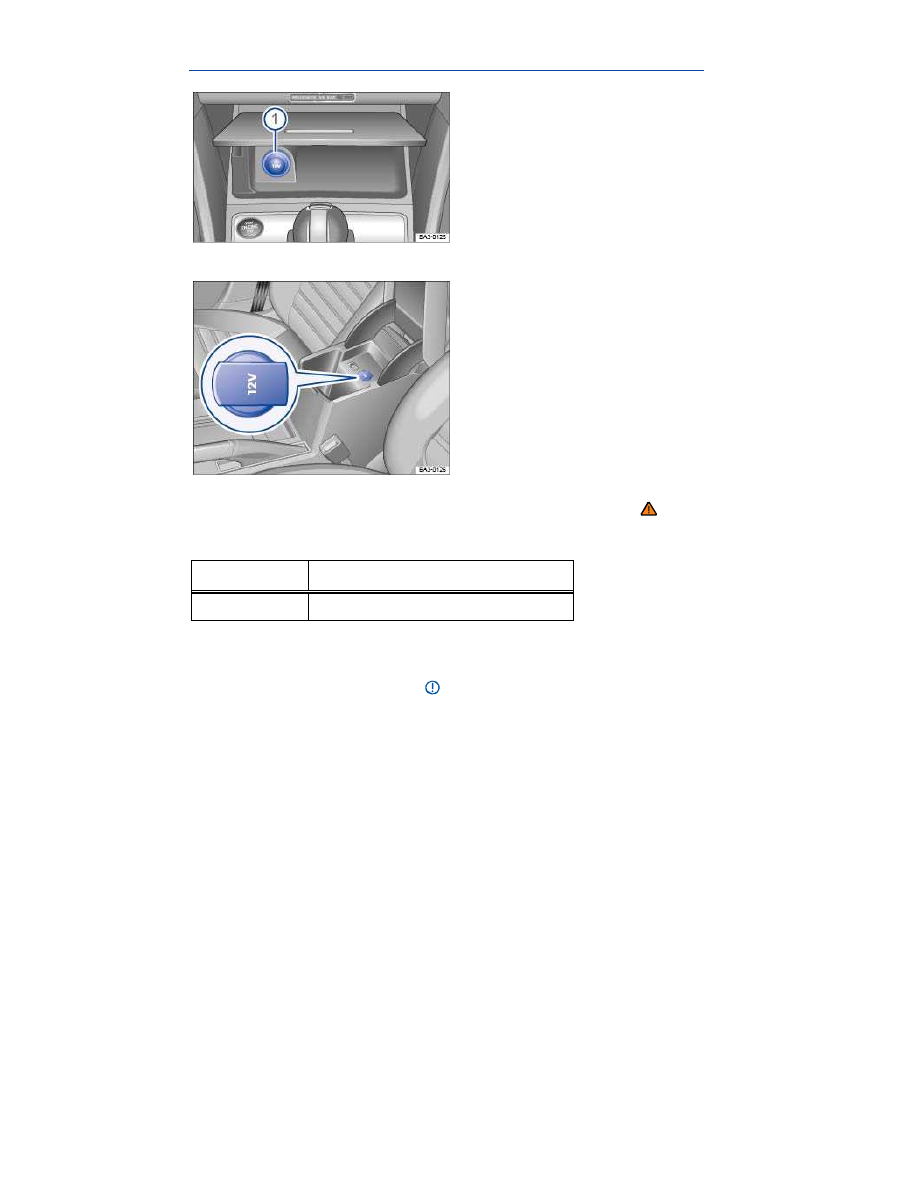
12 Volt sockets in the vehicle 


Fig. 148 12 Volt socket in the front center console. 


Fig. 149 12 Volt socket in the front center armrest. 

 Please first read and note the introductory information and heed the WARNINGS 


Maximum power draw 
 

Socket  

Maximum power draw  

12 volts  

120 watts  


The maximum power draw at any one socket must never be exceeded. Electrical devices should have 
information on them that says how much power they draw. 

If 2 or more electrical devices are connected at the same time, the total power draw of all connected 

devices must never be more than 190 watts 

⇒ 

12 Volt socket 

The 12 Volt socket works only when the ignition is switched on. 

If the ignition is on but the engine is not running, the vehicle battery will be drained by any device that 
is plugged in and turned on. For this reason, never use the electrical sockets unless the engine is 
running. 

To help prevent damage from voltage fluctuations, switch off all electrical devices connected to a 
12 Volt socket before switching the ignition on or off or starting the engine. 


The vehicle may have 12 Volt sockets at the following places: 

  In the storage compartment in the front center console 

⇒ 

fig. 148


(1)

  In the storage compartment in the front center armrest 

⇒ 

fig. 149

  NOTICE 

  Follow the manufacturer's instructions for connected devices! 
  Never exceed the maximum power consumption, or the entire vehicle electrical system may 

be damaged. 

  12 Volt socket: 

–  Only use equipment that has been tested for electromagnetic compatibility and complies 
with applicable guidelines.
 
–  Never feed current into the socket, with a solar panel, for example. 

  Unshielded devices may interfere with radio reception or the vehicle's electrical system. 


Starting and stopping the engine 


 Introduction 

In this section you’ll find information about: 

Warning and indicator lights


Vehicle key positions in the ignition switch


Starter button


Starting the engine


Remote start feature


Stopping the engine


Electronic immobilizer


Engine preheating system


Explanatory notes in this section regarding automatic transmissions also apply to the DSG

®


Direct Shift Gearbox automatic transmission. 

Immobilizer display 

If an unauthorized vehicle key is used or the system malfunctions, Immobilizer active! may 
appear on the instrument cluster. The engine cannot be started. 

Push-starting and tow-starting 

For technical reasons, never try to push-start or tow-start the vehicle. Jump-start the vehicle instead 
while following proper and safe procedures. 

More information: 

  Vehicle key set  
  Shifting gears 
  Braking, stopping and parking  
  Steering  
  Driver assistance systems 
  Refueling  
  Fuel  
  Emergency closing and opening  
  Jump-starting  
  Towing  

  WARNING 

Switching off the engine while the vehicle is moving can make the vehicle harder to stop and 
result in loss of vehicle control, leading to collisions and severe personal injuries. 

  Brake and steering assistance systems, the airbag system, safety belt pretensioners, and 

other vehicle safety features only work when the engine is running. 

  Switch off the engine only when the vehicle is not moving. 


  WARNING 

To reduce the risk of serious personal injury when starting and running the vehicle's engine: 

  Never start the engine or let it run in a confined or enclosed area. Engine exhaust contains 

carbon monoxide, a poisonous, colorless, and odorless gas. Carbon monoxide can cause 
unconsciousness and death. 

  Never start the engine or let it run if oil, fuel or other flammable substances are under or 

around or have leaked from the vehicle, for example as a result of vehicle damage. 

  Never leave the vehicle unattended with the engine running and especially when it is in 

gear. The vehicle could move suddenly or some other unexpected event could occur, result-
ing in property damage, fire or personal injury. 

  Never use starting assist fluids. Starting fluids can explode and can cause a “run-away” 

vehicle condition. 


  WARNING 

The vehicle exhaust system and the catalytic converter or diesel particulate filter get very hot. 
They can cause fires and serious personal injury. 

  Never park the vehicle where the hot exhaust system or catalytic converter could ignite 

flammable materials, such as brush, leaves, dry grass, spilled fuel, etc. 

  Never apply additional undercoating or rust proofing on or near the exhaust manifold, 

exhaust pipes, catalytic converter, diesel particulate filter, or heat shields. 

Warning and indicator lights 

 Please first read and note the introductory information and heed the WARNINGS 


Lights 

up  

Possible cause  

Proper response  


Glow plug preheating before diesel en-

gine start-up.  

Starting the engine  


Brake pedal not depressed.  

Apply the brake pedal to select a drive gear. 

Also refer to electronic parking brake  


Flashes  

Possible cause  

Proper response  


The release button in the selector lever 

did not engage. Vehicle movement is 

prevented.  

Engage selector lever release button  


When the ignition is switched on, several warning and indicator lights come on briefly for a function 
check. They go out after a few seconds. 


  WARNING 

Failure to heed warning lights and instrument cluster text messages can cause the vehicle to 
break down in traffic and result in a collision and serious personal injury. 

  Never ignore warning lights or text WARNINGS. 
  Always stop the vehicle as soon as it is safe to do so. 
  Whenever stalled or stopped for repair, move the vehicle a safe distance off the road, turn 

on the emergency flashers, stop the engine, and use other warning devices to warn ap-
proaching traffic. 


  NOTICE 

Failure to heed warning lights or text WARNINGS can result in vehicle damage. 

Vehicle key positions in the ignition switch 


Fig. 150 In the ignition switch: Vehicle key positions. 

 Please first read and note the introductory information and heed the WARNINGS 


If there is no vehicle key in the ignition, the steering column is locked. 

Vehicle key position 

⇒ 

fig. 150


(0)


Ignition switched off, steering column lock engaged. The vehicle key can be removed. 

(1)


Ignition is switched on. Diesel engine preheated (if applicable). Steering column lock can be 
released. 

(2)


Start the engine. When the engine starts, release the vehicle key. When released, the vehicle 
key returns to position 

(1)

If you use the wrong key 

If an unauthorized vehicle key has been inserted into the ignition switch, it can be removed as follows: 

  Automatic transmission: The vehicle key cannot be removed from the ignition unless both the key 

and the selector lever have been moved to the correct position. Press the release button on the 
transmission selector lever, move the selector lever to the Park (P) position and release the button. 
The vehicle key can now be removed. 

  Manual transmission: Pull out the vehicle key. 


  WARNING 

Improper use of vehicle keys can result in serious personal injury. 

  Always take the key with you when you leave the vehicle. The engine can be started and 

vehicle systems such as the power windows can be operated, leading to serious personal 
injury. 

  Never leave children, disabled persons, or anyone who cannot help themselves in the 

vehicle. The doors can be locked with the remote control vehicle key. This could result in 
people being trapped in the vehicle in an emergency. For example, depending on the time of 
year, people trapped in the vehicle can be exposed to very high or very low temperatures. 

  Heat build-up in the passenger and luggage compartment of a parked vehicle can result in 

temperatures in the vehicle that are much higher than the outside temperatures, particularly 
in summer. Temperatures can quickly reach levels that can cause unconsciousness and 
death, particularly to small children. 

  Never remove the key from the ignition switch while the vehicle is moving or rolling to a 

stop. The steering wheel will lock and you will not be able to steer or control the vehicle. 

  Leaving the key in the ignition for a long time when the engine is not running will drain the vehi-

cle battery. 

  Leaving the selector lever for a long period of time in any position other than Park (P) when the 

ignition is switched off can drain the vehicle battery. 

  On automatic transmission vehicles, the vehicle key can be removed from the ignition switch 

only when the transmission is in Park (P). You may have to press the release button on the transmis-
sion selector lever to put the lever into Park (P)

Starter button 


Fig. 151 In the center console: Starter button of the Keyless Access with push button start. 


Fig. 152 Emergency starting feature on vehicles with Keyless Access. 

 Please first read and note the introductory information and heed the WARNINGS 


The starter button can only be used when an authorized vehicle key is in the vehicle. 

When leaving the vehicle, the electronic steering column lock is activated when the ignition is 

switched off and the driver door is opened 

⇒  Steering

Switching the ignition on and off 

  Briefly press the starter button once without operating the brake or clutch pedals 

⇒ 

Emergency start feature 

If an authorized remote control vehicle key is in the passenger compartment but the instrument cluster 
displays Key not in Range when you push the starter button, the remote control vehicle key bat-
tery is weak or dead. You can still start the engine using the Emergency start feature. 

  Make sure the selector lever is in the Park (P) position. 

  Hold the remote control vehicle key to the right of the steering column trim immediately after press-

ing the starter button 

⇒ 

fig. 152

  The ignition automatically switches on and the engine starts. 

Emergency shut-off 

If the engine does not switch off by briefly pressing the starter button, emergency shut-off is neces-
sary: 

  Press the starter button twice within 3 seconds or press and hold the button longer than 1 second 

⇒ 

 in Stopping the engine  

  The engine switches off automatically. 

Engine restart feature 

If no authorized remote control vehicle key is identified in the passenger compartment after the engine 
has been switched off, the engine can be restarted within about 5 seconds. A related message is 
shown in the instrument cluster display. 

After the 5 seconds have passed, the engine can no longer be started without an authorized vehicle 
key in the passenger compartment. 


  WARNING 

Unintended vehicle movement can cause serious personal injury. 

  Do not depress the brake or clutch pedals when switching on the ignition, as the engine 

could otherwise start immediately. 


  WARNING 

Improper use of vehicle keys can result in serious personal injury. 

  Always take the key with you when you leave the vehicle. Children or unauthorized per-

sons may use it to lock the vehicle, start the engine, and operate vehicle systems such as the 
power windows, leading to serious personal injury. 

  Never leave children, disabled persons, or anyone who cannot help themselves in the 

vehicle. The doors can be locked using the remote control vehicle key. This could result in 
people being trapped in the vehicle in an emergency. For example, depending on the time of 
year, people trapped in the vehicle can be exposed to very high or very low temperatures. 

  Heat build-up in the passenger and luggage compartment of a parked vehicle can result in 

temperatures in the vehicle that are much higher than the outside temperatures, particularly 
in summer. Temperatures can quickly reach levels that can cause unconsciousness and 
death, particularly to small children. 

  In vehicles with a diesel engine and Keyless Access, the engine start may be delayed if the 

engine has to be preheated. 

  If the ignition is switched on or the engine is running and the driver door is opened, a chime 

sounds. The chime is also a reminder to switch off the engine and turn off the ignition before leaving 
and locking the vehicle from the outside. 

Starting the engine 

 Please first read and note the introductory information and heed the WARNINGS 


Please perform these steps only in the order listed.  

Step  

Vehicles without Keyless Access  

Vehicles with Keyless Access  

1.


Automatic transmission: Depress the brake pedal and hold it down until step 5 is com-

pleted.  

1 a.


Manual transmission: Depress clutch pedal fully and hold until the engine has started.  

2.


Shift the transmission into Neutral (N) or Park (P) (automatic), or into Neutral (manual only).  

3.


Only for vehicles with a diesel engine: To 

preheat the glow plug, turn the vehicle key 

to position 

⇒ 

fig. 150


(1)

. The indicator light 

 will come on in the instrument cluster.  


Please perform these steps only in the order listed.  

Step  

Vehicles without Keyless Access  

Vehicles with Keyless Access  

4.


Turn the vehicle key to position 

⇒ 

fig. 150


(2)

 – do not depress the accelerator pedal.  

Briefly press the starter button 

⇒ 

fig. 151

 – 

do not depress the accelerator pedal. An 

authorized vehicle key must be inside the 

vehicle in order to start the engine.  

5.


When the engine starts, release the vehicle 

key.  

When the engine starts, release the starter 

button.  

6.


If the engine does not start, switch off the 

ignition and start again after about 1 minute. 

If the engine does not start, switch off the 

ignition and start again after about 1 minute. 

Use the emergency start feature if neces-

sary  

7.


Release the parking brake when you are ready to start driving  


  WARNING 

Never leave the vehicle unattended while the engine is running and especially when it is in 
gear. The vehicle could move suddenly, or some other unexpected event could occur, result-
ing in property damage, fire or personal injury. 


  WARNING 

“Starting fluids” can explode and can cause a “run-away” vehicle condition. 

  Never use starting assist fluids. 


  NOTICE 

  You can damage the starter or the engine if you try to start the engine when the vehicle is 

still moving, or if you try to restart the engine right after switching it off. 

  Avoid high engine speeds, full throttle acceleration, and heavy engine loads when the en-

gine is cold. 

  Do not try to start the engine by pushing or towing the vehicle. Unburned fuel can get into 

the catalytic converter and damage it. The steering column may also be locked. 

  Do not let your vehicle warm up while standing; instead, start driving right away after making 

sure that you have good visibility through all windows. This will help the engine reach operating tem-
perature faster and keep down emissions. 

  Major consumers of electricity are temporarily switched off when the engine is being started. 

  After starting a cold engine, there may be increased operating noises for a few seconds. This is 

normal and harmless. 


  When outside temperatures are below +41 °F (+5 °C) and the diesel fueled preheater is activat-

ed, minor fume build-up may occur underneath the vehicle. 

Remote start feature 


Fig. 153 Remote control vehicle key with remote start button. 

 Please first read and note the introductory information and heed the WARNINGS 


You can start the engine from outside of the vehicle with the remote start button on the remote control 

vehicle key. This feature helps to cool or warm the passenger compartment 

⇒ 

The Climatronic system can cool or warm the vehicle interior automatically to about 68 °F (20 °C) after 
starting the engine. 

If the outside temperature is below 68 °F (20 °C), the mirror heaters also switch on automatically. If the 
outside temperature is 39 °F (4 °C) or colder, the rear window defroster also switches on automatical-
ly. 

If the remote start feature is not interrupted, the engine will run for about 10 minutes. A maximum of 2 
remote starts in a row are possible, regardless of how long each one is allowed to run. 

To be able to run 2 remote starts again, you must switch the ignition on and then off again using the 

remote control vehicle key or the starter button 

⇒ page 210. When the engine is switched on with the 

vehicle key or the starter button, the remote start feature can only be used again after a delay of about 
30 seconds. 

Requirements for a remote start 

In order to warm or cool the passenger compartment with the remote start feature, the following condi-
tions must all be met at the same time

  The vehicle must be ready to drive in all respects. For instance, there must be enough engine 

coolant in the engine cooling system. 

  There must be enough fuel in the fuel tank, and the low fuel indicator light   must not have come 

on before the engine was last switched off 

⇒  Refueling

  The emergency flashers must be switched off 

⇒  In an emergency

  The selector lever must be in Park (P

⇒  Shifting and the brake pedal must not have been de-

pressed. 

  There must not be a vehicle key in the ignition lock. In vehicles with Keyless Access, all valid 

vehicle keys that are inside the vehicle will be deactivated with respect to their keyless start function 

when the engine is running in the remote start mode 

⇒  Power locking system

  All doors, the engine hood and the rear lid must be completely closed and locked 

⇒  Power locking 

system


Using the remote start feature 

The following buttons in the vehicle key must be pressed within 3 seconds in order to start the engine 
with the remote start feature: 


1.


Press the   button 1 time 

⇒ 

fig. 153


(1)

.  

2.


Press the 

 button twice in a row 

(2)

.  


The turn signals will blink each time you press a button. The parking lights come on during the remote 

start 

⇒  Lights

Ending the remote start 

Press button 

(2)

(3)

, or 

(4)

 in the vehicle key to switch the engine off. 

Automatic stop or remote start not possible 

If one of the following conditions occurs, the remote start feature will stop, the engine will be switched 
off automatically, or the engine will not start: 

  The vehicle is unlocked 

⇒  Power locking system

  The engine hood or luggage compartment lid is opened 

⇒  Power locking system

  The selector lever is in not in Park (P

⇒  Shifting

  A vehicle key is in the ignition. 
  The brake pedal or accelerator pedal is depressed. 

  The fuel level drops down to “Reserve” while the engine is running in the remote start mode 

⇒, 

Refueling

  The vehicle battery is too weak or is dead 

⇒  Vehicle battery

  The warning flasher switch is pressed 

⇒  In an emergency

  The engine Malfunction Indicator Light (MIL) 

⇒  Indicator lights, ⇒  Indicator lights was on when the 

vehicle was last parked before activating the remote start mode. 

Driving after a remote start 

You cannot drive the vehicle if the engine was started with the remote start feature or if the engine is 
running in remote start mode. To be able to drive, you must first switch the remote started engine off 
with the vehicle key or the starter button and then start it again with the vehicle key in the ignition lock 
or with the starter button. 


  WARNING 

Improper use of the remote start feature can cause fire, burns and other serious injuries. 

  Always park the vehicle in a place that is vented to the outdoors and has a continuous 

exchange of fresh, outside air. 

  Only use the remote start feature when no one is around or inside the vehicle. 
  Always make sure that you can see the vehicle when the engine is running. 
  Never leave children, disabled persons, anyone who cannot help themselves, or pets in 

the vehicle. The doors are locked when the engine is running with the remote start feature. 
Vehicle occupants would be trapped in the vehicle in an emergency and rescue from the 
outside would be delayed. 

  Never start the engine if children or animals are inside the vehicle. When the engine is 

running, electrical equipment including electrical seat adjustment controls can be operated 
and cause serious injuries. 

  Never start the engine or let it run in a garage, in an enclosed or confined area. Engine 

exhaust contains carbon monoxide, a poisonous, colorless and odorless gas. Carbon mon-
oxide can cause dizziness, nausea, unconsciousness and even death. 

  Always make sure that the area where the engine runs in the remote start mode is well 

ventilated. Carbon monoxide in a garage or other enclosed area can cause dizziness, impair 
the ability to drive, and even result in unconsciousness. 

  Never start the engine when the vehicle is covered with a protective cover. Hot vehicle 

components and exhaust could ignite the protective cover. 

  Never start the engine near combustible or explosive materials. The exhaust could ignite 

flammable materials. 


  NOTICE 

  Do not use the remote start feature if the engine Malfunction Indicator Light (MIL) 

⇒  Indica-

tor lights

⇒  Indicator lights has come on, smoke or unusual smells come from the vehicle, an 

unusual or unexpected operating condition occurs and the condition has not been diagnosed 
and corrected. Please see an authorized Volkswagen dealer or authorized Volkswagen Service 
Facility.
 

  Remote start is possible when one or more windows are open. Always remember that unau-

thorized access to the vehicle through open windows as well as operation of HomeLink

®

, in-

cluding access to your garage or other property, is possible when the engine is running in 
remote start mode. Always make sure that all of the windows are securely closed to help pre-
vent unauthorized access to the vehicle, its features and contents.
 

  Using the remote start feature can increase fuel consumption and drain the vehicle battery. 

  Use of the remote start feature may be regulated or prohibited in some areas. In some areas you 

may be required to be able to see the vehicle when it is running in remote start mode. Please inform 
yourself about state and local requirements that may apply and be sure to follow them when using the 
remote start feature. 

  Various vehicle functions, such as the low beam headlights and the windshield wipers, are 

disabled when the engine is running during a remote start. 


Stopping the engine 

 Please first read and note the introductory information and heed the WARNINGS 


Please perform these steps only in the order listed.  

Vehicles without Keyless Access  

Vehicles with Keyless Access  

1.


Bring the vehicle to a complete stop 

⇒ 

.  

2.


Depress and hold down the brake pedal until step 4 is completed.  

3.


Automatic transmission: Shift the transmission into Park (P).  

4.


Apply the parking brake to help prevent the vehicle from moving  

5.


Turn the vehicle key to position 

⇒ 

fig. 150


(0)

 in the ignition switch.  

Briefly press the starter button 

⇒ 

fig. 151

. If 

the engine will not switch off, carry out the 

emergency shut-off procedure.  

6.


With a manual transmission, shift into 1st gear (vehicle on flat surface or pointing uphill) or 

reverse (vehicle pointing downhill).  

7.


Removing the vehicle key from the ignition 

switches off electrical equipment and acti-

vates the steering column lock.  

Opening the doors switches off electrical 

equipment and activates the steering col-

umn lock.  


  WARNING 

Never stop the engine before the vehicle has come to a complete stop. You can lose control 
of the vehicle, crash, and be seriously injured. 

  The airbags and safety belt pretensioners will not work when the ignition is switched off. 
  The brake booster does not work when the engine is not running. More brake pedal pres-

sure will be needed to stop the vehicle. 

  The power steering system does not work when the engine is not running, and you will 

need more force to steer the vehicle. 

  When the key is removed from the ignition switch, the steering will lock and you will not 

be able to steer the vehicle. 


  NOTICE 

If the vehicle has been driven hard for a long time, the engine could overheat when it is 
stopped. To reduce the risk of engine damage, let the engine idle in Neutral for about 2 minutes 
before you switch off the ignition.
 

  If the ignition is switched on or the engine is running and the driver door is opened, a chime 

sounds. The chime is also a reminder to switch off the engine and turn off the ignition before leaving 
and locking the vehicle from the outside. 


  On vehicles with automatic transmissions, the vehicle key can only be removed from the ignition 

when the transmission is in Park (P)

  After the engine has been switched off, the radiator fan in the engine compartment may keep 

running for several minutes, or may start running after the vehicle has been parked for a while, even if 
the ignition is switched off and the vehicle key has been removed. The radiator fan shuts off automati-
cally when the engine has cooled down enough. 

Electronic immobilizer 

 Please first read and note the introductory information and heed the WARNINGS 


The immobilizer helps to prevent the engine from being started and driven with an unauthorized vehi-
cle key. 

There is a microchip inside the vehicle key. The chip deactivates the immobilizer automatically when 
an authorized vehicle key is inserted into the ignition switch. 

The electronic immobilizer is automatically activated when the remote control vehicle key is pulled out 

of the ignition switch. On vehicles with Keyless Access, the vehicle key must be outside the vehicle 

⇒  

Power locking system

The engine can therefore only be started with an authorized and correctly coded genuine Volkswagen 
vehicle key. Coded vehicle keys are available from authorized Volkswagen dealers, authorized 
Volkswagen Service Facilities, and from certain independent repair facilities and locksmiths who are 

qualified to make these vehicle keys 

⇒  Vehicle key set

If an unauthorized vehicle key is used, Immobilizer active! appears in the instrument cluster 
display. The vehicle cannot be operated with this key. 

A Declaration of Compliance with the United States FCC and Industry Canada regulations is on 

⇒  

Declaration of Compliance, Telecommunications and Electronic Systems . 

  Using genuine Volkswagen keys helps minimize the risk of malfunctions. 


Shifting 

 Introduction 

In this section you’ll find information about: 

Warning and indicator lights


Pedals


Manual transmission: Gearshift lever


Automatic transmission: Selector lever


Shifting with Tiptronic

®


Driving with automatic transmission


Automatic transmission malfunction


Explanatory notes in this section regarding automatic transmissions also apply to the DSG

®


Direct Shift Gearbox automatic transmission. 

When the ignition is switched on and the transmission is in Reverse (R): 

  The backup lights come on. 
  Climatronic switches automatically to air recirculation mode. 

More information: 

  Lower center console 
  Instruments  
  Braking, stopping and parking  
  Climate control  
  Engine control and emission control system  
  Emergency closing and opening  

  WARNING 

Rapid acceleration can cause skidding and loss of traction, especially on slippery roads, 
resulting in a loss of vehicle control, collisions, and serious personal injury. 

  Only use the kick-down feature or fast acceleration if visibility, weather, road, and traffic 

conditions permit and other drivers will not be endangered by your driving and the vehicle's 
acceleration. 


  WARNING 

Constant braking causes the brakes to overheat and even to fail leading to collisions and 
serious personal injury. 

  Never “ride” the brakes or apply the brake pedal too often or too long. 
  Riding the brakes will substantially reduce braking performance, increase stopping dis-

tance, and can cause complete brake system failure. 


  NOTICE 

  Never “ride” the brakes by keeping your foot on the brake pedal when you do not want to 

brake. This will make the brakes wear faster. 

  Before driving downhill, especially on hills that are long or steep, always reduce speed and 

shift into lower gear (manual or automatic transmission). This will let the vehicle use engine 
braking and reduce the load on the brakes. Otherwise, the brake system could overheat and 
even fail. Only use the brakes when you need them to slow the vehicle down more or to stop.
 

Warning and indicator lights 

 Please first read and note the introductory information and heed the WARNINGS 


Lights 

up  

Possible cause  

Proper response  


DSG

®

 transmission too hot.  

 Do not continue driving! 

Allow the transmission to cool with the selec-

tor lever in the P position. 

If the warning does not turn off, do not contin-

ue driving. See your authorized Volkswagen 

dealer for assistance. Otherwise, serious 

transmission damage could result  


Brake pedal not depressed.  

Apply the brake pedal to select a drive gear  


Flashes  

Possible cause  

Proper response  


The release button in the selector lever 

did not engage. Vehicle movement is 

prevented.  

Engage selector lever release button  


Automatic transmission malfunction. 

 blinks, alternating with the selector 

lever indicator, for example D.  

Drive at low engine speed (rpm) to the near-
est authorized Volkswagen dealer or author-

ized Volkswagen Service Facility to have the 

system checked.  


When the ignition is switched on, several warning and indicator lights come on briefly for a function 
check. They go out after a few seconds. 

  WARNING 

Failure to heed warning lights and instrument cluster text messages can cause the vehicle to 
break down in traffic and result in a collision and serious personal injury. 

  Never ignore warning lights or text WARNINGS. 
  Always stop the vehicle as soon as it is safe to do so. 
  Whenever stalled or stopped for repair, move the vehicle a safe distance off the road, turn 

on the emergency flashers, stop the engine, and use other warning devices to warn ap-
proaching traffic. 


Content   ..  12  13  14  15   ..