Volkswagen Jetta / Bora: Electrical System Manual - part 3
 

  Index      Volkswagen     Volkswagen Jetta (2005 year) / Bora (2006 year) - Electrical System manual


Search            copyright infringement  


Content   ..  1  2  3  4  ..


Volkswagen Jetta / Bora: Electrical System Manual - part 3


– Check the electrolyte level of the battery 

⇒ page 7

 .

– Switch off the ignition and all electrical consumers.
– If fitted, remove the protective foil on the cell sealing plug.

Note

The foil with the warning notices must remain on the battery.

– Remove cell sealing plugs.
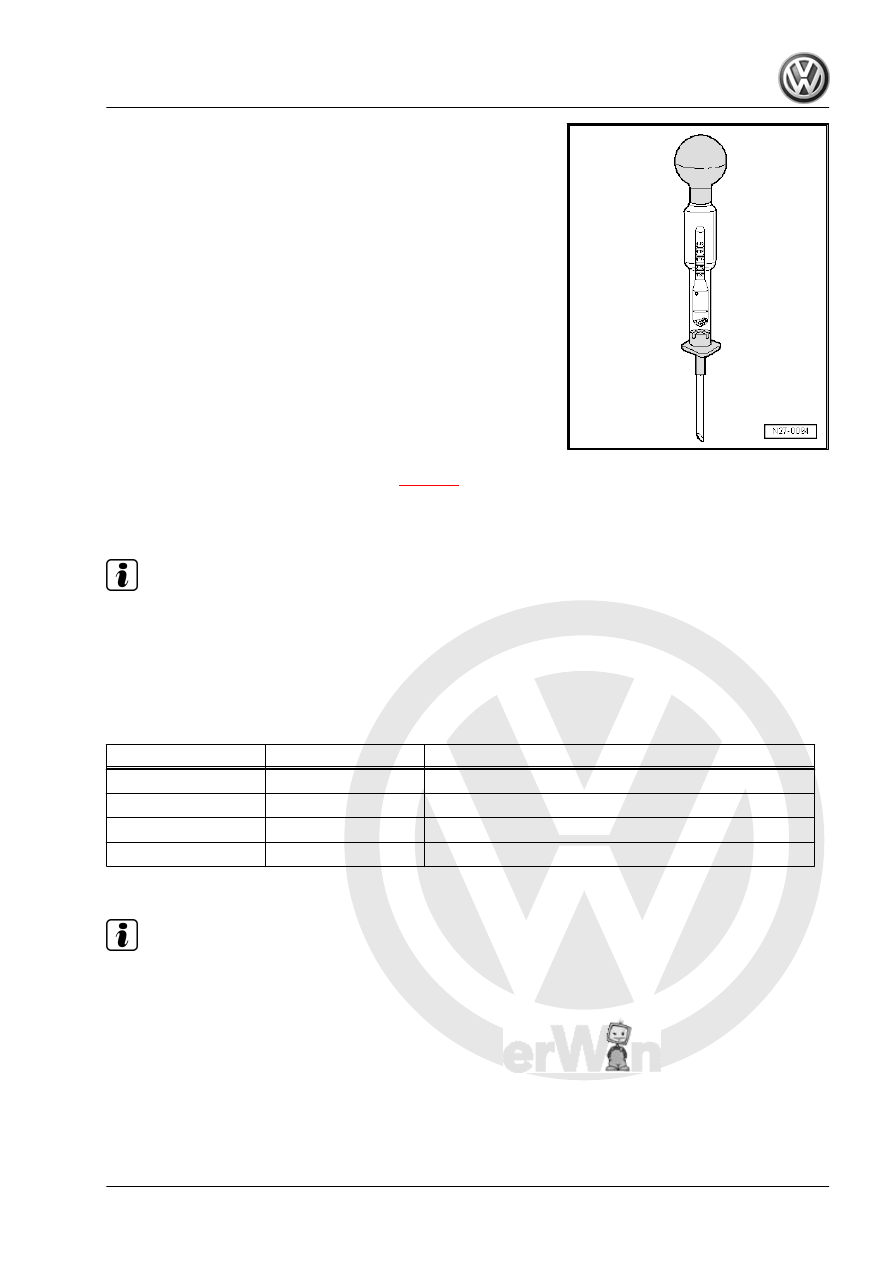
– Draw electrolyte off a cell using a hydrometer until the float

swims unhindered.

The electrolyte density is determined by the float position in the

battery electrolyte. The value can be read from the float scale.

Electrolyte density

Charge

Voltage

1.28 g/cm

3

100 %

12,7 V

1,21 g/cm

3

60 %

12,3 V

1,18 g/cm

3

40 %

12,1 V

1,10 g/cm

3

0 %

11,7 V

Note

Checking electrolyte density directly after topping up with distilled

water will lead to erroneous results. Check electrolyte density only

after charging the battery.

– Check the cell sealing plugs and the O-ring seals for damage.

Damaged parts must be replaced.

– Seal the cells with the cell sealing plugs.

Jetta 2005 ➤ , Bora 2006 ➤

2. Checking battery    

9

Check no load voltage of battery

WARNING

Danger of injury! Observe warning notices and safety regula‐

tions 

⇒ page 2

 !

The no load voltage test is used to determine the capacity of the

battery.

Note

The battery must not be charged or discharged for at least 2 hours

before making the measurements. Charging or discharging dur‐

ing this period falsify the test result.

No load voltage

Charge

Condition of battery

11,70 V

0 %

Discharged, no capacity. Heavily discharged.

⇒ page 27

 .

12,20 V

50 %

Over a period of time sulphate crystals build-up which can

only be reversed using a considerable amount of energy.

At the same time the active mass expands greatly, which

can cause cracks, which leads to heavy corrosion at the

positive plate.

12,35 V

65 %

♦ On batteries with a magic eye, the display will change

from green to black.

♦ The battery should be recharged on new/vehicles which

have been stored.

12.70 V

100 %

Full capacity.

Special tools and workshop equipment required
♦ Hand multimeter -V.A.G 1526 B-

– Switch off ignition and all electrical consumers and pull out

ignition key.

– Disconnect negative terminal on battery 

⇒ page 29

 .

– Wait at least 2 hours. The battery must not be charged or dis‐

charged within this period.

– Check battery no load voltage with hand multimeter -V.A.G

1526 B- .

Jetta 2005 ➤ , Bora 2006 ➤

10

Measure to be performed

No load voltage ≥ 12.5 V

No load voltage is OK, perform

a battery load test 

⇒ page 10

 .

No load voltage < 12.5 V

Charge battery 

⇒ page 15

 .

If the battery has been recharged as a result of the no load test,

proceed as follows:
– Wait at least 2 hours. The battery must not be charged or dis‐

charged within this period.

– Check battery no load voltage again with hand multimeter -

V.A.G 1526 B- .

If after the loading process the battery no load voltage is < 12.5 V,

renew battery 

⇒ page 31

 .

2.6

Battery tester with printer -VAS 5097 A-

WARNING

Danger of injury! Observe warning notices and safety regula‐

tions 

⇒ page 2

 !

It is not necessary to remove or disconnect battery when using

battery tester with printer -VAS 5097 A- .
Battery tester with battery tester with printer -VAS 5097 A- can be

used to test 12 V starter batteries according to
♦ 80 - 499 A A low-temperature test current according to DIN

(Deutsche Industrie Norm (German Industrial Standard))

1)

♦ 95 - 574 A A low-temperature test current according to IEC

(International Engineering Consortium)

♦ 136 - 855 A A low-temperature test current according to EN/

SAE (European Norm/Standard of Automotive Engineers)

1) Batteries with a low-temperature test current of 520 A according to DIN can be

tested using setting for 499A according to DIN.

For test purposes the battery is loaded with a current which is

similar to the starting current required to start the vehicle. The

battery is assessed on this loading and the result is printed out.

Note

Observe the ⇒  Instruction Manual for battery tester with printer

-VAS 5097 A- or sticker ⇒  Brief instructions for battery tester

with printer -VAS 5097 A- stuck on the unit or table Low-tem‐

perature current. 

⇒ page 13

Observe battery manufacture's handling instructions!

Jetta 2005 ➤ , Bora 2006 ➤

2. Checking battery    

11

Description of battery tester with printer

-VAS 5097 A-

Battery tester with printer -VAS 5097 A-
1 - Green LED, “unit operating”
2 - Red LED, “unit reverse-polarity connected”
3 - Red LED, “battery cannot be tested”, recharge battery.
4 - Start tester
5 - Low-temperature current selection switch
6 - ON/OFF and functions switch
7 - Selection switch (battery tester to pick-off point on battery/

external test point in engine compartment)
8 - Button to advance paper
9 - Printer

2.6.2

Battery load test using battery tester

with printer -VAS 5097 A-

WARNING

Danger of injury! Observe warning notices and safety regula‐

tions 

⇒ page 2

 !

Special tools and workshop equipment required
♦ Battery tester with printer -VAS 5097 A-

Perform battery load test:
– Switch off the ignition and all electrical consumers.
– Check no load voltage of battery 

⇒ page 10

 .

– Set low-temperature test current for battery in Ampere (A) ac‐

cording to DIN standard.

If the battery values are shown in IEC or EN/ SAE instead of DIN

then convert figures using table

⇒ “2.6.3 Table: low-temperature test current”, page 13

 or using

table on unit.
– Select low-temperature test current via low-temperature test

current selection switch 

⇒ page 12

 .

– Select measuring range 80 - 379 A or 380 - 499 A with ON/

OFF and functions switch 

⇒ page 12

 .

– Connect red terminal “+” of unit to positive terminal.

Jetta 2005 ➤ , Bora 2006 ➤

12


Content   ..  1  2  3  4  ..