Toyota Venza Hybrid (2023 year). Manual in english - page 11
 

  Index      Toyota     Toyota Venza Hybrid (2023 year). Manual in english


Search            copyright infringement  


Content      ..     9      10      11      12     ..


Toyota Venza Hybrid (2023 year). Manual in english - page 11


176

3-4. Adjusting the steering wheel and mirrors

If you notice any of the following symptoms, refer to the following 

NOTICE

• Do not remove, disassemble or 

modify the camera.

• Do not allow an organic solvent, 

car wax, window cleaner or 

glass coating to adhere to the 

camera. If this happens, wipe it 

off as soon as possible.

• When cleaning the camera lens, 

wipe the camera lens with a 

damp soft cloth.

Do not strongly rub the camera 

lens, as it may be scratched and 

will not be able to transmit a 

clear image.

• When applying colored film 

(including transparent film) to 

the rear window glass, do not 

apply it to the area in front of the 

camera.

If film is applied to the area in 

front of the camera, the image 

from the camera may not dis-

play properly.

Do not subject the camera to a 

strong impact as this could 

cause a malfunction.

If this happens, have the vehicle 

inspected by your Toyota dealer 

as soon as possible.

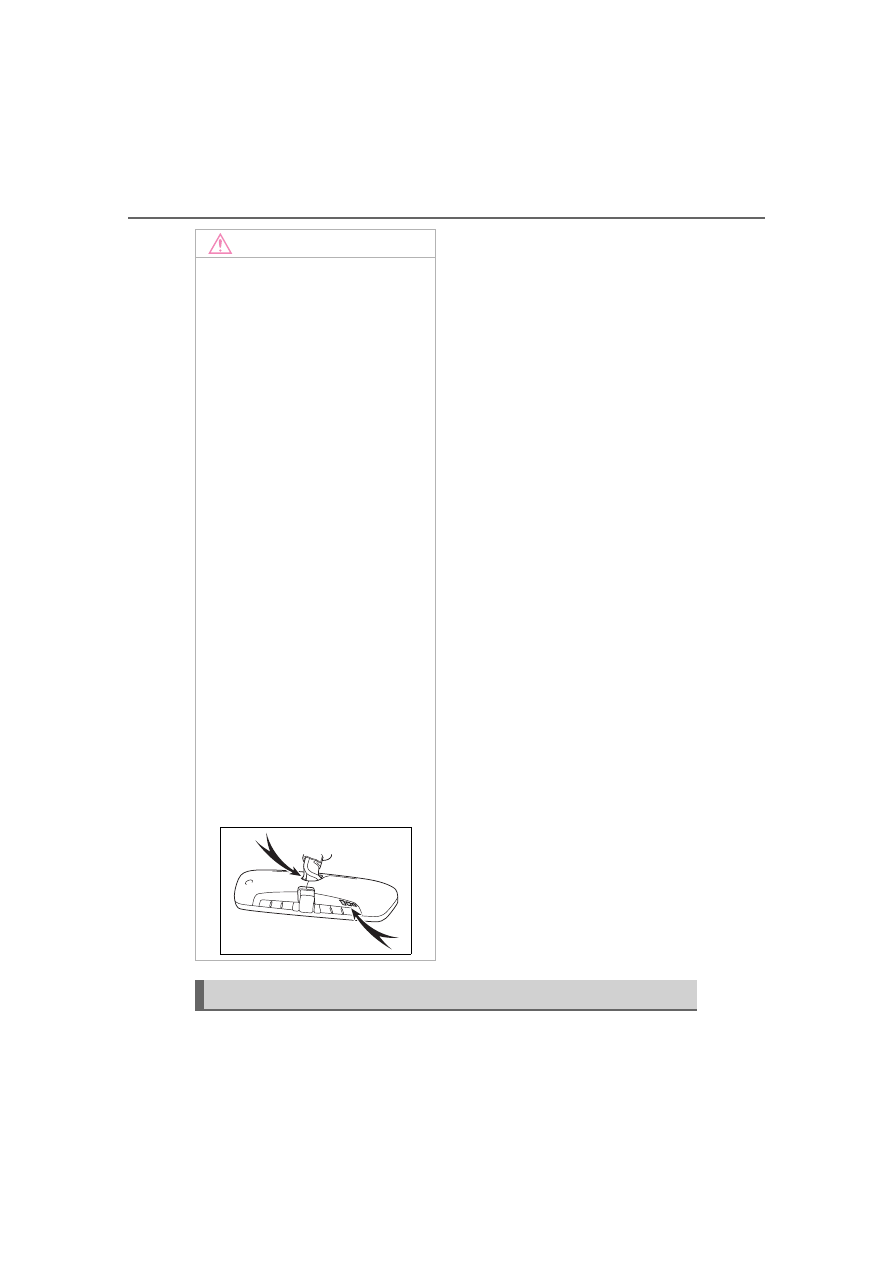
Do not block the vent holes of 

the mirror. Otherwise, the mirror 

may be hot, leading to a mal-

function or a fire.

If you notice any symptoms

177

3-4. Adjusting the steering wheel and mirrors

3

Before 

driving

table for the likely cause and the solution.
If the symptom is not resolved by the solution, have the vehicle 
inspected by your Toyota dealer.

178

3-4. Adjusting the steering wheel and mirrors

Symptom

Likely cause

Solution

The image is difficult to 
see.

The mirror surface is 
dirty.

Clean the mirror surface 
gently, using a soft dry 
cloth.

Sunlight or headlights 
are shining directly into 
the Digital Rear-view 
Mirror.

Change to optical mirror 
mode.
(Vehicles with pan-
oramic fixed moon roof 
with one-touch frosted 
glass control: If the light 
is coming through the 
moon roof, close the 
electronic sunshade.)

• The vehicle is in a dark 

area.

• The vehicle is near a 

TV tower, broadcast-
ing station, electric 
power plant, or other 
location where strong 
radio waves or electri-
cal noise may be pres-
ent.

• The temperature 

around the camera is 
extremely high/low.

• The ambient tempera-

ture is extremely low.

• It is raining or humid.
• Sunlight or headlights 

are shining directly into 
the camera lens.

• The vehicle is under 

fluorescent lights, 
sodium lights, mer-
cury lights, etc.

• Exhaust gas is 

obstructing the cam-
era.

Change to optical mirror 
mode.
(Change back to digital 
mirror mode when the 
conditions have 
improved.)

Foreign matters such as 
water droplets or dust is 
on the camera lens.

Wipe the camera lens 
with a damp soft cloth.

179

3-4. Adjusting the steering wheel and mirrors

3

Before 

driving

The image is difficult to 
see.

The luggage in the lug-
gage compartment is 
reflected off the rear win-
dow glass and obstruct-
ing the camera.

• Change to optical mir-

ror mode.

• Move the luggage to a 

position where it does 
not obstruct the cam-
era or cover it with a 
black cloth to reduce 
the amount it is 
reflected off the rear 
window glass.

The rear window glass is 
fogged up.

Change to optical mirror 
mode.
After defogging the rear 
window using the rear 
window defogger 
(

P.322, 330), use the 

digital mirror mode 
again.

The outside of the rear 
window glass is dirty.

Use the rear window 
wiper to remove dirt.

The inside of the rear 
window glass is dirty.

Wipe the inside of rear 
window glass with a 
damp soft cloth.

The image is out of 
alignment.

The back door is not fully 
closed.

Fully close the back 
door.

The camera or its sur-
rounding area has 
received a strong 
impact.

Change to optical mirror 
mode and have the vehi-
cle inspected by your 
Toyota dealer.

The display is dim and 

 is displayed.

The system may be mal-
functioning.

Change to optical mirror 
mode and have the vehi-
cle inspected by your 
Toyota dealer.

 goes off.

Symptom

Likely cause

Solution

180

3-4. Adjusting the steering wheel and mirrors

 is displayed.

The Digital Rear-view 
Mirror is extremely hot.
(The display will gradu-
ally become more dim. If 
the temperature contin-
ues to increase, the Digi-
tal Rear-view Mirror will 
turn off.)

Reducing the cabin tem-
perature is recom-
mended to reduce the 
temperature of the mir-
ror.
(

 will disappear when 

the mirror becomes 
cool.)

If 

 does not disap-

pear even though the 
mirror is cool, have the 
vehicle inspected by 
your Toyota dealer.

The lever cannot be 
operated properly.

The lever may be mal-
functioning.

Change to optical mirror 
mode and have the vehi-
cle inspected by your 
Toyota dealer.
(To change to optical 
mirror mode, press and 
hold the menu button for 
approximately 10 sec-
onds.)

Symptom

Likely cause

Solution

181

3-4. Adjusting the steering wheel and mirrors

3

Before 

driving

When using the outside rear 

view mirrors in a cold weather

When it is cold and the outside rear 

view mirrors are frozen, it may not 

be possible to fold/extend them or 

adjust the mirror surface.
Remove the ice, snow, etc. covering 

the outside rear view mirrors.

Defogging the mirrors

The outside rear view mirrors can 

be cleared using the mirror defog-

gers. Turn on the rear window 

defogger to turn on the outside rear 

view mirror defoggers.

(

P.322, 330)

1

To select a mirror to adjust, 
turn the switch.

Left

Right

2

To adjust the mirror, operate 
the switch.

Up

Right

Down

Left

Outside rear view mir-

rors

The rear view mirror’s posi-
tion can be adjusted to 
enable sufficient confirma-
tion of the rear view.

WARNING

Important points while driving

Observe the following precautions 

while driving.

Failing to do so may result in loss 

of control of the vehicle and cause 

an accident, resulting in death or 

serious injury.

Do not adjust the mirrors while 

driving.

Do not drive with the mirrors 

folded.

Both the driver and passenger 

side mirrors must be extended 

and properly adjusted before 

driving.

When the mirror defoggers 

are operating

Do not touch the rear view mirror 

surfaces, as they can become 

very hot and burn you.

Adjustment procedure

A

B

A

B

C

D

182

3-4. Adjusting the steering wheel and mirrors

Mirror angle can be adjusted 

when

The power switch is in ACC or ON.

Folds the mirrors

Extends the mirrors

Putting the outside rear view mirror 
folding switch in the neutral position 
(A) sets the mirrors to automatic 
mode. Automatic mode allows the 
folding or extending of the mirrors 
to be linked to locking/unlocking of 
the doors.

Customization

The automatic mirror folding and 

extending operation can be 

changed. (Customizable features: 

P.509)

Folding the mirrors

WARNING

When a mirror is moving

To avoid personal injury and mir-

ror malfunction, be careful not to 

get your hand caught by the mov-

ing mirror.

A

B

183

3-5. Opening, closing the windows

3

Before 

driving

3-5.Opening, closing the windows

The power windows can be 
opened and closed using the 
switches.
Operating the switch moves the 
side windows as follows:

1

Closing

2

One-touch closing

*

3

Opening

4

One-touch opening

*

*

: To stop the side window partway, 

operate the switch in the opposite 
direction.

The power windows can be 

operated when

The power switch is in ON.

Operating the power windows 

after turning the hybrid system 

off

The power windows can be oper-

ated for approximately 45 seconds 

even after the power switch is 

turned to ACC or OFF. They cannot, 

however, be operated once either 

front door is opened.

Jam protection function

If an object becomes jammed 

between the side window and the 

window frame while the side window 

is closing, side window movement is 

stopped and the side window is 

opened slightly.

Catch protection function

If an object becomes caught 

between the door and side window 

while the side window is opening, 

side window movement is stopped.

When the power window cannot 

be opened or closed

When the jam protection function or 

catch protection function operates 

unusually and the side window can-

not be opened and closed, perform 

the following operations with the 

power window switch of that door.

Stop the vehicle. With the power 

switch in ON, within 4 seconds of 

the jam protection function or 

catch protection function activat-

ing, continuously operate the 

power window switch in the one-

touch closing direction or one-

touch opening direction so that the 

side window can be opened and 

closed.

If the side window cannot be 

opened and closed even when 

performing the above operations, 

perform the following procedure 

for function initialization.

1

Turn the power switch to ON.

2

Pull and hold the power window 

switch in the one-touch closing 

direction and completely close 

the side window.

3

Release the power window 

switch for a moment, resume 

pulling the switch in the one-

touch closing direction, and hold 

it there for approximately 6 sec-

onds or more.

4

Press and hold the power win-

dow switch in the one-touch 

opening direction. After the side 

window is completely opened, 

continue holding the switch for 

an additional 1 second or more.

Power windows

Opening and closing the 
power windows

184

3-5. Opening, closing the windows

5

Release the power window 

switch for a moment, resume 

pushing the switch in the one-

touch opening direction, and 

hold it there for approximately 4 

seconds or more.

6

Pull and hold the power window 

switch in the one-touch closing 

direction again. After the side 

window is completely closed, 

continue holding the switch for a 

further 1 second or more.

If you release the switch while the 

side window is moving, start again 

from the beginning.

If the side window reverses and 

cannot be fully closed or opened, 

have the vehicle inspected by your 

Toyota dealer.

Door lock linked power window 

operation

The power windows can be 

opened and closed using the 
mechanical key.

*

 (

P.467)

The power windows can be 

opened using the wireless remote 
control.

*

 (

P.137)

The alarm may be triggered if the 

alarm is set and the power window 

is closed using the door lock 

linked power window operation 

function. (

P.81)

*

: These settings must be custom-

ized at your Toyota dealer.

Power window open reminder 

function

A message is shown on the multi-

information display when the power 

switch is turned to OFF and the 

driver’s door is opened with the 

power windows open.

Customization

Settings (e.g. linked door lock oper-

ation) can be changed. (Customiz-

able features: 

P.509)

WARNING

Observe the following precau-

tions.

Failing to do so may result in 

death or serious injury.

Closing the power windows

The driver is responsible for all 

the power window operations, 

including the operation for the 

passengers. In order to prevent 

accidental operation, especially 

by a child, do not let a child 

operate the power windows. It is 

possible for children and other 

passengers to have body parts 

caught in the power window. 

Also, when riding with a child, it 

is recommended to use the win-

dow lock switch. (

P.185)

Check to make sure that all pas-

sengers do not have any part of 

their body in a position where it 

could be caught when a power 

window is being operated.

When using the wireless remote 

control or mechanical key and 

operating the power windows, 

operate the power window after 

checking to make sure that 

there is no possibility of any 

passenger having any of their 

body parts caught in the side 

window. Also, do not let a child 

operate the power window by 

the wireless remote control or 

mechanical key. It is possible 

for children and other passen-

gers to get caught in the power 

window.

185

3-5. Opening, closing the windows

3

Before 

driving

This function can be used to 
prevent children from acciden-
tally opening or closing a pas-
senger window.
Press the switch.

The indicator 

 will come on and 

the passenger windows will be 

locked.
The passenger windows can still be 
opened and closed using the 
driver’s switch even if the lock 
switch is on.

The window lock switch can be 

operated when

The power switch is in ON.

When the 12-volt battery is dis-

connected

The window lock switch is disabled. 

If necessary, press the window lock 

switch after reconnecting the 12-volt 

battery.

WARNING

When exiting the vehicle, turn 

the power switch to OFF, carry 

the key and exit the vehicle 

along with the child. There may 

be accidental operation, due to 

mischief, etc., that may possibly 

lead to an accident.

Jam protection function

Never use any part of your body 

to intentionally activate the jam 

protection function.

The jam protection function may 

not work if something gets 

jammed just before the side 

window is fully closed. Be care-

ful not to get any part of your 

body jammed in the side win-

dow.

Catch protection function

Never use any part of your body 

or clothing to intentionally acti-

vate the catch protection func-

tion.

The catch protection function 

may not work if something gets 

caught just before the side win-

dow is fully opened. Be careful 

not to get any part of your body 

or clothing caught in the side 

window.

Preventing accidental 
operation (window lock 
switch)

A

187

4

4

Dr

iv

ing

Driving

4-1. Before driving

Driving the vehicle.......

188

Cargo and luggage .....

195

Vehicle load limits .......

198

Trailer towing ..............

199

Dinghy towing .............

200

4-2. Driving procedures

Power (ignition) switch

201

EV drive mode ............

206

Hybrid transmission ....

208

Turn signal lever .........

212

Parking brake..............

213

Brake Hold ..................

217

4-3. Operating the lights and 

wipers

Headlight switch..........

219

AHB (Automatic High 

Beam)........................

222

Fog light switch ...........

225

Windshield wipers and 

washer.......................

226

Rear window wiper and 

washer.......................

229

4-4. Refueling

Opening the fuel tank cap

..................................

231

4-5. Using the driving support 

systems

Toyota Safety Sense 2.5 +

..................................

234

PCS (Pre-Collision System)

..................................

239

LTA (Lane Tracing Assist)

..................................

250

RSA (Road Sign Assist)

..................................

262

Dynamic radar cruise con-

trol with full-speed range

..................................

265

BSM (Blind Spot Monitor)

..................................

277

Intuitive parking assist.

287

PKSB (Parking Support 

Brake)........................

295

Parking Support Brake func-

tion (static objects)

..................................

300

Parking Support Brake 

function (rear-crossing 
vehicles) ....................

302

Driving mode select switch

..................................

304

Driving assist systems.

305

4-6. Driving tips

Hybrid Electric Vehicle driv-

ing tips .......................

311

Winter driving tips........

313

Utility vehicle precautions

..................................

316

188

4-1. Before driving

4-1.Before driving

Starting the hybrid system

P.201

Driving

1

With the brake pedal 
depressed, shift the shift 
lever to D. (

P.209)

2

Release the parking brake. 
(

P.213)

If the parking brake is in automatic 

mode, the parking brake will be 

released automatically. (

P.214)

3

Gradually release the brake 
pedal and gently depress the 
accelerator pedal to acceler-
ate the vehicle.

Stopping

1

With the shift lever in D, 
depress the brake pedal.

2

If necessary, set the parking 
brake. (

P.213)

If the vehicle is to be stopped for an 

extended period of time, shift the 

shift lever to P. (

P.209)

Parking the vehicle

1

With the shift lever in D, 
depress the brake pedal.

2

Set the parking brake. 
(

P.213)

Make sure the parking brake indi-

cator light is on.

3

Shift the shift lever to P. 
(

P.209)

Do not press the shift release but-

ton after shifting the shift lever to P.

4

Turn the power switch to 
OFF to stop the hybrid sys-
tem.

5

Lock the door, making sure 
that you have the electronic 
key on your person.

If parking on a hill, block the wheels 

as needed.

Starting off on a steep 
uphill

1

With the brake pedal 
depressed, shift the shift 
lever to D. (

P.209)

2

Pull the parking brake switch 
and parking brake is set 
manually. (

P.213)

3

Release the brake pedal and 
gently depress the accelera-
tor pedal to accelerate the 
vehicle.

Parking brake automatic release 

function (

P.214)

When starting off on an uphill

The hill-start assist control will acti-

vate. (

P.306)

For fuel-efficient driving

Keep in mind that Hybrid Electric 

Vehicles are similar to conventional 

vehicles, and it is necessary to 

refrain from activities such as sud-

den acceleration. (

P.311)

Driving in the rain

Drive carefully when it is raining, 

because visibility will be reduced, 

the windows may become fogged-

up, and the road will be slippery.

Driving the vehicle

The following procedures 
should be observed to 
ensure safe driving:

Driving procedure

189

4-1. Before driving

4

Dr

iv

ing

Drive carefully when it starts to 

rain, because the road surface will 

be especially slippery.

Refrain from high speeds when 

driving on an expressway in the 

rain, because there may be a 

layer of water between the tires 

and the road surface, preventing 

the steering and brakes from 

operating properly.

ECO Accelerator Guidance 

(

P.103, 114)

It is easier to drive in an Eco-friendly 

manner by driving while referring to 

the ECO Accelerator Guidance dis-

play. Also, by using the ECO Accel-

erator Guidance it is easier to 

increase the “Eco Score” evaluation.

When starting off:

While staying within the ECO Accel-
erator Guidance range, gradually 
depress the accelerator pedal and 
accelerate to the desired speed. If 
excessive acceleration is avoided, 
the “Start” score will increase.

When driving:

After accelerating to the desired 
speed, release the accelerator 
pedal and drive at a stable speed 
within the ECO Accelerator Guid-
ance range. By keeping the vehicle 
within the ECO Accelerator Guid-
ance range, the “Cruise” score will 
increase.

When stopping:

When stopping the vehicle, early 
releasing the accelerator pedal will 
cause the “Stop” score to increase.

Restraining the hybrid system 

output (Brake Override System)

When the accelerator and brake 

pedals are depressed at the same 

time, the hybrid system output 

may be restrained.

A warning message is displayed 

on the multi-information display 

while the system is operating.

Breaking in your new Toyota

To extend the life of the vehicle, 

observing the following precautions 

is recommended:

For the first 200 miles (300 km):

Avoid sudden stops.

For the first 600 miles (1000 km):

• Do not drive at extremely high 

speeds.

• Avoid sudden acceleration.

• Do not drive continuously in low 

gears.

• Do not drive at a constant speed 

for extended periods.

Operating your vehicle in a for-

eign country

Comply with the relevant vehicle 

registration laws and confirm the 

availability of the correct fuel. 

(

P.481)

WARNING

Observe the following precau-

tions.

Failure to do so may result in 

death or serious injury.

When starting the vehicle

Always keep your foot on the 

brake pedal while stopped with 

the “READY” indicator is illumi-

nated. This prevents the vehicle 

from creeping.

190

4-1. Before driving

WARNING

When driving the vehicle

Do not drive if you are unfamil-

iar with the location of the brake 

and accelerator pedals to avoid 

depressing the wrong pedal.

• Accidentally depressing the 

accelerator pedal instead of the 

brake pedal will result in sudden 

acceleration that may lead to an 

accident.

• When backing up, you may twist 

your body around, leading to a 

difficulty in operating the pedals. 

Make sure to operate the pedals 

properly.

• Make sure to keep a correct 

driving posture even when mov-

ing the vehicle only slightly. This 

allows you to depress the brake 

and accelerator pedals properly.

• Depress the brake pedal using 

your right foot. Depressing the 

brake pedal using your left foot 

may delay response in an emer-

gency, resulting in an accident.

The driver should pay extra 

attention to pedestrians when 

the vehicle is powered only by 

the electric motor (traction 

motor). As there is no engine 

noise, the pedestrians may mis-

judge the vehicle’s movement. 

Even though the vehicle is 

equipped with the Acoustic 

Vehicle Alerting System, drive 

with care as pedestrians in the 

vicinity may still not notice the 

vehicle if the surrounding area 

is noisy.

Do not drive the vehicle over or 

stop the vehicle near flammable 

materials such as leaves, paper 

or rags.

The exhaust system and 

exhaust gases can be 

extremely hot. These hot parts 

may cause a fire if there is any 

flammable material nearby.

During normal driving, do not 

turn off the hybrid system. Turn-

ing the hybrid system off while 

driving will not cause loss of 

steering or braking control. 

However, power assist for the 

steering wheel may be lost mak-

ing it difficult to steer smoothly 

before stopping the vehicle 

depending on the remaining 

charge in the 12-volt battery or 

usage conditions. In this situa-

tion, you should pull over and 

stop the vehicle as soon as it is 

safe to do so.

In the event of an emergency, 

such as if it becomes impossible 

to stop the vehicle in the normal 

way: 

P.433

Use engine braking (downshift) 

to maintain a safe speed when 

driving down a steep hill.

Using the brakes continuously 

may cause the brakes to over-

heat and lose effectiveness. 

(

P.208)

Do not adjust the position of the 

steering wheel, the seat, inside 

rear view mirror (if equipped), 

Digital Rear-view Mirror (if 

equipped) or outside rear view 

mirrors while driving.

Doing so may result in a loss of 

vehicle control.

Always check that all passen-

gers’ arms, head or other parts 

of their body are not outside the 

vehicle.

Do not drive the vehicle off-

road.

This is not an AWD vehicle 

designed for off-road driving. 

Drive with due care if it 

becomes unavoidable to drive 

off-road.

191

4-1. Before driving

4

Dr

iv

ing

WARNING

Do not drive across a river or 

through other bodies of water.

This may cause electric/elec-

tronic components to short cir-

cuit, damage the hybrid system 

or cause other serious damage 

to the vehicle.

Do not drive in excess of the 

speed limit. Even if the legal 

speed limit permits it, do not 

drive over 85 mph (140 km/h) 

unless your vehicle has high-

speed capability tires. Driving 

over 85 mph (140 km/h) may 

result in tire failure, loss of con-

trol and possible injury. Be sure 

to consult a tire dealer to deter-

mine whether the tires on your 

vehicle are high-speed capabil-

ity tires or not before driving at 

such speeds.

When driving on slippery 

road surfaces

Sudden braking, acceleration 

and steering may cause tire 

slippage and reduce your ability 

to control the vehicle.

Sudden acceleration, engine 

braking due to shifting, or 

changes in engine speed could 

cause the vehicle to skid.

After driving through a puddle, 

lightly depress the brake pedal 

to make sure that the brakes 

are functioning properly. Wet 

brake pads may prevent the 

brakes from functioning prop-

erly. If the brakes on only one 

side are wet and not functioning 

properly, steering control may 

be affected.

When shifting the shift lever

Do not let the vehicle roll back-

ward while the shift lever is in a 

driving position, or roll forward 

while the shift lever is in R. 

Doing so may result in an acci-

dent or damage to the vehicle.

Do not shift the shift lever to P 

while the vehicle is moving.

Doing so can damage the trans-

mission and may result in a loss 

of vehicle control.

Do not shift the shift lever to R 

while the vehicle is moving for-

ward.

Doing so can damage the trans-

mission and may result in a loss 

of vehicle control.

Do not shift the shift lever to a 

driving position while the vehicle 

is moving backward.

Doing so can damage the trans-

mission and may result in a loss 

of vehicle control.

Shifting the shift lever to N while 

the vehicle is moving will disen-

gage the hybrid system. Engine 

braking is not available with the 

hybrid system disengaged.

Be careful not to shift the shift 

lever with the accelerator pedal 

depressed.

Shifting the shift lever to any 

position other than P or N may 

lead to unexpected rapid accel-

eration of the vehicle that may 

cause an accident and result in 

death or serious injury. Doing so 

can damage the transmission 

and may result in a loss of vehi-

cle control.

192

4-1. Before driving

WARNING

If you hear a squealing or 

scraping noise (brake pad 

wear limit indicators)

Have the brake pads checked and 

replaced by your Toyota dealer as 

soon as possible.

Rotor damage may result if the 

pads are not replaced when 

needed.

It is dangerous to drive the vehicle 

when the wear limits of the brake 

pads and/or those of the brake 

discs are exceeded.

When the vehicle is stopped

Do not depress the accelerator 

pedal unnecessarily. 

If the shift lever is in any posi-

tion other than P or N, the vehi-

cle may accelerate suddenly 

and unexpectedly, causing an 

accident.

In order to prevent accidents 

due to the vehicle rolling away, 

always keep depressing the 

brake pedal while stopped with 

the “READY” indicator is illumi-

nated, and apply the parking 

brake as necessary.

If the vehicle is stopped on an 

incline, in order to prevent acci-

dents caused by the vehicle roll-

ing forward or backward, always 

depress the brake pedal and 

securely apply the parking 

brake as needed.

Avoid revving or racing the 

engine.

Running the engine at high 

speed while the vehicle is 

stopped may cause the exhaust 

system to overheat, which could 

result in a fire if combustible 

material is nearby.

When the vehicle is parked

Do not leave glasses, cigarette 

lighters, spray cans, or soft 

drink cans in the vehicle when it 

is in the sun.

Doing so may result in the fol-

lowing:

• Gas may leak from a cigarette 

lighter or spray can, and may 

lead to a fire.

• The temperature inside the 

vehicle may cause the plastic 

lenses and plastic material of 

glasses to deform or crack.

• Soft drink cans may fracture, 

causing the contents to spray 

over the interior of the vehicle, 

and may also cause a short cir-

cuit in the vehicle’s electrical 

components.

Do not leave cigarette lighters in 

the vehicle. If a cigarette lighter 

is in a place such as the glove 

box or on the floor, it may be lit 

accidentally when luggage is 

loaded or the seat is adjusted, 

causing a fire.

Do not attach adhesive discs to 

the windshield or windows. Do 

not place containers such as air 

fresheners on the instrument 

panel or dashboard. Adhesive 

discs or containers may act as 

lenses, causing a fire in the 

vehicle.

Do not leave a door or window 

open if the curved glass is 

coated with a metallized film 

such as a silver-colored one. 

Reflected sunlight may cause 

the glass to act as a lens, caus-

ing a fire.


Content      ..     9      10      11      12     ..