Toyota Tacoma (2023 year). Manual in english - page 12
 

  Index      Toyota     Toyota Tacoma (2023 year). Manual in english


Search            copyright infringement  


Content      ..     10      11      12      13     ..


Toyota Tacoma (2023 year). Manual in english - page 12


202

4-2. Driving procedures

Engine (ignition) switch (vehicles without a 

smart key system)

Automatic transmission
Check that the parking brake is set.
Check that the shift lever is set in P.
Firmly depress the brake pedal.
Turn the engine switch to the “START” position to start the engine.

Manual transmission
Check that the parking brake is set.
Check that the shift lever is set in N.
Firmly depress the clutch pedal.
Turn the engine switch to the “START” position to start the engine.

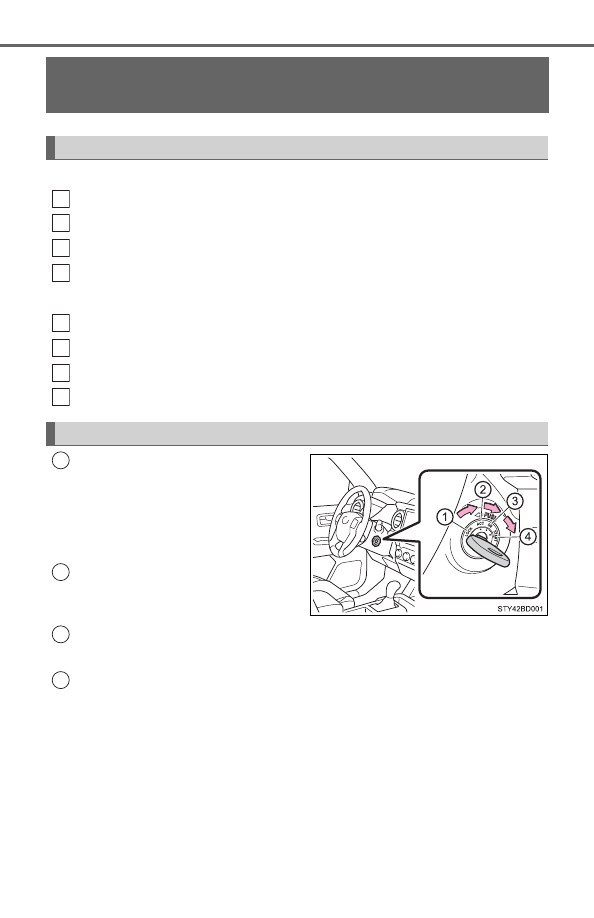
“LOCK”

The  steering  wheel  is  locked  and
the key can be removed. (Vehicles
with  an  automatic  transmission:
The  key  can  be  removed  only
when the shift lever is in P.)

“ACC”

Some  electrical  components  such
as the audio system can be used.

“ON”

All electrical components can be used.

“START”

For starting the engine.

Starting the engine

Changing the engine switch positions

1

2

3

4

1

2

3

4

1

2

3

4

203

4-2. Driving procedures

4

Dr

ivi

ng

Turning the key from “ACC” to “LOCK”

Shift  the  shift  lever  to  P  (automatic  transmission)  or  N  (manual  transmis-
sion).

If the engine does not start (vehicles with engine immobilizer system)

The engine immobilizer system may not have been deactivated. (

P. 78)

Contact your Toyota dealer.

When the steering lock cannot be released

Key reminder function

A buzzer sounds if the driver’s door is opened while the engine switch is in
the “ACC” or “LOCK” position to remind you to remove the key.

Push  in  the  key  and  turn  it  to  the
“LOCK” position.

When  starting  the  engine,  the  engine
switch  may  seem  stuck  in  the  “LOCK”
position. To free it, turn the key while turn-
ing  the  steering  wheel  slightly  left  and
right.

1

2

204

4-2. Driving procedures

WARNING

When starting the engine

Always start the engine while sitting in the driver’s seat. Do not depress the
accelerator pedal while starting the engine under any circumstances.
Doing so may cause an accident resulting in death or serious injury.

Caution while driving

Do not turn the engine switch to the “LOCK” position while driving. If, in an
emergency, you must turn the engine off while the vehicle is moving, turn
the engine switch only to the “ACC” position to stop the engine. An accident
may result if the engine is stopped while driving. (

P. 473)

NOTICE

To prevent battery discharge

Do not leave the engine switch in the “ACC” or “ON” position for long peri-
ods of time without the engine running.

When starting the engine

Do  not  crank  the  engine  for  more  than  30  seconds  at  a  time. This  may
overheat the starter and wiring system.

Do not race a cold engine.

If the engine becomes difficult to start or stalls frequently, have your vehi-
cle checked by your Toyota dealer immediately.

205

4-2. Driving procedures

4

Dr

ivi

ng

Engine (ignition) switch (vehicles with a 

smart key system)

Check that the parking brake is set.
Check that the shift lever is in P.
Firmly depress the brake pedal.

 and a message will be dis-

played on the multi-information dis-
play. 
If  it  is  not  displayed,  the  engine
cannot be started.

Press the engine switch shortly
and firmly. 

When operating the engine switch,
one  short,  firm  press  is  enough.  It
is not necessary to press and hold
the switch.
The engine will crank until it starts
or for up to 30 seconds, whichever
is less.
Continue depressing the brake pedal until the engine is completely started.
The engine can be started from any engine switch mode.

Performing  the  following  operations  when  carrying  the  elec-
tronic key on your person starts the engine or changes engine
switch modes.

Starting the engine

1

2

3

4

206

4-2. Driving procedures

Stop the vehicle.
Set the parking brake (

P. 219), and shift the shift lever to P.

Press the engine switch.
Release the brake pedal and check that the display on the instru-
ment cluster is off.

Modes  can  be  changed  by  pressing  the  engine  switch  with  brake
pedal released. (The mode changes each time the switch is pressed.)

Off

*

The  emergency  flashers  can  be
used.

ACCESSORY mode

Some  electrical  components  such
as the audio system can be used.
“ACCESSORY”  will  be  displayed
on the multi-information display.

IGNITION ON mode

All  electrical  components  can  be
used.
“IGNITION  ON”  will  be  displayed
on the multi-information display.

*

: If  the  shift  lever  is  in  a  position

other  than  P  when  turning  off  the
engine,  the  engine  switch  will  be
turned to ACCESSORY mode, not
to off.

Stopping the engine

Changing engine switch modes

1

2

3

4

1

2

3

207

4-2. Driving procedures

4

Dr

ivi

ng

If the engine is stopped with the shift lever in a position other than P,
the  engine  switch  will  not  be  turned  off  but  instead  be  turned  to
ACCESSORY  mode.  Perform  the  following  procedure  to  turn  the
switch off:

Check that the parking brake is set.
Shift the shift lever to P.
Check that “Turn Power OFF” is displayed on the multi-information
display and then press the engine switch once.
Check that “Turn Power OFF” on the multi-information display is off.

Auto power off function

If the vehicle is left in ACCESSORY mode for more than 20 minutes or IGNI-
TION  ON  mode  (the  engine  is  not  running)  for  more  than  an  hour  with  the
shift  lever  in  P,  the  engine  switch  will  automatically  turn  off.  However,  this
function cannot entirely prevent battery discharge. Do not leave the vehicle
with the engine switch in ACCESSORY or IGNITION ON mode for long peri-
ods of time when the engine is not running.

Automatic engine shut off feature (except for New Caledonia)

The  vehicle  is  equipped  with  a  feature  that  automatically  shuts  off  the
engine when the shift lever is in P with the engine running for an extended
period.

The  engine  will  automatically  shut  off  after  approximately  1  hour  if  it  has
been left running while the shift lever is in P.

The  timer  for  the  automatic  engine  shut  off  feature  will  reset  if  the  brake
pedal is depressed or if the shift lever is in a position other than P.

After  the  vehicle  is  parked,  if  the  door  is  locked  with  the  door  lock  switch
(

P. 121) from the inside or the mechanical key (

P. 528) from the outside,

the automatic engine shut off feature will be disabled. The timer for the auto-
matic  engine  shut  off  feature  will  be  re-enabled  if  the  driver’s  door  is
opened.

Electronic key battery depletion

P. 116

Conditions affecting operation

P. 134

Note for the entry function

P. 135

When stopping the engine with the shift lever in a position other
than P

1

2

3

4

208

4-2. Driving procedures

If the engine does not start

The engine immobilizer system may not have been deactivated. (

P. 78)

Contact your Toyota dealer.

Check that the shift lever is securely set in P. The engine may not start if the
shift lever is displaced out of P. “Shift to P Position” will be displayed on the
multi-information display.

Steering lock

After  turning  the  engine  switch  off  and  opening  and  closing  the  doors,  the
steering wheel will be locked due to the steering lock function. Operating the
engine switch again automatically cancels the steering lock.

When the steering lock cannot be released

Steering lock motor overheating prevention

To prevent the steering lock motor from overheating, operation of the motor
may  be  suspended  if  the  engine  is  turned  on  and  off  repeatedly  in  a  short
period  of  time.  In  this  case,  refrain  from  running  the  engine.  After  about
10 seconds, the steering lock motor will resume functioning.

When  “Smart  Entry  &  Start  System  Check”  is  displayed  on  the  multi-
information display

The  system  may  be  malfunctioning.  Have  the  vehicle  inspected  by  your
Toyota dealer immediately.

If the electronic key battery is depleted

P. 451

Operation of the engine switch

If the switch is not pressed shortly and firmly, the engine switch mode may
not change or the engine may not start.

If  attempting  to  restart  the  engine  immediately  after  turning  the  engine
switch off, the engine may not start in some cases. After turning the engine
switch off, please wait a few seconds before restarting the engine.

If the smart key system has been deactivated by a customized setting

P. 528

A message will be displayed on the multi-
information display. 
Check that the shift lever is in P. Press the
engine  switch  while  turning  the  steering
wheel left and right.

209

4-2. Driving procedures

4

Dr

ivi

ng

WARNING

When starting the engine

Always start the engine while sitting in the driver’s seat. Do not depress the
accelerator pedal while starting the engine under any circumstances. 
Doing so may cause an accident resulting in death or serious injury.

Caution while driving

If engine failure occurs while the vehicle is moving, do not lock or open the
doors  until  the  vehicle  reaches  a  safe  and  complete  stop.  Otherwise,  the
steering lock function will activate and this may lead to an accident, result-
ing in death or serious injury.

Stopping the engine in an emergency

If  you  want  to  stop  the  engine  in  an  emergency  while  driving  the  vehicle,
press and hold the engine switch for more than 2 seconds, or press it briefly
3 times or more in succession. (

P. 473)

However, do not touch the engine switch while driving except in an emer-
gency. Turning the engine off while driving will not cause loss of steering or
braking control, however, power assist to the steering will be lost. This will
make it more difficult to steer smoothly, so you should pull over and stop the
vehicle as soon as it is safe to do so.

When parking (except for New Caledonia)

Exhaust gases  include harmful  carbon  monoxide  (CO), which is colorless
and odorless. Observe the following precautions.
Failure  to  do  so  may  cause  exhaust  gases  to  enter  the  vehicle  and  may
lead to an accident caused by light-headedness, or may lead to death or a
serious health hazard.

If  the  vehicle  is  in  a  poorly  ventilated  area  or  a  closed  area,  such  as  a
garage, stop the engine.

Do not leave the vehicle with the engine running for a long time. If such a
situation cannot be avoided, park the vehicle in an open space and ensure
that exhaust fumes do not enter the vehicle interior.

Do not leave the engine running in an area with snow build-up, or where it
is snowing. If snowbanks build up around the vehicle while the engine is
running, exhaust gases may collect and enter the vehicle.

210

4-2. Driving procedures

NOTICE

To prevent battery discharge

Do not leave the engine switch in ACCESSORY or IGNITION ON mode
for long periods of time without the engine running.

If “ACCESSORY” or “IGNITION ON” is displayed on the multi-information
display while the engine is not running, the engine switch is not off. Exit the
vehicle after turning the engine switch off.

Do not stop the engine when the shift lever is in a position other than P. If
the engine is stopped in another shift lever position, the engine switch will
not be turned off but instead be turned to ACCESSORY mode. If the vehi-
cle is left in ACCESSORY mode, battery discharge may occur.

When starting the engine

Do not race a cold engine.

If the engine becomes difficult to start or stalls frequently, have your vehi-
cle checked by your Toyota dealer immediately.

Symptoms indicating a malfunction with the engine switch

If the engine switch seems to be operating somewhat differently than usual,
such  as  the  switch  sticking  slightly,  there  may  be  a  malfunction.  Contact
your Toyota dealer immediately.

211

4-2. Driving procedures

4

Dr

ivi

ng

Automatic transmission

Vehicles without a smart key system:

While  the  engine  switch  is  in  the  “ON”  position,  move  the  shift

lever with the brake pedal depressed.

When shifting the shift lever between P and D, make sure that the vehi-
cle is completely stopped. 

Vehicles with a smart key system:

While the engine switch is in IGNITION ON mode, move the shift

lever with the brake pedal depressed.

When shifting the shift lever between P and D, make sure that the vehi-
cle is completely stopped.

: If equipped

Shifting the shift lever

212

4-2. Driving procedures

*

1

: To improve fuel efficiency and reduce noises, set the shift lever in the D

position for normal driving.

*

2

: Selecting shift ranges using S mode restricts the upper limit of the possible

gear  ranges,  controls  engine  braking  forces,  and  prevents  unnecessary
upshifting.

Use when high levels of response and feeling are desirable, such as
when driving in mountainous regions or when pulling a trailer.
Press  the  “ECT  PWR”  button  to
select power mode.

The  “ECT  PWR”  indicator  comes
on.
Press  the  button  again  to  cancel
power mode.

Shift position purpose

Shift position

Function

P

Parking the vehicle/starting the engine

R

Reversing

N

Neutral 

(Condition in which the power is not transmitted)

D

Normal driving

*

1

S

S mode driving

*

2

 (

P. 213)

Selecting power mode

213

4-2. Driving procedures

4

Dr

ivi

ng

When the shift lever is in the S position, the shift lever can be oper-
ated as follows:

Upshifting
Downshifting

The initial shift range in S mode is set automatically to 5 or 4 accord-
ing to vehicle speed. However, the initial shift range may be set to 3 if
the AI-SHIFT has operated while the shift lever was in the D position.
(

P. 213)

Shift ranges and their functions

You can choose from 6 levels engine braking force.

A lower shift range will provide greater engine braking force than
a higher shift range, and the engine speed will also increase.

AI-SHIFT

AI-SHIFT automatically selects the suitable gear according to the driver per-
formance and driving conditions.
AI-SHIFT  automatically  operates  when  the  shift  lever  is  in  the  D  position.
(Shifting the shift lever to the S position cancels the function.)

When driving with cruise control activated (if equipped)

Even when performing the following actions with the intent of enabling engine
braking, engine braking will not activate while driving in S mode and down-
shifting to 5 or 4 because cruise control will not be canceled. (

P. 280)

Selecting shift ranges in the S position

1

2

214

4-2. Driving procedures

Shift lock system

The shift lock system is a system to prevent accidental operation of the shift
lever in starting. 
The shift lever can be shifted from P only when the engine switch is in the
“ON” position (vehicles without a smart key system) or IGNITION ON mode
(vehicles with a smart key system) and the brake pedal is being depressed.

If the shift lever cannot be shift from P

First, check whether the brake pedal is being depressed. 
If the shift lever cannot be shifted with your foot on the brake pedal, there may
be a problem with the shift lock system. Have the vehicle inspected by your
Toyota dealer immediately.
The following steps may be used as an emergency measure to ensure that
the shift lever can be shifted. 
Releasing the shift lock:

Set the parking brake.
Vehicles without a smart key system: Turn the engine switch to the
“LOCK” position.
Vehicles with a smart key system: Turn the engine switch off.
Depress the brake pedal.
Pry the cover up with a flathead
screwdriver or equivalent tool.

To  prevent  damage  to  the  cover,
cover the tip of the screwdriver with
a rag.

1

2

3

4

215

4-2. Driving procedures

4

Dr

ivi

ng

Press  the  shift  lock  override
button.

The shift lever can be shifted while
the button is pressed.

If the “S” indicator does not come on even after shifting the shift lever to S

This may indicate a malfunction in the automatic transmission system. Have
the vehicle inspected by your Toyota dealer, immediately. 

Downshifting restrictions warning buzzer (S mode)

To help ensure safety and driving performance, downshifting operation may
sometimes  be  restricted.  In  some  circumstances,  downshifting  may  not  be
possible even when the shift lever is operated. (A buzzer will sound twice.)

Transmission protection function

If  the  tires  spin  continually  when  the  vehicle  becomes  stuck  in  mud,  dirt  or
snow, or if the accelerator pedal is depressed and released repeatedly while
driving,  the  automatic  transmission  temperature  may  become  too  high  and
the automatic transmission may be damaged.
To avoid damaging the automatic transmission, the system may temporarily
lock the gear.
If the automatic transmission temperature falls, the gear locking is canceled
and the automatic transmission is returned to the normal operation.

5

WARNING

When driving on slippery road surfaces

Do not accelerate or shift gears suddenly.
Sudden changes in engine braking may cause the vehicle to spin or skid,
resulting in an accident.

To prevent an accident when releasing the shift lock

Before pressing the shift lock override button, make sure to set the parking
brake and depress the brake pedal. 
If the accelerator pedal is accidentally depressed instead of the brake pedal
when the shift lock override button is pressed and the shift lever is shifted
out  of  P,  the  vehicle  may  suddenly  start,  possibly  leading  to  an  accident
resulting in death or serious injury.

216

4-2. Driving procedures

Manual transmission

Fully  depress  the  clutch  pedal  before  operating  the  shift  lever,  and
then release it slowly.

: If equipped

Shifting the shift lever

217

4-2. Driving procedures

4

Dr

ivi

ng

Maximum allowable speed

Observe the following maximum allowable speeds in each gear when maxi-
mum acceleration is necessary.

mph (km/h)

Reverse warning buzzer

A  buzzer  will  sound  to  inform  the  driver  if  the  shift  lever  is  shifted  to  the  R
position.

Shift position

Transfer position

Maximum speed

1

“2WD” and “4H”

32 (52)

“4L”

12 (20)

2

“2WD” and “4H”

64 (103)

“4L”

25 (39)

3

“2WD” and “4H”

97 (157)

“4L”

37 (60)

4

“2WD” and “4H”

107 (173)

“4L”

49 (80)

5

“2WD” and “4H”

107 (173)

“4L”

58 (94)


Content      ..     10      11      12      13     ..