Toyota Sequoia Hybrid (2023 year). Manual in english - page 16
256
4-5. Using the driving support systems
■
Object detection function
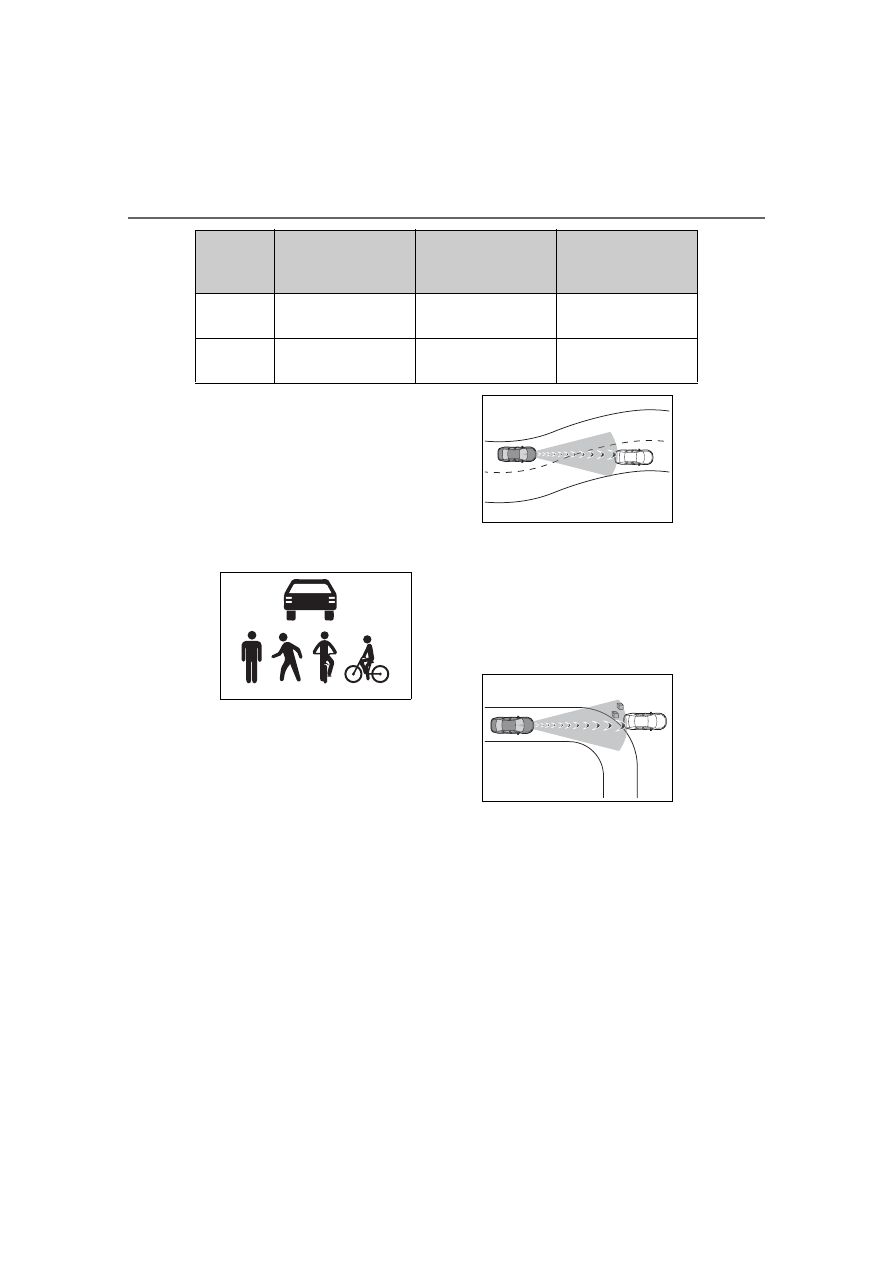
The system detects objects based
on their size, profile, motion, etc.
However, an object may not be
detected depending on the sur-
rounding brightness and the motion,
posture, and angle of the detected
object, preventing the system from
operating properly. (
The illustration shows an image of
detectable objects.
■
Conditions under which the
system may operate even if
there is no possibility of a colli-
sion
●
In some situations such as the fol-
lowing, the system may determine
that there is a possibility of a fron-
tal collision and operate.
• When passing a detectable object,
etc.
• When changing lanes while over-
taking a detectable object, etc.
• When approaching a detectable
object in an adjacent lane or on
the roadside, such as when
changing the course of travel or
driving on a winding road
• When rapidly closing on a detect-
able object, etc.
• When approaching objects on the
roadside, such as detectable
objects, guardrails, utility poles,
trees, or walls
• When there is a detectable object
or other object by the roadside at
the entrance of a curve
• When there are patterns or paint
in front of your vehicle that may be
mistaken for a detectable object
• When the front of your vehicle is
hit by water, snow, dust, etc.
• When overtaking a detectable
object that is changing lanes or
making a right/left turn
Detect-
able
objects
Vehicle speed
Oncoming vehicle
speed
Relative speed
between your vehi-
cle and object
Vehicles
Approx. 10 to 15
mph (15 to 25 km/h)
Approx. 20 to 28
mph (30 to 45 km/h)
Approx. 28 to 43
mph (45 to 70 km/h)
Pedestri-
ans
Approx. 7 to 15 mph
(10 to 25 km/h)
-
Approx. 7 to 15 mph
(10 to 25 km/h)