Toyota Sequoia Hybrid (2023 year). Manual in english - page 8
 

  Index      Toyota     Toyota Sequoia Hybrid (2023 year). Manual in english


Search            copyright infringement  


Content      ..     6      7      8      9     ..


Toyota Sequoia Hybrid (2023 year). Manual in english - page 8


128

3-2. Opening, closing and locking the doors

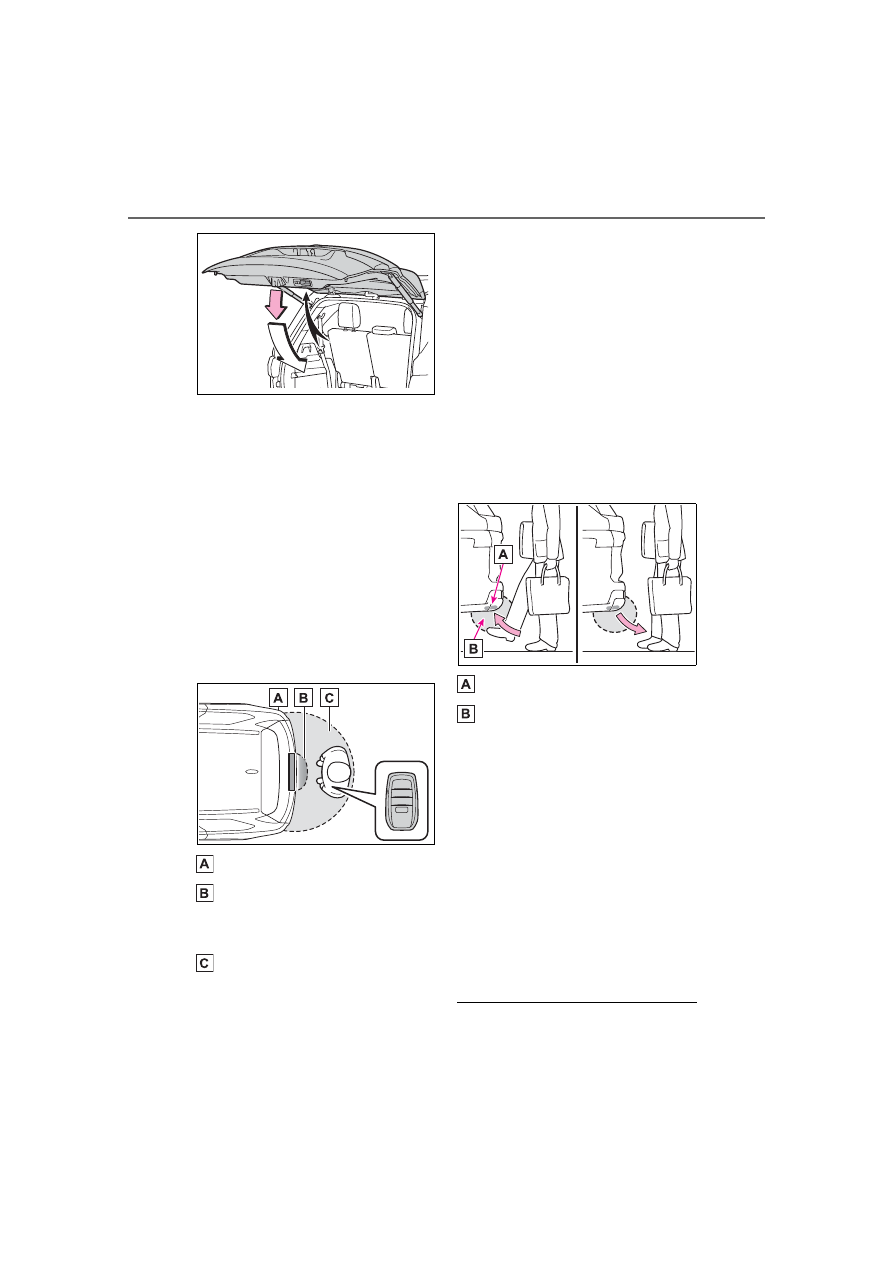
Using the kick sensor

When operating the Hands Free 
Power Back Door, make sure 
that the power switch is in OFF, 
the Hands Free Power Back 
Door operation is enabled 
(

P.130) and you are carrying 

an electronic key.

1

While carrying an electronic 
key, stand within the smart 
key system operation range, 
approximately 2.3 ft. (0.7 m) 
from the rear bumper.

Kick sensor

Hands Free Power Back 
Door operation detection 
area

Smart key system operation 
detection area (

P.140)

2

Perform a kick operation by 
moving your foot to within 

approximately 3.9 in. (10 cm) 
of the rear bumper and then 
pulling it back.

Perform the entire kick operation 

within 1 second.
The back door will not start operat-

ing while a foot is detected under 

the rear bumper.
Operate the Hands Free Power 

Back Door without contacting the 

rear bumper with your foot.
If another electronic key is in the 

cabin or luggage compartment, it 

may take slightly longer than nor-

mal for the operation to occur.

Kick sensor

Hands Free Power Back Door 
operation detection area

3

When the kick sensor detects 
that your foot is pulled back, 
a buzzer will sound and the 
back door will automatically 
fully open/close.

If a foot is moved under the rear 

bumper while the back door is 

opening/closing, the back door will 

stop moving.
If a foot is moved under the rear 

bumper again during the halted 

operation, the back door will per-

form the reverse operation.

Luggage compartment light

The luggage compartment light 

129

3-2. Opening, closing and locking the doors

3

Before 

driving

turns on when the back door is 

opened.

When the power switch is turned 

to OFF, the light will go off auto-

matically after 20 minutes.

Back door closer

In the event that the back door is left 

slightly open, the back door closer 

will automatically close it to the fully 

closed position.
Whatever the state of the power 

switch, the back door closer oper-

ates.

Power back door operating con-

ditions

The power back door can automati-

cally open and close under the fol-

lowing conditions:

When the power back door sys-

tem is enabled. (

P.135)

When the power switch is in ON, 

in addition to the above for the 

opening operations, the back door 

operates for any of the following 

conditions:

• Parking brake is engaged

• The brake pedal is depressed

• The shift position is in P.

Operation of the power back 

door

A buzzer sounds and the emer-

gency flashers flash twice to indi-

cate that the back door is 

opening/closing.

When the power back door sys-

tem is disabled, the power back 

door does not operate but it can 

be opened and closed by hand.

When the power back door auto-

matically opens, if an abnormality 

due to people or objects is 

detected, operation will stop.

Jam protection function

Sensors are equipped on both sides 

of the power back door. If anything 

obstructs the power back door while 

it is closing, the back door will auto-

matically operate in the opposite 

direction or stop.

Fall-down protection function

While the power back door is open-

ing automatically, applying exces-

sive force to it will stop the opening 

operation to prevent the power back 

door from suddenly shutting.

Back door closing assist

If the back door is lowered manually 

when the back door is stopped at an 

open position, the back door will 

fully close automatically.

Back door reserve lock function

This function is a function which 

reserves locking of all doors, before-

hand, when the power back door is 

open.
When the following procedure is 

performed, all the doors except the 

power back door are locked and 

then power back door will also be 

locked at the same time it is closed.

1

Close all doors, except the back 

door.

2

During the power back door clos-

ing operation, lock the doors 

using the smart key system from 

the side doors (

P.115) or the 

wireless remote control. 

(

P.115)

Operation signals will indicate that 

all the doors have been closed and 

locked (

P.116).

If the electronic key is placed 

inside the vehicle after starting a 

close operation via the door 

reserve lock function, the elec-

tronic key may become locked 

inside the vehicle.

If the power back door does not 

130

3-2. Opening, closing and locking the doors

fully close due to the operation of 

the jam protection function, etc., 

while the back door is automati-

cally closing after a door reserve 

lock operation is performed, the 

door reserve lock function is can-

celed and all the doors will unlock.

Before leaving the vehicle, make 

sure that all the doors are closed 

and locked.

Close & lock function

When the power back door is open, 

this function closes the power back 

door and then locks all of the doors 

simultaneously.
When the following procedures are 

performed and there are no elec-

tronic keys for the vehicle within the 

vehicle, all of the doors will lock 

when the power back door is com-

pletely closed.

1

Close all of the doors except the 

power back door.

2

While carrying an electronic key, 
press the 

 switch on the 

lower part of the power back 
door (

P.127).

A different buzzer than the normal 

one will sound and then the power 

back door will begin closing auto-

matically. When the power back 

door is closed, all of the doors will 

lock simultaneously and operation 

signals will indicate that all of the 

doors have been locked.
The double locking system will not 

operate at this time.

Situations in which the close & 

lock function may not operate 

properly

In the following situations, the close 

& lock function may not operate 

properly:

If the 

 switch on the lower part 

of the power back door (

P.127) 

is pressed by a hand which is 
holding an electronic key

If the 

 switch on the lower part 

of the power back door (

P.127

is pressed when the electronic key 
is in a bag, etc. that is placed on 
the ground

If the 

 switch on the lower part 

of the power back door (

P.127

is pressed with the electronic key 
not near the vehicle.

Hands Free Power Back Door 

operating conditions

The Hands Free Power Back Door 

will open/close automatically when 

the following conditions are met:

The Hands Free Power Back Door 

operation is enabled (

P.135)

The power switch is in OFF.

The electronic key is within the 

operational range. (

P.140)

A foot is put near the lower center 

part of the rear bumper and 

moved away from the rear 

bumper.

The power back door may also be 

operated by putting a hand, an 

elbow, a knee, etc. near the lower 

center part of the rear bumper and 

moving it away from the rear 

bumper. Make sure to put it close 

enough to the center part of the 

rear bumper.

Situations in which the Hands 

Free Power Back Door may not 

operate properly

In the following situations, the 

Hands Free Power Back Door may 

not operate properly:

When a foot remains under the 

rear bumper

If the rear bumper is strongly hit 

with a foot or is touched for a while

If the rear bumper has been touched 
for a while, wait for a short time 
before attempting to operate the 
Hands Free Power Back Door 
again.

131

3-2. Opening, closing and locking the doors

3

Before 

driving

When operated while a person is 

too close to the rear bumper

When an external radio wave 

source interferes with the commu-

nication between the electronic 

key and the vehicle (

P.141)

When charging from an external 

power source or connecting the 

AC charging cable

When the vehicle is parked near 

an electrical noise source which 

affects the sensitivity of the Hands 

Free Power Back Door, such as a 

pay parking spot, gas station, 

electrically heated road, or fluo-

rescent light

When the vehicle is near a TV 

tower, electric power plant, radio 

station, large display, airport or 

other facility that generates strong 

radio waves or electrical noise

When a large amount of water is 

applied to the rear bumper, such 

as when the vehicle is being 

washed or in heavy rain

When mud, snow, ice, etc. is 

attached to the rear bumper

When the vehicle has been 

parked for a while near objects 

that may move and contact the 

rear bumper, such as plants

When an accessory is installed to 

the rear bumper

If an accessory has been installed, 
turn the Hands Free Power Back 
Door operation setting off.

Preventing unintentional opera-

tion of the Hands Free Power 

Back Door

When an electronic key is in the 

operation range, the Hands Free 

Power Back Door may operate unin-

tentionally, so be careful in the fol-

lowing situations.

When a large amount of water is 

applied to the rear bumper, such 

as when the vehicle is being 

washed or in heavy rain

When dirt is wiped off the rear 

bumper

When a small animal or small 

object, such as a ball, moves 

under the rear bumper

When an object is moved from 

under the rear bumper

If someone is swinging their legs 

while sitting on the rear bumper

If the legs or another part of some-

one’s body contacts the rear 

bumper while passing by the vehi-

cle

When the vehicle is parked near 

an electrical noise source which 

affects the sensitivity of the Hands 

Free Power Back Door, such as a 

pay parking spot, gas station, 

electrically heated road, or fluo-

rescent light

When the vehicle is near a TV 

tower, electric power plant, radio 

station, large display, airport or 

other facility that generates strong 

radio waves or electrical noise

When the vehicle is parked in a 

place where objects such as 

plants are near the rear bumper

If luggage, etc. is set near the rear 

bumper

If accessories or a vehicle cover is 

installed/removed near the rear 

bumper

When the vehicle is being towed

To prevent unintentional operation, 
turn the Hands Free Power Back 
Door operation setting off. (

P.135)

When reconnecting the 12-volt 

battery

To enable the power back door to 

operate properly, close the back 

door manually.

If the back door opener is inop-

erative

The back door can be unlocked 

from the inside.

1

Remove the cover.

132

3-2. Opening, closing and locking the doors

To prevent damage, cover the tip of 

the screwdriver with a rag.

2

Move the lever.

3

When installing, reverse the 

steps listed.

Customization

Some functions can be customized. 

(Customizable features: 

P.570)

WARNING

Back door closer

In the event that the back door 

is left slightly open, the back 

door closer will automatically 

close it to the fully closed posi-

tion. It takes several seconds 

before the back door closer 

begins to operate. Be careful 

not to catch fingers or anything 

else in the back door, as this 

may cause bone fractures or 

other serious injuries.

Use caution when using the 

back door closer as it still oper-

ates when the power back door 

system is canceled.

Power back door

Observe the following precautions 

when operating the power back 

door. 

Failure to do so may cause death 

or serious injury.

Check the safety of the sur-

rounding area to make sure 

there are no obstacles or any-

thing that could cause any of 

your belongings to get caught.

If anyone is in the vicinity, make 

sure they are safe and let them 

know that the back door is 

about to open or close.

WARNING

If the power back door system is 

turned off while the back door is 

operating automatically, the 

automatic operation is stopped. 

The back door then has to be 

operated manually. Take extra 

care when on an incline, as the 

back door may open or close 

unexpectedly.

If the operating conditions of the 

power back door are no longer 

met, a buzzer may sound and 

the back door may stop opening 

or closing. The back door then 

has to be operated manually. 

Take extra care when on an 

incline, as the back door may 

open or close abruptly.

On an incline, the back door 

may suddenly shut after it 

opens. Make sure the back door 

is fully open and secure.

133

3-2. Opening, closing and locking the doors

3

Before 

driving

In the following situations, the 

power back door may detect an 

abnormality and automatic 

operation may be stopped. In 

this case, the back door has to 

be operated manually. Take 

extra care when on an incline, 

as the back door may open or 

close abruptly.

• When the back door contacts an 

obstacle

• When the 12-volt battery volt-

age suddenly drops, such as 

when the power switch is turned 

to ON or the hybrid system is 

started during automatic opera-

tion

If a bicycle carrier or similar 

heavy object is attached to the 

back door, the power back door 

may not operate, causing itself 

to malfunction, or the back door 

may suddenly shut again after 

being opened, causing some-

one’s hands, arms, head or 

neck to be caught and injured. 

When installing an accessory 

part to the back door, using a 

genuine Toyota part is recom-

mended.

Jam protection function

Observe the following precau-

tions. 

Failure to do so may cause death 

or serious injury.

Never use any part of your body 

to intentionally activate the jam 

protection function.

The jam protection function may 

not work if something gets 

caught just before the back door 

fully closes. Be careful not to 

catch fingers or anything else.

The jam protection function may 

not work depending on the 

shape of the object that is 

caught. Be careful not to catch 

fingers or anything else.

Hands Free Power Back Door

Observe the following precautions 

when operating the Hands Free 

Power Back Door.

Failure to do so may cause death 

or serious injury.

Check the safety of the sur-

rounding area to make sure 

there are no obstacles or any-

thing that could cause any of 

your belongings to get caught.

WARNING

When putting your foot near the 

lower center part of the rear 

bumper and moving it from the 

rear bumper, be careful not to 

touch the exhaust pipes until 

they have cooled down suffi-

ciently, as touching hot exhaust 

pipes can cause burns.

Do not leave the electronic key 

within the effective range 

(detection area) of the luggage 

compartment.

134

3-2. Opening, closing and locking the doors

NOTICE

Back door spindles

The back door is equipped with 

spindles that hold the back door in 

place.

Observe the following precau-

tions. 

Failure to do so may cause dam-

age to the back door spindle, 

resulting in malfunction.

Do not attach any foreign 

objects, such as stickers, plastic 

sheets, or adhesives to the 

spindle rod.

Do not touch the spindle rod 

with gloves or other fabric items.

Do not attach any accessories 

other than genuine Toyota parts 

to the back door.

Do not place your hand on the 

spindle or apply lateral forces to 

it.

To prevent back door closer 

malfunction

Do not apply excessive force to 

the back door while the back door 

closer is operating. Applying 

excessive force may cause the 

back door closer to malfunction.

To prevent damage to the 

power back door

Make sure that there is no ice 

between the back door and 

frame that would prevent move-

ment of the back door. Operat-

ing the power back door when 

excessive load is present on the 

back door may cause a mal-

function.

Do not apply excessive force to 

the back door while the power 

back door is operating.

Take care not to damage the 

sensors (installed on the right 

and left edges of the power 

back door) with a knife or other 

sharp object. If the sensor is 

disconnected, the power back 

door will not close automatically.

Close & lock function

When closing the power back 

door using the close & lock func-

tion, a different buzzer than the 

normal one will sound before the 

operation begins.
To check that the operation has 

started correctly, check that a dif-

ferent buzzer than the normal one 

has sounded.
Additionally, when the power back 

door is fully closed and locked, 

operation signals will indicate that 

all of the doors have been locked.
Before leaving the vehicle, make 

sure that the operation signals 

have operated and that all of the 

doors are locked.

135

3-2. Opening, closing and locking the doors

3

Before 

driving

The settings of the power back 
door system can be changed by 
displaying the “Vehicle Set-
tings” 

 screen from the 

setting screen of the multi-infor-
mation display. (

P.101)

The changed power back door set-
tings are not reset by turning the 
power switch to OFF. In order to 

NOTICE

Hands Free Power Back Door 

precautions

The kick sensor is located behind 

lower center part of the rear 

bumper. Observe the following to 

ensure that the Hands Free 

Power Back Door function oper-

ates properly:

Keep the lower center part of 

the rear bumper clean at all 

times.

If the lower center part of the 

rear bumper is dirty or covered 

with snow, the kick sensor may 

not operate. In this situation, 

clean off the dirt or snow, move 

the vehicle from the current 

position and then check if the 

kick sensor operates.

If it does not operate, have the 

vehicle inspected by your Toy-

ota dealer.

Do not apply coatings that have 

a rain clearing (hydrophilic) 

effect, or other coatings, to the 

lower center part of the rear 

bumper.

Do not park the vehicle near 

objects that may move and con-

tact the lower center part of the 

rear bumper, such as grass or 

trees.

If the vehicle has been parked 

for a while near objects that 

may move and contact the 

lower center part of the rear 

bumper, such as grass or trees, 

the kick sensor may not oper-

ate. In this situation, move the 

vehicle from the current position 

and then check if the kick sen-

sor operates. If it does not oper-

ate, have the vehicle inspected 

by your Toyota dealer.

Do not subject the kick sensor 

or its surrounding area to a 

strong impact.

If the kick sensor or its sur-

rounding area has been sub-

jected to a strong impact, the 

kick sensor may not operate 

properly. If the kick sensor does 

not operate in the following situ-

ations, have the vehicle 

inspected by your Toyota 

dealer.

• The kick sensor or its surround-

ing area has been subjected to 

a strong impact.

• The lower center part of the rear 

bumper is scratched or dam-

aged.

Do not disassemble the rear 

bumper.

Do not attach stickers to the 

rear bumper.

Do not paint the rear bumper.

If a bicycle carrier or similar 

heavy object is attached to the 

power back door, disable the 

Hands Free Power Back Door.

Changing settings of the 
power back door system 
(vehicles with power back 
door)

136

3-2. Opening, closing and locking the doors

restore the original settings, they 
need to be changed back on the 
setting screen of the multi-informa-
tion display.

The open position of the power 
back door can be adjusted.

1

Stop the back door in the 
desirable position. (

P.126)

2

Press and hold the power 
back door switch on the back 
door for approximately 2 sec-
onds.

When the settings are completed, 

the buzzer sounds 4 times.
When opening the back door the 

next time, the back door will stop at 

that position.

Canceling the adjusted open 

position of the back door

Press and hold the power back door 

switch on the back door for approxi-

mately 7 seconds.
After the buzzer sounds 4 times, it 

sounds twice more. When the 

power back door does the opening 

operation the next time, the door will 

open to the initial settings position.

Customization

The opening position can be set 

with the multi-information display. 

(

P.570)

Priority for the stop position is given 

to the last position set by either the 

power back door switch on the back 

door or multi-information display.

Adjusting the open posi-
tion of the back door 
(vehicles with power back 
door)

137

3-2. Opening, closing and locking the doors

3

Before 

driving

1

Press the button to pop up 
the glass hatch.

2

Raise

The glass hatch cannot be opened 
when the back door is locked. 
Unlock the back door to open the 
glass hatch. (

P.124)

When opening the glass hatch

Open the glass hatch slowly and 

carefully.

Use the glass hatch opener or 

wireless remote control when the 

back door is closed.

Opening the glass hatch while 

the rear window wiper is in 

operation

Rear window wiper operation will 

stop moving. Operation will recom-

mence after the glass hatch has 

been closed.

After closing the glass hatch

Check that the glass hatch is firmly 

closed. If it is not firmly closed, the 

power back door, the rear window 

wiper and washer will not operate 

correctly.

Glass hatch

The glass hatch can be 
opened using the glass 
hatch opener.

Opening the glass hatch

WARNING

While driving

Keep the glass hatch closed 

while driving.

If the glass hatch is left open, it 

may hit near-by objects while 

driving or luggage may be unex-

pectedly thrown out, causing an 

accident.

In addition, exhaust gases may 

enter the vehicle, causing death 

or a serious health hazard. 

Make sure to close the glass 

hatch before driving.

Before driving the vehicle, make 

sure that the glass hatch is fully 

closed. If the glass hatch is not 

fully closed, it may open unex-

pectedly while driving, causing 

an accident.

When children are in the vehi-

cle

Do not allow a child to open or 

close the glass hatch.

Doing so may cause the glass 

hatch to move unexpectedly, or 

cause the child’s hands, head, or 

neck to be caught by the closing 

glass hatch.

Operating the glass hatch

Observe the following precau-

tions.

Failure to do so may cause parts 

of the body to be caught, resulting 

in death or serious injury.

Remove any heavy loads, such 

as snow and ice, from the glass 

hatch before opening it. Failure 

to do so may cause the glass 

hatch suddenly shut again after 

it is opened.

When opening or closing the 

glass hatch, thoroughly check to 

make sure the surrounding area 

is safe.

138

3-2. Opening, closing and locking the doors

WARNING

If anyone is in the vicinity, make 

sure they are safe and let them 

know that the glass hatch is 

about to open or close.

Use caution when opening or 

closing the glass hatch in windy 

weather as it may move 

abruptly in strong wind.

The glass hatch may close if it is 

not opened fully. It is more diffi-

cult to open or close the glass 

hatch on an incline than on a 

level surface, so beware of the 

glass hatch unexpectedly open-

ing or closing by itself. Make 

sure that the glass hatch is fully 

open and secure before using 

the luggage compartment.

When closing the glass hatch, 

take extra care to prevent your 

fingers, etc. from being caught.

When closing the glass hatch, 

make sure to press it lightly on 

its outer surface.

Do not pull on the glass hatch 

damper stay to close the glass 

hatch, and do not hang on the 

glass hatch damper stay.

Doing so may cause hands to 

be caught or the glass hatch 

damper stay to break, causing 

an accident.

Do not attach any accessories 

other than genuine Toyota parts 

to the glass hatch. Such addi-

tional weight on the glass hatch 

may cause the glass hatch to 

suddenly shut again after it is 

opened.

NOTICE

Glass hatch damper stays

The glass hatch is equipped with 

damper stays that hold the glass 

hatch in place.

Observe the following precau-

tions.

Failure to do so may cause dam-

age to the glass hatch damper 

stay, resulting in malfunction.

Do not attach any foreign 

objects, such as strikers, plastic 

sheets, or adhesives to the 

damper stay rod.

Do not touch the damper stay 

rod with gloves or other fabric 

items.

Do not attach any accessories 

other than genuine Toyota parts 

to the glass hatch.

139

3-2. Opening, closing and locking the doors

3

Before 

driving

Antenna location

Antennas outside the cabin

Antennas inside the cabin

Antenna outside the luggage 
compartment

NOTICE

Do not place your hand or foot 

on the damper stay or apply lat-

eral forces to it.

Smart key system

The following operations 
can be performed simply by 
carrying the electronic key 
on your person, for example 
in your pocket. The driver 
should always carry the 
electronic key.

Locks and unlocks the 
doors (

P.115)

Locks and unlocks the back 
door (

P.115)

Starts the hybrid system 
(

P.212)

140

3-2. Opening, closing and locking the doors

Effective range (areas within 

which the electronic key is 

detected)

When locking or unlocking the 
doors

The system can be operated when 
the electronic key is within about 2.3 
ft. (0.7 m) of an outside door handle. 
(Only the doors detecting the key 
can be operated.)

When starting the hybrid system 
or changing power switch modes

The system can be operated when 
the electronic key is inside the vehi-
cle.

Alarms and warning messages

An alarm sounds and warning mes-

sages are displayed on the multi-

information display to protect 

against unexpected accidents or 

theft of the vehicle resulting from 

erroneous operation. When a warn-

ing message is displayed, take 

appropriate measures based on the 

displayed message. (

P.519)

When only an alarm sounds, cir-

cumstances and correction proce-

dures are as follows.

When an exterior alarm sounds 

once for 5 seconds

When an interior alarm sounds 

continuously

If “Smart Key System Malfunc-

tion See Owner’s Manual” is 

displayed on the multi-informa-

tion display

The system may be malfunctioning. 

Have the vehicle inspected by Toy-

ota dealer immediately.

If “Key Detected in Vehicle” is 

shown on the multi-information 

display

An attempt was made to lock the 

doors using the smart key system 

while the electronic key was still 

inside the vehicle. Retrieve the elec-

tronic key from the vehicle and lock 

the doors again.

Battery-saving function

The battery-saving function will be 

activated in order to prevent the 

electronic key battery and the 12-

volt battery from being discharged 

Situation

Correction 

procedure

An attempt was 

made to lock the 

vehicle while a door 

was open.

Close all of 

the doors 

and lock the 

doors again.

Situation

Correction 

procedure

The power switch 

was turned to ACC 

while the driver’s 

door was open (The 

driver’s door was 

opened when the 

power switch was in 

ACC).

Turn the 

power 

switch off 

and close 

the driver’s 

door.

The power switch 

was turned off while 

the driver’s door was 

open.

Close the 

driver’s 

door.

141

3-2. Opening, closing and locking the doors

3

Before 

driving

while the vehicle is not in operation 

for a long time.

In the following situations, the 

smart key system may take some 

time to unlock the doors.

• The electronic key has been left in 

an area of approximately 6 ft. (2 

m) of the outside of the vehicle for 

10 minutes or longer.

• The smart key system has not 

been used for 5 days or longer.

If the smart key system has not 

been used for 14 days or longer, 

the doors cannot be unlocked at 

any doors except the driver’s door. 

In this case, take hold of the 

driver’s door handle, or use the 

wireless remote control or the 

mechanical key, to unlock the 

doors.

Turning an electronic key to 

battery-saving mode

When battery-saving mode is set, 

battery depletion is minimized by 

stopping the electronic key from 

receiving radio waves.

Press 

 twice while pressing and 

holding 

. Confirm that the elec-

tronic key indicator flashes 4 times.
While the battery-saving mode is 
set, the smart key system cannot be 
used. To cancel the function, press 
any of the electronic key buttons.

Electronic keys that will not be 

used for long periods of time can 

be set to the battery-saving mode 

in advance.

Conditions affecting operation

The smart key system uses weak 

radio waves. In the following situa-

tions, the communication between 

the electronic key and the vehicle 

may be affected, preventing the 

smart key system, wireless remote 

control and immobilizer system from 

operating properly. (Ways of coping: 

P.535)

When the electronic key battery is 

depleted

Near a TV tower, electric power 

plant, gas station, radio station, 

large display, airport or other facil-

ity that generates strong radio 

waves or electrical noise

When carrying a portable radio, 

cellular phone, cordless phone or 

other wireless communication 

device

When the electronic key is in con-

tact with, or is covered by the fol-

lowing metallic objects

• Cards to which aluminum foil is 

attached

• Cigarette boxes that have alumi-

num foil inside

• Metallic wallets or bags

• Coins

• Hand warmers made of metal

• Media such as CDs and DVDs

When other wireless keys (that 

emit radio waves) are being used 

nearby

When carrying the electronic key 

together with the following devices 

that emit radio waves

• Another electronic key or a wire-

less key that emits radio waves

• Personal computers or personal 

digital assistants (PDAs)

• Digital audio players

• Portable game systems

If window tint with a metallic con-

tent or metallic objects are 

attached to the rear window

When the electronic key is placed 

near a battery charger or elec-

tronic devices

142

3-2. Opening, closing and locking the doors

When the vehicle is parked in a 

pay parking spot where radio 

waves are emitted.

Note for the entry function

Even when the electronic key is 

within the effective range (detec-

tion areas), the system may not 

operate properly in the following 

cases:

• The electronic key is too close to 

the window or outside door han-

dle, near the ground, or in a high 

place when the doors are locked 

or unlocked.

• The electronic key is near the 

ground or in a high place, or too 

close to the center of the rear 

bumper.

• The electronic key is on the instru-

ment panel, or floor, or in the door 

pockets or glove box when the 

hybrid system is started or power 

switch modes are changed.

Do not leave the electronic key on 

top of the instrument panel or near 

the door pockets when exiting the 

vehicle. Depending on the radio 

wave reception conditions, it may 

be detected by the antenna out-

side the cabin and the doors will 

become lockable from the outside, 

possibly trapping the electronic 

key inside the vehicle.

As long as the electronic key is 

within the effective range, the 

doors may be locked or unlocked 

by anyone. However, only the 

doors detecting the electronic key 

can be used to unlock the vehicle.

Even if the electronic key is not 

inside the vehicle, it may be possi-

ble to start the hybrid system if the 

electronic key is near the window.

The doors may unlock or lock if a 

large amount of water splashes on 

the door handle, such as in the 

rain or in a car wash, when the 

electronic key is within the effec-

tive range. (The doors will auto-

matically be locked after 

approximately 60 seconds if the 

doors or the glass hatch are not 

opened and closed.)

If the wireless remote control is 

used to lock the doors when the 

electronic key is near the vehicle, 

there is a possibility that the door 

may not be unlocked by the entry 

function. (Use the wireless remote 

control to unlock the doors.)

Touching the door lock sensor 

while wearing gloves may delay or 

prevent lock operation.

When the lock operation is per-

formed using the lock sensor, rec-

ognition signals will be shown up 

to two consecutive times. After 

this, no recognition signals will be 

given.

If the door handle becomes wet 

while the electronic key is within 

the effective range, the door may 

lock and unlock repeatedly. In this 

case, follow the following correc-

tion procedures to wash the vehi-

cle:

• Place the electronic key in a loca-

tion 6 ft. (2 m) or more away from 

the vehicle. (Take care to ensure 

that the key is not stolen.)

• Set the electronic key to battery-

saving mode to disable the smart 

key system. (

P.141)

If the electronic key is inside the 

vehicle and a door handle 

becomes wet during a car wash, a 

message may be shown on the 

multi-information display and a 

buzzer will sound outside the vehi-

cle. To turn off the alarm, lock all 

the doors.

The lock sensor may not work 

properly if it comes into contact 

with ice, snow, mud, etc. Clean 

the lock sensor and attempt to 

operate it again.

A sudden approach to the effec-

tive range or door handle may pre-

vent the doors from being 

unlocked. In this case, return the 

door handle to the original position 

and check that the doors unlock 

143

3-2. Opening, closing and locking the doors

3

Before 

driving

before pulling the door handle 

again.

If there is another electronic key in 

the detection area, it may take 

slightly longer to unlock the doors 

after the door handle is gripped.

When the vehicle is not driven 

for extended periods

To prevent theft of the vehicle, do 

not leave the electronic key within 

6 ft. (2 m) of the vehicle.

The smart key system can be 

deactivated in advance.

Setting the electronic key to bat-

tery-saving mode helps to reduce 

key battery depletion. (

P.141)

To operate the system properly

Make sure to carry the electronic 

key when operating the system. 

Do not get the electronic key too 

close to the vehicle when operat-

ing the system from the outside of 

the vehicle.

Depending on the position and hold-
ing condition of the electronic key, 
the key may not be detected cor-
rectly and the system may not oper-
ate properly. (The alarm may go off 
accidentally, or the door lock pre-
vention function may not operate.)

If the smart key system does 

not operate properly

Locking and unlocking the doors: 

P.536

Starting the hybrid system: 

P.536

Customization

Some functions can be customized. 

(

P.570)

If the smart key system has 

been deactivated in a custom-

ized setting

Locking and unlocking the doors: 

Use the wireless remote control or 

mechanical key. (

P.115, 536)

Starting the hybrid system and 

changing power switch modes: 

P.536

Stopping the hybrid system: 

P.214

Certification

P.618

WARNING

Caution regarding interfer-

ence with electronic devices

People with implantable car-

diac pacemakers, cardiac 

resynchronization therapy-

pacemakers or implantable car-

dioverter defibrillators should 

keep away from the smart key 

system antennas. (

P.139)

The radio waves may affect the 

operation of such devices. If 

necessary, the entry function 

can be disabled. Ask your Toy-

ota dealer for details, such as 

the frequency of radio waves 

and timing of the emitted radio 

waves. Then, consult your doc-

tor to see if you should disable 

the entry function.

Users of any electrical medical 

device other than implantable 

cardiac pacemakers, cardiac 

resynchronization therapy-

pacemakers or implantable car-

dioverter defibrillators should 

consult the manufacturer of the 

device for information about its 

operation under the influence of 

radio waves.

Radio waves could have unex-

pected effects on the operation 

of such medical devices.

Ask your Toyota dealer for details 

on disabling the entry function.


Content      ..     6      7      8      9     ..