Toyota Camry Hybrid (2023 year). Manual in english - page 5
 

  Index      Toyota     Toyota Camry Hybrid (2023 year). Manual in english


Search            copyright infringement  


Content      ..     3      4      5      6     ..


Toyota Camry Hybrid (2023 year). Manual in english - page 5


78

1-4. Hybrid system

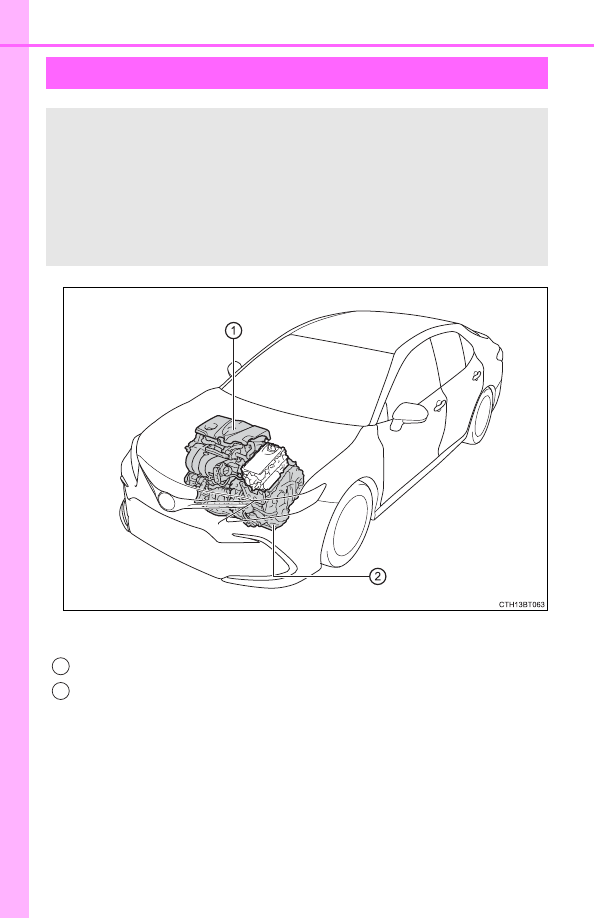
The illustration is an example for explanation and may differ from the
actual item.

Gasoline engine
Electric motor (traction motor)

Hybrid system features

Your vehicle is a hybrid vehicle. It has characteristics different
from conventional vehicles. Be sure you are closely familiar with
the characteristics of your vehicle, and operate it with care.
The hybrid system combines the use of a gasoline engine and
an  electric  motor  (traction  motor)  according  to  driving  condi-
tions,  improving  fuel  efficiency  and  reducing  exhaust  emis-
sions. 

1

2

79

1-4. Hybrid system

1

For safet

y and s

ecurity

When stopped/during start off 

The  gasoline  engine  stops

*

  when  the  vehicle  is  stopped.  During

start  off,  the  electric  motor  (traction  motor)  drives  the  vehicle. At
slow speeds or when traveling down a gentle slope, the engine is
stopped

*

 and the electric motor (traction motor) is used. 

When the shift lever is in N, the hybrid battery (traction battery) is
not being charged.

*

: When  the  hybrid  battery  (traction  battery)  requires  charging  or  the

engine  is  warming  up,  etc.,  the  gasoline  engine  will  not  automatically
stop. (

P. 80)

During normal driving

The  gasoline  engine  is  predominantly  used.  The  electric  motor
(traction motor) charges the hybrid battery (traction battery) as nec-
essary.

When accelerating sharply

When the accelerator pedal is depressed heavily, the power of the
hybrid  battery  (traction  battery)  is  added  to  that  of  the  gasoline
engine via the electric motor (traction motor).

When braking (regenerative braking)

The wheels operate the electric motor (traction motor) as a power
generator, and the hybrid battery (traction battery) is charged.

When  driving  with  the  gasoline  engine  stopped,  a  sound,  which
changes in accordance with the driving speed, will be played in order
to warn people nearby of the vehicle’s approach. The sound will stop
when the vehicle speed exceeds approximately 22 mph (35 km/h).

Acoustic Vehicle Alerting System

80

1-4. Hybrid system

Regenerative braking

In the following situations, kinetic energy is converted to electric energy and
deceleration force can be obtained in conjunction with the recharging of the
hybrid battery (traction battery).

The accelerator pedal is released while driving with the shift lever in D or S.

The brake pedal is depressed while driving with the shift lever in D or S.

EV indicator

Conditions in which the gasoline engine may not stop

The gasoline engine starts and stops automatically. However, it may not stop
automatically in the following conditions:

During gasoline engine warm-up

During hybrid battery (traction battery) charging

When the temperature of the hybrid battery (traction battery) is high or low

When the heater is switched on

Charging the hybrid battery (traction battery)

As the gasoline engine charges the hybrid battery (traction battery), the bat-
tery  does  not  need  to  be  charged  from  an  outside  source.  However,  if  the
vehicle is left parked for a long time the hybrid battery (traction battery) will
slowly discharge. For this reason, be sure to drive the vehicle at least once
every few months for at least 30 minutes or 10 miles (16 km). If the hybrid
battery (traction battery) becomes fully discharged and you are unable to start
the hybrid system, contact your Toyota dealer. 

Charging the 12-volt battery

P. 533

After the 12-volt battery has discharged or when the terminal has been
removed and installed during exchange, etc. 

The gasoline engine may not stop even if the vehicle is being driven by the
hybrid battery (traction battery). If this continues for a few days, contact your
Toyota dealer.

The  EV  indicator  comes  on  when  the
vehicle  is  driven  using  only  the  electric
motor  (traction  motor)  or  the  gasoline
engine is stopped.

81

1-4. Hybrid system

1

For safet

y and s

ecurity

Sounds and vibrations specific to a hybrid vehicle

There may be no engine sound or vibration even though the vehicle is able to
move with the “READY” indicator is illuminated. For safety, apply the parking
brake and make sure to shift the shift lever to P when parked.
The  following  sounds  or  vibrations  may  occur  when  the  hybrid  system  is
operating and are not a malfunction:

Motor sounds may be heard from the engine compartment.

Sounds  may  be  heard  from  the  hybrid  battery  (traction  battery)  under  the
rear seats when the hybrid system starts or stops.

Relay operating sounds such as a snap or soft clank will be emitted from the
hybrid battery (traction battery), under the rear seats, when the hybrid sys-
tem is started or stopped.

Sounds from the hybrid system may be heard when the trunk lid is open.

Sounds  may  be  heard  from  the  transmission  when  the  gasoline  engine
starts or stops, when driving at low speeds, or during idling.

Engine sounds may be heard when accelerating sharply.

Sounds may be heard due to regenerative braking when the brake pedal is
depressed or as the accelerator pedal is released.

Vibration may be felt when the gasoline engine starts or stops.

Cooling fan sounds may be heard from the air intake vent. (

P. 83)

Acoustic Vehicle Alerting System

In the following cases, the Acoustic Vehicle Alerting System may be difficult
for surrounding people to hear.

In very noisy areas

In the wind or the rain

Maintenance, repair, recycling, and disposal

Contact your Toyota dealer regarding maintenance, repair, recycling and dis-
posal. Do not dispose of the vehicle yourself.

Customization

Some functions can be customized. (

P. 569)

82

1-4. Hybrid system

The illustration is an example for explanation and may differ from the
actual item.

Hybrid system precautions

Take care when handling the hybrid system, as it is a high volt-
age system (about 650 V at maximum) as well as contains parts
that become extremely hot when the hybrid system is operating.
Obey the warning labels attached to the vehicle.

Warning label
Service plug
Hybrid  battery  (traction  bat-
tery)
High voltage cables (orange)

Electric motor (traction motor)
Power control unit
Air conditioning compressor

1

2

3

4

5

6

7

83

1-4. Hybrid system

1

For safet

y and s

ecurity

There  is  an  air  intake  vent  under
the  right  side  of  the  rear  seat  for
the  purpose  of  cooling  the  hybrid
battery  (traction  battery).  If  the
vent becomes blocked, the hybrid
battery  (traction  battery)  may
overheat, leading to a reduction in
the  hybrid  battery  (traction  bat-
tery) output.

When a certain level of impact is detected by the impact sensor, the
emergency shut off system blocks the high voltage current and stops
the fuel pump to minimize the risk of electrocution and fuel leakage. If
the emergency shut off system activates, your vehicle will not restart.
To restart the hybrid system, contact your Toyota dealer.

A  message  is  automatically  displayed  when  a  malfunction  occurs  in
the hybrid system or an improper operation is attempted.
If a warning message is shown on
the multi-information display, read
the  message  and  follow  the
instructions. (

P. 507)

Hybrid battery (traction battery) air intake vent

Emergency shut off system 

Hybrid warning message

84

1-4. Hybrid system

If a warning light comes on, a warning message is displayed, or the 12-
volt battery is disconnected

The hybrid system may not start. In this case, try to start the system again. If
the “READY” indicator does not come on, contact your Toyota dealer.

Running out of fuel

When the vehicle has run out of fuel and the hybrid system cannot be started,
refuel  the  vehicle  with  at  least  enough  gasoline  to  make  the  low  fuel  level
warning  light  (

P.  500)  go  off.  If  there  is  only  a  small  amount  of  fuel,  the

hybrid system may not be able to start. (The standard amount of fuel is about
2.3 gal. [8.8 L, 1.9 Imp. gal.] when the vehicle is on a level surface. This value
may vary when the vehicle is on a slope. Add extra fuel when the vehicle is
inclined.)

Electromagnetic waves

High  voltage  parts  and  cables  on  hybrid  vehicles  incorporate  electromag-
netic shielding, and therefore emit approximately the same amount of elec-
tromagnetic  waves  as  conventional  gasoline  powered  vehicles  or  home
electronic appliances.

Your  vehicle  may  cause  sound  interference  in  some  third  party-produced
radio parts.

Hybrid battery (traction battery)

The hybrid battery (traction battery) has a limited service life. The lifespan of
the  hybrid  battery  (traction  battery)  can  change  in  accordance  with  driving
style and driving conditions.

Starting  the  hybrid  system  in  an  extremely  cold  environment  (AXVH70
model

*

)

When the hybrid battery (traction battery) is extremely cold (below approxi-
mately -22°F [-30°C]) under the influence of the outside temperature, it may
not be possible to start the hybrid system. In this case, try to start the hybrid
system  again  after  the  temperature  of  the  hybrid  battery  (traction  battery)
increases due to the outside temperature increase etc.

*

: The model code is indicated on the Certification Label. (

P. 545)

85

1-4. Hybrid system

1

For safet

y and s

ecurity

WARNING

High voltage precautions

This vehicle has high voltage DC and AC systems as well as a 12-volt sys-
tem.  DC  and AC  high  voltage  is  very  dangerous  and  can  cause  severe
burns and electric shock that may result in death or serious injury.

Never  touch,  disassemble,  remove  or  replace  the  high  voltage  parts,
cables or their connectors.

The hybrid system will become hot after starting as the system uses high
voltage. Be careful of both the high voltage and the high temperature, and
always obey the warning labels attached to the vehicle.

Do  not  touch  the  service  plug  located
under the right side of the rear seat. The
service plug is used only when the vehi-
cle  is  serviced  and  is  subject  to  high
voltage.

86

1-4. Hybrid system

WARNING

Road accident cautions

Observe  the  following  precautions  to  reduce  the  risk  of  death  or  serious
injury:

Pull your vehicle off the road, apply the parking brake, shift the shift lever
to P, and turn the hybrid system off.

Do not touch the high voltage parts, cables and connectors.

If  electric  wires  are  exposed  inside  or  outside  your  vehicle,  an  electric
shock may occur. Never touch exposed electric wires.

If a fire occurs in the hybrid vehicle, leave the vehicle as soon as possible.
Never use a fire extinguisher that is not meant for electric fires. Using even
a small amount of water may be dangerous.

If  your  vehicle  needs  to  be  towed,  do  so  with  front  wheels  raised.  If  the
wheels connected to the electric motor (traction motor) are on the ground
when  towing,  the  motor  may  continue  to  generate  electricity.  This  may
cause a fire. (

P. 493)

Carefully inspect the ground under the vehicle. If you find that liquid has
leaked onto the ground, the fuel system may have been damaged. Leave
the vehicle as soon as possible.

If  electrolyte  is  leaking  from  the  hybrid  battery  (traction  battery),  do  not
approach the vehicle.
Even in the unlikely event that the hybrid battery (traction battery) is dam-
aged, the internal construction of the battery will prevent a large amount
of electrolyte from leaking out. However, any electrolyte that does leak out
will give off a vapor. This vapor is an irritant to skin and eyes and could
cause acute poisoning if inhaled.

AXVH70 model

*

Do not touch the hybrid battery (traction battery) if liquid is leaking from or
adhering to it. If electrolyte (carbonic-based organic electrolyte) from the
hybrid battery (traction battery) comes into contact with the eyes or skin, it
could cause blindness or skin wounds. In the unlikely event that it comes
into  contact  with  the  eyes  or  skin,  wash  it  off  immediately  with  a  large
amount of water, and seek immediate medical attention.

Do not bring burning or high-temperature items close to the electrolyte.
The electrolyte may ignite and cause a fire.

*

: The model code is indicated on the Certification Label. (

P. 545)

AXVH71 models

*

If  a fluid  leak occurs,  do  not touch  the fluid  as it  may be strong  alkaline
electrolyte from the hybrid battery (traction battery). If it comes into contact
with your skin or eyes, wash it off immediately with a large amount of water
or, if possible, boric acid solution. Seek immediate medical attention.

*

: The model code is indicated on the Certification Label. (

P. 545)

87

1-4. Hybrid system

1

For safet

y and s

ecurity

WARNING

Hybrid battery (traction battery)

AXVH70 model

*

: Your vehicle contains a sealed lithium-ion battery.

Never resell, hand over or modify the hybrid battery. To prevent accidents,
hybrid batteries that have been removed from a disposed vehicle are col-
lected through Toyota dealer. Do not dispose of the battery yourself.
Unless the battery is properly collected, the following may occur, resulting
in death or serious injury:
• The hybrid battery may be illegally disposed of or dumped, and it is haz-

ardous to the environment or someone may touch a high voltage part,
resulting in an electric shock.

• The hybrid battery is intended to be used exclusively with your hybrid

vehicle. If the hybrid battery is used outside of your vehicle or modified
in any way, accidents such as electric shock, heat generation,  smoke
generation, an explosion and electrolyte leakage may occur.

When reselling or handing over your vehicle, the possibility of an accident
is  extremely  high  because  the  person  receiving  the  vehicle  may not  be
aware of these dangers.

If  your  vehicle  is  disposed  of  without  the  hybrid  battery  having  been
removed, there is a danger of serious electric shock if high voltage parts,
cables  and  their  connectors  are  touched.  In  the  event  that  your  vehicle
must  be  disposed  of,  the  hybrid  battery  must  be  disposed  of  by  your
Toyota dealer or a qualified service shop. If the hybrid battery is not dis-
posed of properly, it may cause electric shock that can result in death or
serious injury.

*

: The model code is indicated on the Certification Label. (

P. 545)

88

1-4. Hybrid system

NOTICE

Hybrid battery (traction battery) air intake vent

Make sure not to block the air intake vent with anything, such as a seat
cover, plastic cover, or luggage. The hybrid battery (traction battery) may
overheat and be damaged.

When dust etc. has accumulated in the air intake vent, clean it with a vac-
uum cleaner to prevent the vent from clogging.

Do  not  get  water  or  foreign  materials  in  the  air  intake  vent  as  this  may
cause a short circuit and damage the hybrid battery (traction battery).

Do  not carry large amounts of  water such  as water  cooler  bottles in  the
vehicle. If water spills onto the hybrid battery (traction battery), the battery
may be damaged. Have the vehicle inspected by your Toyota dealer.

There  is  a  filter  installed  to  the  air  intake  vent.  When  the  filter  remains
noticeably  dirty  even  after  cleaning  the  air  intake  vent,  filter  cleaning  or
replacement is recommended. When cleaning the filter, refer to P. 465.

89

1

For safet

y and s

ecurity

1-5. Theft deterrent system

The  indicator  light  flashes  after
the power switch has been turned
off  to  indicate  that  the  system  is
operating.
The  indicator  light  stops  flashing
after  the  power  switch  has  been
turned  to  ACCESSORY  or  ON
mode  to  indicate  that  the  system
has been canceled.

System maintenance

The vehicle has a maintenance-free type immobilizer system.

Conditions that may cause the system to malfunction

If the grip portion of the key is in contact with a metallic object

If the key is in close proximity to or touching a key to the security system
(key with a built-in transponder chip) of another vehicle

Immobilizer system

The vehicle’s keys have built-in transponder chips that prevent
the hybrid system from starting if a key has not been previously
registered in the vehicle’s on-board computer. 
Never leave the keys inside the vehicle when you leave the vehi-
cle.
This system is designed to help prevent vehicle theft but does
not guarantee absolute security against all vehicle thefts.

NOTICE

To ensure the system operates correctly

Do  not  modify  or  remove  the  system.  If  modified  or  removed,  the  proper
operation of the system cannot be guaranteed.

90

1-5. Theft deterrent system

The alarm uses light and sound to give an alert when an intrusion is
detected.
The  alarm  is  triggered  in  the  following  situations  when  the  alarm  is
set:

A locked door is unlocked or opened in any way other than using
the entry function, wireless remote control or mechanical key. 
(The doors will lock again automatically.)

The trunk is opened in any way other than using the entry function
or wireless remote control.

The hood is opened.

Close  the  doors,  trunk  and  hood,
and lock all the doors. The system
will  be  set  automatically  after  30
seconds.

The  indicator  light  changes  from
being on to flashing when the sys-
tem is set.

Do one of the following to deactivate or stop the alarm:

Unlock the doors.

Open the trunk using the entry function or wireless remote control.

Turn  the  power  switch  to ACCESSORY  or  ON  mode,  or  start  the
hybrid system. (The alarm will be deactivated or stopped after a few
seconds.)

Alarm

The alarm

Setting the alarm system

Deactivating or stopping the alarm

91

1-5. Theft deterrent system

1

For safet

y and s

ecurity

System maintenance

The vehicle has a maintenance-free type alarm system.

Items to check before locking the vehicle

To prevent unexpected triggering of the alarm and vehicle theft, make sure of
the following:

Nobody is in the vehicle.

The windows and moon roof are closed before the alarm is set.

No valuables or other personal items are left in the vehicle.

Triggering of the alarm

The alarm may be triggered in the following situations:
(Stopping the alarm deactivates the alarm system.)

For  Canada:  The  doors  are  unlocked
using the mechanical key.

Except for Canada: The trunk is opened
using the mechanical key.

A person inside the vehicle opens a door
or the trunk or hood, or unlocks the vehi-
cle.

The  12-volt  battery  is  recharged  or
replaced  when  the  vehicle  is  locked.
(

P. 533)

92

1-5. Theft deterrent system

Alarm-operated door lock

In the following cases, depending on the situation, the door may automatically
lock to prevent improper entry into the vehicle:

When a person remaining in the vehicle unlocks the door and the alarm is
activated.

While the alarm is activated, a person remaining in the vehicle unlocks the
door.

When recharging or replacing the 12-volt battery

NOTICE

To ensure the system operates correctly

Do  not  modify  or  remove  the  system.  If  modified  or  removed,  the  proper
operation of the system cannot be guaranteed.


Content      ..     3      4      5      6     ..