Toyota C-HR (2023 year). Manual in english - page 2
 

  Index      Toyota     Toyota C-HR (2023 year). Manual in english


Search            copyright infringement  


Content      ..      1      2      3      ..


Toyota C-HR (2023 year). Manual in english - page 2


30

Pictorial index

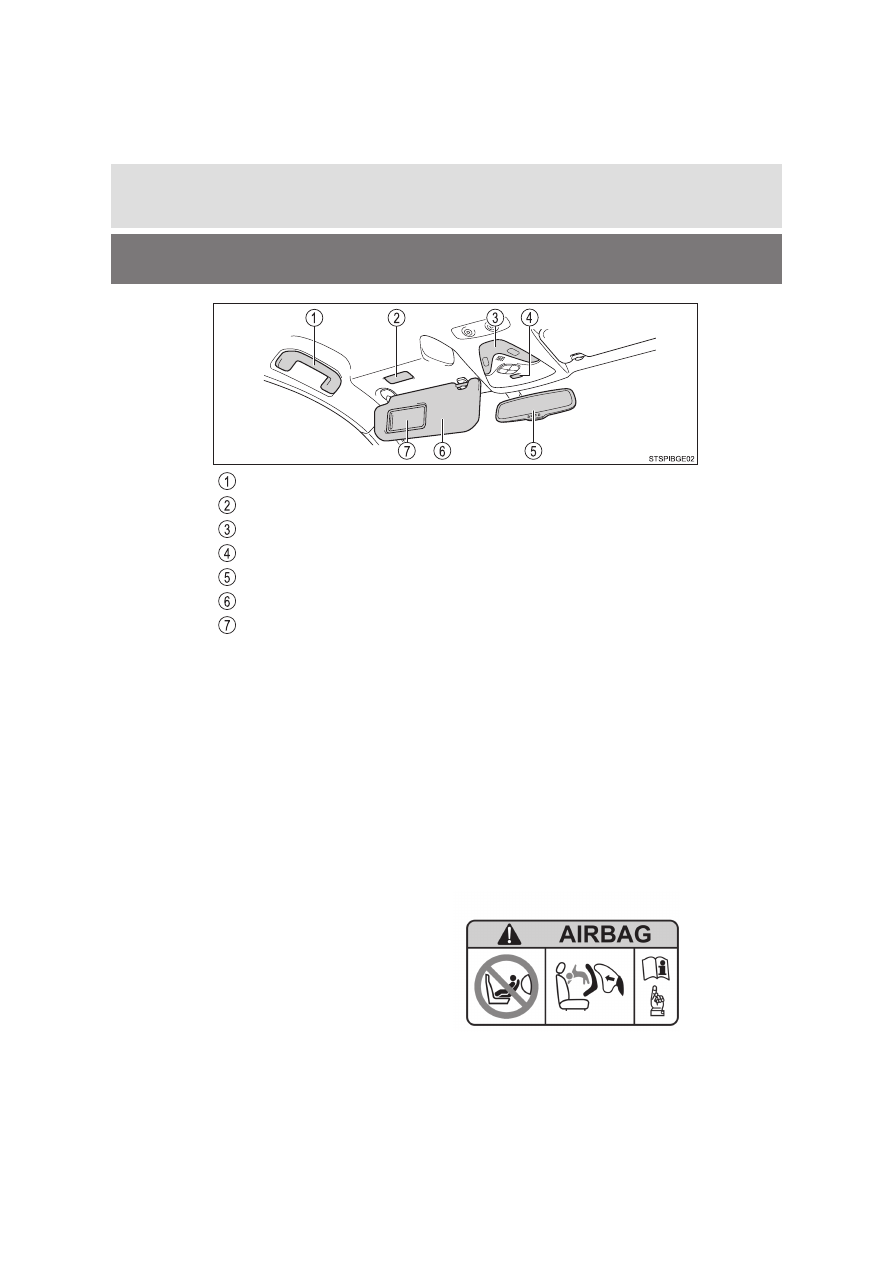
Assist grips  . . . . . . . . . . . . . . . . . . . . . . . . . . . . . . . . . . . . . .  P. 575

Vanity lights

*

1

 . . . . . . . . . . . . . . . . . . . . . . . . . . . . . . . . . . . .  P. 572

Interior lights/personal lights . . . . . . . . . . . . . . . . . . . . . . . .  P. 558

Theft sensor off switch

*

1

 . . . . . . . . . . . . . . . . . . . . . . . . . . .  P. 150

Inside rear view mirror  . . . . . . . . . . . . . . . . . . . . . . . . . . . . .  P. 270

Sun visors

*

2

. . . . . . . . . . . . . . . . . . . . . . . . . . . . . . . . . . . . . .  P. 572

Vanity mirrors  . . . . . . . . . . . . . . . . . . . . . . . . . . . . . . . . . . . .  P. 572

*

1

: If equipped

*

2

: NEVER  use  a  rearward  facing  child

restraint  on  a  seat  protected  by  an
ACTIVE AIRBAG in front of it, DEATH
or  SERIOUS  INJURY  to  the  CHILD
can occur. (

P. 63)

31

1

For safety and security

1-1. For safe use

Before driving.......................32
For safe driving ....................34
Seat belts.............................36
SRS airbags.........................41
Exhaust gas precautions .....54

1-2. Child safety

Airbag manual on-off 

system ...............................55

Riding with children..............58
Child restraint systems ........59

1-3. Emergency assistance

eCall.....................................96

1-4. Hybrid system

Hybrid system features ......117
Hybrid system 

precautions ......................122

1-5. Theft deterrent system

Immobilizer system ............129
Double locking system.......144
Alarm .................................146
Theft prevention labels ......154

32

1-1. For safe use

Before driving

Use  only  floor  mats  designed  specifically  for  vehicles  of  the  same
model  and  model  year  as  your  vehicle.  Fix  them  securely  in  place
onto the carpet.

Insert the retaining hooks (clips)
into the floor mat eyelets.

Turn  the  upper  knob  of  each
retaining  hook  (clip)  to  secure
the floor mats in place.

*

: Always align the 

 marks.

The shape of the retaining hooks (clips) may differ from that shown in the
illustration.

Floor mat

1

*

2

33

1-1. For safe use

1

Fo
r s

a

fe

ty a
nd

 se
cu

rity

WARNING

Observe the following precautions. 
Failure to do so may cause the driver’s floor mat to slip, possibly interfering
with the pedals while driving. An unexpectedly high speed may result or it may
become difficult to stop the vehicle. This could lead to an accident, resulting in
death or serious injury.

When installing the driver’s floor mat 

Do not use floor mats designed for other models or different model year
vehicles, even if they are Toyota Genuine floor mats.

Only use floor mats designed for the driver’s seat.

Always install the floor mat securely using the retaining hooks (clips) pro-
vided.

Do not use two or more floor mats on top of each other.

Do not place the floor mat bottom-side up or upside-down.

Before driving

Check  that  the  floor  mat  is  securely
fixed  in  the  correct  place  with  all  the
provided  retaining  hooks  (clips).  Be
especially careful to perform this check
after cleaning the floor.

With the hybrid system stopped and the
shift lever in P, fully depress each pedal
to  the  floor  to  make  sure  it  does  not
interfere with the floor mat.

34

1-1. For safe use

For safe driving

Adjust  the  angle  of  the
seatback so that you are sitting
straight  up  and  so  that  you  do
not  have  to  lean  forward  to
steer. (

P. 260)

Adjust the seat so that you can
depress the pedals fully and so
that  your  arms  bend  slightly  at
the  elbow  when  gripping  the
steering wheel. (

P. 260, 268)

Lock the head restraint in place with the center of the head restraint
closest to the top of your ears. (

P. 264)

Wear the seat belt correctly. (

P. 36)

Make sure that all occupants are wearing their seat belts before driv-
ing the vehicle. (

P. 36)

Use  a  child  restraint  system  appropriate  for  the  child  until  the  child
becomes large enough to properly wear the vehicle’s seat belt. 
(

P. 59)

For  safe  driving,  adjust  the  seat  and  mirror  to  an  appropriate
position before driving.

Correct driving posture

Correct use of the seat belts

35

1-1. For safe use

1

Fo
r s

a

fe

ty a
nd

 se
cu

rity

Make sure that you can see the rear of the vehicle clearly by adjusting
the inside and outside rear view mirrors properly. (

P. 270, 272)

Adjusting the mirrors

WARNING

Observe the following precautions.
Failure to do so may result in death or serious injury.

Do not adjust the position of the driver’s seat while driving.
Doing so could cause the driver to lose control of the vehicle.

Do not place a cushion between the driver or passenger and the seatback.
A cushion may prevent correct posture from being achieved, and reduce
the effectiveness of the seat belt and head restraint.

Do not place anything under the front seats.
Objects  placed  under  the  front  seats  may  become  jammed  in  the  seat
tracks and stop the seat from locking in place. This may lead to an acci-
dent and the adjustment mechanism may also be damaged.

Always observe the legal speed limit when driving on public roads.

When driving over long distances, take regular breaks before you start to
feel tired.
Also, if you feel tired or sleepy while driving, do not force yourself to con-
tinue driving and take a break immediately.

36

1-1. For safe use

Seat belts

Extend the shoulder belt so that
it comes fully over the shoulder,
but does not come into contact
with  the  neck  or  slide  off  the
shoulder.

Position  the  lap  belt  as  low  as
possible over the hips.

Adjust  the  position  of  the
seatback.  Sit  up  straight  and
well back in the seat.

Do not twist the seat belt.

To fasten the seat belt, push the
plate into the buckle until a click
sound is heard. 
To  release  the  seat  belt,  press
the release button.

Make sure that all occupants are wearing their seat belts before
driving the vehicle. 

Correct use of the seat belts

Fastening and releasing the seat belt

37

1-1. For safe use

1

Fo
r s

a

fe

ty a
nd

 se
cu

rity

Push  the  seat  belt  shoulder
anchor down while pressing the
release button.
Push  the  seat  belt  shoulder
anchor up.

Move  the  height  adjuster  up  and
down  as  needed  until  you  hear  a
click.

Vehicles with knee airbag and Greenland

The  pretensioners  help  the  seat
belts  to  quickly  restrain  the  occu-
pants  by  retracting  the  seat  belts
when  the  vehicle  is  subjected  to
certain  types  of  severe  frontal  or
side collision.

The  pretensioners  do  not  activate
in  the  event  of  a  minor  frontal
impact, a minor side impact, a rear
impact or a vehicle rollover.

Vehicles without knee airbag (except for Greenland)

The  pretensioners  help  the  seat
belts  to  quickly  restrain  the  occu-
pants  by  retracting  the  seat  belts
when  the  vehicle  is  subjected  to
certain  types  of  severe  frontal  or
side collision.

The  pretensioners  do  not  activate
in  the  event  of  a  minor  frontal
impact, a minor side impact, a rear
impact or a vehicle rollover.

Adjusting the seat belt shoulder anchor height (front seats)

Seat  belt  pretensioners  (front  and  outboard  rear  seats  [if
equipped])

38

1-1. For safe use

Emergency locking retractor (ELR)

The retractor will lock the belt during a sudden stop or on impact. It may also
lock if you lean forward too quickly. A slow, easy motion will allow the belt to
extend so that you can move around fully.

Child seat belt usage

The seat belts of your vehicle were principally designed for persons of adult
size. 

Use  a  child  restraint  system  appropriate  for  the  child,  until  the  child
becomes large enough to properly wear the vehicle’s seat belt. (

P. 59)

When the child becomes large enough to properly wear the vehicle’s seat
belt, follow the instructions regarding seat belt usage. (

P. 36)

Replacing the belt after the pretensioner has been activated

If the vehicle is involved in multiple collisions, the pretensioner will activate for
the first collision, but will not activate for the second or subsequent collisions.

Seat belt regulations

If seat belt regulations exist in the country where you reside, please contact
any  authorized Toyota  retailer  or Toyota  authorized  repairer,  or  any  reliable
repairer for seat belt replacement or installation.

39

1-1. For safe use

1

Fo
r s

a

fe

ty a
nd

 se
cu

rity

WARNING

Observe the following precautions to reduce the risk of injury in the event of
sudden braking, sudden swerving or an accident.
Failure to do so may cause death or serious injury.

Wearing a seat belt

Ensure that all passengers wear a seat belt.

Always wear a seat belt properly.

Each seat belt should be used by one person only. Do not use a seat belt
for more than one person at once, including children.

Toyota recommends that children be seated in the rear seat and always
use a seat belt and/or an appropriate child restraint system.

To  achieve  a  proper  seating  position,  do  not  recline  the  seat  more  than
necessary. The seat belt is most effective when the occupants are sitting
up straight and well back in the seats.

Do not wear the shoulder belt under your arm.

Always wear your seat belt low and snug across your hips.

Pregnant women

Obtain medical advice and wear the seat
belt in the proper way. (

P. 36)

Women  who  are  pregnant  should  posi-
tion the lap belt  as low as  possible over
the  hips  in  the  same  manner  as  other
occupants,  extending  the  shoulder  belt
completely over the shoulder and avoid-
ing  belt  contact  with  the  rounding  of  the
abdominal area.
If  the  seat  belt  is  not  worn  properly,  not
only  the  pregnant  woman,  but  also  the
fetus could suffer death or serious injury
as  a  result  of  sudden  braking  or  a  colli-
sion.

40

1-1. For safe use

WARNING

People suffering illness

Obtain medical advice and wear the seat belt in the proper way. (

P. 36)

When children are in the vehicle 

P. 91

Seat belt pretensioners

If the pretensioner has activated, the SRS warning light will come on. In that
case,  the  seat  belt  cannot  be  used  again  and  must  be  replaced  at  any
authorized  Toyota  retailer  or  Toyota  authorized  repairer,  or  any  reliable
repairer.

Adjustable shoulder anchor (front seats)

Always make sure the shoulder belt is positioned across the center of your
shoulder. The belt should be kept away from your neck, but not falling off
your shoulder. Failure to do so could reduce the amount of protection in an
accident and cause death or serious injuries in the event of a sudden stop,
sudden swerve or accident. (

P. 37)

Seat belt damage and wear

Do not damage the seat belts by allowing the belt, plate, or buckle to be
jammed in the door.

Inspect the seat belt system periodically. Check for cuts, fraying, and loose
parts. Do not use a damaged seat belt until it is replaced. Damaged seat
belts cannot protect an occupant from death or serious injury.

Ensure that the belt and plate are locked and the belt is not twisted.
If the seat belt does not function correctly, immediately contact any autho-
rized Toyota retailer or Toyota authorized repairer, or any reliable repairer.

Replace the seat assembly, including  the belts, if your  vehicle has been
involved in a serious accident, even if there’s no obvious damage.

Do not attempt to  install, remove,  modify, disassemble or dispose of the
seat  belts.  Have  any  necessary  repairs  carried  out  by  any  authorized
Toyota retailer or Toyota authorized repairer, or any reliable repairer. Inap-
propriate handling may lead to incorrect operation.

41

1-1. For safe use

1

Fo
r s

a

fe

ty a
nd

 se
cu

rity

SRS airbags

SRS front airbags

SRS driver airbag/front passenger airbag
Can help protect the head and chest of the driver and front pas-
senger from impact with interior components
SRS driver’s knee airbag (if equipped)
Can help provide driver protection

SRS side and curtain shield airbags

SRS front side airbags
Can help protect the torso of the front seat occupants
SRS curtain shield airbags
Can  help  protect  primarily  the  head  of  occupants  in  the  outer
seats

The SRS airbags inflate when the vehicle is subjected to certain
types of severe impacts that may cause significant injury to the
occupants. They work together with the seat belts to help reduce
the risk of death or serious injury.

42

1-1. For safe use

SRS airbag system components

43

1-1. For safe use

1

Fo
r s

a

fe

ty a
nd

 se
cu

rity

The  main  SRS  airbag  system  components  are  shown  above.  The
SRS  airbag  system  is  controlled  by  the  airbag  sensor  assembly. As
the airbags deploy, a chemical reaction in the inflators quickly fills the
airbags  with  non-toxic  gas  to  help  restrain  the  motion  of  the  occu-
pants.

Front impact sensors
Airbag manual on-off switch (if
equipped)
Front passenger airbag
“PASSENGER AIR BAG” indi-
cator (if equipped)
Side impact sensors (front)
Side  impact  sensors  (front
door)
Seat  belt  pretensioners  and
force limiters (front)
Side airbags

Curtain shield airbags
Driver’s  seat  position  sensor
(if equipped)
Driver airbag
Driver’s 

knee 

airbag 

(if

equipped)
SRS warning light
Airbag sensor assembly
Seat  belt  pretensioners  and
force  limiters  (rear  outboard
seats) (if equipped) 

44

1-1. For safe use

WARNING

SRS airbag precautions

Observe the following precautions regarding the SRS airbags. 
Failure to do so may cause death or serious injury.

The  driver  and  all  passengers  in  the  vehicle  must  wear  their  seat  belts
properly.
The SRS airbags are supplemental devices to be used with the seat belts.

The  SRS  driver  airbag  deploys  with  considerable  force,  and  can  cause
death or serious injury especially if the driver is very close to the airbag.
Since the risk zone for the driver’s airbag is the first 50 - 75 mm (2 - 3 in.)
of inflation, placing yourself 250 mm (10 in.) from your driver airbag pro-
vides you with a clear margin of safety. This distance is measured from
the center of the steering wheel to your breastbone. If you sit less than
250 mm (10 in.) away now, you can change your driving position in sev-
eral ways:
• Move your seat to the rear as far as you can while still reaching the ped-

als comfortably.

• Slightly  recline  the  back  of  the  seat.  Although  vehicle  designs  vary,

many drivers can achieve the 250 mm (10 in.) distance, even with the
driver seat all the way forward, simply by reclining the back of the seat
somewhat. If reclining the back of  your  seat makes it hard to see  the
road, raise yourself by using a firm, non-slippery cushion, or raise the
seat if your vehicle has that feature.

• If  your  steering  wheel  is  adjustable,  tilt  it  downward.  This  points  the

airbag toward your chest instead of your head and neck.

The seat should be adjusted as recommended above, while still maintain-
ing control of the foot pedals, steering wheel, and your view of the instru-
ment panel controls.

45

1-1. For safe use

1

Fo
r s

a

fe

ty a
nd

 se
cu

rity

WARNING

SRS airbag precautions

The SRS front passenger airbag also deploys with considerable force, and
can cause death or serious injury especially if the front passenger is very
close  to  the  airbag. The  front  passenger  seat  should  be  as  far  from  the
airbag as possible with the seatback adjusted, so the front passenger sits
upright.

Improperly seated and/or restrained infants and children can be killed or
seriously injured by a deploying airbag. An infant or child who is too small
to use a seat belt should be properly secured using a child restraint sys-
tem. Toyota strongly recommends that all infants and children be placed in
the rear seats of the vehicle and properly restrained. The rear seats are
safer for infants and children than the front passenger seat. (

P. 59)

Do  not  sit  on  the  edge  of  the  seat  or
lean against the dashboard.

Do not allow a child to stand in front of
the SRS front passenger airbag unit or
sit on the knees of a front passenger.

Do not allow the front seat occupants to
hold items on their knees.

Do  not  lean  against  the  door,  the  roof
side  rail  or  the  front,  side  and  rear  pil-
lars.


Content      ..      1      2      3      ..