Toyota 4Runner (2023 year). Manual in english - page 16
 

  Index      Toyota     Toyota 4Runner (2023 year). Manual in english


Search            copyright infringement  


Content      ..     14      15      16      17     ..


Toyota 4Runner (2023 year). Manual in english - page 16


257

4-5. Using the driving support systems

4

Drivin

g

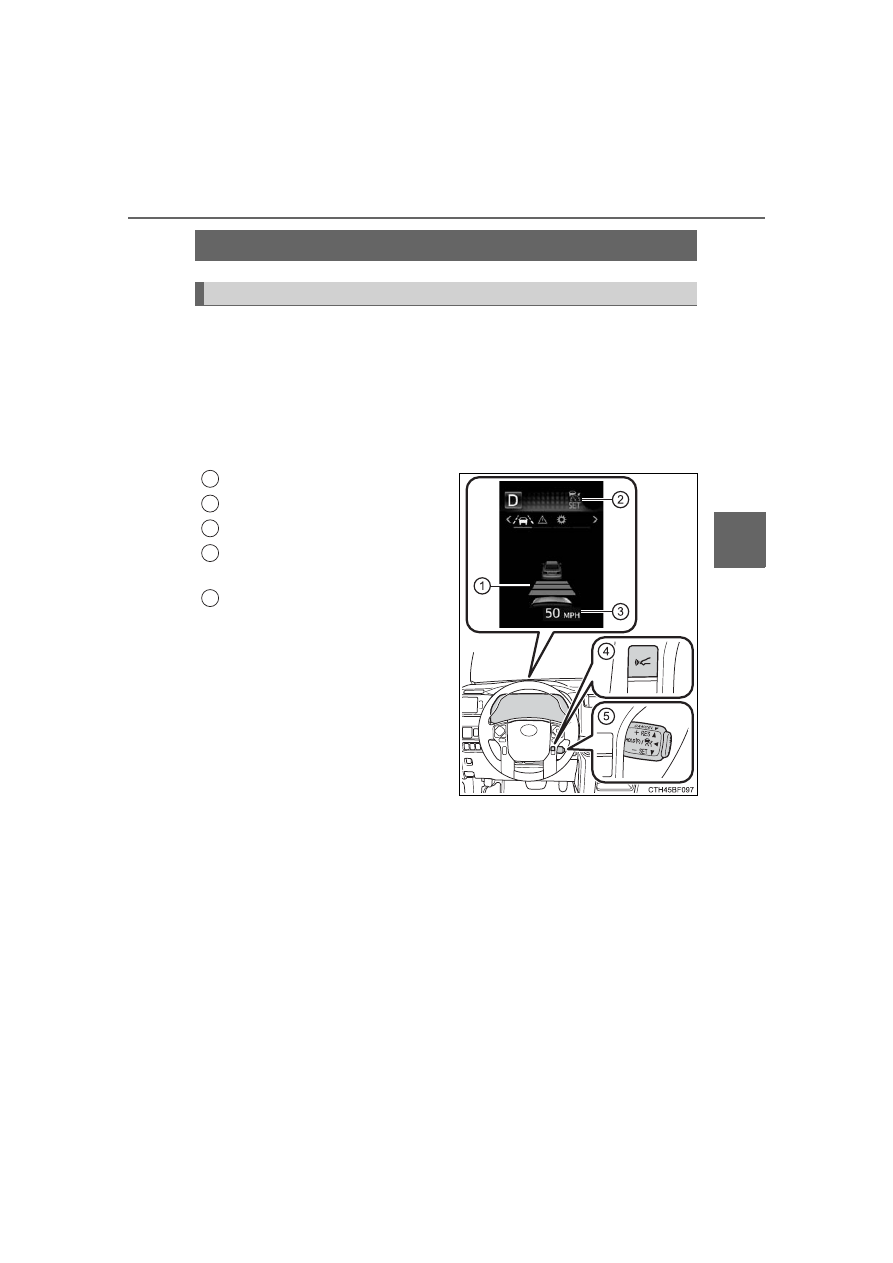
In vehicle-to-vehicle distance control mode, the vehicle automatically
accelerates and decelerates to match the speed changes of the pre-
ceding vehicle even if the accelerator pedal is not depressed. In con-
stant speed control mode, the vehicle runs at a fixed speed.
Use the dynamic radar cruise control on freeways and highways.

Vehicle-to-vehicle distance control mode (

P. 261)

Constant speed control mode (

P. 266)

Display
Indicators
Set speed
Vehicle-to-vehicle 

distance

switch
Cruise control switch

Dynamic radar cruise control

Summary of functions

1

2

3

4

5

258

4-5. Using the driving support systems

WARNING

Before using dynamic radar cruise control

Driving safely is the sole responsibility of the driver. Do not rely solely on
the system, and drive safely by always paying careful attention to your sur-
roundings.

The dynamic radar cruise control provides driving assistance to reduce the
driver's burden. However, there are limitations to the assistance provided.
Read the following conditions carefully. Do not overly rely on this system
and always drive carefully.
• When the sensor may not be correctly detecting the vehicle ahead: 

P. 268

• Conditions  under  which  the  vehicle-to-vehicle  distance  control  mode

may not function correctly: 

P. 269

Set the speed appropriately depending on the speed limit, traffic flow, road
conditions, weather conditions, etc. The driver is responsible for checking
the set speed.

Even when the system is functioning normally, the condition of the preced-
ing  vehicle  as  detected  by  the  system  may  differ  from  the  condition
observed  by  the  driver.  Therefore,  the  driver  must  always  remain  alert,
assess the danger of each situation and drive safely. Relying on this sys-
tem or assuming the system ensures safety while driving can lead to an
accident, resulting in death or serious injury.

Switch  the  dynamic  radar  cruise  control  off  using  the  “ON-OFF”  button
when not in use.

259

4-5. Using the driving support systems

4

D

riv

in

g

WARNING

Cautions regarding the driving assist systems

Observe the following precautions, as there are limitations to the assistance
provided by the system.
Failure to do so may cause an accident resulting in death or serious injury.

Assisting the driver to measure following distance
The  dynamic  radar  cruise  control  is  only  intended  to  help  the  driver  in
determining the following distance between the driver’s own vehicle and a
designated vehicle traveling ahead. It is not a mechanism that allows care-
less or inattentive driving, and it is not a system that can assist the driver in
low-visibility conditions. It is still necessary for driver to pay close attention
to the vehicle’s surroundings.

Assisting the driver to judge proper following distance
The  dynamic  radar  cruise  control  determines  whether  the  following  dis-
tance between the driver’s own vehicle and a designated vehicle traveling
ahead is within a set range. It is not capable of making any other type of
judgement. Therefore,  it  is  absolutely  necessary  for  the  driver  to  remain
vigilant and to determine whether or not there is a possibility of danger in
any given situation.

Assisting the driver to operate the vehicle
The dynamic radar cruise control has limited capability to prevent or avoid
a  collision  with a  vehicle  traveling  ahead. Therefore,  if  there  is  ever  any
danger,  the  driver  must  take  immediate  and  direct  control  of  the  vehicle
and act appropriately in order to ensure the safety of all involved.

260

4-5. Using the driving support systems

WARNING

Situations unsuitable for dynamic radar cruise control

Do not use dynamic radar cruise control in any of the following situations.
Doing so may result in inappropriate speed control and could cause an acci-
dent resulting in death or serious injury.

Roads where there are pedestrians, cyclers, etc.

In heavy traffic

On roads with sharp bends

On winding roads

On slippery roads, such as those covered with rain, ice or snow

On steep downhills, or where there are sudden changes between sharp up
and down gradients 
Vehicle speed may exceed the set speed when driving down a steep hill.

At entrances to freeways and highways

When weather conditions are bad enough that they may prevent the sen-
sors from detecting correctly (fog, snow, sandstorm, heavy rain, etc.)

When there is rain, snow, etc. on the front surface of the radar sensor or
camera sensor

In traffic conditions that require frequent repeated acceleration and decel-
eration

When your vehicle is towing a trailer or during emergency towing

When an approach warning buzzer is heard often

261

4-5. Using the driving support systems

4

Drivin

g

This mode employs a radar sensor to detect the presence of vehicles
up  to  approximately  320  ft.  (100  m)  ahead,  determines  the  current
vehicle-to-vehicle following distance, and operates to maintain a suit-
able following distance from the vehicle ahead.

Note  that  vehicle-to-vehicle  distance  will  close  in  when  traveling  on  long
downhill slopes.

Example of constant speed cruising
When there are no vehicles ahead

The vehicle travels at the speed set by the driver. The desired vehicle-to-
vehicle  distance  can  also  be  set  by  operating  the  vehicle-to-vehicle  dis-
tance switch.

Example of deceleration cruising and follow-up cruising
When  a  preceding  vehicle  driving  slower  than  the  set  speed
appears

When a vehicle is detected running ahead of you, the system automatically
decelerates  your  vehicle.  When  a  greater  reduction  in  vehicle  speed  is
necessary, the system applies the brakes (the stop lights will come on at
this time). The system will respond to changes in the speed of the vehicle
ahead in order to maintain the vehicle-to-vehicle distance set by the driver.
Approach  warning  warns  you  when  the  system  cannot  decelerate  suffi-
ciently to prevent your vehicle from closing in on the vehicle ahead.

Example of acceleration 
When  there  are  no  longer  any  preceding  vehicles  driving  slower
than the set speed

The system accelerates until the set speed is reached. The system then
returns to constant speed cruising.

Driving in vehicle-to-vehicle distance control mode

1

2

3

262

4-5. Using the driving support systems

Press  the  “ON-OFF”  button  to
activate the cruise control.

Radar  cruise  control  indicator  will
come  on  and  a  message  will  be
displayed  on  the  multi-information
display.
Press  the  button  again  to  deacti-
vate the cruise control.
If  the  “ON-OFF”  button  is  pressed
and held for 1.5 seconds or more,
the  system  turns  on  in  constant
speed control mode. (

P. 266)

Accelerate  or  decelerate,  with
accelerator  pedal  operation,  to
the desired vehicle speed (at or
above  approximately  30  mph
[50  km/h])  and  push  the  lever
down to set the speed.

Cruise  control  “SET”  indicator  will
come on.
The  vehicle  speed  at  the  moment
the  lever  is  released  becomes  the
set speed.

Setting  the  vehicle  speed  (vehicle-to-vehicle  distance  control
mode)

1

2

263

4-5. Using the driving support systems

4

Drivin

g

To change the set speed, operate the lever until the desired set speed
is displayed.

Increases the speed
Decreases the speed

Fine  adjustment:  Momentarily
move  the  lever  in  the  desired
direction.
Large  adjustment:  Hold  the  lever
up or down to change the speed,
and  release  when  the  desired
speed is reached.
In the vehicle-to-vehicle distance control mode, the set speed will be
increased or decreased as follows:

For U.S. mainland and Hawaii

Fine adjustment: By 1 mph (1.6 km/h)

*

1

 or 1 km/h (0.6 mph)

*

2

 each time

the lever is operated
Large adjustment: Increases or decreases in 1 mph (1.6 km/h) 

*

1

 or 1 km/h

(0.6 mph)

*

2

 increments for as long as the lever is held

Except for U.S. mainland and Hawaii

Fine adjustment: By 1 mph (1.6 km/h)

*

1

 or 1 km/h (0.6 mph)

*

2

 each time

the lever is operated
Large adjustment: Increases or decreases in 5 mph (8 km/h)

*

1

 or 5 km/h

(3.1 mph)

*

2

 increments for as long as the lever is held

In the constant speed control mode (

P. 266), the set speed will be

increased or decreased as follows:

Fine adjustment: By 1 mph (1.6 km/h)

*

1

 or 1 km/h (0.6 mph)

*

2

 each time

the lever is operated
Large  adjustment:  The  speed  will  continue  to  change  while  the  lever  is
held.

*

1

:  When the set speed is shown in “MPH”

*

2

:  When the set speed is shown in “km/h”

Adjusting the set speed

1

2

264

4-5. Using the driving support systems

Pressing  the  switch  changes  the
vehicle-to-vehicle  distance  as  fol-
lows:

Long
Medium
Short

The  vehicle-to-vehicle  distance  is
set  automatically  to  long  mode
when the engine switch is turned to
IGNITION ON mode.
If a vehicle is running ahead of you, the preceding vehicle mark will also be
displayed.

Select a distance from the table below. Note that the distances shown
correspond to a vehicle speed of 50 mph (80 km/h). Vehicle-to-vehicle
distance increases/decreases in accordance with vehicle speed.

Changing the vehicle-to-vehicle distance (vehicle-to-vehicle dis-
tance control mode)

Preceding 
vehicle mark

1

2

3

Vehicle-to-vehicle distance settings (vehicle-to-vehicle distance
control mode)

Distance options

Vehicle-to-vehicle distance

Long

Approximately 160 ft. (50 m)

Medium

Approximately 130 ft. (40 m)

Short

Approximately 100 ft. (30 m)

265

4-5. Using the driving support systems

4

Drivin

g

Pulling  the  lever  toward  you
cancels the speed control.

The speed setting is also canceled
when 

the 

brake 

pedal 

is

depressed.

Pushing  the  lever  up  resumes
the  cruise  control  and  returns
vehicle speed to the set speed.

However,  cruise  control  does  not  resume  when  the  vehicle  speed  is
approximately 25 mph (40 km/h) or less.

When your vehicle is too close to
a  vehicle  ahead,  and  sufficient
automatic  deceleration  via  the
cruise  control  is  not  possible,  the
display  will  flash  and  the  buzzer
will  sound  to  alert  the  driver.  An
example  of  this  would  be  if
another driver cuts in front of you
while you are following a vehicle.
Depress  the  brake  pedal  to
ensure  an  appropriate  vehicle-to-
vehicle distance.

Warnings may not occur when

In the following instances, warnings may not occur even when the
vehicle-to-vehicle distance is small.

When  the  speed  of  the  preceding  vehicle  matches  or  exceeds
your vehicle speed

When  the  preceding  vehicle  is  traveling  at  an  extremely  slow
speed

Immediately after the cruise control speed was set

When depressing the accelerator pedal

Canceling and resuming the speed control

1

2

Approach warning (vehicle-to-vehicle distance control mode)

266

4-5. Using the driving support systems

When constant speed control mode is selected, your vehicle will main-
tain  a  set  speed  without  controlling  the  vehicle-to-vehicle  distance.
Select this mode only when vehicle-to-vehicle distance control mode
does not function correctly due to a dirty radar sensor, etc.

With  the  cruise  control  off,
press  and  hold  the  “ON-OFF”
button for 1.5 seconds or more.

Immediately  after  the  “ON-OFF”
button is pressed, the radar cruise
control  indicator  will  come  on.
Afterwards, it switches to the cruise
control indicator.
Switching  to  constant  speed  con-
trol  mode  is  only  possible  when
operating  the  lever  with  the  cruise
control off.

Accelerate  or  decelerate,  with
accelerator  pedal  operation,  to
the desired vehicle speed (at or
above  approximately  25  mph
[40  km/h])  and  push  the  lever
down to set the speed.

Cruise  control  “SET”  indicator  will
come on.

The vehicle speed at the moment the lever is released becomes the set
speed.
Adjusting the speed setting: 

P. 263

Canceling and resuming the speed setting: 

P. 265

Selecting constant speed control mode

1

2

267

4-5. Using the driving support systems

4

Drivin

g

Dynamic radar cruise control can be set when

The shift lever is in D or range 3 or higher of S has been selected.

Vehicle speed is at or above approximately 30 mph (50 km/h).

Accelerating after setting the vehicle speed

The vehicle can accelerate by operating the accelerator pedal. After acceler-
ating,  the  set  speed  resumes.  However,  during  vehicle-to-vehicle  distance
control mode, the vehicle speed may decrease below the set speed in order
to maintain the distance to the preceding vehicle.

Automatic cancelation of vehicle-to-vehicle distance control mode

Vehicle-to-vehicle distance control mode is automatically canceled in the fol-
lowing situations:

Actual vehicle speed falls at or below approximately 25 mph (40 km/h).

VSC is activated.

TRAC is activated for a period of time.

When the VSC or TRAC system is turned off.

The sensor cannot detect correctly because it is covered in some way.

Pre-collision braking is activated.

If vehicle-to-vehicle distance control mode is automatically canceled for any
other reason, there may be a malfunction in the system. Contact your Toyota
dealer.

268

4-5. Using the driving support systems

Automatic cancelation of constant speed control mode

Constant speed control mode is automatically canceled in the following situa-
tions:

Actual vehicle speed is more than approximately 10 mph (16 km/h) below
the set vehicle speed.

Actual vehicle speed falls below approximately 25 mph (40 km/h).

VSC is activated.

TRAC is activated for a period of time.

When the VSC or TRAC system is turned off.

Pre-collision braking is activated.

If constant speed control mode is automatically canceled for any other rea-
son, there may be a malfunction in the system. Contact your Toyota dealer.

Brake system operation sound

If the brakes are applied automatically while the vehicle is in vehicle-to-vehi-
cle  distance  control  mode,  a  brake  system  operation  sound  may  be  heard.
This does not indicate a malfunction.

Warning messages and buzzers for dynamic radar cruise control 

Warning messages and buzzers are used to indicate a system malfunction or
to inform the driver of the need for caution while driving. If a warning message
is shown on the multi-information display, read the message and follow the
instructions.

When the sensor may not be correctly detecting the vehicle ahead

In  the  case  of  the  following  and  depending  on  the  conditions,  operate  the
brake  pedal  when  deceleration  of  the  system  is  insufficient  or  operate  the
accelerator pedal when acceleration is required.
As the sensor may not be able to correctly detect these types of vehicles, the
approach warning (

P. 265) may not be activated.

Vehicles that cut in suddenly

Vehicles traveling at low speeds

Vehicles that are not moving in the same lane

Vehicles with small rear ends (trailers with no load on board, etc.)

Motorcycles traveling in the same lane

269

4-5. Using the driving support systems

4

Drivin

g

When  water  or  snow  thrown  up  by  the  surrounding  vehicles  hinders  the
detecting of the sensor

Conditions  under  which  the  vehicle-to-vehicle  distance  control  mode
may not function correctly

In the case of the following conditions, operate the brake pedal (or accelera-
tor pedal, depending on the situation) as necessary.
As the sensor may not be able to correctly detect vehicles ahead, the system
may not operate properly.

When the vehicle ahead of you decelerates suddenly

When driving on a road surrounded by a structure, such as in a tunnel or on
a bridge

While  the  vehicle  speed  is  decreasing  to  the  set  speed  after  the  vehicle
accelerates by depressing the accelerator pedal

When  your  vehicle  is  pointing  upwards
(caused by a heavy load in the luggage
compartment, etc.)

Preceding  vehicle  has  an  extremely
high ground clearance

When  the  road  curves  or  when  the
lanes are narrow

When steering wheel operation or your
position in the lane is unstable

270

4-5. Using the driving support systems

Multi-information display

Turning the Blind Spot Monitor on/
off.

Outside rear view mirror indica-
tors

When  a  vehicle  is  detected  in  a
blind spot of the outside rear view
mirrors or approaching rapidly from
behind  into  a  blind  spot,  the  out-
side  rear  view  mirror  indicator  on
the  detected  side  will  illuminate.  If
the  turn  signal  lever  is  operated
toward  the  detected  side,  the  out-
side  rear  view  mirror  indicator  will
flash.

The Blind Spot Monitor can be enabled/disabled on 

 screen of the

multi-information display. (

P. 95)

When the Blind Spot Monitor is disabled, the BSM OFF indicator (

P. 85)

will come on. Each time the engine switch is turned to the off then changed
to the IGNITION ON mode, the Blind Spot Monitor will be enabled auto-
matically.

BSM (Blind Spot Monitor)

The Blind Spot Monitor is a system that uses rear side radar sen-
sors installed on the inner side of the rear bumper on the left and
right side to assist the driver in confirming safety when chang-
ing lanes.

System components

1

2

Turning the Blind Spot Monitor on/off

271

4-5. Using the driving support systems

4

Drivin

g

Outside rear view mirror indicator visibility

In  strong  sunlight,  the  outside  rear  view  mirror  indicator  may  be  difficult  to
see.

When  “BSM  Unavailable  See  Owner’s  Manual”  is  shown  on  the  multi-
information display

The sensor voltage has become abnormal, or water, snow, mud, etc., may be
attached  to  the  rear  bumper  around  the  sensors  (

P.  272).  Removing  the

water, snow, mud, etc., from the vicinity of the sensor area should return it to
normal. Also, the sensor may not function normally when used in extremely
hot or cold weather.

When  “Blind  Spot  Monitor  Malfunction  Visit Your  Dealer”  is  shown  on
the multi-information display

There  may  be  a  sensor  malfunction  or  misaligned.  Have  the  vehicle
inspected by your Toyota dealer.

Customization

Some functions can be customized. (

P. 558)

272

4-5. Using the driving support systems

WARNING

To ensure the system can operate properly

Blind Spot Monitor sensors are installed behind the left and right sides of the
rear  bumper  respectively.  Observe  the  following  to  ensure  the  Blind  Spot
Monitor can function correctly.

Do not subject a sensor or its surrounding area on the rear bumper to a
strong impact.
If a sensor is moved even slightly off position, the system may malfunction
and  vehicles  may  not  be  detected  correctly.  In  the  following  situations,
have your vehicle inspected by your Toyota dealer.
• A sensor or its surrounding area is subject to a strong impact.
• If  the  surrounding  area  of  a  sensor  is  scratched  or  dented,  or  part  of

them has become disconnected.

Do not disassemble the sensor.

Do not attach stickers or install accessories to the sensor or surrounding
area on the rear bumper.

If a sensor or the rear bumper needs to be removed/installed or replaced,
contact any authorized Toyota retailer or Toyota authorized repairer, or any
reliable repairer.

Do not modify the sensor or surrounding area on the rear bumper.

Do not paint the rear bumper any color other than an official Toyota color.

Keep  the  sensors  and  the  surrounding
areas  on  the  rear  bumper  clean  at  all
times.
If  a  sensor  or  its  surrounding  area  on
the rear bumper is dirty or covered with
snow,  the  Blind  Spot  Monitor  may  not
operate  and  a  warning  message  (

P.

271) will be displayed. In this situation,
clear  off  the  dirt  or  snow  and  drive  the
vehicle with the operation conditions of
the Blind Spot Monitor (

P. 275) satis-

fied for approximately 10 minutes. If the
warning  message  does  not  disappear,
have the vehicle inspected by your Toy-
ota dealer.


Content      ..     14      15      16      17     ..