Toyota 4Runner (2023 year). Manual in english - page 4
 

  Index      Toyota     Toyota 4Runner (2023 year). Manual in english


Search            copyright infringement  


Content      ..     2      3      4      5     ..


Toyota 4Runner (2023 year). Manual in english - page 4


65

1-1. For safe use

1

Fo
r safety and securi

ty

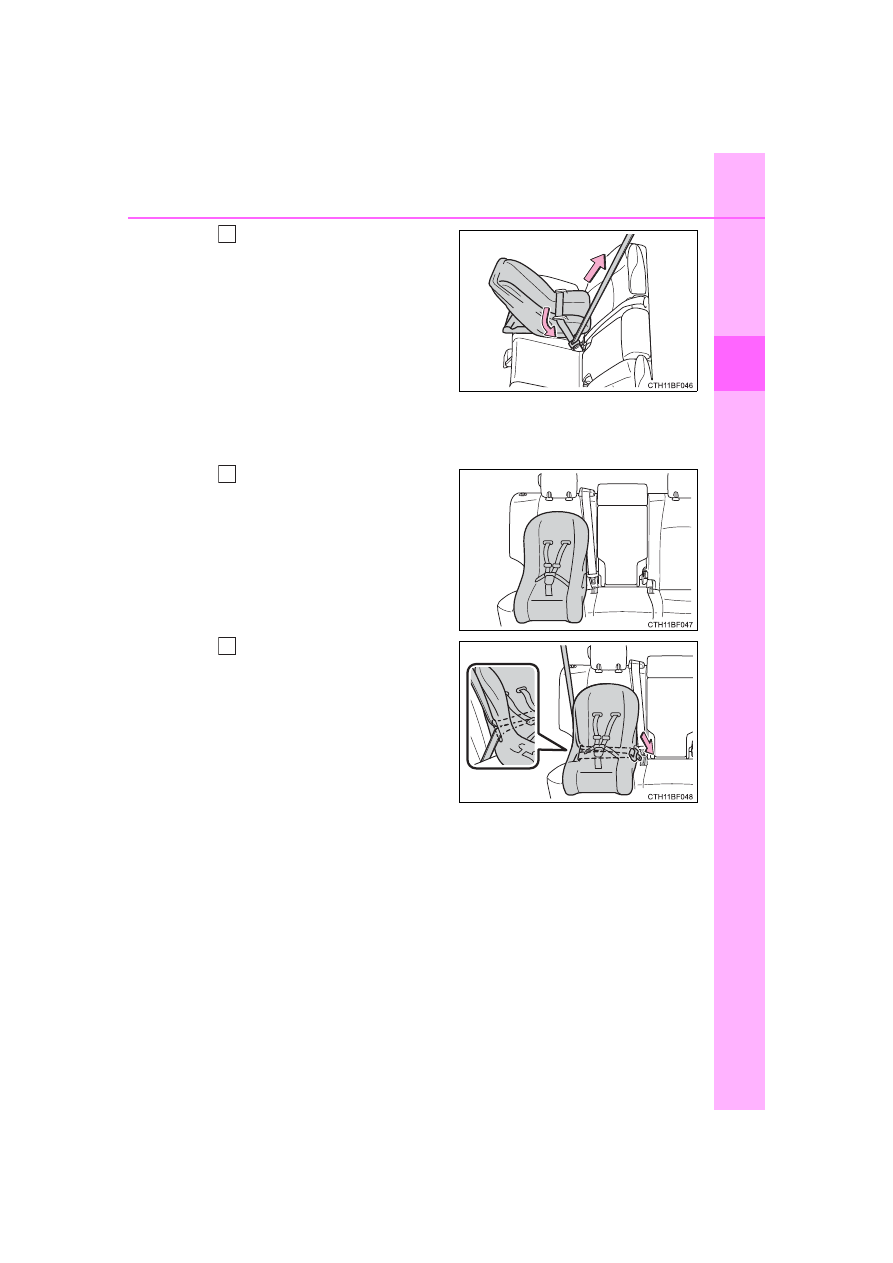
While  pushing  the  child
restraint  system  down  into
the  rear  seat,  allow  the
shoulder  belt  to  retract  until
the  child  restraint  system  is
securely in place.

After  the  shoulder  belt  has
retracted to a point where there
is  no  slack  in  the  belt,  pull  the
belt  to  check  that  it  cannot  be
extended. 

Forward-facing 



Convertible seat

Place the child  restraint sys-
tem  on  the  seat  facing  the
front of the vehicle.

Run the seat belt through the
child  restraint  system  and
insert  the  plate  into  the
buckle.  Make  sure  that  the
belt is not twisted.

4

1

2

66

1-1. For safe use

Fully extend the shoulder belt
and allow it to retract to put it
in  lock  mode.  In  lock  mode,
the belt cannot be extended.

While  pushing  the  child
restraint system into the rear
seat,  allow  the  shoulder  belt
to  retract  until  the  child
restraint  system  is  securely
in place.

After  the  shoulder  belt  has
retracted to a point where there
is  no  slack  in  the  belt,  pull  the
belt  to  check  that  it  cannot  be
extended.

If  the  child  restraint  has  a  top  tether  strap,  the  top  tether  strap
should be latched onto the top tether strap anchor. (

P. 68)

3

4

5

67

1-1. For safe use

1

Fo
r safety and securi

ty

Booster seat

Place the child  restraint sys-
tem  on  the  seat  facing  the
front of the vehicle.

Sit  the  child  in  the  child
restraint system. Fit the seat
belt to the child restraint sys-
tem  according  to  the  manu-
facturer’s  instructions  and
insert  the  plate  into  the
buckle.  Make  sure  that  the
belt is not twisted.

Check  that  the  shoulder  belt  is  correctly  positioned  over  the  child’s
shoulder and that the lap belt is as low as possible. (

P. 32)

Push  the  buckle  release  button
and fully retract the seat belt. 

1

2

Removing a child restraint installed with a seat belt

68

1-1. For safe use

Secure  the  child  restraint  sys-
tem  using  the  seat  belt  or  the
lower anchors, and remove the
head restraint.

Open the anchor bracket cover,
latch  the  hook  onto  the  anchor
bracket  and  tighten  the  top
tether strap.

Make  sure  the  top  tether  strap  is
securely latched.

Replace the head restraint.

Child restraint systems with a top tether strap

1

2

3

69

1-1. For safe use

1

Fo
r safety and secu

ri

ty

Laws and regulations pertaining to anchorages

The LATCH system conforms to FMVSS225 or CMVSS210.2.
Child  restraint  systems  conforming  to  FMVSS213  or  CMVSS213  specifica-
tions can be used.
This vehicle is designed to conform to the SAE J1819.

WARNING

When installing a booster seat 

To prevent the belt from going into ALR lock mode, do not fully extend the
shoulder belt. ALR mode causes the belt to tighten only. This could cause
injury or discomfort to the child. (

P. 33)

When installing a child restraint system

Follow the directions given in the child restraint system installation manual
and fix the child restraint system securely in place.
If the child restraint system is not correctly fixed in place, the child or other
passengers may be seriously injured or even killed in the event of a sudden
braking or an accident.

If  the  driver’s  seat  interferes  with  the
child  restraint  system  and  prevents  it
from being attached correctly, attach the
child  restraint  system  to  the  right-hand
rear seat.

Adjust the front passenger seat so that
it  does  not  interfere  with  the  child
restraint system.

Only put a forward-facing child restraint
system on the front seat when unavoid-
able.  When  installing  a  forward-facing
child  restraint  system  on the  front  pas-
senger seat, move the seat as far back
as possible even if the “AIR BAG OFF”
indicator  light  is  illuminated.  Failure  to
do  so  may  result  in  death  or  serious
injury if the airbags deploy (inflate).

70

1-1. For safe use

WARNING

When installing a child restraint system

Vehicles with third row seats: When using the LATCH anchors for a child
restraint system, move the seat as far back as possible, with the seatback
close to the child restraint system.

When a booster seat is installed, always ensure that the shoulder belt is
positioned  across  the  center  of  the  child’s  shoulder.  The  belt  should  be
kept away from the child’s neck, but not so that it could fall off the child’s
shoulder. Failing to do so may result in death or serious injury in the event
of an accident or a sudden braking.

Ensure that the belt and plate are securely locked and the seat belt is not
twisted.

Shake the child restraint system left and right, and forward and backward
to ensure that it has been securely installed.

After securing a child restraint system, never adjust the seat.

Follow  all  installation  instructions  provided  by  the  child  restraint  system
manufacturer.

When  securing  some  types  of  child  restraint  systems  in  second  or  third
row seats, it may not be possible to properly use the seat belts in positions
next  to  the  child  restraint  without  interfering  with  it  or  affecting  seat  belt
effectiveness. Be sure your seat belt fits snugly across your shoulder and
low  on  your  hips.  If  it  does  not,  or  if  it  interferes  with  the child  restraint,
move to a different position. Failure to do so may result in death or serious
injury.

Do not use a seat belt extender

If a seat belt extender is used when installing a child restraint system, the
seat belt will not securely hold the child restraint system, which could cause
death or serious injury to the child or other passengers in the event of a sud-
den braking, sudden swerving or an accident.

To correctly attach a child restraint system to the anchors

When using the LATCH anchors, be sure that there are no foreign objects
around  the  anchors  and  that  the  seat  belt  is  not  caught  behind  the  child
restraint system. Make sure the child restraint system is securely attached,
or it may cause death or serious injury to the child or other passengers in
the event of a sudden braking or an accident.

71

1-1. For safe use

1

Fo
r safety and secu

ri

ty

Exhaust gas precautions

Harmful  substance  to  the  human  body  is  included  in  exhaust
gases if inhale.

WARNING

Exhaust gases include harmful carbon monoxide (CO), which is colorless and
odorless. Observe the following precautions.
Failure to do so may cause exhaust gases enter the vehicle and may lead to
an accident caused by light-headedness, or may lead to death or a serious
health hazard.

Important points while driving

Keep the back door closed.

If  you  smell  exhaust  gases  in  the  vehicle  even  when  the  back  door  is
closed, open the windows and have the vehicle inspected at your Toyota
dealer as soon as possible.

When parking

If  the  vehicle  is  in  a  poorly  ventilated  area  or  a  closed  area,  such  as  a
garage, stop the engine.

Do not leave the vehicle with the engine on for a long time.
If such a situation cannot be avoided, park the vehicle in an open space
and ensure that exhaust fumes do not enter the vehicle interior.

Do not leave the engine running in an area with snow build-up, or where it
is snowing. If snowbanks build up around the vehicle while the engine is
running, exhaust gases may collect and enter the vehicle.

Exhaust pipe

The exhaust system needs to be checked periodically. If there is a hole or
crack caused by corrosion, damage to a joint or abnormal exhaust noise, be
sure to have the vehicle inspected and repaired by your Toyota dealer. 

72

1-2. Emergency assistance

System components

Microphone
“SOS” button
LED light indicators

Safety Connect

: If equipped

Safety  Connect  is  a  subscription-based  telematics  service  that
uses Global Positioning System (GPS) data and embedded cel-
lular technology to provide safety and security features to sub-
scribers.  Safety  Connect  is  supported  by  Toyota’s  designated
response  center,  which  operates  24  hours  per  day,  7  days  per
week.
Safety  Connect  service  is  available  by  subscription  on  select,
telematics hardware-equipped vehicles.
By  using  the  Safety  Connect  service,  you  are  agreeing  to  be
bound  by  the  Telematics  Subscription  Service Agreement  and
its Terms and Conditions, as in effect and amended from time to
time, a current copy of which is available at Toyota.com in the
United  States,  Toyotapr.com  in  Puerto  Rico  and  Toyota.ca  in
Canada. All use of the Safety Connect service is subject to such
then-applicable Terms and Conditions.

1

2

3

73

1-2. Emergency assistance

1

Fo
r safety and securi

ty

Services

Subscribers have the following Safety Connect services available:

Automatic Collision Notification

*

Helps drivers receive necessary response from emergency ser-
vice providers. (

P. 75)

*

: U.S. Patent No. 7,508,298 B2

Stolen Vehicle Location
Helps drivers in the event of vehicle theft. (

P. 75)

Emergency Assistance Button (“SOS”)
Connects drivers to response-center support. (

P. 75)

Enhanced Roadside Assistance
Provides drivers various on-road assistance. (

P. 76)

Subscription

After you have signed the Telematics Subscription Service Agree-
ment and are enrolled, you can begin receiving services. 
A variety of subscription terms are available for purchase. Contact
your Toyota dealer, call the following appropriate Customer Experi-
ence  Center  or  push  the  “SOS”  button  in  your  vehicle  for  further
subscription details.

• The United States 

1-800-331-4331

• Canada 

1-888-869-6828

• Puerto Rico 

1-877-855-8377

74

1-2. Emergency assistance

Safety Connect Services Information

Phone  calls  using  the  vehicles  Bluetooth

®

  technology  will  not  be  possible

when Safety Connect is active and in use.

Safety Connect is available beginning Fall 2009 on select Toyota models (in
the  contiguous  United  States  only).  Contact  with  the  Safety  Connect
response center is dependent upon the telematics device being in operative
condition, cellular connection availability, and GPS satellite signal reception,
which  can  limit  the  ability  to  reach  the  response  center  or  receive  emer-
gency  service  support.  Enrollment  and  Telematics  Subscription  Service
Agreement  required. A  variety  of  subscription  terms  is  available;  charges
vary by subscription term selected and location.

Automatic Collision Notification, Emergency Assistance and Stolen Vehicle
Location  are  available  in  the  United  States,  including  Hawaii  and Alaska,
Puerto Rico and Canada, and Enhanced Roadside Assistance are available
in the United States, Puerto Rico and Canada.

Automatic Collision Notification, Emergency Assistance, Stolen Vehicle and
Enhanced Road Assistance are not available in the U.S. Virgin Islands. 
For vehicles first sold in the U.S. Virgin Islands, no Safety Connect services
will function in or outside the U.S. Virgin Islands.

Safety Connect services are not subject to section 255 of the Telecommuni-
cations Act and the device is not TTY compatible.

Languages

The Safety Connect response center will offer support in multiple languages.
The Safety Connect system will offer voice prompts in English, Spanish, and
French. Please indicate your language of choice when enrolling.

When contacting the response center

You may be unable to contact the response center if the network is busy.

When the engine switch is turned to IGNITION ON mode, the red indi-
cator light comes on for 2 seconds then turns off. Afterward, the green
indicator light comes on, indicating that the service is active. 
The  following  indicator  light  patterns  indicate  specific  system  usage
conditions:

Green indicator light on = Active service

Green indicator light flashing = Safety Connect call in process

Red indicator light (except at vehicle start-up) = System malfunction
(contact your Toyota dealer)

No indicator light (off) = Safety Connect service not active

Safety Connect LED light Indicators

75

1-2. Emergency assistance

1

Fo
r safety and securi

ty

Automatic Collision Notification

In case of either airbag deployment or severe rear-end collision, the
system is designed to automatically call the response center. The
responding  agent  receives  the  vehicle’s  location  and  attempts  to
speak with the vehicle occupants to assess the level of emergency.
If  the  occupants  are  unable  to  communicate,  the  agent  automati-
cally  treats the call  as  an  emergency,  contacts  the  nearest emer-
gency services provider to describe the situation, and requests that
assistance be sent to the location.

Stolen Vehicle Location

If your vehicle is stolen, Safety Connect can work with local author-
ities to assist them in locating and recovering the vehicle. After filing
a police report, call the Customer Experience Center at 1-800-331-
4331 in the United States, 1-877-855-8377 in Puerto Rico or 1-888-
869-6828 in Canada, and follow the prompts for Safety Connect to
initiate this service.
In  addition  to assisting law enforcement with  recovery of  a stolen
vehicle, Safety-Connect-equipped vehicle location data may, under
certain  circumstances,  be  shared  with  third  parties  to  locate  your
vehicle. Further information is available at Toyota.com in the United
States, Toyotapr.com in Puerto Rico and Toyota.ca in Canada.

Emergency Assistance Button (“SOS”)

In the event of an emergency on the road, push the “SOS” button to
reach  the  Safety  Connect  response  center.  The  answering  agent
will determine your vehicle’s location, assess the emergency, and
dispatch the necessary assistance required.

If  you  accidentally  press  the  “SOS”  button,  tell  the  response-center
agent that you are not experiencing an emergency.

Safety Connect services

76

1-2. Emergency assistance

Enhanced Roadside Assistance

Enhanced  Roadside  Assistance  adds  GPS  data  to  the  already
included warranty-based Toyota roadside service.
Subscribers can press the “SOS” button to reach a Safety Connect
response-center agent, who can help with a wide range of needs,
such as: towing, flat tire, fuel delivery, etc. For a description of the
Enhanced  Roadside  Assistance  services  and  their  limitations,
please  see  the  Safety  Connect  Terms  and  Conditions,  which  are
available  at  Toyota.com  in  the  United  States,  Toyotapr.com  in
Puerto Rico and Toyota.ca in Canada.

Important! Read this information before using Safety Connect.

Exposure to radio frequency signals

The Safety Connect system installed in your vehicle is a low-power
radio transmitter and receiver. It receives and also sends out radio
frequency (RF) signals.
In August  1996,  the  Federal  Communications  Commission  (FCC)
adopted RF exposure guidelines with safety levels for mobile wire-
less phones. Those guidelines are consistent with the safety stan-
dards  previously  set  by  the  following  U.S.  and  international
standards bodies.

ANSI (American National Standards Institute) C95.1 [1992]

NCRP (National  Council  on  Radiation  Protection  and Measure-
ment) Report 86 [1986]

ICNIRP  (International  Commission  on  Non-Ionizing  Radiation
Protection) [1996]

Those standards were based on comprehensive and periodic eval-
uations of the relevant scientific literature. Over 120 scientists, engi-
neers,  and  physicians  from  universities,  and  government  health
agencies and industries reviewed the available body of research to
develop the ANSI Standard (C95.1).
The design of Safety Connect complies with the FCC guidelines in
addition to those standards. 

Safety information for Safety Connect

77

1-2. Emergency assistance

1

Fo
r safety and securi

ty

Certification for Safety Connect

78

1-3. Theft deterrent system

The  indicator  light  flashes  after
the engine switch has been turned
off  to  indicate  that  the  system  is
operating.
The  indicator  light  stops  flashing
after  the  engine  switch  has  been
turned  to  ACCESSORY  or  IGNI-
TION  ON  mode  to  indicate  that
the system has been canceled.

System maintenance

The vehicle has a maintenance-free type engine immobilizer system.

Conditions that may cause the system to malfunction

If the grip portion of the key is in contact with a metallic object

If the key is in close proximity to or touching a key to the security system
(key with a built-in transponder chip) of another vehicle

Engine immobilizer system

The vehicle’s keys have built-in transponder chips that prevent
the engine from starting if a key has not been previously regis-
tered in the vehicle’s on-board computer. 
Never leave the keys inside the vehicle when you leave the vehi-
cle.
This system is designed to help prevent vehicle theft but does
not guarantee absolute security against all vehicle thefts.

WARNING

Certifications for the engine immobilizer system

Changes or modifications not expressly approved by the party responsible
for compliance could void the user’s authority to operate the equipment.

NOTICE

To ensure the system operates correctly

Do  not  modify  or  remove  the  system.  If  modified  or  removed,  the  proper
operation of the system cannot be guaranteed.

79

1-3. Theft deterrent system

1

Fo
r safety and securi

ty

The alarm uses light and sound to give an alert when an intrusion is
detected.
The  alarm  is  triggered  in  the  following  situations  when  the  alarm  is
set:

A locked door is unlocked or opened in any way other than using
the entry function, wireless remote control or mechanical key. (The
doors will lock again automatically.)

The hood is opened.

The battery is reconnected.

Close  the  doors  and  hood,  and
lock all the doors. The system will
be set automatically after 30 sec-
onds.

The  indicator  light  changes  from
being on to flashing when the sys-
tem is set.

Do one of the following to deactivate or stopping the alarms:

Unlock the doors.

Turn the engine switch is in ACCESSORY or IGNITION ON mode,
or start the engine. (The alarm will be deactivated or stopped after a
few seconds.)

Alarm

: If equipped

The alarm

Setting the alarm system

Deactivating or stopping the alarm

80

1-3. Theft deterrent system

System maintenance

The vehicle has a maintenance-free type alarm system.

Items to check before locking the vehicle

To prevent unexpected triggering of the alarm and vehicle theft, make sure of
the following:

Nobody is in the vehicle.

The windows and moon roof are closed before the alarm is set.

No valuables or other personal items are left in the vehicle.

Triggering of the alarm

The alarm may be triggered in the following situations:
(Stopping the alarm deactivates the alarm system.)

Alarm-operated door lock

When the alarm is operating, the doors are locked automatically to prevent
intruders.

Do  not  leave  the  key  inside  the  vehicle  when  the  alarm  is  operating,  and
make sure the key is not inside the vehicle when recharging or replacing the
battery.

A person inside the vehicle opens a door
or the hood.

The  battery  is  recharged  or  replaced
when the vehicle is locked.

NOTICE

To ensure the system operates correctly

Do  not  modify  or  remove  the  system.  If  modified  or  removed,  the  proper
operation of the system cannot be guaranteed.


Content      ..     2      3      4      5     ..