Toyota Highlander Hybrid (2022 year). Manual in english - page 13
 

  Index      Toyota     Toyota Highlander Hybrid (2022 year). Manual in english


Search            copyright infringement  


Content      ..     11      12      13      14     ..


Toyota Highlander Hybrid (2022 year). Manual in english - page 13


205

4-1. Before driving

4

Dr

iv

ing

Rear GAWR

TWR (Trailer Weight Rating)

The maximum allowable gross 
trailer weight. The gross trailer 
weight is the sum of the trailer 
weight and the weight of the 
cargo in the trailer.
TWR is calculated assuming 
base vehicle with one driver, 
one front passenger, towing 
package (if available), hitch and 
hitch systems (if required).

Additional optional equipment, pas-
sengers and cargo in the vehicle 
will reduce the trailer weight rating 
so as not to exceed GCWR, GVWR 
and GAWR.
If the gross trailer weight exceeds 
3000 lb. (1360 kg), it is recom-
mended to use a trailer with 2 or 
more axles.

With brakes

Unbraked TWR (Unbraked 
Trailer Weight Rating)

The trailer weight rating for tow-
ing a trailer without a trailer ser-
vice brake system.

Without brakes

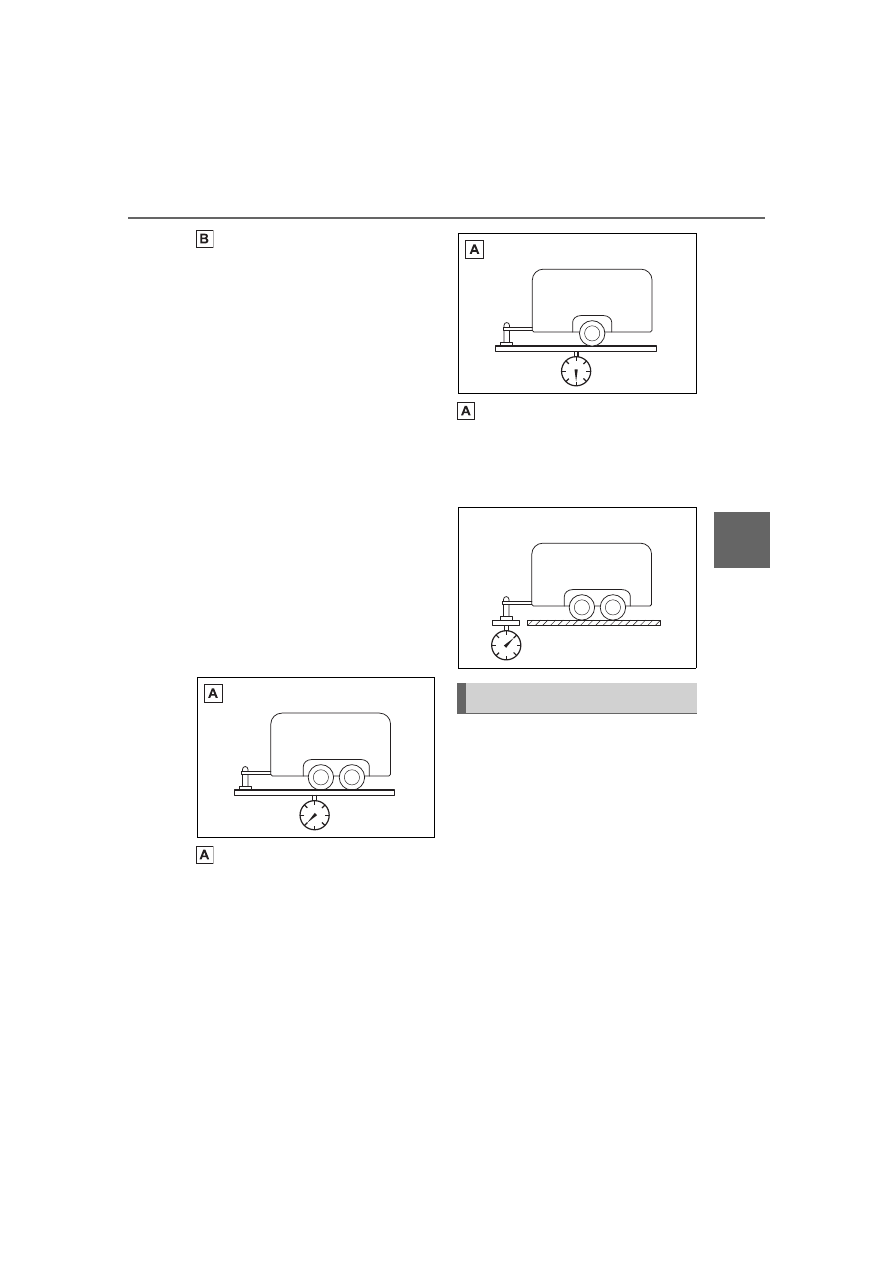
Tongue Weight

The load placed on the trailer 
hitch ball. (

P.206)

The gross trailer weight must 
never exceed the TWR 
described in the table. 
(

P.206)

The gross combination weight 
must never exceed the 
GCWR described in the table. 
(

P.206)

The gross vehicle weight 
must never exceed the 
GVWR indicated on the Certi-
fication Label. (

P.508)

The gross axle weight on 
each axle must never exceed 
the GAWR indicated on the 

Weight limits

206

4-1. Before driving

Certification Label. (

P.508)

If the gross trailer weight is 
over the unbraked TWR, 
trailer service brakes are 
required.

If the gross trailer weight is 
over 2000 lb. (900 kg), a sway 
control device with sufficient 
capacity is required.

Confirm that the gross trailer weight, gross combination weight, 
gross vehicle weight, gross axle weight and tongue weight are all 
within the limits.

GCWR

*1

 and TWR

*1

Unbraked TWR

*1

1000 lb. (450 kg)

*1

:These models meet the tow-vehicle trailering requirement of SAE Inter-

national per SAE J2807.

*2

:The model code is indicated on the Certification Label. (

P.508)

*3

:For 7-seat models

*4

:For 8-seat models

A recommended tongue 
weight varies in accordance 
with the types of trailers or 
towing as described below.

To ensure the recommended 
values shown below, the 
trailer must be loaded by 
referring to the following 
instructions.

• Tongue Weight

GCWR, TWR and Unbraked TWR

Model code

*2

Engine

Driving 

system

GCWR

TWR

AXUH70L-ARXNHA

AXUH70L-ARXMHA

AXUH70L-ARXGHA

2.5L L4 
(A25A-FX
S) engine

2WD

9460 lb. 
(4290 kg)

3500 lb. 

(1590 kg)

AXUH78L-ARXNHA

AXUH78L-ARXMHA

AXUH78L-ARXGHA

*3

AWD

9500 lb. 
(4310 kg)

AXUH78L-ARXGHA

*4

9565 lb. 
(4340 kg)

Trailer Tongue Weight

207

4-1. Before driving

4

Dr

iv

ing

The gross trailer weight should be 
distributed so that the tongue 
weight is 9% to 11%.
(Tongue weight/Gross trailer weight 
x 100 = 9% to 11%)

Gross trailer weight
Tongue weight

The gross trailer weight, gross axle 
weight and tongue weight can be 
measured with platform scales 
found at a highway weighing sta-
tion, building supply company, 
trucking company, junk yard, etc.

Trailer hitch assemblies have 
different weight capacities. Toy-
ota recommends the use of Toy-
ota hitch/bracket for your 
vehicle. For details, contact your 
Toyota dealer.

If you wish to install a trailer 
hitch, contact your Toyota 
dealer.

Use only a hitch that con-
forms to the gross trailer 
weight requirement of your 
vehicle.

Follow the directions supplied 
by the hitch manufacturer.

Lubricate the hitch ball with a 
light coating of grease.

Remove the hitch ball when-
ever you are not towing a 
trailer. Remove the trailer 
hitch if you do not need it. 
After removing the hitch, seal 
any mounting hole in the vehi-
cle body to prevent entry of 
any substances into the vehi-
cle.

Use the correct trailer ball for 
your application.

Hitch

WARNING

Hitch

Trailer hitch assemblies have dif-

ferent weight capacities estab-

lished by the hitch manufacturer. 

Even though the vehicle may be 

physically capable of towing a 

higher weight, the operator must 

determine the maximum weight 

rating of the particular hitch 

assembly and never exceed the 

maximum weight rating specified 

for the trailer-hitch. Exceeding the 

maximum weight rating set by the 

trailer-hitch manufacturer can 

cause an accident resulting in 

death or serious personal injuries.

NOTICE

When installing a trailer hitch

Use only the position recom-

mended by your Toyota dealer. 

Do not install the trailer hitch on 

the bumper; this may cause body 

damage.

Selecting trailer ball

208

4-1. Before driving

Trailer ball load rating

Matches or exceeds the gross 
trailer weight rating of the trailer.

Ball diameter

Matches the size of the trailer cou-
pler. Most couplers are stamped 
with the required trailer ball size.

Shank length

Protrudes beyond the bottom of the 
lock washer and nut at least 2 
threads.

Shank diameter

Matches the ball mount hole diame-
ter size.

Weight carrying ball position: 
50.7 in. (1289 mm)

Use the wire harness stored in 
the rear end under body.

Please consult your dealer 
when installing trailer lights, as 
incorrect installation may cause 
damage to the vehicle’s lights. 
Please take care to comply with 
your state’s laws when install-
ing trailer lights.

Auto current cut-off function

In case of over current, the auto 

cut-off function stops the power 

flowing to the trailer lights to prevent 

damage to the vehicle’s electrical 

system.

Trailer class

Typical trailer ball 

size

IV

2 5/16 in.

II and III

2 in.

I

1 7/8 in.

Positions for towing hitch 
ball

Connecting trailer lights

209

4-1. Before driving

4

Dr

iv

ing

This function is activated when the 

rated current of any of the following 

trailer light circuit components is 

exceeded:

Tail lights: maximum 4.5 A

Stop/turn signal light (right): maxi-

mum 7.8 A

Stop/turn signal light (left): maxi-

mum 4.5 A

When the auto current cut func-

tion is activated

If a trailer light does not come on 

due to the activation of the auto cur-

rent cut function, the light system 

will need to be reset.
Follow the reset procedure shown 

below.

If a tail light does not come on, 

turn off the headlight switch.

If the right-side stop/turn signal 

light does not come on, put the 

turn signal in the off position or 

remove foot from the brake pedal.

If the left-side stop/turn signal light 

does not come on, put the turn 

signal in the off position or remove 

foot from the brake pedal.

If the emergency flashers do not 

operate, press the emergency 

flasher switch to turn them off.
After the light system is reset, oper-

ate the light switches again to see if 

the lights operate normally.
If the lights do not operate normally, 

have the vehicle inspected by your 

Toyota dealer.

Your vehicle will handle differ-
ently when towing a trailer. Help 
to avoid an accident, death or 
serious injury, keep the following 
in mind when towing:

Speed limits for towing a 
trailer vary by state or prov-
ince. Do not exceed the 
posted towing speed limit.

Toyota recommends that the 
vehicle-trailer speed limit is 65 
mph (104 km/h) on a flat, 
straight, dry road. Do not 
exceed this limit, the posted 
towing speed limit or the 
speed limit for your trailer as 
set forth in your trailer owner’s 
manual, whichever is lowest. 
Instability of the towing vehi-
cle-trailer combination (trailer 
sway) increases as speed 
increases. Exceeding speed 
limits may cause loss of con-
trol.

Before starting out, check the 
trailer lights, tires and the 
vehicle-trailer connections. 
Recheck after driving a short 
distance.

Practice turning, stopping and 
reversing with the trailer 
attached in an area away 
from traffic until you become 
accustomed to the feel of the 
vehicle-trailer combination.

Reversing with a trailer 
attached is difficult and 

NOTICE

Do not directly splice trailer 

lights

Do not directly splice trailer lights. 

Directly splicing trailer lights may 

damage your vehicle’s electrical 

system and cause a malfunction.

Trailer towing tips

210

4-1. Before driving

requires practice. Grip the 
bottom of the steering wheel 
and move your hand to the 
left to move the trailer to the 
left. Move your hand to the 
right to move the trailer to 
right. (This is generally oppo-
site to reversing without a 
trailer attached.) Avoid sharp 
or prolonged turning. Have 
someone guide you when 
reversing to reduce the risk of 
an accident.

As stopping distance is 
increased when towing a 
trailer, vehicle-to vehicle dis-
tance should be increased. 
For each 10 mph (16 km/h) of 
speed, allow at least one 
vehicle and trailer length.

Avoid sudden braking as you 
may skid, resulting in the 
trailer jackknifing and a loss of 
vehicle control. This is espe-
cially true on wet or slippery 
surfaces.

Avoid jerky starts or sudden 
acceleration.

Avoid jerky steering and 
sharp turns, and slow down 
before making turn.

Note that when making a turn, 
the trailer wheels will be 
closer than the vehicle wheels 
to the inside of the turn. Com-
pensate by making a wider 
than normal turning radius.

Slow down before making a 

turn, in cross winds, on wet or 
slippery surfaces, etc. 
Increasing vehicle speed can 
destabilize the trailer.

Take care when passing other 
vehicles. Passing requires 
considerable distance. After 
passing a vehicle, do not for-
get the length of your trailer, 
and be sure you have plenty 
of room before changing 
lanes.

To maintain engine braking 
efficiency and charging sys-
tem performance when using 
engine braking, do not put the 
transmission in D. If in the S 
mode, the hybrid transmission 
shift range position must be in 
5 or lower. (

P.219)

Instability happens more fre-
quently when descending 
steep or long downhill grades. 
Before descending, slow 
down and downshift. Do not 
make sudden downshifts 
while descending steep or 
long downhill grades.

Avoid holding the brake pedal 
down too long or applying the 
brakes too frequently. This 
could cause the brakes to 
overheat and result in 
reduced braking efficiency.

Due to the added load of the 
trailer, your vehicle’s engine 
may overheat on hot days (at 
temperatures over 85°F 
[30°C]) when driving up a long 

211

4-1. Before driving

4

Dr

iv

ing

or steep grade. If the engine 
coolant temperature gauge 
indicates overheating, imme-
diately turn off the air condi-
tioning (if in use), pull your 
vehicle off the road and stop 
in a safe spot. (

P.502)

Always place wheel blocks 
under both the vehicle’s and 
the trailer’s wheels when 
parking. Put the transmission 
in P and apply the parking 
brake. Avoid parking on a 
slope, but if unavoidable, do 
so only after performing the 
following:

1

Apply the brakes and keep 
them applied.

2

Have someone place wheel 
blocks under both the vehi-
cle’s and trailer’s wheels.

3

When the wheel blocks are in 
place, release the brakes 
slowly until the blocks absorb 
the load.

4

Shift into P and apply the 
parking brake.

5

Turn off the hybrid system.

When restarting after parking 
on a slope:

1

With the transmission in P, 
start the hybrid system. Be 
sure to keep the brake pedal 
depressed.

2

Shift into a forward gear. If 
reversing, shift into R.

3

If the parking brake is in man-
ual mode, release the park-
ing brake. (

P.223)

4

Release the brake pedal, and 
slowly pull or back away from 
the wheel blocks. Stop and 
apply the brakes.

5

Have someone retrieve the 
blocks.

212

4-1. Before driving

Dinghy towing

Your vehicle is not designed 
to be dinghy towed (with 4 
wheels on the ground) 
behind a motor home.

NOTICE

To avoid serious damage to 

your vehicle

Do not tow your vehicle with the 4 

wheels on the ground.

To prevent causing serious 

damage to the hybrid trans-

mission and Hybrid AWD sys-

tem

Never tow this vehicle with any of 

the wheels on the ground. This 

may cause serious damage to the 

hybrid transmission and Hybrid 

AWD system.

213

4-2. Driving procedures

4

Dr

iv

ing

4-2.Driving procedures

1

Check that the parking brake 
is set.

2

Check that the shift lever is in 
P.

3

Firmly depress the brake 
pedal.

 and a message will be dis-

played on the multi-information dis-

play.
If it is not displayed, the hybrid sys-

tem cannot be started.

4

Press the power switch 
shortly and firmly.

When operating the power switch, 

one short, firm press is enough. It is 

not necessary to press and hold the 

switch.
If the “READY” indicator turns on, 

the hybrid system will operate nor-

mally.
Continue depressing the brake 

pedal until the “READY” indicator is 

illuminated.
The hybrid system can be started 

from any power switch mode.

5

Check that the “READY” indi-
cator is illuminated.

The vehicle will not move when the 

“READY” indicator is off.

If the hybrid system does not 

start

The immobilizer system may not 

have been deactivated. (

P.79) 

Contact your Toyota dealer.

If a message related to start-up is 

shown on the multi-information 

display, read the message and fol-

low the instructions.

When the ambient temperature 

is low, such as during winter 

driving conditions

When starting the hybrid system, 

the flashing time of the “READY” 

indicator may be long. Leave the 

vehicle as it is until the “READY” 

indicator is steady on, as steady 

means the vehicle is able to move.

Sounds and vibrations specific 

to a hybrid vehicle

P.73

If the 12-volt battery is dis-

charged

The hybrid system cannot be started 

using the smart key system. Refer 

to P.497to restart the hybrid system.

Electronic key battery depletion

P.128

Power (ignition) 

switch

Performing the following 
operations when carrying 
the electronic key on your 
person starts the hybrid 
system or changes power 
switch modes.

Starting the hybrid sys-
tem

214

4-2. Driving procedures

Conditions affecting operation

P.147

Note for the entry function

P.148

If the “READY” indicator does 

not come on

In the event that the “READY” indi-

cator does not come on even after 

performing the proper procedures 

for starting the vehicle, contact your 

Toyota dealer immediately.

If the hybrid system is malfunc-

tioning

P.78

Electronic key battery

P.442

Operation of the power switch

If the switch is not pressed shortly 

and firmly, the power switch mode 

may not change or the hybrid sys-

tem may not start.

If attempting to restart the hybrid 

system immediately after turning 

the power switch off, the hybrid 

system may not start in some 

cases. After turning the power 

switch off, please wait a few sec-

onds before restarting the hybrid 

system.

Customization

If the smart key system has been 

deactivated in a customized setting, 

refer to P.495.

1

Stop the vehicle completely.

2

Set the parking brake 
(

P.223), and shift the shift 

lever to P.

Check the parking brake indicator 

is illuminated.

3

Press the power switch.

The hybrid system will stop, and the 

meter display will be extinguished.

4

Release the brake pedal and 
check that “ACCESSORY” or 
“IGNITION ON” is not shown 
on the multi-information dis-
play.

Automatic hybrid system shut 

off feature

The vehicle is equipped with a 

feature that automatically shuts off 

the hybrid system when the shift 

lever is in P with the hybrid system 

operating for an extended period.

The hybrid system will automati-

WARNING

When starting the hybrid sys-

tem

Always start the hybrid system 

while sitting in the driver’s seat. 

Do not depress the accelerator 

pedal while starting the hybrid 

system under any circumstances. 

Doing so may cause an accident 

resulting in death or serious injury.

NOTICE

When starting the hybrid sys-

tem

If the hybrid system becomes diffi-

cult to start, have your vehicle 

checked by your Toyota dealer 

immediately.

Symptoms indicating a mal-

function with the power 

switch

If the power switch seems to be 

operating somewhat differently 

than usual, such as the switch 

sticking slightly, there may be a 

malfunction. Contact your Toyota 

dealer immediately.

Stopping the hybrid sys-
tem

215

4-2. Driving procedures

4

Dr

iv

ing

cally shut off after approximately 1 

hour if it has been left running 

while the shift lever is in P.

The timer for the automatic hybrid 

system shut off feature will reset if 

the brake pedal is depressed or if 

the shift lever is in a position other 

than P.

After the vehicle is parked, if the 

door is locked with the door lock 

switch (

P.134) from the inside or 

the mechanical key from the out-

side, the automatic hybrid system 

shut off feature will be disabled. 

The timer for the automatic hybrid 

system shut off feature will be 

re-enabled if the driver’s door is 

opened.

Modes can be changed by 
pressing the power switch with 
brake pedal released. (The 
mode changes each time the 
switch is pressed.)

WARNING

Stopping the hybrid system 

in an emergency

If you want to stop the hybrid 

system in an emergency while 

driving the vehicle, press and 

hold the power switch for more 

than 2 seconds, or press it 

briefly 3 times or more in suc-

cession. (

P.456)

However, do not touch the 

power switch while driving 

except in an emergency. Turn-

ing the hybrid system off while 

driving will not cause loss of 

steering or braking control, how-

ever, power assist to the steer-

ing will be lost. This will make it 

more difficult to steer smoothly, 

so you should pull over and stop 

the vehicle as soon as it is safe 

to do so.

If the power switch is operated 

while the vehicle is running, a 

warning message will be shown 

on the multi-information display 

and a buzzer sounds.

To restart the hybrid system 

after performing an emergency 

shutdown, shift the shift lever to 

N and then press the power 

switch.

When parking

Exhaust gases include harmful 

carbon monoxide (CO), which is 

colorless and odorless. Observe 

the following precautions.
Failure to do so may cause 

exhaust gases to enter the vehicle 

and may lead to an accident 

caused by light-headedness, or 

may lead to death or a serious 

health hazard.

If the vehicle is in a poorly venti-

lated area or a closed area, 

such as a garage, stop the 

hybrid system.

Do not leave the vehicle with 

the hybrid system operating for 

a long time. If such a situation 

cannot be avoided, park the 

vehicle in an open space and 

ensure that exhaust fumes do 

not enter the vehicle interior.

Do not leave the hybrid system 

operating in an area with snow 

build-up, or where it is snowing. 

If snowbanks build up around 

the vehicle while the hybrid sys-

tem is operating, exhaust gases 

may collect and enter the vehi-

cle.

Changing power switch 
modes

216

4-2. Driving procedures

1

OFF

*

The emergency flashers can be 
used.

2

ACC

Some electrical components such 
as the audio system can be used.
“ACCESSORY” will be displayed 
on the multi-information display.

3

ON

All electrical components can be 
used.
“IGNITION ON” will be displayed on 
the multi-information display.

*

: If the shift lever is in a position 

other than P when turning off the 
hybrid system, the power switch 
will be turned to ACC, not to OFF.

Auto power off function

If the vehicle is left in ACC for more 

than 20 minutes or ON (the hybrid 

system is not operating) for more 

than an hour with the shift lever in P, 

the power switch will automatically 

turn off. However, this function can-

not entirely prevent 12-volt battery 

discharge. Do not leave the vehicle 

with the power switch in ACC or ON 

for long periods of time when the 

hybrid system is not operating.

If the hybrid system is stopped 
with the shift lever in a position 
other than P, the power switch 
will not be turned off but instead 
be turned to ACC. Perform the 
following procedure to turn the 
switch off:

1

Check that the parking brake 
is set.

2

Shift the shift lever to P.

3

Check that “ACCESSORY” is 
displayed on the multi-infor-
mation display and press the 
power switch shortly and 
firmly.

4

Check that “ACCESSORY” 
or “IGNITION ON” on the 

NOTICE

To prevent 12-volt battery dis-

charge

Do not leave the power switch 

in ACC or ON for long periods of 

time without the hybrid system 

on.

If “ACCESSORY” or “IGNITION 

ON” is displayed on the 

multi-information display, the 

power switch is not off. Exit the 

vehicle after turning the power 

switch off.

When stopping the hybrid 
system with the shift lever 
in a position other than P

217

4-2. Driving procedures

4

Dr

iv

ing

multi-information display are 
off.

Turns EV drive mode on/off

When EV drive mode is turned on, 
the EV drive mode indicator will 
come on. Pressing the switch when 
in EV drive mode will return the 
vehicle to normal driving (using the 
gasoline engine and electric motor 
[traction motor]).

NOTICE

To prevent 12-volt battery dis-

charge

Do not stop the hybrid system 

when the shift lever is in a position 

other than P. If the hybrid system 

is stopped in another shift lever 

position, the power switch will not 

be turned off but instead be 

turned to ACC. If the vehicle is left 

in ACC, 12-volt battery discharge 

may occur.

EV drive mode

In EV drive mode, electric 
power is supplied by the 
hybrid battery (traction bat-
tery), and only the electric 
motor (traction motor) is 
used to drive the vehicle.

This mode allows you to 
drive in residential areas 
early in the morning and 
late at night, or in indoor 
parking lots, etc., without 
concern for noises and gas 
emissions.

However, when the Acoustic 
Vehicle Alerting System is 
active, the vehicle may pro-
duce sound.

Operating instructions

218

4-2. Driving procedures

Situations in which EV drive 

mode cannot be turned on

It may not be possible to turn EV 

drive mode on in the following situa-

tions. If it cannot be turned on, a 

buzzer will sound and a message 

will be shown on the multi-informa-

tion display.

The temperature of the hybrid sys-

tem is high.

The vehicle has been left in the 

sun, driven on a hill, driven at high 

speeds, etc.

The temperature of the hybrid sys-

tem is low.

The vehicle has been left in tem-

peratures lower than about 32°F 

(0 °C) for a long period of time, 

etc.

The gasoline engine is warming 

up.

The hybrid battery (traction bat-

tery) is low.

The remaining battery level indi-

cated in the energy monitor dis-

play is low. (

P.117)

Vehicle speed is high.

The accelerator pedal is 

depressed firmly or the vehicle is 

on a hill, etc.

The windshield defogger is in use.

Switching to EV drive mode 

when the gasoline engine is 

cold

If the hybrid system is started while 

the gasoline engine is cold, the gas-

oline engine will start automatically 

after a short period of time in order 

to warm up. In this case, you will 

become unable to switch to EV drive 

mode.
After the hybrid system has started 

and the “READY” indicator has illu-

minated, press the EV drive mode 

switch before the gasoline engine 

starts to switch to EV drive mode.

Automatic cancelation of EV 

drive mode

When driving in EV drive mode, the 

gasoline engine may automatically 

restart in the following situations. 

When EV drive mode is canceled, a 

buzzer will sound, the EV drive 

mode indicator will go off after flash-

ing, and a message is displayed on 

the multi-information display.

The hybrid battery (traction bat-

tery) becomes low.

The remaining battery level indi-

cated in the energy monitor dis-

play is low. (

P.117)

Vehicle speed is high.

The accelerator pedal is 

depressed firmly or the vehicle is 

on a hill, etc.

Possible driving distance when 

driving in EV drive mode

EV drive mode’s possible driving 

distance ranges from a few hundred 

meters to approximately 0.6 mile (1 

km). However, depending on vehicle 

conditions, there are situations 

when EV drive mode cannot be 

used. 

(The distance that is possible 

depends on the hybrid battery [trac-

tion battery] level and driving condi-

tions.)

Fuel economy

The hybrid system is designed to 

achieve the best possible fuel econ-

omy during normal driving (using 

the gasoline engine and electric 

motor [traction motor]). Driving in 

EV drive mode more than neces-

sary may lower fuel economy.

If “EV Mode Unavailable” is 

shown on the multi-information 

display

The EV drive mode is not available. 

The reason the EV drive mode is 

not available (the vehicle is idling, 

battery charge is low, vehicle speed 

is higher than the EV drive mode 

operating speed range or accelera-

tor pedal is depressed too much) 

219

4-2. Driving procedures

4

Dr

iv

ing

may be displayed. Use the EV drive 

mode when it becomes available.

If “EV Mode Deactivated” is 

shown on the multi-information 

display

The EV drive mode has been auto-

matically canceled. The reason the 

EV drive mode is not available (the 

battery charge is low, vehicle speed 

is higher than the EV drive mode 

operating speed range or accelera-

tor pedal is depressed too much) 

may be displayed. Drive the vehicle 

for a while before attempting to turn 

on the EV drive mode again.

*1

:To improve fuel efficiency and 

reduce noise, shift the shift lever 
to D for normal driving.

*2

:By selecting shift ranges using S 

mode, you can control accelerat-
ing force and engine braking 
force.

When driving with dynamic 

radar cruise control with 

full-speed range activated

Even when switching the driving 

mode to sport mode with the intent 

of enabling engine braking, engine 

braking will not activate because 

dynamic radar cruise control with 

full-speed range will not be can-

celed.

Restraining sudden start 

(Drive-Start Control)

P.191

WARNING

Caution while driving

When driving in EV drive mode, 

pay special attention to the area 

around the vehicle. Because 

there is no engine noise, pedestri-

ans, people riding bicycles or 

other people and vehicles in the 

area may not be aware of the 

vehicle starting off or approaching 

them, so take extra care while 

driving. Therefore, take extra care 

while driving even if the acoustic 

vehicle alerting system is active.

Hybrid transmission

Select the shift position 
depending on your purpose 
and situation.

Shift position purpose 
and functions

Shift posi-

tion

Objective or function

P

Parking the vehi-

cle/starting the hybrid 

system

R

Reversing

N

Neutral

D

Normal driving

*1

S

S mode driving

*2


(

P.221)

220

4-2. Driving procedures

: While the power switch is in 

ON and the brake pedal 
depressed

*

, shift the shift lever 

while pushing the shift release 
button on the shift knob.

: Shift the shift lever while 

pushing the shift release button 
on the shift knob.

: Shift the shift lever normally.

When shifting the shift lever 
between P and D, make sure that 
the vehicle is completely stopped 
and the brake pedal is depressed.

*

: For the vehicle to be able to be 

shifted from P, the brake pedal 
must be depressed before the 
shift release button is pushed. If 
the shift release button is pushed 
first, the shift lock will not be 
released.

Shift lock system

The shift lock system is a system to 

prevent accidental operation of the 

shift lever in starting.
The shift lever can be shifted from P 

only when the power switch is in ON 

and the brake pedal is being 

depressed.

If the shift lever cannot be 

shifted from P

First, check whether the brake pedal 

is being depressed.
If the shift lever cannot be shifted 

with your foot on the brake pedal, 

there may be a problem with the 

shift lock system. Have the vehicle 

inspected by your Toyota dealer 

immediately.
The following steps may be used as 

an emergency measure to ensure 

that the shift lever can be shifted.
Releasing the shift lock:

1

Turn the power switch to ON and 

check that the parking brake is 

set. (

P.215, 223)

2

Turn the power switch to off.

3

Depress the brake pedal.

4

Pry the cover up with a flathead 

screwdriver or equivalent tool.

To prevent damage to the cover, 

WARNING

When driving on slippery 

road surfaces

Be careful of downshifting and 

sudden acceleration, as this could 

result in the vehicle skidding to 

the side or spinning.

NOTICE

Hybrid battery (traction bat-

tery) charge

If the shift lever is in N, the hybrid 

battery (traction battery) will not 

be charged even when the engine 

is running. Therefore, if the vehi-

cle is left with the shift lever in N 

for a long period of time, the 

hybrid battery (traction battery) 

will discharge, and this may result 

in the vehicle not being able to 

start.

Shifting the shift lever


Content      ..     11      12      13      14     ..