Toyota Yaris Hatchback (2020 year). Manual in english - part 1
 

  Index      Toyota     Toyota Yaris Hatchback (2020 year). Manual in english


Search            copyright infringement  


Content      ..      1       2         ..


Toyota Yaris Hatchback (2020 year). Manual in english - part 1


12

Pictorial index

YARIS_YARIS HATCHBACK_OM_OM99V59z_(U)

Pictorial Index

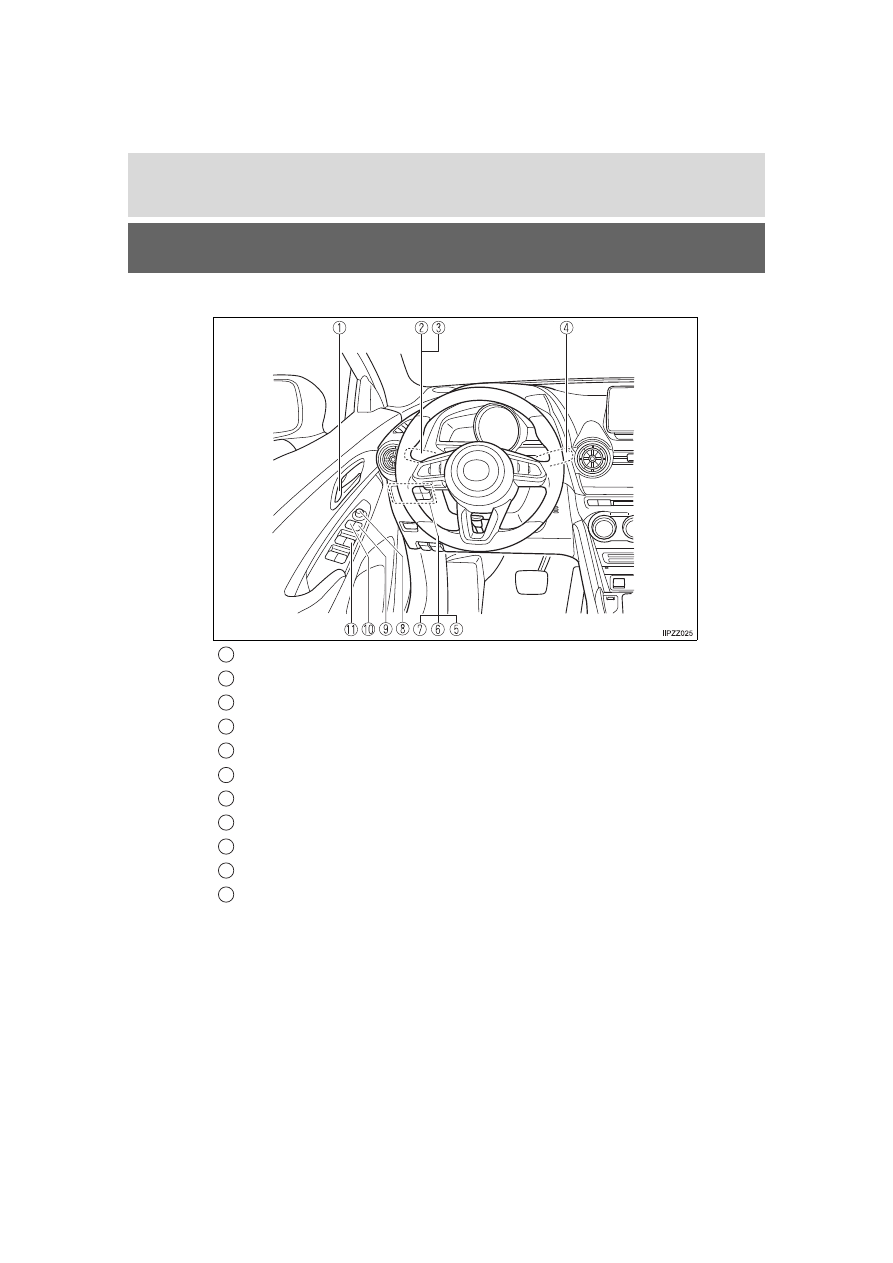
Interior Equipment (View A)

Door-lock knob  . . . . . . . . . . . . . . . . . . . . . . . . . . . . . . . . . . .  P. 111

Turn and lane-change signal  . . . . . . . . . . . . . . . . . . . . . . . . P. 199

Lighting control . . . . . . . . . . . . . . . . . . . . . . . . . . . . . . . . . . . P. 192

Wiper and washer lever. . . . . . . . . . . . . . . . . . . . . . . . . . . . . P. 201

DSC OFF switch. . . . . . . . . . . . . . . . . . . . . . . . . . . . . . . . . . . P. 219

Tire pressure monitoring system set switch  . . . . . . . . . P. 244
Low Speed Pre-Collision System OFF switch  . . . . . . . . . . P. 233

Outside mirror switch . . . . . . . . . . . . . . . . . . . . . . . . . . . . . . P. 129

Door-lock switch . . . . . . . . . . . . . . . . . . . . . . . . . . . . . . . . . . P. 107

Power window lock switch . . . . . . . . . . . . . . . . . . . . . . . . . . P. 133

Power window switches . . . . . . . . . . . . . . . . . . . . . . . . . . . . P. 132

1

2

3

4

5

6

7

8

9

10

11

-------------------------------------------------------------------------------------------------------------------------------------------------------------

13

Pictorial index

YARIS_YARIS HATCHBACK_OM_OM99V59z_(U)

Audio control switches . . . . . . . . . . . . . . . . . . . . . . . . . . . . . P. 304

Combination meter  . . . . . . . . . . . . . . . . . . . . . . . . . . . . . . . . P. 164

Dashboard illumination knob . . . . . . . . . . . . . . . . . . . . . . . . P. 169

Cruise control switches  . . . . . . . . . . . . . . . . . . . . . . . . . . . . P. 236

Hazard warning flasher switch . . . . . . . . . . . . . . . . . . . . . . . P. 208

Push button start . . . . . . . . . . . . . . . . . . . . . . . . . . . . . . . . . . P. 156

Lock release lever . . . . . . . . . . . . . . . . . . . . . . . . . . . . . . . . . P. 127

Hood release handle . . . . . . . . . . . . . . . . . . . . . . . . . . . . . . . P. 392

Remote fuel-filler lid release. . . . . . . . . . . . . . . . . . . . . . . . . P. 125

Trunk release button . . . . . . . . . . . . . . . . . . . . . . . . . . . . . . .  P. 115

The equipment and installation position varies by vehicle

1

2

3

4

5

6

7

8

9

10

-------------------------------------------------------------------------------------------------------------------------------------------------------------

14

Pictorial index

YARIS_YARIS HATCHBACK_OM_OM99V59z_(U)

Interior Equipment (View B)

SRS air bags. . . . . . . . . . . . . . . . . . . . . . . . . . . . . . . . . . . . . . . P. 66

Climate control system . . . . . . . . . . . . . . . . . . . . . . . . . . . . . P. 256

Rear window defogger switch  . . . . . . . . . . . . . . . . . . . . . . . P. 207

Audio system . . . . . . . . . . . . . . . . . . . . . . . . . . . . . . . . . . . . . P. 271

Seat warmer switches . . . . . . . . . . . . . . . . . . . . . . . . . . . . . . . P. 24

Accessory socket  . . . . . . . . . . . . . . . . . . . . . . . . . . . . . . . . . P. 378

External input terminal . . . . . . . . . . . . . . . . . . . . . . . . . . . . . P. 307

Drive selection switch . . . . . . . . . . . . . . . . . . . . . . . . . . . . . . P. 224

Shift lever/Selector lever. . . . . . . . . . . . . . . . . . . . . . . . P. 177, 181

Fuse block (Left side) . . . . . . . . . . . . . . . . . . . . . . . . . . . . . . P. 435

1

2

3

4

5

6

7

8

9

10

-------------------------------------------------------------------------------------------------------------------------------------------------------------

15

Pictorial index

YARIS_YARIS HATCHBACK_OM_OM99V59z_(U)

Interior Equipment (View C)

Seat belts . . . . . . . . . . . . . . . . . . . . . . . . . . . . . . . . . . . . . . . . . P. 33

SRS air bag. . . . . . . . . . . . . . . . . . . . . . . . . . . . . . . . . . . . . . . . P. 66

Bottle holder. . . . . . . . . . . . . . . . . . . . . . . . . . . . . . . . . . . . . . P. 380

Sunvisor . . . . . . . . . . . . . . . . . . . . . . . . . . . . . . . . . . . . . . . . . P. 374

Vanity mirror. . . . . . . . . . . . . . . . . . . . . . . . . . . . . . . . . . . . . . P. 374

Overhead lights . . . . . . . . . . . . . . . . . . . . . . . . . . . . . . . . . . . P. 375

Rearview mirror . . . . . . . . . . . . . . . . . . . . . . . . . . . . . . . . . . . P. 130

Glove compartment . . . . . . . . . . . . . . . . . . . . . . . . . . . . . . . . P. 382

Commander switch . . . . . . . . . . . . . . . . . . . . . . . . . . . . . . . . P. 283

Parking brake . . . . . . . . . . . . . . . . . . . . . . . . . . . . . . . . . . . . . P. 210

Cup holders . . . . . . . . . . . . . . . . . . . . . . . . . . . . . . . . . . . . . . P. 379

Front seat . . . . . . . . . . . . . . . . . . . . . . . . . . . . . . . . . . . . . . . . . P. 23

Rear seat. . . . . . . . . . . . . . . . . . . . . . . . . . . . . . . . . . . . . . . . . . P. 26

The equipment and installation position varies by vehicle

1

2

3

4

5

6

7

8

9

10

11

12

13

-------------------------------------------------------------------------------------------------------------------------------------------------------------

16

Pictorial index

YARIS_YARIS HATCHBACK_OM_OM99V59z_(U)

Exterior Overview

4-Door

Hood . . . . . . . . . . . . . . . . . . . . . . . . . . . . . . . . . . . . . . . . . . . . P. 392

Windshield wiper blades . . . . . . . . . . . . . . . . . . . . . . . . . . . . P. 404

Door and key  . . . . . . . . . . . . . . . . . . . . . . . . . . . . . . . . . . . . . P. 103

Fuel-filler lid . . . . . . . . . . . . . . . . . . . . . . . . . . . . . . . . . . . . . . P. 124

Wheels and Tires . . . . . . . . . . . . . . . . . . . . . . . . . . . . . . . . . . P. 413

Exterior lights. . . . . . . . . . . . . . . . . . . . . . . . . . . . . . . . . . . . . P. 419

Trunk lid . . . . . . . . . . . . . . . . . . . . . . . . . . . . . . . . . . . . . . . . .  P. 115

Child safety lock  . . . . . . . . . . . . . . . . . . . . . . . . . . . . . . . . . .  P. 112

Outside mirror . . . . . . . . . . . . . . . . . . . . . . . . . . . . . . . . . . . . P. 129

The equipment and installation position varies by vehicle

1

2

3

4

5

6

7

8

9

-------------------------------------------------------------------------------------------------------------------------------------------------------------

17

Pictorial index

YARIS_YARIS HATCHBACK_OM_OM99V59z_(U)

5-Door

Hood . . . . . . . . . . . . . . . . . . . . . . . . . . . . . . . . . . . . . . . . . . . . P. 392

Windshield wiper blades . . . . . . . . . . . . . . . . . . . . . . . . . . . . P. 404

Door and key  . . . . . . . . . . . . . . . . . . . . . . . . . . . . . . . . . . . . . P. 103

Fuel-filler lid . . . . . . . . . . . . . . . . . . . . . . . . . . . . . . . . . . . . . . P. 124

Wheels and Tires . . . . . . . . . . . . . . . . . . . . . . . . . . . . . . . . . . P. 413

Exterior lights. . . . . . . . . . . . . . . . . . . . . . . . . . . . . . . . . . . . . P. 419

Rear window wiper blade . . . . . . . . . . . . . . . . . . . . . . . . . . . P. 406

Liftgate . . . . . . . . . . . . . . . . . . . . . . . . . . . . . . . . . . . . . . . . . .  P. 115

Antenna  . . . . . . . . . . . . . . . . . . . . . . . . . . . . . . . . . . . . . . . . . P. 271

Child safety lock  . . . . . . . . . . . . . . . . . . . . . . . . . . . . . . . . . .  P. 112

Outside mirror . . . . . . . . . . . . . . . . . . . . . . . . . . . . . . . . . . . . P. 129

The equipment and installation position varies by vehicle

1

2

3

4

5

6

7

8

9

10

11

-------------------------------------------------------------------------------------------------------------------------------------------------------------

18

Pictorial index

YARIS_YARIS HATCHBACK_OM_OM99V59z_(U)

-------------------------------------------------------------------------------------------------------------------------------------------------------------

19

YARIS_YARIS HATCHBACK_OM_OM99V59z_(U)

Essential Safety

Equipment

1

1-1. Seats

Seat Precautions................. 20
Front Seat ........................... 23
Rear Seat............................ 26
Head Restraints .................. 30

1-2. Seat Belt Systems

Seat Belt Precautions ......... 33
Seat Belt ............................. 37
Seat Belt Pretensioner 

and Load Limiting 
Systems ............................ 39

Seat Belt Extender .............. 42

1-3. Child Restraint

Child-Restraint 

Precautions....................... 44

Child-Restraint System 

Installation......................... 49

Installing Child-Restraint 

Systems ............................ 51

1-4. SRS Air Bags

Supplemental Restraint 

System (SRS) 
Precautions....................... 66

Supplemental Restraint 

System Components ........ 73

How the SRS Air Bags 

Work ................................. 74

SRS Air Bag Deployment 

Criteria .............................. 78

Limitations to 

SRS Air Bag...................... 80

Front Passenger 

Occupant Classification 
System.............................. 82

Constant Monitoring............ 87

-------------------------------------------------------------------------------------------------------------------------------------------------------------

20

YARIS_YARIS HATCHBACK_OM_OM99V59z_(U)

1-1. Seats

Seat Precautions

When returning a rear seat to its original position, place the seat belt
in its normal position. Verify that the seat belt pulls out and retracts.

WARNING

Make sure the adjustable components of a seat are locked in place

Adjustable seats and seatbacks that are not securely locked are dangerous.
In  a  sudden  stop  or  collision,  the  seat  or  seatback  could  move,  causing
injury. Make sure the adjustable components of the seat are locked in place
by attempting to slide the seat forward and backward and rocking the seat-
back.

Never allow children to adjust a seat

Allowing children to adjust a seat is dangerous as it could result in serious
injury if a child’s hands or feet become caught in the seat.

Do not drive with the seatback unlocked

All of the seatbacks play an important role in your protection in a vehicle.
Leaving the seatback unlocked is dangerous as it can allow passengers to
be ejected or thrown around and baggage to strike occupants in a sudden
stop  or  collision,  resulting  in  severe  injury. After  adjusting  the  seatback  at
any time, even when there are no other passengers, rock the seatback to
make sure it is locked in place.

Adjust a seat only when the vehicle is stopped

If the seat is adjusted while the vehicle is being driven, the seating posture
may become unstable  and  the seat could move unexpectedly resulting in
injury.

Do not modify or replace the front seats

Modifying or replacing the front seats such as replacing the upholstery or
loosening any bolts is dangerous. The front seats contain air bag compo-
nents  essential  to  the  supplemental  restraint  system.  Such  modifications
could damage the supplemental restraint system and result in serious injury.
Consult your Toyota dealer  if there is any  need to  remove  or  reinstall  the
front seats.

Do not drive with damaged front seats

Driving with damaged front seats, such as seat cushions torn or damaged
down  to  the  urethane,  is  dangerous.  A  collision,  even  one  not  strong
enough to inflate the air bags, could damage the front seats which contain
essential  air  bag  components.  If  there  was  a  subsequent  collision,  an  air
bag may not deploy which could lead to injuries. Always have your Toyota
dealer  inspect  the  front  seats,  front  seat  belt  pretensioners  and  air  bags
after a collision.

-------------------------------------------------------------------------------------------------------------------------------------------------------------

YARIS_YARIS HATCHBACK_OM_OM99V59z_(U)

21

1-1. Seats

1

Essential 

Safety E

quipm

e

nt

WARNING

Do not drive with either front seats reclined

Sitting  in  a  reclined  position  while  the  vehicle  is  moving  is  dangerous
because you do not get the full protection from seat belts. During sudden
braking  or  a  collision,  you  can  slide  under  the  lap  belt  and  suffer  serious
injuries. For maximum protection, sit well back and upright.

Do  not  place  an  object such as  a cushion between  the  seatback  and
your back

Putting an object such as a cushion between the seatback and your back is
dangerous  because  you  will  be  unable  to  maintain  a  safe  driving  posture
and  the  seat  belt  cannot  function  at  its  full  capacity  in  a  collision,  which
could result in a serious accident, injury or death.

Do not place objects under the seat

The object could get stuck and cause the seat to not be fixed securely, and
result in an accident.

Do not stack cargo higher than the seatbacks

Stacking  luggage  or  other  cargo  higher  than  the  seatbacks  is  dangerous.
During  sudden  braking  or  a  collision,  objects  can  fly  around  and  become
projectiles that may hit and injure passengers.

Make sure luggage and cargo is secured before driving

Not  securing  cargo  while  driving  is  dangerous  as  it  could  move  or  be
crushed during sudden braking or a collision and cause injury.

Never allow a passenger to sit or stand on the folded seatback while
the vehicle is moving

Driving with a passenger on the folded seatback is dangerous. Allowing a
child to sit up on the folded seatback while the vehicle is moving is particu-
larly dangerous. In a sudden stop or even a minor collision, a child not in a
proper seat or child-restraint system and seat belt could be thrown forward,
back  or  even  out  of  the  vehicle  resulting  in  serious  injuries  or  death. The
child in the baggage area could be thrown into other occupants and cause
serious injury.

Never give the car keys to children and do not allow them to play in the
vehicle

Playing  with  the  folding  rear  seats  is  dangerous.  Once  the  seatbacks  are
back up, a child in the trunk would not be able to get out the way they had
entered. If you have small children, keep the seatbacks locked.

-------------------------------------------------------------------------------------------------------------------------------------------------------------

22

YARIS_YARIS HATCHBACK_OM_OM99V59z_(U)

1-1. Seats

WARNING

Always leave your car locked and keep the car keys safely away from
children

Leaving  your  car  unlocked  or  the  keys  in  reach  of  children  is  dangerous.
Children  who  find  their  way  into  the  trunk  through  an  unlocked  rear  seat-
back  or  an  open  trunk  can  become  accidentally  locked  in  the  trunk. This
could result in death or brain damage from heat prostration, particularly in
the summer. Always lock the doors and the trunk, and as an added mea-
sure,  keep  the  rear  seatbacks  locked,  whether  you  have  children  in  your
home or not.

When operating a seat

When operating a seat, be careful not to put your hands or fingers near the
moving parts of the seat or on the side trim to prevent injury.

When moving the seats forward and rearward or returning a rear-reclined
seatback to its upright position, make sure you hold onto the seatback with
your hand while operating. If the seatback is not held, the seat will move
suddenly and could cause injury.

When  inserting  your  hand  under  the  seat  to  clean  the  cabin  or  pick  up
something you dropped under the seat, be careful not to hurt yourself. If
you contact the moving parts of the seat rail or seat frame, it could result in
injury.

NOTICE

When  moving  the  seats,  make  sure  there  is  no  cargo  in  the  surrounding
area. If the cargo gets caught it could damage the cargo.

-------------------------------------------------------------------------------------------------------------------------------------------------------------

23

YARIS_YARIS HATCHBACK_OM_OM99V59z_(U)

1-1. Seats

1

Essential 

Safety E

quipm

e

nt

Front Seat

Seat Slide

To move a seat forward or backward, raise the lever and slide the seat to
the desired position and release the lever.
Make sure the lever returns to its original position and the seat is locked in
place by attempting to push it forward and backward.

Height Adjustment (Driver’s Seat)

To adjust the seat height, move the lever up or down.

Seat Recline

To change the seatback angle, lean forward slightly while raising the lever.
Then lean back to the desired position and release the lever.
Make  sure  the  lever  returns  to  its  original  position  and  the  seatback  is
locked in place by attempting to push it forward and backward.

Seat Operation

1

2

3

-------------------------------------------------------------------------------------------------------------------------------------------------------------

24

YARIS_YARIS HATCHBACK_OM_OM99V59z_(U)

1-1. Seats

The front seats are electrically heated. The ignition must be switched
ON.
Press  the  seat  warmer  switch  to
illuminate  the  indicator  light  while
the  ignition  is  switched  ON.  The
mode  changes  as  follows  each
time  the  seat  warmer  switch  is
pressed.

OFF
High
Mid
Low

If the ignition is switched off while the seat warmer is operating (High, Mid or
Low) and then switched ON again, the seat warmer will automatically oper-
ate at the temperature set before switching off the ignition.

Use the seat warmer when the engine is running. Leaving the seat warmer
on  for  long  periods  with  the  engine  not  running  could  cause  the  battery
power to be depleted.

The temperature of the seat warmer cannot be adjusted beyond High, Mid
and Low because the seat warmer is controlled by a thermostat.

Seat Warmer (if equipped)

1

2

3

4

WARNING

Be careful when using the seat warmer

The heat  from the seat  warmer may be  too hot for some people, as  indi-
cated below, and could cause a low-temperature burn.

Infants, small babies, elderly people, and physically challenged people

People with delicate skin

People who are excessively fatigued

People who are intoxicated

People who have taken sleep-inducing medicine such as sleeping pills or
cold medicine

Do not use the seat warmer with anything having high moisture-reten-
tion ability such as a blanket or cushion on the seat

The seat may be heated excessively and cause a low-temperature burn.

-------------------------------------------------------------------------------------------------------------------------------------------------------------

YARIS_YARIS HATCHBACK_OM_OM99V59z_(U)

25

1-1. Seats

1

Essential 

Safety E

quipm

e

nt

WARNING

Do not use the seat warmer even when taking a short nap in the vehicle

The seat may be heated excessively and cause a low-temperature burn.

Do not place heavy objects with sharp projections on the seat, or insert
needles or pins into it

This could cause the seat to become excessively heated and result in injury
from a minor burn.

NOTICE

Do not use solvents to clean the seat. It may damage the seat surface and
the heater.

-------------------------------------------------------------------------------------------------------------------------------------------------------------

26

YARIS_YARIS HATCHBACK_OM_OM99V59z_(U)

1-1. Seats

Rear Seat

By lowering the rear seatbacks the luggage compartment space can
be expanded.

Split Folding the Seatback

WARNING

Do not drive the vehicle with occupants on folded down seatbacks or
in the luggage compartment.

Putting occupants in the luggage compartment is dangerous because seat
belts cannot be fastened which could lead to serious injury or death during
sudden braking or a collision.

Do not allow children to play inside the vehicle with the seatbacks low-
ered.

Allowing  children to play in the vehicle  with the seatbacks  folded down is
dangerous.  If  a  child  enters  the  luggage  compartment  and  the  seatbacks
were  raised  back  up,  the  child  may  become  trapped  in  the  luggage  com-
partment which could lead to an accident.

Tightly  secure  cargo  in  the  luggage  compartment  when  it  is  trans-
ported with the seatbacks folded down.

Driving without tightly securing cargo and luggage is dangerous as it could
move and become an obstruction to driving during emergency braking or a
collision resulting in an unexpected accident.

When transporting cargo, do not allow the cargo to exceed the height
of the seatbacks.

Transporting cargo stacked higher than the seatbacks is dangerous as visi-
bility to the  rear and sides of the vehicle is reduced which could interfere
with driving operations and lead to an accident.

-------------------------------------------------------------------------------------------------------------------------------------------------------------

YARIS_YARIS HATCHBACK_OM_OM99V59z_(U)

27

1-1. Seats

1

Essential 

Safety E

quipm

e

nt

4-Door
Lower the head restraint all the way down.
Refer to Head Restraints on P. 30.
Open  the  trunk  lid  and  pull  the
lever of the seatback you want
to fold down.

Open a rear door and fold the rear seat forward.

5-Door
Lower the head restraint all the way down. 
Refer to Head Restraints on P. 30
Press  the  push  knob  to  fold
down the seatback you want to
fold down.

Secure the rear seat belt in the belt clip.

Lowering the seatbacks

1

2

3

1

2

3

Belt clip

-------------------------------------------------------------------------------------------------------------------------------------------------------------

28

YARIS_YARIS HATCHBACK_OM_OM99V59z_(U)

1-1. Seats

4-Door

Make  sure  that  the  seat  belt
passes  through  the  seat  belt
guide  correctly  and  it  is  not
twisted, then raise the seatback
while  preventing  the  seat  belt
from  being  caught  in  the  seat-
back.

Press the seatback rearward and lock it in place. After returning the
seatback to its upright position, make sure it is securely locked.

5-Door

Verify  that  the  seat  belt  is
secured in the belt clip.

Lift the seatback upright.
Press the seatback rearward and lock it in place. After returning the
seatback to its upright position, make sure it is securely locked.
Make  sure  that  the  seat  belt  is  neither  stuck  in  the  rear  seat  nor
twisted, then remove the seat belt from the belt clip.

NOTICE

5-Door: When folding the seatback forward, always support the seatback
with your hand. If it is not supported by a hand, fingers or the hand press-
ing the push knob could be injured.

Check the position of a front seat before folding a rear seatback.
Depending on the position of a front seat, it may not be possible to fold a
rear seatback all the way down because it may hit the seatback of the front
seat which could scratch or damage the front seat or its pocket. Lower or
remove the head restraint on the rear outboard seat if necessary.

To return the seatback to its upright position

Seat belt guide

1

2

Belt clip

1

2

3

4

-------------------------------------------------------------------------------------------------------------------------------------------------------------

YARIS_YARIS HATCHBACK_OM_OM99V59z_(U)

29

1-1. Seats

1

Essential 

Safety E

quipm

e

nt

WARNING

When  returning  a  seatback  to  its  upright  position,  make  sure  the  3-
point seat belt is not caught in the seatback and the 3-point seat belt is
not twisted.

If the seat belt is used while it is twisted and caught in the seatback, the
seat  belt  cannot  function  at  its  full  capacity,  which  could  cause  serious
injury or death.

When returning a seatback to its upright position, make sure that it is firmly
locked and the red indication is not visible (5-Door).

If the red indication is visible behind the
push knob, it means the seatback is not
locked.  If  the  vehicle  is  driven  without
the seatback locked, it could fold down
suddenly and cause an accident.

Locked position

Unlocked position
Red indication

-------------------------------------------------------------------------------------------------------------------------------------------------------------

30

YARIS_YARIS HATCHBACK_OM_OM99V59z_(U)

1-1. Seats

Head Restraints

Adjust  the  head  restraint  so  that
the center is even with the top of
the passenger’s ears.

To raise a head restraint, pull it up to the desired position.
To lower the head restraint, press the stop-catch release, then push
the head restraint down.

Front seats

Your  vehicle  is  equipped  with  head  restraints  on  all  outboard
seats and the rear center seat. The head restraints are intended
to help protect you and the passengers from neck injury.

WARNING

Always  drive  with  the  head  restraints  installed  when  seats  are  being
used  and  make  sure  they  are  properly  adjusted.  In  addition,  always
raise the head restraints on all rear seats when they are being used

Driving with the head restraints adjusted too low or removed is dangerous.
With no support behind your head, your neck could be seriously injured in a
collision.

Height Adjustment

-------------------------------------------------------------------------------------------------------------------------------------------------------------

YARIS_YARIS HATCHBACK_OM_OM99V59z_(U)

31

1-1. Seats

1

Essential 

Safety E

quipm

e

nt

Rear outboard seats 

Rear center seat

To remove the head restraint, pull it up while pressing the stop-catch.
To install the head restraint, insert the legs into the holes while press-
ing the stop-catch.

Removal/Installation

-------------------------------------------------------------------------------------------------------------------------------------------------------------

32

YARIS_YARIS HATCHBACK_OM_OM99V59z_(U)

1-1. Seats

WARNING

Always  drive  with  the  head  restraints  installed  when  seats  are  being
used and make sure they are properly installed

Driving with the head restraints not installed is dangerous. With no support
behind your head, your neck could be seriously injured in a collision.

When installing a head restraint, make sure that it is installed correctly with
the  front  of  the  head  restraint  facing  forward.  If  the  head  restraint  is
installed  incorrectly,  it  could  detach  from  the  seat  during  a  collision  and
result in injury.

The head restraints on each of the front and rear seats are specialized to
each  seat.  Do  not  switch  around  the  head  restraint  positions.  If  a  head
restraint is not installed to its correct seat position, the effectiveness of the
head  restraint during  a  collision will be  compromised which could  cause
injury.

After installing a head restraint, try lifting it to make sure that it does
not pull out

Driving with an unsecured head restraint is dangerous as the effectiveness
of the head restraint will be compromised which could cause it to unexpect-
edly detach from the seat.

-------------------------------------------------------------------------------------------------------------------------------------------------------------

33

YARIS_YARIS HATCHBACK_OM_OM99V59z_(U)

1-2. Seat Belt Systems

1

Essential 

Safety E

quipm

e

nt

Seat Belt Precautions

All  of  the  seat  belt  retractors  are  designed  to  keep  the  lap/shoulder
belts out of the way when not in use.
The driver’s seat belt has no provisions for child-restraint systems and
has only an emergency locking mode. The driver may wear it comfort-
ably, and it will lock during a collision.
However,  the  front  passenger’s  seat  and  all  rear  lap/shoulder  belt
retractors  operate  in  two  modes:  emergency  locking  mode,  and  for
child-restraint  systems,  automatic  locking  mode.  While  we  recom-
mend you put all children in the rear seats, if you must use the front
passenger seat for a child, slide the front passenger seat as far back
as possible and make sure any child-restraint system is secured prop-
erly.

Seat  belts  help  to  decrease  the  possibility  of  severe  injury
during  accidents  and  sudden  stops.  Toyota  recommends  that
the driver and all passengers always wear seat belts.

WARNING

Always wear your seat belt and make sure all occupants are properly
restrained

Not  wearing  a  seat  belt  is  extremely  dangerous.  During  a  collision,  occu-
pants not wearing seat belts could hit someone or things inside the vehicle
or  even  be  thrown  out  of  the  vehicle.  They  could  be  seriously  injured  or
even  killed.  In  the  same  collision,  occupants  wearing  seat  belts  would  be
much safer.

-------------------------------------------------------------------------------------------------------------------------------------------------------------

34

YARIS_YARIS HATCHBACK_OM_OM99V59z_(U)

1-2. Seat Belt Systems

WARNING

Do not wear twisted seat belts

Twisted seat belts are dangerous. In a collision, the full width of the belt is
not  available  to  absorb  the  impact.  This  puts  more  force  on  the  bones
beneath the belt, which could cause serious injury or death. So, if your seat
belt is twisted, you must straighten the seat belt to remove any twists and to
allow the full width of the belt to be used.

Never use one seat belt on more than one person at a time

Using one seat belt for more than one person at a time is dangerous. A seat
belt used in this way cannot spread the impact forces properly and the two
passengers could be crushed together and seriously injured or even killed.
Never use one belt for more than one person at a time and always operate
the vehicle with each occupant properly restrained.

Do not operate a vehicle with a damaged seat belt

Using  a  damaged  seat  belt  is  dangerous. An  accident  could  damage  the
belt  webbing  of  the  seat  belt  in  use. A  damaged  seat  belt  cannot  provide
adequate protection in a collision. Have your Toyota dealer inspect all seat
belt systems in use during an accident before they are used again.

Have your seat belts changed immediately if the pretensioner or load
limiter has been expended

Always have your Toyota dealer immediately inspect the seat belt preten-
sioners and air bags after any collision. Like the air bags, the seat belt pre-
tensioners  and  load  limiters  will  only  function  once  and  must  be  replaced
after any collision that caused them to deploy. A seat belt with an expended
pretensioner  or  load  limiter  is  still  better  than  wearing  no  seat  belt  at  all;
however, if the seat belt pretensioners and load limiters are not replaced,
the risk of injury in a collision will increase.

Positioning the Shoulder Portion of the Seat Belt

Improper positioning of the shoulder portion of the seat belt is dangerous.
Always make sure the shoulder portion of the seat belt is positioned across
your shoulder and near your neck, but never under your arm, on your neck,
or on your upper arm.

Positioning the Lap Portion of the Seat Belt

The lap portion of the seat belt worn too high is dangerous. In a collision,
this  would  concentrate  the  impact  force  directly  on  the  abdominal  area,
causing serious injury. Wear the lap portion of the belt snugly and as low as
possible.

-------------------------------------------------------------------------------------------------------------------------------------------------------------

YARIS_YARIS HATCHBACK_OM_OM99V59z_(U)

35

1-2. Seat Belt Systems

1

Essential 

Safety E

quipm

e

nt

Pregnant women should always wear seat belts. Ask your doctor for
specific recommendations.
The  lap  belt  should  be  worn
SNUGLY AND AS LOW AS POS-
SIBLE  OVER  THE  HIPS.  The
shoulder  belt  should  be  worn
across your shoulder properly, but
never across the stomach area.

Persons with serious medical conditions also should wear seat belts.
Check with your doctor for any special instructions regarding specific
medical conditions.

NOTICE

Pregnant Women and Persons with Serious Medical Conditions

Belt retraction may become difficult if the
belts and rings are soiled, so try to keep
them  clean.  For  more  details  about
cleaning the seat belts, refer to “Cleaning
the Lap/Shoulder Belt Webbing” 
(

P. 453).

Ring

-------------------------------------------------------------------------------------------------------------------------------------------------------------

36

YARIS_YARIS HATCHBACK_OM_OM99V59z_(U)

1-2. Seat Belt Systems

When  the  seat  belt  is  fastened,  it  will  always  be  in  the  emergency
locking mode.
In the emergency locking mode, the belt remains comfortable on the
occupant and the retractor will lock in position during a collision.
If the belt is locked and cannot be pulled out, retract the belt once, and
then try pulling it out slowly. If this fails, pull the belt strongly one time
and loosen, then pull it out again slowly.
Seat Belt with Automatic Locking Mode: 
When  the  seat  belt  is  fastened,  it  will  always  be  in  the  emergency
locking mode until it is switched to automatic locking mode by pulling
it  all  the  way  out  to  its  full  length.  If  the  belt  feels  tight  and  hinders
comfortable  movement  while  the  vehicle  is  stopped  or  in  motion,  it
may  be  in  the  automatic  locking  mode  because  the  belt  has  been
pulled  too  far  out. To  return  the  belt  to  the  more  comfortable  emer-
gency locking mode, wait until the vehicle has stopped in a safe, level
area,  retract  the  belt  fully  to  convert  it  back  to  emergency  locking
mode and then extend it around you again.

Always  use  the  automatic  locking  mode  to  keep  the  child-restraint
system from shifting to an unsafe position in the event of an accident.
To enable seat belt automatic locking mode, pull it all the way out and
connect  it  as  instructed  on  the  child-restraint  system.  It  will  retract
down to the child-restraint system and stay locked on it. See the sec-
tion on child restraint (

P. 44).

Emergency Locking Mode

Automatic Locking Mode (if equipped)

-------------------------------------------------------------------------------------------------------------------------------------------------------------

37

YARIS_YARIS HATCHBACK_OM_OM99V59z_(U)

1-2. Seat Belt Systems

1

Essential 

Safety E

quipm

e

nt

Seat Belt

Position  the  lap  belt  as  low  as
possible,  not  on  the  abdominal
area, then adjust the shoulder belt
so  that  it  fits  snugly  against  your
body.

4-Door

Before  fastening  the  rear  seat
belt, make sure that the seat belt
passes  through  the  seat  belt
guide  correctly  and  it  is  not
twisted.

Fastening the Seat Belt

Seat belt 
tongue

Seat belt 
buckle

Too high

Take up slack

Keep low on 
hip bone

Seat belt guide

-------------------------------------------------------------------------------------------------------------------------------------------------------------

38

YARIS_YARIS HATCHBACK_OM_OM99V59z_(U)

1-2. Seat Belt Systems

Depress  the  button  on  the  seat
belt  buckle.  If  the  belt  does  not
fully  retract,  pull  it  out  and  check
for  kinks  or  twists.  Then  make
sure  it  remains  untwisted  as  it
retracts.

If  a  belt  does  not  fully  retract,  inspect  it  for  kinks  and  twists.  If  it  is  still  not
retracting properly, have it inspected at your Toyota dealer.

To raise
To lower

Make sure the adjuster is locked.

If it detects that the occupant seat belt is unfastened, the warning light
or beep alerts the occupant. 
Refer to Taking Action on P. 496.
Refer to Seat Belt Warning Beep on P. 503.

Unfastening the Seat Belt

Button

Front Shoulder Belt Adjuster

1

2

Seat Belt Warning Systems

-------------------------------------------------------------------------------------------------------------------------------------------------------------

39

YARIS_YARIS HATCHBACK_OM_OM99V59z_(U)

1-2. Seat Belt Systems

1

Essential 

Safety E

quipm

e

nt

Seat Belt Pretensioner and Load Limiting 

Systems

Pretensioners

When  a  collision is detected,  the  pretensioners deploy simultane-
ously with the air bags.
The pretensioners deploy simultaneously with the air bags when a
roll-over is also detected.
For deployment details, refer to the SRS Air Bag Deployment Crite-
ria (

P. 78).

The front seat belt retractors remove slack quickly as the air bags
are  expanding. Any time  the  air  bags  and  seat belt  pretensioners
have fired they must be replaced.
A  system  malfunction  or  operation  conditions  are  indicated  by  a
warning.
Refer to Warning/Indicator Lights on P. 173.
Refer  to  Air  Bag/Front  Seat  Belt  Pretensioner  System  Warning
Beep on P. 503.
In addition, the pretensioner system for the front passenger, like the
front and side passenger air bag, is designed to only deploy when
the  front  passenger  occupant  classification  sensor  detects  a  pas-
senger sitting on the front passenger’s seat.
For details, refer to the front passenger occupant classification sen-
sor (

P. 82).

For  optimum  protection,  the  driver  and  front  passenger  seat
belts are equipped with pretensioner and load limiting systems.
For both these systems to work properly you must wear the seat
belt properly.

-------------------------------------------------------------------------------------------------------------------------------------------------------------

40

YARIS_YARIS HATCHBACK_OM_OM99V59z_(U)

1-2. Seat Belt Systems

Load limiter

The load limiting system releases belt webbing in a controlled man-
ner  to  reduce  belt  force  on  the  occupant’s  chest.  While  the  most
severe load on a seat belt occurs in frontal collisions, the load lim-
iter has an automatic mechanical function and can activate in any
accident mode with sufficient occupant movement.
Even if the pretensioners have not fired, the load limiting function
must be checked by your Toyota dealer.

The pretensioner system may not operate depending on the type of the col-
lision. For details, refer to the SRS Air Bag Deployment Criteria (

P. 78)

Some smoke (non-toxic gas) will be released when the air bags and preten-
sioners deploy. This does not indicate a fire. This gas normally has no effect
on occupants, however, those with sensitive skin may experience light skin
irritation. If residue from the deployment of the air bags or the front preten-
sioner system gets on the skin or in the eyes, wash it off as soon as possi-
ble.

-------------------------------------------------------------------------------------------------------------------------------------------------------------

YARIS_YARIS HATCHBACK_OM_OM99V59z_(U)

41

1-2. Seat Belt Systems

1

Essential 

Safety E

quipm

e

nt

WARNING

Wear seat belts only as recommended in this owner’s manual

Incorrect positioning of the driver and front passenger seat belts is danger-
ous. Without proper positioning, the pretensioner and load limiting systems
cannot provide adequate protection in an accident and this could result in
serious injury. For more details about wearing seat belts, refer to “Fastening
the seat belts” (

P. 37).

Have your seat belts changed immediately if the pretensioner or load
limiter has been expended

Always have your Toyota dealer immediately inspect the seat belt preten-
sioners and air bags after any collision. Like the air bags, the seat belt pre-
tensioners  and  load  limiters  will  only  function  once  and  must  be  replaced
after any collision that caused them to deploy. A seat belt with an expended
pretensioner  or  load  limiter  is  still  better  than  wearing  no  seat  belt  at  all;
however, if the seat belt pretensioners and load limiters are not replaced,
the risk of injury in a collision will increase.

Do  not  modify  the  components  or  wiring,  or  use  electronic  testing
devices on the pretensioner system

Modifying  the  components  or  wiring  of  the  pretensioner  system,  including
the  use of electronic testing  devices is dangerous. You  could accidentally
activate it or make it inoperable which would prevent it from activating in an
accident. The occupants or repairers could be seriously injured.

Properly dispose of the pretensioner system

Improper disposal of the pretensioner system or a vehicle with non-deacti-
vated  pretensioners  is  dangerous.  Unless  all  safety  procedures  are  fol-
lowed,  injury  could  result.  Have  your  Toyota  dealer  safely  dispose  of  the
pretensioner system or scrap a pretensioner system equipped vehicle.

-------------------------------------------------------------------------------------------------------------------------------------------------------------

42

YARIS_YARIS HATCHBACK_OM_OM99V59z_(U)

1-2. Seat Belt Systems

Seat Belt Extender

This  extender  will  be  only  for  you  and  for  the  particular  vehicle  and
seat. Even if it plugs into other seat belts, it may not hold in the critical
moment of a crash.
When ordering an extender, only order one that provides the neces-
sary additional length to fasten the seat belt properly. 
Please contact your Toyota dealer for more information.

When not in use, remove the seat belt extender and store it in the vehicle. If
the seat belt extender is left connected, the seat belt extender might get dam-
aged as it will not retract with the rest of the seat belt and can easily fall out of
the door when not in use and be damaged. In addition, the seat belt warning
light will not illuminate and function properly.

If your seat belt is not long enough, even when fully extended, a
seat  belt  extender  may  be  available  to  you  at  no  charge  from
your Toyota dealer.

WARNING

Do not use a seat belt extender unless it is necessary

Using a seat belt extender when not necessary is dangerous. The seat belt
will be too long and not fit properly. In an accident, the seat belt will not pro-
vide adequate protection and you could be seriously injured. Only use the
extender when it is required to fasten the seat belt properly.

Do not use an improper extender

Using a seat belt extender that is for another person or a different vehicle or
seat is dangerous. The seat belt will not provide adequate protection and
the  user  could  be  seriously  injured  in  an  accident.  Only  use  the  extender
provided  for  you  and  for  the  particular  vehicle  and  seat.  NEVER  use  the
extender in a different vehicle or seat. If you sell your Toyota, do not leave
your seat belt extender in the vehicle. It could be used accidentally by the
new owner of the vehicle. After removing the seat belt extender, discard it.
Never use the seat belt extender in any other vehicle you may own in the
future.

-------------------------------------------------------------------------------------------------------------------------------------------------------------

YARIS_YARIS HATCHBACK_OM_OM99V59z_(U)

43

1-2. Seat Belt Systems

1

Essential 

Safety E

quipm

e

nt

WARNING

Do not use an extender that is too long

Using  an  extender  that  is  too  long  is  dangerous. The  seat  belt  will  not  fit
properly. In an accident, the seat belt will not provide adequate protection
and you could be seriously injured. Do not use the extender or choose one
shorter in length if the distance between the extender’s buckle and the cen-
ter of the user’s body is less than 6 in. (150 mm).

Do not leave a seat belt extender connected to the buckle

Leaving a seat belt extender connected to the buckle without using the seat
belt is dangerous. When the seat belt extender is connected to the driver’s
seat belt buckle (or front passenger’s seat belt buckle), the SRS driver’s (or
front passenger’s) air bag system will determine that the driver (or front pas-
senger) is wearing the seat belt even if the driver (or front passenger) is not
wearing it. This condition could cause the driver’s (or front passenger’s) air
bag to not activate correctly and result in death or serious injury in the event
of collision. Always wear the seat belt with the seat belt extender.

Do not use the seat belt extender when installing a child-restraint sys-
tem on the front or rear passenger seat

Using a seat belt extender to fasten a child-restraint system on any seat is
dangerous. Always follow the child-restraint system manufacturer’s installa-
tion instructions and never use a seat belt extender.

-------------------------------------------------------------------------------------------------------------------------------------------------------------

44

YARIS_YARIS HATCHBACK_OM_OM99V59z_(U)

1-3. Child Restraint

Child-Restraint Precautions

Whatever child-restraint system you consider, please pick the appro-
priate one for the age and size of the child, obey the law and follow
the instructions that come with the individual child-restraint system.
A child who has outgrown child-restraint systems should sit in the rear
and use seat belts, both lap and shoulder. If the shoulder belt crosses
the neck or face, move the child closer to the center of the vehicle in
the outboard seats, and towards the buckle on the right if the child is
seated on the center seat.
Statistics confirm that the rear seat is the best place for all children up
to 12 years of age, and more so with a supplemental restraint system
(air bags).
A  rear-facing  child-restraint  system  should  NEVER  be  used  on  the
front  seat  with  the  air  bag  system  activated.  The  front  passenger’s
seat is also the least preferred seat for other child-restraint systems.
To  reduce  the  chance  of  injuries  caused  by  deployment  of  the  front
passenger air bag, the front passenger occupant classification sensor
works  as  a  part  of  the  supplemental  restraint  system.  This  system
deactivates the front passenger front and side air bags and also the
front passenger seat belt pretensioner system when the front passen-
ger air bag deactivation indicator light illuminates.
When an infant or small child sits on the front passenger seat, the sys-
tem shuts off the front passenger front and side air bags and seat belt
pretensioner system, so make sure the front passenger air bag deac-
tivation indicator light illuminates.

Toyota strongly urges the use of child-restraint systems for chil-
dren small enough to use them.
You are required by law to use a child-restraint system for chil-
dren in the U.S. and Canada. 
Check  your  local  and  state  or  provincial  laws  for  specific
requirements  regarding  the  safety  of  children  riding  in  your
vehicle.

-------------------------------------------------------------------------------------------------------------------------------------------------------------

YARIS_YARIS HATCHBACK_OM_OM99V59z_(U)

45

1-3. Child Restraint

1

Essential 

Safety E

quipm

e

nt

Even if the front passenger air bag is shut off, Toyota strongly recom-
mends that children be properly restrained and child-restraint systems
of all kinds are properly secured on the rear seats which are the best
place for children.
For  more  details,  refer  to  “Front  passenger  occupant  classification
sensor” (

P. 82).

Your Toyota  is  equipped  with  LATCH  lower  anchors  for  attachment  of  spe-
cially designed LATCH child-restraint systems on the rear seats. When using
these  anchors  to  secure  a  child-restraint  system,  refer  to  “Using  LATCH
Lower Anchor” (

P. 61).

WARNING

Use the correct size child-restraint system

For effective protection in vehicle accidents and sudden stops, a child must
be properly restrained using a seat belt or child-restraint system depending
on age and size. If not, the child could be seriously injured or even killed in
an accident.

Follow  the  manufacturer’s  instructions  and  always  keep  the  child-
restraint system buckled down

An  unsecured  child-restraint  system  is  dangerous.  In  a  sudden  stop  or  a
collision it could move causing serious injury or death to the child or other
occupants.  Make  sure  any  child-restraint  system  is  properly  secured  in
place  according  to  the  child-restraint  system  manufacturer’s  instructions.
When not in use, remove it from the vehicle or fasten it with a seat belt, or
attach it to BOTH LATCH lower anchors for LATCH child-restraint systems
and the corresponding tether anchor.

Always secure a child in a proper child-restraint system

Holding a child in your arms while the vehicle is moving is extremely dan-
gerous. No  matter how  strong  the person  may be, he or she cannot  hold
onto a child in a sudden stop or collision and it could result in serious injury
or death to the child or other occupants. Even in a moderate accident, the
child may be exposed to air bag forces that could result in serious injury or
death to the child, or the child may be slammed into an adult, causing injury
to both child and adult.

-------------------------------------------------------------------------------------------------------------------------------------------------------------

46

YARIS_YARIS HATCHBACK_OM_OM99V59z_(U)

1-3. Child Restraint

WARNING

Never use a rear-facing child-restraint system in the front seat with an
air bag that could deploy

Do not install a front-facing child-restraint system on the front passen-
ger seat unless it is unavoidable

Rear-facing  child-restraint  systems  on
the  front seat are particularly dangerous
even though you may feel assured that a
front  passenger  air  bag  will  not  deploy
based  on  the  fact  that  the  front  passen-
ger  air  bag  deactivation  indicator  light
illuminates.  The  child-restraint  system
can  be  hit  by  a  deploying  air  bag  and
moved  violently  backward  resulting  in
serious injury or death to the child.

Vehicles  with  a  front  passenger  air  bag
have a warning label attached as shown
below. 
The warning label reminds you not to put
a  rear-facing  child-restraint  system  on
the front passenger seat at any time.

In a collision, the force of a deploying air
bag  could  cause  serious  injury  or  death
to  the  child.  If  installing  a  front-facing
child-restraint  system  on  the  front  pas-
senger  seat  is  unavoidable,  move  the
front passenger seat as far back as pos-
sible.

-------------------------------------------------------------------------------------------------------------------------------------------------------------

YARIS_YARIS HATCHBACK_OM_OM99V59z_(U)

47

1-3. Child Restraint

1

Essential 

Safety E

quipm

e

nt

WARNING

Seating a child in a child-restraint system on the front passenger seat
is dangerous under certain conditions

Your vehicle is equipped with front passenger occupant classification sen-
sor.  Even  with  the  front  passenger  occupant  classification  sensor,  if  you
must  use  the  front  passenger  seat  to  seat  a  child,  using  a  child-restraint
system  on  the  front  passenger  seat  under  the  following  conditions
increases  the  danger  of  the  front  passenger  air  bag  deploying  and  could
result in serious injury or death to the child.

The front passenger air bag deactivation indicator light does not illuminate
when seating a child in the child-restraint system.

Luggage or other items are placed on the seat with the child in the child-
restraint system.

A rear passenger or luggage pushing or pulling down on the front passen-
ger seatback.

Luggage or other items are placed on the seatback or hung on the head
restraint.

The seat is washed.

Liquids are spilled on the seat.

The  front  passenger  seat  is  moved  backward,  pushing  into  luggage  or
other items placed behind it.

The front passenger seatback contacts the rear seat.

Luggage or other items are placed between the front passenger seat and
driver seat.

An electric device is put on the front passenger’s seat.

An additional electrical device, such as a seat warmer is installed to the
surface of the front passenger seat.

The  designated  positions  with  seat  belts  on  the  rear  seats  are  the  safest
places for children. Always use seat belts and child restraints.

-------------------------------------------------------------------------------------------------------------------------------------------------------------

48

YARIS_YARIS HATCHBACK_OM_OM99V59z_(U)

1-3. Child Restraint

WARNING

Do not allow a child or anyone to lean over or against the side window
of a vehicle with side and curtain air bags

It is dangerous to allow anyone to lean over or against the side window, the
area of the front passenger seat, the front and rear window pillars and the
roof edge along both sides from which the side and curtain air bags deploy,
even if a child-restraint system is used. The impact of inflation from a side or
curtain air bag could cause serious injury or death to an out of position child.
Furthermore, leaning over or against the front door could block the side and
curtain air bags and eliminate the advantages of supplemental protection.
With the front air bag and the additional side air bag that comes out of the
front seat, the rear seat is always a better location for children. Take special
care not to allow a child to lean over or against the side window, even if the
child is seated in a child-restraint system.

Never use one seat belt on more than one person at a time

Using one seat belt for more than one person at a time is dangerous. A seat
belt used in this way cannot spread the impact forces properly and the two
passengers could be crushed together and seriously injured or even killed.
Never use one belt for more than one person at a time and always operate
the vehicle with each occupant properly restrained.

To prevent burns

A seat belt or child-restraint system can become very hot in a closed vehicle
during  warm  weather.  To  avoid  burning  yourself  or  a  child,  check  them
before you or your child touches them.

-------------------------------------------------------------------------------------------------------------------------------------------------------------

49

YARIS_YARIS HATCHBACK_OM_OM99V59z_(U)

1-3. Child Restraint

1

Essential 

Safety E

quipm

e

nt

Child-Restraint System Installation

In this owner’s manual, explanation of child-restraint systems is pro-
vided for the following three types of popular child-restraint systems:
infant seat, child seat, booster seat.

Child-Restraint System Types

Infant seat

Child seat

An  infant  seat  provides  restraint
by bracing the infant’s head, neck
and back against the seating sur-
face.

A  child  seat  restrains  a  child’s
body using the harness.

Booster seat

A booster seat is  a child restraint
accessory  designed  to  improve
the  fit  of  the  seat  belt  system
around the child’s body.

-------------------------------------------------------------------------------------------------------------------------------------------------------------

50

YARIS_YARIS HATCHBACK_OM_OM99V59z_(U)

1-3. Child Restraint

Installation  position  is  determined  by  the  type  of  child-restraint  system.
Always read the manufacturer’s instructions and this owner’s manual care-
fully.

Due to variations in the design of child-restraint systems, vehicle seats and
seat belts, all child-restraint systems may not fit all seating positions. Before
purchasing a child-restraint system, it should be tested in the specific vehi-
cle seating position (or positions) where it is intended to be used. If a previ-
ously  purchased  child-restraint  system  does  not  fit,  you  may  need  to
purchase a different one that will.

-------------------------------------------------------------------------------------------------------------------------------------------------------------

51

YARIS_YARIS HATCHBACK_OM_OM99V59z_(U)

1-3. Child Restraint

1

Essential 

Safety E

quipm

e

nt

Installing Child-Restraint Systems

Some  child-restraint  systems  now  come  with  tethers  and  therefore
must be installed on the seats that take tethers to be effective. In your
Toyota, tethered child-restraint systems can only be accommodated in
the three positions on the rear seat.
Some child-restraint systems also employ specially designed LATCH
attachments; refer to “Using LATCH Lower Anchor” (

P. 61).

Even if your vehicle is equipped with front passenger occupant classification
sensor (

P. 82), which automatically deactivates the front passenger air bag,

a rear seat is the safest place for a child of any age or size.

Accident  statistics  reveal  that  a  child  is  safer  in  the  rear  seat.
The  front  passenger’s  seat  is  clearly  the  worst  choice  for  any
child under 12, and with rear-facing child-restraint systems it is
clearly unsafe due to air bags.

WARNING

Tethered Child-Restraint Systems Work Only on Tether-Equipped Rear
Seats

Installation of a tether equipped child-restraint system in the front passen-
ger’s  seat  defeats  the  safety  design  of  the  system  and  will  result  in  an
increased chance of serious injury if the child-restraint system goes forward
without benefit of being tethered. 
Place  tether  equipped  child-restraint  systems  where  there  are  tether
anchors.

-------------------------------------------------------------------------------------------------------------------------------------------------------------

52

YARIS_YARIS HATCHBACK_OM_OM99V59z_(U)

1-3. Child Restraint

Anchor brackets for securing child-restraint systems are equipped in
the vehicle. Locate each anchor position using the illustration.
To install a child-restraint system, if the seat is equipped with a head
restraint, remove it. Always follow the instruction manual accompany-
ing the child-restraint system.

Anchor bracket location

Anchor Bracket

4-Door

Use  the  indicated  anchor
bracket  locations  when  install-
ing  a  child-restraint  system
equipped with a tether.

For right
For center
For left

5-Door

1

2

3

Anchor bracket

-------------------------------------------------------------------------------------------------------------------------------------------------------------

YARIS_YARIS HATCHBACK_OM_OM99V59z_(U)

53

1-3. Child Restraint

1

Essential 

Safety E

quipm

e

nt

WARNING

Always attach the tether strap to the correct tether anchor position

Attaching the tether strap to the incorrect tether anchor position is danger-
ous.  In  a  collision,  the  tether  strap  could  come  off  and  loosen  the  child-
restraint system. If the child-restraint system moves it could result in death
or injury to the child.

Always remove the head restraint and install child-restraint system

4-Door

Installing a child-restraint system without
removing  the  head  restraint  is  danger-
ous. The child-restraint system cannot be
installed  correctly  which  may  result  in
death or injury to the child in a collision.

5-Door

Tether strap

Anchor bracket

Anchor bracket

Tether strap

Tether strap

Forward

Tether strap

Forward

-------------------------------------------------------------------------------------------------------------------------------------------------------------

54

YARIS_YARIS HATCHBACK_OM_OM99V59z_(U)

1-3. Child Restraint

Follow these instructions when using a child-restraint system, unless
you are attaching a LATCH-equipped child-restraint system to the rear
LATCH lower anchors. Refer to “Using LATCH Lower Anchor” 
(

P. 61).

Make sure the seatback is securely latched by pushing it back until
it is fully locked.
Remove the head restraint.
Refer to Head Restraints on P. 30.
Secure  the  child-restraint  system  with  the  lap  portion  of  the  lap/
shoulder belt.
See the manufacturer’s instructions on the child-restraint system for
belt routing instructions.
To  get  the  retractor  into  the
automatic  locking  mode,  pull
the shoulder belt portion of the
seat  belt  until  the  entire  length
of the belt is out of the retractor.

WARNING

Always install the head restraint and adjust it to the appropriate posi-
tion after removing the child-restraint system

Driving with the head restraint removed is dangerous as impact to the occu-
pant’s head cannot be prevented during emergency braking or in a collision,
which could result in a serious accident, injury or death. 
Refer to Head Restraints on P. 30.

Using Automatic Locking Mode (if equipped)

1

2

3

4

-------------------------------------------------------------------------------------------------------------------------------------------------------------

YARIS_YARIS HATCHBACK_OM_OM99V59z_(U)

55

1-3. Child Restraint

1

Essential 

Safety E

quipm

e

nt

Push  the  child-restraint  system
firmly  into  the  vehicle  seat.  Be
sure the belt retracts as snugly
as  possible.  A  clicking  noise
from the retractor will be heard
during retraction if the system is
in  the  automatic  locking  mode.
If the belt does not lock the seat
down tight, repeat this step.

Inspect  this  function  before  each  use  of  the  child-restraint  system.  You
should not be able to pull the shoulder belt out of the retractor while the
system  is  in  the  automatic  locking  mode.  When  you  remove  the  child-
restraint  system,  be  sure  the  belt  fully  retracts  to  return  the  system  to
emergency locking mode before occupants use the seat belts.

If your child-restraint system requires the use of a tether strap, refer
to  the  manufacturer’s  instructions  to  hook  and  tighten  the  tether
strap.

Follow the child-restraint system manufacturer’s instructions carefully. If you
are not sure whether you have a LATCH system or tether, check in the child-
restraint  system  manufacturer’s  instructions  and  follow  them  accordingly.
Depending on the type of child-restraint system, it may use LATCH system
instead of seat belts or if the belt goes across the child’s chest, may recom-
mend against using automatic locking mode.

5

6

-------------------------------------------------------------------------------------------------------------------------------------------------------------

56

YARIS_YARIS HATCHBACK_OM_OM99V59z_(U)

1-3. Child Restraint

WARNING

Use the tether and tether anchor only for a child-restraint system

Using  the  tether  or  tether  anchor  to  secure  anything  but  a  child-restraint
system  is  dangerous.  This  could  weaken  or  damage  the  tether  or  tether
anchor and result in injury.

Always remove the head restraint and install child-restraint system

4-Door

Installing a child-restraint system without
removing  the  head  restraint  is  danger-
ous. The child-restraint system cannot be
installed  correctly  which  may  result  in
death or injury to the child in a collision.

5-Door

Tether strap

Anchor bracket

Anchor bracket

Tether strap

Tether strap

Forward

Tether strap

Forward

-------------------------------------------------------------------------------------------------------------------------------------------------------------

YARIS_YARIS HATCHBACK_OM_OM99V59z_(U)

57

1-3. Child Restraint

1

Essential 

Safety E

quipm

e

nt

If you cannot put all children in the rear seat, at least put the smallest
children in the rear and be sure the largest child up front uses a front-
facing child-restraint system.
NEVER put a rear-facing child-restraint system on the front passenger
seat whether your vehicle is equipped with a occupant classification
sensor or not. 
This  seat  is  also  not  set  up  for  tethered  child-restraint  systems,  put
them in one of the rear seat positions set up with tether anchors.
Likewise the LATCH child-restraint system cannot be secured in the
front passenger’s seat and should be used in the rear seat.
Do  not  allow  anyone  to  lean  over  or  against  the  side  window  since
your vehicle has side and curtain air bags, it could cause serious inju-
ries  to  an  out  of  position  occupant. As  children  more  often  sleep  in
cars, it is better to put them in the rear seat.
If installing the child-restraint system on the front seat is unavoidable,
follow these instructions when using a front-facing child-restraint sys-
tem in the front passenger’s seat.

To check if your front seats have side air bags:
The vehicle equipped with side air bag will have a “SRS AIRBAG” tag on the
outboard shoulder of the front seats.

To check if your vehicle has curtain air bags:
The vehicle equipped with curtain air bag will have an “SRS AIRBAG” mark-
ing on the window pillars along the roof edge.

WARNING

Always attach the tether strap to the correct tether anchor position

Attaching the tether strap to the incorrect tether anchor position is danger-
ous.  In  a  collision,  the  tether  strap  could  come  off  and  loosen  the  child-
restraint system. If the child-restraint system moves it could result in death
or injury to the child.

Always install the head restraint and adjust it to the appropriate posi-
tion after removing the child-restraint system

Driving with the head restraint removed is dangerous as impact to the occu-
pant’s head cannot be prevented during emergency braking or in a collision,
which could result in a serious accident, injury or death. 
Refer to Head Restraints on P. 30.

If You  Must  Use  a  Child-Restraint  System  in  the  Front  Seat  for
Children

-------------------------------------------------------------------------------------------------------------------------------------------------------------

58

YARIS_YARIS HATCHBACK_OM_OM99V59z_(U)

1-3. Child Restraint

WARNING

Always move the front passenger seat as far back as possible if install-
ing a front-facing child-restraint system on it is unavoidable

As your vehicle has front air bags and doubly so because your vehicle has
side air bags, a front-facing child-restraint system should be put on the front
passenger seat only when it is unavoidable.
Even if the front passenger air bag deactivation indicator light illuminates,
always  move  the  seat  as  far  back  as  possible,  because  the  force  of  a
deploying air bag could cause serious injury or death to the child.

Never use a rear-facing child-restraint system in the front seat with an
air bag that could deploy

Rear-facing child-restraint systems on the front seat are particularly danger-
ous.
Even  in  a  moderate  collision,  the  child-restraint  system  can  be  hit  by  a
deploying air bag and moved violently backward resulting in serious injury
or death to the child. Even though you may feel assured that the front pas-
senger air bag will not deploy based on the fact that the front passenger air
bag  deactivation  indicator  light  illuminates,  never  use  a  rear-facing  child-
restraint system in the front seat.

Do not allow a child or anyone to lean over or against the side window
of a vehicle with side and curtain air bags

It is dangerous to allow anyone to lean over or against the side window, the
area of the front passenger seat, the front and rear window pillars and the
roof edge along both sides from which the side and curtain air bags deploy,
even if a child-restraint system is used. The impact of inflation from a side or
curtain air bag could cause serious injury or death to an out of position child.
Furthermore, leaning over or against the front door could block the side and
curtain air bags and eliminate the advantages of supplemental protection.
With the front air bag and the additional side air bag that comes out of the
front seat, the rear seat is always a better location for children. Take special
care not to allow a child to lean over or against the side window, even if the
child is seated in a child-restraint system.

-------------------------------------------------------------------------------------------------------------------------------------------------------------

YARIS_YARIS HATCHBACK_OM_OM99V59z_(U)

59

1-3. Child Restraint

1

Essential 

Safety E

quipm

e

nt

Make sure the ignition is switched off.
Slide  the  seat  as  far  back  as
possible.

Remove the head restraint.
Place  the  child-restraint  system  on  the  seat  without  putting  your
weight on the seat and fasten the seat belt. See the manufacturer’s
instructions  on  the  child-restraint  system  for  belt  routing  instruc-
tions.
To get the retractor into the automatic locking mode, pull the shoul-
der belt portion of the seat belt until the entire length of the belt is
out of the retractor.

WARNING

Always remove the head restraint and install child-restraint system

Installing  a  child-restraint  system  without  removing  the  head  restraint  is
dangerous.  The  child-restraint  system  cannot  be  installed  correctly  which
may result in death or injury to the child in a collision.

Always install the head restraint and adjust it to the appropriate posi-
tion after removing the child-restraint system

Driving with the head restraint removed is dangerous as impact to the occu-
pant’s head cannot be prevented during emergency braking or in a collision,
which could result in a serious accident, injury or death.
Refer to Head Restraints on P. 30.

Front Passenger’s Seat Child-Restraint System Installation

1

2

3

4

5

-------------------------------------------------------------------------------------------------------------------------------------------------------------

60

YARIS_YARIS HATCHBACK_OM_OM99V59z_(U)

1-3. Child Restraint

Push the child-restraint system firmly into the vehicle seat. Be sure
the  belt  retracts  as  snugly  as  possible. A  clicking  noise  from  the
retractor will be heard during retraction if the system is in automatic
locking mode. If the belt does not lock the seat down tight, repeat
the previous step and also this one.

Inspect  this  function  before  each  use  of  the  child-restraint  system.  You
should not be able to pull the shoulder belt out of the retractor while the
system  is  in  the  automatic  locking  mode.  When  you  remove  the  child-
restraint  system,  be  sure  the  belt  fully  retracts  to  return  the  system  to
emergency locking mode before occupants use the seat belts.

Seat your child safely in the child-restraint system and secure the
child  according  to  the  instructions  from  the  child-restraint  system
manufacturer.
Switch  the  ignition  ON  and
make  sure  the  front  passenger
air  bag  deactivation  indicator
light illuminates after installing a
child-restraint  system  on  the
front passenger seat. 
If  the  front  passenger  air  bag
deactivation indicator light does
not illuminate, remove the child-
restraint  system,  switch  the
ignition  to  OFF,  and  then  re-
install  the  child-restraint  sys-
tem (

P. 82).

Follow the child-restraint system manufacturer’s instructions carefully.
Depending on the type of child-restraint system, it may not employ seat belts
which are in automatic locking mode.

6

7

8

-------------------------------------------------------------------------------------------------------------------------------------------------------------

YARIS_YARIS HATCHBACK_OM_OM99V59z_(U)

61

1-3. Child Restraint

1

Essential 

Safety E

quipm

e

nt

Your Toyota is equipped with LATCH lower anchors for attachment of
specially  designed  LATCH  child-restraint  systems  in  the  rear  seats.
Both  anchors  must  be  used,  otherwise  the  seat  will  bounce  around
and put the child in danger. Most LATCH child-restraint systems must
also be used in conjunction with a tether to be effective. If they have a
tether you must use it to better assure your child’s safety.

WARNING

Do not seat a child in a child-restraint system on the front passenger
seat if the front passenger air bag deactivation indicator light does not
illuminate

While it is always better to install any child-restraint system on the rear seat,
it is imperative that a child-restraint system ONLY be used on the front pas-
senger seat  if the deactivation indicator  light illuminates when  the child is
seated  in  the  child-restraint  system  (

P.  82).  Seating  a  child  in  a  child-

restraint system installed on the front passenger seat with the front passen-
ger air bag deactivation indicator light not illuminated is dangerous. If this
indicator light does not illuminate, this means that the front passenger front
and side air bags, and seat belt pretensioners are ready for deployment. If
an accident were to deploy an air bag, a child in a child-restraint system sit-
ting  in  the  front  passenger  seat  could  be  seriously  injured  or  killed.  If  the
indicator  light  does  not  illuminate  after  seating  a  child  in  a  child-restraint
system on the front passenger seat, seat a child in a child-restraint system
on the rear seat and consult your Toyota dealer as soon as possible.

Using LATCH Lower Anchor

WARNING

Follow the manufacturer’s instructions for the use of the child-restraint
system

An  unsecured  child-restraint  system  is  dangerous.  In  a  sudden  stop  or  a
collision it could move causing serious injury or death to the child or other
occupants. Make sure the child-restraint system is properly secured in place
according to the child-restraint system manufacturer’s instructions.

-------------------------------------------------------------------------------------------------------------------------------------------------------------

62

YARIS_YARIS HATCHBACK_OM_OM99V59z_(U)

1-3. Child Restraint

First,  adjust  the  front  seat  to  allow  clearance  between  the  child-
restraint system and the front seat (

P. 23).

Make sure the seatback is securely latched by pushing it back until
it is fully locked.

WARNING

Never  attach  two  child-restraint  systems  to  the  same  LATCH  lower
anchor

Attaching  two child-restraint systems  to the  same LATCH  lower anchor is
dangerous. In a collision, one anchor may not be strong enough to hold two
child-restraint system attachments, and it may break, causing serious injury
or death. If you use the seat position for another child-restraint system when
an outboard LATCH position is occupied, use the center seat belts instead,
and the tether if tether-equipped.

Make sure the child-restraint system is properly secured

An  unsecured  child-restraint  system  is  dangerous.  In  a  sudden  stop  or  a
collision it could move causing serious injury or death to the child or other
occupants. Follow the child-restraint system manufacturer’s instructions on
belt  routing  to  secure  the  seat  just  as  you  would  with  a  child  in  it  so  that
nobody  is  tempted  to  put  a  child  in  an  improperly  secured  seat  later  on.
When not in use, remove it from the vehicle or fasten it with a seat belt, or
latch it down to BOTH LATCH lower anchors for LATCH child-restraint sys-
tems.

Make sure there are no seat belts or foreign objects near or around the
LATCH child-restraint system

Not  following  the  child-restraint  system  manufacturer’s  instructions  when
installing the child-restraint system is dangerous. If seat belts or a foreign
object prevent the child-restraint system from being securely attached to the
LATCH lower anchors and the child-restraint system is installed improperly,
the child-restraint system could move in a sudden stop or collision causing
serious injury or death to the child or other occupants. When installing the
child-restraint system, make sure there are no seat belts or foreign objects
near or around the LATCH lower anchors. Always follow the child-restraint
system manufacturer’s instructions.

Installation on rear outboard seats

1

2

-------------------------------------------------------------------------------------------------------------------------------------------------------------

YARIS_YARIS HATCHBACK_OM_OM99V59z_(U)

63

1-3. Child Restraint

1

Essential 

Safety E

quipm

e

nt

Expand the open seams on the
rear  of  the  seat  bottom  slightly
to  verify  the  locations  of  the
LATCH lower anchors.

The  markings  above  the  LATCH
lower  anchors  indicate  the  loca-
tions  of  the  LATCH  lower  anchors
for  the  attachment  of  a  child-
restraint system.

Remove the head restraint.
Refer to Head Restraints on P. 30.
Secure  the  child-restraint  system  using  BOTH  LATCH  lower
anchors, following the child-restraint system manufacturer’s instruc-
tion.  Pull  on  the  child-restraint  to  be  sure  both  anchors  are
engaged.
If  your  child-restraint  system  came  equipped  with  a  tether,  that
means  it  is  very  important  to  properly  secure  the  tether  for  child
safety.  Please  carefully  follow the  child-restraint  system  manufac-
turer’s instructions when installing tethers.

3

WARNING

Use the tether and tether anchor only for a child-restraint system

Using  the  tether  or  tether  anchor  to  secure  anything  but  a  child-restraint
system  is  dangerous.  This  could  weaken  or  damage  the  tether  or  tether
anchor and result in injury.

Always remove the head restraint and install child-restraint system

Installing  a  child-restraint  system  without  removing  the  head  restraint  is
dangerous.  The  child-restraint  system  cannot  be  installed  correctly  which
may result in death or injury to the child in a collision.

4

5

6

4-Door

5-Door

Tether strap

Anchor bracket

Tether strap

Forward

-------------------------------------------------------------------------------------------------------------------------------------------------------------

64

YARIS_YARIS HATCHBACK_OM_OM99V59z_(U)

1-3. Child Restraint

The LATCH lower anchors at the center of the rear seat are much fur-
ther  apart  than  the  sets  of  LATCH  lower  anchors  for  child-restraint
system installation at other seating positions. Child-restraint systems
with rigid LATCH attachments cannot be installed on the center seat-
ing  position.  Some  LATCH  equipped  child-restraint  systems  can  be
placed in the center position and will reach the nearest LATCH lower
anchors which are 14.2 in. (360 mm) apart. LATCH compatible child-
restraint systems (with attachments on belt webbing) can be used at
this seating position only if the child-restraint system manufacturer’s
instructions  state  that  the  child-restraint  system  can  be  installed  to
LATCH lower anchors that are 14.2 in. (360 mm) apart. Do not attach
two child-restraint systems to the same LATCH lower anchor. If your
child-restraint system has a tether, it must also be used for your child’s
optimum safety.
The procedure for installation on the rear outboard seats is the same.

LATCH lower anchor location

WARNING

Always attach the tether strap to the correct tether anchor position

Attaching the tether strap to the incorrect tether anchor position is danger-
ous.  In  a  collision,  the  tether  strap  could  come  off  and  loosen  the  child-
restraint system. If the child-restraint system moves it could result in death
or injury to the child.

Always install the head restraint and adjust it to the appropriate posi-
tion after removing the child-restraint system

Driving with the head restraint removed is dangerous as impact to the occu-
pant’s head cannot be prevented during emergency braking or in a collision,
which could result in a serious accident, injury or death.
Refer to Head Restraints on P. 30.

Installation on rear center seat

-------------------------------------------------------------------------------------------------------------------------------------------------------------

YARIS_YARIS HATCHBACK_OM_OM99V59z_(U)

65

1-3. Child Restraint

1

Essential 

Safety E

quipm

e

nt

WARNING

Always remove the head restraint and install child-restraint system

Installing  a  child-restraint  system  without  removing  the  head  restraint  is
dangerous.  The  child-restraint  system  cannot  be  installed  correctly  which
may result in death or injury to the child in a collision.

Always attach the tether strap to the correct tether anchor position

Attaching the tether strap to the incorrect tether anchor position is danger-
ous.  In  a  collision,  the  tether  strap  could  come  off  and  loosen  the  child-
restraint system. If the child-restraint system moves it could result in death
or injury to the child.

Always install the head restraint and adjust it to the appropriate posi-
tion after removing the child-restraint system

Driving with the head restraint removed is dangerous as impact to the occu-
pant’s head cannot be prevented during emergency braking or in a collision,
which could result in a serious accident, injury or death. 
Refer to Head Restraints on P. 30.

4-Door

5-Door

Tether strap

Anchor bracket

Tether strap

Forward

-------------------------------------------------------------------------------------------------------------------------------------------------------------

66

YARIS_YARIS HATCHBACK_OM_OM99V59z_(U)

1-4. SRS Air Bags

Supplemental Restraint System (SRS) Pre-

cautions

The front and side supplemental restraint systems (SRS) include dif-
ferent types of air bags. Please verify the different types of air bags
which  are  equipped  on  your  vehicle  by  locating  the  “SRS AIRBAG”
location indicators. These indicators are visible in the area where the
air bags are installed.
The air bags are installed in the following locations:

• The steering wheel hub (driver air bag)
• The front passenger dashboard (front passenger air bag)
• The outboard sides of the front seatbacks (side air bags)
• The  front  and  rear  window  pillars,  and  the  roof  edge  along  both

sides (curtain air bags)

Vehicles  with  the  Front  Passenger  Occupant  Classification  System
have a sensor which detects an impending roll-over accident.
The air bag supplemental restraint systems are designed to provide
supplemental protection in certain situations so seat belts are always
important in the following ways:
Without seat belt usage, the air bags cannot provide adequate protec-
tion during an accident. Seat belt usage is necessary to:

• Keep the occupant from being thrown into an inflating air bag.
• Reduce  the  possibility  of  injuries  during  an  accident  that  is  not

designed for air bag inflation, such as rear impact.

• Reduce the possibility of injuries in frontal, near frontal or side colli-

sions or roll-over accidents that are not severe enough to activate
the air bags.

• Reduce the possibility of being thrown from your vehicle.
• Reduce the possibility of injuries to lower body and legs during an

accident because the air bags provide no protection to these parts
of the body.

• Hold the driver in a position which allows better control of the vehi-

cle.

-------------------------------------------------------------------------------------------------------------------------------------------------------------

YARIS_YARIS HATCHBACK_OM_OM99V59z_(U)

67

1-4. SRS Air Bags

1

Essential 

Safety E

quipm

e

nt

If your vehicle is also equipped with a front passenger occupant clas-
sification  system,  refer  to  the  Front  Passenger  Occupant  Classifica-
tion System (

P. 82) for details.

If  your vehicle is equipped with  a
front passenger occupant classifi-
cation  system,  the  front  passen-
ger  air  bag  deactivation  indicator
light  illuminates  for  a  specified
time  after  the  ignition  is  switched
ON.

Small children must be protected by a child-restraint system as stipu-
lated by law in every state and province. In certain states and prov-
inces, larger children must use a child-restraint system (

P. 44).

Carefully consider which child-restraint system is necessary for your
child and follow the installation directions in this Owner’s Manual as
well as the child-restraint system manufacturer’s instructions.

If  it  becomes  necessary  to  have  the  components  or  wiring  system  for  the
supplementary  restraint  system  modified  to  accommodate  a  person  with
certain medical conditions in accordance with a certified physician, contact
your Toyota dealer.

When  an  air  bag  deploys,  a  loud  inflation  noise  can  be  heard  and  some
smoke will be released. Neither is likely to cause injury, however, the texture
of the air bags may cause light skin injuries on body parts not covered with
clothing through friction.

Should you sell your Toyota, we urge you to tell the new owner of its air bag
systems  and  that  familiarization  with  all  instructions  about  them,  from  the
Owner’s Manual, is important.

This  highly-visible  label  is  displayed
which  warns  against  the  use  of  a  rear-
facing child-restraint system on the front
passenger seat.

-------------------------------------------------------------------------------------------------------------------------------------------------------------

68

YARIS_YARIS HATCHBACK_OM_OM99V59z_(U)

1-4. SRS Air Bags

WARNING

Seat belts must be worn in air bag equipped vehicles

Depending only on the air bags for protection during an accident is danger-
ous. Alone, air bags may not prevent serious injuries. The  appropriate air
bags  can be expected to  inflate only in  the first accident, such  as frontal,
near frontal or side collisions or roll-over accidents that are at least moder-
ate. Vehicle occupants should always wear seat belts.

Children should not ride in the front passenger seat

Placing a child, 12 years or under, in the front seat is dangerous. The child
could be hit by a deploying air bag and be seriously injured or even killed. A
sleeping child is more likely to lean against the door and be hit by the side
air  bag  in  moderate  collision  to  the  front-passenger  side  of  the  vehicle.
Whenever possible, always secure a child 12 years and under on the rear
seats with an appropriate child-restraint system for the child’s age and size.

Never use a rear-facing child-restraint system in the front seat with an
air bag that could deploy

Do not sit too close to the driver and front passenger air bags

Sitting too close to the driver and front passenger air bag modules or plac-
ing hands or feet on them is extremely dangerous. The driver and front pas-
senger  air  bags  inflate  with  great  force  and  speed.  Serious  injuries  could
occur if someone is too close. The driver should always hold onto only the
rim of the steering wheel. The front seat passenger should keep both feet
on the floor. Front seat occupants should adjust their seats as far back as
possible and always sit upright against the seatbacks with seat belts worn
properly.

Rear-facing  child-restraint  systems  on
the  front seat are particularly dangerous
even though you may feel assured that a
front  passenger  air  bag  will  not  deploy
based  on  the  fact  that  the  front  passen-
ger  air  bag  deactivation  indicator  light
illuminates.  The  child-restraint  system
can  be  hit  by  a  deploying  air  bag  and
moved  violently  backward  resulting  in
serious injury or death to the child.

-------------------------------------------------------------------------------------------------------------------------------------------------------------

YARIS_YARIS HATCHBACK_OM_OM99V59z_(U)

69

1-4. SRS Air Bags

1

Essential 

Safety E

quipm

e

nt

WARNING

Sit in the center of the seat and wear seat belts properly

Sitting too close to the side air bag modules or placing hands on them, or
sleeping up against the door or hanging out the windows is extremely dan-
gerous.  The  side  and  curtain  air  bags  inflate  with  great  force  and  speed
directly expanding along the door on the side the car is hit. Serious injury
could occur if someone is sitting too close to the door or leaning against a
window, or if rear seat occupants grab the sides of the front seatbacks. Give
the side and curtain air bags room to work by sitting in the center of the seat
while the vehicle is moving with seat belts worn properly.

Do not attach objects on or around the area where driver and front pas-
senger air bags deploy

Attaching  an  object  to  the  driver  and  front  passenger  air  bag  modules  or
placing something in front of them is dangerous. In an accident, an object
could interfere with air bag inflation and injure the occupants.

Do  not  attach  objects  on  or  around  the  area  where  a  side  air  bag
deploys

Attaching objects to the front seat in such a way as to cover the outboard
side of the seat in any way is dangerous. In an accident the object could
interfere with the side air bag, which inflates from the outboard side of the
front  seats,  impeding  the  added  protection  of  the  side  air  bag  system  or
redirecting  the  air  bag  in  a  way  that  is  dangerous.  Furthermore,  the  bag
could be cut open releasing the gas.
Do  not  hang  net  bags,  map  pouches,  backpacks  with  side  straps  or  any
other objects on the front seats. Never use seat covers on the front seats.
Always keep the side air bag modules in your front seats free to deploy in
the event of a side collision.

Do  not  attach  objects  on  or  around  the  area  where  a  curtain  air  bag
deploys

Attaching objects to the areas where the curtain air bag activates such as
on the windshield glass, side door glass, front and rear window pillars and
along the roof edge and assist grips is dangerous. In an accident the object
could interfere with the curtain air bag, which inflates from the front and rear
window pillars and along the roof edge, impeding the added protection of
the curtain air bag system or redirecting the air bag in a way that is danger-
ous. Furthermore, the bag could be cut open releasing the gas.
Do not place hangers or any other objects on the assist grips. When hang-
ing clothes, hang them on the coat hook directly. Always keep the curtain air
bag modules free to deploy in the event of a side collision or roll-over acci-
dent.

-------------------------------------------------------------------------------------------------------------------------------------------------------------

70

YARIS_YARIS HATCHBACK_OM_OM99V59z_(U)

1-4. SRS Air Bags

WARNING

Do  not  touch  the  components  of  the  supplemental  restraint  system
after the air bags have inflated

Touching the components of the supplemental restraint system after the air
bags have inflated is dangerous. Immediately after inflation, they are very
hot. You could get burned.

Never install any front-end equipment to your vehicle

Installation of front-end equipment, such as frontal protection bar (kangaroo
bar, bull bar, push bar, or other similar devices), snowplow, or winches, is
dangerous. The air bag crash sensor system could be affected. This could
cause air bags to inflate unexpectedly, or it could prevent the air bags from
inflating during an accident. Front occupants could be seriously injured.

Do not modify the suspension

Modifying the vehicle suspension is dangerous. If the vehicle’s height or the
suspension is modified, the vehicle will be unable to accurately detect a col-
lision  or  roll-over  accident  resulting  in  incorrect  or  unexpected  air  bag
deployment and the possibility of serious injuries.

To prevent false detection by the air bag sensor system, heed the fol-
lowing

Do not use tires or wheels other than those specified for your Toyota:
Use of any tire or wheel other than those specified for your Toyota (

P. 553)

is dangerous. Use of such wheels will prevent the vehicle’s accident detec-
tions system from accurately detecting a collision or roll-over accident result-
ing  in  incorrect  or  unexpected  air  bag  deployment  and  the  possibility  of
serious injuries.

Do not overload your vehicle:
Overloading  your  vehicle  is  dangerous  as  it  could  prevent  the  air  bag
crash sensor system from accurately detecting a collision or roll-over acci-
dent resulting in incorrect or unexpected air bag deployment and the pos-
sibility  of  serious  injuries. The  gross  axle  weight  rating  (GAWR)  and  the
gross  vehicle  weight  rating  (GVWR)  for  your  vehicle  are  on  the  Motor
Vehicle Safety Standard Label on the driver’s door frame. Do not exceed
these ratings.

Do not drive the vehicle off-road:
Driving  your  Toyota  off-road  is  dangerous  because  the  vehicle  has  not
been designed to do so. Driving the vehicle off-road could prevent the air
bag crash sensor system from accurately detecting a collision or roll-over
accident resulting in incorrect or unexpected air bag deployment and the
possibility of serious injuries.

-------------------------------------------------------------------------------------------------------------------------------------------------------------

YARIS_YARIS HATCHBACK_OM_OM99V59z_(U)

71

1-4. SRS Air Bags

1

Essential 

Safety E

quipm

e

nt

WARNING

Do  not  modify  a  front  door  or  leave  any  damage  unrepaired. Always
have your Toyota dealer inspect a damaged front door

Modifying  a  front  door  or  leaving  any  damage  unrepaired  is  dangerous.
Each front door has a side crash sensor as a component of the supplemen-
tal restraint system. If holes are drilled in a front door, a door speaker is left
removed,  or  a  damaged  door  is  left  unrepaired,  the  sensor  could  be
adversely  affected  causing  it  to  not  detect  the  pressure  of  an  impact  cor-
rectly during a side collision. If a sensor does not detect a side impact cor-
rectly, the side and curtain air bags and the front seat belt pretensioner may
not operate normally which could result in serious injury to occupants.

Do not modify the supplemental restraint system

Modifying the components or wiring of the supplemental restraint system is
dangerous. You could accidentally activate it or make it inoperable. Do not
make any modifications to the supplemental restraint system. This includes
installing  trim,  badges,  or  anything  else  over  the  air  bag  modules.  It  also
includes installing extra electrical equipment on or near system components
or  wiring.  Your Toyota  dealer  can  provide  the  special  care  needed  in  the
removal and installation of front seats. It is important to protect the air bag
wiring and connections to assure that the bags do not accidentally deploy,
and that the front passenger occupant classification system and the seats
retain an undamaged air bag connection.

Do not place luggage or other objects under the front seats

Placing  luggage  or  other  objects  under  the  front  seats  is  dangerous. The
components essential to the supplemental restraint system could be dam-
aged, and in the event of a side collision, the appropriate air bags may not
deploy, which could result in death or serious injury. To prevent damage to
the  components  essential  to  the  supplemental  restraint  system,  do  not
place luggage or other objects under the front seats.

Do not operate a vehicle with damaged air bag/seat belt pretensioner
system components

Expended or damaged air bag/seat belt pretensioner system components
must be replaced after any collision which caused them to deploy or dam-
age them. Only a trained Authorized Toyota Dealer can fully evaluate these
systems to see that they will work in any subsequent accident. Driving with
an expended or damaged air bag or pretensioner unit will not afford you the
necessary protection in the event of any subsequent accident which could
result in serious injury or death.

-------------------------------------------------------------------------------------------------------------------------------------------------------------

72

YARIS_YARIS HATCHBACK_OM_OM99V59z_(U)

1-4. SRS Air Bags

WARNING

Do not remove interior air bag parts

Removing  any  components  such  as  the  front  seats,  front  dashboard,  the
steering wheel or parts on the front and rear window pillars and along the
roof  edge,  containing  air  bag  parts  or  sensors  is  dangerous. These  parts
contain essential air bag components. The air bag could accidentally acti-
vate  and  cause  serious  injuries. Always  have  your  Toyota  dealer  remove
these parts.

Properly dispose of the air bag system

Improper disposal of an air bag or a vehicle with live air bags in it can be
extremely  dangerous.  Unless  all  safety  procedures  are  followed,  injury
could result. Have your Toyota dealer safely dispose of the air bag system
or scrap an air bag equipped vehicle.

-------------------------------------------------------------------------------------------------------------------------------------------------------------

73

YARIS_YARIS HATCHBACK_OM_OM99V59z_(U)

1-4. SRS Air Bags

1

Essential 

Safety E

quipm

e

nt

Supplemental Restraint System Compo-

nents

Side and curtain inflators and air bags
Side crash sensors
Driver/Front passenger inflators and air bags
Air bag/seat belt pretensioner system warning light (

P. 173)

Roll-over sensor, crash sensors, and diagnostic module (SAS unit) 
Front passenger air bag deactivation indicator light (

P. 83) 

Front air bag sensors
Seat belt pretensioners (

P. 39)

Front passenger occupant classification sensor (

P. 82)

Front passenger occupant classification module

1

2

3

4

5

6

7

8

9

10

-------------------------------------------------------------------------------------------------------------------------------------------------------------

74

YARIS_YARIS HATCHBACK_OM_OM99V59z_(U)

1-4. SRS Air Bags

How the SRS Air Bags Work

Front Seat Belt Pretensioners

The front seat belt pretensioners are designed to deploy in moder-
ate or severe frontal, near frontal collisions.
In addition, the pretensioners operate when a side collision or a roll-
over  accident  is  detected.  The  pretensioners  operate  differently
depending on what types of air bags are equipped. For more details
about the seat belt pretensioner operation, refer to the SRS Air Bag
Deployment Criteria (

P. 78).

Driver Air Bag

The driver’s air bag is mounted in the steering wheel.
When  air  bag  crash  sensors
detect  a  frontal  impact  of
greater  than  moderate  force,
the  driver’s  air  bag  inflates
quickly helping to reduce injury
mainly  to  the  driver’s  head  or
chest caused by directly hitting
the steering wheel.

For more details about air bag deployment, refer to “SRS Air Bag
Deployment Criteria” (

P. 78).

The  driver’s  dual-stage  air  bag  controls  air  bag  inflation  in  two
energy stages. During an impact of moderate severity, the driver’s
air  bag  deploys  with  lesser  energy,  whereas  during  more  severe
impacts, it deploys with more energy.

Your  Toyota  is  equipped  with  the  following  types  of  SRS  air
bags. SRS air bags are designed to work together with the seat
belts to help to reduce injuries during an accident. The SRS air
bags are designed to provide further protection for passengers
in addition to the seat belt functions. Be sure to wear seat belts
properly.

-------------------------------------------------------------------------------------------------------------------------------------------------------------

YARIS_YARIS HATCHBACK_OM_OM99V59z_(U)

75

1-4. SRS Air Bags

1

Essential 

Safety E

quipm

e

nt

Front Passenger Air Bag

The  front  passenger  air  bag  is  mounted  in  the  front  passenger
dashboard.
The inflation mechanism for the
front  passenger  air  bag  is  the
same as the driver’s air bag, as
mentioned above.
For  more  details  about  air  bag
deployment,  refer  to  “SRS  Air
Bag Deployment Criteria” 
(

P. 78).

In addition, the front passenger air bag is designed to only deploy in
accordance  with  the  total  seated  weight  on  the  front  passenger
seat. For details, refer to the  front passenger occupant classifica-
tion system (

P. 82).

Side Air Bags

The  side  air  bags  are  mounted  in  the  outboard  sides  of  the  front
seatbacks.
When the air bag crash sensors
detect  a  side  impact  of  greater
than  moderate  force,  the  sys-
tem  inflates  the  side  air  bag
only  on  the  side  in  which  the
vehicle  was  hit.  The  side  air
bag  inflates  quickly  to  reduce
injury to the driver or front pas-
senger’s  chest  caused  by
directly  hitting  interior  parts
such as a door or window.
For more details about air bag deployment, refer to “SRS Air Bag
Deployment Criteria” (

P. 78).

In  addition,  the  front  passenger  side  air  bag  is  designed  to  only
deploy  when  the  front  passenger  occupant  classification  sensor
detects  a  passenger  sitting  on  the  front  passenger’s  seat.  For
details, refer to the front passenger occupant classification system
(

P. 82).

-------------------------------------------------------------------------------------------------------------------------------------------------------------


Content      ..      1       2         ..


///////////////////////////////////////