Toyota 4Runner (2021 year). Manual in english - part 1
 

  Index      Toyota     Toyota 4Runner (2021 year). Manual in english


Search            copyright infringement  


Content      ..      1       2         ..


Toyota 4Runner (2021 year). Manual in english - part 1


14

4RUNNER (U)

Pictorial index

Pictorial index

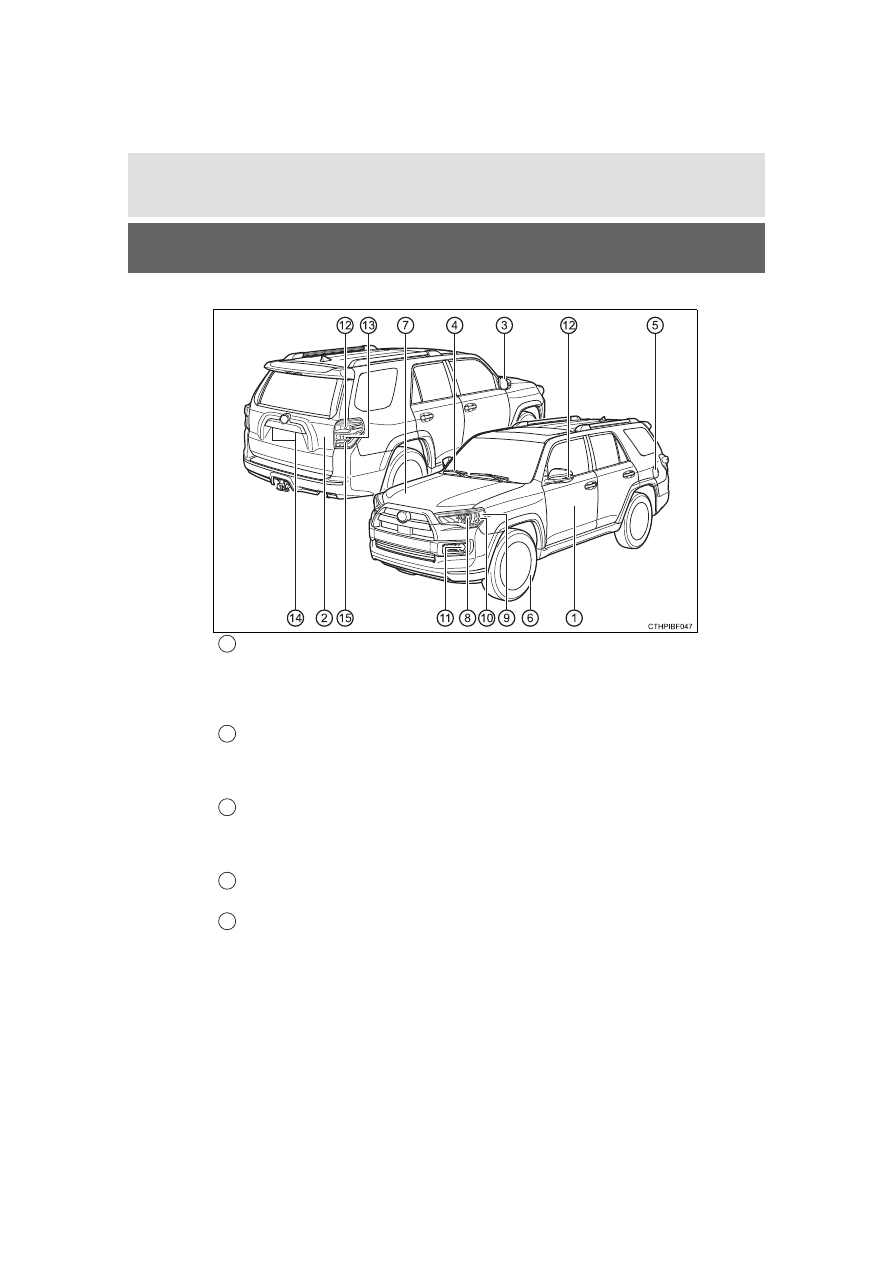
Exterior

Side doors  . . . . . . . . . . . . . . . . . . . . . . . . . . . . . . . . . . . . . . .  P. 110

Locking/unlocking  . . . . . . . . . . . . . . . . . . . . . . . . . . . . . . . . . .  P. 110
Opening/closing the door glasses . . . . . . . . . . . . . . . . . . . . . . P. 162
Locking/unlocking by using the mechanical key

*

 . . . . . . . . . . P. 507

Warning lights/warning messages . . . . . . . . . . . . . . . . . . P. 476, 484

Back door . . . . . . . . . . . . . . . . . . . . . . . . . . . . . . . . . . . . . . . . P. 131

Locking/unlocking  . . . . . . . . . . . . . . . . . . . . . . . . . . . . . . . . . . P. 131
Opening/closing the door glasses . . . . . . . . . . . . . . . . . . . . . . P. 166
Warning lights/warning messages . . . . . . . . . . . . . . . . . . P. 476, 484

Outside rear view mirrors . . . . . . . . . . . . . . . . . . . . . . . . . . . P. 160

Adjusting the mirror angle . . . . . . . . . . . . . . . . . . . . . . . . . . . . P. 160
Folding the mirrors. . . . . . . . . . . . . . . . . . . . . . . . . . . . . . . . . . P. 160
Defogging the mirrors  . . . . . . . . . . . . . . . . . . . . . . . . . . . P. 342, 349

Windshield wipers . . . . . . . . . . . . . . . . . . . . . . . . . . . . . . . . . P. 236

Precautions against winter season  . . . . . . . . . . . . . . . . . . . . . P. 329

Fuel filler door . . . . . . . . . . . . . . . . . . . . . . . . . . . . . . . . . . . . P. 242

Refueling method. . . . . . . . . . . . . . . . . . . . . . . . . . . . . . . . . . . P. 242
Fuel type/fuel tank capacity . . . . . . . . . . . . . . . . . . . . . . . . . . . P. 522

1

2

3

4

5

-------------------------------------------------------------------------------------------------------------------------------------------------------------

15

Pictorial index

4RUNNER (U)

Tires . . . . . . . . . . . . . . . . . . . . . . . . . . . . . . . . . . . . . . . . . . P. 422

Tire size/inflation pressure  . . . . . . . . . . . . . . . . . . . . . . . . . P. 528
Winter tires/tire chain  . . . . . . . . . . . . . . . . . . . . . . . . . . . . . P. 329
Checking/rotation/tire pressure warning system . . . . . . . . . P. 422
Coping with flat tires . . . . . . . . . . . . . . . . . . . . . . . . . . . . . . P. 489

Hood . . . . . . . . . . . . . . . . . . . . . . . . . . . . . . . . . . . . . . . . . . . . P. 407

Opening . . . . . . . . . . . . . . . . . . . . . . . . . . . . . . . . . . . . . . . . . . P. 407
Engine oil . . . . . . . . . . . . . . . . . . . . . . . . . . . . . . . . . . . . . . . . . P. 523
Coping with overheat . . . . . . . . . . . . . . . . . . . . . . . . . . . . . . . . P. 514

Headlights/daytime running lights . . . . . . . . . . . . . . . . . . . . P. 225

Front side marker lights . . . . . . . . . . . . . . . . . . . . . . . . . . . . P. 225

Front turn signal/parking lights . . . . . . . . . . . . . . . . . . . . . . P. 225

Fog lights . . . . . . . . . . . . . . . . . . . . . . . . . . . . . . . . . . . . . . . . P. 234

Turn signal lights . . . . . . . . . . . . . . . . . . . . . . . . . . . . . . . . . . P. 223

Stop/tail lights/rear side marker lights  . . . . . . . . . . . . . . . . P. 225

License plate lights . . . . . . . . . . . . . . . . . . . . . . . . . . . . . . . . P. 225

Back-up lights

Shifting the shift lever to R. . . . . . . . . . . . . . . . . . . . . . . . . . . . P. 218

6

7

Light bulbs of the exterior lights for driving

(Replacing method: P. 449, Wattages: P. 529)

*

: Vehicles with a smart key system

8

9

10

11

12

13

14

15

-------------------------------------------------------------------------------------------------------------------------------------------------------------

16

Pictorial index

4RUNNER (U)

Instrument panel

Engine switch. . . . . . . . . . . . . . . . . . . . . . . . . . . . . . . . . P. 209, 212

Starting the engine/changing the modes . . . . . . . . . . . . . P. 209, 212
Emergency stop of the engine . . . . . . . . . . . . . . . . . . . . . . . . . P. 463
When the engine will not start . . . . . . . . . . . . . . . . . . . . . . . . . P. 504
Warning messages  . . . . . . . . . . . . . . . . . . . . . . . . . . . . . . . . . P. 484

Shift lever . . . . . . . . . . . . . . . . . . . . . . . . . . . . . . . . . . . . . . . . P. 218

Changing the shift position  . . . . . . . . . . . . . . . . . . . . . . . . . . . P. 218
Precautions against towing . . . . . . . . . . . . . . . . . . . . . . . . . . . P. 466
When the shift lever does not move  . . . . . . . . . . . . . . . . . . . . P. 221

Meters . . . . . . . . . . . . . . . . . . . . . . . . . . . . . . . . . . . . . . . . . . . . P. 88

Reading the meters . . . . . . . . . . . . . . . . . . . . . . . . . . . . . . . . . . P. 88
Warning lights/indicator lights  . . . . . . . . . . . . . . . . . . . . . . . . . . P. 82
When the warning lights come on . . . . . . . . . . . . . . . . . . . . . . P. 474

1

2

3

-------------------------------------------------------------------------------------------------------------------------------------------------------------

17

Pictorial index

4RUNNER (U)

Multi-information display  . . . . . . . . . . . . . . . . . . . . . . . . . . . . P. 90

Display . . . . . . . . . . . . . . . . . . . . . . . . . . . . . . . . . . . . . . . . . . . . P. 90
When the warning messages are displayed  . . . . . . . . . . . . . . P. 484

Parking brake . . . . . . . . . . . . . . . . . . . . . . . . . . . . . . . . . . . . . P. 224

Applying/releasing . . . . . . . . . . . . . . . . . . . . . . . . . . . . . . . . . . P. 224
Precautions against winter season  . . . . . . . . . . . . . . . . . . . . . P. 330
Warning buzzer/message  . . . . . . . . . . . . . . . . . . . . . . . . P. 474, 484

Turn signal lever  . . . . . . . . . . . . . . . . . . . . . . . . . . . . . . . . . . P. 223

Headlight switch. . . . . . . . . . . . . . . . . . . . . . . . . . . . . . . . . . . . P. 225
Headlights/parking lights/tail lights/daytime running lights. . . . P. 225
Fog lights . . . . . . . . . . . . . . . . . . . . . . . . . . . . . . . . . . . . . . . . . P. 234

Windshield wiper and washer switch  . . . . . . . . . . . . . . . . . P. 236

Usage  . . . . . . . . . . . . . . . . . . . . . . . . . . . . . . . . . . . . . . . . . . . P. 236
Adding washer fluid . . . . . . . . . . . . . . . . . . . . . . . . . . . . . . . . . P. 420

Emergency flasher switch  . . . . . . . . . . . . . . . . . . . . . . . . . . P. 462

Hood lock release lever. . . . . . . . . . . . . . . . . . . . . . . . . . . . . P. 407

Tilt and telescopic steering lock release lever . . . . . . . . . . P. 156

Air conditioning system . . . . . . . . . . . . . . . . . . . . . . . . P. 340, 347

Usage  . . . . . . . . . . . . . . . . . . . . . . . . . . . . . . . . . . . . . . . P. 340, 347
Rear window defogger. . . . . . . . . . . . . . . . . . . . . . . . . . . P. 342, 349

Audio/Navigation system

*

Clock . . . . . . . . . . . . . . . . . . . . . . . . . . . . . . . . . . . . . . . . . . . . P. 373

*

: Refer to “NAVIGATION AND MULTIMEDIA SYSTEM OWNER’S MANUAL”.

4

5

6

7

8

9

10

11

12

13

-------------------------------------------------------------------------------------------------------------------------------------------------------------

18

Pictorial index

4RUNNER (U)

Switches

Outside rear view mirror switches . . . . . . . . . . . . . . . . . . . . P. 160

Instrument panel light control dial . . . . . . . . . . . . . . . . . . . . . P. 89

Automatic High Beam switch . . . . . . . . . . . . . . . . . . . . . . . . P. 230

Windshield wiper de-icer switch

*

1

. . . . . . . . . . . . . . . . P. 342, 350

Automatic running boards switch

*

1

 . . . . . . . . . . . . . . . . . . P. 128

Power outlet main switch

*

1

 . . . . . . . . . . . . . . . . . . . . . . . . . P. 374

Window lock switch. . . . . . . . . . . . . . . . . . . . . . . . . . . . . . . . P. 162

Door lock switches  . . . . . . . . . . . . . . . . . . . . . . . . . . . . . . . .  P. 113

Power window switches . . . . . . . . . . . . . . . . . . . . . . . . . . . . P. 162

Driving position memory switches

*

1

. . . . . . . . . . . . . . . . . . P. 149

1

2

3

4

5

6

7

8

9

10

-------------------------------------------------------------------------------------------------------------------------------------------------------------

19

Pictorial index

4RUNNER (U)

USB port

*

2

Seat heater/ventilator switches

*

1

. . . . . . . . . . . . . . . . . . . . . P. 355

Power outlets . . . . . . . . . . . . . . . . . . . . . . . . . . . . . . . . . . . . . P. 378

Front-wheel drive control lever

*

1

. . . . . . . . . . . . . . . . . . . . . P. 292

Front-wheel drive control switch

*

1

 . . . . . . . . . . . . . . . . . . . P. 292

Four-wheel drive control switch

*

1

. . . . . . . . . . . . . . . . . . . . P. 296

USB charging ports . . . . . . . . . . . . . . . . . . . . . . . . . . . . . . . . P. 381

Power back window switch  . . . . . . . . . . . . . . . . . . . . . . . . . P. 166

Seat heater switches

*

1

 . . . . . . . . . . . . . . . . . . . . . . . . . . . . . P. 355

*

1

: If equipped

*

2

: Refer to “NAVIGATION AND MULTIMEDIA SYSTEM OWNER’S MANUAL”.

1

2

3

4

5

6

7

8

-------------------------------------------------------------------------------------------------------------------------------------------------------------

20

Pictorial index

4RUNNER (U)

Audio remote control switches

*

Talk switch

*

Meter control switches . . . . . . . . . . . . . . . . . . . . . . . . . . . . . . P. 91

Cruise control switch

Dynamic radar cruise control . . . . . . . . . . . . . . . . . . . . . . . . . . P. 272

LDA (Lane Departure Alert) switch. . . . . . . . . . . . . . . . . . . . P. 264

Vehicle-to-vehicle distance switch. . . . . . . . . . . . . . . . . . . . P. 279

Telephone switches

*

1

2

3

4

5

6

7

-------------------------------------------------------------------------------------------------------------------------------------------------------------

21

Pictorial index

4RUNNER (U)

Interior

SRS airbags . . . . . . . . . . . . . . . . . . . . . . . . . . . . . . . . . . . . . . . P. 35

Floor mat  . . . . . . . . . . . . . . . . . . . . . . . . . . . . . . . . . . . . . . . . . P. 26

Front seats . . . . . . . . . . . . . . . . . . . . . . . . . . . . . . . . . . . . . . . P. 136

Rear seats. . . . . . . . . . . . . . . . . . . . . . . . . . . . . . . . . . . . . . . . P. 139

Head restraints. . . . . . . . . . . . . . . . . . . . . . . . . . . . . . . . . . . . P. 153

Seat belts . . . . . . . . . . . . . . . . . . . . . . . . . . . . . . . . . . . . . . . . . P. 30

Console box/tissue pocket . . . . . . . . . . . . . . . . . . . . . . P. 361, 365

Inside lock buttons  . . . . . . . . . . . . . . . . . . . . . . . . . . . . . . . .  P. 113

Cup holders . . . . . . . . . . . . . . . . . . . . . . . . . . . . . . . . . . . . . . P. 362

Bottle holders. . . . . . . . . . . . . . . . . . . . . . . . . . . . . . . . . . . . . P. 366

Armrest/cup holders . . . . . . . . . . . . . . . . . . . . . . . . . . . P. 362, 383

Power window switches . . . . . . . . . . . . . . . . . . . . . . . . . . . . P. 162

*

: Refer to “NAVIGATION AND MULTIMEDIA SYSTEM OWNER’S MANUAL”.

1

2

3

4

5

6

7

8

9

10

11

12

-------------------------------------------------------------------------------------------------------------------------------------------------------------

22

Pictorial index

4RUNNER (U)

Inside rear view mirror  . . . . . . . . . . . . . . . . . . . . . . . . . . . . . P. 158

Sun visors  . . . . . . . . . . . . . . . . . . . . . . . . . . . . . . . . . . . . . . . P. 372

Vanity mirrors. . . . . . . . . . . . . . . . . . . . . . . . . . . . . . . . . . . . . P. 372

Interior light

*

2

 . . . . . . . . . . . . . . . . . . . . . . . . . . . . . . . . . . . . P. 358

Personal lights . . . . . . . . . . . . . . . . . . . . . . . . . . . . . . . . . . . . P. 358

Moon roof switches

*

1

 . . . . . . . . . . . . . . . . . . . . . . . . . . . . . . P. 170

“SOS” button

*

1

 . . . . . . . . . . . . . . . . . . . . . . . . . . . . . . . . . . . . P. 70

Garage door opener switches

*

1

. . . . . . . . . . . . . . . . . . . . . . P. 384

Microphone

*

3

Assist grips  . . . . . . . . . . . . . . . . . . . . . . . . . . . . . . . . . . . . . . P. 383

Active traction control switch

*

1

. . . . . . . . . . . . . . . . . . . . . . P. 300

VSC off switch . . . . . . . . . . . . . . . . . . . . . . . . . . . . . . . . . . . . P. 322

DAC switch

*

1

. . . . . . . . . . . . . . . . . . . . . . . . . . . . . . . . . . . . . P. 307

Rear differential lock switch

*

1

 . . . . . . . . . . . . . . . . . . . . . . . P. 304

Crawl Control switch

*

1

 . . . . . . . . . . . . . . . . . . . . . . . . . . . . . P. 310

Multi-terrain Select switch

*

1

. . . . . . . . . . . . . . . . . . . . . . . . . P. 313

Auxiliary box

*

1

. . . . . . . . . . . . . . . . . . . . . . . . . . . . . . . . . . . . P. 364

1

2

3

4

5

6

7

8

9

10

11

12

13

14

15

16

17

-------------------------------------------------------------------------------------------------------------------------------------------------------------

23

Pictorial index

4RUNNER (U)

Back door handles. . . . . . . . . . . . . . . . . . . . . . . . . . . . . . . . . P. 132

Luggage compartment lights . . . . . . . . . . . . . . . . . . . . . . . . P. 133

Back door strap . . . . . . . . . . . . . . . . . . . . . . . . . . . . . . . . . . . P. 132

Child restraint anchor brackets . . . . . . . . . . . . . . . . . . . . . . . P. 57

Power outlets . . . . . . . . . . . . . . . . . . . . . . . . . . . . . . . . . . . . . P. 378

Power outlets (120 V AC)

*

1

. . . . . . . . . . . . . . . . . . . . . . . . . . P. 374

Slide deck

*

1

 . . . . . . . . . . . . . . . . . . . . . . . . . . . . . . . . . . . . . . P. 370

Storage compartment

*

1

 . . . . . . . . . . . . . . . . . . . . . . . . . . . . P. 369

Jack. . . . . . . . . . . . . . . . . . . . . . . . . . . . . . . . . . . . . . . . . . . . . P. 489

Tool bag  . . . . . . . . . . . . . . . . . . . . . . . . . . . . . . . . . . . . . . . . . P. 489

Cargo net hooks/Grocery bag hooks. . . . . . . . . . . . . . P. 368, 370

*

1

: If equipped

*

2

: The illustration shows the front, but they are also equipped in the rear.

*

3

: Refer to “NAVIGATION AND MULTIMEDIA SYSTEM OWNER’S MANUAL”.

1

2

3

4

5

6

7

8

9

10

11

-------------------------------------------------------------------------------------------------------------------------------------------------------------

24

Pictorial index

4RUNNER (U)

-------------------------------------------------------------------------------------------------------------------------------------------------------------

-------------------------------------------------------------------------------------------------------------------------------------------------------------

26

4RUNNER (U)

1-1. For safe use

Use  only  floor  mats  designed  specifically  for  vehicles  of  the  same
model  and  model  year  as  your  vehicle.  Fix  them  securely  in  place
onto the carpet.

Insert the retaining hooks (clips)
into the floor mat eyelets.

Turn  the  upper  knob  of  each
retaining  hook  (clip)  to  secure
the floor mats in place.

*

: Always align the 

 marks.

The shape of the retaining hooks (clips) may differ from that shown in the
illustration.

Before driving

Floor mat

1

*

2

-------------------------------------------------------------------------------------------------------------------------------------------------------------

27

1-1. For safe use

1

Fo
r safety and securi

ty

4RUNNER (U)

WARNING

Observe the following precautions. 
Failure to do so may cause the driver’s floor mat to slip, possibly interfering
with the pedals while driving. An unexpectedly high speed may result or it may
become difficult to stop the vehicle. This could lead to an accident, resulting in
death or serious injury.

When installing the driver’s floor mat 

Do not use floor mats designed for other models or different model year
vehicles, even if they are Toyota Genuine floor mats.

Only use floor mats designed for the driver’s seat.

Always install the floor mat securely using the retaining hooks (clips) pro-
vided.

Do not use two or more floor mats on top of each other.

Do not place the floor mat bottom-side up or upside-down.

Before driving

Check  that  the  floor  mat  is  securely
fixed  in  the  correct  place  with  all  the
provided  retaining  hooks  (clips).  Be
especially careful to perform this check
after cleaning the floor.

With  the  engine  stopped  and  the  shift
lever  in  P,  fully  depress  each  pedal  to
the floor to make sure it does not inter-
fere with the floor mat.

-------------------------------------------------------------------------------------------------------------------------------------------------------------

28

1-1. For safe use

4RUNNER (U)

Adjust  the  angle  of  the  seat-
back  so  that  you  are  sitting
straight  up  and  so  that  you  do
not  have  to  lean  forward  to
steer. (

P. 136)

Adjust the seat so that you can
depress the pedals fully and so
that  your  arms  bend  slightly  at
the  elbow  when  gripping  the
steering wheel. (

P. 136)

Adjust the tilt and telescopic positions of the steering wheel down-
ward so the airbag is facing your chest. (

P. 156)

Lock the head restraint in place with the center of the head restraint
closest to the top of your ears. (

P. 153)

Wear the seat belt correctly. (

P. 30)

Make sure that all occupants are wearing their seat belts before driv-
ing the vehicle. (

P. 30)

Use  a  child  restraint  system  appropriate  for  the  child  until  the  child
becomes large enough to properly wear the vehicle’s seat belt. 
(

P. 53)

For safe driving

For  safe  driving,  adjust  the  seat  and  mirror  to  an  appropriate
position before driving.

Correct driving posture

1

2

Correct use of the seat belts

3

4

5

-------------------------------------------------------------------------------------------------------------------------------------------------------------

29

1-1. For safe use

1

Fo
r safety and securi

ty

4RUNNER (U)

Make sure that you can see backward clearly by adjusting the inside
and outside rear view mirrors properly. (

P. 158, 160)

Adjusting the mirrors

WARNING

Observe the following precautions.
Failure to do so may result in death or serious injury.

Do not adjust the position of the driver’s seat while driving.
Doing so could cause the driver to lose control of the vehicle.

Do not place a cushion between the driver or passenger and the seatback.
A cushion may prevent correct posture from being achieved, and reduce
the effectiveness of the seat belt and head restraint.

Do not place anything under the front seats.
Objects  placed  under  the  front  seats  may  become  jammed  in  the  seat
tracks and stop the seat from locking in place. This may lead to an acci-
dent and the adjustment mechanism may also be damaged.

Always observe the legal speed limit when driving on public roads.

When driving over long distances, take regular breaks before you start to
feel tired.
Also, if you feel tired or sleepy while driving, do not force yourself to con-
tinue driving and take a break immediately.

-------------------------------------------------------------------------------------------------------------------------------------------------------------

30

1-1. For safe use

4RUNNER (U)

Extend the shoulder belt so that
it comes fully over the shoulder,
but does not come into contact
with  the  neck  or  slide  off  the
shoulder.

Position  the  lap  belt  as  low  as
possible over the hips.

Adjust  the  position  of  the  seat-
back.  Sit  up  straight  and  well
back in the seat.

Do not twist the seat belt.

To fasten the seat belt, push the
plate into the buckle until a click
sound is heard. 
To  release  the  seat  belt,  press
the release button.

Push  the  seat  belt  shoulder
anchor down while pressing the
release button.
Push  the  seat  belt  shoulder
anchor up.

Move  the  height  adjuster  up  and
down  as  needed  until  you  hear  a
click.

Seat belts

Make sure that all occupants are wearing their seat belts before
driving the vehicle. 

Correct use of the seat belts

Fastening and releasing the seat belt

Release button

1

2

Adjusting the seat belt shoulder anchor height (front seats)

1

2

-------------------------------------------------------------------------------------------------------------------------------------------------------------

31

1-1. For safe use

1

Fo
r safety and securi

ty

4RUNNER (U)

The  pretensioners  help  the  seat
belts to quickly restrain  the occu-
pants  by  retracting  the  seat  belts
when  the  vehicle  is  subjected  to
certain  types  of  severe  frontal  or
side collision or a vehicle rollover.

The  pretensioners  do  not  activate
in  the  event  of  a  minor  frontal
impact,  a  minor  side  impact  or  a
rear impact.

Emergency locking retractor (ELR)

The retractor will lock the belt during a sudden stop or on impact. It may also
lock if you lean forward too quickly. A slow, easy motion will allow the belt to
extend so that you can move around fully. 

Automatic locking retractor (ALR)

When a passenger’s shoulder belt is completely extended and then retracted
even slightly, the belt is locked in that position and cannot be extended. This
feature is used to hold the child restraint system (CRS) firmly. To free the belt
again, fully retract the belt and then pull the belt out once more. (

P. 57)

Child seat belt usage

The seat belts of your vehicle were principally designed for persons of adult
size. 

Use  a  child  restraint  system  appropriate  for  the  child,  until  the  child
becomes large enough to properly wear the vehicle’s seat belt. (

P. 53)

When the child becomes large enough to properly wear the vehicle’s seat
belt, follow the instructions regarding seat belt usage. (

P. 30)

Replacing the belt after the pretensioner has been activated

If the vehicle is involved in multiple collisions, the pretensioner will activate for
the first collision, but will not activate for the second or subsequent collisions.

Seat belt extender

Seat belt pretensioners (front seats)

If  your  seat  belts  cannot  be  fastened
securely  because  they  are  not  long
enough, a personalized seat belt extender
is  available  from  your Toyota  dealer  free
of charge.

-------------------------------------------------------------------------------------------------------------------------------------------------------------

32

1-1. For safe use

4RUNNER (U)

WARNING

Observe the following precautions to reduce the risk of injury in the event of
sudden braking, sudden swerving or an accident.
Failure to do so may cause death or serious injury.

Wearing a seat belt

Ensure that all passengers wear a seat belt.

Always wear a seat belt properly.

Each seat belt should be used by one person only. Do not use a seat belt
for more than one person at once, including children.

Toyota recommends that children be seated in the rear seat and always
use a seat belt and/or an appropriate child restraint system.

To  achieve  a  proper  seating  position,  do  not  recline  the  seat  more  than
necessary. The seat belt is most effective when the occupants are sitting
up straight and well back in the seats.

Do not wear the shoulder belt under your arm.

Always wear your seat belt low and snug across your hips.

Pregnant women

Obtain medical advice and wear the seat
belt in the proper way. (

P. 30)

Women  who  are  pregnant  should  posi-
tion the lap belt as low as possible over
the  hips  in  the  same  manner  as  other
occupants,  extending  the  shoulder  belt
completely over the shoulder and avoid-
ing  belt  contact  with  the  rounding  of  the
abdominal area.
If  the  seat  belt  is  not  worn  properly,  not
only  the  pregnant  woman,  but  also  the
fetus could suffer death or serious injury
as  a  result  of  sudden  braking  or  a  colli-
sion.

-------------------------------------------------------------------------------------------------------------------------------------------------------------

33

1-1. For safe use

1

Fo
r safety and securi

ty

4RUNNER (U)

WARNING

People suffering illness

Obtain medical advice and wear the seat belt in the proper way. (

P. 30)

When children are in the vehicle

Do  not  allow  children  to  play  with  the  seat  belt.  If  the  seat  belt  becomes
twisted around a child’s neck, it may lead to choking or other serious injuries
that could result in death.
If this occurs and the buckle cannot be unfastened, scissors should be used
to cut the belt.

Seat belt pretensioners

Do not place anything, such as a cushion, on the front passenger's seat.
Doing so will disperse the passenger's weight, which prevents the sensor
from detecting the passenger's weight properly. As a result, the seat belt
pretensioner for the front passenger's seat may not activate in the event of
a collision.

If the pretensioner has activated, the SRS warning light will come on. In
that  case,  the  seat  belt  cannot  be  used  again  and  must  be  replaced  at
your Toyota dealer.

Adjustable shoulder anchor

Always make sure the shoulder belt is positioned across the center of your
shoulder. The belt should be kept away from your neck, but not falling off
your shoulder. Failure to do so could reduce the amount of protection in an
accident and cause death or serious injuries in the event of a sudden stop,
sudden swerve or accident. (

P. 30)

-------------------------------------------------------------------------------------------------------------------------------------------------------------

34

1-1. For safe use

4RUNNER (U)

WARNING

Seat belt damage and wear

Do not damage the seat belts by allowing the belt, plate, or buckle to be
jammed in the door.

Inspect the seat belt system periodically. Check for cuts, fraying, and loose
parts. Do not use a damaged seat belt until it is replaced. Damaged seat
belts cannot protect an occupant from death or serious injury.

Ensure that the belt and plate are locked and the belt is not twisted.
If the seat belt does not function correctly, immediately contact your Toyota
dealer.

Replace the seat assembly, including the belts, if your vehicle has been
involved in a serious accident, even if there is no obvious damage.

Do not attempt to install, remove, modify, disassemble or dispose of the
seat belts. Have any necessary repairs carried out by your Toyota dealer.
Inappropriate handling may lead to incorrect operation.

Using a seat belt extender

Do not wear the seat belt extender if you can fasten the seat belt without
the extender.

Do not use the seat belt extender when installing a child restraint system
because the belt will not securely hold the child restraint system, increas-
ing the risk of death or serious injury in the event of an accident.

The  personalized  extender  may  not  be  safe  on  another  vehicle,  when
used by another person, or at a different seating position other than the
one originally intended.

NOTICE

When using a seat belt extender

When  releasing  the  seat  belt,  press  on  the  buckle  release  button  on  the
extender, not on the seat belt.
This helps prevent damage to the vehicle interior and the extender itself.

-------------------------------------------------------------------------------------------------------------------------------------------------------------

35

1-1. For safe use

1

Fo
r safety and securi

ty

4RUNNER (U)

SRS front airbags

SRS driver airbag/front passenger airbag
Can help protect the head and chest of the driver and front pas-
senger from impact with interior components
SRS knee airbags
Can help provide driver and front passenger protection

SRS side and curtain shield airbags

SRS side airbags
Can help protect the torso of the front seat occupants
SRS curtain shield airbags

Can help protect primarily the head of occupants in the outer
seats

Can  help  prevent  the  occupants  from  being  thrown  from  the
vehicle in the event of vehicle rollover

SRS airbags

The SRS airbags inflate when the vehicle is subjected to certain
types of severe impacts that may cause significant injury to the
occupants. They work together with the seat belts to help reduce
the risk of death or serious injury.

1

2

3

4

-------------------------------------------------------------------------------------------------------------------------------------------------------------

36

1-1. For safe use

4RUNNER (U)

SRS airbag system components

Side airbags
“AIR BAG ON” and “AIR BAG
OFF” indicator lights
Curtain shield airbags
Front passenger airbag
Knee airbags
Side  impact  sensors  (front
door)
Seat  belt  pretensioners  and
force limiters
Front impact sensors
Airbag sensor assembly

Front  passenger’s  seat  belt
buckle switch
Front  passenger  occupant
classification  system  (ECU
and sensors)
Side impact sensors (rear)
SRS warning light
Safing sensor (rear)
Driver airbag
Driver’s  seat  belt  buckle
switch

1

2

3

4

5

6

7

8

9

10

11

12

13

14

15

16

-------------------------------------------------------------------------------------------------------------------------------------------------------------

37

1-1. For safe use

1

Fo
r safety and securi

ty

4RUNNER (U)

Your vehicle is equipped with ADVANCED AIRBAGS designed based
on  the  US  motor  vehicle  safety  standards  (FMVSS208). The  airbag
sensor  assembly  (ECU)  controls  airbag  deployment  based  on  infor-
mation obtained from the sensors  etc. shown in the system compo-
nents  diagram  above.  This  information  includes  crash  severity  and
occupant  information. As  the  airbags  deploy,  a  chemical  reaction  in
the inflators quickly fills the airbags with non-toxic gas to help restrain
the motion of the occupants.

WARNING

SRS airbag precautions

Observe the following precautions regarding the SRS airbags. 
Failure to do so may cause death or serious injury.

The  driver  and  all  passengers  in  the  vehicle  must  wear  their  seat  belts
properly.
The SRS airbags are supplemental devices to be used with the seat belts.

The  SRS  driver  airbag  deploys  with  considerable  force,  and  can  cause
death or serious injury especially if the driver is very close to the airbag.
The National Highway Traffic Safety Administration (NHTSA) advises:
Since the risk zone for the driver’s airbag is the first 2 - 3 in. (50 - 75 mm)
of inflation, placing yourself 10 in. (250 mm) from your driver airbag pro-
vides you with a clear margin of safety. This distance is measured from
the center of the steering wheel to your breastbone. If you sit less than 10
in. (250 mm) away now, you can change your driving position in several
ways:
• Move your seat to the rear as far as you can while still reaching the ped-

als comfortably.

• Slightly recline the back of the seat. 

Although vehicle designs vary, many drivers can achieve the 10 in. (250
mm) distance, even with the driver seat all the way forward, simply by
reclining  the  back  of  the  seat  somewhat.  If  reclining  the  back  of  your
seat makes it hard to see the road, raise yourself by using a firm, non-
slippery cushion, or raise the seat if your vehicle has that feature.

• If your steering wheel is adjustable, tilt it downward. This points the air-

bag toward your chest instead of your head and neck.

The seat should be adjusted as recommended  by NHTSA above, while
still maintaining control of the foot pedals, steering wheel, and your view
of the instrument panel controls.

-------------------------------------------------------------------------------------------------------------------------------------------------------------

38

1-1. For safe use

4RUNNER (U)

WARNING

SRS airbag precautions

The SRS front passenger airbag also deploys with considerable force, and
can cause death or serious injury especially if the front passenger is very
close to the airbag. The front passenger seat should be as far from the air-
bag  as  possible  with  the  seatback  adjusted,  so  the  front  passenger  sits
upright.

Improperly seated and/or restrained infants and children can be killed or
seriously injured by a deploying airbag. An infant or child who is too small
to use a seat belt should be properly secured using a child restraint sys-
tem. Toyota strongly recommends that all infants and children be placed in
the rear seats of the vehicle and properly restrained. The rear seats are
safer for infants and children than the front passenger seat. (

P. 53)

If the seat belt extender has been con-
nected to the front seat belt buckles but
the seat belt extender has not also been
fastened  to  the  latch  plate  of  the  seat
belt,  the  SRS  front  airbags  will  judge
that the driver and front passenger are
wearing  the  seat  belt  even  though  the
seat  belt  has  not  been  connected.  In
this  case,  the  SRS  front  airbags  may
not  activate  correctly  in  a  collision,
resulting in death or serious injury in the
event of a collision. Be sure to wear the
seat belt with the seat belt extender.

Do  not  sit  on  the  edge  of  the  seat  or
lean against the dashboard.

-------------------------------------------------------------------------------------------------------------------------------------------------------------

39

1-1. For safe use

1

Fo
r safety and securi

ty

4RUNNER (U)

WARNING

SRS airbag precautions

Do not allow a child to stand in front of
the SRS front passenger airbag unit or
sit on the knees of a front passenger.

Do not allow the front seat occupants to
hold items on their knees.

Do  not  lean  against  the  door,  the  roof
side  rail  or  the  front,  side  and  rear  pil-
lars.

Do  not  allow  anyone  to  kneel  on  the
passenger seats toward the door or put
their head or hands outside the vehicle.

Do  not  attach  anything  to  or  lean  any-
thing  against  areas  such  as  the  dash-
board,  steering  wheel  pad  and  lower
portion of the instrument panel. 
These  items  can  become  projectiles
when  the  SRS  driver,  front  passenger
and knee airbags deploy.

Do not attach anything to areas such as
a  door,  windshield  glass,  side  door
glass,  front  or  rear  pillar,  roof  side  rail
and assist grip. 

-------------------------------------------------------------------------------------------------------------------------------------------------------------

40

1-1. For safe use

4RUNNER (U)

WARNING

SRS airbag precautions

Do not hang coat hangers or other hard objects on the coat hooks. All of
these  items  could  become  projectiles  and  may  cause  death  or  serious
injury, should the SRS curtain shield airbags deploy.

If a vinyl cover is put on the area where the SRS knee airbag will deploy,
be sure to remove it.

Do  not use  seat accessories  which  cover  the parts where  the  SRS  side
airbags  inflate  as  they  may  interfere  with  inflation  of  the  airbags.  Such
accessories may prevent the side airbags from activating correctly, disable
the  system  or  cause  the  side  airbags  to  inflate  accidentally,  resulting  in
death or serious injury.

Do not strike or apply significant levels of force to the area of the SRS air-
bag components. 
Doing so can cause the SRS airbags to malfunction.

Do not touch any of the component parts immediately after the SRS air-
bags have deployed (inflated) as they may be hot.

If breathing becomes difficult after the SRS airbags have deployed, open a
door or window to allow fresh air in, or leave the vehicle if it is safe to do
so. Wash off any residue as soon as possible to prevent skin irritation. 

If the areas where the SRS airbags are stored, such as the steering wheel
pad  and  front  and  rear  pillar  garnishes,  are  damaged  or  cracked,  have
them replaced by your Toyota dealer.

Do not place anything, such as a cushion, on the front passenger's seat.
Doing so will disperse the passenger's weight, which prevents the sensor
from detecting the passenger's weight properly. As a result, the SRS front
airbags for the front passenger may not deploy in the event of a collision.

Vehicles  without  a  smart  key  system:
Do not attach any heavy, sharp or hard
objects  such  as  keys  and  accessories
to the key. The objects may restrict the
SRS  knee  airbag  inflation  or  be  thrust
into the driver's seat area by the force of
the  deploying  airbag,  thus  causing  a
danger.

-------------------------------------------------------------------------------------------------------------------------------------------------------------

41

1-1. For safe use

1

Fo
r safety and securi

ty

4RUNNER (U)

If the SRS airbags deploy (inflate)

Slight abrasions, burns, bruising etc., may be sustained from SRS airbags,
due to the extremely high speed deployment (inflation) by hot gases.

A loud noise and white powder will be emitted.

Parts of the airbag module (steering wheel hub, airbag cover and inflator) as
well as the front seats, parts of the front and rear pillars, and roof side rails
may be hot for several minutes. The airbag itself may also be hot.

The windshield may crack.

Fuel supply to the engine will be stopped. (

P. 473)

For Safety Connect subscribers, if any of the following situations occur, the
system is designed to send an emergency call to the response center, noti-
fying them of the vehicle's location (without needing to push the “SOS” but-
ton) and an agent will attempt to speak with the occupants to ascertain the
level of emergency and assistance required. If the occupants are unable to
communicate, the agent automatically treats the call as an emergency and
helps to dispatch the necessary emergency services. (

P. 70)

• An SRS airbag is deployed.
• A seat belt pretensioner is activated.
• The vehicle is involved in a severe rear-end collision.
• The vehicle is involved in a rollover accident.

WARNING

Modification and disposal of SRS airbag system components

Do not dispose of your vehicle or perform any of the following modifications
without consulting your Toyota dealer. The SRS airbags may malfunction or
deploy (inflate) accidentally, causing death or serious injury.

Installation, removal, disassembly and repair of the SRS airbags

Repairs,  modifications,  removal  or  replacement  of  the  steering  wheel,
instrument panel, dashboard, seats or seat upholstery, front, side and rear
pillars or roof side rails

Repairs  or  modifications  of  the  front  fender,  front  bumper,  or  side  of  the
occupant compartment

Installation  of  a  grill  guard  (bull  bars,  kangaroo  bar  etc.),  snow  plows,
winches or roof luggage carrier.

Modifications to the vehicle’s suspension system

Installation of electronic devices such as mobile two-way radios and CD
players

Modifications to your vehicle for a person with a physical disability

-------------------------------------------------------------------------------------------------------------------------------------------------------------

42

1-1. For safe use

4RUNNER (U)

SRS airbag deployment conditions (SRS front airbags)

The SRS front airbags will deploy in the event of an impact that exceeds the
set threshold level (the level of force corresponding to an approximately 12 -
18 mph [20 - 30 km/h] frontal collision with a fixed wall that does not move or
deform).
However, this threshold velocity will be considerably higher in the following
situations:
• If  the  vehicle  strikes  an  object,  such  as  a  parked  vehicle  or  sign  pole,

which can move or deform on impact

• If the vehicle is involved in an underride collision, such as a collision in

which the front of the vehicle “underrides”, or goes under, the bed of a
truck

Depending on the type of collision, it is possible that only the seat belt pre-
tensioners will activate.

The SRS front airbags for the front passenger will not activate if there is no
passenger sitting in the front passenger seat. However, the SRS front air-
bags for the front passenger may deploy if luggage is put in the seat, even if
the seat is unoccupied.

SRS airbag deployment conditions (SRS side and curtain shield airbags)

The  SRS  side  and  curtain  shield  airbags  will  deploy  in  the  event  of  an
impact that exceeds the set threshold level (the level of force corresponding
to the impact force produced by an approximately 3300 lb. [1500 kg] vehicle
colliding with the vehicle cabin from a direction perpendicular to the vehicle
orientation at an approximate speed of 12 - 18 mph [20 - 30 km/h]).

Both SRS curtain shield airbags will deploy in the event of vehicle rollover.

All SRS side and curtain shield airbags will deploy in the event of a severe
frontal collision.

-------------------------------------------------------------------------------------------------------------------------------------------------------------

43

1-1. For safe use

1

Fo
r safety and securi

ty

4RUNNER (U)

Conditions under which the SRS airbags may deploy (inflate), other than
a collision 

The SRS front airbags, SRS side and curtain shield airbags may also deploy
if a serious impact occurs to the underside of your vehicle. Some examples
are shown in the illustration.

The SRS curtain shield airbags may also deploy under the situations shown
in the illustration.

Types of collisions that may not deploy the SRS airbags (SRS front air-
bags)

The SRS front airbags do not generally inflate if the vehicle is involved in a
side or rear collision, if it rolls over, or if it is involved in a low-speed frontal
collision.  But,  whenever  a  collision  of  any  type  causes  sufficient  forward
deceleration of the vehicle, deployment of the SRS front airbags may occur.

Hitting a curb, edge of pavement or hard
surface

Falling into or jumping over a deep hole

Landing hard or falling

The angle of vehicle tip-up is marginal.

The vehicle skids and hits a curb stone.

Collision from the side

Collision from the rear

Vehicle rollover

-------------------------------------------------------------------------------------------------------------------------------------------------------------

44

1-1. For safe use

4RUNNER (U)

Types of collisions that may not deploy the SRS airbags (SRS side and
curtain shield airbags)

The  SRS  side  and  curtain  shield  airbags  may  not  activate  if  the  vehicle  is
subjected to a collision from the side at certain angles, or a collision to the
side of the vehicle body other than the passenger compartment.

The SRS side airbags do not generally inflate if the vehicle is involved in a
rear  collision,  if  it  rolls  over,  or  if  it  is  involved  in  a  low-speed  side  or  low-
speed frontal collision.

The  SRS  curtain  shield  airbags  do  not  generally  inflate  if  the  vehicle  is
involved in a rear collision, if it pitches end over end, or if it is involved in a
low-speed side or low-speed frontal collision.

Collision  from  the  side  to  the  vehicle
body other than the passenger compart-
ment

Collision from the side at an angle

Collision from the rear

Vehicle rollover

Collision from the rear

Pitching end over end

-------------------------------------------------------------------------------------------------------------------------------------------------------------

45

1-1. For safe use

1

Fo
r safety and securi

ty

4RUNNER (U)

When to contact your Toyota dealer

In the following cases, the vehicle will require inspection and/or repair. Con-
tact your Toyota dealer as soon as possible. 

Any of the SRS airbags have been inflated.

The  front  of  the  vehicle  is  damaged  or
deformed,  or  was  involved  in  an  acci-
dent  that  was  not  severe  enough  to
cause the SRS front airbags to inflate.

A  portion  of  a  door  or  its  surrounding
area  is  damaged  or  deformed,  or  the
vehicle was involved in an accident that
was  not  severe  enough  to  cause  the
SRS  side  and  curtain  shield  airbags  to
inflate.

The  pad  section  of  the  steering  wheel,
dashboard near the front passenger air-
bag  or  lower  portion  of  the  instrument
panel  is  scratched,  cracked,  or  other-
wise damaged.

The  surface  of  the  seats  with  the  SRS
side airbag is scratched, cracked, or oth-
erwise damaged.

The  portion  of  the  front  pillars,  rear  pil-
lars or roof side rail garnishes (padding)
containing  the  SRS  curtain  shield  air-
bags  inside  is  scratched,  cracked,  or
otherwise damaged.

-------------------------------------------------------------------------------------------------------------------------------------------------------------

46

1-1. For safe use

4RUNNER (U)

SRS warning light
Seat belt reminder light
“AIR BAG OFF” indicator light
“AIR BAG ON” indicator light

Front passenger occupant classification 

system

Your vehicle is equipped with a front passenger occupant classi-
fication system. This system detects the conditions of the front
passenger seat and activates or deactivates the front passenger
airbag, front passenger knee airbag, and front passenger's seat
belt pretensioner.

U.S.A.

Canada

1

2

3

4

-------------------------------------------------------------------------------------------------------------------------------------------------------------

47

1-1. For safe use

1

Fo
r safety and securi

ty

4RUNNER (U)

Adult

*

1

Child

*

4

 or child restraint system

*

5

Condition and operation in the front passenger occupant classi-
fication system

Indicator/

warning light

“AIR BAG ON” and “AIR BAG OFF” 

indicator lights

“AIR BAG ON”

SRS warning light

Off

Seat belt reminder light

Off

*

2

 or 

flashing

*

3

Devices

Front passenger airbag

Activated

Front passenger knee airbag

Front passenger's seat belt pretensioner

Indicator/

warning light

“AIR BAG ON” and “AIR BAG OFF” 

indicator lights

“AIR BAG 

OFF”

*

6

SRS warning light

Off

Seat belt reminder light

Flashing

*

3

Devices

Front passenger airbag

Deactivated

Front passenger knee airbag

Front passenger's seat belt pretensioner

Activated

-------------------------------------------------------------------------------------------------------------------------------------------------------------

48

1-1. For safe use

4RUNNER (U)

Unoccupied

Indicator/

warning light

“AIR BAG ON” and “AIR BAG OFF” 

indicator lights

Not illuminated

SRS warning light

Off

Seat belt reminder light

Devices

Front passenger airbag

Deactivated

Front passenger knee airbag

Front passenger's seat belt pretensioner

Activated

*

or 

deactivated

*

8

-------------------------------------------------------------------------------------------------------------------------------------------------------------

49

1-1. For safe use

1

Fo
r safety and securi

ty

4RUNNER (U)

There is a malfunction in the system

*

1

: The system judges a person of adult size as an adult. When a smaller

adult sits in the front passenger seat, the system may recognize him/her
as a child depending on his/her physique and posture.

*

2

: In the event the front passenger is wearing a seat belt.

*

3

: In the event the front passenger does not wear a seat belt.

*

4

: When a larger child who has outgrown a child restraint system sits in the

front  passenger  seat,  the  system  may  recognize  him/her  as  an  adult
depending on his/her physique or posture.

*

5

: Never install a rear-facing child restraint system on the front passenger

seat. A forward-facing child restraint system should only be installed on
the front passenger seat when it is unavoidable. 
(

P. 53)

*

6

: In case the indicator light is not illuminated, consult this manual on how

to install the child restraint system properly. (

P. 57)

*

7

: In the event of a side collision.

*

8

: In the event of a frontal collision or rollover.

Indicator/

warning light

“AIR BAG ON” and “AIR BAG OFF” 

indicator lights

“AIR BAG OFF”

SRS warning light

On

Seat belt reminder light

On or flashing

Devices

Front passenger airbag

Deactivated

Front passenger knee airbag

Front passenger's seat belt pretensioner

Activated

-------------------------------------------------------------------------------------------------------------------------------------------------------------

50

1-1. For safe use

4RUNNER (U)

WARNING

Front passenger occupant classification system precautions

Observe the following precautions regarding the front passenger occupant
classification system. 
Failure to do so may cause death or serious injury.

Wear the seat belt properly.

Make sure the front passenger’s seat belt plate has not been left inserted
into the buckle before someone sits in the front passenger seat.

Make sure the “AIR BAG OFF” indicator light is not illuminated when using
the seat belt extender for the front passenger seat. If the “AIR BAG OFF”
indicator light is illuminated, disconnect the extender tongue from the seat
belt buckle, and reconnect the seat belt. Reconnect the seat belt extender
after making  sure  the “AIR BAG  ON” indicator light is  illuminated. If  you
use the seat belt extender while the “AIR BAG OFF” indicator light is illumi-
nated,  the  SRS  airbags  for  the  front  passenger  will  not  activate,  which
could cause death or serious injury in the event of a collision.

Do not apply a heavy load to the front passenger seat or equipment.

Do  not  put  weight  on  the  front  passenger  seat  by  putting  your  hands  or
feet on the front passenger seat seatback from the rear passenger seat.

Do not let a rear passenger lift the front passenger seat with their feet or
press on the seatback with their legs.

Do not put objects under the front passenger seat.

-------------------------------------------------------------------------------------------------------------------------------------------------------------

51

1-1. For safe use

1

Fo
r safety and securi

ty

4RUNNER (U)

WARNING

Front passenger occupant classification system precautions

Do not recline the front passenger seatback so far that it touches a rear
seat. This may cause the “AIR BAG OFF” indicator light to be illuminated,
which  indicates  that  the  SRS  airbags  for  the  front  passenger  will  not
deploy in the event of a severe accident. If the seatback touches the rear
seat,  return  the  seatback  to  a  position  where  it  does  not  touch  the  rear
seat. Keep the front passenger seatback as upright as possible when the
vehicle  is  moving.  Reclining  the  seatback  excessively  may  lessen  the
effectiveness of the seat belt system.

If  an  adult  sits  in  the  front  passenger  seat,  the  “AIR  BAG  ON”  indicator
light is illuminated. If the “AIR BAG OFF” indicator is illuminated, ask the
passenger to sit up straight, well back in the seat, feet on the floor, and
with  the  seat  belt  worn  correctly.  If  the  “AIR  BAG  OFF”  indicator  still
remains illuminated, either ask the passenger to move to the rear seat, or
if that is not possible, move the front passenger seat fully rearward.

When it is unavoidable to install a forward-facing child restraint system on
the front passenger seat, install the child restraint system on the front pas-
senger seat in the proper order. (

P. 57)

Do not modify or remove the front seats.

Do not kick the front passenger seat or subject it to severe impact. Other-
wise, the SRS warning light may come on to indicate a malfunction of the
front passenger occupant classification system. In this case, contact your
Toyota dealer immediately.

Child restraint systems installed on the second seat should not contact the
front seatbacks.

Do not use a seat accessory, such as a cushion and seat cover, that cov-
ers the seat cushion surface.

Do not modify or replace the upholstery of the front seat.

-------------------------------------------------------------------------------------------------------------------------------------------------------------

52

1-1. For safe use

4RUNNER (U)

It is recommended that children sit in the rear seats to avoid acci-
dental contact with the shift lever, wiper switch etc.

Use the rear door child-protector lock or the window lock switch to
avoid  children  opening  the  door  while  driving  or  operating  the
power window accidentally.

Do  not  let  small  children  operate  equipment  which  may  catch  or
pinch  body  parts,  such  as  the  power  window,  hood,  back  door,
seats etc.

Safety information for children

Observe the following precautions when children are in the vehi-
cle.
Use a child restraint system appropriate for the child, until the
child becomes large enough to properly wear the vehicle’s seat
belt.

WARNING

Never leave children unattended in the vehicle, and never allow children to
have or use the key.
Children  may  be  able  to  start  the  vehicle  or  shift  the  vehicle  into  neutral.
There is also a danger that children may injure themselves by playing with
the windows, the moon roof or other features of the vehicle. In addition, heat
build-up or extremely cold  temperatures  inside the vehicle can be fatal  to
children.

-------------------------------------------------------------------------------------------------------------------------------------------------------------

53

1-1. For safe use

1

Fo
r safety and securi

ty

4RUNNER (U)

Studies have shown that installing a child restraint on a rear seat is
much safer than installing one on the front passenger seat.

Choose a child restraint system that suits your vehicle and is appro-
priate to the age and size of the child. 

For installation details, follow the instructions provided with the child
restraint system.
General installation instructions are provided in this manual. 
(

P. 57)

Child restraint systems

A child restraint system for a small child or baby must itself be
properly restrained on the seat with the LATCH anchors or the
lap portion of the lap/shoulder belt.
The laws of all 50 states of the U.S.A. and Canada now require
the use of child restraint systems.

Points to remember

-------------------------------------------------------------------------------------------------------------------------------------------------------------

54

1-1. For safe use

4RUNNER (U)

Child  restraint  systems  are  classified  into  the  following  3  types
according to the age and size of the child:

Selecting an appropriate child restraint system

Use a child restraint system appropriate for the child until the child becomes
large enough to properly wear the vehicle’s seat belt.

If the child is too large for a child restraint system, sit the child on a rear seat
and use the vehicle’s seat belt. (

P. 30)

Types of child restraints

Rear  facing 

  Infant  seat/con-

vertible seat

Forward facing 

 Convertible

seat

Booster seat

-------------------------------------------------------------------------------------------------------------------------------------------------------------

55

1-1. For safe use

1

Fo
r safety and securi

ty

4RUNNER (U)

WARNING

Child restraint precautions

For effective protection in automobile accidents and sudden stops, a child
must  be  properly  restrained,  using  a  seat  belt  or  child  restraint  system
depending on the age and size of the child. Holding a child in your arms is
not a substitute for a child restraint system. In an accident, the child can be
crushed against the windshield, or between you and the vehicle’s interior.

Toyota strongly urges the use of a proper child restraint system that con-
forms to the size of the child, installed on the rear seat. According to acci-
dent statistics, the child is safer when properly restrained in the rear seat
than in the front seat.

Never  install  a  rear-facing  child  restraint  system  on  the  front  passenger
seat even if the “AIR BAG OFF” indicator light is illuminated. 
In the event of an accident, the force of the rapid inflation of the front pas-
senger airbag can cause death or serious injury to the child if the rear-fac-
ing child restraint system is installed on the front passenger seat.

A forward-facing child restraint system may be installed on the front pas-
senger  seat  only  when  it  is  unavoidable.  A  child  restraint  system  that
requires a top tether strap should not be used in the front passenger seat
since  there  is  no  top  tether  strap  anchor  for  the  front  passenger  seat.
Adjust the seatback as upright as possible and always move the seat as
far  back  as  possible  even  if  the  “AIR  BAG  OFF”  indicator  light  is  illumi-
nated, because the front passenger airbag could inflate with considerable
speed and force. Otherwise, the child may be killed or seriously injured.

Do not use the seat belt extender when installing a child restraint system
on  the  front  or  rear  passenger  seat.  If  installing  a  child  restraint  system
with the seat belt extender connected to the seat belt, the seat belt will not
securely hold the child restraint system, which could cause death or seri-
ous injury to the child or other passengers in the event of an accident.

Do  not  allow  the  child  to  lean  his/her  head  or  any  part  of  his/her  body
against the door or the area of the seat, front and rear pillars or roof side
rails from which the SRS side airbags or SRS curtain shield airbags deploy
even if the child is seated in the child restraint system. It is dangerous if
the  SRS  side  airbags  and  curtain  shield  airbags  inflate,  and  the  impact
could cause death or serious injury to the child.

Make sure you have complied with all installation instructions provided by
the child restraint manufacturer and that the system is properly secured. If
it is not secured properly, it may cause death or serious injury to the child
in the event of a sudden stop, sudden swerve or accident.

-------------------------------------------------------------------------------------------------------------------------------------------------------------

56

1-1. For safe use

4RUNNER (U)

WARNING

When children are in the vehicle

Do  not  allow  children  to  play  with  the  seat  belt.  If  the  seat  belt  becomes
twisted around a child’s neck, it may lead to choking or other serious injuries
that could result in death.
If this occurs and the buckle cannot be unfastened, scissors should be used
to cut the belt.

When the child restraint system is not in use

Keep the child restraint system properly secured on the seat even if it is
not in use. Do not store the child restraint system unsecured in the pas-
senger compartment.

If it is necessary to detach the child restraint system, remove it from the
vehicle or store it securely in the luggage compartment. This will prevent it
from injuring passengers in the event of a sudden stop, sudden swerve or
accident.

-------------------------------------------------------------------------------------------------------------------------------------------------------------

57

1-1. For safe use

1

Fo
r safety and securi

ty

4RUNNER (U)

Vehicles without third row seats

Child restraint LATCH anchors

LATCH  anchors  are  provided  for
the  outboard  rear  seats.  (Buttons
displaying  the  location  of  the
anchors are attached to the seats.) 

Vehicles with third row seats

Child restraint LATCH anchors

LATCH  anchors  are  provided  for
the  outboard  second  row  seats.
(Buttons  displaying  the  location  of
the  anchors  are  attached  to  the
seats.)

Seat  belts  equipped  with  a  child
restraint 

locking 

mechanism

(ALR/ELR  belts  except  driver’s
seat belt) (

P. 31)

Installing child restraints

Follow  the  child  restraint  system  manufacturer’s  instructions.
Firmly  secure  child  restraints  to  the  seats  using  the  LATCH
(Lower Anchors and Tethers for Children) anchors or a seat belt.
Attach the top tether strap when installing a child restraint.
The lap/shoulder belt can be used if your child restraint system
is not compatible with the LATCH system.

-------------------------------------------------------------------------------------------------------------------------------------------------------------

58

1-1. For safe use

4RUNNER (U)

Vehicles without third row seats

Anchor  brackets  (for  top  tether
strap)

An  anchor  bracket  is  provided  for
each rear seat.

Vehicles with third row seats

Anchor  brackets  (for  top  tether
strap)

An  anchor  bracket  is  provided  for
each second row seat.

-------------------------------------------------------------------------------------------------------------------------------------------------------------

59

1-1. For safe use

1

Fo
r safety and securi

ty

4RUNNER (U)

Installing on the rear seats (vehicles without third row seats)

Fold the seatback while pull-
ing  the  seatback  angle
adjustment  lever.  Return  the
seatback and secure it at the
first lock position. (

P. 139)

Type A

Latch the hooks of the lower
straps  onto  the  LATCH
anchors. If the child restraint
has a top tether strap, the top
tether  strap  should  be
latched  onto  the  top  tether
strap anchor. 
For owners in Canada:
The  symbol  on  a  child
restraint system indicates the
presence of a lower connec-
tor system.

Installation with LATCH system (rear/second row seats only)

1

Canada only

2

-------------------------------------------------------------------------------------------------------------------------------------------------------------

60

1-1. For safe use

4RUNNER (U)

Type B

Latch  the  buckles  onto  the
LATCH  anchors.  If  the  child
restraint  has  a  top  tether
strap,  the  top  tether  strap
should  be  latched  onto  the
top tether strap anchor. 
For owners in Canada:
The  symbol  on  a  child
restraint system indicates the
presence of a lower connec-
tor system.

Installing  on  the  second  row  seats  (vehicles  with  third  row
seats)

Fold the seatback while pull-
ing  the  seatback  angle
adjustment  lever.  Return  the
seatback and secure it at the
first lock position. (

P. 139)

Flip the cover.

Canada only

2

1

2

-------------------------------------------------------------------------------------------------------------------------------------------------------------

61

1-1. For safe use

1

Fo
r safety and securi

ty

4RUNNER (U)

Type A

Latch the hooks of the lower
straps  onto  the  LATCH
anchors. If the child restraint
has a top tether strap, the top
tether  strap  should  be
latched  onto  the  top  tether
strap anchor.
For owners in Canada:
The  symbol  on  a  child
restraint system indicates the
presence of a lower connec-
tor system.

Type B

Latch  the  buckles  onto  the
LATCH  anchors.  If  the  child
restraint  has  a  top  tether
strap,  the  top  tether  strap
should  be  latched  onto  the
top tether strap anchor.
For owners in Canada:
The  symbol  on  a  child
restraint system indicates the
presence of a lower connec-
tor system.

Canada only

3

Canada only

3

-------------------------------------------------------------------------------------------------------------------------------------------------------------

62

1-1. For safe use

4RUNNER (U)

Rear-facing 

 Infant seat/convertible seat

Place the child  restraint sys-
tem  on  the  rear  seat  facing
the rear of the vehicle.

Run the seat belt through the
child  restraint  system  and
insert  the  plate  into  the
buckle.  Make  sure  that  the
belt is not twisted.

Fully extend the shoulder belt
and allow it to retract to put it
in  lock  mode.  In  lock  mode,
the belt cannot be extended.

Installing  child  restraints  using  a  seat  belt  (child  restraint  lock
function belt)

1

2

3

-------------------------------------------------------------------------------------------------------------------------------------------------------------

63

1-1. For safe use

1

Fo
r safety and securi

ty

4RUNNER (U)

While  pushing  the  child
restraint  system  down  into
the  rear  seat,  allow  the
shoulder  belt  to  retract  until
the  child  restraint  system  is
securely in place.

After  the  shoulder  belt  has
retracted to a point where there
is  no  slack  in  the  belt,  pull  the
belt  to  check  that  it  cannot  be
extended. 

Forward-facing 



Convertible seat

Place the child  restraint sys-
tem  on  the  seat  facing  the
front of the vehicle.

Run the seat belt through the
child  restraint  system  and
insert  the  plate  into  the
buckle.  Make  sure  that  the
belt is not twisted.

4

1

2

-------------------------------------------------------------------------------------------------------------------------------------------------------------

64

1-1. For safe use

4RUNNER (U)

Fully extend the shoulder belt
and allow it to retract to put it
in  lock  mode.  In  lock  mode,
the belt cannot be extended.

While  pushing  the  child
restraint system into the rear
seat,  allow  the  shoulder  belt
to  retract  until  the  child
restraint  system  is  securely
in place.

After  the  shoulder  belt  has
retracted to a point where there
is  no  slack  in  the  belt,  pull  the
belt  to  check  that  it  cannot  be
extended.

If  the  child  restraint  has  a  top  tether  strap,  the  top  tether  strap
should be latched onto the top tether strap anchor. (

P. 66)

3

4

5

-------------------------------------------------------------------------------------------------------------------------------------------------------------

65

1-1. For safe use

1

Fo
r safety and securi

ty

4RUNNER (U)

Booster seat

Place the child  restraint sys-
tem  on  the  seat  facing  the
front of the vehicle.

Sit  the  child  in  the  child
restraint system. Fit the seat
belt to the child restraint sys-
tem  according  to  the  manu-
facturer’s  instructions  and
insert  the  plate  into  the
buckle.  Make  sure  that  the
belt is not twisted.

Check  that  the  shoulder  belt  is  correctly  positioned  over  the  child’s
shoulder and that the lap belt is as low as possible. (

P. 30)

Push  the  buckle  release  button
and fully retract the seat belt. 

1

2

Removing a child restraint installed with a seat belt

-------------------------------------------------------------------------------------------------------------------------------------------------------------

66

1-1. For safe use

4RUNNER (U)

Secure  the  child  restraint  sys-
tem  using  the  seat  belt  or  the
lower anchors, and remove the
head restraint.

Open the anchor bracket cover,
latch  the  hook  onto  the  anchor
bracket  and  tighten  the  top
tether strap.

Make  sure  the  top  tether  strap  is
securely latched.

Replace the head restraint.

Child restraint systems with a top tether strap

1

2

3

-------------------------------------------------------------------------------------------------------------------------------------------------------------

67

1-1. For safe use

1

Fo
r safety and securi

ty

4RUNNER (U)

Laws and regulations pertaining to anchorages

The LATCH system conforms to FMVSS225 or CMVSS210.2.
Child  restraint  systems  conforming  to  FMVSS213  or  CMVSS213  specifica-
tions can be used.
This vehicle is designed to conform to the SAE J1819.

WARNING

When installing a booster seat 

To prevent the belt from going into ALR lock mode, do not fully extend the
shoulder belt. ALR mode causes the belt to tighten only. This could cause
injury or discomfort to the child. (

P. 31)

When installing a child restraint system

Follow the directions given in the child restraint system installation manual
and fix the child restraint system securely in place.
If the child restraint system is not correctly fixed in place, the child or other
passengers may be seriously injured or even killed in the event of a sudden
braking or an accident.

If  the  driver’s  seat  interferes  with  the
child  restraint  system  and  prevents  it
from being attached correctly, attach the
child  restraint  system  to  the  right-hand
rear seat.

Adjust the front passenger seat so that
it  does  not  interfere  with  the  child
restraint system.

Only put a forward-facing child restraint
system on the front seat when unavoid-
able.  When  installing  a  forward-facing
child  restraint  system  on the  front  pas-
senger seat, move the seat as far back
as possible even if the “AIR BAG OFF”
indicator  light  is  illuminated.  Failure  to
do  so  may  result  in  death  or  serious
injury if the airbags deploy (inflate).

-------------------------------------------------------------------------------------------------------------------------------------------------------------

68

1-1. For safe use

4RUNNER (U)

WARNING

When installing a child restraint system

Vehicles with third row seats: When using the LATCH anchors for a child
restraint system, move the seat as far back as possible, with the seatback
close to the child restraint system.

When a booster seat is installed, always ensure that the shoulder belt is
positioned  across  the  center  of  the  child’s  shoulder.  The  belt  should  be
kept away from the child’s neck, but not so that it could fall off the child’s
shoulder. Failing to do so may result in death or serious injury in the event
of an accident or a sudden braking.

Ensure that the belt and plate are securely locked and the seat belt is not
twisted.

Shake the child restraint system left and right, and forward and backward
to ensure that it has been securely installed.

After securing a child restraint system, never adjust the seat.

Follow  all  installation  instructions  provided  by  the  child  restraint  system
manufacturer.

When  securing  some  types  of  child  restraint  systems  in  second  or  third
row seats, it may not be possible to properly use the seat belts in positions
next  to  the  child  restraint  without  interfering  with  it  or  affecting  seat  belt
effectiveness. Be sure your seat belt fits snugly across your shoulder and
low  on  your  hips.  If  it  does  not,  or  if  it  interferes  with  the  child  restraint,
move to a different position. Failure to do so may result in death or serious
injury.

Do not use a seat belt extender

If a seat belt extender is used when installing a child restraint system, the
seat belt will not securely hold the child restraint system, which could cause
death or serious injury to the child or other passengers in the event of a sud-
den braking, sudden swerving or an accident.

To correctly attach a child restraint system to the anchors

When using the LATCH anchors, be sure that there are no foreign objects
around  the  anchors  and  that  the  seat  belt  is  not  caught  behind  the  child
restraint system. Make sure the child restraint system is securely attached,
or it may cause death or serious injury to the child or other passengers in
the event of a sudden braking or an accident.

-------------------------------------------------------------------------------------------------------------------------------------------------------------

69

1-1. For safe use

1

Fo
r safety and securi

ty

4RUNNER (U)

Exhaust gas precautions

Harmful  substance  to  the  human  body  is  included  in  exhaust
gases if inhale.

WARNING

Exhaust gases include harmful carbon monoxide (CO), which is colorless and
odorless. Observe the following precautions.
Failure to do so may cause exhaust gases enter the vehicle and may lead to
an accident caused by light-headedness, or may lead to death or a serious
health hazard.

Important points while driving

Keep the back door closed.

If  you  smell  exhaust  gases  in  the  vehicle  even  when  the  back  door  is
closed, open the windows and have the vehicle inspected at your Toyota
dealer as soon as possible.

When parking

If  the  vehicle  is  in  a  poorly  ventilated  area  or  a  closed  area,  such  as  a
garage, stop the engine.

Do not leave the vehicle with the engine on for a long time.
If such a situation cannot be avoided, park the vehicle in an open space
and ensure that exhaust fumes do not enter the vehicle interior.

Do not leave the engine running in an area with snow build-up, or where it
is snowing. If snowbanks build up around the vehicle while the engine is
running, exhaust gases may collect and enter the vehicle.

Exhaust pipe

The exhaust system needs to be checked periodically. If there is a hole or
crack caused by corrosion, damage to a joint or abnormal exhaust noise, be
sure to have the vehicle inspected and repaired by your Toyota dealer. 

-------------------------------------------------------------------------------------------------------------------------------------------------------------

70

4RUNNER (U)

1-2. Emergency assistance

System components

Microphone
“SOS” button
LED light indicators

Safety Connect

: If equipped

Safety  Connect  is  a  subscription-based  telematics  service  that
uses Global Positioning System (GPS) data and embedded cel-
lular technology to provide safety and security features to sub-
scribers.  Safety  Connect  is  supported  by  Toyota’s  designated
response  center,  which  operates  24  hours  per  day,  7  days  per
week.
Safety  Connect  service  is  available  by  subscription  on  select,
telematics hardware-equipped vehicles.
By  using  the  Safety  Connect  service,  you  are  agreeing  to  be
bound  by  the  Telematics  Subscription  Service Agreement  and
its Terms and Conditions, as in effect and amended from time to
time, a current copy of which is available at Toyota.com in the
United  States,  Toyotapr.com  in  Puerto  Rico  and  Toyota.ca  in
Canada. All use of the Safety Connect service is subject to such
then-applicable Terms and Conditions.

1

2

3

-------------------------------------------------------------------------------------------------------------------------------------------------------------

71

1-2. Emergency assistance

1

Fo
r safety and securi

ty

4RUNNER (U)

Services

Subscribers have the following Safety Connect services available:

Automatic Collision Notification

*

Helps drivers receive necessary response from emergency ser-
vice providers. (

P. 73)

*

: U.S. Patent No. 7,508,298 B2

Stolen Vehicle Location
Helps drivers in the event of vehicle theft. (

P. 73)

Emergency Assistance Button (“SOS”)
Connects drivers to response-center support. (

P. 73)

Enhanced Roadside Assistance
Provides drivers various on-road assistance. (

P. 74)

Subscription

After you have signed the Telematics Subscription Service Agree-
ment and are enrolled, you can begin receiving services. 
A variety of subscription terms are available for purchase. Contact
your Toyota dealer, call the following appropriate Customer Experi-
ence  Center  or  push  the  “SOS”  button  in  your  vehicle  for  further
subscription details.

• The United States 

1-800-331-4331

• Canada 

1-888-869-6828

• Puerto Rico 

1-877-855-8377

-------------------------------------------------------------------------------------------------------------------------------------------------------------

72

1-2. Emergency assistance

4RUNNER (U)

Safety Connect Services Information

Phone  calls  using  the  vehicles  Bluetooth

®

  technology  will  not  be  possible

when Safety Connect is active and in use.

Safety Connect is available beginning Fall 2009 on select Toyota models (in
the  contiguous  United  States  only).  Contact  with  the  Safety  Connect
response center is dependent upon the telematics device being in operative
condition, cellular connection availability, and GPS satellite signal reception,
which  can  limit  the  ability  to  reach  the  response  center  or  receive  emer-
gency  service  support.  Enrollment  and  Telematics  Subscription  Service
Agreement  required. A  variety  of  subscription  terms  is  available;  charges
vary by subscription term selected and location.

Automatic Collision Notification, Emergency Assistance and Stolen Vehicle
Location  are  available  in  the  United  States,  including  Hawaii  and Alaska,
Puerto Rico and Canada, and Enhanced Roadside Assistance are available
in the United States, Puerto Rico and Canada.

Automatic Collision Notification, Emergency Assistance, Stolen Vehicle and
Enhanced Road Assistance are not available in the U.S. Virgin Islands. 
For vehicles first sold in the U.S. Virgin Islands, no Safety Connect services
will function in or outside the U.S. Virgin Islands.

Safety Connect services are not subject to section 255 of the Telecommuni-
cations Act and the device is not TTY compatible.

Languages

The Safety Connect response center will offer support in multiple languages.
The Safety Connect system will offer voice prompts in English, Spanish, and
French. Please indicate your language of choice when enrolling.

When contacting the response center

You may be unable to contact the response center if the network is busy.

When the engine switch is turned to the “ON” position (vehicles with-
out a smart key system) or the engine switch is turned to IGNITION
ON mode (vehicles with a smart key system), the red indicator light
comes on for 2 seconds then turns off. Afterward, the green indicator
light comes on, indicating that the service is active.
The  following  indicator  light  patterns  indicate  specific  system  usage
conditions:

Green indicator light on = Active service

Green indicator light flashing = Safety Connect call in process

Red indicator light (except at vehicle start-up) = System malfunction
(contact your Toyota dealer)

No indicator light (off) = Safety Connect service not active

Safety Connect LED light Indicators

-------------------------------------------------------------------------------------------------------------------------------------------------------------

73

1-2. Emergency assistance

1

Fo
r safety and securi

ty

4RUNNER (U)

Automatic Collision Notification

In case of either airbag deployment or severe rear-end collision, the
system is designed to automatically call the response center. The
responding  agent  receives  the  vehicle’s  location  and  attempts  to
speak with the vehicle occupants to assess the level of emergency.
If  the  occupants  are  unable  to  communicate,  the  agent  automati-
cally  treats the call  as  an  emergency,  contacts  the  nearest emer-
gency services provider to describe the situation, and requests that
assistance be sent to the location.

Stolen Vehicle Location

If your vehicle is stolen, Safety Connect can work with local author-
ities to assist them in locating and recovering the vehicle. After filing
a police report, call the Customer Experience Center at 1-800-331-
4331 in the United States, 1-877-855-8377 in Puerto Rico or 1-888-
869-6828 in Canada, and follow the prompts for Safety Connect to
initiate this service.
In  addition  to assisting law enforcement with  recovery of  a stolen
vehicle, Safety-Connect-equipped vehicle location data may, under
certain  circumstances,  be  shared  with  third  parties  to  locate  your
vehicle. Further information is available at Toyota.com in the United
States, Toyotapr.com in Puerto Rico and Toyota.ca in Canada.

Emergency Assistance Button (“SOS”)

In the event of an emergency on the road, push the “SOS” button to
reach  the  Safety  Connect  response  center.  The  answering  agent
will determine your vehicle’s location, assess the emergency, and
dispatch the necessary assistance required.

If  you  accidentally  press  the  “SOS”  button,  tell  the  response-center
agent that you are not experiencing an emergency.

Safety Connect services

-------------------------------------------------------------------------------------------------------------------------------------------------------------

74

1-2. Emergency assistance

4RUNNER (U)

Enhanced Roadside Assistance

Enhanced  Roadside  Assistance  adds  GPS  data  to  the  already
included warranty-based Toyota roadside service.
Subscribers can press the “SOS” button to reach a Safety Connect
response-center agent, who can help with a wide range of needs,
such as: towing, flat tire, fuel delivery, etc. For a description of the
Enhanced  Roadside  Assistance  services  and  their  limitations,
please  see  the  Safety  Connect  Terms  and  Conditions,  which  are
available  at  Toyota.com  in  the  United  States,  Toyotapr.com  in
Puerto Rico and Toyota.ca in Canada.

Important! Read this information before using Safety Connect.

Exposure to radio frequency signals

The Safety Connect system installed in your vehicle is a low-power
radio transmitter and receiver. It receives and also sends out radio
frequency (RF) signals.
In August  1996,  the  Federal  Communications  Commission  (FCC)
adopted RF exposure guidelines with safety levels for mobile wire-
less phones. Those guidelines are consistent with the safety stan-
dards  previously  set  by  the  following  U.S.  and  international
standards bodies.

ANSI (American National Standards Institute) C95.1 [1992]

NCRP (National  Council  on  Radiation  Protection  and Measure-
ment) Report 86 [1986]

ICNIRP  (International  Commission  on  Non-Ionizing  Radiation
Protection) [1996]

Those standards were based on comprehensive and periodic eval-
uations of the relevant scientific literature. Over 120 scientists, engi-
neers,  and  physicians  from  universities,  and  government  health
agencies and industries reviewed the available body of research to
develop the ANSI Standard (C95.1).
The design of Safety Connect complies with the FCC guidelines in
addition to those standards. 

Safety information for Safety Connect

-------------------------------------------------------------------------------------------------------------------------------------------------------------

75

1-2. Emergency assistance

1

Fo
r safety and securi

ty

4RUNNER (U)

Certification for Safety Connect

-------------------------------------------------------------------------------------------------------------------------------------------------------------

76

4RUNNER (U)

1-3. Theft deterrent system

Vehicles without a smart key system

The  indicator  light  flashes  after
the  key  has  been  removed  from
the  engine  switch  to  indicate  that
the system is operating.
The  indicator  light  stops  flashing
after the registered key has been
inserted into the engine switch to
indicate that the system has been
canceled.

Vehicles with a smart key system 

The indicator light flashes after the engine switch has been turned off
to indicate that the system is operating.
The  indicator  light  stops  flashing  after  the  engine  switch  has  been
turned  to ACCESSORY  or  IGNITION  ON  mode  to  indicate  that  the
system has been canceled.

System maintenance

The vehicle has a maintenance-free type engine immobilizer system.

Conditions that may cause the system to malfunction

If the grip portion of the key is in contact with a metallic object

If the key is in close proximity to or touching a key to the security system
(key with a built-in transponder chip) of another vehicle

Engine immobilizer system

The vehicle’s keys have built-in transponder chips that prevent
the engine from starting if a key has not been previously regis-
tered in the vehicle’s on-board computer. 
Never leave the keys inside the vehicle when you leave the vehi-
cle.
This system is designed to help prevent vehicle theft but does
not guarantee absolute security against all vehicle thefts.

-------------------------------------------------------------------------------------------------------------------------------------------------------------

77

1-3. Theft deterrent system

1

Fo
r safety and securi

ty

4RUNNER (U)

Certifications  for  the  engine  immobilizer  system  (vehicles  without  a
smart key system)

For vehicles sold in the U.S.A.

For vehicles sold in Canada

-------------------------------------------------------------------------------------------------------------------------------------------------------------


Content      ..      1       2         ..


///////////////////////////////////////