Toyota Tundra. Manual - part 1438


  Index      Toyota     Toyota Tundra (2007-2010 year) - Service and Repair Manual


Search            copyright infringement  


Content   ..  1436  1437  1438  1439   ..


Toyota Tundra. Manual - part 1438
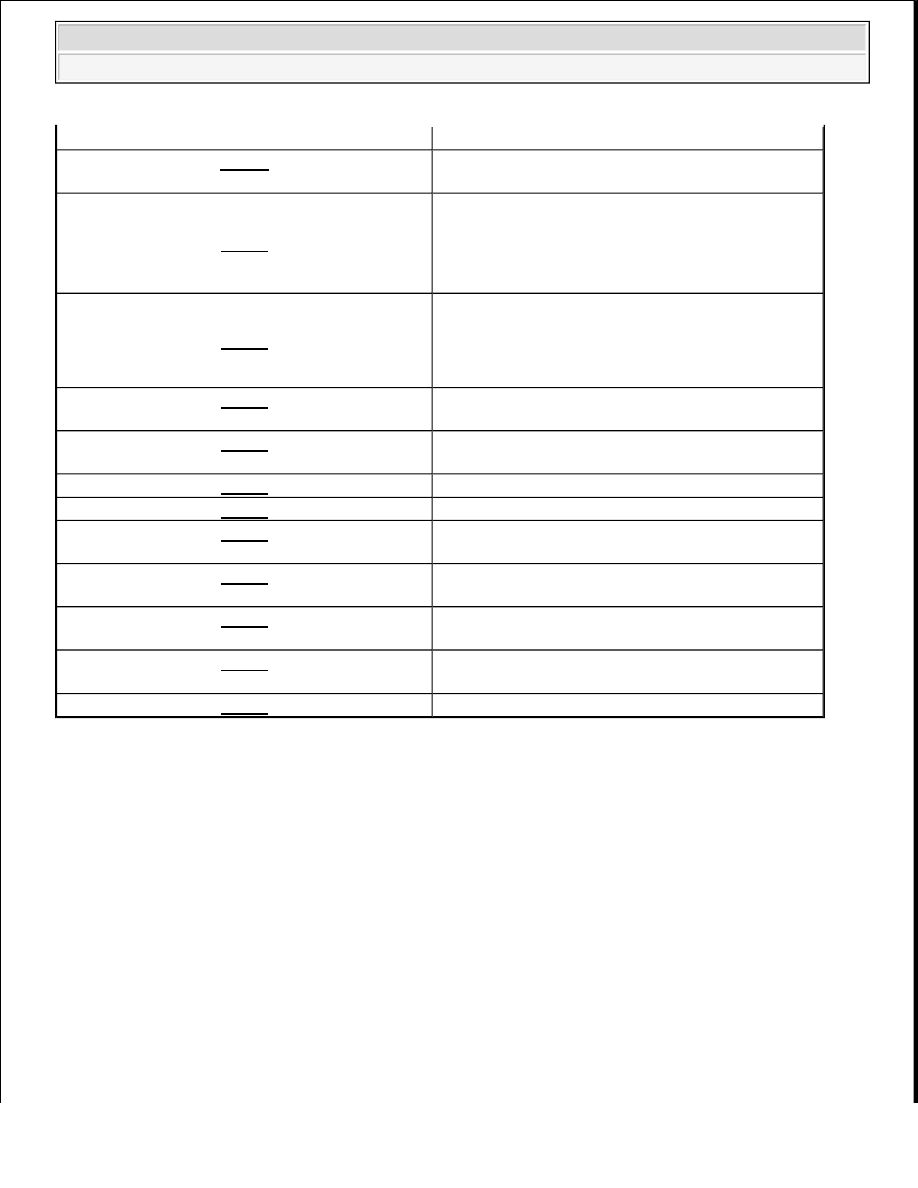


If any EVAP system DTCs are set, the malfunctioning area can be determined using the table below. 

module)

P043F

Reference orifice high-flow (built into canister pump 
module)

P0441

Purge VSV (Vacuum Switching Valve) stuck 
closed  

Purge VSV stuck open  

Purge flow  

P0451

Canister pressure sensor (built into canister 
pump module) noise  

Canister pressure sensor (built into canister 
pump module) signal becomes fixed/flat  

P0452

Canister pressure sensor (built into canister pump 
module) voltage low

P0453

Canister pressure sensor (built into canister pump 
module) voltage high

P0455

EVAP gross leak

P0456

EVAP small leak

P2401

Leak detection pump stuck OFF (built into canister 
pump module)

P2402

Leak detection pump stuck ON (built into canister 
pump module)

P2419

Vent valve stuck closed (built into canister pump 
module)

P2420

Vent valve stuck open (vent) (built into canister 
pump module)

P2610

Soak timer (built into ECM)


2008 Toyota Tundra 

2008 ENGINE PERFORMANCE Engine Control System (2UZ-FE) - Tundra


Fig. 244: DTC Chart 

DESCRIPTION 

NOTE:

If the reference pressure difference between the first and second checks is 
greater than the specification, all the DTCs relating to the reference pressure 
(P043E, P043F, P2401, P2402 and P2419) are stored.


2008 Toyota Tundra 

2008 ENGINE PERFORMANCE Engine Control System (2UZ-FE) - Tundra


Fig. 245: Identifying Evaporative Emission System Replacement Components Location 


2008 Toyota Tundra 

2008 ENGINE PERFORMANCE Engine Control System (2UZ-FE) - Tundra


Fig. 246: EVAP System Circuit Diagram 

While the engine is running, if a predetermined condition (closed-loop, etc.) is met, the purge VSV is opened by 
the ECM and stored fuel vapors in the canister are purged into the intake manifold. The ECM changes the duty 
cycle ratio of the purge VSV to control purge flow volume. 

The purge flow volume is also determined by the intake manifold pressure. Atmospheric pressure is allowed 
into the canister through the vent valve to ensure that the purge flow is maintained when the negative pressure 
(vacuum) is applied to the canister. 

The following two monitors run to confirm the appropriate EVAP system operation. 

1. Key-off monitor 

This monitor checks for EVAP (Evaporative Emission) system leaks and canister pump module 
malfunctions. The monitor starts 5 hours* after the ignition switch is turned off. At least 5 hours are 
required for the fuel to cool down to stabilize the EVAP pressure, thus making the EVAP system monitor 
more accurate. 

The leak detection pump creates negative pressure (vacuum) in the EVAP system and the pressure is 
measured. Finally, the ECM monitors for leaks from the EVAP system, and malfunctions in both the 
canister pump module and purge VSV, based on the EVAP pressure. 

HINT: 

*: If the engine coolant temperature is not below 35°C (95°F) 5 hours after the ignition switch is turned 

NOTE:

In this vehicle's EVAP system, turning ON the vent valve does not seal off the 
EVAP system. To check for leaks in the EVAP system, disconnect the air inlet 
vent hose and apply pressure from the atmospheric side of the canister.


2008 Toyota Tundra 

2008 ENGINE PERFORMANCE Engine Control System (2UZ-FE) - Tundra


Content   ..  1436  1437  1438  1439   ..