Content .. 1237 1238 1239 1240 ..
Toyota Tundra. Manual - part 1239
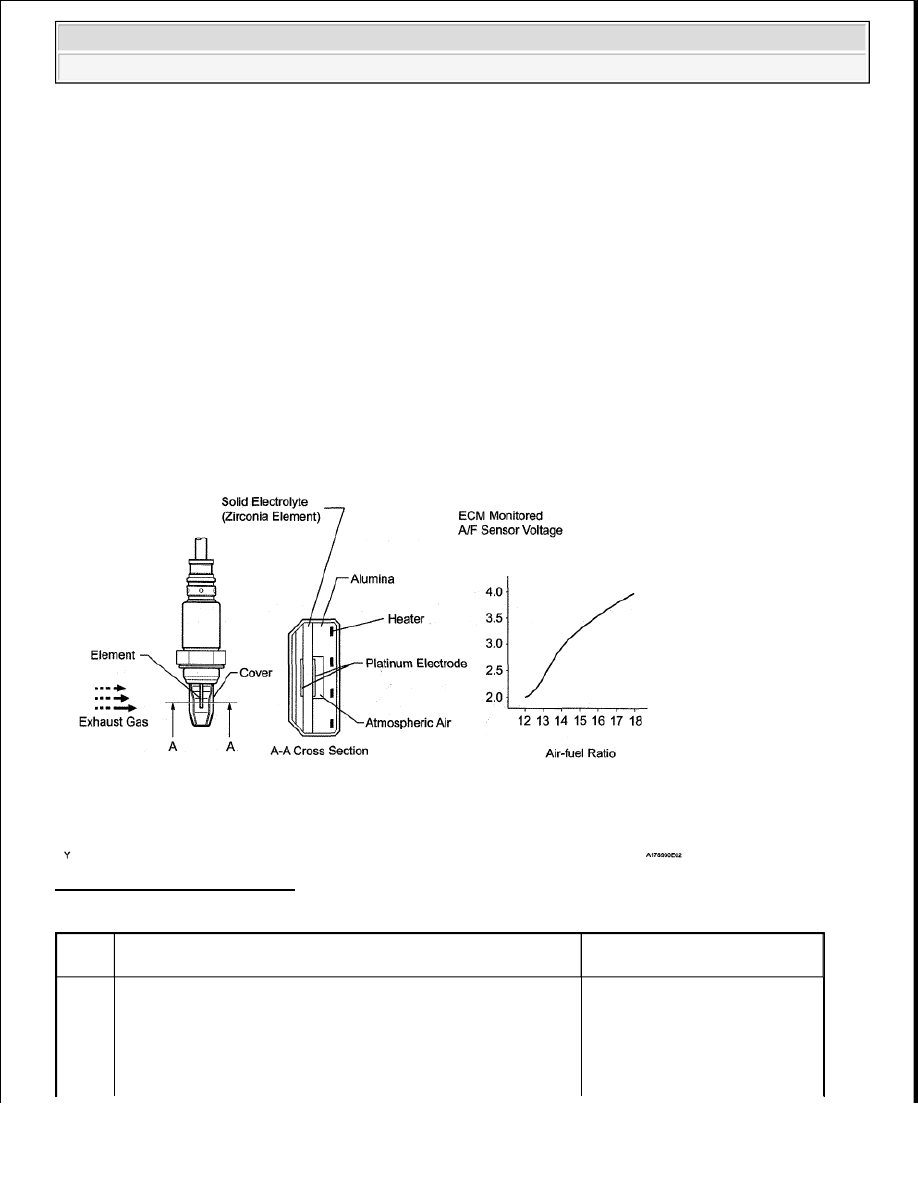
provide the ECM with feedback so that it can control the air-fuel ratio. The ECM determines the deviation from
the stoichiometric air-fuel ratio level, and regulates the fuel injection time. If the A/F sensor malfunctions, the
ECM is unable to control the air-fuel ratio accurately.
The A/F sensor is the planar type and is integrated with the heater, which heats the solid electrolyte (zirconia
element). This heater is controlled by the ECM. When the intake air volume is low (the exhaust gas temperature
is low), a current flows into the heater to heat the sensor, in order to facilitate accurate oxygen concentration
detection. In addition, the sensor and heater portions are the narrow type. The heat generated by the heater is
conducted to the solid electrolyte through the alumina, therefore the sensor activation is accelerated.
In order to obtain a high purification rate of the carbon monoxide (CO), hydrocarbon (HC) and nitrogen oxide
(NOx) components in the exhaust gas, a TWC is used. For the most efficient use of the TWC, the air-fuel ratio
must be precisely controlled so that it is always close to the stoichiometric level.
*: Value changes inside the ECM. Since the A/F sensor is the current output element, a current is converted into
a voltage inside the ECM. Any measurements taken at the A/F sensor or ECM connectors will show a constant
voltage.
Fig. 200: Air-Fuel Ratio Graph
DTC TROUBLE DETECTION CONDITION CHART
DTC
No.
DTC Detection Condition
Trouble Area
Open or short in A/F
sensor (bank 1, 2 sensor 1)
circuit
A/F sensor (bank 1, 2
sensor 1)
2008 Toyota Tundra
2008 ENGINE PERFORMANCE Engine Control System (1GR-FE) - Tundra