Subaru BRZ (2023 year). Manual in english - page 3
SRS Airbag (Supplemental Restraint System Airbag)
61
The SRS side airbags and SRS
WARNING
WARNING
curtain airbags are designed only
to be a supplement to the primary
The SRS airbags deploy with con-
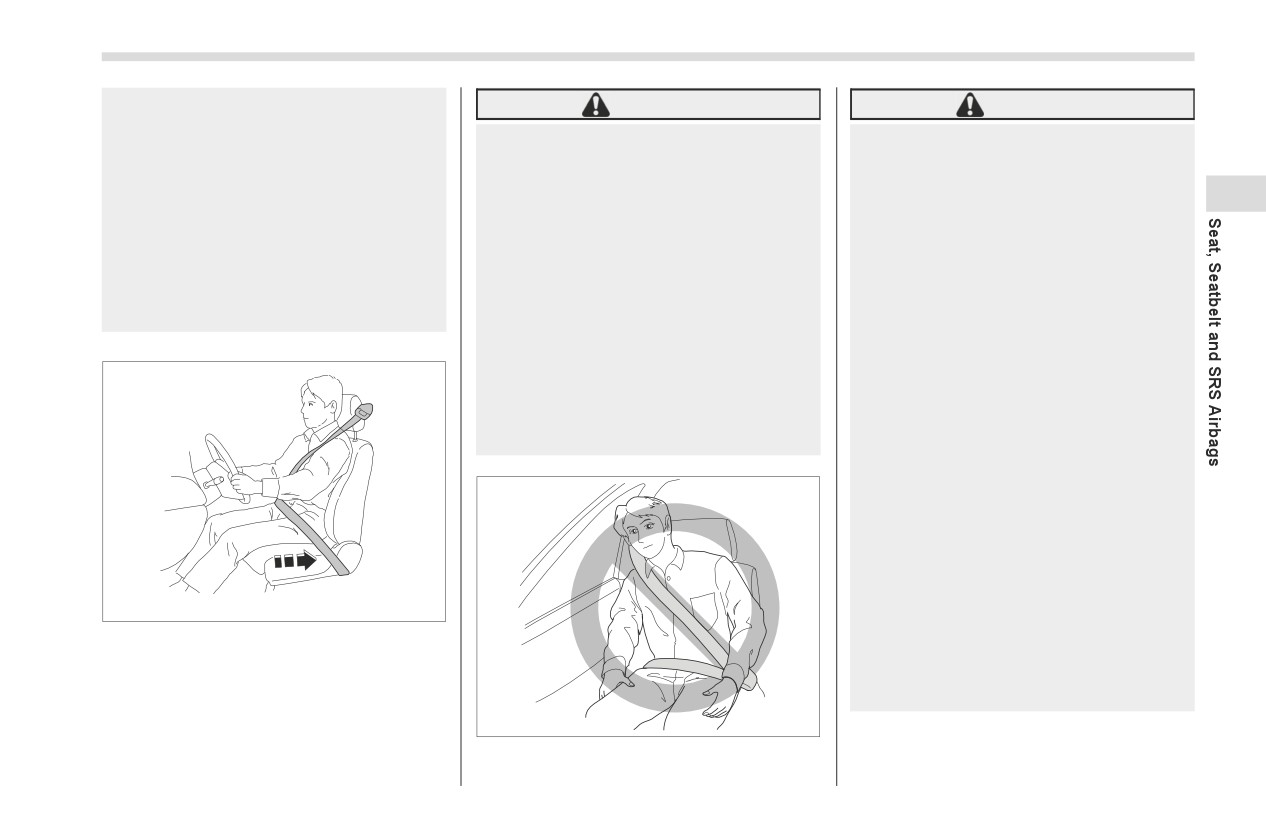
Do not sit or lean close to either
protection provided by the
siderable speed and force. Occu-
door. The SRS side airbags are
seatbelt. They do not eliminate
pants who are not seated in proper
stored in both front seat
seatbacks next to the door, and
1
the need to fasten seatbelts. It is
upright position when the SRS
also important to wear a seatbelt
airbag deploys could suffer serious
they provide protection by
to help avoid injuries that can
injury. Because the SRS airbag
deploying rapidly in the event of a
result when an occupant is not
needs enough space for deploy-
side impact collision. However,
the force of SRS side airbag
seated in a proper upright posi-
ment, the driver should always sit
tion.
upright and back in the seat as far
deployment can injure an occu-
from the steering wheel as practical
pant whose body is too close to
while still maintaining full vehicle
an SRS airbag.
control, and the front passenger
Since your vehicle is equipped
should move the seat as far back as
with SRS curtain airbags, do not
possible and sit
upright and well
sit or lean close to the door on
back in the seat.
either side. Do not put body parts
out of the window. The SRS
curtain airbags on both sides of
the cabin are stored in the roof
side (between the front pillar and
a point behind the rear quarter
glass), and they provide protec-
tion by deploying rapidly in the
event of a side impact, rollover or
100155
an offset frontal collision.
However, the force of its deploy-
ment can injure an occupant
whose body is too close to an
SRS airbag.
102008
- CONTINUED -
62
SRS Airbag (Supplemental Restraint System Airbag)
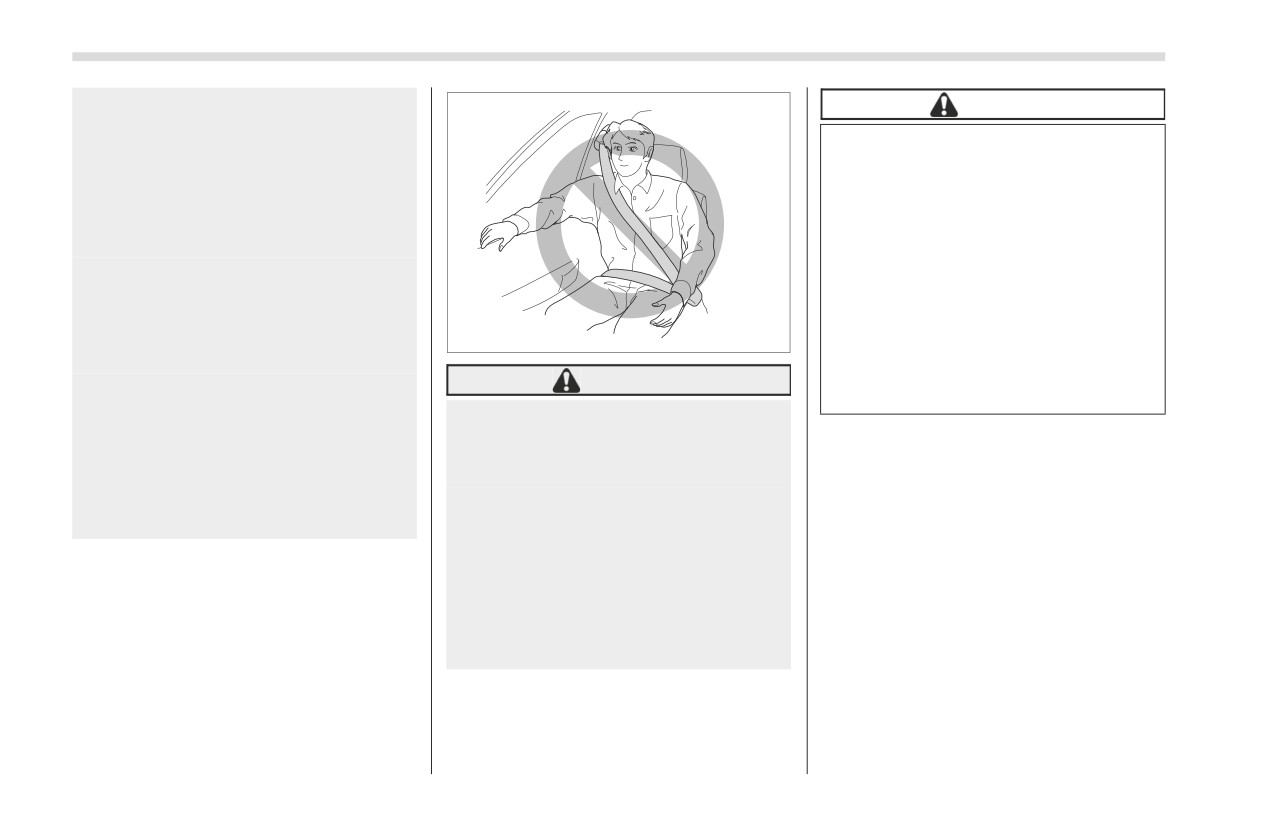
Do not sit or lean unnecessarily
CAUTION
close to the SRS airbag. Because
the SRS airbag deploys with
When the SRS airbag deploys,
considerable speed and force to
some smoke will be released.
protect in high speed collisions,
This smoke could cause
the force of an airbag can injure
breathing problems for people
an occupant whose body is too
with a history of asthma or other
close to SRS airbag.
breathing trouble. If you or your
passengers have breathing prob-
It is also important to wear
lems after SRS airbag deploys,
seatbelts to help avoid injuries
get fresh air promptly.
that can result when the SRS
A deploying SRS airbag releases
airbag contacts an occupant not
102009
hot gas. Occupants could get
in their proper position.
burned if they come into direct
WARNING
Even when properly positioned,
contact with the hot gas.
there remains a possibility that
Keep arms away from either door
an occupant may suffer minor
or its internal trim. They could be
NOTE
injury, such as abrasions and
injured in the event of SRS side
When you sell your vehicle, we urge
bruises to the face or arms,
airbag deployment.
you to inform the buyer that the vehicle
because of the SRS airbag
Do not place any objects over or
is equipped with SRS airbags. Also,
deployment force.
near the SRS airbag cover or
notify the buyer of the applicable
between you and the SRS airbag.
section in this Owner’s Manual.
If the SRS airbag deploys, these
If the SRS airbag deploys, fuel
objects could interfere with its
supply will be cut off to reduce the risk
proper operation and could be
of fire caused by leaking fuel. For
propelled inside the vehicle,
details about restarting of the engine,
causing injury.
refer to "If Your Vehicle Is Involved in
an Accident" ) P328.
SRS Airbag (Supplemental Restraint System Airbag)
63
■ General Precautions
WARNING
regarding SRS Airbag
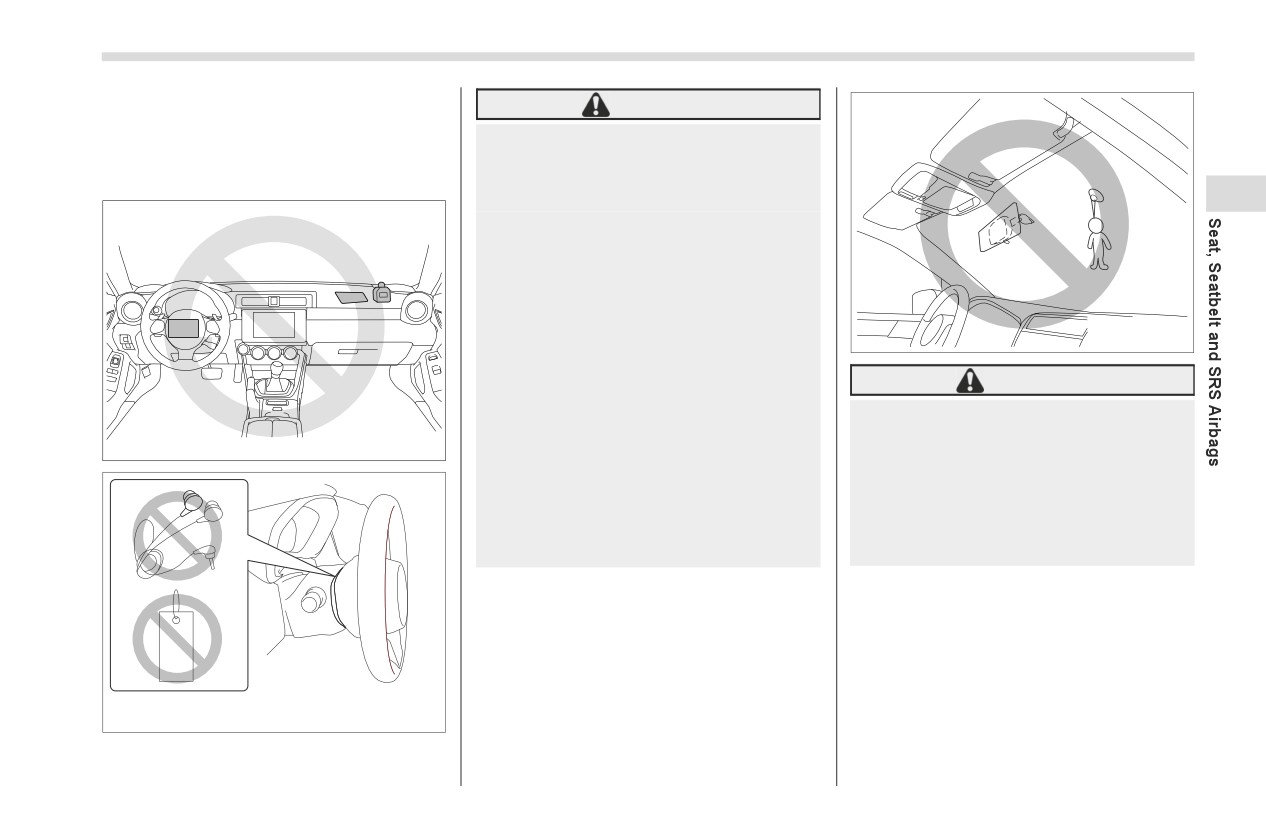
Do not put any objects (including
System for Accessories and
straps or cord) over the steering
Any Objects
wheel pad, column cover, or
dashboard.
1
-
These objects could be entan-
gled with the steering wheel,
preventing the SRS frontal
airbag, etc. from operating
properly.
-
If the SRS frontal airbag
101940
deploys, these objects could
be propelled inside the
WARNING
vehicle, causing injury.
Do not put any objects under the
Do not attach accessories to the
driver’s side of the instrument
windshield, or fit an extra-wide mir-
102683
panel. If the SRS knee airbag
ror over the inside rear view mirror.
deploys, those objects could
If the SRS airbag deploys, those
interfere with its proper operation
objects could become projectiles
and could be propelled inside the
that could seriously injure vehicle
vehicle, causing injury.
occupants.
102218
- CONTINUED -
64
SRS Airbag (Supplemental Restraint System Airbag)
Do not attach a hands-free micro-
WARNING
phone or any other accessory to a
front pillar, a center pillar, a rear
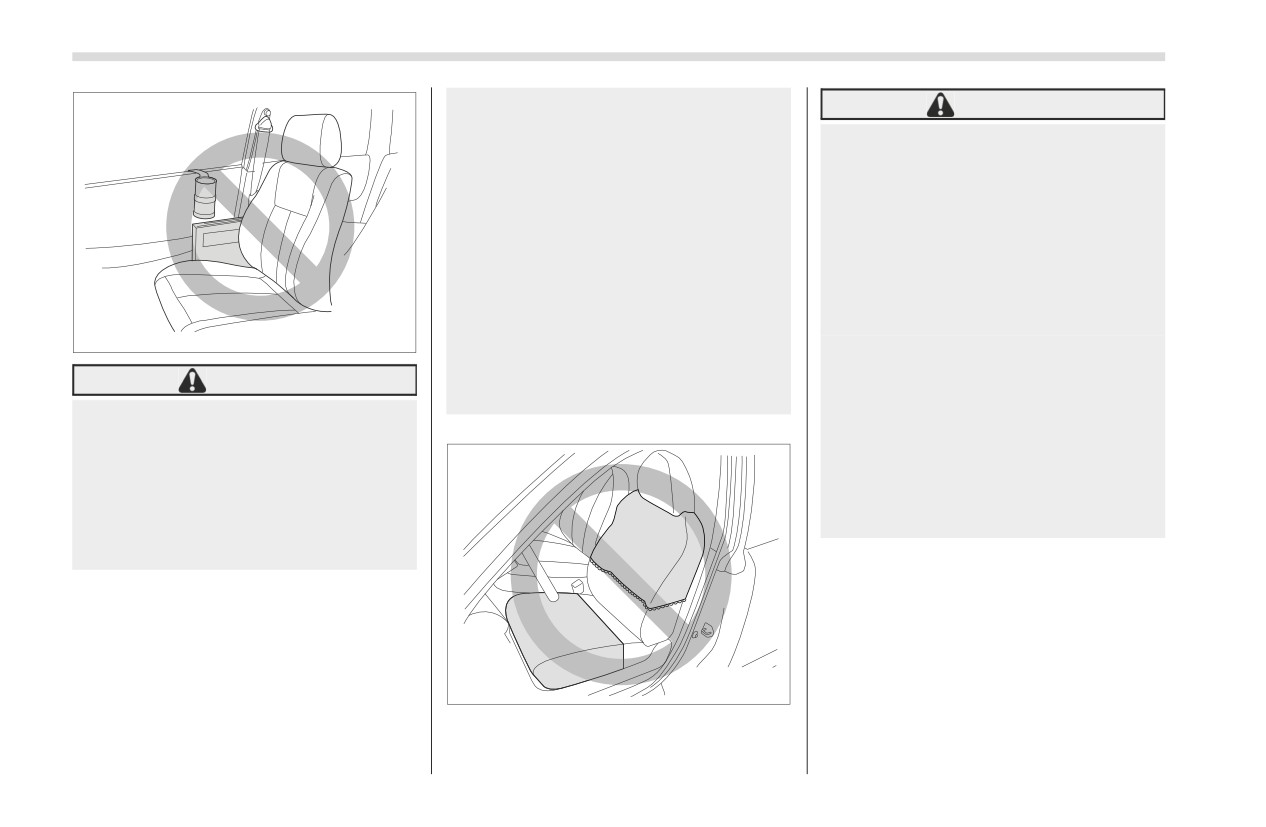
Do not put any kind of clothes or
pillar, the windshield, a side
other objects over the front
window, or any other cabin
seatback and do not attach labels
surface that would be near a
or stickers to the front seat
deploying SRS curtain airbag. A
surface on or near the SRS side
hands-free microphone or other
airbag. They could prevent
accessory in such a location
proper deployment of the SRS
side airbag, reducing protection
could be propelled through the
available to the front seat’s occu-
cabin with great force by the
curtain airbag, or it could prevent
pant.
100168
correct deployment of the curtain
Do not install a seat cover unless
airbag. In either case, the result
it is a genuine SUBARU seat
WARNING
could be serious injuries.
cover exclusively designed for
Do not attach accessories to the
use with the SRS airbag. Even
door trim or near either SRS side
when using a genuine SUBARU
airbags and do not place objects
seat cover, the SRS side airbag
near the SRS side airbags. In the
system may not function
event of SRS side airbag deploy-
normally if the seat cover is not
ment, they could be propelled
installed correctly.
dangerously toward the vehicle’s
occupants and cause injuries.
101973
SRS Airbag (Supplemental Restraint System Airbag)
65
■ General Precautions
For that reason, we strongly recom-
regarding SRS Airbag
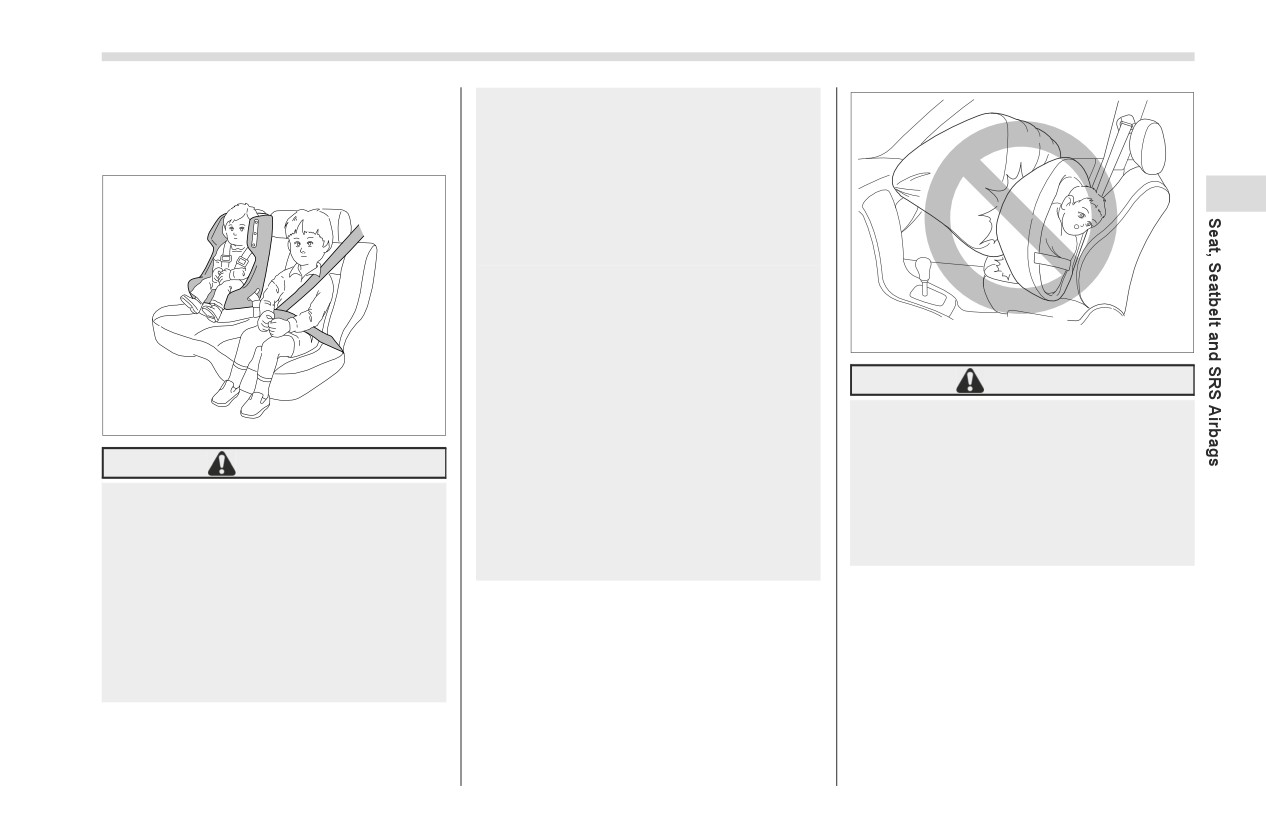
mend that ALL children (including
those in child restraint systems) sit
System and Children
in the REAR seat properly
restrained at all times in a child
1
restraint system or in a seatbelt,
whichever is appropriate for the
child’s age, height and weight.
Secure ALL types of child restraint
systems (including forward facing
child restraint system) in the REAR
101999
seats at all times.
According to accident statistics,
WARNING
children are safer when properly
100082
restrained in the rear seating posi-
NEVER
INSTALL A
CHILD
tions than in the front seating posi-
RESTRAINT SYSTEM IN THE
tions.
FRONT SEAT. DOING SO RISKS
WARNING
SERIOUS INJURY OR DEATH TO
For instructions and precautions
Seat children in the rear seat prop-
THE CHILD BY PLACING THE
concerning the child restraint sys-
erly restrained at all times. The SRS
CHILD’S HEAD TOO CLOSE TO THE
tem, refer to "Child Restraint Sys-
airbag deploys with considerable
SRS AIRBAG.
tems" ) P46.
speed and force and can injure or
even kill children, especially if they
are not restrained or improperly
restrained. Because children are
lighter and weaker than adults, their
risk of being injured from deploy-
ment is greater.
- CONTINUED -
66
SRS Airbag (Supplemental Restraint System Airbag)
100126
100125
100166
WARNING
WARNING
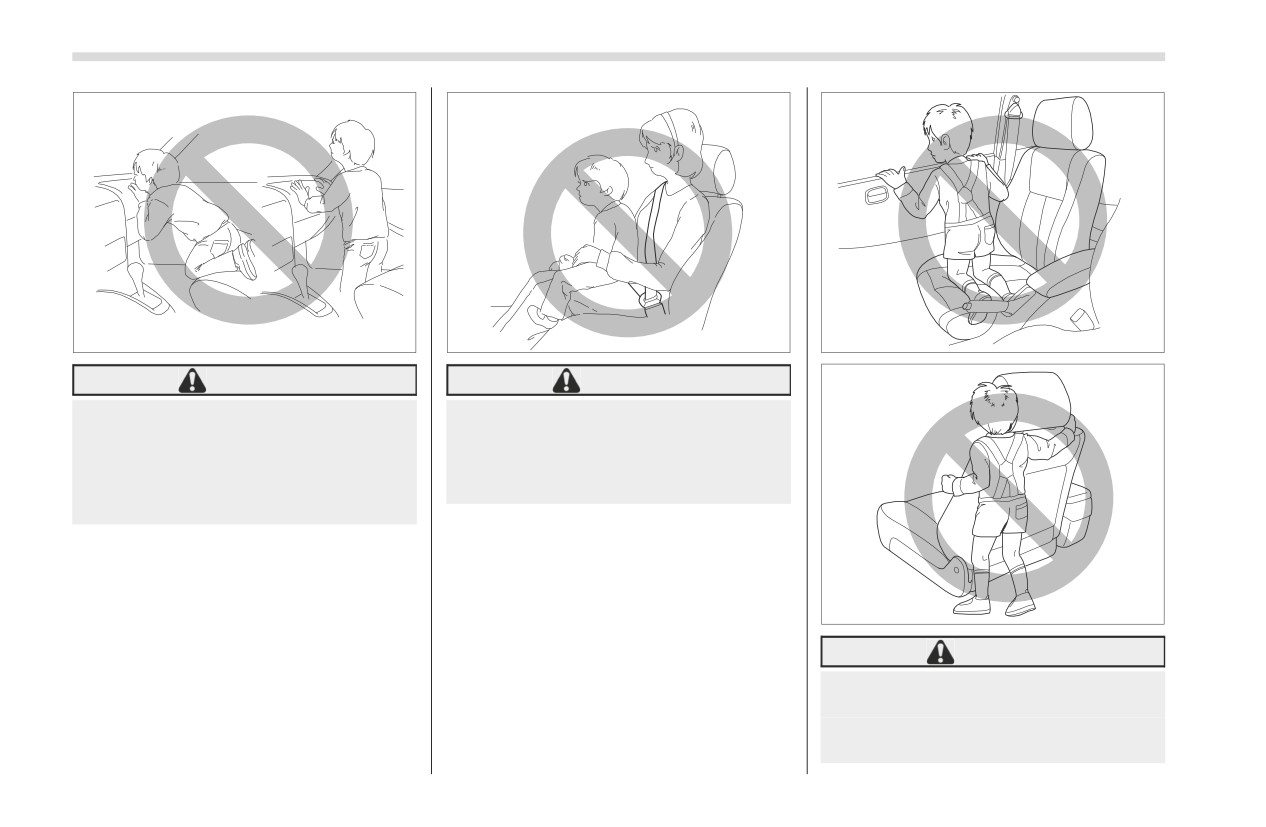
Never allow a child to stand up or
Never hold a child on your lap or in
kneel on the front passenger’s seat.
your arms. The SRS airbag deploys
The SRS airbag deploys with con-
with considerable force and can
siderable force and can injure or
injure or even kill the child.
even kill the child.
100167
WARNING
Never allow a child to do the
following.
-
Kneel on any passenger’s
seat facing the side window
SRS Airbag (Supplemental Restraint System Airbag)
67
-
Wrap his/her arms around the
front seat seatback
-
Put his/her head, arms or
other parts of the body out of
the window
1
In the event of an accident, the
force of SRS side airbag and/or
SRS curtain airbag deployment
could injure the child seriously
because his/her head, arms or
other parts of the body are too
close to the SRS side airbag and/
or SRS curtain airbag.
Since your vehicle is also
equipped
with
a
front
passenger’s SRS frontal airbag,
children should be placed in the
rear seat anyway and should be
properly restrained at all times.
- CONTINUED -
68
SRS Airbag (Supplemental Restraint System Airbag)
■ Components
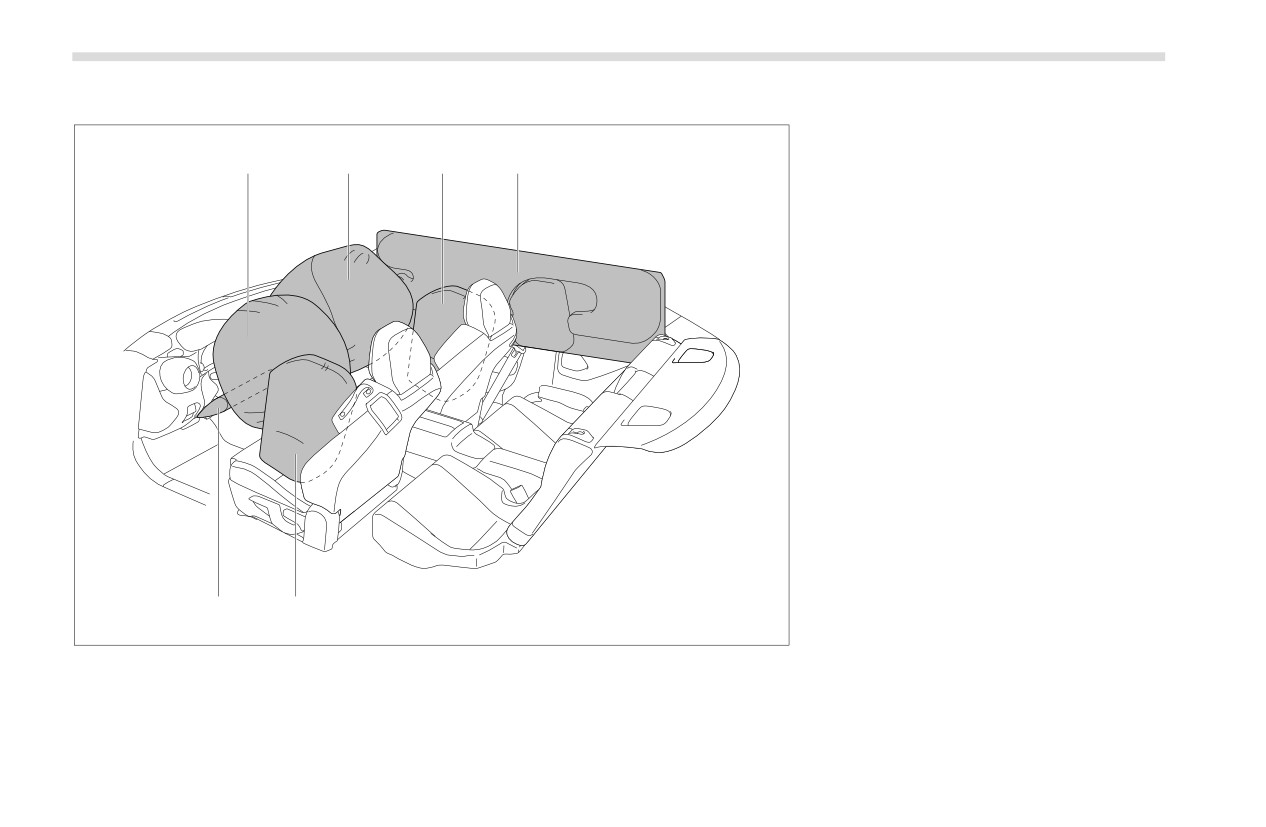
The SRS airbags are stowed in the
following locations.
1
2
3
4
Driver’s SRS frontal airbag: in the
center portion of the steering wheel
An “SRS AIRBAG” mark is located on the
pad of the airbag.
Front passenger’s SRS frontal airbag:
near the top of the right side of dashboard
An “SRS AIRBAG” mark is located on the
right corner of the dashboard.
SRS side airbag: in the door side of each
front seat seatback
“SRS AIRBAG” marks are located on the
door side of each front seat cushion.
SRS curtain airbag: in the roof side
(between the front pillar and a point over
the rear seat)
“SRS AIRBAG” marks are located at the
top of each center pillar.
SRS knee airbag: under the steering
column
5
3
An “SRS AIRBAG” mark is located at the
102684
door of the airbag.
1)
Driver’s SRS frontal airbag
2)
Front passenger’s SRS frontal airbag
3)
SRS side airbag
4)
SRS curtain airbag
5)
SRS knee airbag
SRS Airbag (Supplemental Restraint System Airbag)
69
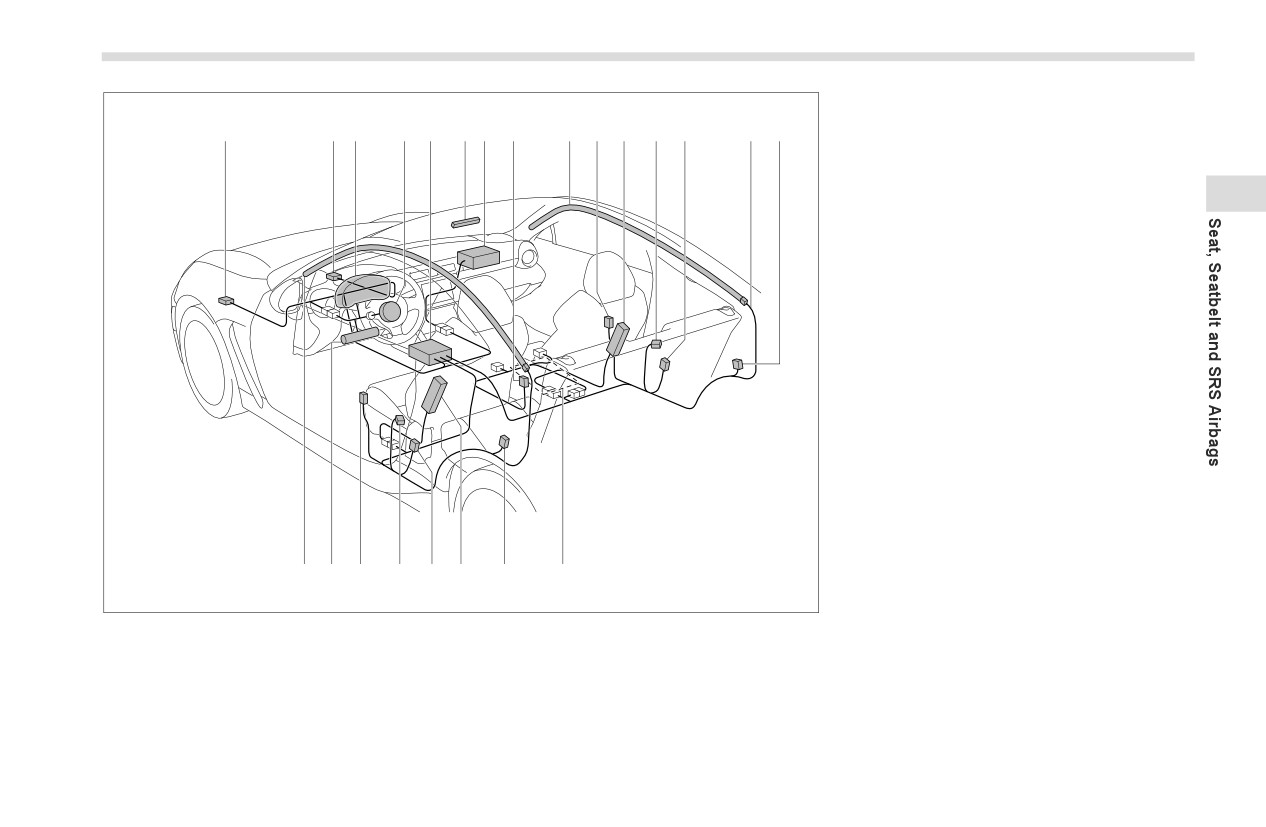
1) Front impact sensor (left-hand side)
2) Front impact sensor (right-hand side)
1
2
3
4
5
6
7
8
9
10
11
12
13
14
15
3) SRS airbag system warning light
4) Frontal airbag module (driver’s side)
5) Airbag control module (including impact
sensor and rollover sensor)
1
6) Front passenger’s frontal airbag ON
and OFF indicator
7) Frontal
airbag
module
(front
passenger’s side)
8) Seatbelt
buckle
switch
(front
passenger’s side)
9) Curtain airbag module (right-hand side)
10) Side impact sensor
(door right-hand
side)
11) Side airbag module (front passenger’s
side)
12) Seatbelt pretensioner and adaptive
force limiter (front passenger’s side)
13) Side impact sensor (center pillar right-
hand side)
14) Airbag wiring
15) Side impact sensor (rear wheel house
right-hand side)
16) Front passenger’s occupant detection
23
22
21
20
19
18
17
16
sensors
102764
17) Side impact sensor (rear wheel house
left-hand side)
18) Side airbag module (driver’s side)
19) Side impact sensor (center pillar left-
hand side)
20) Seatbelt pretensioner (driver’s side)
21) Side impact sensor (door left-hand side)
22) Knee airbag module (driver’s side)
23) Curtain airbag module (left-hand side)
- CONTINUED -
70
SRS Airbag (Supplemental Restraint System Airbag)
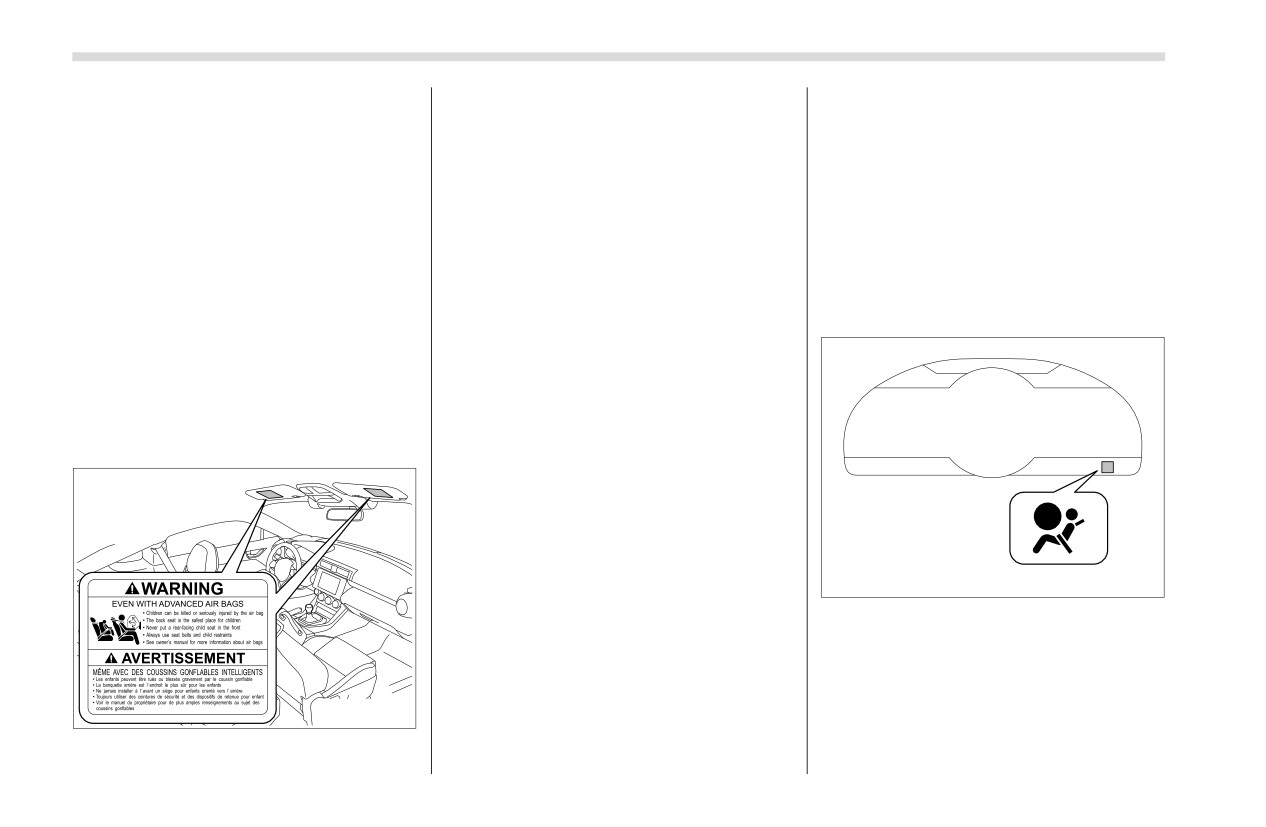
■ SUBARU Advanced Frontal
beginning with the phrase “EVEN WITH
NOTE
ADVANCED AIR BAGS” and a tag
Airbag System
Only driver’s SRS frontal airbag and
attached to the glove box lid beginning
front passenger’s SRS frontal airbag
This vehicle is equipped with a SUBARU
with the phrase “Even with Advanced Air
are controlled by the SUBARU
advanced frontal airbag system that
Bags”. Make sure that you carefully read
advanced frontal airbag system.
complies with the new advanced frontal
the instructions on the warning labels and
airbag requirements in the amended
tag.
▼ Driver’s SRS frontal airbag
Federal Motor Vehicle Safety Standard
Always wear your seatbelt. The SUBARU
(FMVSS) No. 208.
The driver’s SRS frontal airbag uses a
advanced frontal airbag system is a
dual stage inflator. The inflator operates in
The SUBARU advanced frontal airbag
supplemental restraint system and must
different ways depending on the severity
system automatically determines the
be used in combination with a seatbelt. All
of impact.
deployment force of the driver’s SRS
occupants should wear a seatbelt or be
frontal airbag at the time of deployment as
seated in an appropriate child restraint
well as whether or not to activate the front
system.
passenger’s SRS frontal airbag and, if
For the locations of the SRS airbags, refer
activated, the deployment force of the
to "Components" ) P68.
SRS frontal airbag at the time of deploy-
In a moderate to severe frontal collision,
ment.
the following components deploy.
SRS frontal airbag for driver
SRS frontal airbag for front passenger
SRS curtain airbag*
SRS knee airbag for driver
*: When an offset frontal collision that is
102698
severe enough to deploy the front airbag
occurs.
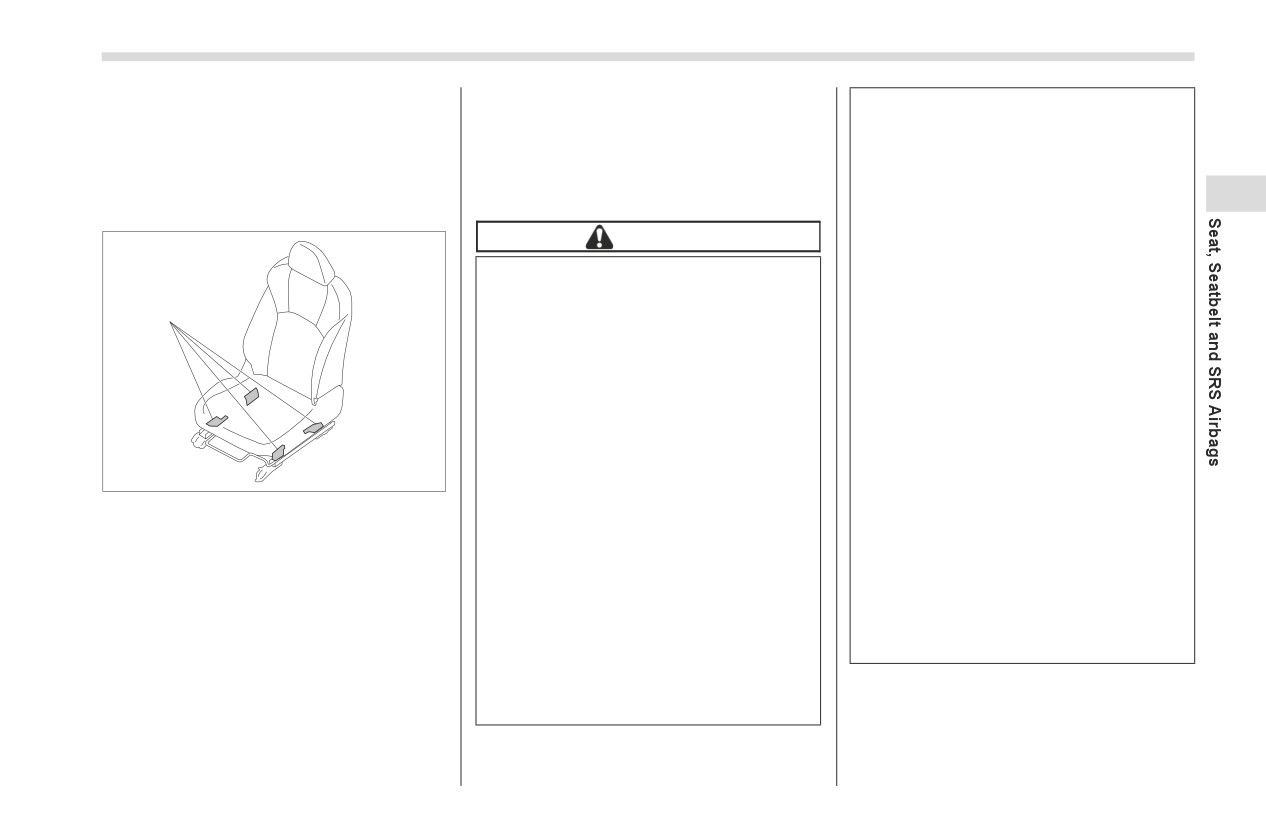
SRS airbag system warning light
These components supplement the
seatbelts by reducing the impact to the
occupant’s head, chest and knees.
102697
This vehicle has warning labels on the
driver’s and front passenger’s sun visors
SRS Airbag (Supplemental Restraint System Airbag)
71
▼ Front passenger’s SRS frontal
frontal airbag does not operate, the front
Do not place any objects (books,
airbag
passenger’s seatbelt pretensioner oper-
etc.)
around
the
front
ates with
the
driver’s
seatbelt
passenger’s seat.
The front passenger’s SRS frontal airbag
pretensioner.
For details about the
uses a dual stage inflator. The inflator
Do not use the front passenger’s
seatbelt pretensioner, refer to "Seatbelt
operates in different ways depending on
seat with the head restraint
Pretensioners" ) P44.
1
the severity of impact.
removed.
Do not leave any articles on the
CAUTION
front passenger’s seat or the
Observe the following precautions.
seatbelt tongue and buckle
Failure to do so may prevent the
engaged when you leave your
1
SUBARU advanced frontal airbag
vehicle.
system from functioning correctly
Do not put sharp object(s) on the
or cause the system to fail.
seat or pierce the seat uphol-
Do not apply any strong impact to
stery.
the front passenger’s seat such
Do not place a magnet near the
as by kicking.
seatbelt buckle and the seatbelt
Do not let rear passengers rest
retractor.
102171
their feet between the front
Do not use front seats with their
seatback and seat cushion.
backward-forward position and
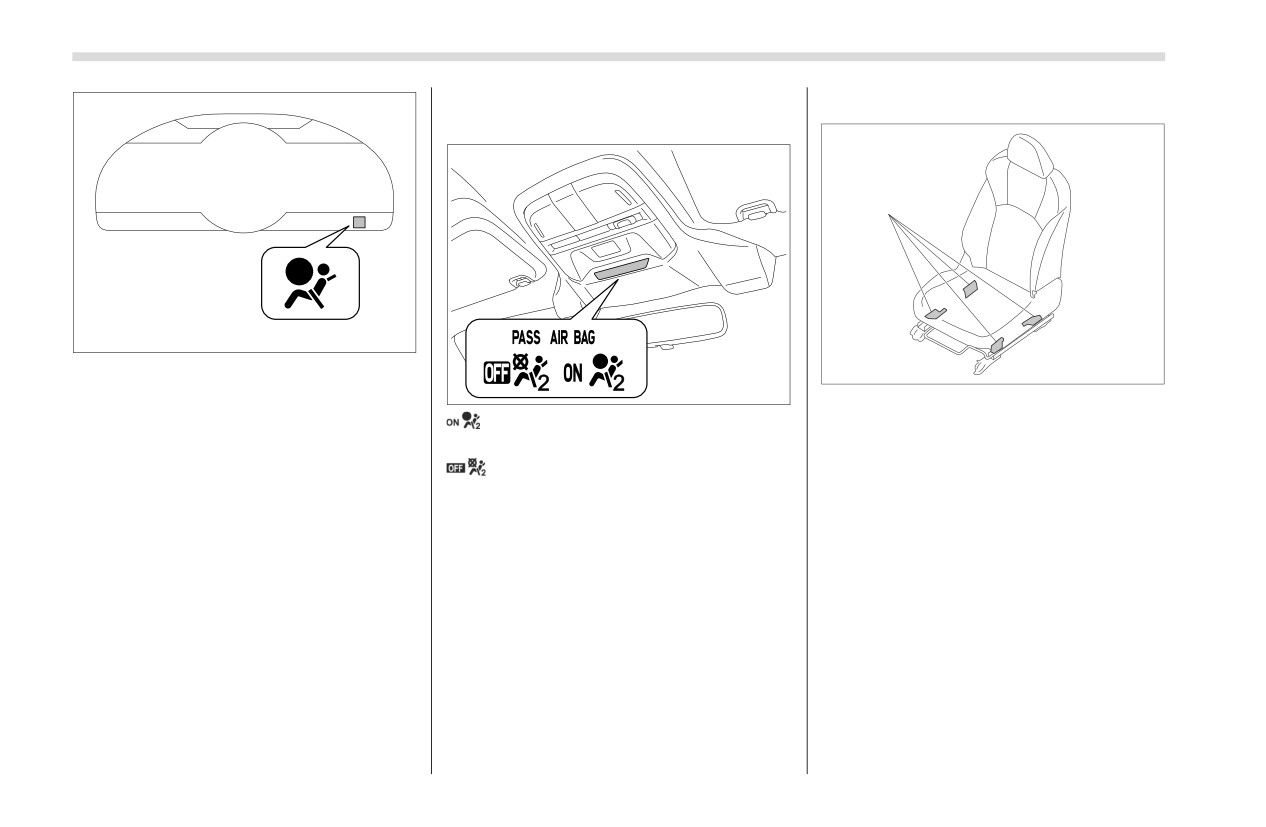
1) Occupant detection sensors
Do not remove or disassemble
seatback not being locked into
The occupant detection sensors are
the front passenger’s seat.
place securely. If any of them are
installed between the seat and seat rails,
not locked securely, adjust them
Do not install any accessory
and monitor the physique and posture of
again. For adjusting procedure,
(such as an audio amplifier) other
refer to "Manual Seat"
) P33
the front passenger. Using this informa-
than a genuine SUBARU acces-
tion, the occupant detection system deter-
sory under the front passenger’s
(models equipped with manual
mines whether the front passenger’s SRS
seat.
seats only).
frontal airbag should be deployed or not.
Do not place anything (shoes,
The occupant detection system may not
umbrella, etc.) under the front
inflate the front passenger’s SRS frontal
passenger’s seat.
airbag even when the driver’s SRS frontal
airbag deploys. This is normal. In this
case, although the front passenger’s SRS
- CONTINUED -
72
SRS Airbag (Supplemental Restraint System Airbag)
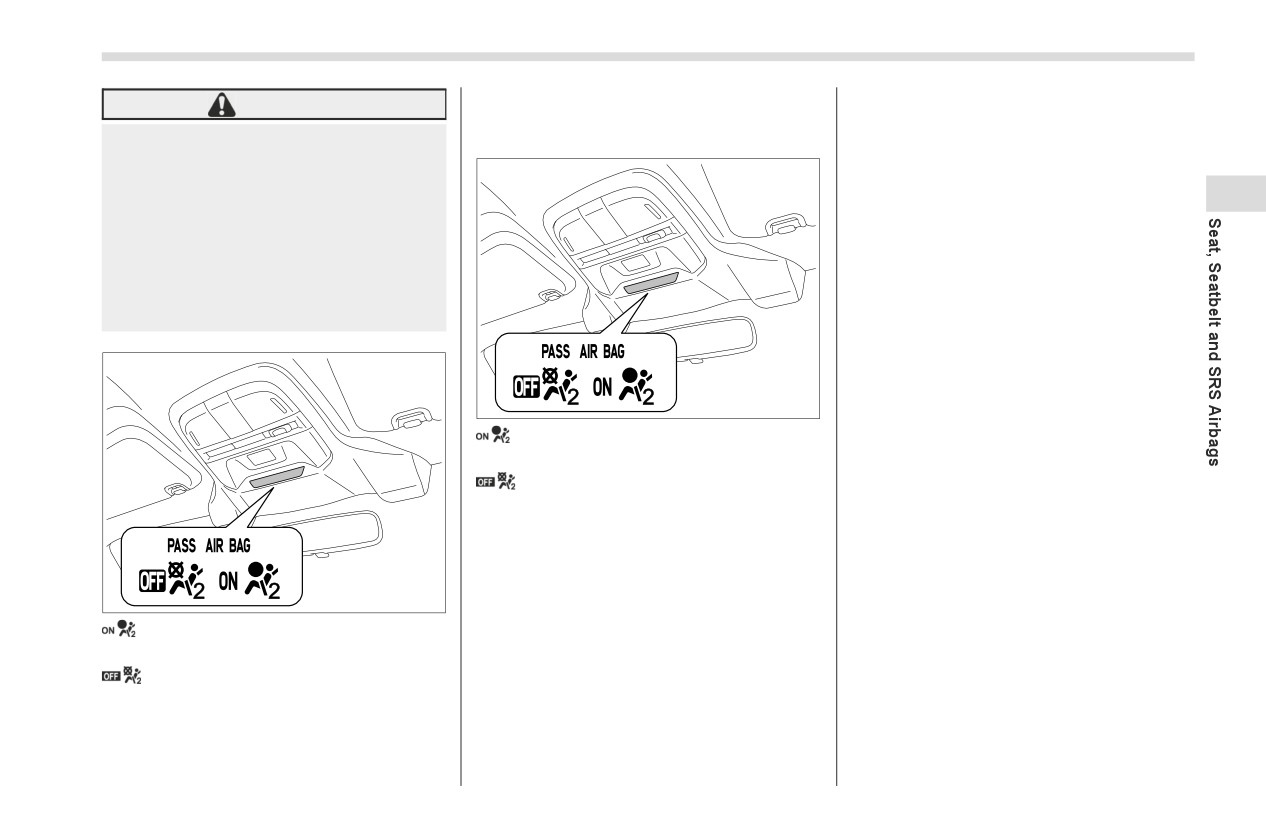
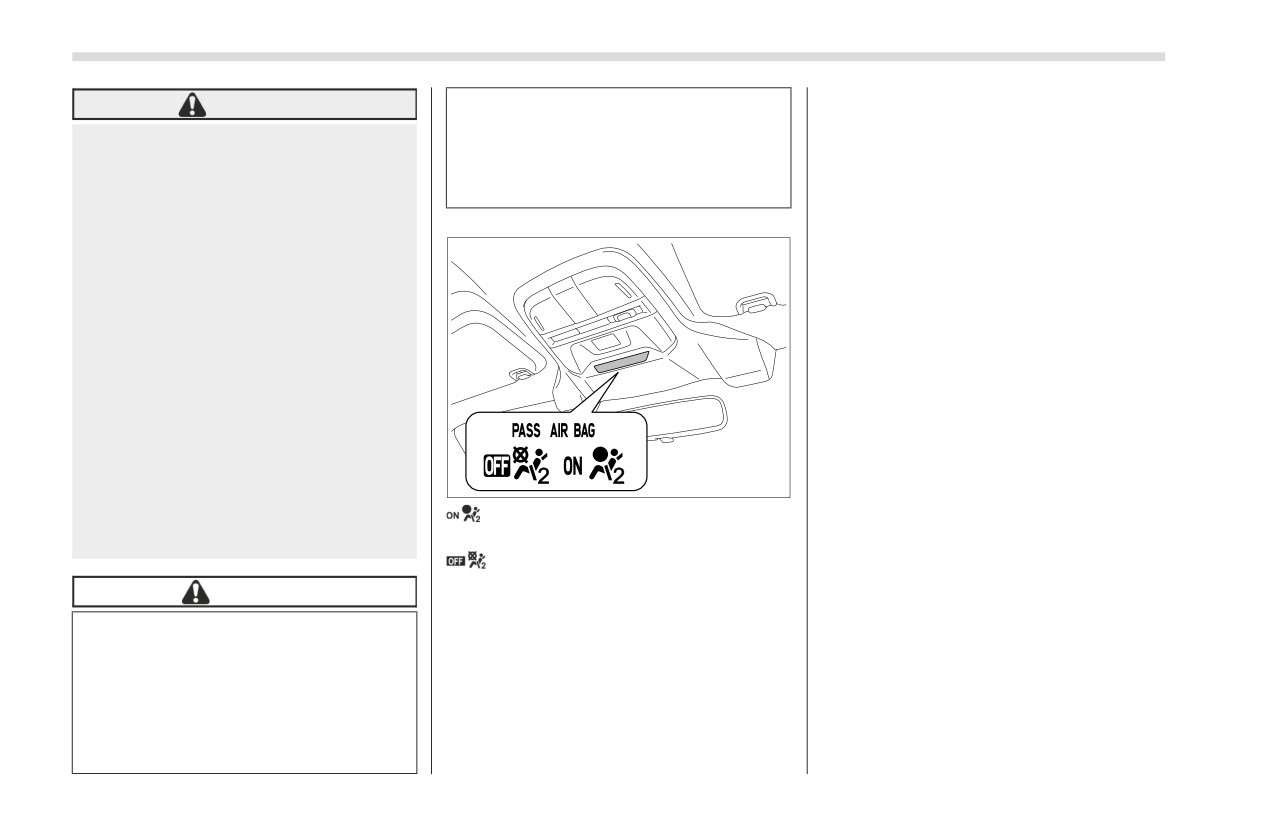
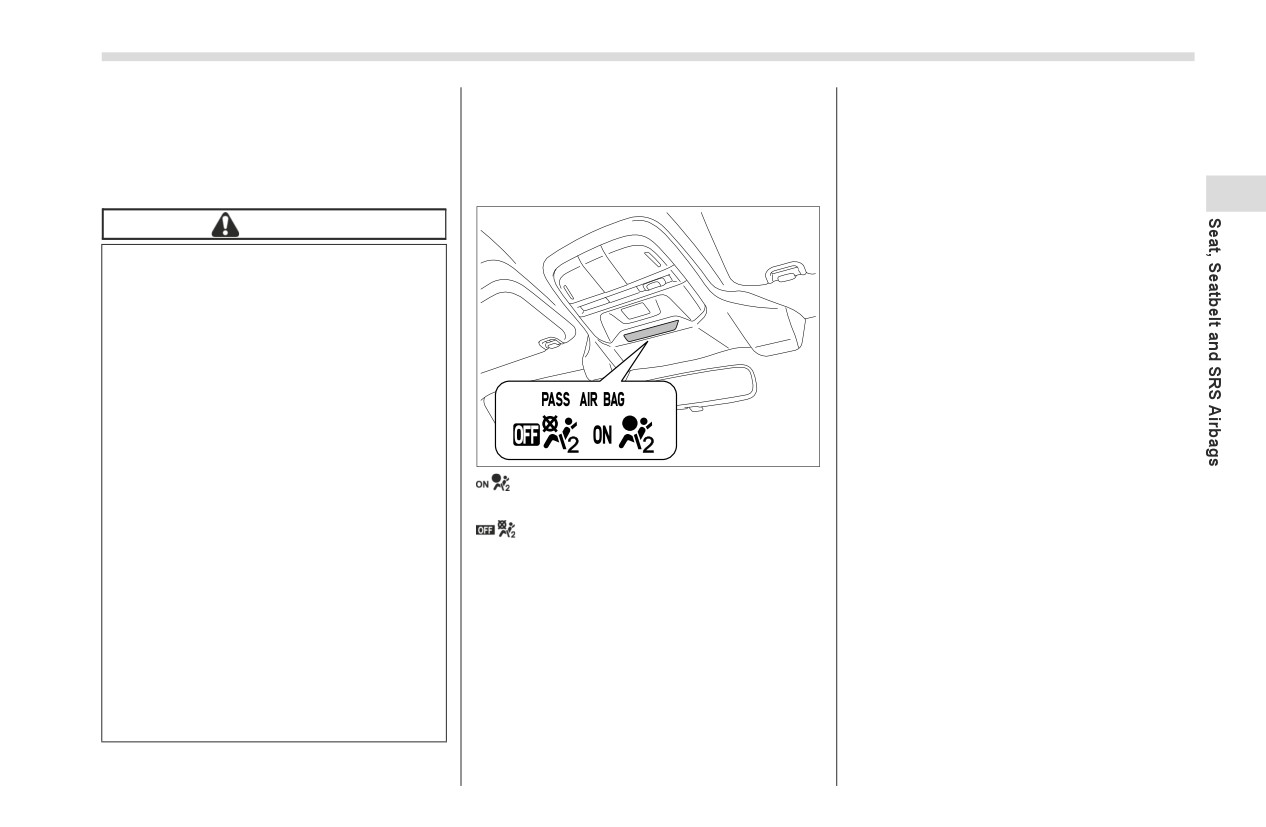
▼ Passenger’s frontal airbag ON and
▼ Occupant detection system
OFF indicators
1
102698
SRS airbag system warning light
102171
If the seatbelt buckle switch and/or front
306789
1) Occupant detection sensors
passenger’s occupant detection system
: Front passenger’s frontal airbag ON
have failed, the SRS airbag system
The occupant detection sensors are
indicator
warning light will illuminate. Have the
installed between the seat and seat rails,
system inspected by your SUBARU
:Front passenger’s frontal airbag
and monitor the physique and posture of
OFF indicator
dealer immediately if the SRS airbag
the front passenger. Using this informa-
system warning light illuminates.
Refer to "Front Passenger’s Frontal
tion, the occupant detection system deter-
If your vehicle has sustained impact, this
Airbag ON and OFF Indicators" ) P135.
mines whether the front passenger’s SRS
may affect the proper function of the
frontal airbag should be deployed or not.
SUBARU advanced frontal airbag system.
If the SRS airbag system warning light illu-
minates, immediately stop the vehicle in a
safe place, and consult a SUBARU
dealer.
SRS Airbag (Supplemental Restraint System Airbag)
73
passenger’s seat and have the occupant
▼ Conditions in which front
WARNING
detection system checked by your
passenger’s SRS frontal airbag is
Do not kick the front passenger seat
SUBARU dealer.
not activated
or subject it to severe impact. Oth-
The front passenger’s SRS frontal airbag
erwise, the SRS airbag system
will not be activated when any of the
1
warning light may illuminate to indi-
following conditions are met regarding the
cate a malfunction of the front pas-
front passenger’s seat:
senger occupant detection system.
The seat is empty.
In this case, immediately stop the
The seat is equipped with an appro-
vehicle in a safe place, and consult
priate child restraint system and an infant
a SUBARU dealer.
or a child is restrained in it.
(See
WARNING that follows.)
The front passenger’s occupant detec-
tion system is malfunctioning.
306789
:
Front passenger’s frontal airbag ON
indicator
: Front passenger’s frontal airbag
OFF indicator
Also, if luggage is placed on the front
passenger’s seat, this may adversely
affect the ability of the system to deter-
mine deployment. This may prevent the
306789
front passenger’s frontal airbag ON and
:
Front passenger’s frontal airbag ON
OFF indicators from working properly.
indicator
Check that the indicators work properly.
:Front passenger’s frontal airbag
When the OFF indicator turns off and the
OFF indicator
ON indicator illuminates, the front
If the front passenger’s frontal airbag ON
passenger’s frontal airbag may deploy
and OFF indicators do not work properly,
during a collision. Remove luggage from
do not allow anyone to sit on the front
the front passenger’s seat.
- CONTINUED -
74
SRS Airbag (Supplemental Restraint System Airbag)
moving the seat back and forth. (Models
Do not allow the rear seat occu-
WARNING
equipped with manual seats only)
pant to place his/her hands or
NEVER INSTALL A CHILD
legs on the front passenger's
If the ON indicator still remains illuminated
RESTRAINT SYSTEM IN THE
seatback, or allow him/her to pull
while the OFF indicator turns off after
FRONT PASSENGER’S SEAT EVEN
the seatback.
taking
relevant
corrective
actions
IF THE FRONT PASSENGER’S SRS
described above, immediately contact
FRONTAL AIRBAG IS DEACTI-
your SUBARU dealer for an inspection.
VATED. Be sure to install it in the
Even if the system has passed the dealer
REAR seat in a correct manner.
inspection, it is recommended that on
Also, it is strongly recommended
subsequent trips the small adult always
that any child restraint system
take the rear seat.
(including any booster seat) be
installed in the REAR seat, and that
NOTE
even children who have outgrown a
When a small adult is seated in the
child restraint system be also
front passenger’s seat, the SUBARU
seated in the REAR seat. This is
advanced frontal airbag system may or
because children sitting in the front
may not activate the front passenger’s
passenger’s seat may be killed or
SRS frontal airbag depending on the
severely injured should the front
306789
occupant’s seating posture. If the OFF
passenger’s SRS frontal airbag
indicator remains illuminated while the
deploy. REAR seats are the safest
:
Front passenger’s frontal airbag ON
ON indicator turns off when a small
place for children.
indicator
adult is seated in the front passenger's
:Front passenger’s frontal airbag
seat, see next section “Conditions in
OFF indicator
which front passenger's SRS frontal
CAUTION
If you think that the Front passenger's
airbag is activated.”
Observe the following precautions
frontal airbag ON/OFF indicator is incor-
rect, take the following actions.
▼ Conditions in which front
as it increase the load on the front
passenger’s SRS frontal airbag is
passenger's seat and not work
Ensure that no article is placed on the
activated
properly.
seat other than the occupant.
Ensure that the backward-forward
The front passenger’s SRS frontal airbag
Do not install any accessory such
position and seatback of front passenger’s
will be activated for deployment upon
as a table or TV onto the
seat are locked into place securely by
impact when any of the following condi-
seatback.
SRS Airbag (Supplemental Restraint System Airbag)
75
tions are met regarding the front
▽ If the passenger’s frontal airbag
her legs out forward, and adjust the seat
passenger’s seat.
OFF indicator illuminates and
to the rearmost position.
When the seat is occupied by an adult.
the ON indicator turns off even
3. Turn the ignition switch to the “ON”
when the front passenger’s seat
position.
When certain items (e.g. jug of water)
is occupied by an adult
are placed on the seat.
If the OFF indicator remains illuminated
1
while the ON indicator remains off, take
CAUTION
the following actions.
When the front passenger's seat is
1. Turn the ignition switch to the “OFF”
occupied by an adult, observe the
position.
following precautions.
2. Make sure that the front passenger
does not use a blanket, extra seat
Failure to do so may lessen the load
cushion, seat cover, extra seat heater or
on the front passenger's seat, deac-
massager, etc.
tivating the front passenger's SRS
3. If wearing excessive layers of clothing,
frontal airbag despite the fact that
the front passenger should remove any
the seat is occupied by an adult.
unnecessary items before sitting in the
This may result in personal injury.
306789
front passenger’s seat, or should sit in a
rear seat.
Do not allow the rear seat occu-
:
Front passenger’s frontal airbag ON
pant to lift the front passenger's
indicator
4. Turn the ignition switch to the “ON”
seat cushion using his/her feet.
position and wait 6 seconds to allow the
: Front passenger’s frontal airbag
system to complete self-checking.
Do not place any article under the
OFF indicator
Following the system check, both indica-
front passenger's seat, or
This can be caused by the adult incor-
tors turn off for 2 seconds. Now, the ON
squeeze any article from behind
rectly sitting in the front passenger’s seat.
indicator should illuminate while the OFF
and under the seat.
1. Turn the ignition switch to the “OFF”
indicator remains off.
Do not squeeze any article
position.
If the OFF indicator still remains illumi-
between the front passenger's
seat and side trim/pillar, door or
2. Ask the front passenger to set the
nated while the ON indicator remains off,
center console box. This may lift
seatback to the upright position, sit up
ask the occupant to move to the rear seat
the seat cushion.
straight in the center of the seat cushion,
and immediately contact your SUBARU
correctly fasten the seatbelt, position his/
dealer for an inspection.
- CONTINUED -
76
SRS Airbag (Supplemental Restraint System Airbag)
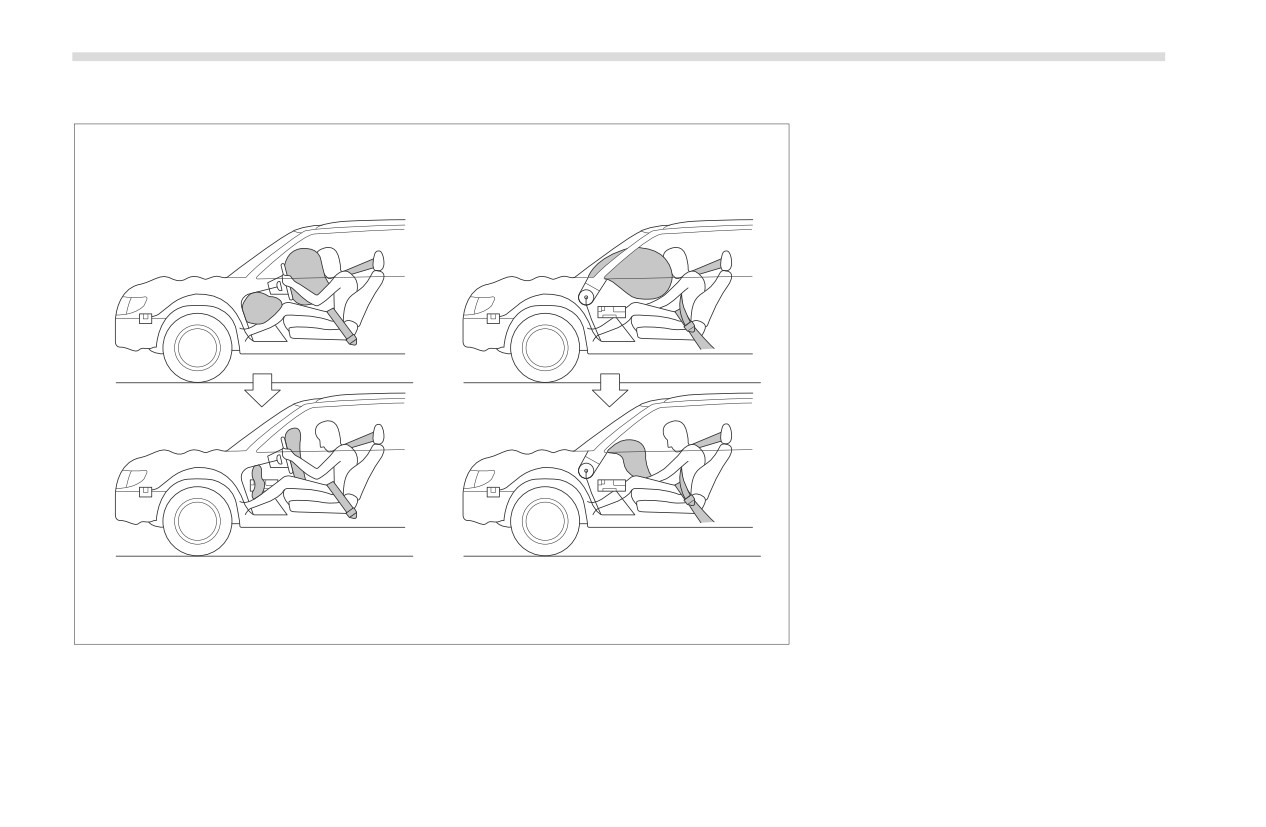
▼ Operation
A) Driver’s side
B) Passenger’s side
1) SRS AIRBAGs deploy as soon as a
collision occurs.
2) After deployment, SRS AIRBAGs start
A
B
to deflate immediately so that the
driver’s vision is not obstructed.
1
The SRS airbags can function only when
the ignition switch is in the “ON” position.
The SUBARU advanced frontal airbag
system is designed to determine the acti-
vation or deactivation condition of the front
passenger’s
SRS frontal airbag
depending on the characteristic of item(s)
2
or person on the front passenger’s seat
monitored by the front passenger’s occu-
pant detection sensors. For this reason,
only the driver’s SRS frontal airbag may
deploy in the event of a collision, but this
does not mean failure of the system.
If the following sensors detect a predeter-
mined amount of force during a frontal
collision, the control module sends signals
101586
to the airbag module(s)
(only driver’s
module or both driver’s and front
passenger’s modules) instructing the
module(s) to inflate the SRS frontal
airbag(s).
SRS Airbag (Supplemental Restraint System Airbag)
77
The front impact sensors
When the SRS airbag deploys, a sudden,
To deploy in most side or rear impacts
The impact sensors in the airbag
fairly loud inflation noise will be heard and
or in most rollover accidents*2
control module
some smoke will be released. These
*1: Because the necessary protection can be
occurrences are a normal result of the
achieved by the seatbelt alone.
On the driver’s side, the SRS knee airbag
deployment. This smoke does not indicate
*2: Because deployment of only the driver’s
also inflates with the SRS frontal airbag.
a fire in the vehicle.
SRS frontal airbag or both the driver’s and
1
The driver’s and front passenger’s SRS
front passenger’s SRS frontal airbags would
frontal airbags use dual stage inflators.
not protect the occupant in those situations.
CAUTION
The two inflators of each airbag are trig-
SRS airbag deployment depends on the
gered either sequentially or simultane-
Do not touch the SRS airbag system
level of force experienced in the
ously, depending on the severity of
components around the steering
passenger compartment during a colli-
impact, in the case of the driver’s SRS
wheel and dashboard with bare
sion. That level differs from one type of
frontal airbag and depending on the
hands right after deployment. Doing
collision to another, and it may have no
severity of impact and the characteristic of
so can cause burns because the
bearing on the visible damage done to the
item(s) or person on the seat in the case
components can be very hot as a
vehicle itself.
of the front passenger’s SRS frontal
result of deployment.
airbag.
▼ Example of the type of accident
▼ After deployment
The driver’s SRS frontal airbag and front
After deployment, the SRS airbag immedi-
passenger’s SRS frontal airbag are
ately starts to deflate so that the driver’s
designed as follows.
vision is not obstructed and the driver’s
ability to maintain control of the vehicle is
To deploy in the event of an accident
not impaired. The time required from
involving a moderate to severe frontal
detecting impact to the deflation of the
collision
SRS airbag after deployment is shorter
To function on a one-time-only basis
than the blink of an eye.
The driver’s SRS frontal airbag and front
Both when only the driver’s SRS frontal
passenger’s SRS frontal airbag are not
airbag deploys and the driver’s and front
designed as follows.
passenger’s SRS frontal airbags deploy,
To deploy in most lesser frontal
the driver’s and front passenger’s seatbelt
*1
impacts
pretensioners operate at the same time.
– CONTINUED -
78
SRS Airbag (Supplemental Restraint System Airbag)
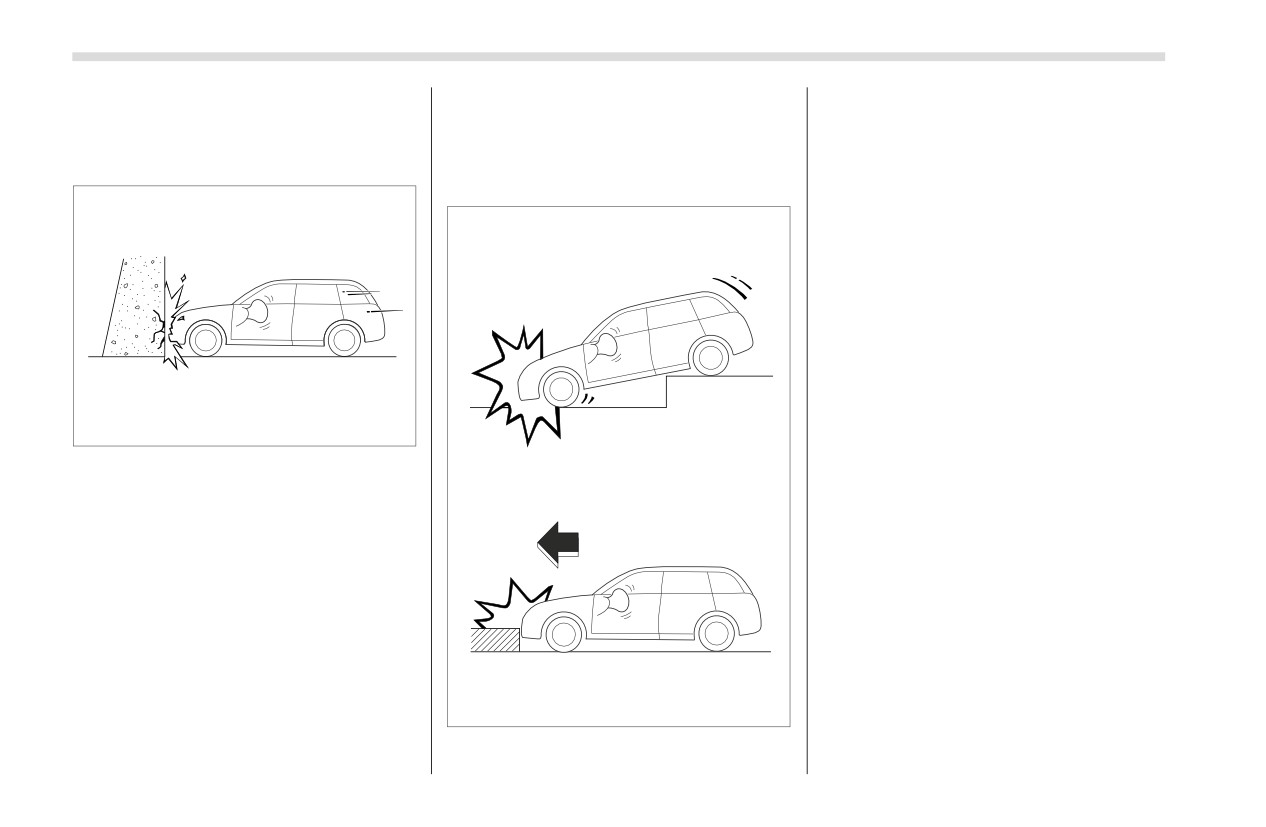
▽ Example of accident in which
▽ Examples of the types of acci-
Only the driver’s SRS frontal airbag or
the driver’s/driver’s and front
dents in which it is possible that
both driver’s and front passenger’s SRS
passenger’s SRS frontal
the driver’s/driver’s and front
frontal airbags may be activated when the
airbag(s) will most likely deploy
passenger’s SRS frontal
vehicle sustains a hard impact in the
airbag(s) will deploy
undercarriage area from the road surface
(such as when the vehicle plunges into a
deep ditch, is severely impacted or
knocked hard against an obstacle on the
road such as a curb).
101394
A head-on collision against a thick
concrete wall at a vehicle speed of 12 to
19 mph (20 to 30 km/h) or higher activates
only the driver’s SRS frontal airbag or both
driver’s and front passenger’s SRS frontal
airbags. The airbag(s) will also be acti-
vated when the vehicle is exposed to a
frontal impact similar in fashion and
magnitude to the collision described
above.
101313
SRS Airbag (Supplemental Restraint System Airbag)
79
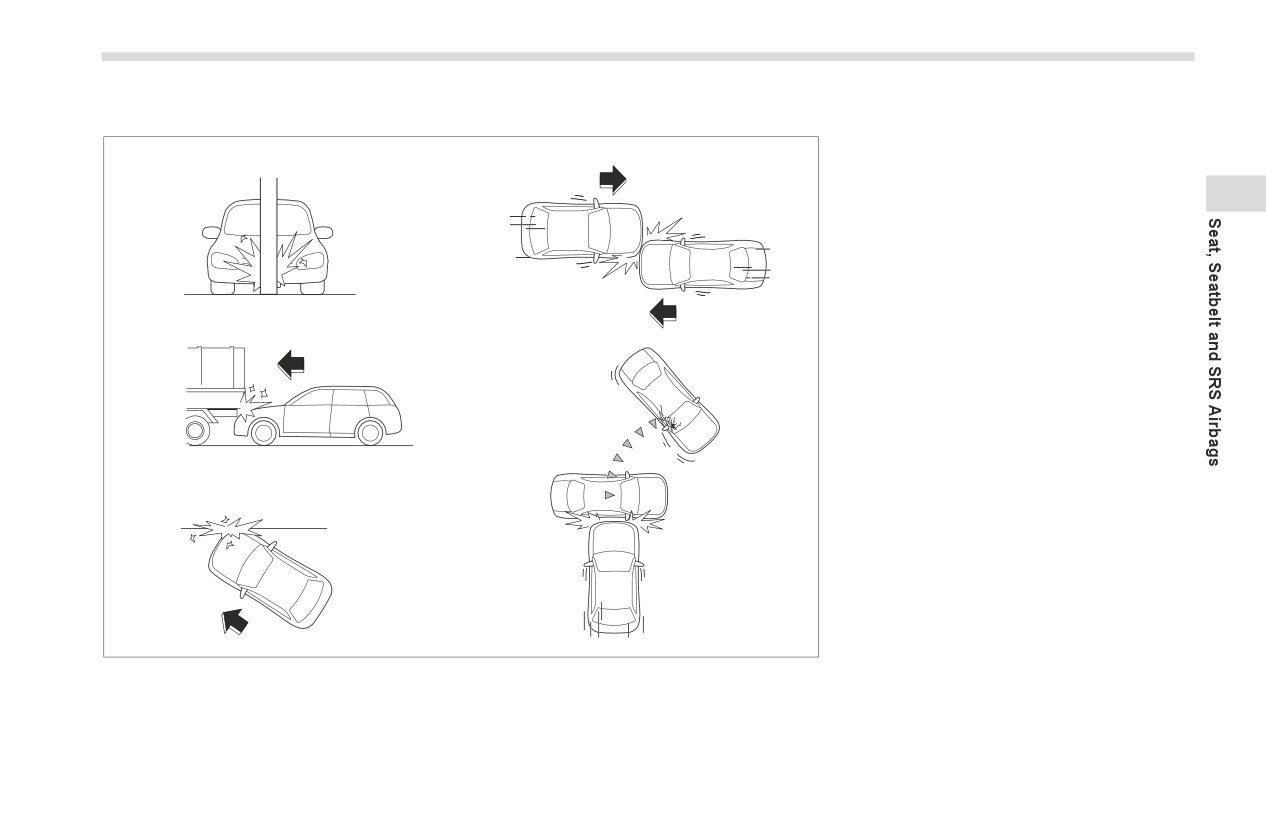
▽ Examples of the types of accidents in which deployment of the driver’s/driver’s and front passenger’s SRS frontal
airbag(s) is unlikely to occur
1) The vehicle strikes an object, such as a
telephone pole or sign pole.
1
4
2) The vehicle slides under the load bed of
a truck.
1
3) The vehicle sustains an oblique offset
frontal impact.
4) The vehicle sustains an offset frontal
collision.
5) The vehicle strikes an object that can
move or deform, such as a parked
vehicle.
2
5
There are many types of collisions which
might not necessarily require deployment
of driver’s/driver’s and front passenger’s
SRS frontal airbag(s). In the event of acci-
dents like those illustrated, the driver’s/
driver’s and front passenger’s SRS frontal
airbag(s) may not deploy depending on
3
the level of accident forces involved.
101418
- CONTINUED -
80
SRS Airbag (Supplemental Restraint System Airbag)
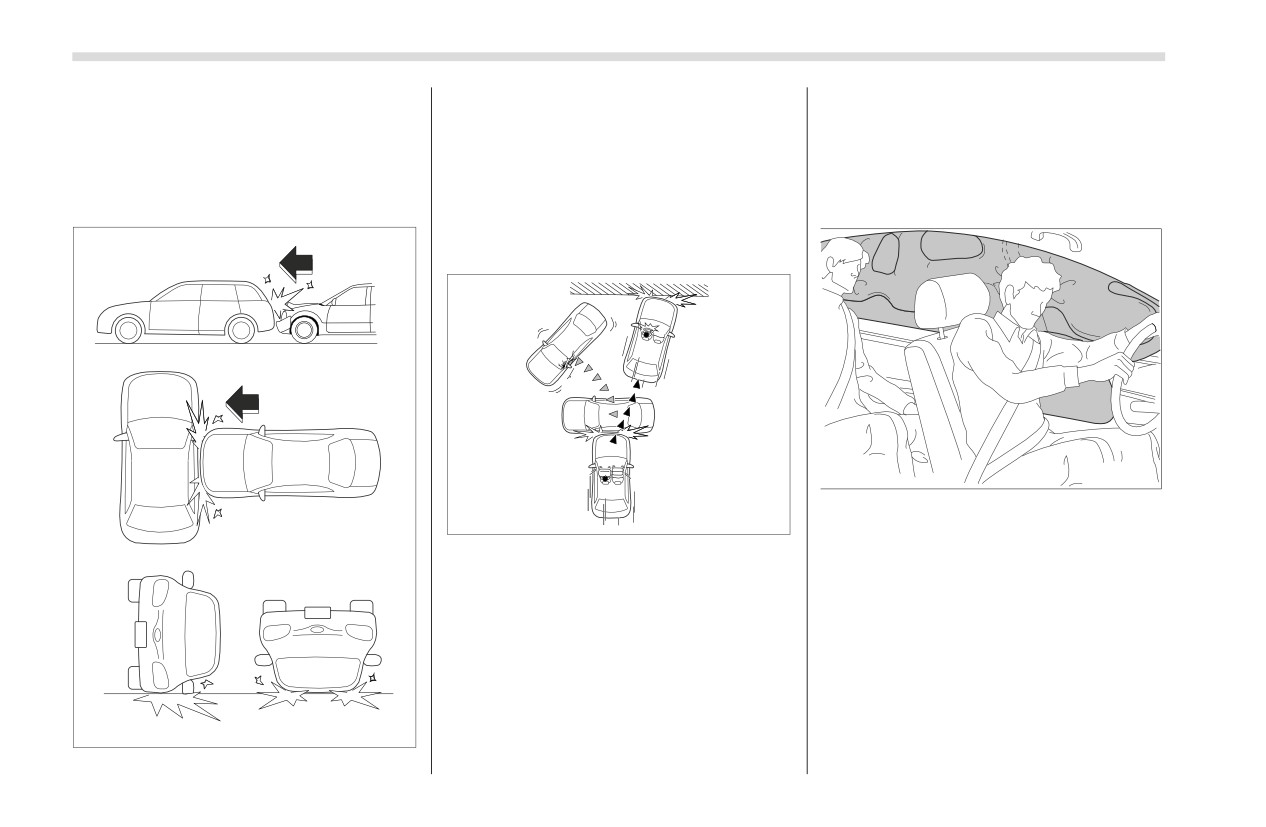
▽ Examples of the types of acci-
The driver’s and front passenger’s SRS
passenger’s SRS frontal airbags is/are
dents in which the driver’s/
frontal airbags are not designed to deploy
activated on the first impact, it/they will not
driver’s and front passenger’s
in most of the following cases.
be activated on the second impact.
SRS frontal airbag(s) are not
If the vehicle is struck from the side or
designed to deploy in most
from behind
■ SRS Side Airbag and SRS
cases
If the vehicle rolls onto its side or roof
Curtain Airbag
If the vehicle is involved in a low-speed
frontal collision
2
1
100281
101395
▼ SRS side airbag
1) First impact
The SRS side airbag is stored in the door
2) Second impact
side of each front seat seatback, which
bears an “SRS AIRBAG” mark.
In an accident where the vehicle is
In a moderate to severe side impact colli-
impacted more than once, the driver’s
sion, the SRS side airbag on the impacted
and/or front passenger’s SRS frontal
side of the vehicle deploys between the
airbag(s) will deploy only once on the first
occupant and the door panel and supple-
impact.
ments the seatbelt by reducing the impact
Example: In the case of a double collision,
on the occupant’s chest and waist. The
101315
first with another vehicle, then against a
SRS side airbag operates only for front
concrete wall in immediate succession,
seat occupants.
once either or both of the driver’s and front
SRS Airbag (Supplemental Restraint System Airbag)
81
▼ SRS curtain airbag
▼ Operation
The SRS side airbag and SRS curtain
airbag deploy even when no one occupies
Your vehicle is equipped with a SUBARU
The SRS side airbag and SRS curtain
the seat on the side on which an impact is
SRS curtain airbag system that complies
airbag can function only when the ignition
applied.
with the Federal Motor Vehicle Safety
switch is in the “ON” position.
When the SRS side airbag and SRS
Standard (FMVSS) No. 226.
The following airbags deploy inde-
curtain airbag deploy, a sudden, fairly loud
1
The SRS curtain airbag on each side of
pendently of each other since each has its
inflation noise will be heard and some
the cabin is stored in the roof side
own impact sensor.
smoke will be released. These occur-
(between the front pillar and a point over
Driver’s SRS side airbag
rences are a normal result of the deploy-
the rear seat). An “SRS AIRBAG” mark is
Front passenger’s SRS side airbag
ment. This smoke does not indicate a fire
located at the top of each center pillar.
SRS curtain airbag (right-hand side)
in the vehicle.
In a moderate to severe side impact colli-
SRS curtain airbag (left-hand side)
sion, the SRS curtain airbag on the
CAUTION
impacted side of the vehicle deploys
Therefore, they may not both deploy in the
between the occupant and the side
same accident. Also, the SRS side airbag
Do not touch the SRS side airbag
window and supplements the seatbelt by
and SRS curtain airbag deploys inde-
system components around the
reducing the impact on the occupant’s
pendently of the driver’s and front
front seat seatback with bare hands
head.
passenger’s SRS frontal airbags in the
right after deployment. Doing so
steering wheel and instrument panel.
can cause burns because the com-
In a rollover, SRS curtain airbags on both
sides of the vehicle deploy between the
For the locations of the sensors and
ponents can be very hot as a result
control modules, refer to "Components"
of deployment.
occupant and the side window and
supplement the seatbelt by reducing the
) P68.
After deployment, do not touch any
impact to the occupant’s head.
part of the SRS curtain airbag sys-
▼ After deployment
In an offset frontal collision, SRS curtain
tem (from the front pillar to the part
airbags on both sides of the vehicle
After the deployment, the SRS side airbag
of the roof side over the rear seat).
deploy between the occupant and the side
immediately starts to deflate. The time
Doing so can cause burns because
window and supplement the seatbelt by
required from detection of an impact to
the components can be very hot as
reducing the impact to the occupant’s
deflation of an SRS side airbag after
a result of deployment.
head and chest.
deployment is shorter than the blink of an
eye.
▼ Example of the type of accident
The SRS curtain airbag remains inflated
for a while following deployment then
The SRS side airbag and SRS curtain
slowly deflates.
airbag are designed as follows:
- CONTINUED -
82
SRS Airbag (Supplemental Restraint System Airbag)
To deploy in the event of an accident
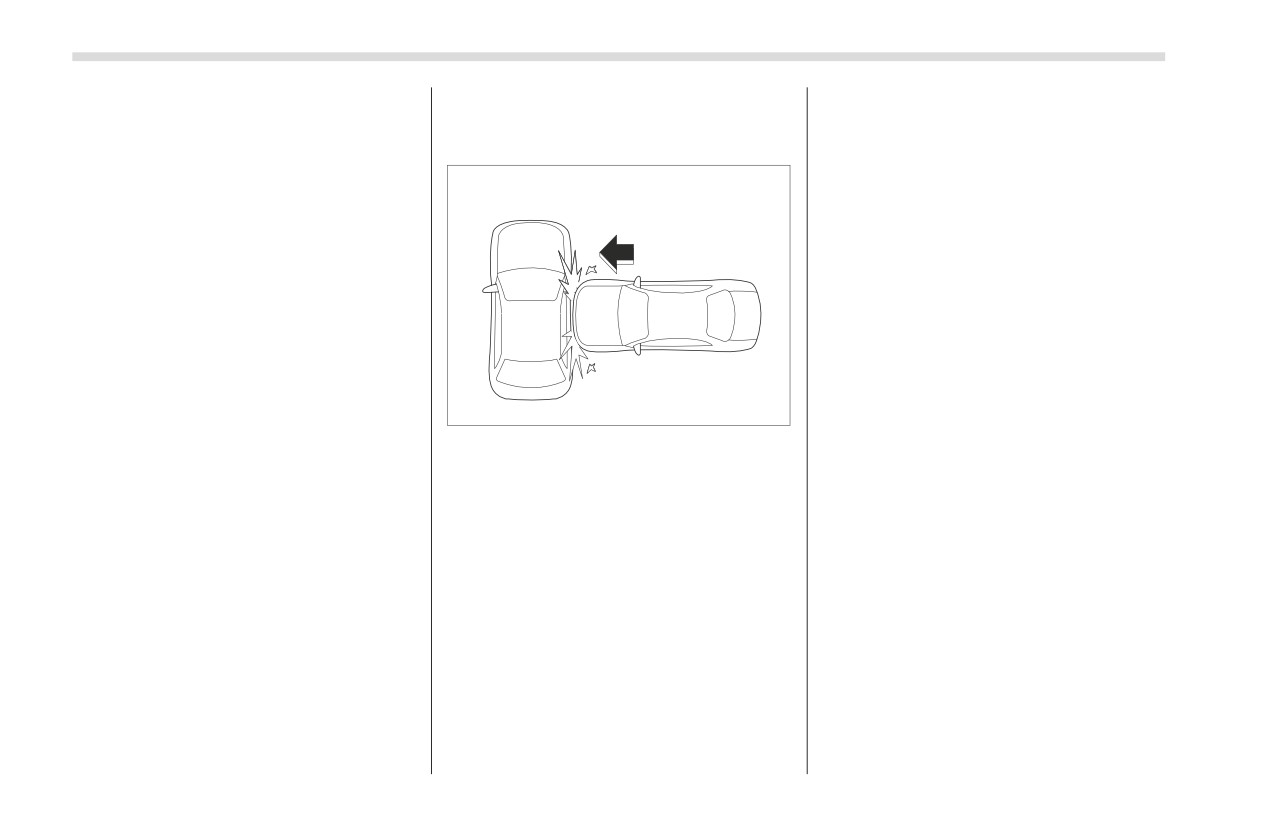
▽ Example of the type of accident
involving a moderate to severe side
in which the SRS side airbag will
impact collision
most likely deploy.
To function on a one-time-only basis.
The SRS side airbag and SRS curtain
1
airbag are not designed to deploy in the
following cases:
In most lesser side impact
In most frontal or most rear impacts
(because the SRS side airbag and SRS
curtain airbag deployment would not
protect the occupant in those situations)
The SRS curtain airbags are also
designed to deploy when the vehicle is in
an extremely inclined state such as during
101369
a rollover. They are not designed to
1)
A severe side impact near the front seat.
deploy in most lesser inclined state.
SRS side airbag and SRS curtain airbag
deployment depend on the level of force
experienced in the passenger compart-
ment during a side impact collision. That
level differs from one type of collision to
another, and it may have no bearing on
the visible damage done to the vehicle
itself.
SRS Airbag (Supplemental Restraint System Airbag)
83
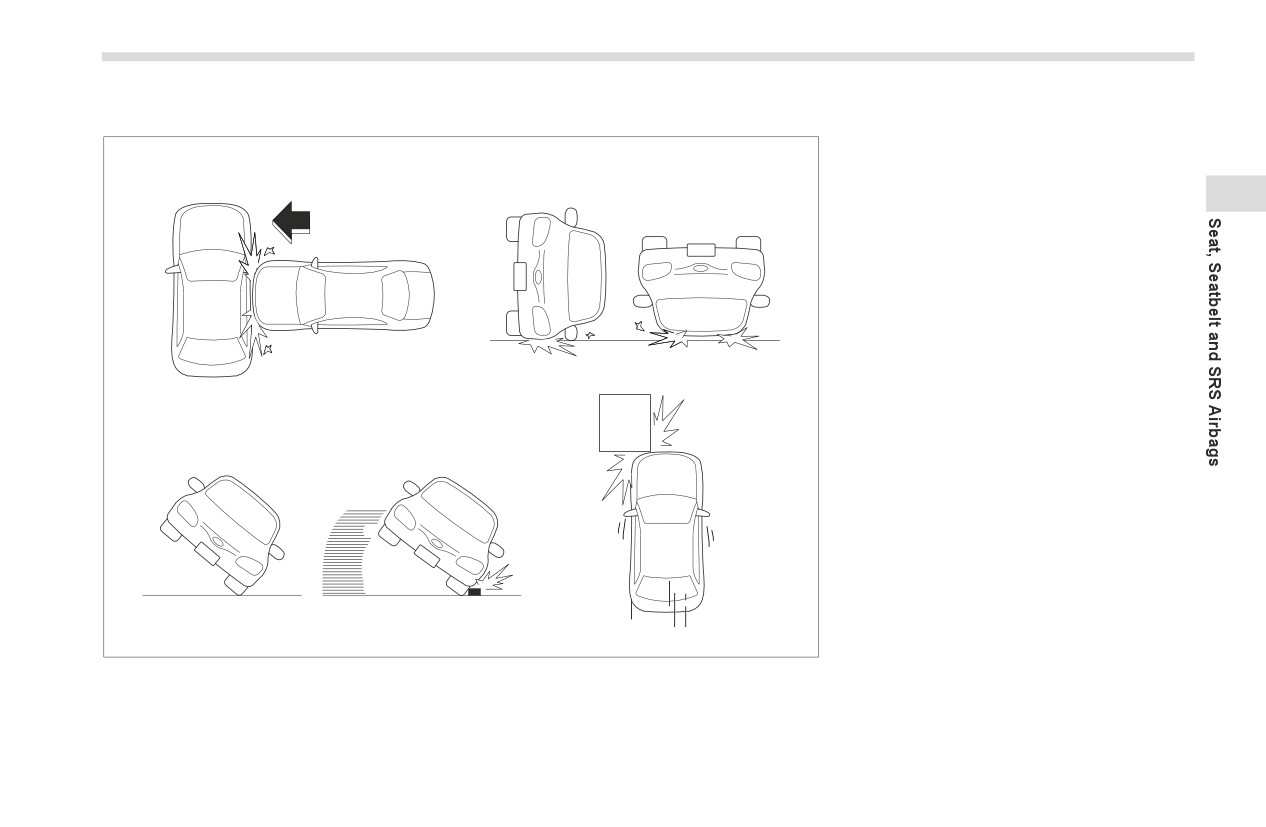
▽ Examples of the types of accidents in which the SRS curtain airbag will most likely deploy.
1) The vehicle is involved in a severe side
impact near the front seat or the rear
1
2
seat.
2) The vehicle rolls onto its side or the roof.
1
3) The angle of vehicle tip-up is marginal
or the skidding vehicle’s tires hit a curb-
stone laterally.
4) An offset frontal collision that is severe
enough to deploy the front airbag.
3
4
101789
- CONTINUED -
84
SRS Airbag (Supplemental Restraint System Airbag)
▽ Examples of the types of accidents in which it is possible that the SRS side airbag and the SRS curtain airbag will
deploy.
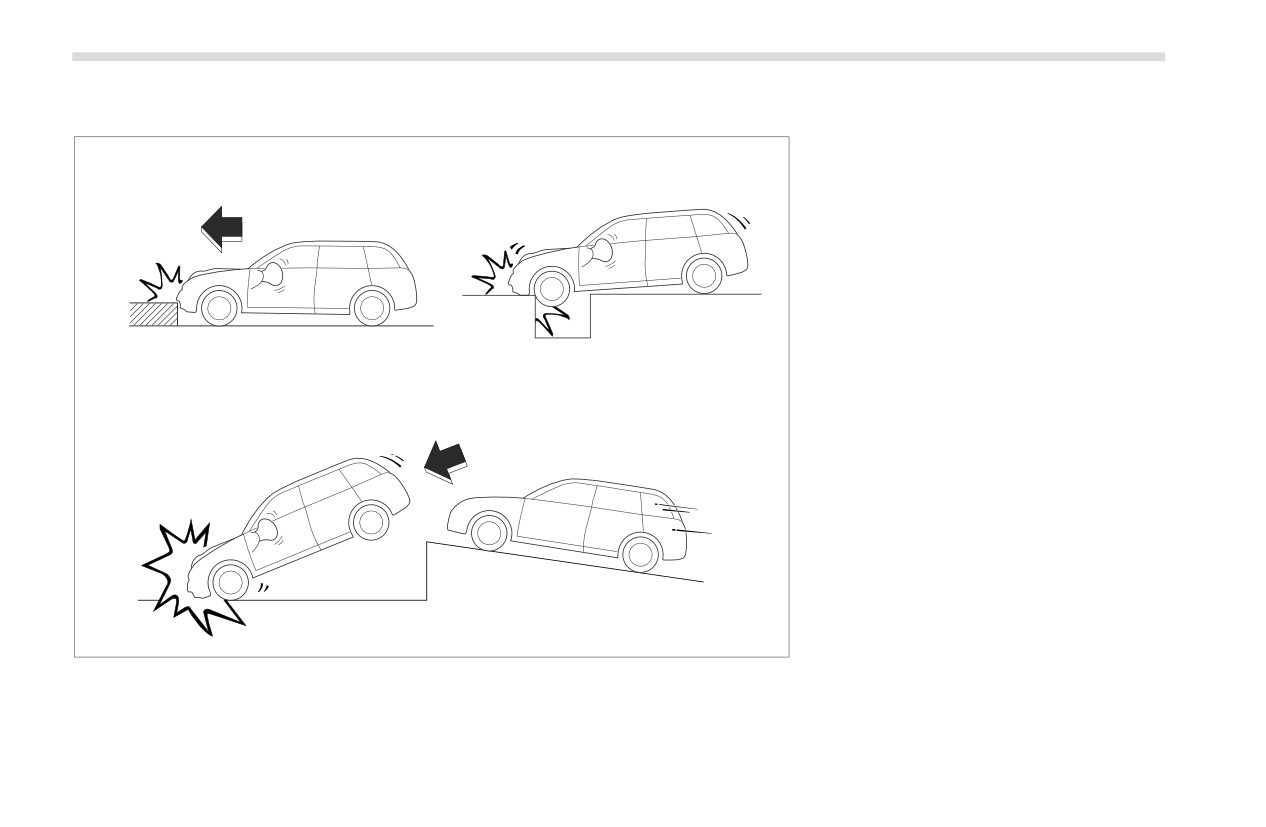
1) Hitting a curb, edge of pavement or hard
surface
2) Falling into or jumping over a deep hole
1
2
3) Landing hard or vehicle falling
It is possible that the SRS side and curtain
airbags will deploy if a serious impact
occurs to the underside of your vehicle.
Some examples are shown in the illustra-
tion.
3
102055
SRS Airbag (Supplemental Restraint System Airbag)
85
▽ Examples of the types of accidents in which the SRS side airbag is unlikely to deploy.
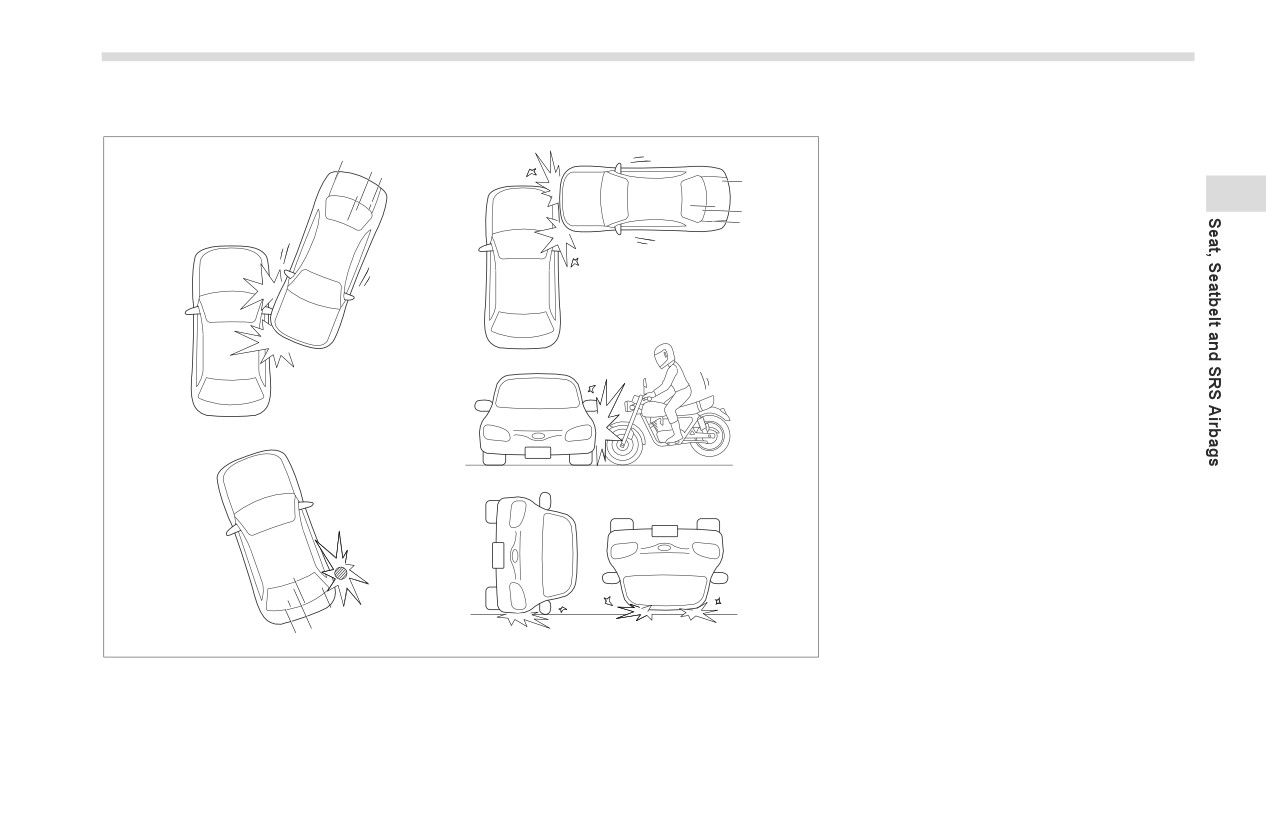
1) The vehicle is involved in an oblique
side-on impact.
2) The vehicle is involved in a side-on
1
2
impact in an area outside the vicinity of
1
the passenger compartment.
3) The vehicle strikes a telephone pole or
similar object.
4) The vehicle is involved in a side-on
impact from a motorcycle.
5) The vehicle rolls onto its side or the roof.
There are many types of collisions which
might not necessarily require SRS side
4
airbag deployment. In the event of acci-
dents like those illustrated, the SRS side
airbag may not deploy depending on the
level of accident forces involved.
3
5
101319
- CONTINUED -
86
SRS Airbag (Supplemental Restraint System Airbag)
▽ Examples of the types of accidents in which the SRS curtain airbag is unlikely to deploy.
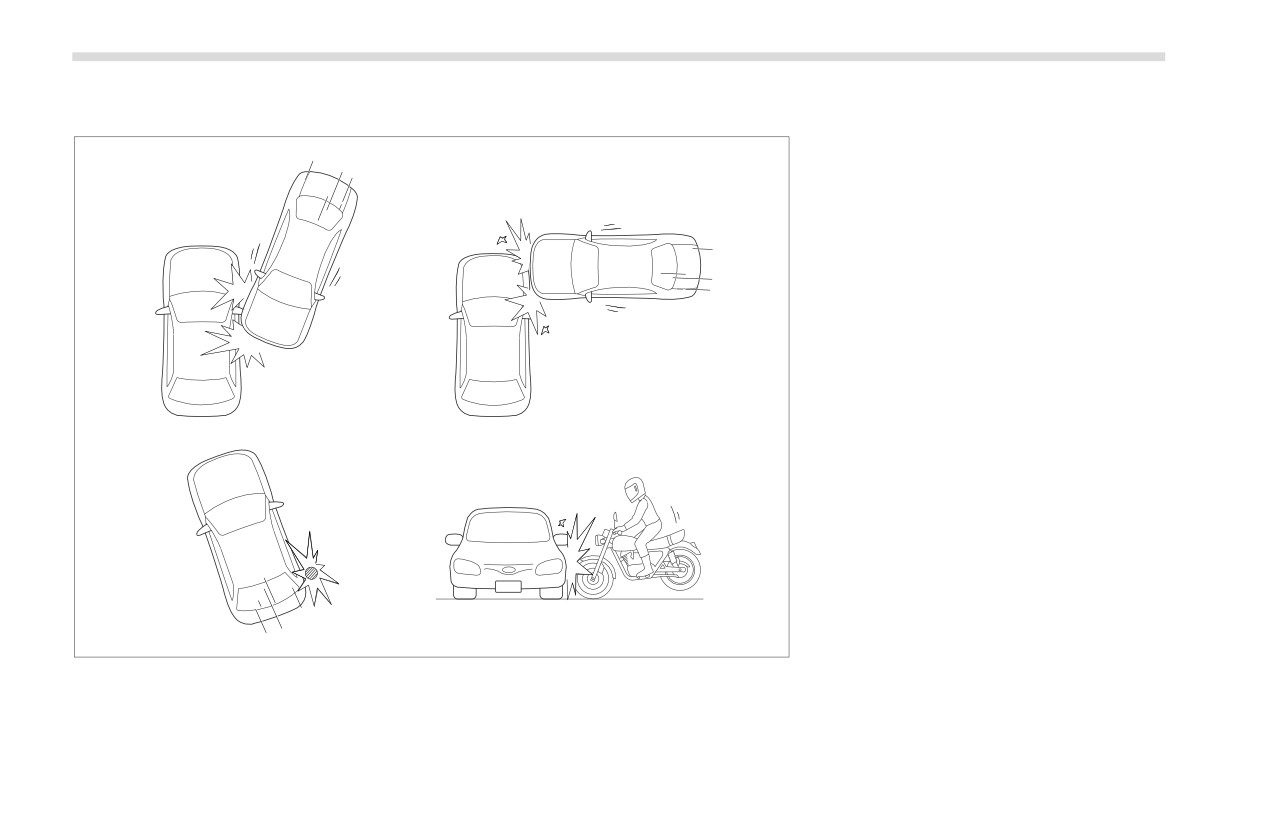
1) The vehicle is involved in an oblique
side-on impact.
2) The vehicle is involved in a side-on
1
2
impact in an area outside the vicinity of
the passenger compartment.
3) The vehicle strikes a telephone pole or
similar object.
4) The vehicle is involved in a side-on
impact from a motorcycle.
There are many types of collisions which
might not necessarily require SRS curtain
airbag deployment. In the event of acci-
dents like those illustrated, the SRS
curtain airbag may not deploy depending
on the level of accident forces involved.
3
4
101480
SRS Airbag (Supplemental Restraint System Airbag)
87
▽ Examples of the types of acci-
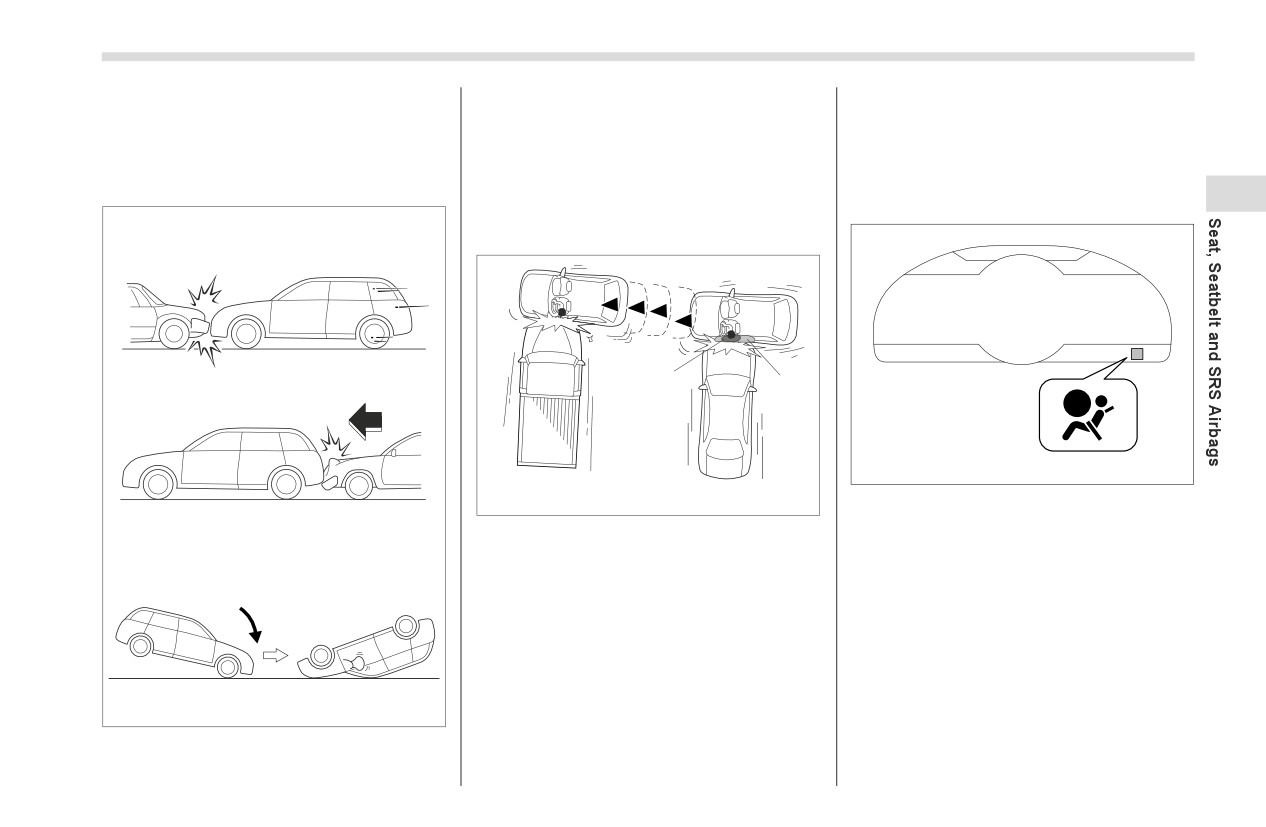
stationary).
same direction, once the SRS side airbag
dents in which the SRS side
2) The vehicle is struck from behind.
and SRS curtain airbag are activated on
airbag and SRS curtain airbag
3) The vehicle pitches end over end.
the first impact, they will not be activated
are not designed to deploy in
on the second.
In the event of accidents like those illus-
most cases
trated, the SRS side airbag and SRS
■ SRS Airbag System Monitors
1
curtain airbag are not designed to deploy
1
in most cases.
B
A
2
2
1
102698
101410
SRS airbag system warning light
A diagnostic system continually monitors
1) First impact
the readiness of the SRS airbag system
2) Second impact
3
(including seatbelt pretensioners) with the
A) SRS curtain airbag
ignition switch in the “ON” position. The
B) SRS side airbag
SRS airbag system warning light will show
normal system operation by illuminating
In an accident where the vehicle is struck
for approximately
6 seconds when the
from the side more than once, the SRS
ignition switch is turned to the “ON” posi-
side airbag and SRS curtain airbag deploy
tion.
only once on the first impact.
102056
The following components are monitored
Example: In the case of a double side
by the indicator:
1)
The vehicle is involved in frontal colli-
impact collision, first with one vehicle and
sion with another vehicle
(moving or
Front impact sensor
immediately followed by another from the
- CONTINUED -

88
SRS Airbag (Supplemental Restraint System Airbag)
- Right-hand side
Front passenger’s occupant detection
■ SRS Airbag System
- Left-hand side
sensor
Servicing
Airbag control module
(including
Front passenger’s frontal airbag ON
impact sensor and rollover sensor)
and OFF indicator
WARNING
Frontal airbag module
All related wiring
When discarding an airbag
- Driver’s side
module or scrapping the entire
- Front passenger’s side
WARNING
vehicle damaged by a collision,
Knee airbag module
If the warning light exhibits any of
consult your SUBARU dealer.
- Driver’s side
the following conditions, immedi-
The SRS airbag has no user-
Side impact sensor
ately stop the vehicle in a safe
serviceable parts. Do not use
- Center pillar left-hand side
place, and consult a SUBARU
electrical test equipment on any
- Center pillar right-hand side
dealer. Unless a technician checks
circuit related to the SRS airbag
- Forward of rear wheel house left-
and repairs the system as needed,
system. For required servicing of
hand side
the seatbelt pretensioners and/or
the SRS airbag, consult your
- Forward of rear wheel house right-
the SRS airbag will not operate
nearest
SUBARU dealer.
hand side
properly in the event of a collision,
Tampering with or disconnecting
- Door left-hand side
which may result in injury.
the system’s wiring could result
- Door right-hand side
Flashing or flickering of the
in accidental inflation of the SRS
Side airbag module
warning light
airbag or could make the system
- Driver’s side
inoperative, which may result in
No illumination of the warning
- Front passenger’s side
serious injury.
light when the ignition switch is
Curtain airbag module
first turned to the “ON” position
- Right-hand side
Continuous illumination of the
- Left-hand side
CAUTION
warning light
Front seatbelt pretensioner and adap-
If
you need service or repair in
tive force limiter
Illumination of the warning light
while driving
areas indicated in the following list,
- Front passenger's side
have the work performed by an
Front seatbelt pretensioner
authorized SUBARU dealer. The
- Driver's side
SRS airbag control module, impact
Seatbelt buckle switch
sensors and airbag modules are
- Front passenger’s side
stored in these areas.

SRS Airbag (Supplemental Restraint System Airbag)
89
Under the center of the instru-
NOTE
■ Precautions against Vehicle
ment panel
In the following cases, contact your
Modification
On both the right and left sides at
SUBARU dealer as soon as possible.
the front of the vehicle
The front part of the vehicle was
WARNING
involved in an accident in which only
Steering wheel and column and
To avoid accidental activation of
1
the driver’s SRS frontal airbag or both
nearby areas
the system or rendering the
driver’s and front passenger’s SRS
Bottom of the steering column
system inoperative, which may
frontal airbags did not deploy.
and nearby areas
result in serious injury, no modifi-
The pad of the steering wheel, the
Top of the dashboard on front
cations should be made to any
cover over the front passenger’s SRS
passenger’s side and nearby
components or wiring of the SRS
frontal airbag, or either roof side (from
areas
airbag system.
the front pillar to a point over the rear
This includes following modifica-
Each front seat and nearby area
seat) is scratched, cracked, or other-
tions.
Inside each center pillar
wise damaged.
The center pillar, door, rear wheel
-
Installation of custom steering
Inside each door
house or rear sub frame, or an area
wheels
In each roof side (from the front
near these parts, was involved in an
-
Attachment of additional trim
pillar to a point over the rear seat)
accident in which the SRS side airbag
materials to the dashboard
Between the rear seat cushion
and SRS curtain airbag did not deploy.
-
Installation of custom seats
and rear wheel house on each
The fabric or leather of either front
-
Replacement of seat fabric or
side
seatback is cut, frayed, or otherwise
leather
damaged.
-
Installation of additional fabric
The rear part of the vehicle was
In
the event that the SRS airbag is
or leather on the front seat
involved in an accident in which no
deployed, replacement of the system
SRS airbag was deployed.
-
Attachment of a hands-free
should be performed only by an autho-
microphone or any other
rized SUBARU dealer. When the
accessory to a front pillar, a
components of the SRS airbag system
center pillar, a rear pillar, the
are replaced, use only genuine
windshield, a side window or
SUBARU parts.
any other cabin surface that
would be near a deploying
SRS curtain airbag.
- CONTINUED -
90
SRS Airbag (Supplemental Restraint System Airbag)
-
Installation of additional elec-
Attachment of any equipment
■ How to Contact the Vehicle
trical/electronic
equipment
(bush bar, winches, snow plow,
Manufacturer concerning
such as a mobile two-way
skid plate, etc.) other than
Modifications for Persons
radio on or near the SRS
genuine SUBARU accessory
with Disabilities That May
airbag system components
parts to the front end.
and/or wiring is not advisable.
Affect the Advanced Airbag
Modification of the suspension
This could interfere with
system or front end structure.
System
proper operation of the SRS
Installation of a tire of different
Changing or moving any parts of the front
airbag system.
size and construction from the
seats, rear seat, seatbelts, front bumper,
-
Modifications on or inside the
tires specified on the vehicle
front side frame, radiator panel, instru-
door panels for the purpose of
placard attached to the driver’s
ment panel, combination meter, steering
a speaker replacement or
center pillar or specified for indi-
wheel, steering column, tire, suspension
sound insulation
vidual vehicle models in this
or floor panel can affect the operation of
The impact sensors, which detect
Owner’s Manual.
the SUBARU advanced airbag system. If
the pressure of an impact, are
Attachment of any equipment
you have any questions, you may contact
located in the doors. Do not
(side steps or side sill protectors,
the following SUBARU distributors.
modify any components of the
etc.) other than genuine SUBARU
<Continental U.S., Alaska and the District
doors or door trims, such as the
accessory parts to the side body.
of Columbia>
addition of door speakers for
Subaru of America, Inc.
example. Any modifications to
Customer Advocacy Department
the doors will create a risk of the
Always consult your SUBARU dealer if
airbag system becoming inopera-
you want to install any accessory parts on
One Subaru Drive
tive or unintended airbag deploy-
your vehicle.
P.O. Box 9103
ment.
Camden, NJ 08101-9877
1-800-SUBARU3 (1-800-782-2783)
<Hawaii>
CAUTION
Subaru Hawaii
Do not perform any of the following
2850-A Pukoloa St.,
modifications. Such modifications
Honolulu, HI 96819
can interfere with proper operation
877-215-0338
of the SRS airbag system.
<Guam>