Subaru Impreza 3 / Impreza WRX / Impreza WRX STI. Manual - part 588
 

  Index      Subaru     Subaru Impreza 3 / Impreza WRX / Impreza WRX STI - service repair manual 2008-2014 year


Search            


Content   ..  586  587  588  589   ..


Subaru Impreza 3 / Impreza WRX / Impreza WRX STI. Manual - part 588


AC-11

General Description

HVAC SYSTEM (HEATER, VENTILATOR AND A/C)

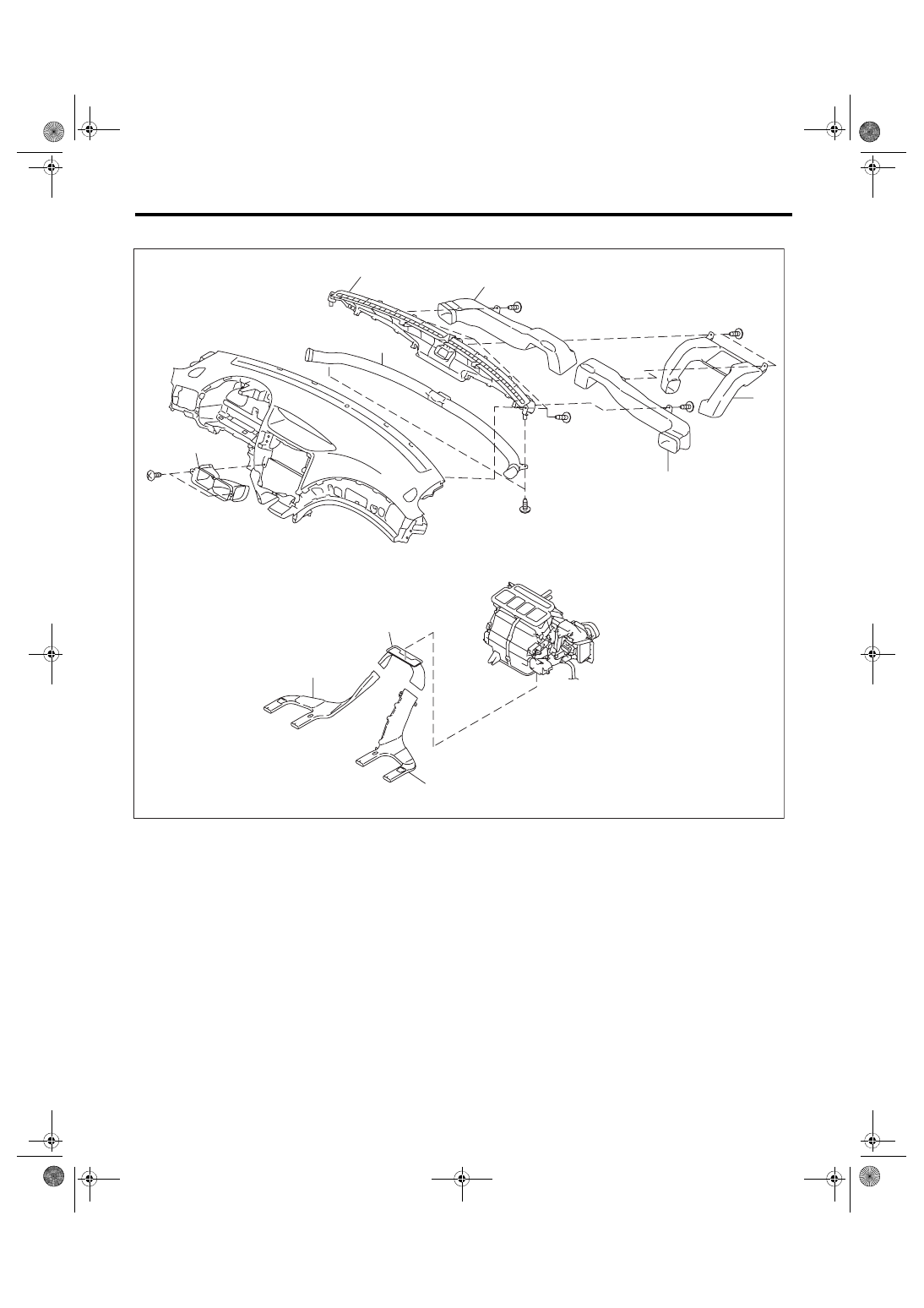
7. HEATER DUCT

(1)

Front defroster nozzle

(4)

Side vent duct (RH)

(7)

Rear heater duct (LH)

(2)

Side defroster duct

(5)

Center vent duct

(8)

Rear heater duct (RH)

(3)

Side vent duct (LH)

(6)

Center vent duct front

(9)

Rear heater duct center

(7)

(6)

(2)

(1)

(3)

(4)

(5)

(8)

(9)

AC-01969

AC-12

General Description

HVAC SYSTEM (HEATER, VENTILATOR AND A/C)

C: CAUTION

• Before disassembling or reassembling parts, al-

ways disconnect the battery ground cable from bat-

tery. When replacing the audio, control module and

other parts provided with memory functions, record

the memory contents before disconnecting the bat-

tery  ground  cable.  Otherwise,  the  memory  is

cleared.

• Reassemble the parts in the reverse order of dis-

assembly procedure unless otherwise indicated.

• Adjust parts to the given specifications.

• Connect  the  connectors  securely  during  reas-

sembly.

• After reassembly, make sure that the functional

parts operate normally.

1. HFC-134A A/C SYSTEM

• The  cooling  system  components  for  the  HFC-

134a system such as the refrigerant and compres-

sor oil are different from the conventional CFC-12

system components and they are incompatible with

each other.

• Vehicles with the HFC-134a system can be iden-

tified by the label (A) attached to the vehicle.

Before maintenance, check which A/C system is in-

stalled to the vehicle.

2. COMPRESSOR OIL

• HFC-134a  compressor  oil  has  no  compatibility

with that of CFC-12 system.

• Use only the manufacturer-authorized compres-

sor oil for the HFC-134a system; only use DH-PR

(ZXL200PG).

• Do not mix multiple compressor oils.

If CFC-12 compressor oil is used in the HFC-134a

A/C  system,  the  compressor  may  become  stuck

due to poor lubrication, or the refrigerant may leak

due to swelling of rubber parts.

On the other hand, if HFC-134a compressor oil is

used in a CFC-12 A/C system, the durability of the

A/C system will be lowered.

• HFC-134a  compressor  oil  is  very  hygroscopic.

When  replacing  or  installing/removing  A/C  parts,

immediately isolate the oil from atmosphere using a

plug or tape. In order to avoid moisture, store the oil

in a container with its cap tightly closed.

3. REFRIGERANT

• CFC-12  refrigerant  cannot  be  used  in  a  HFC-

134a A/C system. HFC-134a refrigerant, also can-

not be used in a CFC-12 A/C system.

• If an incorrect or no refrigerant is used, it will re-

sult  in  poor  lubrication  and  the  compressor  itself

may be damaged.

4. HANDLING OF REFRIGERANT

• The  refrigerant  boils  at  approx.  –30°C  (–22°F).

When handling it, be sure to wear protective gog-

gles and protective gloves. Direct contact of the re-

frigerant with skin may cause frostbite.

If the refrigerant gets into your eye, avoid rubbing

your  eyes  with  your  hands.  Wash  your  eye  with

plenty of water, and receive medical treatment from

an eye doctor.

• Do not heat a service can. If a service can is di-

rectly heated, or put into boiling water, the inside

pressure  will  become  extremely  high.  This  may

cause the can to explode. If a service can must be

warmed  up,  use  warm  water  of  40°C  (104°F)  or

less.

• Do not drop or impact a service can. (Observe

the precautions and operation procedure described

on the refrigerant can.)

• When  the  engine  is  running,  do  not  open  the

high-pressure valve of manifold gauge. The high-

pressure  gas  will  back-flow  resulting  in  an  explo-

sion of the can.

• Provide  good  ventilation  and  do  not  work  in  a

closed area.

• In order to prevent global warming, avoid releas-

ing HFC-134a into the atmosphere. Using a refrig-

erant recovery system, discharge and recycle the

gas.

(A)

AC-01771

AC-13

General Description

HVAC SYSTEM (HEATER, VENTILATOR AND A/C)

5. O-RING CONNECTIONS

• Always use a new O-ring.

• In order to keep the O-rings free of lint which will

cause a refrigerant gas leak, perform work without

using gloves or waste cloths.

• Apply compressor oil to O-rings to avoid sticking,

before installation.

• Use a torque wrench to tighten the O-ring fittings.

Over-tightening will result in damage of the O-ring

and deformation of the pipe end.

• If the work is interrupted before completing pipe

connections, recap the pipes, components and fit-

tings with a plug or tape to prevent foreign matter

from entering.

• Visually check the surfaces and mating surfaces

of O-rings, threads and connecting points. If a fail-

ure is found, replace the applicable parts.

• Install  the  O-rings  straight  against  the  pipe

groove.

• Use compressor oil specified in the service man-

ual to lubricate the O-rings.

Apply oil to the top and sides of O-rings before in-

stallation.

Apply compressor oil to the pipe grooves.

• After tightening, use a clean cloth to remove ex-

cess compressor oil from the connections and any

oil which may have run on the vehicle body or other

parts.

• If any leakage is suspected after tightening, do

not tighten the connections further, but disconnect

the  connections,  remove  the  O-rings,  and  check

the O-rings, threads, and connections.

(A) Goggles
(B) Gloves

(C) Avoid open flame
(D) No direct heat on container

(E) Do not discharge

(F) Loosen

(A) Seal

(A)

(B)

(C)

(D)

(E)

(F)

AC-00007

AC-00008

(A)

(A) O-ring
(B) OK

(C) NG
(D) Groove

AC-00009

(D)

(B)

(C)

(C)

(A)

AC-00010

AC-14

General Description

HVAC SYSTEM (HEATER, VENTILATOR AND A/C)

D: PREPARATION TOOL

CAUTION:

When working on vehicles with a HFC-134a system, only use HFC-134a specified tools and parts. Do

not mix CFC-12 tools and parts. If HFC-134a and CFC-12 refrigerant or compressor oil is mixed, it will

result in poor lubrication and the compressor itself may be damaged.

In order to prevent the mixture of HFC-134a and CFC-12 parts and liquid, the type of tool and screw,

and the replacement valves used are different. The gas leak detectors for the HFC-134a and CFC-12

systems must also not be interchanged.


HFC-134a

CFC-12

Tool & screw type

Millimeter size

Inch size

Valve type

Quick joint type

Screw-in type

Illustration

Tools and Equipment

Wrench
Various 

WRENCHES will be required to service any A/C system. 7 — 

40 N·m (0.7 to 4.1 kgf-m, 5 to 30 ft-lb) torque wrench and various crow-
foot wrenches will be needed. Open end or flare nut wrenches will be 
needed to hold the tube and hose fittings.

Applicator bottle
A small 

APPLICATOR BOTTLE is recommended to apply compressor 

oil to the various parts. It can be available at a hardware store.

Manifold gauge set

MANIFOLD GAUGE SET (with hoses) is available at either a refrig-

erant supplier or an automotive equipment supplier.

AC-00213

AC-00012

AC-00013


Content   ..  586  587  588  589   ..