SsangYong Rodius (2013 year). Manual - part 175
 

  Index      SsangYong     SsangYong Rodius - service repair manual 2013 year


Search            


Content   ..  173  174  175  176   ..


SsangYong Rodius (2013 year). Manual - part 175


12-4

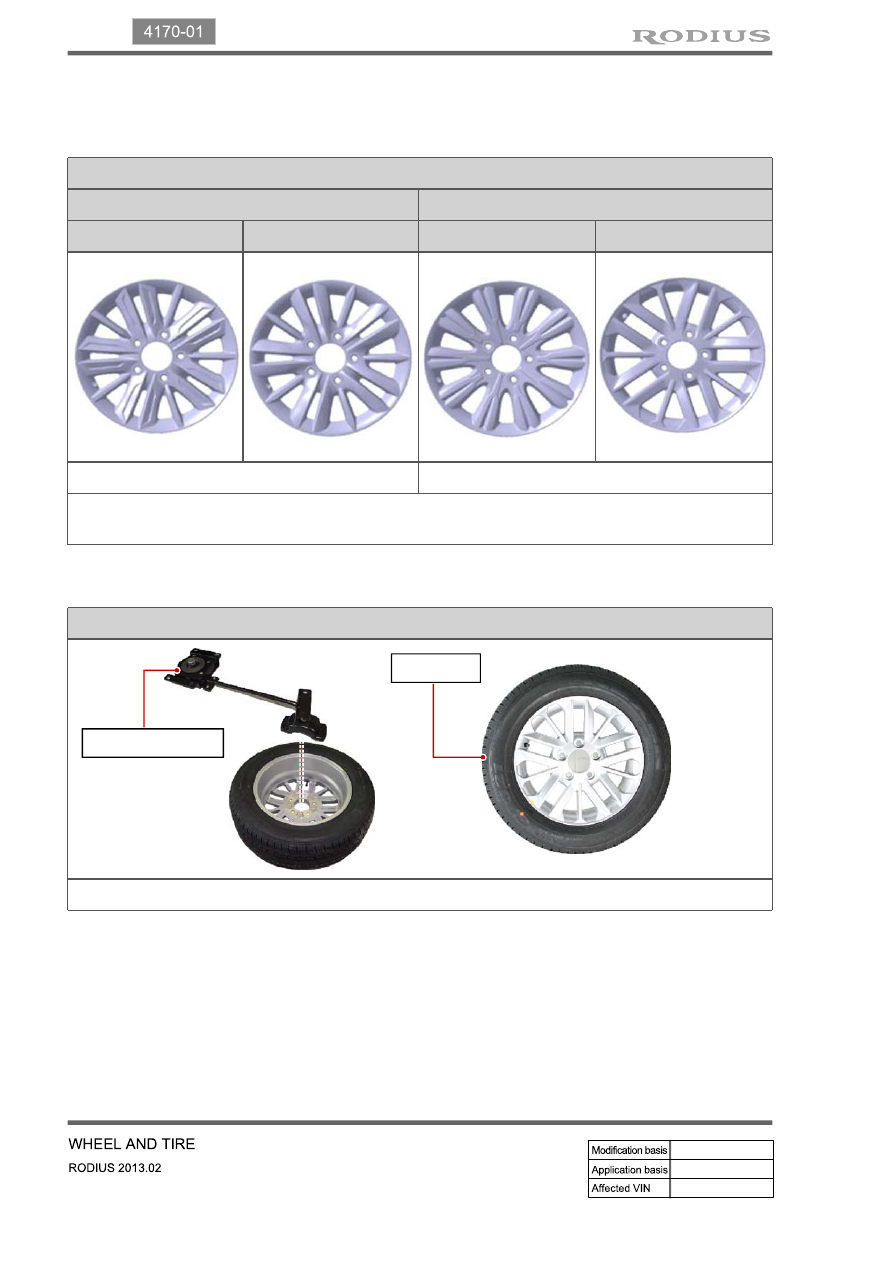
Spare Tire & Winch Assembly

- Spare tire specification added (same as one fitted to vehicle with standard wheel and tire) 

Wheel assembly

16 inch (6.5JX16)

17 inch (7.0JX17)

2WD

4WD

2WD

4WD

225/65R16

235/60R17

- 16 inch wheel design changed (same as before for tire size) 
- 17 inch wheel specification added (235/60R17 tire)

2. CHANGES

Wheel tire design changed and specification added

With spare tire

Spare tire

Winch assembly

12-5

4170-01

1. OVERVIEW

A radial tire uses a cord angle of 90 degrees. That is, the cord material runs in a radial or direct line 

from one bead to the other across the tread. In addition, a radial tire has a belt overwrap under the 

tread surface to provide greater structural stability. The belt overwrap of a radial tire distortion while the 

radial structure enables high speed driving.

Tire supports the weight of the vehicle, reduces the impact from the road and at the same time, 

transmits the power to propel, brake and steer on the road. It also functions to maintain a 
vehicle’s movement. In order to complete such tasks, a tire must be structured to be a resilient 

vessel of air.

There is wear limit mark on the tire, which protrudes as a strip shape located approximately 1.6 mm 

from the groove bottom. This wear limit mark is not seen from the outside so there is additional 
"▲" mark on the shoulder to let the driver find the wear mark easily. To measure the tire groove 

depth, measure at any point other than the point which has a wear limit mark.

The tire is worn unevenly according to the driver's driving habit, improper servicing, low tire inflation 

pressure, changed tire location, etc.

1) Structure of Tire

Tread

This thick layer of rubber provides the interface 

between the tire and the road. Wear-resistant 

rubber is used to protect the carcass and belt 

against fractures and impacts and to deliver a 

long driving life. 

Shoulder

Located between the tread and sidewall, the 

shoulder rubber is the thickest so that the 

design must allow for the easy diffusion of heat 

generated within the tire while driving. 

Sidewall

The part between the shoulder and bead, the 

flexible sidewall protects the carcass and 
enhances the ride. A tire’s type, size, 

structure, pattern, manufacturing company, 

product name and various characters are 

indicated here. 

Bead

The bead attaches the tire to the rim and wraps 

the end of the cord fabric. Comprised of the bead 

wire, core, flipper and other parts, the bead is 

generally designed to be slightly tight around the 

rim so that in the case of a sudden drop in 

inflation pressure, the tire will not fall off the rim.

Carcass

As the most important framework of a tire, the 

entire inner layer of cord fabric is called the 

carcass. The carcass acts to support air 

pressure, vertical load and absorb shocks. 

Valve

Belt

Bead core

12-6

2) Tire Unit Indication

Aspect ratio (%)

= Nominal section height (H) / Nominal section 

width (W)

X 100

3) Tire Inflation Pressure (35 psi)

Proper inflation pressure

Excessive inflation pressure

Low inflation pressure

The contact area between the 

ground and tire faces the tread 

layer completely. Thus the driving 

force and the braking force are 

optimized, and the tire is worn out 

evenly resulting in increased life.

The contact area between the 

ground and tire is not enough, 

so the tire is worn out unevenly 

and the tire is vulnerability to 

outside influence.

The contact area between the 

ground and tire is excessive, so 

a lot of heat is generated and 

the tire is worn out unevenly 

and abnormally.

Tread width

Tread width

Tread width

12-7

4170-01

During driving, the rotating tire repeats deformation and restoring movement in is tread. This happens 

when the tire pressure is low in high speed driving. 

However, when the wheel rotating speed is fast, the tire is deformed even before it is restored to its 

original shape and the trembling wave appears on the tread portion. If this symptom lasts for an 

extended period of time, the tire can be blown out in a short period of time.  

If the standing wave symptom occurs on the tire, rubber on the tread comes off and eventually the tire 

can be blown out which is very dangerous. When driving at high speed, the inflation pressure should 

be increased to decrease heat generation due to extension and contraction motion, to decrease 

hydroplaning and to prevent standing wave. 

To prevent this symptom, it is recommended to increase the tire pressure 10 ~ 30 % higher than the 

specified pressure value in high speed driving. 

Specified tire inflation pressure

35 psi

2. ABNORMAL TIRE SYMPTOM

1) Standing Wave


Content   ..  173  174  175  176   ..