SsangYong Rodius (2013 year). Manual - part 62


  Index      SsangYong     SsangYong Rodius - service repair manual 2013 year


Search            


Content   ..  60  61  62  63   ..


SsangYong Rodius (2013 year). Manual - part 62


05-7

1729-01

3. OPERATING PROCESS

1) Exhaust Gas Flow

2) Input & Output Devices
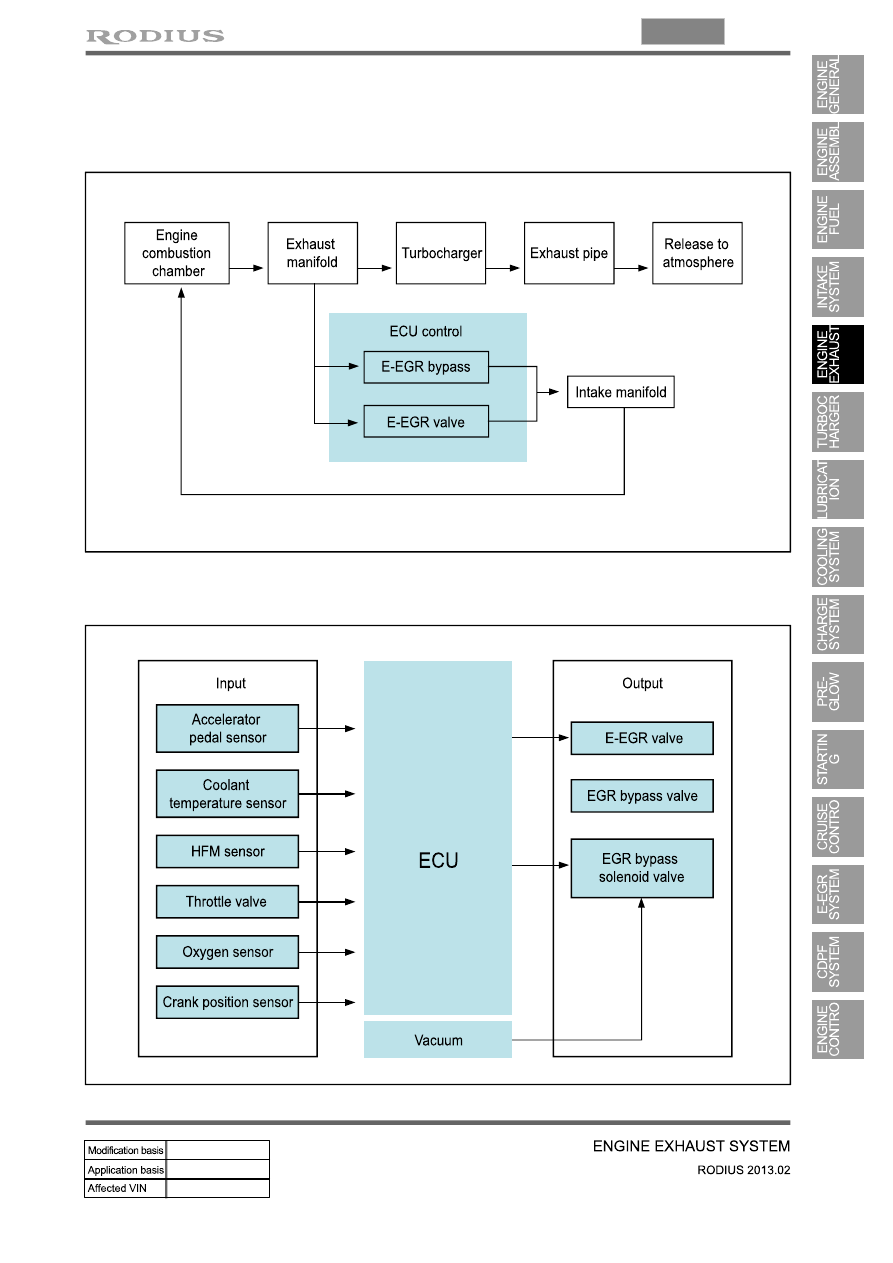
06-3

1914-01

1. SPECIFICATION

Unit

Description

Specification

Turbocharger

Max. expansion coefficient

4.0 

Max. turbine speed

226,000rpm 

Max. temperature of turbine 

housing

790 ℃ 

Weight

6.5kg 

E-VGT actuator

Operation duty cycle

250Hz 

E-VGT turbocharger

Plate

Impeller

Turbine

Unison ring

Turbine housing

Compressor 

housing

E-VGT actuator

06-4

2. INSPECTION

1) Cautions During Driving

The following lists cautions to take during test drive and on the turbocharger vehicle, which must be 

considered during the operation.

It's important not to drastically increase the engine rpm starting the engine. It could make rotation at 

excessive speed even before the journal bearing is lubricated and when the turbocharger rotates in 

poor oil supply condition, it could cause damage of bearing seizure within few seconds.

If the engine is running radically after replacing the engine oil or oil filter brings poor oil supply

condition. To avoid this, it's necessary to start off after idling the engine for about 1 minute allowing 

oil to circulate to the turbocharger after the replacement.

When the engine is stopped abruptly after driving at high speed, the turbocharger continues to rotate 

in condition where the oil pressure is at '0'. In such condition, an oil film between the journal bearing 

and the housing shaft journal section gets broken and this causes abrasion of the journal bearing 

due to the rapid contact. The repeat of such condition significantly reduces life of the turbocharger.

Therefore, the engine should be stopped possibly in the idle condition.

1.

2.

3.

After string for long period of time during winter season or in the low temperature condition where 

the fluidity of engine oil declines, the engine, before being started, should be cranked to circulate 

oil and must drive after checking the oil pressure is in normal condition by idling the engine for few 

minutes.

06-5

1914-01

2) Inspection of Turbocharger

When problem occurs with the turbocharger, it could cause engine power decline, excessive discharge 

of exhaust gas, outbreak of abnormal noise and excessive consumption of oil.

On-board Inspection

1.

Check the bolts and nuts foe looseness or missing

Check the intake and exhaust manifold for looseness or damage

Check the oil supply pipe and drain pipe for damages

Check the housing for crack and deterioration

-

-

-

-

Inspection of turbine

2.

Remove the exhaust pipe at the opening of the turbine and check, with a lamp, the existence of

interference of housing and wheel, oil leakage and contamination (at blade edge) of foreign materials.

Interference: In case where the oil leak sign exists, even the small traces of interferences on the 

turbine wheel mean, most of times, that abrasion has occurred on the journal bearing. Must 

inspect after overhauling the turbocharger.

Oil Leakage: Followings are the reasons for oil leakage condition

-

-

Problems in engine: In case where the oil is smeared on inner wall section of the exhaust gas 

opening.

Problems in turbocharger: In case where the oil is smeared on only at the exhaust gas

outlet section.

*

*

Idling for long period of time can cause oil leakage to the turbine side due to low pressure of exhaust 

gas and the rotation speed of turbine wheel. Please note this is not a turbocharger problem.

Oil Drain Pipe Defect

In case where oil flow from the turbocharger sensor housing to the crank case is not smooth 

would become the reason for leakage as oil builds up within the center housing. Also, oil thickens 

(sludge) at high temperature and becomes the indirect reason of wheel hub section. In such case, 

clogging and damage of the oil drain pipe and the pressure of blow-by gas within the crank case 

must be inspected. 

Damages due to Foreign Materials.

When the foreign materials get into the system, it could induce inner damage as rotating balance 

of the turbocharger gets out of alignment.

-

-

-


Content   ..  60  61  62  63   ..