Nissan GT-R (2024 year). Manual in english - page 4
It is recommended you always check with
EXTERIOR AND INTERIOR LIGHTS
the Parts Department at a GT-R certified
Item
Wattage (W)
Bulb No.
NISSAN dealer for the latest parts infor-
mation.
Headlight assembly
low-beam*
LED
-
Replacement procedures
high-beam*
LED
-
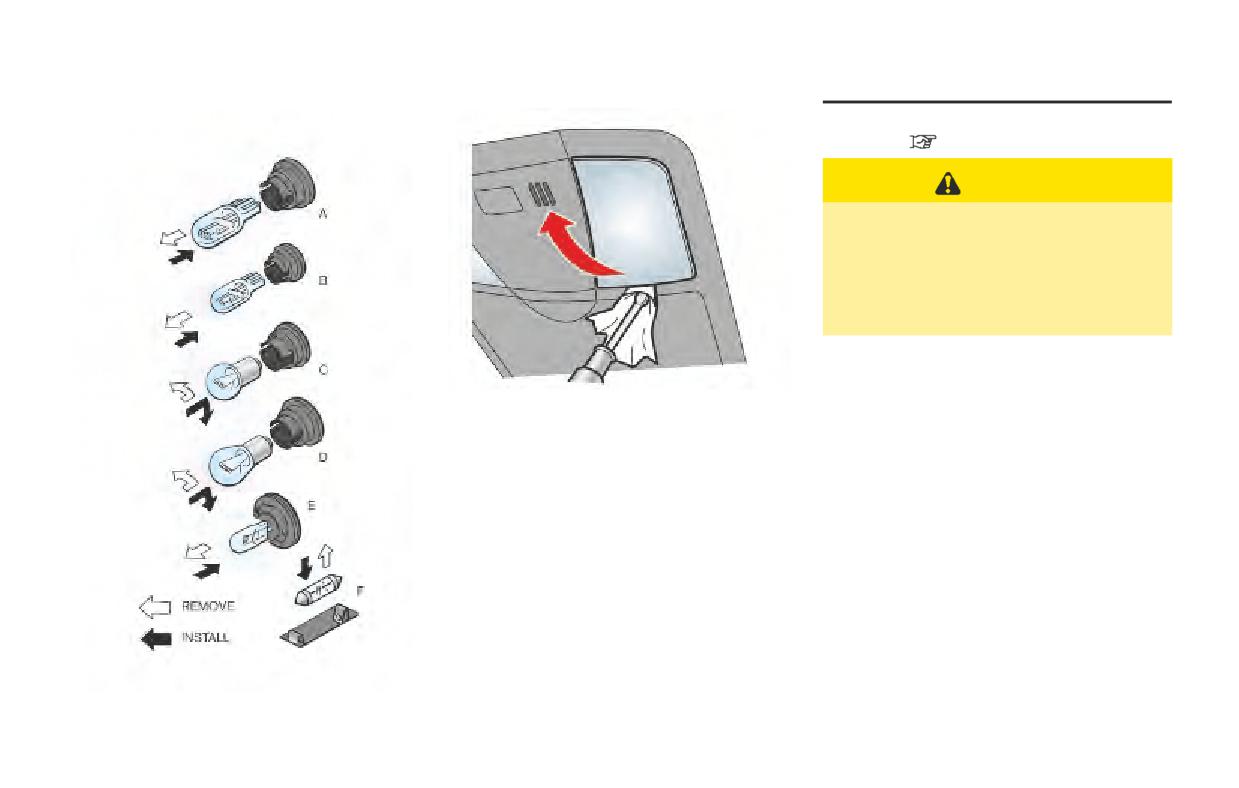
All other lights are either type A, B, C, D, E
or F. When replacing a bulb, first remove
Front turn signal light*
28/8
7444NA
the lens and/or cover.
Front parking light*
LED
-
Daytime running light*
LED
-
Front side marker light*
3.8
T10
Rear combination light*
back-up
16
W16W
turn signal
21
WY21W
stop/tail
LED
-
Rear side marker light*
LED
-
License plate light*
LED
-
Map light
8
-
Vanity mirror light*
2
-
Step light*
2.7
-
Trunk light*
3.4
-
High-mounted stop light*
LED
-
*:
It is recommended you see a GT-R certified NISSAN dealer for replacement.
8-28
Do-it-yourself
WHEELS AND TIRES
If you have a flat tire, see the following
section. (
“Flat tire” page 6-3)
CAUTION
A GT-R certified NISSAN dealer
should perform a tire change. It will
be necessary to reset the tire pres-
sure sensors. To change the tires, it is
recommended you contact a GT-R
certified NISSAN dealer.
Be sure to use the tires and wheels
together as a set that are designated for
Map light
use with this vehicle.
When tire replacement is required, repla-
cing the tires as a set of four with new
tires is recommended. However, if a tire is
punctured or damaged, it may be possi-
ble to replace only the damaged tire.
Determining whether one tire or a com-
plete set of tires should be replaced is
based on a number of factors including
tire wear and condition. It is recom-
mended you contact your GT-R certified
NISSAN dealer. They can recommend if an
individual tire or a complete set should be
replaced.
Do-it-yourself
8-29
nitrogen. It is recommended you
Tire inflation pressure
NOTICE
contact a GT-R certified NISSAN
Check the tire pressure often and
dealer for information on filling the
Make sure the tire valve stem cap is
always prior to long distance trips.
tires with nitrogen.
installed and that the valve stem is
The recommended tire pressure
. If nitrogen is not available, com-
tight. When installing the cap, make
sure to tighten the cap by hand. If a
specifications are shown on the F.
pressed air may be safely used
tool is used to tighten the cap, the
M.V.S.S./C.M.V.S.S. label or the Tire
under normal driving conditions.
cap may be damaged.
However, NISSAN recommends re-
and Loading Information label (if so
filling with nitrogen for maximum
equipped) under the “Cold Tire
tire performance.
Pressure” heading. The Tire and
TIRE PRESSURE
The tire pressures should be
Loading Information label is affixed
checked when the tires are cold.
Tire Pressure Monitoring System
to the driver side door end. Tire
The tires are considered COLD after
pressures should be checked reg-
(TPMS)
the vehicle has been parked for 3 or
ularly because:
This vehicle is equipped with the Tire
more hours, or driven less than 1
Pressure Monitoring System (TPMS). It
. Most tires naturally lose air over
mile (1.6 km) at moderate speeds.
monitors tire pressure of all tires. When
time.
the low tire pressure warning light is lit,
Incorrect tire pressure, including
. Tires can lose air suddenly when
one or more of your tires is significantly
under inflation, may adversely
driven over potholes or other
under-inflated. The system also displays
affect tire life and vehicle hand-
pressure of all tires on the touch screen
objects or if the vehicle strikes
ling.
display by sending a signal from a sensor
a curb while parking.
that is installed in each wheel.
NOTE:
WARNING
The TPMS will activate only when the
. You can check the pressure of all
vehicle is driven at speeds above 16 MPH
four tires on the touch screen dis-
. Improperly inflated tires can
(25
km/h). Also, this system may not
play. See the separate Multi Func-
fail suddenly and cause an
detect a sudden drop in tire pressure.
tion Display Owner’s Manual.
(
“Low tire pressure warning light”
accident.
page 2-30) (
“Tire Pressure Monitoring
. The tires of this vehicle are filled
. The Gross Vehicle Weight
System (TPMS)” page 5-4) (
“Flat tire”
with nitrogen gas. When the tire
rating (GVWR) is located on
page 6-3)
pressure is low, fill the tires with
8-30
Do-it-yourself
- Genuine GT-R tires and road
the F.M.V.S.S./C.M.V.S.S. cer-
tion” (US) or “Tire Safety
wheels help prevent the decrease
tification label. The vehicle
Information” (Canada) in the
of straight-running stability
weight capacity is indicated
Warranty Information Book-
caused by uneven tire wear due
on the Tire and Loading In-
let.
to high rigidity wheels and wide
formation label (if so
tires.
equipped). Do not load your
. The GT-R uses specially designed
NOTE:
vehicle beyond this capacity.
run-flat tires which feature an ex-
. Use only genuine GT-R tires and
tremely rigid side wall. Special tech-
Overloading your vehicle
road wheels.
niques and equipment are therefore
may result in reduced tire
The GT-R uses specially designed
required when replacing these tires.
life, unsafe operating condi-
run-flat tires and matching road
NISSAN recommends that tire repla-
wheels. Use of these specially devel-
tions due to premature tire
cement be performed at a GT-R
oped tires and wheels provides the
failure, or unfavorable hand-
certified NISSAN dealer.
greatest potential for maximum
ling characteristics and
performance.
. Specific tire changing equipment
could also lead to a serious
- Genuine GT-R tires and road
must be used to remove the GT-R
accident. Loading beyond
wheels help achieve maximum
tires from the wheel and to install
cornering and braking perfor-
the GT-R tires onto the wheel. It is
the specified capacity may
mance.
only possible to reuse the tires when
also result in failure of other
- Genuine GT-R tires and road
they have no cracks and/or defor-
vehicle components.
wheels help achieve maximum
mations on the bead portion of the
. Before taking a long trip, or
tire durability during acceleration.
tire. If the incorrect equipment is
used to remove the GT-R tires from
whenever you heavily load
- Genuine GT-R tires and road
the wheel and to install the GT-R
your vehicle, use a tire pres-
wheels help achieve maximum
tires onto the wheel, cracks and
handling capability during perfor-
sure gauge to ensure that
deformation may occur on the bead
mance driving.
the tire pressures are at the
portion of the tires meaning that the
- Genuine GT-R tires and road
specified level.
tires cannot be reused. It is recom-
wheels help provide road holding
mended you contact a GT-R certified
. For additional information
in the event of decreasing tire
NISSAN dealer if the tires need to be
regarding tires, refer to “Im-
pressure and punctures.
removed from the wheels.
portant Tire Safety Informa-
Do-it-yourself
8-31
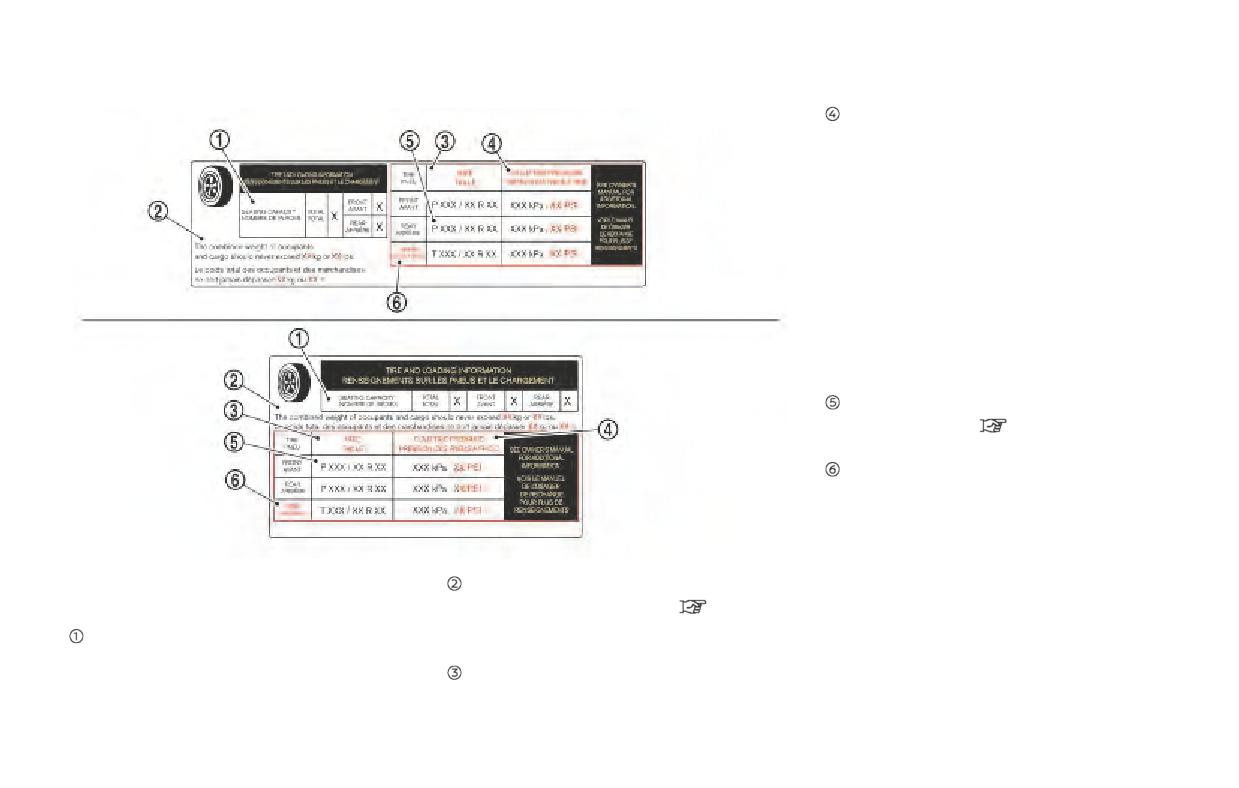
Cold tire pressure: Inflate the
tires to this pressure when the
tires are cold. Tires are consid-
ered COLD after the vehicle has
been parked for 3 or more
hours, or driven less than 1 mile
(1.6
km) at moderate speeds.
The recommended cold tire
inflation is set by the manufac-
turer to provide the best bal-
ance of tire wear, vehicle
handling, driveability, tire noise,
etc., up to the vehicle’s GVWR.
Tire size - see the following
section.
(
“Tire labeling”
page 8-34)
Spare tire size or compact
spare tire size (if so equipped)
Vehicle load limit: See the fol-
TIRE AND LOADING INFORMATION
lowing section.
(
“Vehicle
LABEL
loading information” page 10-
Seating capacity: The maxi-
16)
mum number of occupants
Original size: The size of the
that can be seated in the
tires originally installed on the
vehicle.
vehicle at the factory.
8-32
Do-it-yourself
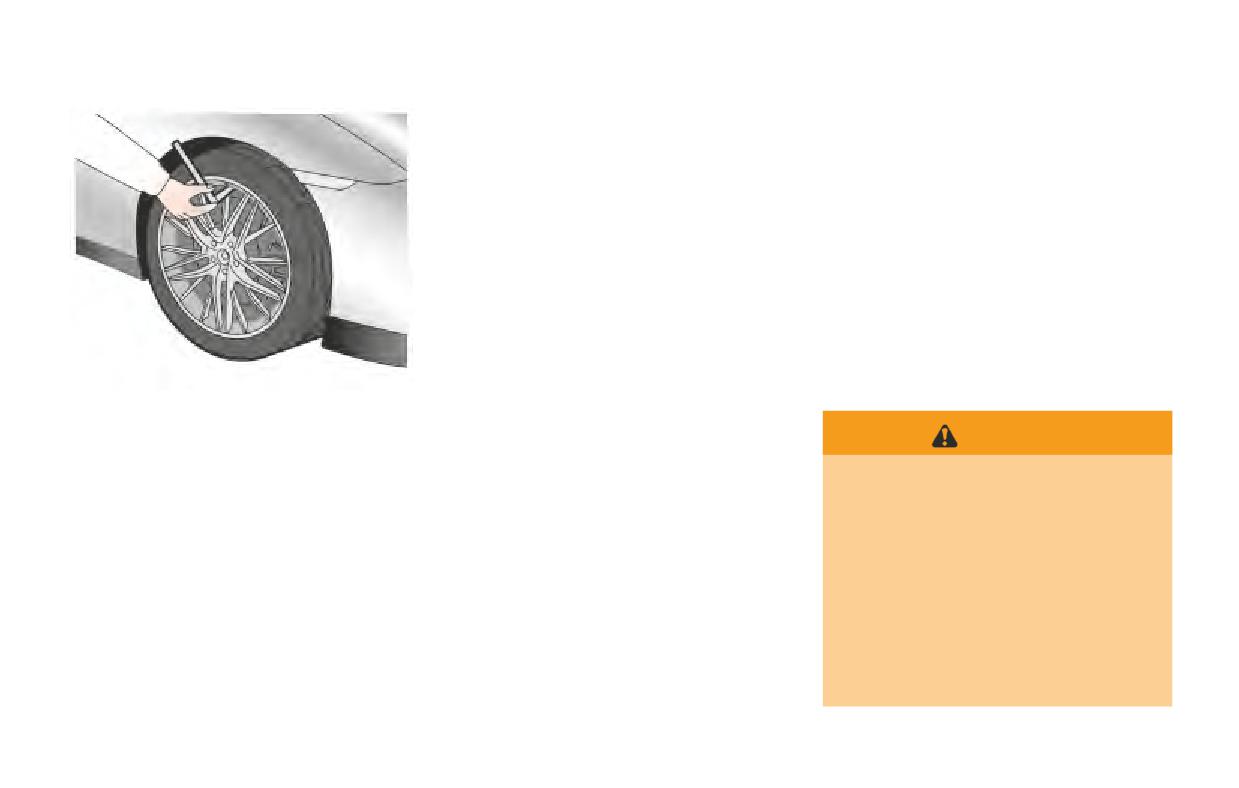
4.
Read the tire pressure on the
the tire pressure is low, fill the
gauge stem and compare it to
tires with nitrogen. It is recom-
the specification shown on the
mended you contact a GT-R
Tire and Loading Information
certified NISSAN dealer for in-
label.
formation on filling the tires
5.
Add air to the tire as needed. If
with nitrogen.
too much air is added, press the
If nitrogen is not available,
core of the valve stem briefly
compressed air may be safely
with the tip of the gauge stem to
used under normal driving
release pressure. Recheck the
conditions. However, NISSAN
pressure and add or release air
recommends refilling with ni-
as needed.
trogen for maximum tire per-
6.
Install the valve stem cap.
formance.
7.
Check the pressure of all other
CHECKING THE TIRE PRESSURE
tires.
WARNING
1.
Remove the valve stem cap from
8.
Check the pressure when driv-
the tire.
ing the vehicle at speeds of 100
. Driving at high speeds, 100
2. Press the pressure gauge
MPH (160 km/h) or higher where
MPH (160 km/h) or higher
squarely onto the valve stem.
it is legal to do so.
sustained where it is legal to
Do not press too hard or force
do so, can cause tires to
NOTE:
the valve stem sideways, or air
have excessive heat build
. You can check the pressure of
will escape. If the hissing sound
up, which may result in a
all four tires on the touch
of air escaping from the tire is
tire failure causing loss of
screen display. See the sepa-
heard while checking the pres-
control, crash, injuries or
rate Multi Function Display
sure, reposition the gauge to
even death. Some high-
Owner’s Manual.
eliminate this leakage.
speed rated tires require in-
. The tires of this vehicle are
3. Remove the gauge.
flation pressure adjustment
filled with nitrogen gas. When
Do-it-yourself
8-33
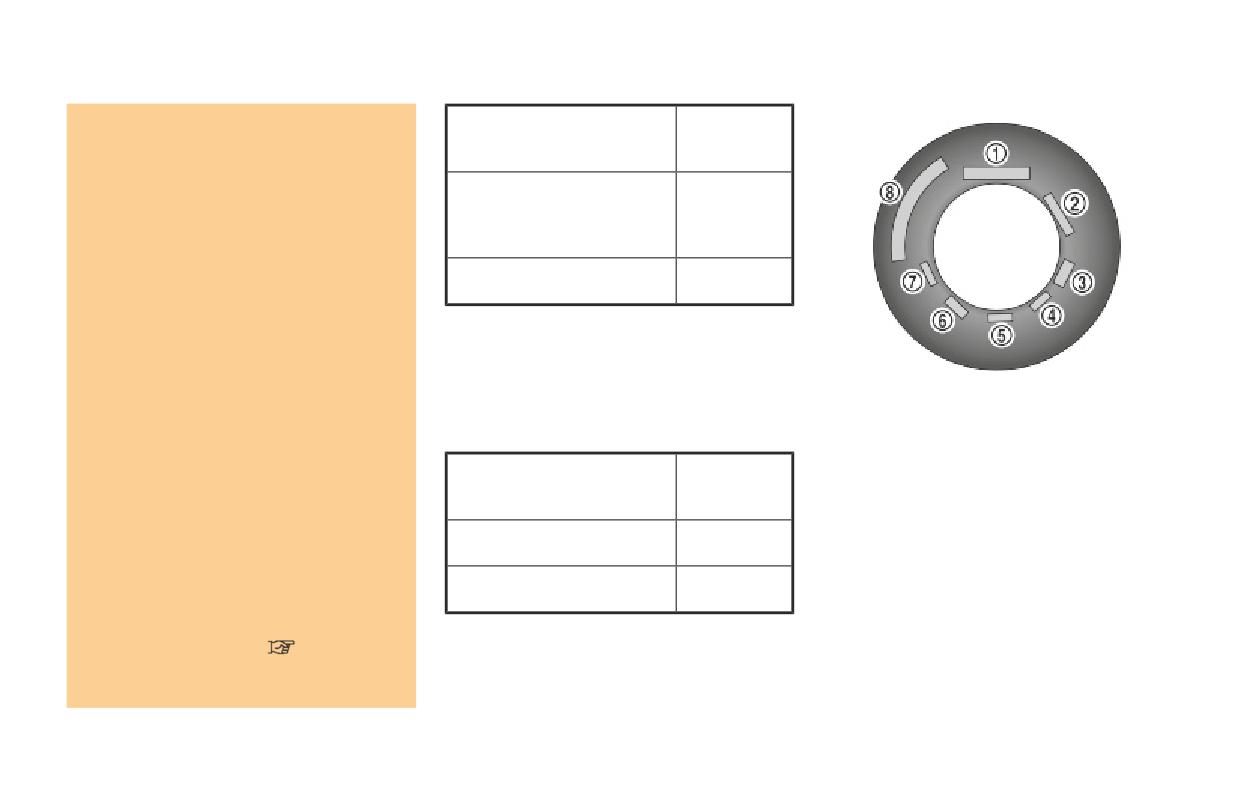
Cold Tire
for high-speed operation.
Size
Inflation
When speed limits and road
Pressure
conditions allow vehicle
30 psi, 210
driving at high speeds, make
Front Original Tire:
kPa *1
sure tires are rated to sup-
255/40ZRF20 (97Y)
32 psi, 220
port high speed operation,
kPa *2
tires are in optimal condi-
Rear Original Tire:
29 psi, 200
tions and pressure is ad-
285/35ZRF20 (100Y)
kPa
justed to correct cold
inflation pressure for high
*1: Except for NISMO models
speed operation.
*2: NISMO models
. Tires require adjustment to
Recommended tire inflation pressures
the inflation pressure when
at speeds of 100 MPH (160 km/h) or
Example
driving the vehicle at speeds
higher where it is legal to do so.
TIRE LABELING
of 100 MPH (160 km/h) or
higher where it is legal to do
Federal law requires tire manufac-
Cold Tire
so. See recommended tire
turers to place standardized infor-
Size
Inflation
inflation chart for correct
Pressure
mation on the sidewall of all tires.
operating pressure.
This information identifies and de-
Front Original Tire:
33 psi, 230
kPa
scribes the fundamental character-
. After vehicle high speed op-
255/40ZRF20 (97Y)
istics of the tire and also provides
eration has ended, readjust
Rear Original Tire:
33 psi, 230
the tire identification number (TIN)
the tire pressure to the re-
285/35ZRF20 (100Y)
kPa
for safety standard certification.
commended cold inflation
The TIN can be used to identify
pressure. (See
“Checking
the tire in case of a recall.
the tire pressure” page 8-
33.)
8-34
Do-it-yourself
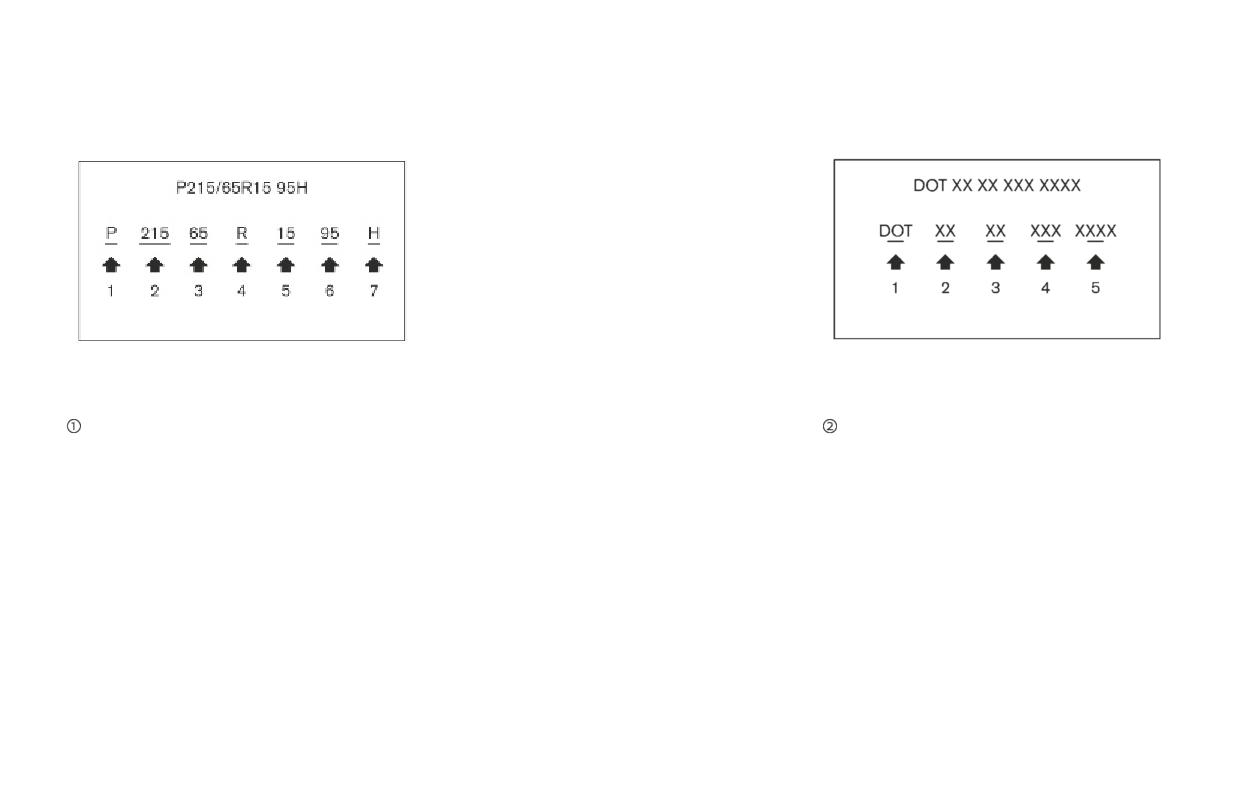
4.
R: The “R” stands for radial.
F: The “F” after “R” indicates Self-
Supporting type run-flat tire.
5.
Two-digit number
(15): This
number is the wheel or rim
diameter in inches.
6.
Two- or three-digit number (95):
This number is the tire’s load
index. It is a measurement of
how much weight each tire can
support. You may not find this
information on all tires because
it is not required by law.
Example
7.
H: Tire speed rating. You should
Example (Type A) (if so equipped)
Tire size (example: P215/60R16
not drive the vehicle faster than
TIN (Tire Identification Number)
94H)
the tire speed rating.
for a new tire (example: DOT XX XX
1.
P: The “P” indicates the tire is
XXX XXXX)
designed for passenger vehicles.
1.
DOT: Abbreviation for the “De-
(Not all tires have this informa-
partment Of Transportation”.
tion.)
The symbol can be placed
2. Three-digit number (215): This
above, below or to the left or
number gives the width in milli-
right of the Tire Identification
meters of the tire from sidewall
Number.
edge to sidewall edge.
2. Two-digit code: Manufacturer’s
3. Two-digit number
(65): This
identification mark
number, known as the aspect
3. Two-digit code: Tire size
ratio, gives the tire’s ratio of
4. Three-digit code: Tire type code
height to width.
(Optional)
Do-it-yourself
8-35
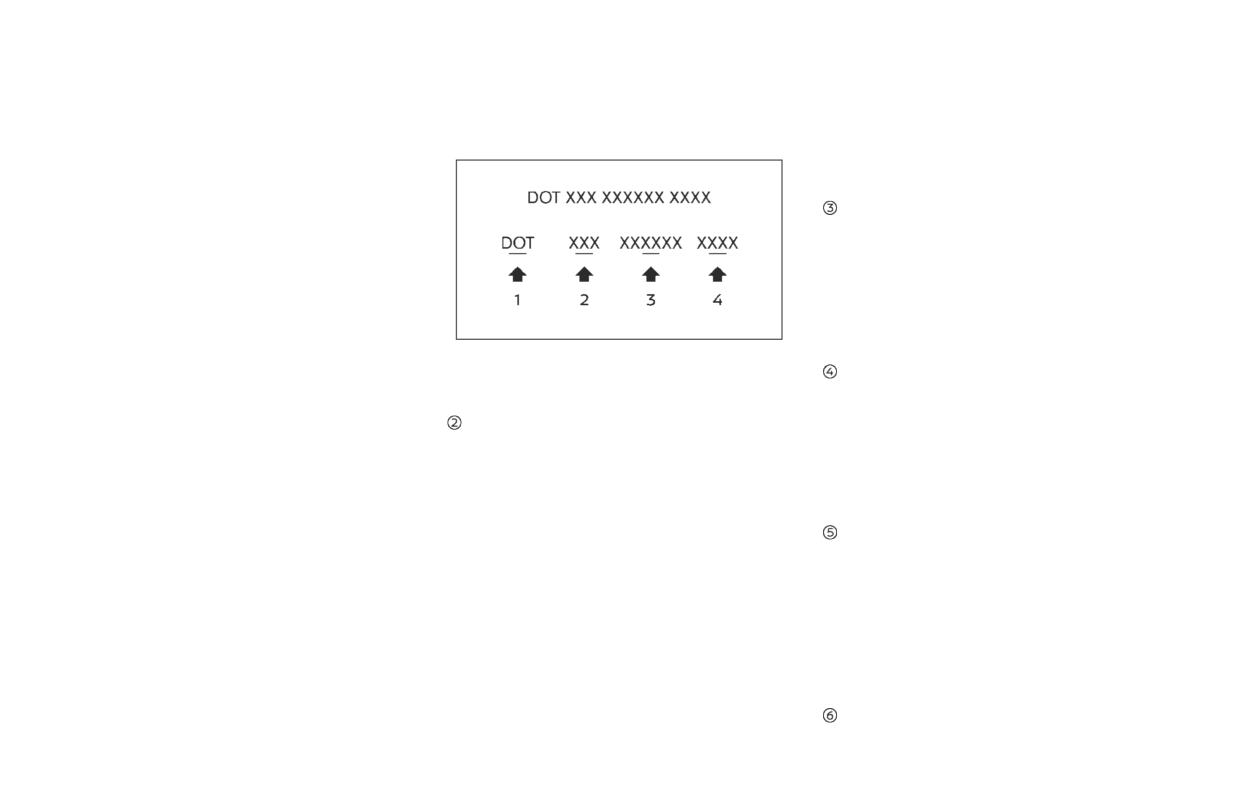
5. Four numbers represent the
4. Four numbers represent the
week and year the tire was built.
week and year the tire was built.
For example, the numbers 3103
For example, the numbers 3103
means the 31st week of 2003. If
means the 31st week of 2003.
these numbers are missing, then
Tire ply composition and material
look on the other sidewall of the
The number of layers or plies of
tire.
rubber-coated fabric in the tire.
Tire manufacturers also must in-
dicate the materials in the tire,
which include steel, nylon, polye-
ster, and others.
Maximum permissible inflation
pressure
Example (Type B) (if so equipped)
TIN (Tire Identification Number)
This number is the greatest
for a new tire (example: DOT
amount of air pressure that should
XXX XXXXXX XXXX)
be put in the tire. Do not exceed the
maximum permissible inflation
1.
DOT: Abbreviation for the “De-
pressure.
partment Of Transportation”.
The symbol can be placed
Maximum load rating
above, below or to the left or
This number indicates the maxi-
right of the Tire Identification
mum load in kilograms and pounds
Number.
that can be carried by the tire.
2.
Three-digit code: Manufacturer’s
When replacing the tires on the
identification mark
vehicle, always use a tire that has
3.
Six-digit code: Descriptive code
the same load rating as the factory
used to identify significant char-
installed tire.
acteristics of the tire.
Term of “tubeless” or “tube type”
8-36
Do-it-yourself

fully. NISSAN recommends the use of
Indicates whether the tire requires
TYPES OF TIRES
winter tires on all four wheels if you plan
an inner tube (“tube type”) or not
to operate your vehicle in snowy or icy
(“tubeless”).
WARNING
conditions when temperatures are less
The word “radial”
than 32°F (0°C).
. When changing or replacing tires,
The word “radial” is shown, if the
be sure all four tires are of the
tire has radial structure.
same type (Examples: Summer)
WARNING
Manufacturer or brand name
and construction. A GT-R certified
NISSAN dealer may be able to
Never use summer tires when the
Manufacturer or brand name is
help you with information about
temperature is below -4°F (-20°C) to
shown.
prevent permanent tread deforma-
tire type, size, speed rating and
Other tire-related terminology:
availability.
tion which may cause tire damage or
tire failure. This may cause a loss of
In addition to the many terms that
. Replacing tires with those not
vehicle control which can result in
are defined throughout this sec-
originally specified by NISSAN
serious personal injury or death.
tion, Intended Outboard Sidewall is
could affect the proper operation
of the TPMS.
(1) the sidewall that contains a
whitewall, bears white lettering or
. For additional information re-
Run-flat tires
garding tires, refer to “Important
bears manufacturer, brand and/or
Your vehicle is equipped with run-flat
Tire Safety Information” (US) or
model name molding that is higher
tires. You can continue driving to a safe
“Tire Safety Information” (Cana-
or deeper than the same molding
location even if they are punctured. Al-
da) in the Warranty Information
ways use run-flat tires of the specified
on the other sidewall of the tire, or
Booklet.
size on all four wheels. Mixing tire sizes or
(2) the outward facing sidewall of
construction may reduce vehicle handling
an asymmetrical tire that has a
stability. If necessary, contact a GT-R
Summer tires
particular side that must always
certified NISSAN dealer for assistance.
face outward when mounted on a
The GT-R summer tires are made from a
Frequently check the tire pressure infor-
vehicle.
specially formulated rubber to maximize
mation on the touch screen display and
the vehicle’s performance capabilities.
adjust pressure of each tire properly. See
Performance of summer tires is substan-
the separate Multi Function Display Own-
tially reduced when temperatures are less
er’s Manual.
than 32°F (0°C) so you must drive care-
Do-it-yourself
8-37

It can be difficult to tell if a run-flat tire is
sure, the warning light will continue to
. Drive safely at reduced speeds.
under-inflated or flat. Check the tire
illuminate until the system is reset.
Avoid hard cornering or braking,
pressures as described earlier in this
If the low tire pressure and the run-flat
which may cause you to lose
section. If the tire becomes under-inflated
tire warning appears on the vehicle
control of the vehicle.
while driving, the low tire pressure warn-
information display:
ing light will come on. If the tire becomes
. Do not exceed 50 MPH (80 km/h).
flat while driving, the low tire pressure
warning light and the run-flat tire warn-
. Increase your following distance to
NOTICE
ing display will come on.
allow for increased stopping dis-
. Never install tire chains on a
tances.
Low tire pressure:
punctured run-flat tire, as this
. Avoid sudden maneuvers, hard cor-
could damage your vehicle.
If the vehicle is being driven with low tire
nering and hard braking.
pressure, the low tire pressure warning
. Avoid driving over any projection
light will illuminate and the low tire
or pothole, as the clearance be-
pressure warning will appear in the vehi-
WARNING
tween the vehicle and the ground
cle information display.
is smaller than normal.
. Although you can continue driv-
Flat tire:
. Do not enter an automated car
ing with a punctured run-flat tire,
If the vehicle is being driven with one or
remember that vehicle handling
wash with a punctured run-flat
more flat tires, the low tire pressure
stability is reduced, which could
tire.
warning light will illuminate continuously
lead to an accident and personal
. It is recommended you have the
and a chime will sound for 10 seconds.
injury. Also, driving a long dis-
punctured tire replaced by a GT-R
The run-flat tire warning also appears in
tance at high speeds may da-
certified NISSAN dealer as soon
the vehicle information display.
mage the tire.
as possible, as the tire’s perfor-
The chime will only sound at the first
mance capability is reduced.
. Do not drive at speeds above 50
indication of a flat tire and the run-flat tire
MPH (80 km/h) and do not drive
warning display will illuminate continu-
more than 50 miles (80 km) with a
ously. When the flat tire warning is
Tires for All-Wheel Drive (AWD)
punctured run-flat tire. The actual
activated, it is recommended you have
distance the vehicle can be driven
If excessive tire wear is found, it is
the system reset and the tire checked
on a flat tire depends on outside
recommended that all four tires be re-
and replaced if necessary by a GT-R
temperature, vehicle load, road
placed with tires of the specified size,
certified NISSAN dealer. Even if the tire is
conditions and other factors.
brand, construction and tread pattern.
inflated to the specified COLD tire pres-
8-38
Do-it-yourself
The tire pressure and wheel alignment
using tire chains. In addition, drive at a
CHANGING WHEELS AND TIRES
should also be checked and corrected as
reduced speed. Otherwise, your vehicle
necessary. It is recommended you con-
may be damaged and/or vehicle handling
Tire rotation
tact a GT-R certified NISSAN dealer.
and performance may be adversely af-
fected.
Tires cannot be rotated because
TIRE CHAINS
your vehicle is equipped with dif-
NOTE:
Use of tire chains may be prohibited
ferent sized tires in the front and
according to location. Check the local
Tire chains must be installed only on
rear.
laws before installing tire chains. When
the rear wheels and not on the front
installing tire chains, make sure they are
wheels.
of proper size for the tires on your vehicle
and are installed according to the chain
CAUTION
manufacturer instructions. Use only SAE
class S chains. Class “S” chains are used
Do not use tire chains on dry roads.
on vehicles with restricted tire to vehicle
clearance. Vehicles that can use Class “S”
chains are designed to meet the SAE
NOTICE
standard minimum clearances between
the tire and the closest vehicle suspen-
Never install tire chains on a punctu-
sion or body component required to
red run-flat tire, as this could da-
accommodate the use of a winter trac-
mage your vehicle.
tion device (tire chains or cables). The
minimum clearances are determined
using the factory equipped tire size. Other
Do not drive with tire chains on paved
types may damage your vehicle. Use
roads that are clear of snow. Driving with
chain tensioners when recommended by
chains in such conditions can cause
the tire chain manufacturer to ensure a
damage to the various mechanisms of
tight fit. Loose end links of the tire chain
the vehicle due to some overstress.
must be secured or removed to prevent
the possibility of whipping action damage
to the fenders or undercarriage. If possi-
ble, avoid fully loading your vehicle when
Do-it-yourself
8-39
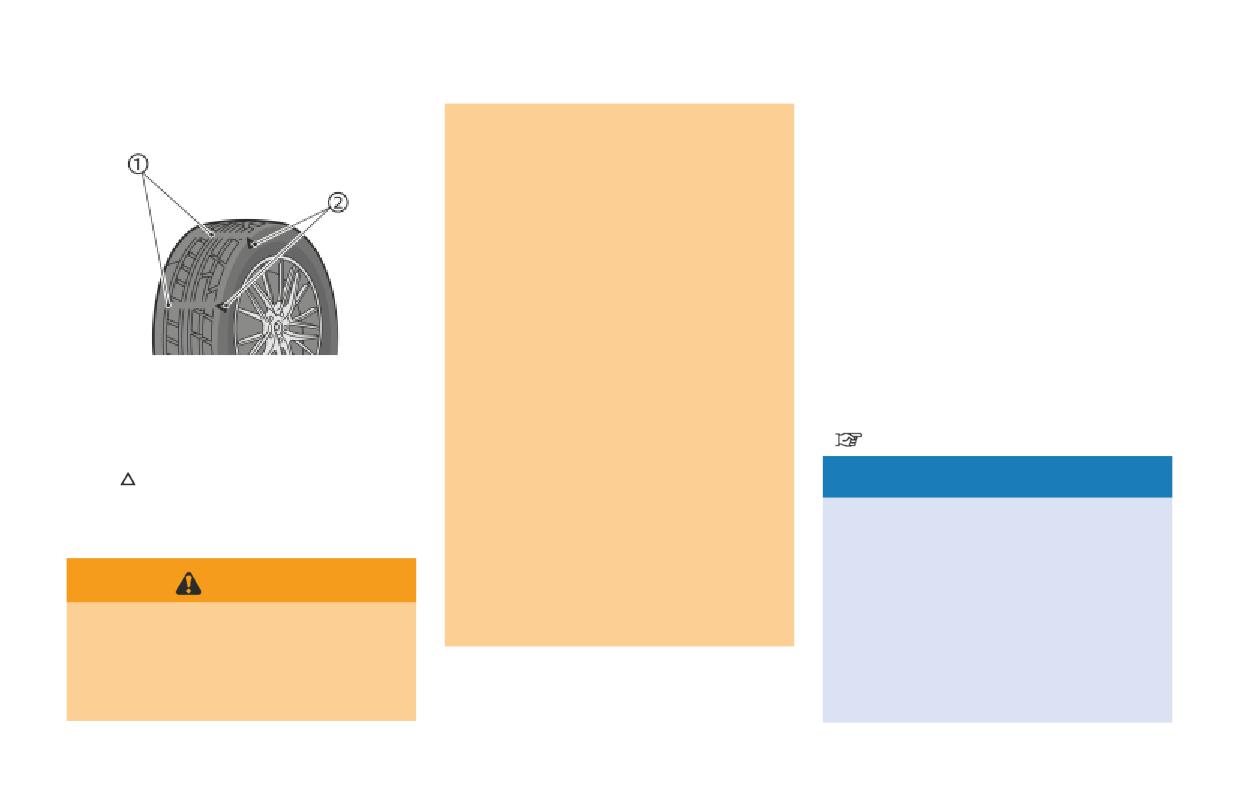
are found, the tire(s) should
Replacing wheels and tires
be replaced.
When tire replacement is required, repla-
The original tires have built-
cing tires as a set of four with new tires is
recommended. However, if a tire is punc-
in tread wear indicators.
tured or damaged, it may be possible to
When the wear indicators
replace only the damaged tire. Determin-
are visible, the tire(s) should
ing whether one tire or a complete set of
be replaced.
tires should be replaced is based on a
number of factors including tire wear and
Tires degrade with age and
condition. It is recommended you contact
use. Have tires, over 6 years
your GT-R certified NISSAN dealer. They
old checked by a qualified
can recommend if an individual tire or a
technician because some
complete set should be replaced.
tire damage may not be
When replacing a tire, use the specified
obvious. Replace the tires
size, speed rating and load carrying
1.
Wear indicator
capacity as originally equipped.
as necessary to prevent tire
2.
Wear indicator location marks.
(
“Wheels and tires” page 10-10)
failure and possible perso-
The locations are shown by
nal injury.
“
”, “TWI”, etc. depending on
NOTICE
tire types.
For additional information
regarding tires, refer to “Im-
. When you replace the GT-R tires,
Tire wear and damage
portant Tire Safety Informa-
it is recommended that you re-
place all the tires at the same
tion” (US) or “Tire Safety
time.
WARNING
Information” (Canada) in the
. The GT-R uses specially designed
Warranty Information Book-
. Tires should be periodically
run-flat tires which feature an
let.
extremely rigid side wall. Special
inspected for wear, cracking,
techniques and equipment are
bulging or objects caught in
therefore required when repla-
the tread. If excessive wear,
cing these tires. NISSAN recom-
cracks, bulging or deep cuts
mends that tire replacement be
8-40
Do-it-yourself

performed at a GT-R certified
versely affect the ride, braking,
dealer as soon as possible for tire
NISSAN dealer.
VDC system, handling, ground
replacement and/or system re-
clearance, body-to-tire clearance,
setting.
When tires are reinstalled after
tire chain clearance, speed-
being uninstalled from the
. Replacing tires with those not
ometer calibration, headlight
wheels, use equipment such as a
originally specified by NISSAN
aim and bumper height. Some of
leverless automatic tire changer.
could affect the proper operation
these effects may lead to acci-
It is only possible to reuse the
of the TPMS.
dents and could result in serious
tires when they have no cracks
personal injury.
. The TPMS sensor may be da-
and/or deformations on the bead
maged if it is not handled cor-
portion. However, if you use a
. If the wheels are changed for any
rectly. Be careful when handling
lever-type tire changer, cracks
reason, always replace with
the TPMS sensor.
and deformation may occur on
wheels which have the same off-
the bead portion of the tires
set dimension. Wheels of a differ-
. When replacing the TPMS sensor,
meaning that the tires cannot be
ent off-set could cause prema-
the ID registration may be re-
reused.
ture tire wear, degrade vehicle
quired. Contact a GT-R certified
handling characteristics, affect
NISSAN dealer for ID registration.
Make sure the tire valve stem cap
the VDC system and/or cause
. Do not use a valve stem cap that
is installed and that the valve
interference with the brake discs.
is not specified by NISSAN. The
stem is tight. When installing the
Such interference can lead to
valve stem cap may become
cap, make sure to tighten the cap
decreased braking efficiency
stuck.
by hand. If a tool is used to
and/or early brake pad wear.
tighten the cap, the cap may be
. Be sure that the valve stem caps
(
“Wheels and tires” page 10-
damaged.
are correctly fitted. Otherwise the
10)
valve may be clogged up with dirt
. When a wheel is replaced, tire
and cause a malfunction or loss
pressure will not be indicated,
of pressure.
WARNING
the TPMS will not function and
. Do not install a damaged or
the low tire pressure warning
The use of tires other than those
deformed wheel or tire even if it
light will flash for approximately
specified or the mixed use of tires
has been repaired. Such wheels
1 minute and remain on after the
of different brands, construction
or tires could have structural
1 minute. It is recommended you
(bias, bias-belted, radial or run-
damage and could fail without
contact a GT-R certified NISSAN
flat), or tread patterns can ad-
warning.
Do-it-yourself
8-41
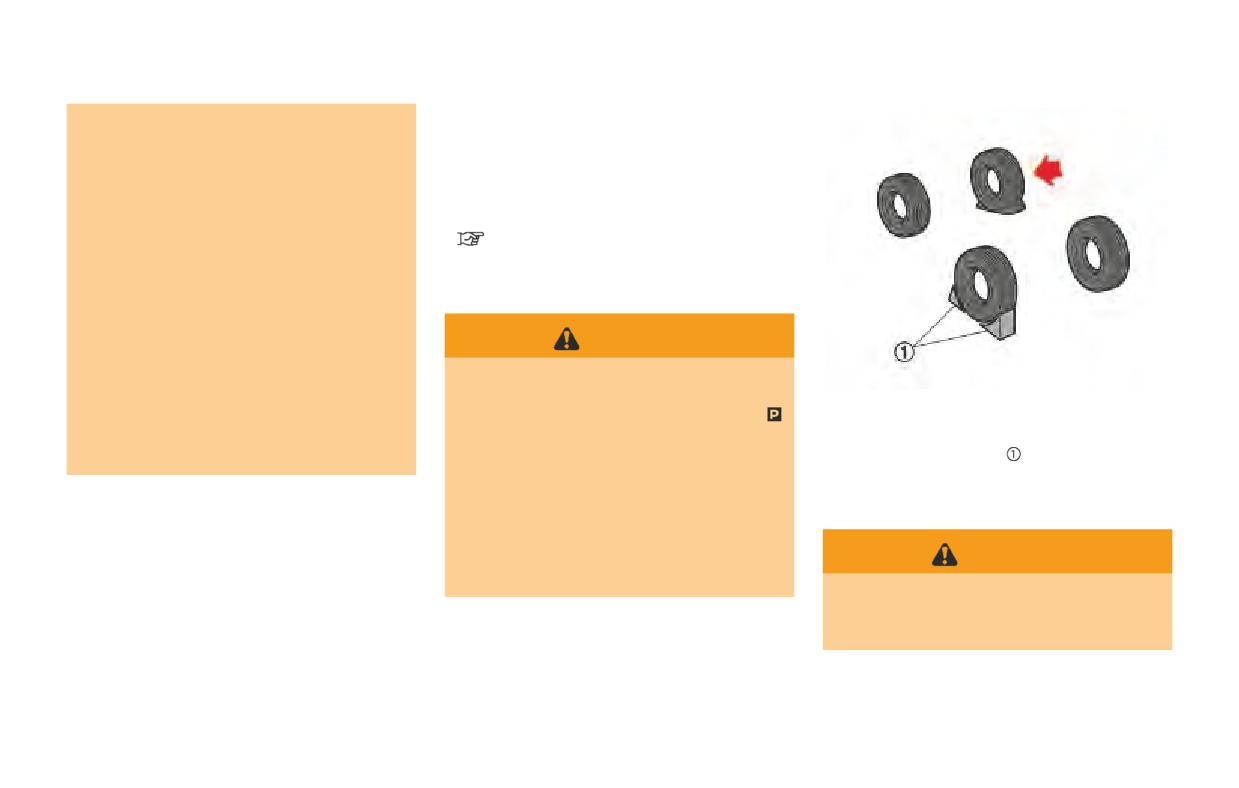
refer to “Important Tire Safety Informa-
. Never use retread tires.
tion” (US) or “Tire Safety Information”
. For additional information re-
(Canada) in the Warranty Information
garding tires, refer to “Important
Booklet.
Tire Safety Information” (US) or
“Tire Safety Information” (Cana-
Care of wheels
da) in the Warranty Information
(
“Cleaning exterior” page 7-2)
Booklet.
. Always use tires of the specified
JACKING VEHICLE AND REMOVING
type, size, brand, construction
WHEELS
(bias, bias-belted, radial or run-
flat), and tread pattern on all four
wheels. Failure to do so may
WARNING
result in a circumference differ-
. Make sure the parking brake is
ence between tires on the front
securely applied and the trans-
and rear axles which will cause
mission is shifted into the
excessive tire wear and may da-
position.
Blocking wheels
mage the transmission, transfer
case and differential gears.
. Never change tires when the ve-
Place suitable blocks
at both the front
and back of the wheel diagonally oppo-
hicle is on a slope, ice or slippery
site the flat tire to prevent the vehicle
areas. This is hazardous.
Wheel balance
from moving when it is jacked up.
. Never change tires if oncoming
Unbalanced wheels may affect vehicle
traffic is close to your vehicle.
handling and tire life. Even with regular
Wait for professional road assis-
WARNING
use, wheels can get out of balance.
tance.
Be sure to block the wheel as the
Therefore, they should be balanced as
vehicle may move and result in
required.
personal injury.
Wheel balance service should be per-
formed with the wheels off the vehicle.
Spin balancing the rear wheels on the
vehicle could lead to mechanical damage.
For additional information regarding tires,
8-42
Do-it-yourself
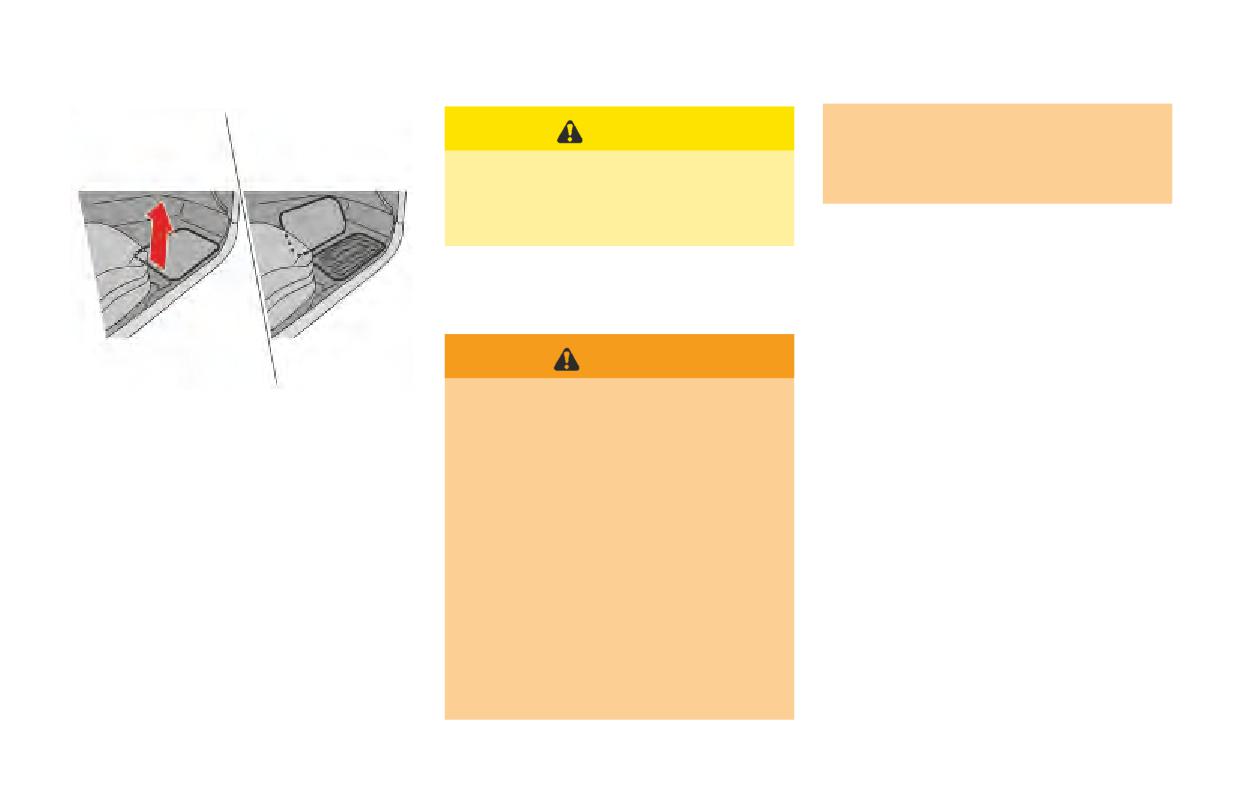
with limited slip differentials.
CAUTION
. Do not allow passengers to stay
After using the tools, put them back
in the vehicle while it is on the
in their original places. An accident
jack.
may occur if you leave them in the
car unsecured.
Carefully read the caution label at-
tached to the jack body and the follow-
ing instructions.
Jacking up the vehicle and re-
moving the tire
WARNING
Never get under the vehicle while
it is supported only by the jack. If
Getting the tools
it is necessary to work under the
vehicle, support it with safety
NOTE:
stands.
A jack, jack lever and rod are not
Use the correct jack-up points.
equipped as standard with this vehicle.
Never use any other part of the
These parts are dealer options. It is
vehicle for jack support.
recommended you contact a GT-R cer-
tified NISSAN dealer about acquiring a
Never jack up the vehicle more
jack, jack lever and rod. You can store a
than necessary.
jack, jack lever and rod in the floor in
Never use blocks on or under the
front of the passenger’s seat.
jack.
Do not start or run the engine
while vehicle is on the jack, as it
may cause the vehicle to move.
This is especially true for vehicles
Do-it-yourself
8-43
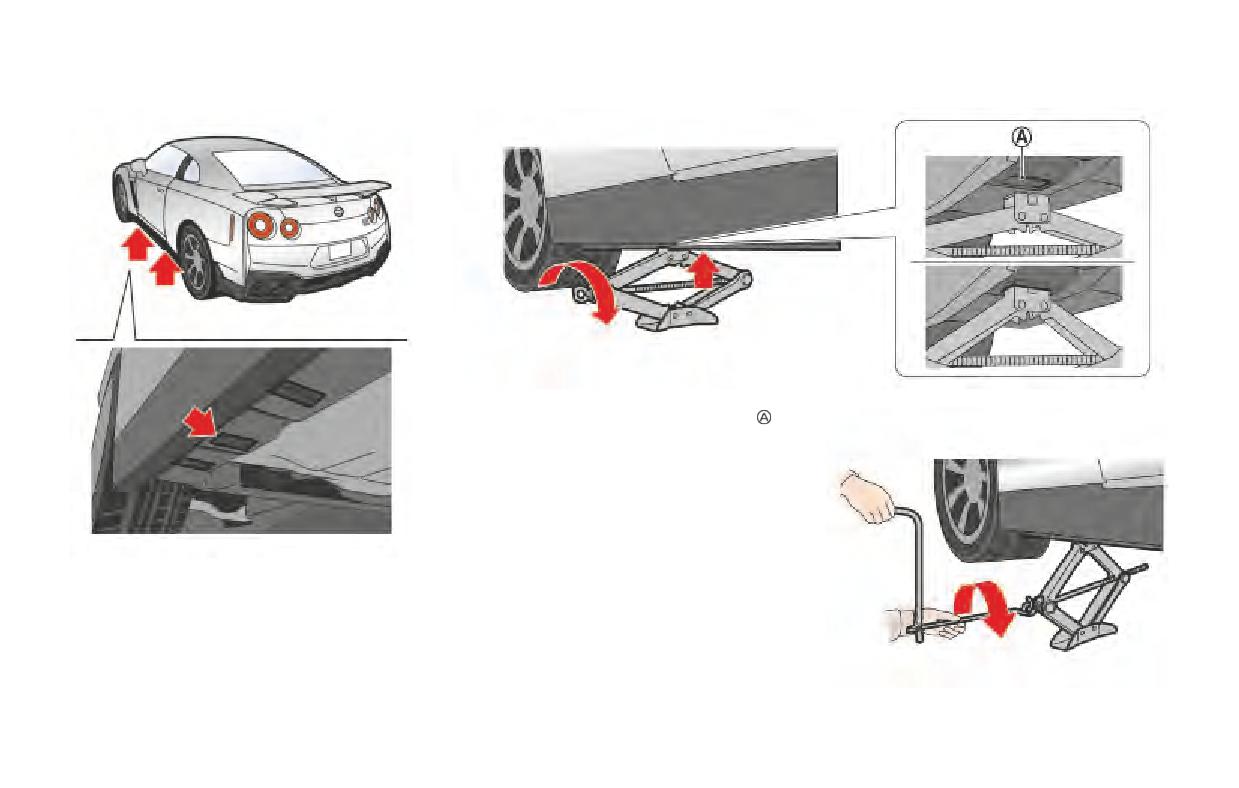
2. Fit the jack head into the recess
of
the jack-up point by turning the jack-
screw clockwise with your fingers.
3. Loosen each wheel nut one or two
turns by turning counterclockwise
with the wheel nut wrench. Do not
remove the wheel nuts until the tire
is off the ground.
Jack-up point
1.
Place the jack directly under the jack-
up point as illustrated so the top of
the jack contacts the vehicle at the
jack-up point. The jack should be
used on level firm ground.
8-44
Do-it-yourself
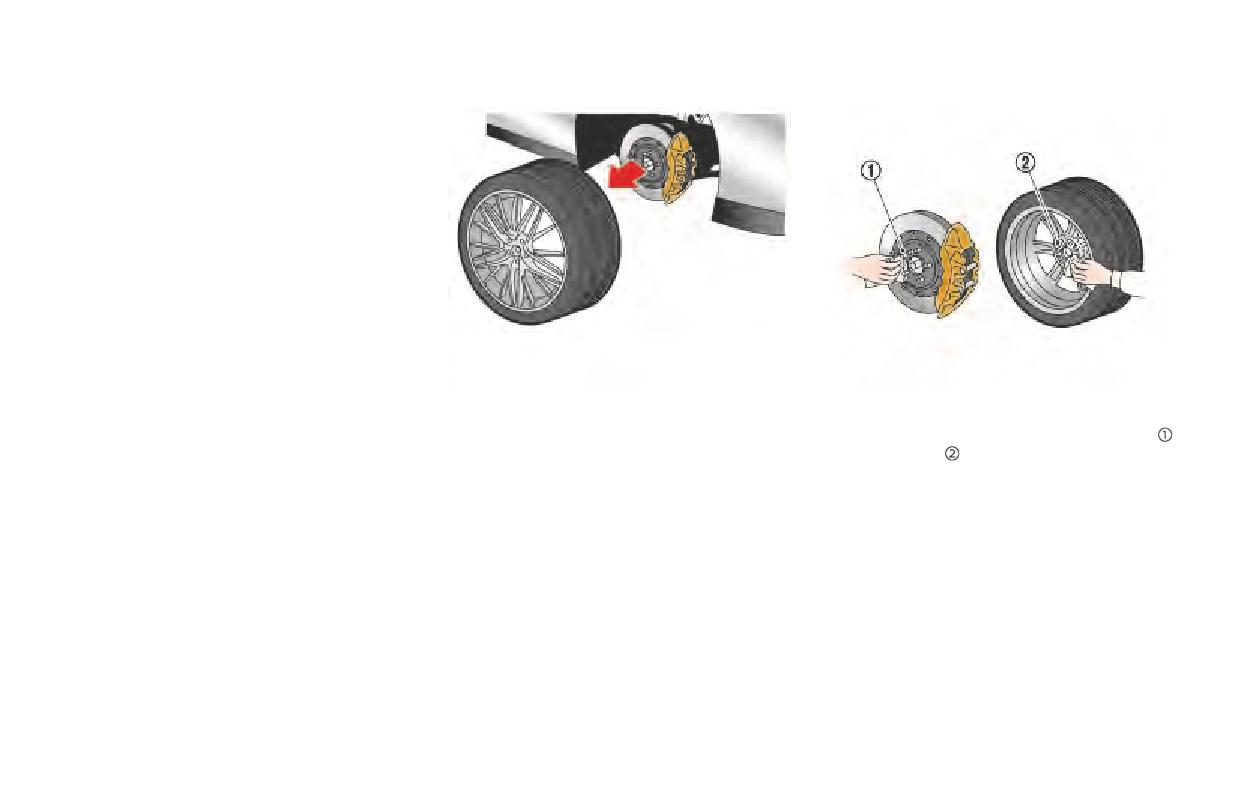
4. Carefully raise the vehicle until the tire
clears the ground. To lift the vehicle,
securely hold the jack lever and rod
with both hands as shown above.
5. Remove the wheel nuts and then
6. Clean any mud or dirt from the sur-
remove the wheel.
face between the brake disc rotor
and wheel
NOTE:
When putting a wheel on the
ground, put it down with the outer
side of the wheel facing up to pre-
vent scratching of the wheel surface.
Do-it-yourself
8-45
WARNING
. Incorrect wheel nuts or impro-
perly tightened wheel nuts can
cause the wheel to become loose
or come off. This could cause an
accident.
. Do not use oil or grease on the
wheel studs or nuts. This could
cause the nuts to become loose.
. Retighten the wheel nuts when
the vehicle has been driven for
600 miles (1,000 km).
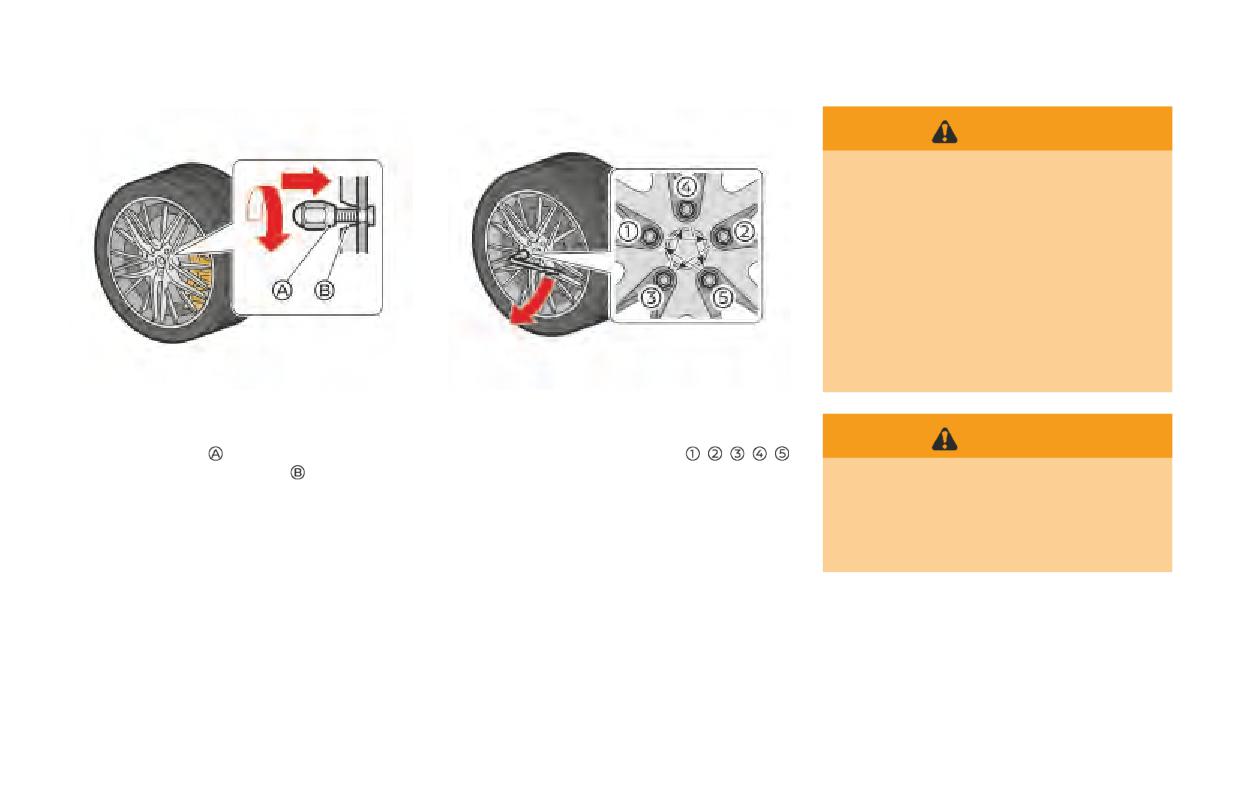
7. Tighten the wheel nuts by hand by
8. With the wheel nut wrench, tighten
turning them clockwise until the ta-
wheel nuts alternately and evenly in
WARNING
pered part
of each nut lightly
the sequence illustrated (
,
,
,
,
)
contacts the seat part
of the wheel
until they are tight.
If the road wheels are hot, allow
hole.
9. Lower the vehicle slowly until the tire
them to cool sufficiently before tigh-
When replacing a front wheel, make
touches the ground. Then, with the
tening the wheel nuts. Otherwise, the
sure the hole in the wheel is aligned
wheel nut wrench, tighten the wheel
wheel nuts cannot be tightened to
with the pin on the brake disc rotor.
nuts securely in the sequence as
specification.
illustrated. Lower the vehicle comple-
tely.
NOTE:
. As soon as possible, tighten the
wheel nuts to the specified torque
with a torque wrench.
Wheel nut tightening torque:
8-46
Do-it-yourself
Except for NISMO models, T-spec
WHEEL LOCK NUTS (if so
version and NISMO Special Edition
equipped)
97 ft-lb (132 N·m)
NISMO models, T-spec version
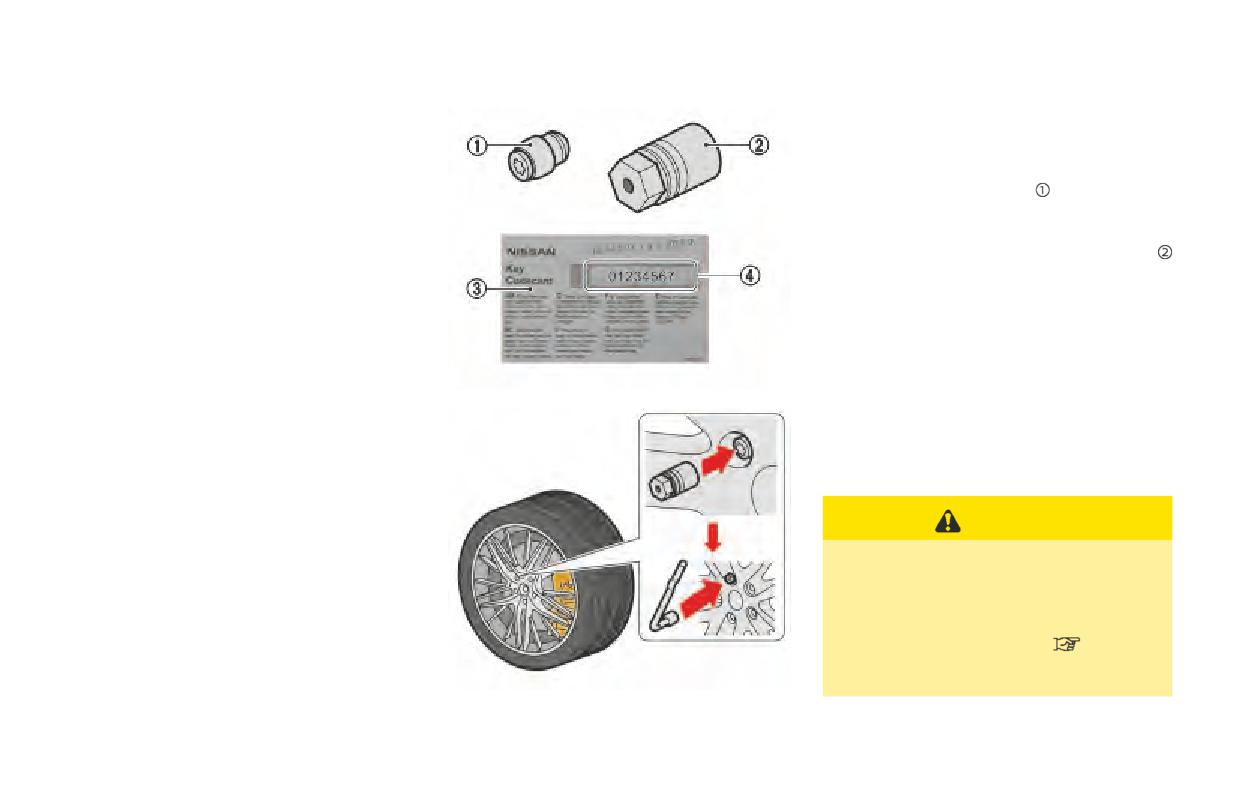
In order to prevent theft, the specially
and NISMO Special Edition
designed wheel lock nut
is installed on
114 ft-lb (155 N·m)
each wheel. The wheel lock nut cannot be
removed with commonly used tools.
The wheel nuts must be kept
tightened to specification at all
When removing tires, use the lock key
times. It is recommended that
provided with your vehicle.
wheel nuts be tightened to speci-
fications at each lubrication inter-
Removing the wheel lock nut
val.
To remove the wheel lock nut, use the
. Adjust tire pressure to the COLD
lock key stored under the passenger’s
pressure.
side floor.
COLD pressure: After the vehicle
1.
Insert the lock key to the wheel lock
has been parked for three hours
nut.
or more or driven less than 1 mile
(1.6 km).
2. To remove the wheel lock nut, turn
the lock key counterclockwise using
COLD tire pressures are shown on
the wheel nut wrench.
the Tire and Loading Information
label affixed to the driver’s door
opening.
CAUTION
10. Securely store the jacking equipment
. Do not use a power tool to re-
in the vehicle.
move the wheel lock nuts.
. Tighten the wheel lock nuts to the
same tightening torque as the
normal wheel nuts. (
“Jacking
up the vehicle and removing the
tire” page 8-43)
Do-it-yourself
8-47
NOTE:
. The wheel lock nut has an individual
code. A lock key which does not
match the individual code cannot
remove the wheel lock nut. If you
lose the wheel lock key, it is recom-
mended you contact a GT-R certified
NISSAN dealer immediately.
. Keep the key code card
in a safe
place. To purchase a lock key, con-
tact a GT-R certified NISSAN dealer
with your original code
on the key
code card.
. When you ask for a service at a GT-R
certified NISSAN dealer, make sure
to keep the lock key in the vehicle.
Otherwise, tires cannot be removed
and any service requiring the re-
moval of the wheels cannot be
performed.
8-48
Do-it-yourself
9 Maintenance and schedules
Maintenance requirement
9-2
Chassis and body maintenance
9-7
Scheduled maintenance
9-2
Additional maintenance items
9-8
General maintenance
9-2
Setting guide of wheel alignment depending
Where to go for service
9-2
on the customer’s driving
9-21
Determining the proper maintenance interval
9-3
Tire replacement record
9-23
General maintenance
9-3
Transmission assembly/parts
Explanation of maintenance items
9-3
replacement record
9-26
Maintenance log and records
9-28
Explanation of scheduled maintenance items
9-6
Emission control system maintenance
9-6
MAINTENANCE REQUIREMENT
Some day-to-day and regular mainte-
These checks or inspections can be done
forms the best job to meet the main-
nance is essential to maintain your vehi-
by yourself, a qualified technician or, if you
tenance requirements on your vehicle.
cle good mechanical condition, as well as
prefer, a GT-R certified NISSAN dealer.
To find a GT-R certified NISSAN dealer
its emission and engine performance.
near you, call 1-866-668-1GTR in the US or
WHERE TO GO FOR SERVICE
It is the owner’s responsibility to make
1-800-387-0122 in Canada, or go to www.
GT-R certified NISSAN dealers are re-
gtrnissan.com/.
sure that the scheduled maintenance, as
quired to have additional training and
well as general maintenance, is per-
equipment and are the only NISSAN deal-
formed.
ers authorized to perform warranty work
As the vehicle owner, you are the only one
on key vehicle performance systems such
who can ensure that your vehicle receives
as engine, transmission, suspension and
the proper maintenance care. You are a
brakes.
vital link in the maintenance chain.
If maintenance service is required or your
SCHEDULED MAINTENANCE
vehicle appears to malfunction, it is re-
commended that you have the systems
For your convenience, both required and
checked and serviced by a GT-R certified
optional scheduled maintenance items
NISSAN dealer.
are described and listed in this section.
You must refer to that guide to ensure
NISSAN technicians are well-trained spe-
that necessary maintenance is performed
cialists and are kept up to date with the
on your vehicle at regular intervals.
latest service information through tech-
nical bulletins, service tips, and in-dealer
GENERAL MAINTENANCE
information systems. They are completely
General maintenance includes those
qualified to work on NISSAN vehicles
before work begins.
items which should be checked during
normal day-to-day operation. They are
If your vehicle is involved in a collision, it is
essential for proper vehicle operation. It is
recommended that you ask your NISSAN
your responsibility to perform these pro-
dealer where the nearest NISSAN Certified
cedures regularly as prescribed.
Collision Center is located, or go to http://
Performing general maintenance checks
collision.nissanusa.com.
requires minimal mechanical skill and
You can be confident that a GT-R certified
only a few general automotive tools.
NISSAN dealer’s service department per-
9-2
Maintenance and schedules
DETERMINING THE PROPER
MAINTENANCE INTERVAL
GENERAL MAINTENANCE
Depending on your driving habits and
highway driving in temperate conditions.
During the normal day-to-day operation
local conditions, you should follow one of
Use Schedule 2 only if you primarily
of the vehicle, general maintenance
the two maintenance schedules listed
operate your vehicle under conditions
should be performed regularly as pre-
below for scheduled maintenance. In
other than those listed in Schedule 1.
scribed in this section. If you detect any
addition to Schedule 1 maintenance, ad-
unusual sounds, vibrations or smell, be
ditional maintenance must be performed
sure to check for the cause and have it
for optimum performance. Use these
checked promptly. In addition, it is re-
guidelines to determine which mainte-
commended you notify a GT-R certified
nance schedule to use:
NISSAN dealer if you think that repairs are
required. (
“Maintenance precautions”
Schedule 1 (Every 6,000 miles (10,000
page 8-3)
km) or 6 months, whichever comes first)
Schedule 1 features 6,000-mile (10,000
EXPLANATION OF MAINTENANCE
km) service intervals. Use Schedule 1 if you
ITEMS
primarily operate your vehicle under any
of these conditions:
Additional information on the following
items with “*” is found later in the “8. Do-
. Repeated short trips of less than 5
it-yourself” section of this manual.
miles (8 km) in normal temperatures
or less than 10 miles (16 km) in freezing
Outside the vehicle
temperatures
The maintenance items listed here should
. Stop-and-go traffic in hot weather or
be performed from time to time, unless
lowspeed driving for long distances
otherwise specified.
. Driving in dusty conditions or on
Doors and engine hood: Check that all
rough, muddy, or salt-spread roads
doors and the engine hood, operate
Schedule 2 (Every 6,000 miles (10,000
properly. Also ensure that all latches lock
km) or 6 months, whichever comes first)
securely. Lubricate hinges, latches, latch
Schedule 2 features 6,000-mile (10,000
pins, rollers and links if necessary. Make
km) service intervals; with Schedule
2
sure that the secondary latch keeps the
fewer maintenance items are regularly
hood from opening when the primary
checked or replaced than with Schedule 1.
latch is released.
Generally, Schedule 2 applies only to
When driving in areas using road salt or
Maintenance and schedules
9-3
other corrosive materials, check lubrica-
contact a GT-R certified NISSAN
damage. Have a damaged windshield
tion frequently.
dealer for information on filling the
repaired by a qualified repair facility.
tires with nitrogen.
Lights*: Clean the headlights on a regular
It is recommended that you have a
basis. Make sure that the headlights, stop
. If nitrogen is not available, com-
damaged windshield repaired by a GT-R
lights, tail lights, turn signal lights, and
pressed air may be safely used
certified NISSAN dealer, or a NISSAN
other lights are all operating properly and
under normal driving conditions.
Certified Collision Center. To locate a
installed securely. Also check headlight
However, NISSAN recommends re-
collision center in your area, refer to
aim.
filling with nitrogen for maximum
Road wheel nuts (lug nuts)*: When
tire performance.
Windshield wiper blades*: Check for
checking the tires, make sure no wheel
Tire Pressure Monitoring System (TPMS)
cracks or wear if they do not wipe
nuts are missing, and check for any loose
transmitter components: Replace grom-
properly.
wheel nuts. Tighten if necessary.
met seal of transmitter in TPMS, when
Tire rotation*: Tires cannot be rotated
replacing each tire by reaching the wear
Inside the vehicle
because your vehicle is equipped with
limit.
The maintenance items listed here should
different sized tires in the front and rear.
Tire, wheel alignment and balance: If the
be checked on a regular basis, such as
Tires*: Check the pressure with a gauge
vehicle should pull to either side while
when performing scheduled mainte-
often and always prior to long distance
driving on a straight and level road, or if
nance, cleaning the vehicle, etc.
trips. If necessary, adjust the pressure in
you detect uneven or abnormal tire wear,
Accelerator pedal: Check the pedal for
all tires to the pressure specified. Check
there may be a need for wheel alignment.
smooth operation and make sure the
carefully for damage, cuts or excessive
If the steering wheel or seat vibrates at
pedal does not catch or require uneven
wear.
normal highway speeds, wheel balancing
effort. Keep the floor mat away from the
may be needed.
pedal.
NOTE:
Transmission
mechanism: On a fairly
. You can check the pressure of all
For additional information regarding tires,
four tires on the touch screen dis-
refer to “Important Tire Safety Informa-
steep hill, check that your vehicle is held
play. See the separate Multi Func-
tion” (US) or “Tire Safety Information”
securely with the shift lever in the
tion Display Owner’s Manual.
(Canada) in the Warranty Information
position without applying any brakes.
Booklet.
Brake pedal: Check the pedal for smooth
. The tires of this vehicle are filled
Windshield: Clean the windshield on a
operation. If the brake pedal suddenly
with nitrogen gas. When the tire
regular basis. Check the windshield at
goes down further than normal, the pedal
pressure is low, fill the tires with
least every six months for cracks or other
feels spongy or the vehicle seems to take
nitrogen. It is recommended you
longer to stop, it is recommended you see
9-4
Maintenance and schedules
a GT-R certified NISSAN dealer immedi-
erly and in sufficient quantity when oper-
be charged to maintain battery health.
ately. Keep the floor mat away from the
ating the heater or air conditioner.
Brake fluid level*: Make sure that the
pedal.
Windshield wiper and washer*: Check
brake fluid level is between the MAX and
Brakes: Check that the brakes do not pull
that the wipers and washer operate
MIN lines on the reservoir.
the vehicle to one side when applied.
properly and that the wipers do not
Engine coolant level*: Check the coolant
Parking brake: Check the parking brake
streak.
level when the engine is cold.
operation regularly. The vehicle should be
Engine drive belts*: Make sure that no
Under the hood and vehicle
securely held on a fairly steep hill with
belt is frayed, worn, cracked or oily.
only the parking brake applied. If the
The maintenance items listed here should
Engine oil level*: Check the level after
parking brake needs to be adjusted, it is
be checked periodically (for example,
parking the vehicle on a level spot and
recommended you see a GT-R certified
each time you check the engine oil or
turning off the engine. Wait at least 5
NISSAN dealer.
refuel).
minutes for the oil to drain back into the
Seat belts: Check that all parts of the seat
Battery*: Check the fluid level in each cell.
oil pan before checking the oil.
belt system (for example, buckles, an-
It should be between the MAX and MIN
Exhaust system: Make sure there are no
chors, adjuster and retractors) operate
lines. Vehicles operated in high tempera-
loose supports, cracks or holes. If the
properly and smoothly, and are installed
tures or under severe condition require
sound of the exhaust seems unusual or
securely. Check the belt webbing for cuts,
frequent checks of the battery fluid level.
there is a smell of exhaust fumes in the
fraying, wear or damage.
NOTE:
engine compartment, it is recommended
Seats: Check seat position controls such
you immediately have the exhaust sys-
Care should be taken to avoid situations
as seat adjusters, seatback recliner, etc. to
tem inspected. It is recommended you
that can lead to potential battery dis-
ensure they operate smoothly and that all
contact a GT-R certified NISSAN dealer.
charge and potential no-start condi-
latches lock securely in every position.
(
“Exhaust gas (carbon monoxide)”
tions such as:
Steering wheel: Check for changes in the
page 5-3)
1.
Installation or extended use of elec-
steering conditions, such as excessive
Fluid leaks: Check under the vehicle for
tronic accessories that consume
free play, hard steering or strange noises.
fuel, oil, water or other fluid leaks after the
battery power when the engine is
Warning lights and chimes: Make sure
not running (Phone chargers, GPS,
vehicle has been parked for a while. Water
that all warning lights and chimes are
DVD players, etc.)
dripping from the air conditioner after use
operating properly.
is normal. If you should notice any leaks
2. Vehicle is not driven regularly and/
or if gasoline fumes are evident, check for
Windshield defroster: Check that the air
or only driven short distances.
the cause and have it corrected immedi-
comes out of the defroster outlets prop-
In these cases, the battery may need to
ately.
Maintenance and schedules
9-5
EXPLANATION OF SCHEDULED
MAINTENANCE ITEMS
Power steering fluid level* and lines:
The following descriptions are provided
NISSAN.
Check the level when the fluid is cold, with
to give you a better understanding of the
For recommended fuel, lubricants,
the engine off. Check the lines for proper
scheduled maintenance items that
fluids, grease, and refrigerant, refer to
attachment, leaks, cracks, etc.
should be regularly checked or replaced.
“Capacities and recommended
Radiator and hoses: Check the front of
The maintenance log indicates at which
fluids/lubricants” page
10-2
of this
the radiator and clean off any dirt, insects,
mileage/time intervals each item requires
manual.
leaves, etc., that may have accumulated.
service.
EMISSION CONTROL SYSTEM
Make sure the hoses have no cracks,
In addition to scheduled maintenance,
deformation, rot or loose connections.
MAINTENANCE
your vehicle requires that some items be
Underbody: The underbody is frequently
checked during normal day-to-day op-
Drive belts*:
exposed to corrosive substances such as
eration. Refer to
“General mainte-
Check engine drive belts for wear, fraying
those used on icy roads or to control
nance” page 9-3.
or cracking. Replace any damaged drive
dust. It is very important to remove these
Maintenance items and intervals marked
belts.
substances, otherwise rust will form on
with “*” are recommended by NISSAN for
Engine air filter:
the floor pan, frame, fuel lines and around
reliable vehicle operation. You are not
the exhaust system. At the end of winter,
Replace at specified intervals. When driv-
required to perform such maintenance
the underbody should be thoroughly
ing for prolonged periods in dusty condi-
in order to maintain the emission war-
flushed with plain water, being careful to
tions, check/replace the filter more
ranty or manufacturer recall liability.
clean those areas where mud and dirt
frequently.
When applicable, additional information
may accumulate. (
“Underbody” page
Engine coolant*:
can be found in the “8. Do-it-yourself”
7-4)
section of this manual.
Replace coolant at the specified interval.
Windshield washer fluid*: Check that
When adding or replacing coolant, be
there is adequate fluid in the reservoir.
NOTE:
sure to use only Genuine NISSAN Long
NISSAN does not advocate the use of
Life Antifreeze/Coolant (blue) or equiva-
non-OEM approved aftermarket flush-
lent with the proper mixture. (Refer to
ing systems and strongly advises
“Engine cooling system” page 8-6 to
against performing these services on a
determine the proper mixture for your
NISSAN product. Many of the aftermar-
area.)
ket flushing systems use non-OEM ap-
proved chemicals or solvents, the use of
which has not been validated by
9-6
Maintenance and schedules
NOTE:
Throttle chamber deposits*:
tions, replace the filter more frequently.
Mixing any other type of coolant or the
Visually inspect the throttle chamber for
Measurement and adjustment of wheel
use of non-distilled water may reduce
deposits and clean as necessary.
alignment:
the recommended service interval of
Spark plugs:
Manage the wheel alignment by measur-
the coolant.
ing and adjusting at specified intervals.
Replace at specified intervals. Install new
Engine oil and oil filter:
plugs of the same type as originally
Propeller shaft(s):
Replace engine oil and oil filter at the
equipped.
Check for damage, looseness, and grease
specified intervals. Check engine oil level
leakage.
every 1,800 miles (3,000 km) and add as
CHASSIS AND BODY MAINTENANCE
needed. For recommended oil grade and
Steering gear and linkage, axle and
Brake lines and cables:
viscosity refer to
“Capacities and
suspension parts, drive shaft boots:
recommended fluids/lubricants” page
Visually inspect for proper installation.
Check for damage, looseness, and leak-
Check for chafing, cracks, deterioration,
10-2.
age of oil or grease. Under severe driving
and signs of leaking. Replace any deterio-
Engine valve clearance*:
conditions, inspect more frequently.
rated or damaged parts immediately.
Inspect only if valve noise increases.
Tire rotation:
Brake pads and rotors:
Adjust valve clearance if necessary.
Tires cannot be rotated as front tires are
Check for wear, deterioration and fluid
different size from rear tires.
Evaporative emissions control vapor
leaks. Replace any deteriorated or da-
lines*:
maged parts immediately. Replace all four
Transmission oil, differential oil:
Check vapor lines for leaks or looseness.
sets of brake pads and disc rotors at the
Replace fluid at specified intervals. Vi-
Tighten connections or replace parts as
same time to maintain maximum brake
sually inspect for signs of leakage at
necessary.
performance.
specified intervals.
Fuel filter
Exhaust system:
Transmission settings:
Maintenance-free item.
Visually inspect the exhaust pipes, muffler
To keep the best condition for transmis-
and hangers for leaks, cracks, deteriora-
sion, this inspection allows learning of the
Fuel lines*:
tion, and damage. Tighten connections or
clutch touch point and the engaged gear
Check the fuel hoses, piping and connec-
replace parts as necessary.
position and neutral position for each
tions for leaks, looseness, or deterioration.
gear.
In-cabin microfilter:
Tighten connections or replace parts as
necessary.
Replace at specified intervals. When driv-
ing for prolonged periods in dusty condi-
Maintenance and schedules
9-7
ADDITIONAL MAINTENANCE ITEMS
Additional maintenance items for perfor-
mance driving - 2023 GT-R maintenance
record list (Inspection before and after
driving)
9-8
Maintenance and schedules
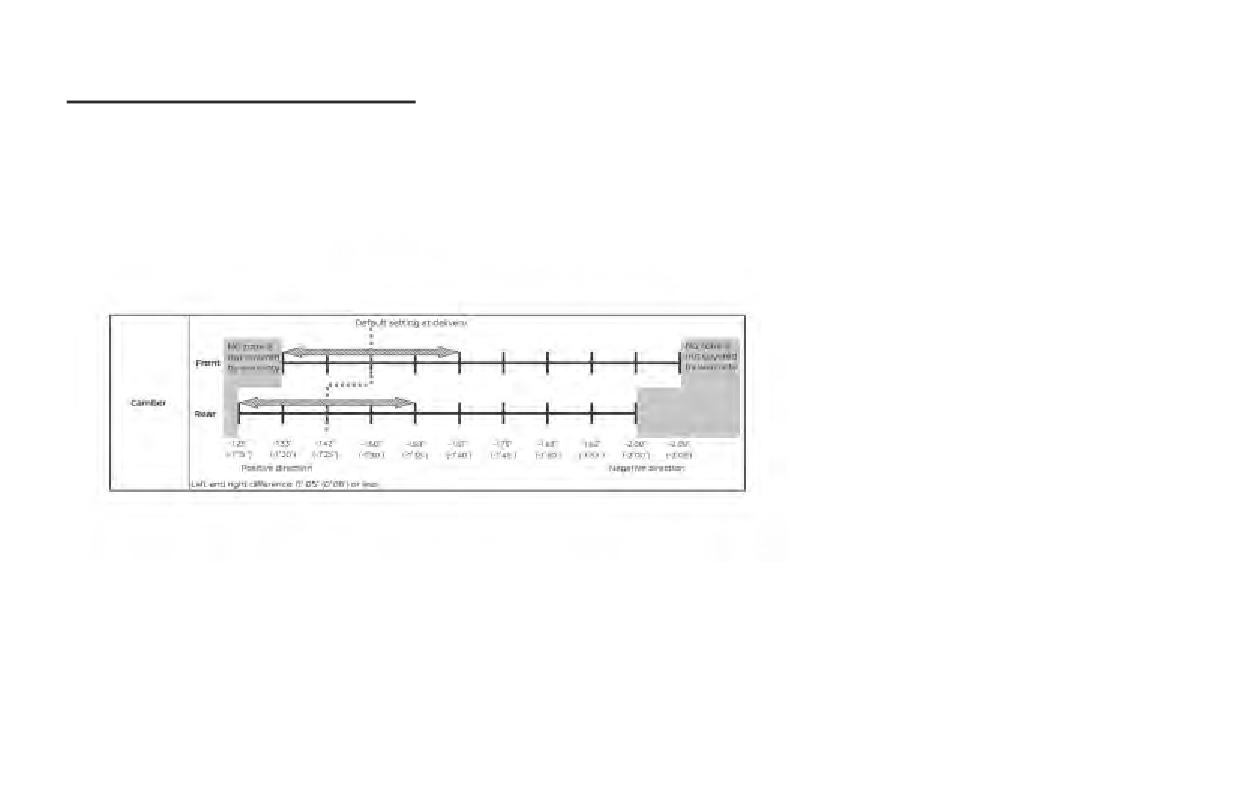
SETTING GUIDE OF WHEEL ALIGNMENT
DEPENDING ON THE CUSTOMER’S DRIVING
Except For NISMO models
Toe-out can cause uneven tire wear
or damage to areas inside the tires
The wheel alignment can be adjusted. We recommend that you contact a GT-R certified
due to high heat. Be sure to have the
NISSAN dealer for further details.
wheel alignment toe-in setting
checked and adjusted. We recom-
mend that you contact your GT-R
certified NISSAN dealer for this service.
The toe changes, depending on vehi-
cle attitude changes or the perma-
nent set of bushings. Accordingly, the
state of the front wheels change to
toe-out and the rear wheels, toe in.
For the above reasons, be sure to
adjust to toe-in when engaging in
high performance driving on a race-
track. (Toe-out is not covered by the
warranty.)
Maintenance and schedules
9-21
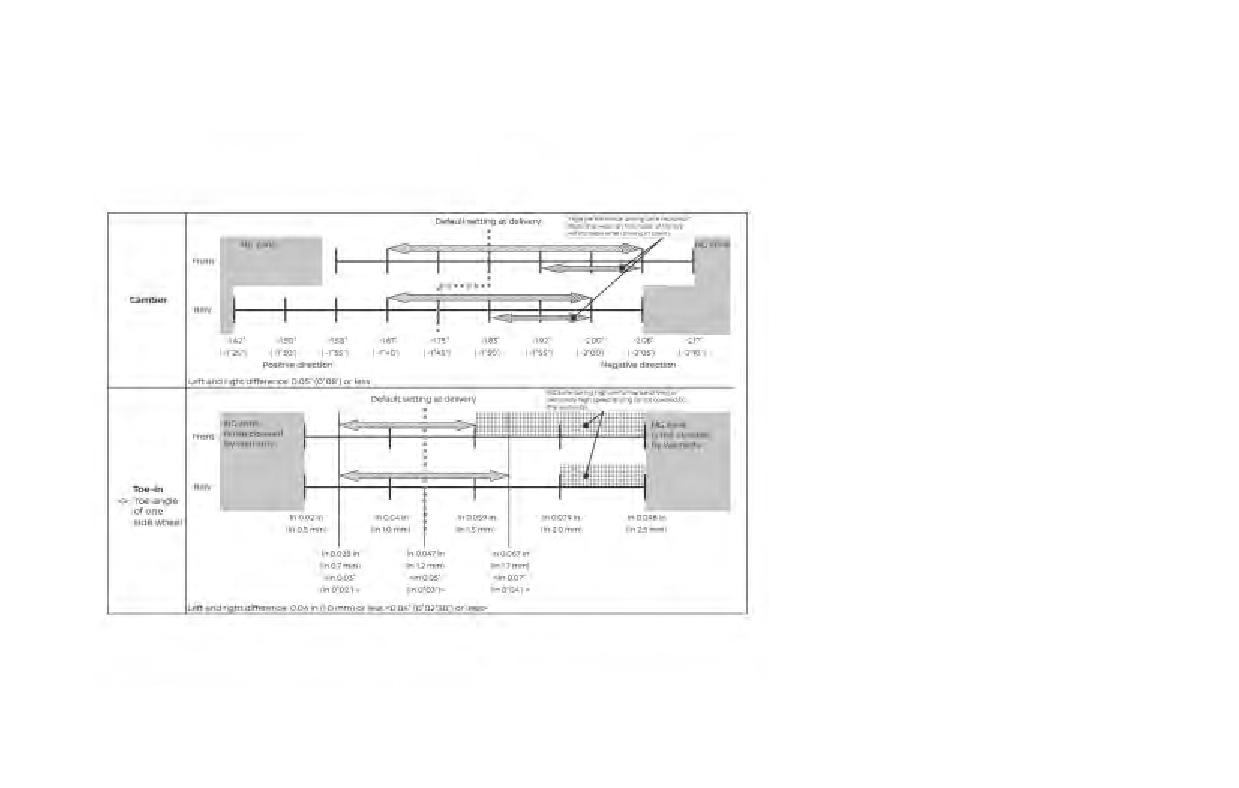
For NISMO models
Toe-out can cause uneven tire wear
or damage to areas inside the tires
due to high heat. Be sure to have the
wheel alignment toe-in setting
checked and adjusted by your GT-R
certified NISSAN dealer before any
performance driving on closed circuit
tracks. Obey all traffic laws when on
public roads.
Toe-in specification
Front: ≤ 0.059 in (1.5 mm)
Rear: ≤ 0.079 in (2.0 mm)
The toe changes, depending on vehi-
cle attitude changes or the perma-
nent set of bushings. Accordingly, the
state of the front wheels change to
toe-out and the rear wheels, toe in.
For the above reasons, be sure to
adjust to toe-in when engaging in
high performance driving on a race-
track. (Toe-out is not covered by the
warranty.)
9-22
Maintenance and schedules
TIRE REPLACEMENT RECORD
The GT-R uses specially designed run-flat
tires and matching road wheels. Use of
these specially developed tires and
wheels provides the greatest potential
for maximum performance.
NOTICE
. When you replace the GT-R tires,
it is recommended that you re-
place all the tires at the same
time.
. The GT-R uses specially designed
run-flat tires which feature an
extremely rigid side wall. Special
techniques and equipment are
therefore required when repla-
cing these tires. NISSAN recom-
mends that tire replacement be
performed at a GT-R certified
NISSAN dealer.
Maintenance and schedules
9-23
10 Technical and consumer information
Capacities and
Installing front license plate
10-16
recommended fluids/lubricants
10-2
Vehicle loading information
10-16
Fuel information
10-4
Terms
10-16
Engine oil and oil filter recommendation
10-6
Vehicle load capacity
10-17
Air conditioning system refrigerant and
Loading tips
10-18
oil recommendations
10-7
Measurement of weights
10-19
Specifications
10-9
Towing a trailer
10-19
Engine
10-9
Flat towing
10-20
Wheels and tires
10-10
Uniform tire quality grading
10-20
Dimensions
10-11
Treadwear
10-20
When traveling or registering in
Traction AA, A, B and C
10-20
another country
10-12
Temperature A, B and C
10-20
Vehicle identification
10-12
Emission control system warranty
10-21
Vehicle Identification Number (VIN) plate
10-12
Reporting safety defects
10-21
Vehicle identification number
Readiness for Inspection/Maintenance (I/M)
(chassis number)
10-12
test (US only)
10-22
Engine serial number
10-13
Event Data Recorders (EDR)
10-23
F.M.V.S.S./C.M.V.S.S. certification label
10-13
Vehicle status data recorder (VSDR)
10-24
Emission control information label
10-13
Handling of data
10-24
Tire and loading information label
10-14
Owner’s Manual/Service Manual
Air conditioner specification label
10-14
order information
10-24
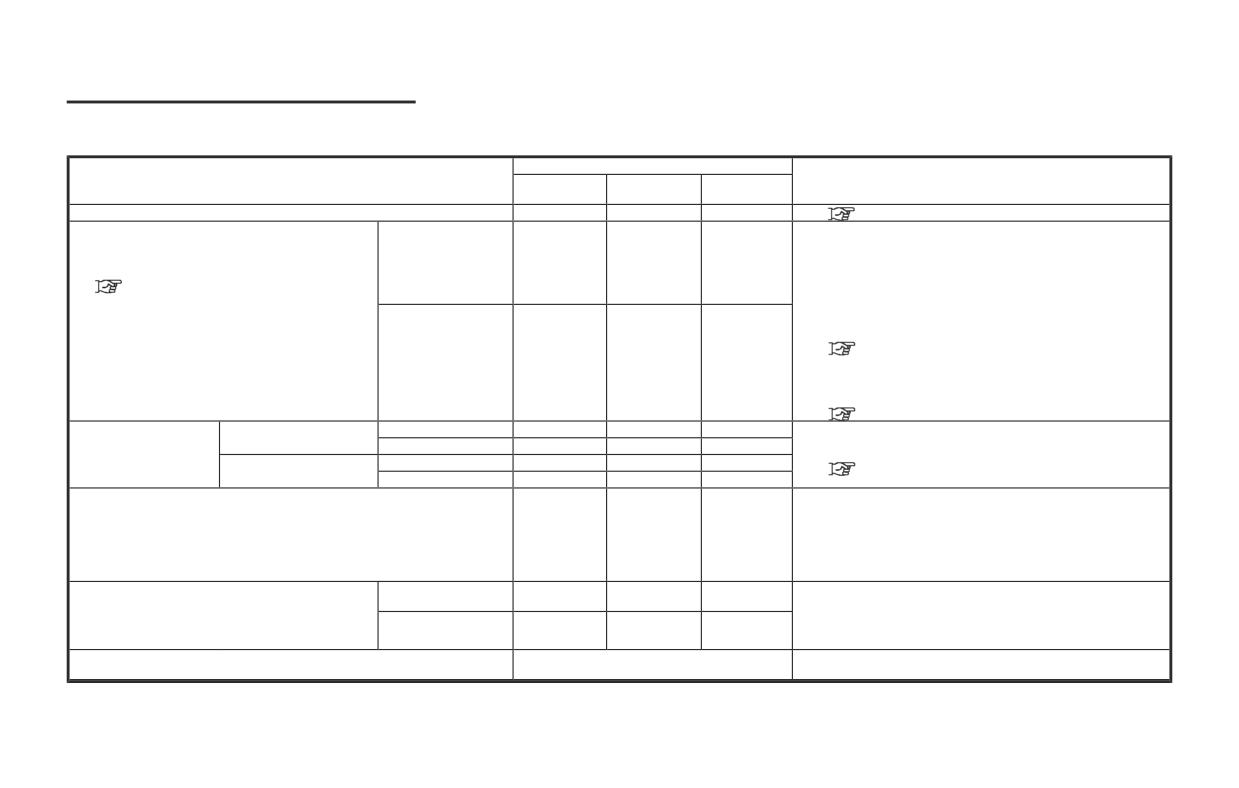
CAPACITIES AND RECOMMENDED
FLUIDS/LUBRICANTS
The following are approximate capacities. The actual refill capacities may be a little different. When refilling, follow the
procedure instructed in the “8. Do-it-yourself” section to determine the proper refill capacity.
Capacity (approximate)
Fluid type
Metric
US
Imperial
Recommended Fluids/Lubricants
Measure
Measure
Measure
Fuel
73.8 L
19-1/2 gal
16-1/4 gal
ā
(
“Fuel information” page 10-4)
Engine oil*
With oil filter change
5.0 L
5-1/4 qt
4-3/8 qt
ā
Mobil 1 (0W-40) or equivalent
Drain and refill
ā
Mobil 1 (0W-40) (100% synthetic) is the factory fill oil. The
*For additional infor-
VR38 engine with its plasma-sprayed bores was developed
mation, see
using this oil. NISSAN cannot ensure proper engine opera-
“Changing en-
tion and durability if other 0W-40 non-equivalent synthetic
gine oil and filter”
oil is used. If Mobil 1 (0W-40) or equivalent is not available,
Mobil 1 (10W-40) (100% synthetic) or equivalent may be
page 8-10.
Without oil filter
4.5 L
4-3/4 qt
4 qt
change
used; however, some performance loss may be noticed. For
additional information, see the following section.
(
“Engine oil and oil filter recommendation” page 10-
6)
ā
The recommended oil capacity level is 0.39 in (10 mm) (0.5
L) below the H mark on the engine oil dipstick. For
additional information, see the following section.
(
“Engine oil” page 8-9)
Engine coolant
For NISMO models
With reservoir
11.7 L
12-3/8 qt
10-1/4 qt
ā
Genuine NISSAN Long Life Antifreeze/Coolant (blue) or
Reservoir
1.8 L
1-7/8 qt
1-5/8 qt
equivalent
ā
For additional information, see the following section.
Except for NISMO models
With reservoir
11.3 L
12 qt
10 qt
(
“Engine cooling system” page 8-6)
Reservoir
1.4 L
1-1/2 qt
1-1/4 qt
Transmission oil (Drain and refill)
9.4 L
10 qt
8-1/4 qt
ā
Genuine NISSAN Transmission Oil R35 Special or equivalent
ā
The use of fluids and lubricants other than the specified
may cause vehicle malfunctions and result in non-warranty
vehicle repairs.
ā
All of the fluid cannot be removed when servicing the
transmission. The actual refill amount may be less than
shown.
Differential oil
Front
0.65 L
1-3/8 pt
1-1/8 pt
ā
Genuine NISSAN Differential Oil R35 COMPETITION type
(Drain and refill)
2189E or equivalent
Rear
1.35 L
2-7/8 pt
2-3/8 pt
ā
The use of fluids and lubricants other than the specified
may cause vehicle malfunctions and result in non-warranty
vehicle repairs.
Power steering fluid (PSF)
Refill to the proper oil level according to the
ā
Genuine NISSAN PSF II or equivalent
instructions in the “8. Do-it-yourself” section.
ā
DEXRONTM VI type ATF or equivalent may also be used.
10-2
Technical and consumer information
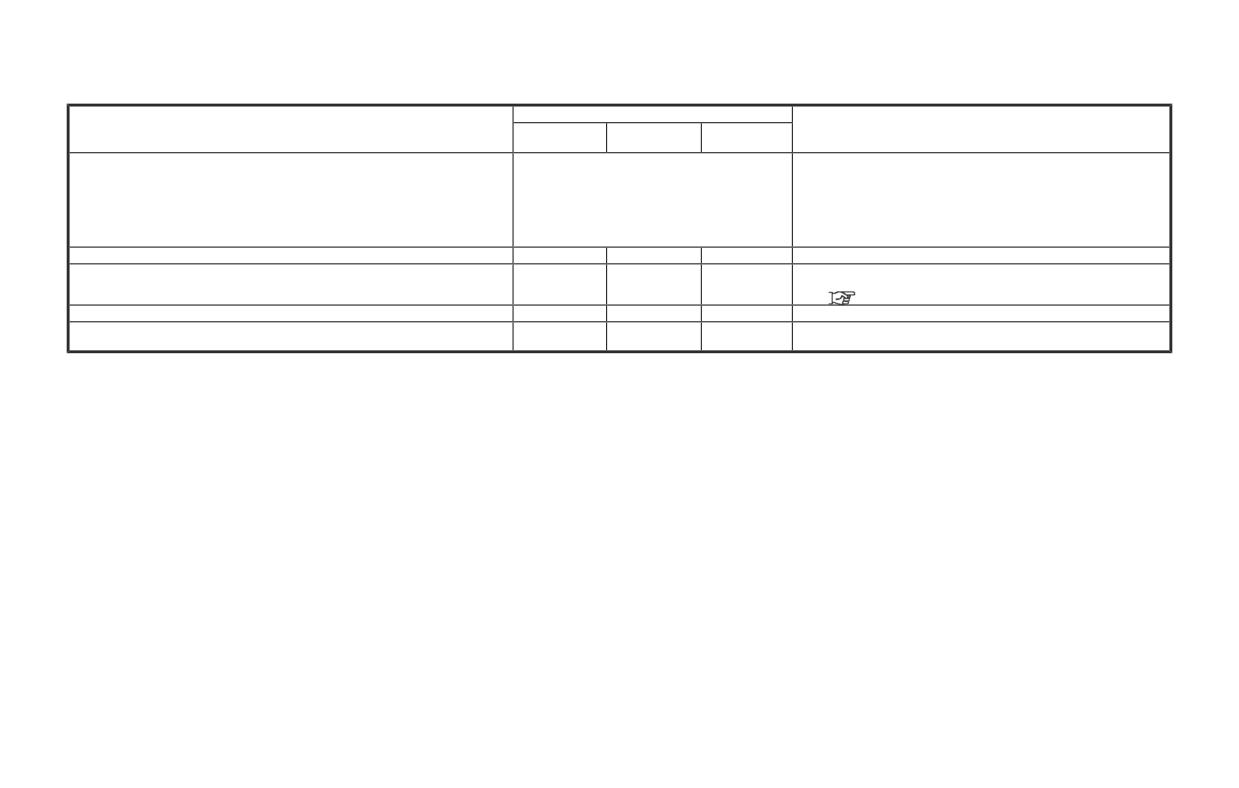
Capacity (approximate)
Fluid type
Metric
US
Imperial
Recommended Fluids/Lubricants
Measure
Measure
Measure
Brake fluid
Refill to the proper oil level according to the
ā Genuine NISSAN Brake Fluid R35 Special II or equivalent
instructions in the “8. Do-it-yourself” section.
ā Genuine NISSAN Brake Fluid R35 Special II is the factory fill
brake fluid. The Vehicle Dynamic Control (VDC) unit and
other related parts were specially designed for this brake
fluid and NISSAN cannot ensure the best performance and
proper operation of the vehicle if other non-equivalent
brake fluid is used.
Multi-purpose grease
-
-
-
ā NLGI No. 2 (Lithium soap base)
Air conditioning system refrigerant
-
-
-
ā HFO-1234yf (R-1234yf)
ā For additional information, see the following section.
(
“Air conditioner specification label” page 10-14)
Air conditioning system oil
-
-
-
ā NISSAN A/C System Oil VC100YF (PAG) or equivalent
Window washer fluid
-
-
-
ā Genuine NISSAN Windshield Washer Concentrate Cleaner &
Antifreeze or equivalent
Technical and consumer information
10-3
FUEL INFORMATION
your vehicle. Your vehicle is not
that contain no alcohol. However,
designed to run on E-15 or E-85
fuels containing up to 10% alco-
VR38 engine
fuel. Using E-15 or E-85 fuel in a
hol may be used, if necessary. To
vehicle not specifically designed
avoid serious engine damage due
Use unleaded premium gasoline with an
for E-15 or E-85 fuel can adversely
to increased cylinder tempera-
octane rating of at least 93 AKI (Anti-
affect the emission control de-
tures, do not use fuels that con-
Knock Index) number (Research octane
vices and systems of the vehicle.
tain more alcohol than indicated
number 98) to maximize vehicle perfor-
Damage caused by such fuel is
in this section. Also, do not use
mance.
not covered by the NISSAN new
fuel additives, fuel stabilizers or
If the premium gasoline specified above is
vehicle limited warranty.
fuel deicers that contain alcohol.
not available, you may use unleaded
premium gasoline with an octane rating
. Do not use fuel that contains the
of at least
91
AKI number (Research
octane booster methylcyclopen-
Gasoline specifications
octane number 96), but you may notice
tadienyl manganese tricarbonyl
a decrease in performance.
(MMT). Using fuel containing
NISSAN recommends using gasoline that
MMT may adversely affect vehicle
meets the World-Wide Fuel Charter
Do not use gasoline with an octane rating
performance and vehicle emis-
(WWFC) specifications where it is avail-
lower than 91 AKI (Research octane num-
sions. Not all fuel dispensers are
able. Many of the automobile manufac-
ber 96).
labeled to indicate MMT content,
turers developed this specification to
so you may have to consult your
improve emission system and vehicle
NOTICE
gasoline retailer for more details.
performance. Ask your service station
Note that Federal and California
manager if the gasoline meets the
. Using a fuel other than that spe-
laws prohibit the use of MMT in
World-Wide Fuel Charter (WWFC) specifi-
cified could adversely affect the
reformulated gasoline.
cations.
emission control system, and
. U.S. government regulations re-
may also affect warranty cover-
Reformulated gasoline
quire ethanol dispensing pumps
age.
to be identified by a small,
Some fuel suppliers are now producing
. Under no circumstances should a
square, orange and black label
reformulated gasolines. These gasolines
leaded gasoline be used, because
with the common abbreviation or
are specially designed to reduce vehicle
this will damage the three-way
the appropriate percentage for
emissions. NISSAN supports efforts to-
catalyst.
that region.
wards cleaner air and suggests that you
. Do not use E-15 or E-85 fuel in
use reformulated gasoline when avail-
. NISSAN recommends using fuels
10-4
Technical and consumer information
able.
by such fuel is not covered under the
E-15 fuel
NISSAN new vehicle limited war-
Gasoline containing oxygenates
ranty.
E-15 fuel is a mixture of approximately
15% fuel ethanol and 85% unleaded gaso-
Some fuel suppliers sell gasoline contain-
. If a methanol blend is used, it should
line. E-15 can only be used in vehicles
ing oxygenates such as ethanol, MTBE
contain no more than 5% methanol
designed to run on E-15 fuel. Do not use E-
and methanol with or without advertising
(methyl alcohol and wood alcohol). It
15 in your vehicle. U.S. government reg-
their presence. NISSAN does not recom-
should also contain a suitable
ulations require fuel ethanol dispensing
mend the use of fuels of which the
amount of appropriate cosolvents
pumps to be identified with small, square,
oxygenate content and the fuel compat-
and corrosion inhibitors. If not prop-
orange and black label with the common
ibility for your NISSAN cannot be readily
erly formulated with the appropriate
abbreviation or the appropriate percen-
determined. If in doubt, ask your service
cosolvents and corrosion inhibitors,
tage for that region.
station manager.
such methanol blends may cause
If you use oxygenate-blend gasoline,
fuel system damage and/or vehicle
E-85 fuel
performance malfunctions. At this
please take the following precautions as
time, sufficient data is not available
E-85 fuel is a mixture of approximately
the usage of such fuels may cause vehicle
to ensure that all methanol blends
85% fuel ethanol and 15% unleaded gaso-
performance problems and/or fuel sys-
are suitable for use in NISSAN vehi-
line. E-85 can only be used in a Flexible
tem damage.
cles.
Fuel Vehicle (FFV). Do not use E-85 fuel in
. The fuel should be unleaded and
your vehicle. U.S. government regulations
If any undesirable driveability problems
have an octane rating no lower than
require fuel ethanol dispensing pumps to
such as engine stalling or hard hot
that recommended for unleaded
be identified by a small, square, orange
starting are experienced after using oxy-
gasoline.
and black label with the common abbre-
genate-blend fuels, immediately change
. If an oxygenate-blend, excepting a
to a non-oxygenate fuel or a fuel with a
viation or the appropriate percentage for
methanol blend, is used, it should
low blend of MTBE.
that region.
contain no more than 10% oxyge-
nate. (MTBE may, however, be added
Fuel containing MMT
NOTICE
up to 15%.)
MMT, or methylcyclopentadienyl manga-
. E-15 fuel contains more than 10%
Take care not to spill gasoline during
nese tricarbonyl, is an octane boosting
oxygenate. E-15 fuel will adversely
refueling. Gasoline containing oxy-
additive. NISSAN does not recommend
affect the emission control devices
genates can cause paint damage.
the use of fuel containing MMT. Such fuel
may adversely affect vehicle perfor-
and systems of the vehicle and
mance, including the emissions control
should not be used. Damage caused
Technical and consumer information
10-5
system. Note that while some fuel pumps
roads, it is recommended you have a
factory fill oil. The VR38 engine with its
label MMT content, not all do, so you may
GT-R certified NISSAN dealer correct the
plasma-sprayed bores was developed
have to consult your gasoline retailer for
condition. Failure to correct the condi-
using this oil. NISSAN cannot ensure
more details.
tion is misuse of the vehicle, for which
proper engine operation and durability if
NISSAN is not responsible.
other 0W-40 non-equivalent synthetic oil
Aftermarket fuel additives
is used. If Mobil 1 (0W-40) or equivalent is
Incorrect ignition timing will result in
not available, Mobil
1
(10W-40)
(100%
knocking, after-run or overheating. This
synthetic) or equivalent may be used;
NOTICE
in turn may cause excessive fuel con-
sumption or damage to the engine. If any
however, some performance loss may
NISSAN does not recommend the use
of the above symptoms are encountered,
be noticed.
of any aftermarket fuel additives
it is recommended you have your vehicle
(Example: fuel injector cleaner, in-
checked at a GT-R certified NISSAN dealer
NOTICE
take valve deposit removers, etc.)
or other competent service facility.
which are sold commercially. Many
Using an engine oil other than that
However, now and then you may notice
of these additives intended for gum,
specified could adversely affect the
light spark knock for a short time while
varnish or deposit removal may con-
engine. See the 2023 NISSAN GT-R
accelerating or driving up hills. This is
tain active solvent or similar ingre-
Warranty Information Booklet for
no cause for concern, because you get
dients that can be harmful to the fuel
details and exclusions.
the greatest fuel benefit when there is
system and engine.
light spark knock for a short time under
heavy engine load.
Oil additives
Octane rating tips
ENGINE OIL AND OIL FILTER RE-
NISSAN does not recommend the use of
Using unleaded gasoline with an octane
COMMENDATION
oil additives. The use of an oil additive is
rating lower than recommended above
not necessary when the proper oil type is
can cause persistent, heavy spark
Selecting the correct oil
used and maintenance intervals are fol-
knock. (Spark knock is a metallic rap-
lowed.
It is essential to choose the correct grade,
ping noise.) If severe, this can lead to
quality, and viscosity engine oil to ensure
Oil which may contain foreign matter or
engine damage. If you detect a persis-
satisfactory engine life and performance.
has been previously used should not be
tent heavy spark knock even when
(
“Capacities and recommended
used.
using gasoline of the stated octane
fluids/lubricants” page 10-2)
rating, or if you hear steady spark knock
Mobil 1 (0W-40) (100% synthetic) is the
while holding a steady speed on level
10-6
Technical and consumer information
engine oil when it was built. You do not
Oil viscosity
have to change the oil before the first
CAUTION
The engine oil viscosity or thickness
recommended change interval. Oil and
changes with temperature. Because of
filter change intervals depend upon how
The use of any other refrigerant or oil
this, it is important that the engine oil
you use your vehicle. Operation under the
will cause severe damage to the air
viscosity be selected based on the tem-
following conditions may require more
conditioning system and will require
peratures at which the vehicle will be
frequent oil and filter changes.
the replacement of all air conditioner
operated before the next oil change.
system components.
. repeated short distance driving at
Choosing an oil viscosity other than that
cold outside temperatures
recommended could cause serious en-
The refrigerant HFO-1234yf (R-1234yf) in
gine damage.
. driving in dusty conditions
your NISSAN vehicle does not harm the
. extensive idling
earth’s ozone layer. Although this refrig-
Selecting the correct oil filter
erant does not affect the earth’s atmo-
. stop and go “rush hour” traffic
Your new vehicle is equipped with a high-
sphere, certain government regulations
Refer to the "9. Maintenance and sche-
quality genuine NISSAN oil filter. NISSAN
require the recovery and recycling of any
dules" section of this manual for the
recommends to use the genuine NISSAN
refrigerant during automotive air condi-
maintenance schedule.
oil filter for the reason described in
tioner system service. Air conditioner
change intervals.
system should only be serviced by trained
AIR CONDITIONING SYSTEM RE-
and certified technicians to ensure proper
FRIGERANT AND OIL RECOMMEN-
Change intervals
and safe operation (SAE J2845). Your GT-R
DATIONS
certified NISSAN dealer has the trained
The oil and oil filter change intervals for
your engine are based on the use of the
The air conditioner system in your
technicians and equipment needed to
specified quality oils and filters. Oil and
NISSAN vehicle must be charged with
recover and recycle your air conditioner
filter other than the specified quality, or
the refrigerant HFO-1234yf (R-1234yf)
system refrigerant. Only new and
oil and filter change intervals longer than
and NISSAN A/C System Oil VC100YF
SAEJ2842 certified evaporator(s) shall be
recommended could reduce engine life.
(PAG) or the exact equivalents.
used as replacement parts.
Damage to engines caused by improper
A damaged or leaking air conditioning
maintenance or use of incorrect oil and
evaporator shall never be repaired or
filter quality and/or viscosity is not cov-
replaced with one removed from a used
ered by the NISSAN new vehicle limited
or salvaged vehicle. To replace a da-
warranties.
maged or leaking evaporator, use only
Your engine was filled with a high quality
new and SAE J2842 certified evaporator
Technical and consumer information
10-7
(s). It is recommended that you visit a
GT-R certified NISSAN dealer when servi-
cing your air conditioner system.
10-8
Technical and consumer information
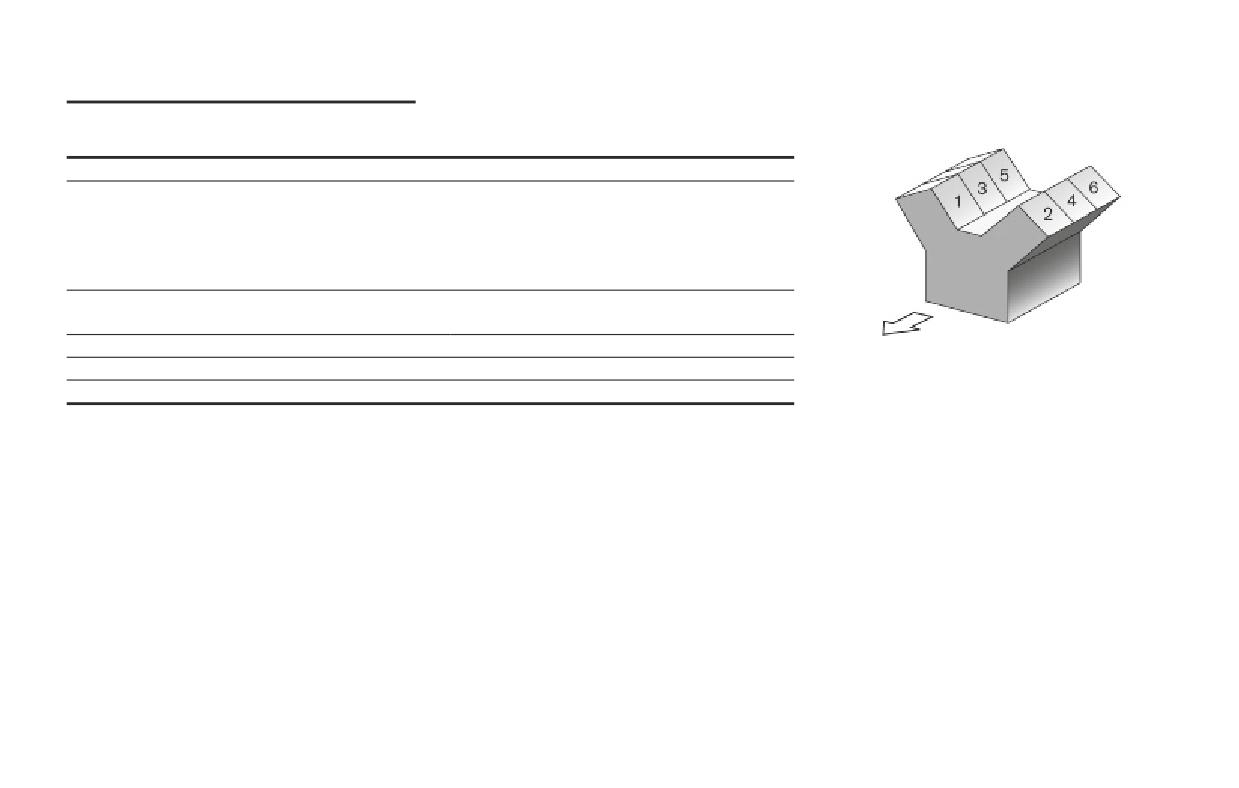
SPECIFICATIONS
ENGINE
Model
VR38
Type
Gasoline, 4-cycle
Cylinder arrangement
6-cylinder, V-slanted at 60°
Bore × Stroke
in (mm)
3.760 × 3.480 (95.5 × 88.4)
Displacement
cu in (cm3)
231.83 (3,799)
Firing order
1-2-3-4-5-6
Idle speed
rpm
No adjustment is necessary.
Ignition timing (B.T.D.C.)
degree/rpm
Spark plug
Standard
DILKAR8A8
Spark plug gap (Normal)
in (mm)
0.031
(0.8)
Camshaft operation
Timing chain
This spark ignition system complies with the Canadian standard ICES-002.
Technical and consumer information
10-9
WHEELS AND TIRES
Tire
Size
Pressure PSI (kPa) [Cold]
30 (210)*1
Front:
255/40ZRF20 (97Y)
32 (220)*2
Rear:
285/35ZRF20 (100Y)
29 (200)
*1: Except for NISMO models
*2: NISMO models
Make sure to use the tires for GT-R. See the 2023 Warranty Information Booklet for the
applicable exclusions.
10-10
Technical and consumer information
Road wheel
DIMENSIONS
in (mm)
Type
Size
Offset in (mm)
185.4 (4,710)*1
Overall length
20 × 9-1/2J*1
1.77 (45)*1
185.0 (4,700)*2
Front:
20 × 10J*2
1.61 (41)*2
Aluminum
Overall width
74.6 (1,895)
Rear:
20 × 10-1/2J
0.98 (25)
Overall height
53.9 (1,370)
62.6 (1,590)*3
*1: Except for NISMO models, T-spec version and NISMO Special Edition
Front tread
63.0 (1,600)*4
*2: NISMO models, T-spec version and NISMO Special Edition
Rear tread
63.0 (1,600)
Make sure to use the road wheels for GT-R. See the 2023 Warranty Information Booklet
Wheelbase
109.4 (2,780)
for the applicable exclusions.
*1: Except for NISMO models
*2: NISMO models
*3: Except for NISMO models, T-spec
version and NISMO Special Edition
*4: NISMO models, T-spec version and
NISMO Special Edition
Technical and consumer information
10-11
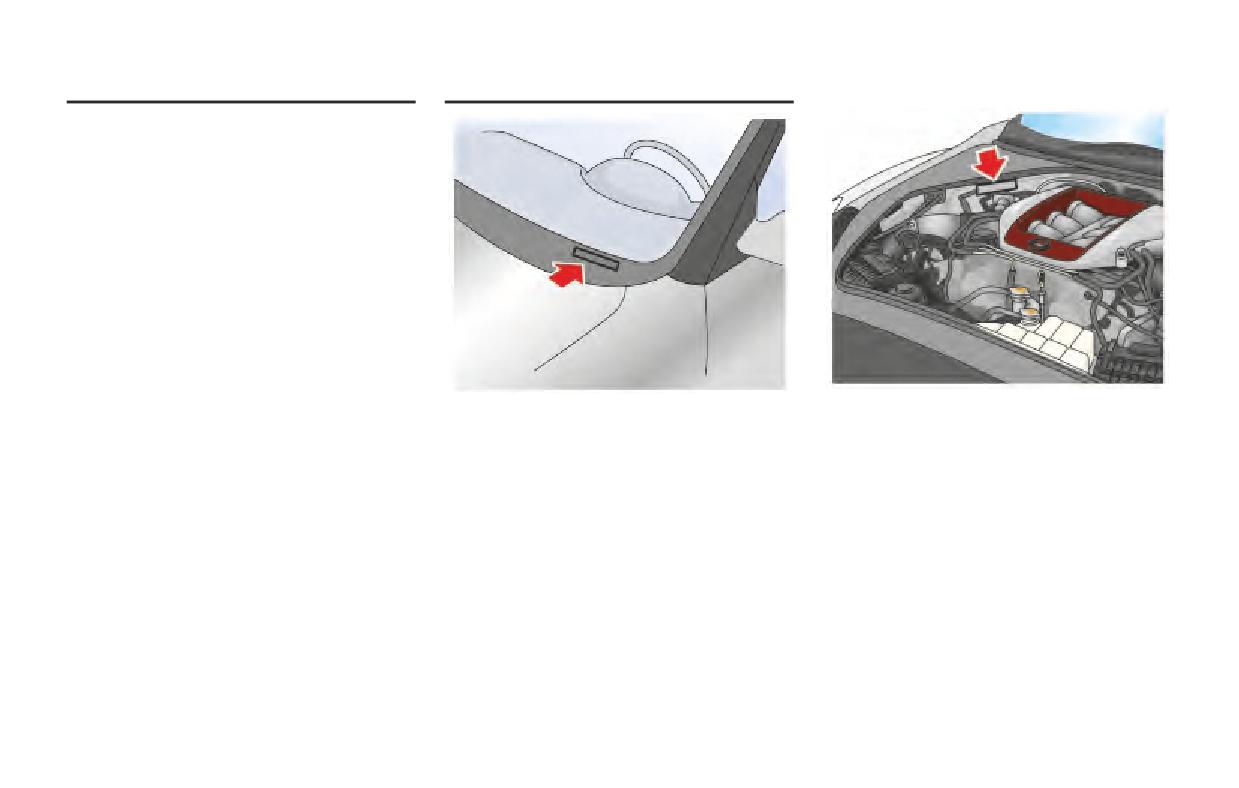
WHEN TRAVELING OR REGISTERING
IN ANOTHER COUNTRY
VEHICLE IDENTIFICATION
If you plan to travel in another country,
you should first find out if the fuel
available is suitable for your vehicle’s
engine.
Using fuel with too low an octane rating
may cause engine damage. All gasoline
vehicles must be operated with unleaded
gasoline. Therefore, avoid taking your
vehicle to areas where appropriate fuel
is not available.
When transferring the registration of
your vehicle to another country, state,
province or district, it may be necessary
to modify the vehicle to meet local laws
and regulations.
The laws and regulations for motor
VEHICLE IDENTIFICATION NUMBER
VEHICLE IDENTIFICATION NUMBER
vehicle emission control and safety stan-
(VIN) PLATE
(chassis number)
dards vary according to the country,
state, province or district; therefore, vehi-
The vehicle identification number plate is
The number is stamped as shown in the
cle specifications may differ.
attached as shown. This number is the
engine compartment.
When any vehicle is to be taken into
identification for your vehicle and is used
another country, state, province or dis-
in the vehicle registration.
trict and registered, its modifications,
transportation, and registration are the
responsibility of the user. NISSAN is not
responsible for any inconvenience that
may result.
10-12
Technical and consumer information
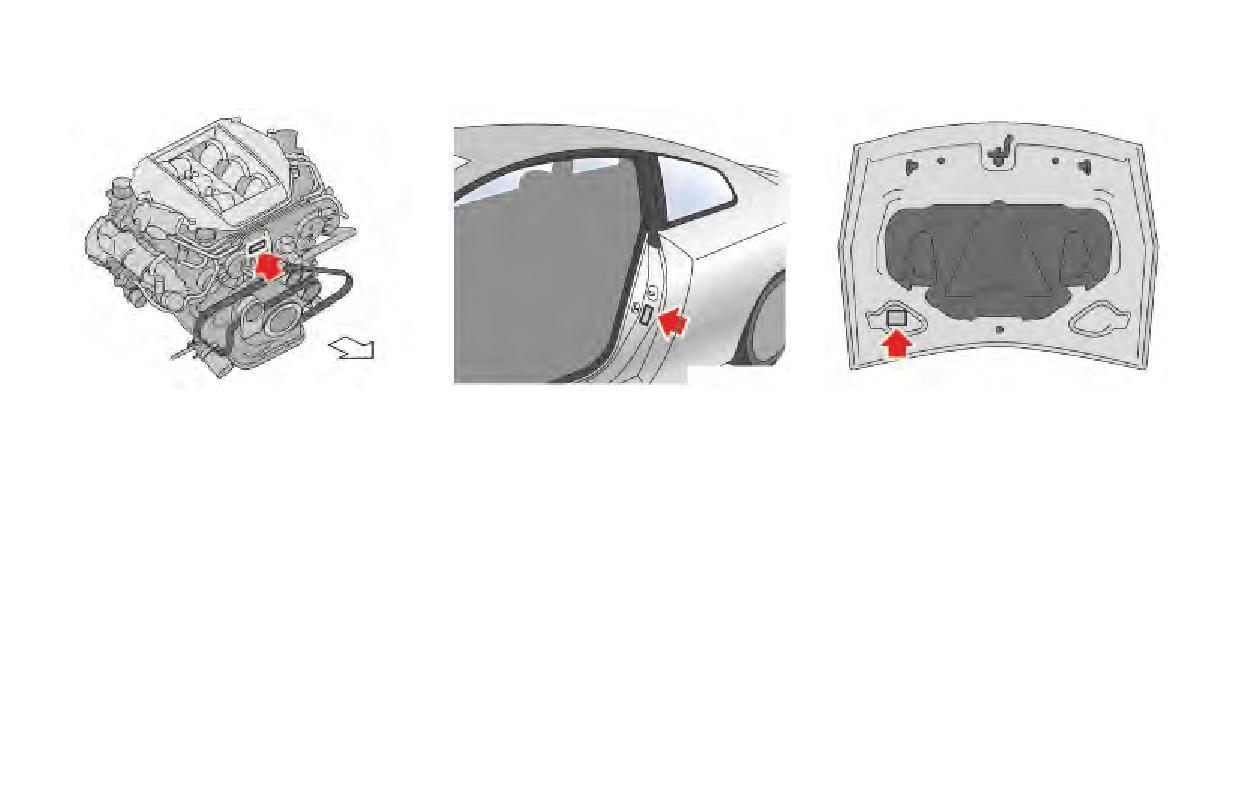
ENGINE SERIAL NUMBER
F.M.V.S.S./C.M.V.S.S. CERTIFICA-
EMISSION CONTROL INFORMA-
The number is stamped on the engine as
TION LABEL
TION LABEL
shown.
The Federal/Canadian Motor Vehicle
The emission control information label is
Safety Standards (F.M.V.S.S./C.M.V.S.S.)
attached as shown.
certification label is affixed as shown. This
label contains valuable vehicle informa-
tion, such as: Gross Vehicle Weight Rat-
ings (GVWR), Gross Axle Weight Rating
(GAWR), month and year of manufacture,
Vehicle Identification Number (VIN), etc.
Review it carefully.
Technical and consumer information
10-13
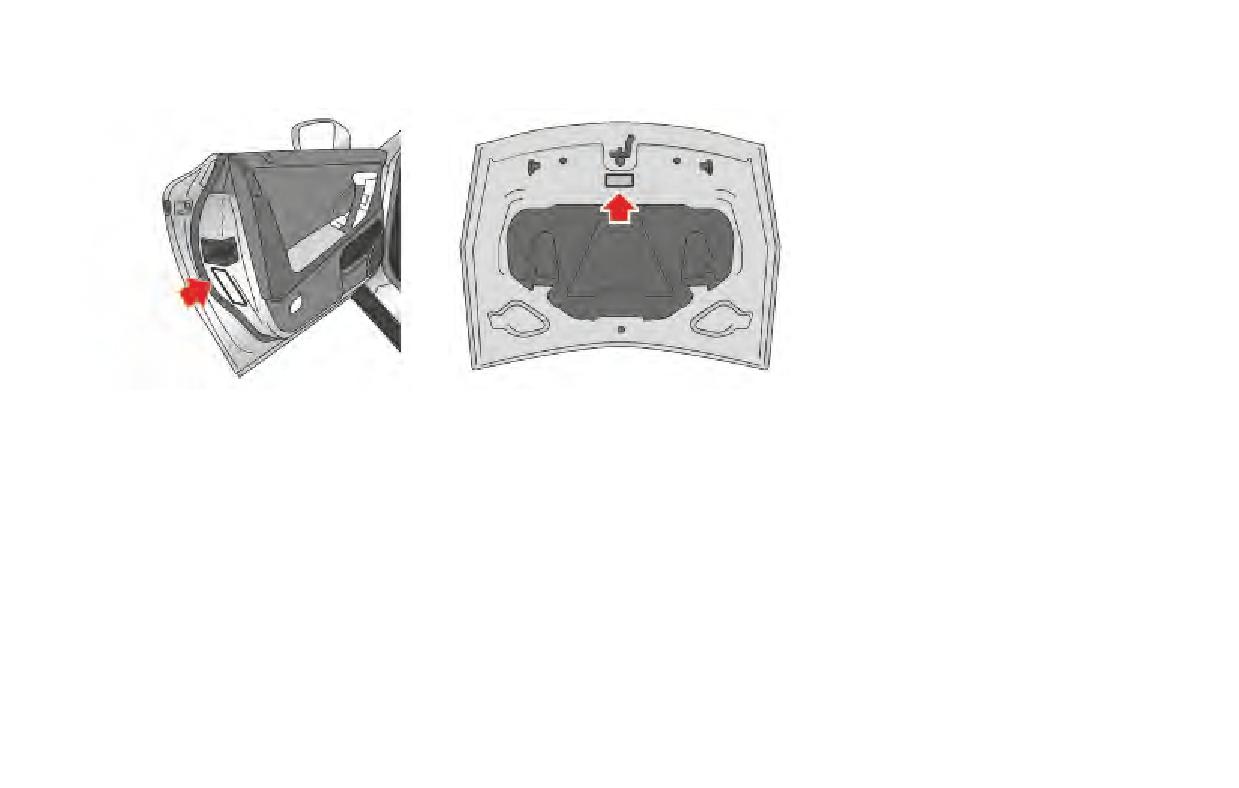
TIRE AND LOADING INFORMATION
AIR CONDITIONER SPECIFICATION
LABEL
LABEL
The cold tire pressure is shown on the
The air conditioner specification label is
Tire and Loading Information label affixed
attached as shown.
to the door end as illustrated.
10-14
Technical and consumer information
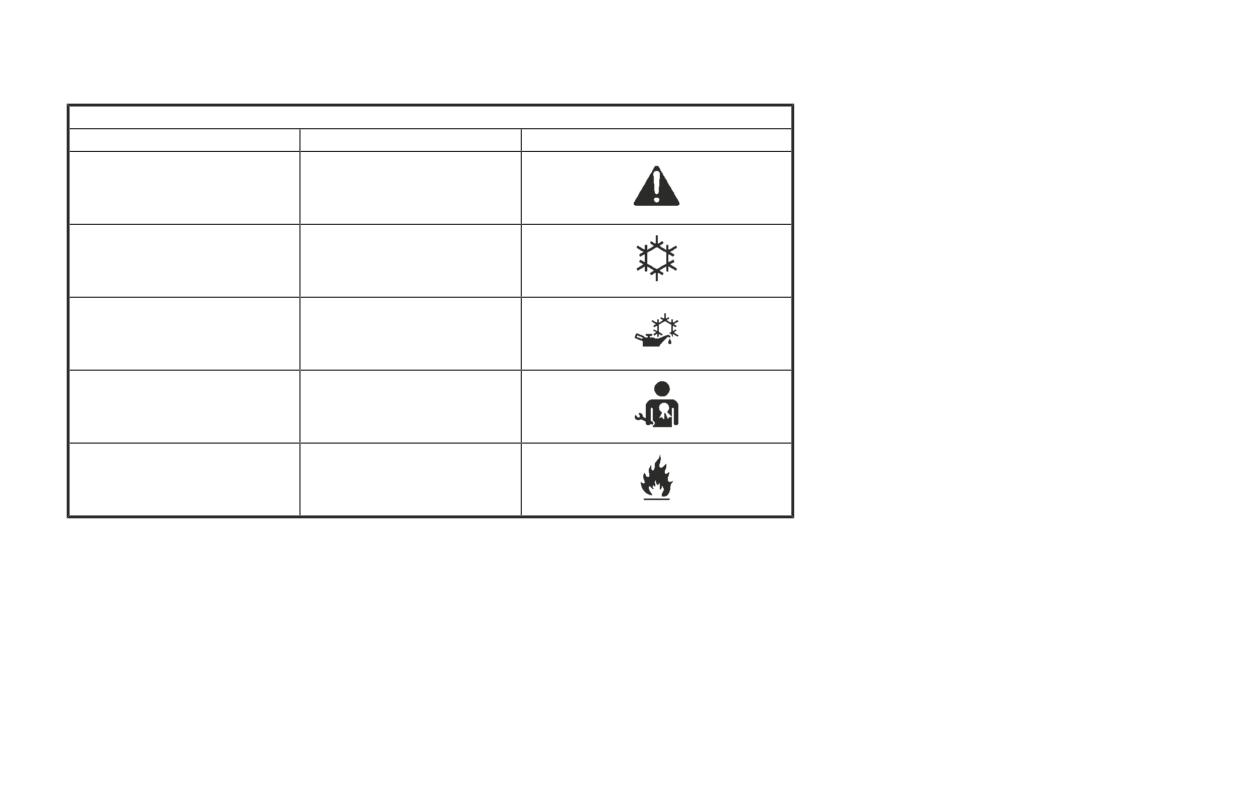
Air conditioner specification label symbols:
Symbol Name
Reference
Graphic
Caution
ISO 7000 0434
Air Conditioning System
ISO 2575 D01
(MAC)
MAC System Lubricant Type
(PAG-POE)
Requires Registered Techni-
cian to Service MAC System
Flammable Refrigerant
Technical and consumer information
10-15
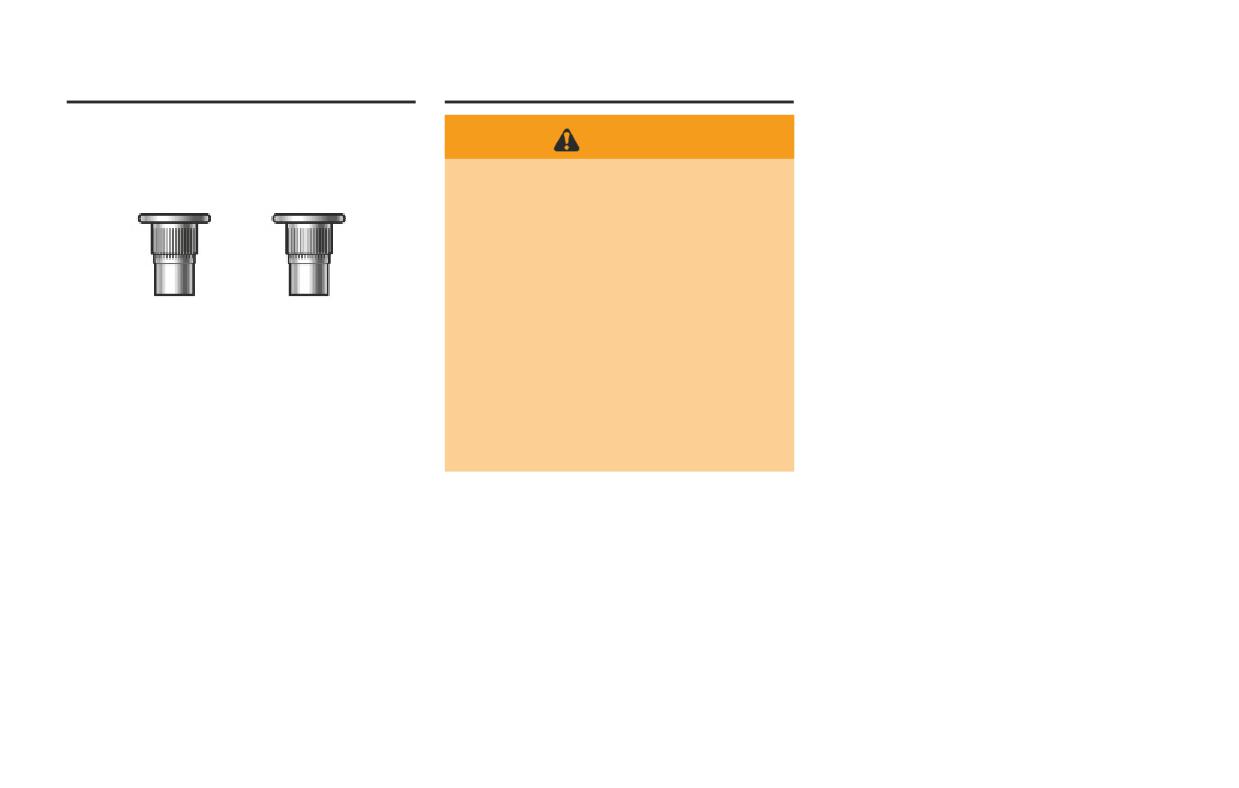
INSTALLING FRONT LICENSE PLATE
VEHICLE LOADING INFORMATION
clude passengers and cargo.
WARNING
GVW (Gross Vehicle Weight) -
curb weight plus the combined
. It is extremely dangerous to
weight of passengers and cargo.
ride in a cargo area inside
the vehicle. In a collision,
GVWR (Gross Vehicle Weight Rat-
people riding in these areas
ing) - maximum total combined
are more likely to be ser-
weight of the unloaded vehicle,
iously injured or killed.
passengers, luggage, hitch, trai-
ler tongue load and any other
. Do not allow people to ride
optional equipment. This infor-
in any area of vehicle that is
mation is located on the F.M.V.S.
not equipped with seats and
S./C.M.V.S.S. label.
seat belts.
GAWR (Gross Axle Weight Rating)
. Be sure everyone in your
Make sure that the two POP® nuts as
- maximum weight (load) limit
vehicle is in a seat and using
illustrated are enclosed in the plastic bag.
specified for the front or rear
They are used for front license plate
a seat belt properly.
axle. This information is located
installation.
on the F.M.V.S.S./C.M.V.S.S. label.
To install the front license plate to your
TERMS
vehicle, it is recommended you contact a
GCWR (Gross Combined Weight
GT-R certified NISSAN dealer.
It is important to familiarize your-
Rating) - The maximum total
self with the following terms before
weight rating of the vehicle,
loading your vehicle:
passengers, cargo, and trailer.
. Curb Weight (actual weight of
Vehicle Capacity Weight, Load
your vehicle) - vehicle weight
limit, Total load capacity - max-
including: standard and optional
imum total weight limit specified
equipment, fluids or emergency
of the load (passengers and
tools. This weight does not in-
cargo) for the vehicle. This is
10-16
Technical and consumer information
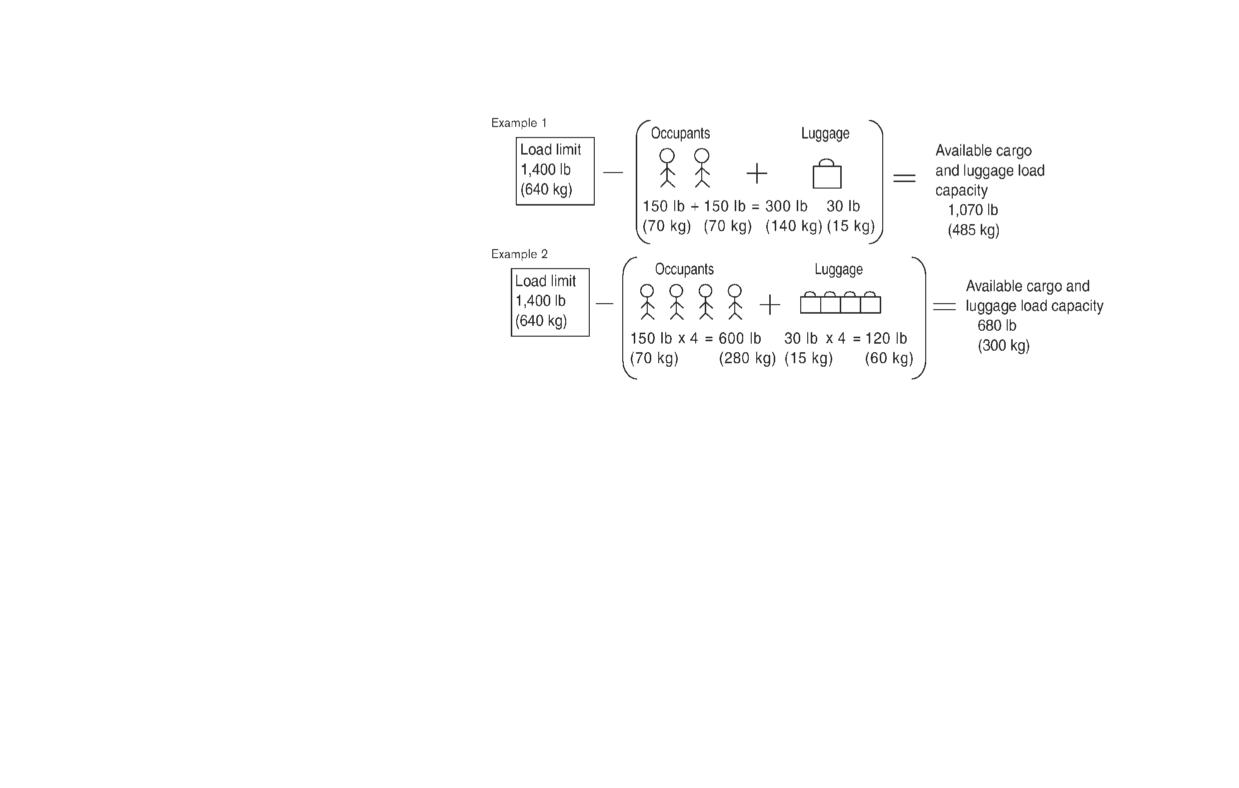
the maximum combined weight
of occupants and cargo that can
be loaded into the vehicle. If the
vehicle is used to tow a trailer,
the trailer tongue weight must
be included as part of the cargo
load. This information is located
on the Tire and Loading Infor-
mation label.
. Cargo capacity - permissible
weight of cargo, the weight of
total occupants weight sub-
tracted from the load limit.
VEHICLE LOAD CAPACITY
are shown in the illustration.
Do not exceed the load limit of your
Steps For Determining Correct
vehicle shown as “The combined
Load Limit
weight of occupants and cargo” on
the Tire and Loading Information
1.
Locate the statement “The com-
label. Do not exceed the number of
bined weight of occupants and
occupants shown as “Seating Ca-
cargo should never exceed XXX
pacity” on the Tire and Loading
kg or XXX lbs” on your vehicle’s
Information label.
placard.
2. Determine the combined weight
To get “the combined weight of
occupants and cargo”, add the
of the driver and passengers
that will be riding in your vehicle.
weight of all occupants, then add
the total luggage weight. Examples
3. Subtract the combined weight
Technical and consumer information
10-17
of the driver and passengers
is not intended for towing may
LOADING TIPS
from XXX kg or XXX lbs.
result in an accident involving in-
The GVW must not exceed GVWR
4. The resulting figure equals the
jury or death.
or GAWR as specified on the F.M.
available amount of cargo and
V.S.S./C.M.V.S.S. certification la-
luggage load capacity. For ex-
WARNING
bel.
ample, if the “XXX” amount
Do not load the front and rear
Do not tow a trailer with your
equals 1400 lbs. and there will
axle to the GAWR. Doing so will
vehicle. Towing a trailer may
be five 150 lb. passengers in your
exceed the GVWR.
vehicle, the amount of available
result in an accident involving
injury or death.
cargo and luggage load capacity
WARNING
is 650 lbs. (1400 - 750 (5 x 150) =
650 lbs)
Before driving a loaded vehicle,
Properly secure all cargo to
5. Determine the combined weight
confirm that you do not exceed
help prevent it from sliding
of luggage and cargo being
the Gross Vehicle Weight Rating
or shifting. Do not place
loaded on the vehicle. That
(GVWR) or the Gross Axle Weight
cargo higher than the seat-
weight may not safely exceed
Rating (GAWR) for your vehicle.
backs. In a sudden stop or
the available cargo and luggage
(
“Measurement of weights”
collision, unsecured cargo
load capacity calculated in step
page 10-19)
could cause personal injury.
4.
Also check tires for proper inflation
Do not load your vehicle any
6. If your vehicle will be towing a
pressures. See the Tire and Loading
heavier than the GVWR or
trailer, load from your trailer will
Information label.
the maximum front and rear
be transferred to your vehicle.
GAWRs. If you do, parts of
Consult this manual to deter-
your vehicle can break, tire
mine how this reduces the avail-
damage could occur, or it
able cargo and luggage load
can change the way your
capacity of your vehicle.
vehicle handles. This could
result in loss of control and
Towing a trailer with a vehicle that
10-18
Technical and consumer information
TOWING A TRAILER
MEASUREMENT OF WEIGHTS
Do not tow a trailer with your vehicle.
cause personal injury.
. Overloading could not only
Secure loose items to prevent
shorten the life of your ve-
weight shifts that could affect the
hicle and the tires, but also
balance of your vehicle. When the
could lead to hazardous ve-
vehicle is loaded, drive to a scale
hicle handling and long
and weigh the front and the rear
braking distance. This may
wheels separately to determine
cause a premature tire mal-
axle loads. Individual axle loads
function, which could result
should not exceed either of the
in a serious accident and
Gross Axle Weight Ratings (GAWR).
personal injury. Repairs due
The total of the axle loads should
to overloading the vehicle
not exceed the Gross Vehicle
are not covered by the vehi-
Weight Rating (GVWR). These rat-
cle’s warranty. (See the 2023
ings are given on the vehicle certi-
NISSAN GT-R Warranty Infor-
fication label. If weight ratings are
mation Booklet.)
exceeded, move or remove items to
bring all weights below the ratings.
Technical and consumer information
10-19
FLAT TOWING
UNIFORM TIRE QUALITY GRADING
Towing your vehicle with all four wheels
DOT (Department Of Transportation)
TRACTION AA, A, B AND C
on the ground is sometimes called flat
Quality Grades: All passenger car tires
The traction grades, from highest to low-
towing. This method is sometimes used
must conform to federal safety require-
est, are AA, A, B and C. Those grades
when towing a vehicle behind a recrea-
ments in addition to these grades.
represent the tire’s ability to stop on wet
tional vehicle, such as a motor home.
Quality grades can be found where ap-
pavement as measured under controlled
DO NOT tow the GT-R with all four wheels
plicable on the tire sidewall between
conditions on specified government test
on the ground (flat towing). Doing so WILL
tread shoulder and maximum section
surfaces of asphalt and concrete. A tire
DAMAGE internal transmission parts. Tow
width. For example:
marked C may have poor traction perfor-
the GT-R with all four wheels off the
mance.
Treadwear 200 Traction AA Tempera-
ground. (
“Towing your vehicle” page
ture A
6-9)
WARNING
TREADWEAR
The treadwear grade is a comparative
The traction grade assigned to this
rating based on the wear rate of the tire
tire is based on straight-ahead brak-
when tested under controlled conditions
ing traction tests, and does not
on a specified government test course.
include acceleration, cornering, hy-
For example, a tire graded 150 would
droplaning, or peak traction charac-
wear one and one-half (1 1/2) times as
teristics.
well on the government course as a tire
graded 100. The relative performance of
tires depends upon the actual conditions
TEMPERATURE A, B AND C
of their use, however, and may depart
The temperature grades A (the highest),
significantly from the norm due to varia-
B, and C, representing the tire’s resistance
tions in driving habits, service practices
to the generation of heat and its ability to
and differences in road characteristics
dissipate heat when tested under con-
and climate.
trolled conditions on a specified indoor
laboratory test wheel. Sustained high
temperature can cause the material of
the tire to degenerate and reduce tire life,
and excessive temperature can lead to
sudden tire failure. The grade C corre-
10-20
Technical and consumer information
EMISSION CONTROL SYSTEM WARRANTY
REPORTING SAFETY DEFECTS
sponds to a level of performance which
Your NISSAN is covered by specific emis-
For USA
all passenger car tires must meet under
sion warranties:
the Federal Motor Vehicle Safety Stan-
If you believe that your vehicle has
For the United States, see the
2023
dard No. 109. Grades B and A represent
a defect which could cause a crash
NISSAN GT-R Warranty Information Book-
higher levels of performance on the
or could cause injury or death, you
let.
laboratory test wheel than the minimum
should immediately inform the Na-
required by law.
For Canada, see the Warranty and Road-
tional Highway Traffic Safety Ad-
side Assistance Information Booklet.
ministration (NHTSA) in addition to
If you did not receive a Warranty Informa-
WARNING
notifying NISSAN.
tion Booklet (Warranty and Roadside
The temperature grade for this tire is
Assistance Information (Canada only)), or
If NHTSA receives similar com-
established for a tire that is properly
it has become lost, you may obtain a
plaints, it may open an investiga-
inflated and not overloaded. Exces-
replacement by writing to:
tion, and if it finds that a safety
sive speed, under-inflation, or exces-
. NISSAN Division
defect exists in a group of vehicles,
sive loading, either separately or in
NISSAN North America, Inc.
it may order a recall and remedy
combination, can cause heat build-
Consumer Affairs Department
up and possible tire failure.
campaign. However, NHTSA cannot
P.O. Box 685003
become involved in individual pro-
Franklin, TN 37068-5003
blems between you, your dealer, or
. NISSAN Canada Inc.
NISSAN.
5290 Orbitor Drive
To contact NHTSA, you may call the
Mississauga, Ontario,
Vehicle Safety Hotline toll-free at 1-
L4W 4Z5
888-
327-4236
(TTY:
1-800-424-
9153); go to http://www.safercar.
gov; or write to: Administrator,
NHTSA, 400 Seventh Street, SW.,
Washington, D.C. 20590. You can
also obtain other information
about motor vehicle safety from
Technical and consumer information
10-21
READINESS FOR INSPECTION/
MAINTENANCE (I/M) TEST (US only)
You may notify NISSAN by contact-
Sur/7/PCDB-BDPP/fc-cp.aspx?lan-
A vehicle equipped with All-Wheel Drive
ing our Consumer Affairs Depart-
g=eng (English speakers) or
(AWD) should never be tested using a two
wheel dynamometer (such as the dynam-
ment, toll-free, at 1-866-668-1GTR
ometers used by some states for emis-
(1-866-668-1487).
Sur/7/PCDB-BDPP/fc-cp.aspx?
sions testing), or similar equipment. Make
For Canada
lang=fra (French speakers).
sure you inform test facility personnel
that your vehicle is equipped with AWD
If you believe that your vehicle has
Additional information concerning
before it is placed on a dynamometer.
a defect which could cause a crash
motor vehicle safety may be ob-
Using the wrong test equipment may
or could cause injury or death, you
tained from Transport Canada’s
result in transmission damage or unex-
should immediately inform Trans-
Road Safety Information Centre at
pected vehicle movement which could
port Canada in addition to notifying
1-800-333-0371 or online at www.
result in serious vehicle damage or per-
sonal injury.
NISSAN.
tc.gc.ca/roadsafety (English speak-
ers) or www.tc.gc.ca/securiterou-
Due to legal requirements in some states/
If Transport Canada receives com-
areas, your vehicle may be required to be
tiere (French speakers).
plaints, it may open an investiga-
in what is called the “ready condition” for
tion, and if it finds that a safety
To notify NISSAN of any safety
an Inspection/Maintenance (I/M) test of
defect exists in a group of vehicles,
concerns please contact our Con-
the emission control system.
it may request that NISSAN con-
sumer Information Centre toll free
The vehicle is set to the “ready condition”
duct a recall campaign. However,
at 1-800-387-0122.
when it is driven through certain driving
patterns. Usually, the “ready condition”
Transport Canada cannot become
can be obtained by ordinary usage of
involved in individual problems be-
the vehicle.
tween you, your dealer, or NISSAN.
If a powertrain system component is
You may contact Transport Cana-
repaired or the battery is disconnected,
da’s Defect Investigations and Re-
the vehicle may be reset to a “not ready
calls Division toll free at 1-800-333-
condition”. Before taking the I/M test,
check the vehicle’s inspection/mainte-
0510. You may also report safety
nance test readiness condition. Push the
defects online at:
ignition switch to the ON position without
starting the engine. If the Malfunction
10-22
Technical and consumer information
EVENT DATA RECORDERS (EDR)
Indicator Light (MIL) comes on steady for
This vehicle is equipped with an Event
location) are recorded. However, other
20 seconds and then blinks for 10 sec-
Data Recorder (EDR). The main purpose of
parties, such as law enforcement, could
onds, the I/M test condition is “not ready”.
an EDR is to record, in certain crash or
combine the EDR data with the type of
If the MIL does not blink after 20 seconds,
near crash-like situations, such as an air
personally identifying data routinely ac-
the I/M test condition is “ready”.
bag deployment or hitting a road obsta-
quired during a crash investigation.
It is recommended you contact a GT-R
cle, data that will assist in understanding
To read data recorded by an EDR, special
certified NISSAN dealer to set “ready
how a vehicle’s systems performed. The
equipment is required and access to the
condition” or to prepare the vehicle for
EDR is designed to record data related to
vehicle or the EDR is needed. In addition
testing.
vehicle dynamics and safety systems for a
to the vehicle manufacturer and NISSAN
short period of time, typically 30 seconds
dealer, other parties, such as law enforce-
or less. The EDR in this vehicle is designed
ment, that have the special equipment,
to record such data as:
can read the information if they have
access to the vehicle or the EDR. EDR data
. How various systems in your vehicle
will only be accessed with the consent of
were operating;
the vehicle owner or lessee or as other-
. Whether or not the driver and passen-
wise required or permitted by law.
ger safety belts were buckled/fas-
tened;
. How far (if at all) the driver was
depressing the accelerator and/or
brake pedal; and,
. How fast the vehicle was traveling.
. Sounds are not recorded.
These data can help provide a better
understanding of the circumstances in
which crashes and injuries occur. NOTE:
EDR data are recorded by your vehicle
only if a nontrivial crash situation occurs;
no data are recorded by the EDR under
normal driving conditions and no perso-
nal data (e.g. name, gender, age and crash
Technical and consumer information
10-23
OWNER’S MANUAL/SERVICE
VEHICLE STATUS DATA RECORDER (VSDR)
MANUAL ORDER INFORMATION
The Vehicle Status Data Recorder (VSDR)
neither NISSAN nor third parties affiliated
Genuine NISSAN Service Manuals for this
is different from the Event Data Recorder
with NISSAN, shall disclose or offer the
model year and prior can be purchased. A
described in “Event Data Recorder” in this
acquired data to other non-affiliated third
genuine NISSAN Service Manual is the
section. The VSDR is not a crash-activated
parties.
best source of service and repair informa-
device, but it records and accumulates
. With the agreement of the vehicle
tion for your vehicle. This manual is the
vehicle data while driving.
owner
same one used by the factory-trained
technicians working at NISSAN dealer.
Examples are:
. When legally required to, such as
Genuine NISSAN Owner’s Manuals can
. Vehicle operating information such as
when ordered by a court of law, etc.
also be purchased.
the wheel speeds of the front and rear
. When offering processed data so that
For USA:
wheels
neither the vehicle owner nor the
For current pricing and availability of
. Engine control information such as
vehicle is identified, to research cen-
genuine NISSAN Service Manuals,
the engine speed and boost pressure
ters for statistical analysis, etc.
The VSDR always records and stores
vehicle operating data between periodic
For current pricing and availability of
inspections, which can assist and be used
genuine NISSAN Owner’s Manuals, con-
for servicing, diagnosing and performing
tact:
warranty repairs.
1-800-247-5321
The VSDR does not record sounds, con-
For Canada:
versations or images.
To purchase a copy of a genuine NISSAN
To read data recorded by the VSDR,
Service Manual or Owner’s Manual for this
special equipment is required and access
model year and prior, please contact a
to the vehicle or the VSDR is needed.
GT-R certified NISSAN dealer. For the
phone number and location of a GT-R
HANDLING OF DATA
certified NISSAN dealer in your area call
NISSAN and third parties affiliated with
the NISSAN Information Center at 1-800-
NISSAN can acquire and use the data
387-0122 and a bilingual NISSAN repre-
recorded by the VSDR in order to confirm
sentative will assist you.
the part replacement history to improve
the quality of NISSAN vehicles.
With the exception of the following cases,
10-24
Technical and consumer information