Nissan Versa (2024 year). Manual in english - page 1
 

  Index      Manuals     Nissan Versa (2024 year). Manual in english


Search            copyright infringement  


Content      ..      1       2         ..


Nissan Versa (2024 year). Manual in english - page 1


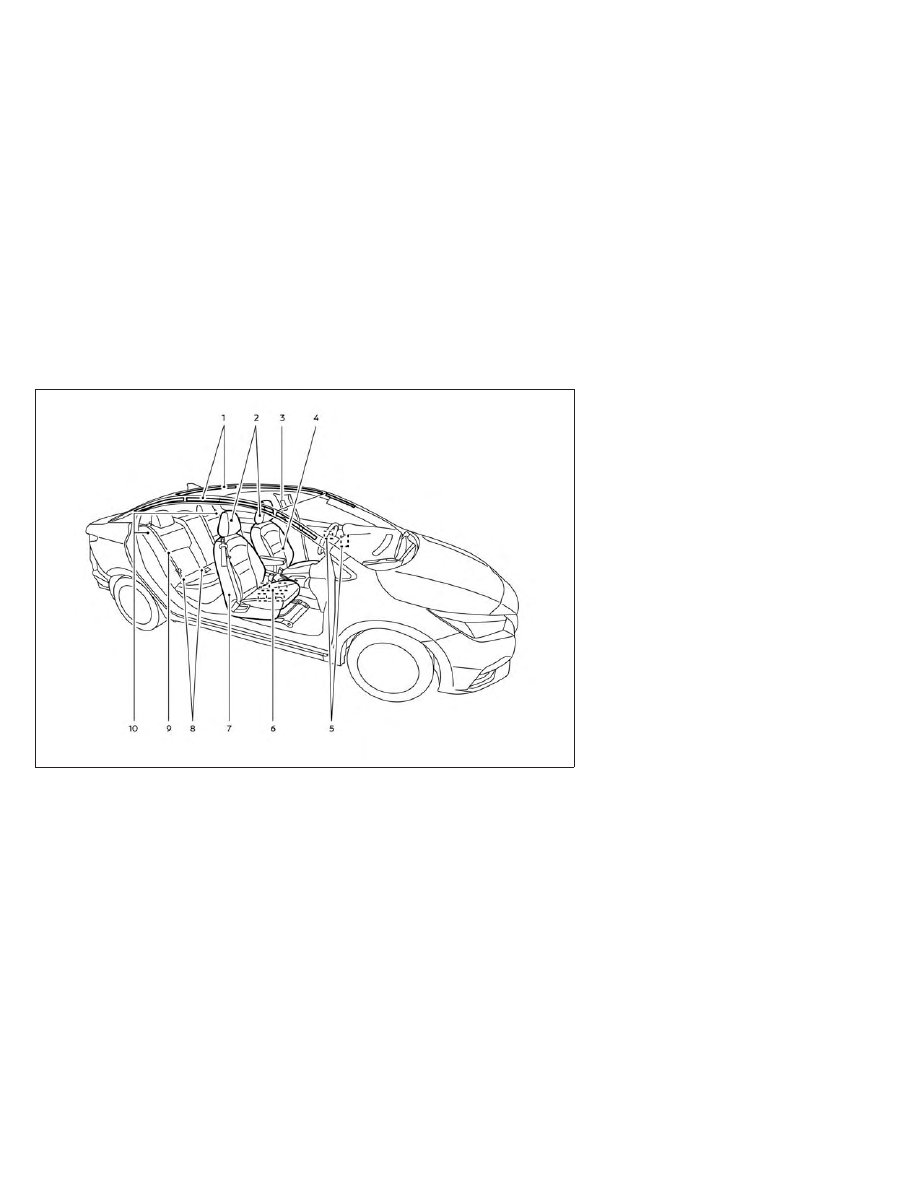
1.

Roof-mounted curtain side-impact and
rollover supplemental air bag (P. 1-56)

2.

Head restraints/headrests (P. 1-5)

3.

Front seat belt with pretensioner(s) and
shoulder height adjuster (P. 1-9, 1-15)

4.

Seat (P. 1-2)

5.

Supplemental air bag modules (P. 1-40)

6.

Occupant classification sensor (weight
sensor) (P. 1-40)

7.

Front seat-mounted side-impact
supplemental air bag (P. 1-56)

8.

LATCH (Lower Anchors and Tethers for
CHildren) system (P. 1-21)

9.

Rear outboard seat belts with preten-
sioner(s) (P. 1-9)

10.

Rear outboard seat-mounted side-
impact supplemental air bags (P. 1-56)

Refer to the page number indicated in
parentheses for operating details.

LII2886

AIR BAGS, SEAT BELTS AND CHILD
RESTRAINTS

0-2

Illustrated table of contents
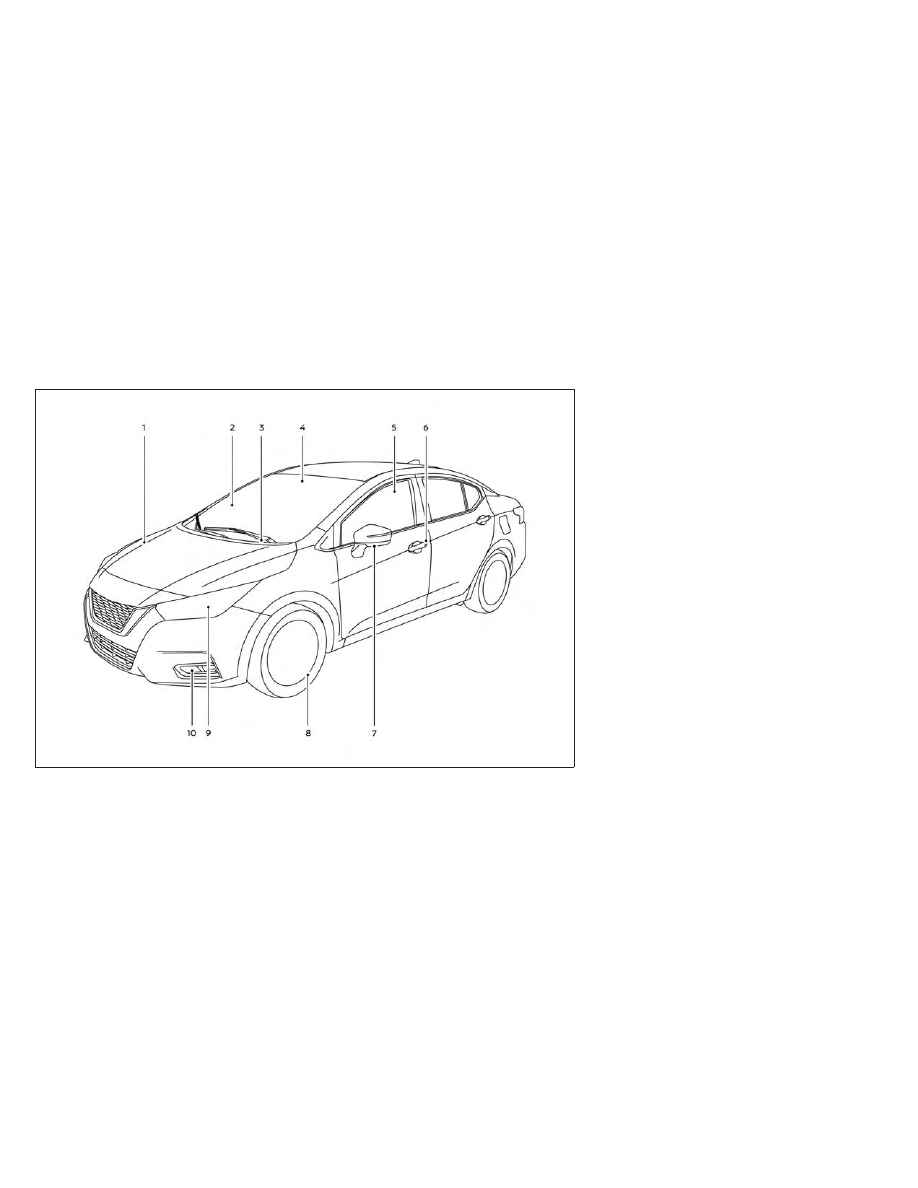
1.

Engine hood (P. 3-23)

2.

Windshield (P. 8-17)

3.

Wiper and washer switch (P. 2-43)

4.

Front camera (if so equipped) (P. 5-26),
(P. 5-83)

5.

Power windows (P. 2-67)

6.

Door locks (P. 3-4)
NISSAN Intelligent Key® system (if so
equipped) (P. 3-7)
Keys (P. 3-2)

7.

Mirrors (P. 3-31)

8.

Tire pressure (P. 8-27)
Flat tire (P. 6-3)
Tire chains (P. 8-36)

9.

Headlight and turn signal switch
(P. 2-45)
Daytime Running Lights (DRL) system
(if so equipped) (P. 2-49)
LED Daytime Running Lights (DRL) sys-
tem (if so equipped) (P. 2-50)
Replacing bulbs (P. 8-24)

10.

Fog light switch (if so equipped) (P. 2-51)

Refer to the page number indicated in
parentheses for operating details.

LII2883

EXTERIOR FRONT

Illustrated table of contents

0-3

1.

Rear window defroster switch (P. 2-44)

2.

High mounted stop light (P. 8-24)

3.

Trunk opener switch (P. 3-24)

4.

License plate lights (P. 8-24)

5.

Rearview camera (P. 4-8)

6.

Parking sensor(s) (P. 5-122)

7.

Replacing bulbs (P. 8-24)

8.

Fuel-filler door (P. 3-26)
Fuel-filler cap (P. 3-26)
Fuel recommendation (P. 10-2)

9.

Child safety rear door locks (P. 3-7)

Refer to the page number indicated in
parentheses for operating details.

LII2593

EXTERIOR REAR

0-4

Illustrated table of contents

1.

Interior light (P. 2-69)

2.

Sun visors (P. 3-29)

3.

Emergency call button (if so equipped)
(P. 2-55)

4.

Map light (P. 2-70)

5.

Rearview mirror (P. 3-31)

6.

Glove box (P. 2-65)

7.

Parking brake (P. 5-25)

Refer to the page number indicated in
parentheses for operating details.

LII2884

PASSENGER COMPARTMENT

Illustrated table of contents

0-5

1.

Vents (P. 4-15)

2.

Headlight/fog light (if so equipped)/
turn signal switch (P. 2-45, 2-51)

3.

Driver's supplemental air bag (P. 1-40)
Horn (P. 2-52)

4.

Meters and gauges (P. 2-4)
Warning and indicator lights (P. 2-12)
Trip computer (if so equipped) (P. 2-10)
Vehicle information display (if so
equipped) (P. 2-25)

5.

Wiper and washer switch (P. 2-43)

6.

Center display controls (if so equipped)
(P. 4-2, 4-7, 4-26)
Audio controls (P. 4-2, 4-7, 4-26)

7.

Front passenger air bag status light
(P. 1-51)
Hazard warning flasher switch (P. 6-2)

8.

Center display (P. 4-2, 4-7, 4-26)

9.

Passenger's supplemental air bag
(P. 1-40)

10.

Front passenger’s supplemental knee
airbag (P. 1-58)

11.

Glove box (P. 2-65)

12.

Climate controls (P. 4-16, 4-23)
Heated seat switches (if so equipped)
(P. 2-52)

13.

Shift lever (P. 5-20)

14.

Push-button ignition switch (if so
equipped) (P. 5-12)

15.

Wireless charger and indicator (if so
equipped) (P. 2-59)

16.

Power outlet (P. 2-62)
USB connection port (P. 4-2, 4-35)
AUX jack (if so equipped) (P. 4-2, 4-38)

LII2852

INSTRUMENT PANEL

0-6

Illustrated table of contents

17.

Cruise control switches (if so equipped)
(P. 5-51)
Intelligent Cruise Control (ICC) switches
(if so equipped) (P. 5-53)
Bluetooth® Hands-Free Phone System
(P. 4-2, 4-49)

18.

Driver supplemental knee air bag
(P. 1-58)

19.

Tilt and telescopic steering wheel lock
lever (P. 3-29)

20.

Hood release (P. 3-23)
Fuel-filler door release (P. 3-26)

21.

Steering wheel switches for audio con-
trol (P. 4-2, 4-44)
Control panel and vehicle information
display switches (if so equipped)
(P. 2-26)

22.

Vehicle Dynamic Control (VDC) OFF
switch (if so equipped) (P. 2-54)
Enter/select switch for trip computer
(if so equipped) (P. 2-10)
Automatic Emergency Braking (AEB)
with Pedestrian Detection OFF switch
(if so equipped) (P 2-54)
Rear Sonar System (RSS) OFF switch
(if so equipped) (P 2-55)
Lane Departure Warning (LDW) switch
(if so equipped) (P 2-53)

* Refer to the separate NissanConnect®
Owner's Manual (if so equipped).

Refer to the page number indicated in
parentheses for operating details.

Illustrated table of contents

0-7

1.6L 4 cylinder (HR16DE engine model)

1.

Engine coolant reservoir (P. 8-4)

2.

Windshield-washer fluid reservoir
(P. 8-11)

3.

Engine oil filler cap (P. 8-6)

4.

Brake and clutch (if so equipped) fluid
reservoir (P. 8-10)

5.

Fuse/Fusible link box (P. 8-19)

6.

Battery (P. 8-12)

7.

Fuse box (P. 8-19)

8.

Air cleaner (P. 8-16)

9.

Engine oil dipstick (P. 8-6)

10.

Drive belt location (P. 8-14)

Refer to the page number indicated in
parentheses for operating details.

NOTE:

Your vehicle may not be equipped with
an engine cover.

LDI3658

ENGINE COMPARTMENT CHECK
LOCATIONS

0-8

Illustrated table of contents

Warning/

Indicator

light (red)

Name

Page

or

Brake warning
light

2-14

Charge warning
light

2-14

Door open
warning light
(if so equipped)

2-15

Engine oil pres-
sure warning light

2-15

High temperature
warning light (red)
(if so equipped)

2-15

Warning/

Indicator

light (red)

Name

Page

Malfunction Indi-
cator Light (MIL)

2-15

Master warning
light (if so
equipped)

2-16

Rear seat belt
warning light and
chime (if so
equipped)

2-16

Seat belt warning
light and chime

2-16

Security indicator
light

2-16

Supplemental air
bag warning light

2-17

Warning/

Indicator

light

(yellow)

Name

Page

or

Anti-lock Braking
System (ABS)
warning light

2-17

Automatic Emer-
gency Braking
(AEB) with Pedes-
trian Detection
system warning
light

2-17

Continuously Vari-
able Transmission
(CVT) indicator
light (if so
equipped)

2-18

WARNING AND INDICATOR LIGHTS

Illustrated table of contents

0-9

Warning/

Indicator

light

(yellow)

Name

Page

Engine start op-
eration indicator
light (if so
equipped)

2-18

Front passenger
air bag status
light

2-18

Lane Departure
Warning (LDW)
indicator light
(if so equipped)

2-18

Low fuel warning
light (if so
equipped)

2-18

Low tire pressure
warning light

2-18

Warning/

Indicator

light

(yellow)

Name

Page

Low windshield-
washer fluid
warning light
(if so equipped)

2-20

Malfunction Indi-
cator Light (MIL)

2-20

Master warning
light (if so
equipped)

2-21

NISSAN Intelligent
Key® warning light
(if so equipped)

2-21

Power steering
warning light

2-21

Warning/

Indicator

light

(yellow)

Name

Page

Rear Automatic
Braking (RAB) sys-
tem warning light

2-22

Shift P (Park)
warning light
(if so equipped)

2-22

Slip indicator light

2-22

Vehicle Dynamic
Control (VDC) OFF
indicator light

2-22

0-10

Illustrated table of contents

Warning/

Indicator

light

(other)

Name

Page

CRUISE indicator
light (green)
(if so equipped)

2-23

Front fog light
indicator light
(green) (if so
equipped)

2-23

High Beam Assist
indicator light
(green)

2-23

High beam indi-
cator light (blue)

2-23

Lane Departure
Warning (LDW)
indicator light
(green) (if so
equipped)

2-23

Warning/

Indicator

light

(other)

Name

Page

NISSAN Intelligent
Key® warning light
(green) (if so
equipped)

2-21

SET indicator light
(green) (if so
equipped)

2-24

Side light and
headlight indica-
tor light (green)

2-24

SPORT mode indi-
cator light (green)
(if so equipped)

2-24

Turn signal/
hazard indicator
lights (green)

2-24

Illustrated table of contents

0-11

MEMO

0-12

Illustrated table of contents

1 Safety-Seats, seat belts and
supplemental restraint system

Seats . . . . . . . . . . . . . . . . . . . . . . . . . . . . . . . . . . . . . . . . . . . . 1-2

Front manual seat adjustment . . . . . . . . . . . . . . . .1-3
Folding rear seat (if so equipped) . . . . . . . . . . . . . 1-4

Head restraints/headrests . . . . . . . . . . . . . . . . . . . . . . 1-5

Adjustable head restraint/headrest
components . . . . . . . . . . . . . . . . . . . . . . . . . . . . . . . . . 1-6
Non-adjustable head restraint/
headrest components . . . . . . . . . . . . . . . . . . . . . . . 1-6
Remove . . . . . . . . . . . . . . . . . . . . . . . . . . . . . . . . . . . . . . .1-7
Install . . . . . . . . . . . . . . . . . . . . . . . . . . . . . . . . . . . . . . . . .1-7
Adjust . . . . . . . . . . . . . . . . . . . . . . . . . . . . . . . . . . . . . . . . 1-8

Seat belts . . . . . . . . . . . . . . . . . . . . . . . . . . . . . . . . . . . . . . . 1-9

Precautions on seat belt usage . . . . . . . . . . . . . . . 1-9
Seat belt warning light and chime . . . . . . . . . . . .1-12
Pregnant women . . . . . . . . . . . . . . . . . . . . . . . . . . . .1-12
Injured persons . . . . . . . . . . . . . . . . . . . . . . . . . . . . . .1-13
Three-point type seat belt with
retractor . . . . . . . . . . . . . . . . . . . . . . . . . . . . . . . . . . . . .1-13
Seat belt extenders . . . . . . . . . . . . . . . . . . . . . . . . . .1-16
Seat belt maintenance . . . . . . . . . . . . . . . . . . . . . . .1-16

Child safety . . . . . . . . . . . . . . . . . . . . . . . . . . . . . . . . . . . . .1-16

Infants . . . . . . . . . . . . . . . . . . . . . . . . . . . . . . . . . . . . . . . 1-17
Small children . . . . . . . . . . . . . . . . . . . . . . . . . . . . . . . . 1-17
Larger children . . . . . . . . . . . . . . . . . . . . . . . . . . . . . . .1-18

Child restraints . . . . . . . . . . . . . . . . . . . . . . . . . . . . . . . . . .1-19

Precautions on child restraints . . . . . . . . . . . . . . .1-19
LATCH (Lower Anchors and Tethers for
CHildren) system . . . . . . . . . . . . . . . . . . . . . . . . . . . . .1-21
Rear-facing child restraint installation
using LATCH . . . . . . . . . . . . . . . . . . . . . . . . . . . . . . . . 1-24
Rear-facing child restraint installation
using the seat belts . . . . . . . . . . . . . . . . . . . . . . . . . 1-26
Forward-facing child restraint
installation using LATCH . . . . . . . . . . . . . . . . . . . . . 1-28
Forward-facing child restraint
installation using the seat belts . . . . . . . . . . . . . .1-31
Booster seats . . . . . . . . . . . . . . . . . . . . . . . . . . . . . . . 1-36

Supplemental Restraint System (SRS) . . . . . . . . . . 1-40

Precautions on SRS . . . . . . . . . . . . . . . . . . . . . . . . . 1-40
Supplemental air bag warning labels . . . . . . . . .1-61
Supplemental air bag warning light . . . . . . . . . .1-61

WARNING

Do not ride in a moving vehicle when
the seatback is reclined. This can be
dangerous. The shoulder belt will not
be against your body. In an accident,
you could be thrown into it and re-
ceive neck or other serious injuries.
You could also slide under the lap belt
and receive serious internal injuries.

For the most effective protection
when the vehicle is in motion, the
seat should be upright. Always sit
well back and upright in the seat with
both feet on the floor and adjust the
seat properly. For additional infor-
mation, see “Precautions on seat belt
usage” (P. 1-9).

After adjustment, gently rock in the
seat to make sure it is securely locked.

Do not leave children unattended in-
side the vehicle. They could unknow-
ingly activate switches or controls or
make the vehicle move. Unattended
children could become involved in
serious accidents.

To help avoid risk of injury or death
through unintended operation of the
vehicle and/or its systems, do not
leave children, people who require
the assistance of others or pets unat-
tended in your vehicle. Additionally,
the temperature inside a closed ve-
hicle on a warm day can quickly be-
come high enough to cause a signifi-
cant risk of injury or death to people
and pets.

Do not adjust the driver’s seat while
driving so full attention may be given
to vehicle operation. The seat may
move suddenly and could cause loss
of control of the vehicle.

The seatback should not be reclined
any more than needed for comfort.
Seat belts are most effective when the
passenger sits well back and straight
up in the seat. If the seatback is re-
clined, the risk of sliding under the lap
belt and being injured is increased.

ARS1152

SEATS

1-2

Safety-Seats, seat belts and supplemental restraint system

CAUTION

When adjusting the seat positions, be
sure not to contact any moving parts to
avoid possible injuries and/or damage.

FRONT MANUAL SEAT
ADJUSTMENT

Your vehicle seats can be adjusted manu-
ally. For additional information about ad-
justing the seats, refer to the steps outlined
in this section.

Forward and backward

Pull the lever up and hold it while you slide
the seat forward or backward to the de-
sired position. Release the lever to lock the
seat in position.

Reclining

To recline the seatback, pull the lever up and
lean back. To bring the seatback forward,
pull the lever up and lean your body forward.
Release the lever to lock the seatback in
position.
The reclining feature allows adjustment of
the seatback for occupants of different sizes
for added comfort and to help obtain proper
seat belt fit. For additional information, see
“Precautions on seat belt usage” (P. 1-9). Also,
the seatback can be reclined to allow occu-
pants to rest when the vehicle is stopped
and the shift lever is in P (Park) or N (Neutral)
position with the parking brake fully applied.

LRS2795

LRS2814

Safety-Seats, seat belts and supplemental restraint system

1-3

Seat lifter (driver's seat)

Pull up or push down the adjusting lever to
adjust the seat height until the desired po-
sition is achieved.

FOLDING REAR SEAT (if so
equipped)

1. Pull up

O

A

to fold each seatback down.

2. To return the rear seat to a seating posi-

tion, lift up on the seatback and push it
up to an upright position. Firmly press
zones

O

A

and

O

B

to lock the seatback in

place.

LRS3254

LRS3247

LRS3281

1-4

Safety-Seats, seat belts and supplemental restraint system

WARNING

Never allow anyone to ride in the
cargo area or on the rear seat when it
is in the fold-down position. Use of
these areas by passengers without
proper restraints could result in seri-
ous injury or death in an accident or
sudden stop.

Properly secure all cargo with ropes
or straps to help prevent it from slid-
ing or shifting. Do not place cargo
higher than the seatbacks. In a sud-
den stop or collision, unsecured
cargo could cause personal injury.

When returning the seatbacks to the
upright position, be certain they are
completely secured in the latched
position. If they are not completely
secured, passengers may be injured
in an accident or sudden stop.

Closely supervise children when they
are around cars to prevent them
from playing and becoming locked in
the hatch where they could be seri-
ously injured. Keep the car locked,
with the rear seatback and hatch se-
curely latched when not in use, and
prevent children's access to car keys.

WARNING

Head restraints/headrests supplement
the other vehicle safety systems. They
may

provide

additional

protection

against injury in certain rear end colli-
sions.

Adjustable

head

restraints/

headrests must be adjusted properly,
as specified in this section. Check the
adjustment after someone else uses
the seat. Do not attach anything to the
head restraint/headrest stalks or re-
move the head restraint/headrest. Do
not use the seat if the head restraint/
headrest has been removed. If the head
restraint/headrest was removed, rein-
stall and properly adjust the head
restraint/headrest before an occupant
uses the seating position. Failure to fol-
low these instructions can reduce the
effectiveness of the head restraints/
headrests. This may increase the risk of
serious injury or death in a collision.

The illustration shows the seating posi-
tions

equipped

with

head

restraints/

headrests.

Indicates the seating position is equipped

with a head restraint.

쮿

Indicates the seating position is equipped

with a headrest.
+ Indicates the seating position is not
equipped with a head restraint or headrest
(if applicable).
• Your vehicle is equipped with a head

restraint/headrest that may be inte-
grated, adjustable or non-adjustable.

LRS2695

HEAD RESTRAINTS/HEADRESTS

Safety-Seats, seat belts and supplemental restraint system

1-5

• Adjustable head restraints/headrests have

multiple notches along the stalk(s) to lock
them in a desired adjustment position.

• The

non-adjustable

head

restraints/

headrests have a single locking notch to
secure them to the seat frame.

• Proper Adjustment:

– For the adjustable type, align the head

restraint/headrest so the center of
your ear is approximately level with the
center of the head restraint/headrest.

– If your ear position is still higher than

the recommended alignment, place
the head restraint/headrest at the
highest position.

• If the head restraint/headrest has been

removed, ensure that it is reinstalled and
locked in place before riding in that des-
ignated seating position.

ADJUSTABLE HEAD RESTRAINT/
HEADREST COMPONENTS

1. Removable head restraint/headrest

2. Multiple notches

3. Lock knob

4. Stalks

NON-ADJUSTABLE HEAD
RESTRAINT/HEADREST
COMPONENTS

1. Removable head restraint/headrest

2. Single notch

3. Lock knob

4. Stalks

LRS2300

LRS2299

1-6

Safety-Seats, seat belts and supplemental restraint system

REMOVE

Use the following procedure to remove the
head restraint/headrest:

1. Pull the head restraint/headrest up to

the highest position.

2. Push and hold the lock knob.

3. Remove the head restraint/headrest

from the seat.

4. Store the head restraint/headrest prop-

erly in a secure place so it is not loose in
the vehicle.

5. Reinstall and properly adjust the head

restraint/headrest before an occupant
uses the seating position.

INSTALL

1. Align the head restraint/headrest stalks

with the holes in the seat. Make sure that
the head restraint/headrest is facing the
correct direction. The stalk with the
notch (notches)

O

1

must be installed in

the hole with the lock knob

O

2

.

2. Push and hold the lock knob and push

the head restraint/headrest down.

3. Properly adjust the head restraint/

headrest before an occupant uses the
seating position.

LRS2302

LRS2303

Safety-Seats, seat belts and supplemental restraint system

1-7

ADJUST

For adjustable head restraint/headrest

Adjust the head restraint/headrest so the
center is level with the center of your ears.
If your ear position is still higher than the
recommended alignment, place the head
restraint/headrest at the highest position.

For non-adjustable head restraint/headrest

Make sure the head restraint/headrest is
positioned so the lock knob is engaged in
the notch before riding in that designated
seating position.

Raise

To raise the head restraint/headrest, pull it
up.

Make sure the head restraint/headrest is
positioned so the lock knob is engaged in
the notch before riding in that designated
seating position.

WRS0134

LRS3658

LRS2305

1-8

Safety-Seats, seat belts and supplemental restraint system

Lower

To lower, push and hold the lock knob and
push the head restraint/headrest down.

Make sure the head restraint/headrest is
positioned so the lock knob is engaged in
the notch before riding in that designated
seating position.

PRECAUTIONS ON SEAT BELT
USAGE

If you are wearing your seat belt properly
adjusted and you are sitting upright and
well back in your seat with both feet on the
floor, your chances of being injured or killed
in a collision and/or the severity of injury
may be greatly reduced. NISSAN strongly
encourages you and all of your passengers
to buckle up every time you drive, even if
your seating position includes a supple-
mental air bag.

Most U.S. states and Canadian provinces
or territories specify that seat belts be
worn at all times when a vehicle is being
driven.

LRS2306

SSS0136

SEAT BELTS

Safety-Seats, seat belts and supplemental restraint system

1-9

WARNING

Every person who drives or rides in
this vehicle should use a seat belt at all
times. Children should be in the rear
seats and in an appropriate restraint.

WARNING

The seat belt should be properly ad-
justed to a snug fit. Failure to do so
may reduce the effectiveness of the
entire restraint system and increase
the chance or severity of injury in an
accident. Serious injury or death can
occur if the seat belt is not worn
properly.

SSS0134

SSS0016

1-10

Safety-Seats, seat belts and supplemental restraint system

WARNING

Always route the shoulder belt over
your shoulder and across your chest.
Never put the belt behind your back,
under your arm or across your neck.
The belt should be away from your
face and neck, but not falling off your
shoulder.

Position the lap belt as low and snug
as possible AROUND THE HIPS, NOT
THE WAIST. A lap belt worn too high
could increase the risk of internal in-
juries in an accident.

Be sure the seat belt tongue is se-
curely fastened to the proper buckle.

Do not wear the seat belt inside out
or twisted. Doing so may reduce its
effectiveness.

Do not allow more than one person
to use the same seat belt.

Never carry more people in the ve-
hicle than there are seat belts.

If the seat belt warning light glows
continuously while the ignition is
turned ON with all doors closed and
all seat belts fastened, it may indi-
cate a malfunction in the system.
Have the system checked. It is rec-
ommended that you visit a NISSAN
dealer for this service.

No changes should be made to the
seat belt system. For example, do not
modify the seat belt, add material, or
install devices that may change the
seat belt routing or tension. Doing so
may affect the operation of the seat
belt system. Modifying or tampering
with the seat belt system may result
in serious personal injury.

Once seat belt pretensioner(s) have
activated, they cannot be reused and
must be replaced together with the
retractor. It is recommended that you
visit a NISSAN dealer for this service.

All seat belt assemblies, including re-
tractors

and

attaching

hardware,

should be inspected after any colli-
sion. It is recommended that you visit a
NISSAN dealer for this service. NISSAN
recommends that all seat belt assem-
blies in use during a collision be re-
placed unless the collision was minor
and the belts show no damage and
continue to operate properly. Seat belt
assemblies not in use during a colli-
sion should also be inspected and re-
placed if either damage or improper
operation is noted.

All child restraints and attaching hard-
ware should be inspected after any
collision. Always follow the restraint
manufacturer's

inspection

instruc-

tions and replacement recommenda-
tions. The child restraints should be
replaced if they are damaged.

SSS0014

Safety-Seats, seat belts and supplemental restraint system

1-11

SEAT BELT WARNING LIGHT AND
CHIME

The driver and front passenger seat is
equipped with an enhanced seat belt re-
minder function. If your vehicle is equipped
with an enhanced seat belt reminder func-
tion, a visual and audible alert will operate if
a driver or front passenger seat belt is un-
buckled at speeds of approximately 9 mph
(15 km/h) or more under the following con-
ditions:
• If the driver seat belt is not fastened.

• The front passenger’s seat belt is not fas-

tened and the seat is occupied by a pas-
senger for 7 seconds after the ignition
switch is placed in the ON position.

• The front passenger’s seat belt is not fas-

tened and objects or external force on
the passenger seat change the seat belt
reminder classification to Occupied.

The seat belt warning light will flash under
the conditions shown above until the nec-
essary seat belt is securely fastened.

A warning chime will sound for approxi-
mately 90 seconds or until one of the fol-
lowing conditions is met:
• The unbuckled front occupant’s seat belt

is securely fastened.

• The seat belt reminder function in the

front passenger seat no longer detects
that the front passenger seat is occupied.

• The ignition is turned off.

The below situations could result in the
seat belt reminder light being illuminated
and the chime sounding, even with no oc-
cupant present in the passenger seat:
• Heavy objects placed on the seat.
• Someone pushing or pulling on the front

passenger seat.

• An object placed under the front passen-

ger seat.

• An object placed between the seat cush-

ion and center console or between the
seat cushion and the door.

• An object hanging on the seat or placed

in the seatback pocket.

• A child restraint or other object pressing

against the rear of the seatback.

NOTE:

The rear seats may be equipped with a
seat belt warning message in the vehicle
information display.

For additional information, see “Vehicle in-
formation display” (P. 2-25 ).

PREGNANT WOMEN

NISSAN

recommends

that

pregnant

women use seat belts. The seat belt should
be worn snug and always position the lap
belt as low as possible around the hips, not
the waist. Place the shoulder belt over your
shoulder and across your chest. Never run
the lap/shoulder belt over your abdomi-
nal area. Contact your doctor for specific
recommendations.

LRS0786

1-12

Safety-Seats, seat belts and supplemental restraint system

INJURED PERSONS

NISSAN recommends that injured persons
use seat belts. Check with your doctor for
specific recommendations.

THREE-POINT TYPE SEAT BELT
WITH RETRACTOR

WARNING

Every person who drives or rides in
this vehicle should use a seat belt at
all times. Children should be in the
rear seats and in an appropriate
restraint.

Do not ride in a moving vehicle when
the seatback is reclined. This can be
dangerous. The shoulder belt will not
be against your body. In an accident,
you could be thrown into it and re-
ceive neck or other serious injuries.
You could also slide under the lap belt
and receive serious internal injuries.

For the most effective protection
when the vehicle is in motion, the
seat should be upright. Always sit
well back and upright in the seat with
both feet on the floor and adjust the
seat belt properly.

Do not allow children to play with the
seat belts. Most seating positions are
equipped with Automatic Locking
Retractor (ALR) mode seat belts. If
the seat belt becomes wrapped
around a child’s neck with the ALR
mode activated, the child can be se-
riously injured or killed if the seat belt
retracts and becomes tight. This can
occur even if the vehicle is parked.
Unbuckle the seat belt to release the
child. If the seat belt cannot be un-
buckled or is already unbuckled, re-
lease the child by cutting the seat
belt with a suitable tool (such as a
knife or scissors) to release the seat
belt.

Fastening the seat belts

1. Adjust the seat. For additional informa-

tion, see “Seats” (P. 1-2).

2. Slowly pull the seat belt out of the retrac-

tor and insert the tongue into the buckle

O

A

until you hear and feel the latch

engage.

The retractor is designed to lock dur-
ing a sudden stop or on impact. A
slow pulling motion permits the seat
belt to move, and allows you some
freedom of movement in the seat.

If the seat belt cannot be pulled from
its fully retracted position, firmly pull
the belt and release it. Then smoothly
pull the belt out of the retractor.

LRS3087

Safety-Seats, seat belts and supplemental restraint system

1-13

3. Position the lap belt portion

low and

snug on the hips

O

B

as shown.

4. Pull the shoulder belt portion toward the

retractor to take up extra slack

O

C

. Be

sure the shoulder belt is routed over
your shoulder and across your chest.

The front passenger seat and the rear
seating positions’ three-point seat belts
have two modes of operation:
• Emergency Locking Retractor (ELR)
• Automatic Locking Retractor (ALR)

The ELR mode allows the seat belt to ex-
tend and retract to allow the driver and
passengers some freedom of movement

in the seat. The ELR locks the seat belt
when the vehicle slows down rapidly or
during certain impacts.

The ALR mode (child restraint mode) locks
the seat belt for child restraint installation.

When the ALR mode is activated, the seat
belt cannot be extended again until the
seat belt tongue is detached from the
buckle and fully retracted. The seat belt re-
turns to the ELR mode after the seat belt
fully retracts. For additional information,
see “Child restraints” (P. 1-19).

The ALR mode should be used only for
child restraint installation. During nor-
mal seat belt use by an occupant, the ALR
mode should not be activated. If it is ac-
tivated, it may cause uncomfortable seat
belt tension. It can also change the op-
eration of the front passenger air bag.
For additional information, see “Supple-
mental air bag warning light” (P. 1-61).

WARNING

When fastening the seat belts, be cer-
tain that the seatbacks are completely
secured in the latched position. If they
are not completely secured, passen-
gers may be injured in an accident or
sudden stop.

Unfastening the seat belts

To unfasten the seat belt, press the button
on the buckle

O

1

. The seat belt automati-

cally retracts.

LRS2675

WRS0139

1-14

Safety-Seats, seat belts and supplemental restraint system

Checking seat belt operation

Seat belt retractors are designed to lock
seat belt movement by two separate
methods:
• When the seat belt is pulled quickly from

the retractor

• When the vehicle slows down rapidly

To increase your confidence in the seat
belts, check the operation as follows:
• Grasp the shoulder belt and pull forward

quickly. The retractor should lock and re-
strict further belt movement.

If the retractor does not lock during this
check, get the system checked. It is recom-
mended that you visit a NISSAN dealer for
this service or to learn more about seat belt
operation.

Shoulder belt height adjustment
(front seats)

The shoulder belt anchor height should be
adjusted to the position best for you. For
additional information, see “Precautions on
seat belt usage” (P. 1-9). To adjust, pull out
the adjustment button

O

1

and move the

shoulder belt anchor to the desired posi-
tion

O

2

, so the belt passes over the center

of the shoulder. The belt should be away
from your face and neck, but not falling off
your shoulder. Release the adjustment but-
ton to lock the shoulder belt anchor into
position.

WARNING

After adjustment, release the adjust-
ment button and try to move the shoul-
der belt anchor up and down to make
sure it is securely fixed in position.

The shoulder belt anchor height should
be adjusted to the position best for you.
Failure to do so may reduce the effec-
tiveness of the entire restraint system
and increase the chance or severity of
injury in an accident.

LRS0242

Safety-Seats, seat belts and supplemental restraint system

1-15

SEAT BELT EXTENDERS

If, because of body size or driving position,
it is not possible to properly fit the lap/
shoulder belt and fasten it, an extender
that is compatible with the installed seat
belts is available for purchase. The ex-
tender adds approximately 8 in (200 mm)
of length and may be used for either the
driver or front passenger seating position.
It is recommended that you visit a NISSAN
dealer for assistance with purchasing an
extender if an extender is required.

WARNING

Only NISSAN seat belt extenders, made
by the same company which made the
original equipment seat belts, should
be used with NISSAN seat belts.

Adults and children who can use the
standard seat belt should not use
an extender. Such unnecessary use
could result in serious personal injury
in the event of an accident.

Never use seat belt extenders to in-
stall child restraints. If the child re-
straint is not secured properly, the
child could be seriously injured or
killed in a collision or a sudden stop.

SEAT BELT MAINTENANCE

To clean the seat belt webbing,

apply a

mild soap solution or any solution rec-
ommended for cleaning upholstery or
carpet. Then wipe with a cloth and allow
the seat belts to dry in the shade. Do not
allow the seat belts to retract until they
are completely dry.

If dirt builds up in the shoulder belt
guide of the seat belt anchors,

the seat

belts may retract slowly. Wipe the shoul-
der belt guide with a clean, dry cloth.

Periodically check to see that the seat
belt and the metal components,

such

as buckles, tongues, retractors, flexible
wires and anchors, work properly. If loose
parts, deterioration, cuts or other dam-
age on the webbing is found, the entire
seat belt assembly should be replaced.

WARNING

Do not allow children to play with the
seat belts. Most seating positions are
equipped with Automatic Locking Re-
tractor (ALR) mode seat belts. If the seat
belt becomes wrapped around a child’s
neck with the ALR mode activated, the
child can be seriously injured or killed if
the seat belt retracts and becomes
tight. This can occur even if the vehicle
is parked. Unbuckle the seat belt to re-
lease the child. If the seat belt cannot
be unbuckled or is already unbuckled,
release the child by cutting the seat
belt with a suitable tool (such as a knife
or scissors) to release the seat belt.

Children need adults to help protect them.
They need to be properly restrained.

In addition to the general information in
this manual, child safety information is
available from many other sources, includ-
ing doctors, teachers, government traffic
safety offices, and community organiza-
tions. Every child is different, so be sure to
learn the best way to transport your child.

CHILD SAFETY

1-16

Safety-Seats, seat belts and supplemental restraint system

There are three basic types of child re-
straint systems:
• Rear-facing child restraints
• Forward-facing child restraints
• Booster seats

The proper restraint depends on the child's
size. Generally, infants up to about 1 year
and less than 20 lbs. (9 kg) should be placed
in rear-facing child restraints. Forward-
facing child restraints are available for chil-
dren who outgrow rear-facing child re-
straints and are at least 1 year old. Booster
seats are used to help position a vehicle
lap/shoulder belt on a child who can no
longer use a forward-facing child restraint.

WARNING

Infants and children need special pro-
tection. The vehicle's seat belts may
not fit them properly. The shoulder belt
may come too close to the face or neck.
The lap belt may not fit over their small
hip bones. In an accident, an improp-
erly fitting seat belt could cause serious
or fatal injury. Always use appropriate
child restraints.

All U.S. states and Canadian provinces or
territories require the use of approved child
restraints for infants and small children.
For additional information, see “Child re-
straints” (P. 1-19).

A child restraint may be secured in the ve-
hicle by using either the LATCH (Lower An-
chors and Tethers for CHildren) system or
with the vehicle seat belt. For additional
information, see “Child restraints” (P. 1-19).

NISSAN recommends that all pre-teens
and children be restrained in the rear
seat. Studies show that children are
safer when properly restrained in the
rear seat than in the front seat.

This is especially important because
your vehicle has a supplemental re-
straint system (air bag system) for the
front passenger. For additional informa-
tion, see “Supplemental Restraint Sys-
tem (SRS)” (P. 1-40).

INFANTS

Infants up to at least 1 year old should be
placed in a rear-facing child restraint.
NISSAN

recommends

that

infants

be

placed in child restraints that comply with
Federal Motor Vehicle Safety Standards or

Canadian Motor Vehicle Safety Standards.
You should choose a child restraint that fits
your vehicle and always follow the manu-
facturer's instructions for installation and
use.

SMALL CHILDREN

Children that are over 1 year old and weigh
at least 20 lbs. (9 kg) should remain in a
rear-facing child restraint as long as pos-
sible up to the height or weight limit of the
child restraint. Children who outgrow the
height or weight limit of the rear-facing
child restraint and are at least 1 year old
should be secured in a forward-facing child
restraint with a harness. Refer to the manu-
facturer’s instructions for minimum and
maximum weight and height recommen-
dations. NISSAN recommends that small
children be placed in child restraints that
comply with Federal Motor Vehicle Safety
Standards or Canadian Motor Vehicle
Safety Standards. You should choose a
child restraint that fits your vehicle and al-
ways follow the manufacturer’s instruc-
tions for installation and use.

Safety-Seats, seat belts and supplemental restraint system

1-17

LARGER CHILDREN

Children should remain in a forward-facing
child restraint with a harness until they reach
the maximum height or weight limit allowed
by the child restraint manufacturer.

Once a child outgrows the height or weight
limit of the harness-equipped forward-
facing child restraint, NISSAN recommends
that the child be placed in a commercially
available booster seat to obtain proper
seat belt fit. For a seat belt to fit properly, the
booster seat should raise the child so that
the shoulder belt is properly positioned
across the chest and the top, middle por-
tion of the shoulder. The shoulder belt
should not cross the neck or face and
should not fall off the shoulder. The lap belt
should lie snugly across the lower hips or
upper thighs, not the abdomen.

A booster seat can only be used in seating
positions that have a three-point type
seat belt. The booster seat should fit the
vehicle seat and have a label certifying
that it complies with Federal Motor Vehicle
Safety Standards or Canadian Motor Ve-
hicle Safety Standards. Once the child has
grown so the shoulder belt is no longer on

or near the face and neck and the lap belt
can be positioned properly across the
lower hips or upper thighs, use the seat belt
without the booster seat.

A booster seat should be used until the
child can pass the seat belt fit test below:
• Are the child’s back and hips against the

vehicle seatback?

• Is the child able to sit without slouching?
• Do the child’s knees bend easily over the

front edge of the seat with feet flat on the
floor?

• Can the child safely wear the seat belt (lap

belt low and snug across the hips and
shoulder belt across mid-chest and
shoulder)?

• Is the child able to use the properly ad-

justed head restraint/headrest?

• Will the child be able to stay in position for

the entire ride?

If you answered no to any of these ques-
tions, the child should remain in a booster
seat using a three-point type seat belt.

NOTE:

Laws in some communities may follow
different guidelines. Check local and
state regulations to confirm your child is
using the correct restraint system before
traveling.

LRS2690

1-18

Safety-Seats, seat belts and supplemental restraint system

WARNING

Never let a child stand or kneel on any
seat and do not allow a child in the
cargo area. The child could be seriously
injured or killed in a sudden stop or
collision.

PRECAUTIONS ON CHILD
RESTRAINTS

WARNING

Failure to follow the warnings and in-
structions for proper use and instal-
lation of child restraints could result
in serious injury or death of a child or
other passengers in a sudden stop or
collision:

The child restraint must be used
and installed properly. Always fol-
low all of the child restraint manu-
facturer's instructions for instal-
lation and use.

Infants and children should never
be held on anyone's lap. Even the
strongest adult cannot resist the
forces of a collision.

Do not put a seat belt around both
a child and another passenger.

NISSAN recommends that all child
restraints be installed in the rear
seat. Studies show that children are
safer when properly restrained in
the rear seat than in the front seat.
If you must install a forward-facing
child restraint in the front seat, see

ARS1098

WRS0256

CHILD RESTRAINTS

Safety-Seats, seat belts and supplemental restraint system

1-19

“Forward-facing child restraint in-
stallation using the seat belts”
(P. 1-31).

Even with the NISSAN Advanced
Air Bag System, never install a
rear-facing child restraint in the
front seat. An inflating air bag
could seriously injure or kill a child.
A rear-facing child restraint must
only be used in the rear seat.

Be sure to purchase a child re-
straint that will fit the child and
vehicle. Some child restraints may
not fit properly in your vehicle.

Child restraint anchorages are de-
signed to withstand only those
loads imposed by correctly fitted
child restraints. Under no circum-
stances are they to be used to at-
tach adult seat belts, or other items
or equipment to the vehicle. Doing
so could damage the child restraint
anchorages. The child restraint will
not be properly installed using the
damaged anchorage, and a child
could be seriously injured or killed
in a collision.

Never use the anchor points for
adult seat belts, or other items.

A child restraint with a top tether
strap should not be used in the
front passenger seat.

Keep seatbacks as upright as pos-
sible after fitting the child restraint.

Infants and children should al-
ways be placed in an appropriate
child restraint while in the vehicle.

When the child restraint is not in use,
keep it secured with the LATCH sys-
tem or a seat belt. In a sudden stop or
collision, loose objects can injure oc-
cupants or damage the vehicle.

CAUTION

A child restraint in a closed vehicle can
become very hot. Check the seating
surface and buckles before placing a
child in the child restraint.

This vehicle is equipped with a universal
child restraint anchor system, referred to
as the LATCH (Lower Anchors and Tethers
for CHildren) system. Some child restraints
include rigid or webbing-mounted attach-

ments that can be connected to these
anchors. For additional information, see
“LATCH (Lower Anchors and Tethers for
CHildren) system” (P. 1-21).

If you do not have a LATCH compatible
child restraint, the vehicle seat belts can be
used.

Several

manufacturers

offer

child

re-

straints for infants and children of various
sizes. When selecting any child restraint,
keep the following points in mind:
• Choose only a restraint with a label certi-

fying that it complies with Federal Motor
Vehicle Safety Standard 213 or Canadian
Motor Vehicle Safety Standard 213.

• Check the child restraint in your vehicle to

be sure it is compatible with the vehicle's
seat and seat belt system.

• If the child restraint is compatible with

your vehicle, place your child in the child
restraint and check the various adjust-
ments to be sure the child restraint is
compatible with your child. Choose a
child restraint that is designed for your
child's height and weight. Always follow
all recommended procedures.

1-20

Safety-Seats, seat belts and supplemental restraint system

• If the combined weight of the child and

child restraint is less than 65 lbs. (29.5 kg),
you may use either the LATCH anchors or
the seat belt to install the child restraint
(not both at the same time).

• If the combined weight of the child and

child restraint is greater than 65 lbs. (29.5
kg), use the vehicle’s seat belt (not the
lower anchors) to install the child restraint.

• Be sure to follow the child restraint manu-

facturer’s instructions for installation.

All U.S. states and Canadian provinces or
territories require that infants and small
children be restrained in an approved
child restraint at all times while the ve-
hicle is being operated. Canadian law re-
quires the top tether strap on forward-
facing child restraints be secured to the
designated anchor point on the vehicle.

LATCH (Lower Anchors and
Tethers for CHildren) SYSTEM

Your vehicle is equipped with special an-
chor points that are used with LATCH sys-
tem compatible child restraints. This sys-
tem may also be referred to as the ISOFIX
or ISOFIX compatible system. With this sys-
tem, you do not have to use a vehicle seat
belt to secure the child restraint unless the
combined weight of the child and child re-
straint exceeds 65 lbs. (29.5 kg). If the com-
bined weight of the child and child restraint
is greater than 65 lbs. (29.5 kg) use the vehi-

cle’s seat belt (not the lower anchors) to
install the child restraint. Be sure to follow
the child restraint manufacturer’s instruc-
tions for installation.

The LATCH anchor points can be used to
install child restraints in either the rear out-
board seating positions or in the center
rear seating position. Please refer to the
following section of this Owner’s Manual for
specific information about installing a child
restraint in the center rear seating position
using the LATCH anchors.

LATCH lower anchor

WARNING

Failure to follow the warnings and in-
structions for proper use and installa-
tion of child restraints could result in
serious injury or death of a child or
other passengers in a sudden stop or
collision:

Only attach LATCH system compat-
ible child restraints to the Lower An-
chors shown in the illustration. For
additional information, refer to the
following sections of this Owner’s
Manual for installation guidance.

LRS3341

LATCH system lower anchor locations

Safety-Seats, seat belts and supplemental restraint system

1-21


Content      ..      1       2         ..


//////////////////////////////////////////