Mitsubishi Eclipse. Manual - part 824
AUTOMATIC TRANSAXLE DIAGNOSIS
TSB Revision
AUTOMATIC TRANSAXLE
23A-305
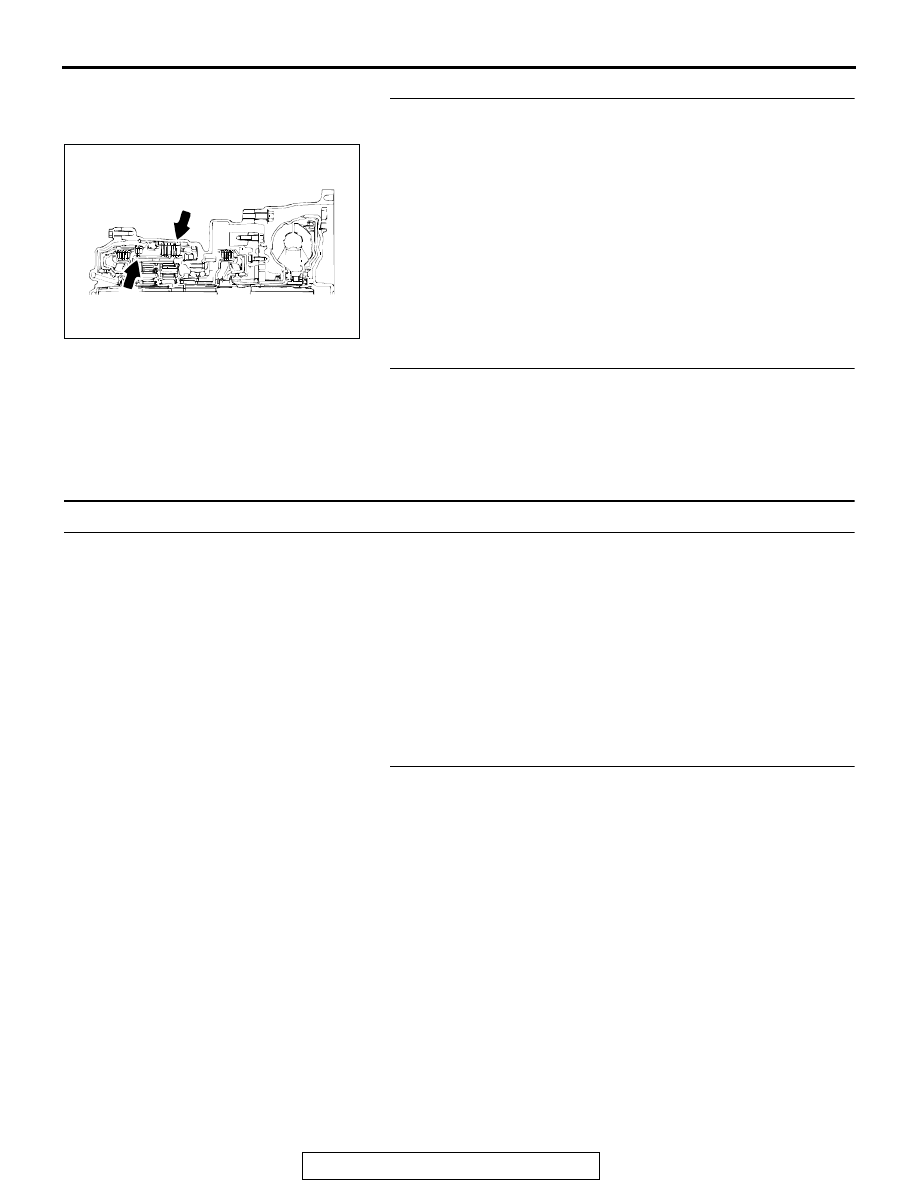
STEP 6. Check the reverse clutch, low-reverse brake or
both. Remove the transaxle.
Check the facing for seizure and the piston seal ring for dam-
age and interference with the retainer. Repair or replace the
faulty parts. Refer to GROUP 23B, Transaxle
Reverse and Overdrive Clutch
. Then check the
symptom.
Q: Is the symptom eliminated?
YES : The procedure is complete.
NO : Go to Step 7.
STEP 7. Replace the PCM.
Q: Is the symptom eliminated?
YES : The procedure is complete.
NO : Start over at Step 1.
INSPECTION PROCEDURE 4: Does not Move (forward or backward)
.
COMMENT
If the vehicle does not move forward or backward
when the selector lever is shifted to any position
while the engine is idling, the cause is probably
abnormal line pressure, or a malfunction of the
power train, oil pump or valve body.
.
TROUBLESHOOTING HINTS (The most likely
causes for this case:)
• Abnormal line pressure
• Malfunction of the power train
• Malfunction of the oil pump
• Malfunction of the valve body
• Low transmission fluid level
• Malfunction of the PCM
DIAGNOSIS
STEP 1. Check the hydraulic pressure.
Measure the hydraulic pressure of each element when the
transaxle is in 1st, 2nd or reverse. Check if each hydraulic
pressure is within the standard value. Refer to
Hydraulic Pressure Test. If some elements pressures are within
the standard value and some are not, recheck the symptom.
Q: Are all pressures within the standard value?
YES : Check transmission fluid level and condition. If not
OK, repair or replace as necessary, then recheck
symptom. If OK, go to Step 3.
NO : Go to Step 2.
AC001863 AB
LOW-REVERSE BRAKE
REVERSE CLUTCH