Mitsubishi Colt Ralliart. Manual - part 490
 

  Index      Mitsubishi     Mitsubishi Colt Ralliart - service repair manual


Search            


Content   ..  488  489  490  491   ..


Mitsubishi Colt Ralliart. Manual - part 490


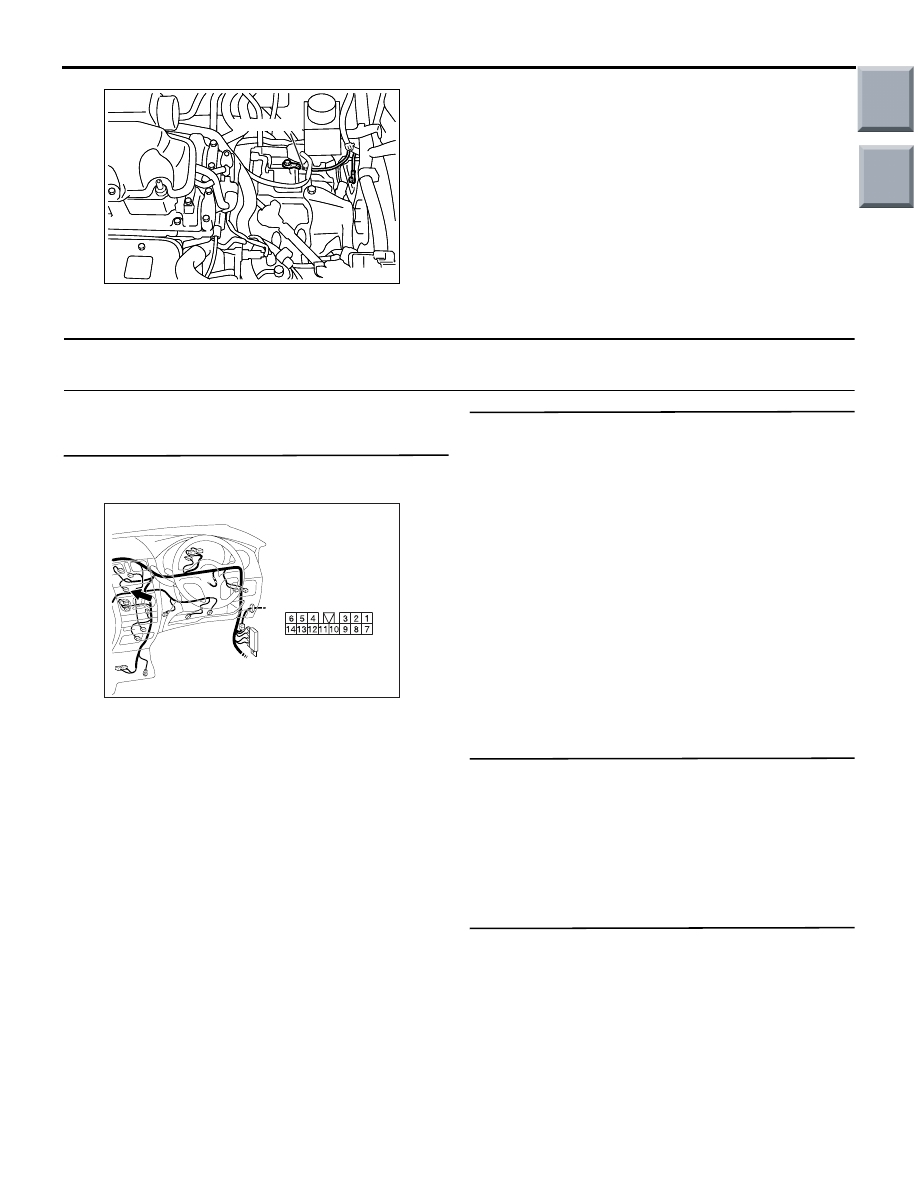
AC401621AB

Earth cable

RADIO AND CD PLAYER

CHASSIS ELECTRICAL

54A-105

INSPECTION PROCEDURE 9: Some Noise Appears When There is Vibration or Shocks During 
Travelling.

DIAGNOSIS PROCEDURE

Step 1. Connector check: Radio and CD player 
connector B-11.

AC401055

AN

Connector: B-11

Harness side

Q: Is radio and CD player connector B-11 in good 

condition?
YES : 

Go to Step 2.

NO : 

Repair or replace the connector. Check that 
there is no noise.

Step 2. Check that noise appear when the radio 
switch is turned on while the vehicle is stopped 
and the radio is tapped while tuned away from a 
station.
NOTE: Static electricity noise: Body static electric 
from the shock absorber rubber bushings used to 
prevent vibration, tires, etc. occurs because of sepa-
ration from the earth, causing a buzzing noise. Since 
no measures can be taken to discharge the static 
electricity of the vehicle body. Check that there is no 
noise.

Q: Does noise appear when the radio switch is turned 

on while the vehicle is stopped and the radio is 
tapped while tuned away from a station?
YES : . 

Go to Step 3.

NO : . 

It may be static electricity noise.

Step 3. Check that the radio correctly earthed. 
The radio is connected to the earth with an assem-
bling screw.

Q: Is the radio correctly earthed?

YES : 

Go to Step 4.

NO : 

Tighten the screw securely. Check that 
there is no noise.

Step 4. Check by replacing the radio and CD 
player.

Q:  Are operations normal when using another radio 

and CD player?
YES : 

Either repair or replace the radio and CD 

player. Check that there is no noise.

NO : 

Either repair or replace the antenna 
assembly. Check that there is no noise.

Main

Index

Group

TOC

RADIO AND CD PLAYER

CHASSIS ELECTRICAL

54A-106

INSPECTION PROCEDURE 10: Noise Sometimes Appears on FM during Travelling.

DIAGNOSIS PROCEDURE

Step 1. Check the state of the antenna.

Q:  Is the mast antenna assembled?

YES : 

Go to Step 2.

NO : 

Assemble the mast antenna. Check that 
there is no noise.

Step 2. The check after adjusting the radio.

Q:  Readjust the radio. Is the noise eliminated?

YES : 

Check that there is no noise.

NO : 

Go to Step 3.

Step 3. Check with several broadcasting stations.
NOTE: Multipath noise and fading noise: Because of 
the frequency of FM waves in extremely high, it is 
highly susceptible to effects from geological forma-
tions and buildings. These effects disrupt the broad-
cast signal and obstruct reception in several ways.

.

Multipath noise

This describes the echo that occurs when the 
broadcast signal is reflected by a large obstruc-
tion and enters the receiver with a slight time 
delay relative to the direct signal (repetitious 
buzzing).

.

Fading noise

This is a buzzing noise that occurs when the 
broadcast beam is disrupted by obstructing 
objects and the signal strength fluctuates intri-
cately within a narrow range.

Q:  Is the abnormality in reception generated only 

within a certain range?
YES : . 

The effect of an electrical field condition 

(multipath noise, fading noise) could be the 
cause. Check that there is not noise.

NO : . 

Go to Step 4.

Step 4. Check that noise appears when the radio 
switch is turned on while the vehicle is stopped.
NOTE: Static electricity noise: Body static electric 
from the shock absorber rubber bushings used to 
prevent vibration, tires, etc. occurs because of sepa-
ration from the earth, causing a buzzing noise. There 
is no measures to discharge the static electricity of 
the vehicle body. Check that there is no noise.

Q: Does noise appear when the radio switch is turned 

on while the vehicle is stopped and the radio is 
tapped while tuned away from a station?
YES : 

Go to Step 5.

NO : 

It may be static electricity noise.

Step 5. Check that the radio is correctly earthed.
The radio is connected to the earth with an assem-
bling screw.

Q: Is the radio correctly earthed? 

YES : 

Go to Step 6.

NO : 

Tighten the screw securely. Check that 
there is no noise.

Step 6. Check by replacing the radio and CD 
player.

Q:  Are operations normal when using another radio 

and CD player?
YES : 

Either repair or replace the radio and CD 

player. Check that there is no noise.

NO : 

Either repair or replace the antenna 
assembly. Check that there is no noise.

Main

Index

Group

TOC

RADIO AND CD PLAYER

CHASSIS ELECTRICAL

54A-107

INSPECTION PROCEDURE 11: Ever-Present Noise.

DIAGNOSIS PROCEDURE

Noise is often created by the following factors, and 
often the radio is OK when it is checked individually.

• Travelling conditions of the vehicle

• Terrain of area travelled through

• Surrounding buildings

• Signal conditions

• Time period

For this reason, if there are still problems with noise 
even after the measures described in inspection pro-
cedure 4 to 10 have been taken, get information on 
the factors listed above as well as determining 
whether the problem occurs with AM or FM, the sta-
tion names, frequencies, etc. and contact the radio 
manufacturer's service centre.

INSPECTION PROCEDURE 12: There is Noise but No Reception for Both AM and FM or No Sound 
from AM, or No Sound from FM.

DIAGNOSIS PROCEDURE

Step 1. Check the state of the antenna.

Q:  Is the mast antenna assembled?

YES : 

Go to Step 2.

NO : 

Assemble the mast antenna. The radio 
should sound normally.

Step 2. Check to see if inspections are taking 
place is an area exposed to special electric 
fields.

Q:  Are inspections taking place under special electric 

field conditions (underground garage, inside a 
building, etc.)?
YES : 

Go to Step 3.

NO : 

Go to Step 4.

Step 3. Relocate and check.
Automatically receive in a good reception area that is 
not exposed to special electric fields.

Q:  Is reception of the strongest radio frequency 

possible within the area?
YES : 

There is no action to be taken.

NO : 

Go to Step 4.

Step 4. Tune then check.

Q:  Did the sensitivity improve after tuning?

YES : 

There is no action to be taken.

NO : 

Go to Step 5.

Step 5. Check the connection of the antenna plug 
and the radio and CD player.

Q:  Is the antenna plug thoroughly connected to the 

radio and CD player?
YES : 

Go to Step 6.

NO : 

Thoroughly connect the antenna plug and 
the radio and CD player. The radio should 
sound normally.

Step 6. Check by replacing the radio and CD 
player.

Q:  Are operations normal when using another radio 

and CD player?
YES : 

Either repair or replace the radio and CD 

player. The radio should sound normally.

NO : 

Either repair or replace the antenna 
assembly. The radio should sound normally.

Main

Index

Group

TOC

RADIO AND CD PLAYER

CHASSIS ELECTRICAL

54A-108

INSPECTION PROCEDURE 13: Poor Reception.

DIAGNOSIS PROCEDURE

Step 1. Check the state of the antenna.

Q:  Is the mast antenna assembled?

YES : 

Go to Step 2.

NO : 

Assemble the mast antenna. Check that a 
poor reception is resolved.

Step 2. Check to see if inspections are taking 
place is an area exposed to special electric 
fields.

Q:  Are inspections taking place under special electric 

field conditions (underneath garage, inside a 
building, etc.)?
YES : 

Go to Step 3.

NO : 

Go to Step 4.

Step 3. Relocate and check.
Automatically receive in a good reception area that is 
not exposed to special electric fields.

Q:  Is reception of the strongest radio frequency 

possible within the area?
YES : 

Check that a poor reception is resolved.

NO : 

Go to Step 4.

Step 4. Tune then check.

Q:  Did the sensitivity improve after tuning?

YES : 

Check that a poor reception is resolved.

NO : 

Go to Step 5.

Step 5. Check with several broadcasting stations.
NOTE: Multipath noise and fading noise: Because 
the frequency of FM waves is extremely high, it is 
highly susceptible to effects from geological forma-
tions and buildings. These effects disrupt the broad-
cast signal and obstruct reception in several ways. 

.

Multipath noise

This describes the echo that occurs when the 
broadcast signal is reflected by a large obstruc-
tion and enters the receiver with a slight time 
delay relative to the direct signal (repetitious 
buzzing).

.

Fading noise

This is a buzzing noise that occurs when the 
broadcast beam is disrupted by obstructing 
objects and the signal strength fluctuates intri-
cately within a narrow range.

Q:  Is the abnormality in reception generated only 

within a certain range?
YES : 

Check that a poor reception is resolved.

NO : 

Go to Step 6.

Step 6. Check the connection of the antenna plug 
and the radio and CD player.

Q:  Is the antenna plug thoroughly connected to the 

radio and CD player?
YES : 

Go to Step 7.

NO : 

Thoroughly connect the antenna plug and 
the radio and CD player. Check that a poor 
reception is resolved.

Step 7. Check by replacing the radio and CD 
player.

Q: Does the another radio and CD player work 

normally?
YES : 

Either repair or replace the radio and CD 

player. Check that a poor reception is 
resolved.

NO : 

Either repair or replace the antenna 
assembly. Check that a poor reception is 
resolved.

Main

Index

Group

TOC


Content   ..  488  489  490  491   ..