Mazda CX-5 (2022 year). Manual in english - page 18
 

  Index      Manuals     Mazda CX-5 (2022 year). Manual in english


Search            copyright infringement  


Content      ..     16      17      18      19     ..


Mazda CX-5 (2022 year). Manual in english - page 18


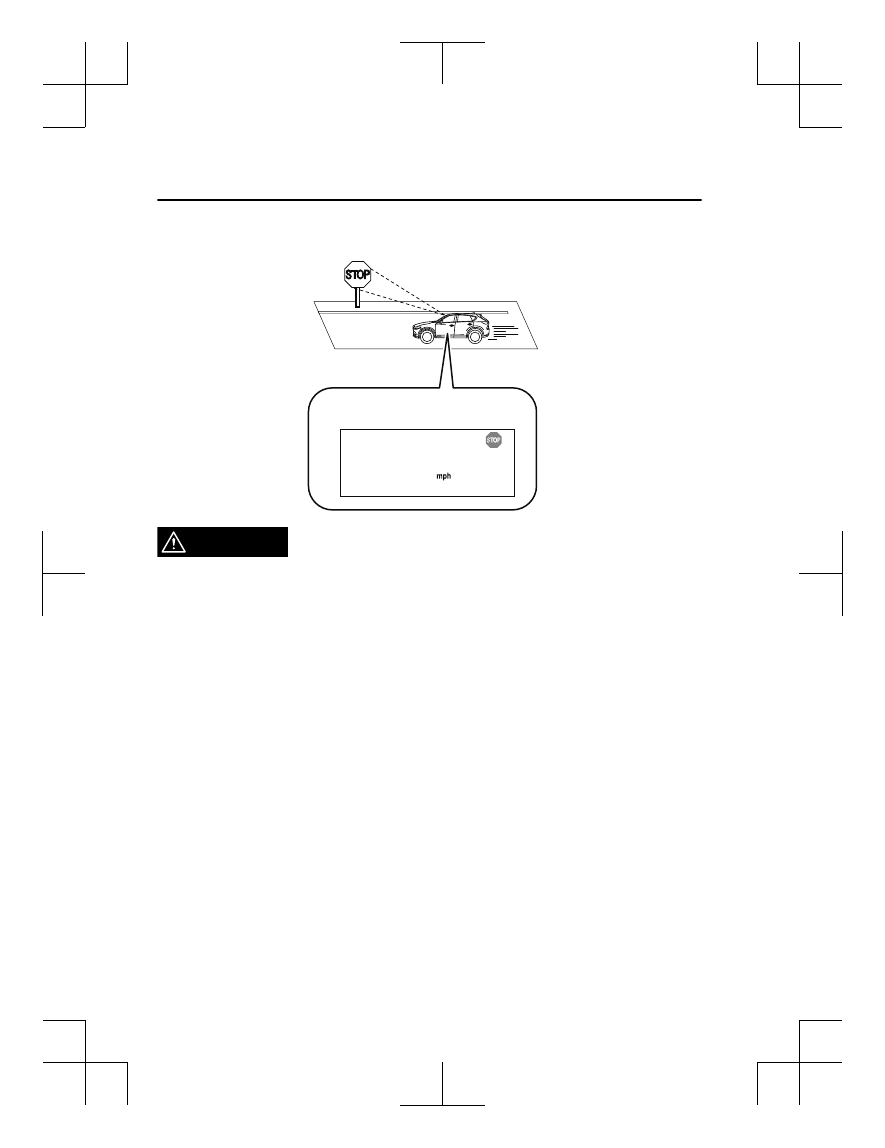
Stop sign

40

Sign recognized and 
displayed at same time

Active driving display indication

WARNING

Always check the traffic signs visually while driving.

The TSR helps prevent the driver from overlooking traffic signs and provides support for safer
driving. Depending on the weather conditions or problems with traffic signs, a traffic sign
may not be recognized or a traffic sign different from the actual traffic sign may be displayed.
Always make it your responsibility as a driver to check the actual traffic signs. Otherwise, it
could result in an accident.

NOTE

The TSR does not operate if there is a malfunction in the Forward Sensing Camera (FSC).

Under the following conditions, the TSR may not operate normally.

An object placed on the dashboard is reflected in the windshield and picked up by the
camera.

Heavy luggage is loaded in the luggage compartment or on the rear seat and the
vehicle is tilted.

The tire pressures are not adjusted to the specified pressure.

Tires other than standard tires are equipped.

The vehicle is driven on the ramp and surrounding area to or from a rest area or a
tollgate on a highway.

When surrounding brightness suddenly changes such as when entering or exiting a
tunnel.

When Driving

i-ACTIVSENSE

4-130

The illumination of the headlights is weakened because of dirt or the optical axis is
deviated.

The windshield is dirty or foggy.

The windshield and camera are fogged (water droplets).

Strong light is directed at the front of the vehicle (such as backlight or high-beam
headlights of on-coming vehicles).

The vehicle is making a sharp turn.

Strong light reflects off the road.

A traffic sign is in a position which makes it difficult to reflect the light from the
vehicle's headlights, such as when the vehicle is driven at night or in a tunnel.

The vehicle is driven under weather conditions such as rain, fog, or snow.

The stored map data for the navigation system is not current.

A traffic sign is obscured by mud or snow.

A traffic sign is concealed by trees or a vehicle.

A traffic sign is partially shaded.

A traffic sign is bent or warped.

A traffic sign is too low or too high.

A traffic sign is too bright or too dark (including electronic traffic signs).

A traffic sign is too big or too small.

There is an object similar to the traffic sign being read (such as another traffic sign or
other signs resembling it).

The TSR does not operate if the active driving display is set to non-display.

The TSR can be set to inoperable.
Refer to the Settings section in the Mazda Connect Owner's Manual.

Traffic Sign Display Indication

The following traffic signs are displayed
on the active driving display.

Speed limit signs

Do not enter signs

Stop signs

NOTE
Speed limit signs

When the vehicle speed is about 1 km/h
(0.6 mph) or faster, the speed limit sign
is displayed when any one of the
following conditions are met.

The Forward Sensing Camera (FSC)
recognizes a speed limit sign as a sign
targeted for your vehicle and the
vehicle passes it.

When Driving

i-ACTIVSENSE

4-131

The speed limit sign stored in the
navigation system is read (if the
Forward Sensing Camera (FSC) does
not recognize a speed limit sign).

In the following cases, display of the
speed limit sign stops.

The Forward Sensing Camera (FSC)
recognizes the speed limit sign and the
vehicle is driven for a certain distance
after passing the sign.

Each sensor determines that the
vehicle has changed direction of
travel.

The Forward Sensing Camera (FSC)
recognizes a new speed limit sign
which differs from the previous one
(displays the new speed limit sign).

The speed limit sign stored in the
navigation system is not read within a
certain period of time (if the Forward
Sensing Camera (FSC) does not
recognize a speed limit sign, the speed
limit sign stored in the navigation
system is displayed).

The vehicle speed exceeds the
displayed speed limit sign by 30 km/h
(19 mph) or more after a certain
period of time has elapsed since the
speed limit sign was displayed.
(Except when there is information for
the speed limit sign in the navigation
system)

Do not enter signs

A do not enter sign is displayed when all
of the following conditions are met.

The vehicle speed is about 60 km/h
(37 mph) or slower.

The Forward Sensing Camera (FSC)
recognizes a do not enter sign as a
sign targeted for your vehicle and the
vehicle passes it.

When the Forward Sensing Camera
(FSC) recognizes the do not enter sign
and a certain period of time has elapsed
since the vehicle passed the sign, display
of the do not enter sign stops.

Stop sign

A stop sign is displayed when all of the
following conditions are met:

The vehicle speed is about 30 km/h
(19 mph) or slower.

The Forward Sensing Camera (FSC)
recognizes a stop sign as a sign
targeted for your vehicle.

When a certain period of time has
elapsed since the stop sign was
displayed, display of the stop sign stops.

When Driving

i-ACTIVSENSE

4-132

Excessive Speed Warning

If the vehicle speed exceeds the speed limit sign displayed in the active driving display, the
area around the speed limit sign flashes 3 times in amber and the warning sound is activated
3 times at the same time. If the vehicle speed continues to exceed the displayed speed limit
sign, the indication stops flashing and remains on. Check the surrounding conditions and
adjust the vehicle speed to the legal speed using the appropriate operation such as
depressing the brake pedal.

While 60 mph is displayed

50 mph is displayed

Active driving display indication

Active driving display indication

The excessive speed warning is initially set to inoperable. If you want to activate the
excessive speed warning, change the setting in the personalization features. In addition, the
warning pattern and the warning activation timing differ depending on the setting contents.
Refer to the Settings section in the Mazda Connect Owner's Manual.

Warning pattern

Off: The excessive speed warning is not activated.

Visual: The area around the speed limit sign displayed in the display flashes 3 times in
amber, and if the vehicle speed continues to exceed the displayed speed limit sign, the
indication stops flashing and remains on.

Audio & Visual: The area around the speed limit sign displayed in the display flashes 3
times in amber and the warning sound is activated 3 times at the same time. If the vehicle
speed continues to exceed the displayed speed limit sign, the indication stops flashing and
remains on.

Warning activation timing

 0: If the vehicle speed exceeds the speed limit sign displayed in the display, the

excessive speed warning is activated.

 5: If the vehicle speed exceeds the speed limit sign displayed in the display by 5 km/h

(3 mph), the excessive speed warning is activated.

When Driving

i-ACTIVSENSE

4-133

 10: If the vehicle speed exceeds the speed limit sign displayed in the display by 10

km/h (5 mph), the excessive speed warning is activated.

NOTE

In the following cases, the excessive speed warning stops operating.

The vehicle speed is less than the speed of the displayed speed limit sign. (If the
activation timing for the excessive speed warning is changed in the personalization
features, the excessive speed warning stops operating when the vehicle speed is less
than the changed vehicle speed.

A speed limit sign indication has been updated and the vehicle speed is lower than the
updated indication.

Display of the speed limit sign stops.

The warning indication is displayed at the same time the excessive speed warning sound
is activated if the vehicle speed exceeds the speed indicated on the speed limit sign.
Refer to Warning Sound is Activated on page 7-41.

If the Forward Sensing Camera (FSC) incorrectly recognizes the actual speed limit sign
at a lower speed, the excessive speed alarm is activated even if the vehicle is driven at the
legal speed.

When Driving

i-ACTIVSENSE

4-134

Distance Recognition Support System (DRSS)

*

The DRSS measures the distance between your vehicle and a vehicle ahead using a radar
sensor (front) while the vehicle speed is about 30 km/h (19 mph) or faster, and if your
vehicle approaches a vehicle ahead more closely than what is appropriate for maintaining
distance between the vehicles according to the vehicle speed, a notification in the
multi-information display is indicated to advise you to keep a safe distance from the vehicle
ahead.

WARNING

Do not rely completely on the DRSS and always drive carefully:

The ability to detect a vehicle ahead is limited depending on the type of vehicle ahead, the
weather conditions, and the traffic conditions. Therefore, if the accelerator and brake pedals
are not operated correctly it could lead to an accident. Always verify the safety of the
surrounding area and depress the brake pedal or accelerator pedal while keeping a safer
distance from vehicles ahead or on-coming vehicles.

NOTE

The DRSS operates when all of the following conditions are met:

The ignition is switched ON.

The DRSS is on.

The selector lever is in a position other than reverse (R).

The vehicle speed is 30 km/h or faster (19 mph or faster).

The objects which activate the system are 4-wheeled vehicles.

The DRSS may also operate in the presence of motorcycles and bicycles.

The DRSS may not operate normally under the following conditions:

The Dynamic Stability Control (DSC) has a malfunction.

The vehicle ahead is traveling at an extremely slow speed.

The system does not operate with the following objects:

Vehicles approaching in the opposite direction.

Stationary objects (stopped vehicles, obstructions)

Indication on Display

The DRSS operation status is indicated in the multi-information display. Regarding
malfunctions, check the vehicle conditions or have it inspected by an Authorized Mazda
Dealer according to the content of the displayed message.

When Driving

i-ACTIVSENSE

*Some models.

4-135

NOTE

When the ignition is switched off, the operation status before the system was turned off is
maintained. For example, if the ignition is switched off with the DRSS operable, the
system will be operable when the ignition is switched ON the next time.

The DRSS can be turned on/off and the system's sensitivity can be changed.
Refer to the Settings section in the Mazda Connect Owner's Manual.


Multi-information display

Vehicle ahead 
display

Vehicle ahead 
display

Instrument Cluster 
(Type A)

Instrument Cluster 
(Type B)

When Driving

i-ACTIVSENSE

4-136

Distance-between-vehicles guide lines

*1

Indication on display

Distance be

tween vehicles

guide lines

(During travel at

about 40 km/h

(25 mph)

Distance be

tween vehicles

guide lines

(During travel at

about 80 km/h

(50 mph)

Multi-information display

Instrument cluster (Type A)

Instrument cluster (Type B)

About 25 m (82
ft)

About 50 m (164
ft)

About 20 m (66
ft)

About 40 m (131
ft)

About 15 m (49
ft)

About 30 m (98
ft)

When Driving

i-ACTIVSENSE

4-137

Indication on display

Distance be

tween vehicles

guide lines

(During travel at

about 40 km/h

(25 mph)

Distance be

tween vehicles

guide lines

(During travel at

about 80 km/h

(50 mph)

Multi-information display

Instrument cluster (Type A)

Instrument cluster (Type B)

About 10 m (33
ft)

About 20 m (66
ft)

Illuminated in amber

*2

Illuminated in amber

*2

About 10 m (32
ft) or less

About 20 m (65
ft) or less

*

1 The distance between vehicles differs depending on vehicle speed.

*

2 Indication when the distance setting for notifying the driver that the vehicle approaches

a vehicle ahead is Near.

When Driving

i-ACTIVSENSE

4-138

Driver Attention Alert (DAA)

*

The DAA is a system which detects driver fatigue and decreased attentiveness, and
encourages the driver to take a rest.
When the vehicle is driven inside traffic lane lines at about 65 to 140 km/h (40 to 87 mph),
the DAA estimates the amount of accumulated fatigue and decreased attentiveness of the
driver based on the information from the Forward Sensing Camera (FSC) and other vehicle
information, and encourages the driver to take a rest using an indication on the
multi-information display and a warning sound.
Use the DAA on expressways or highways.
Refer to Forward Sensing Camera (FSC) on page 4-256.

WARNING

Do not rely completely on DAA and always drive carefully:

The DAA detects driver fatigue and decreased attentiveness and encourages the driver to take
a rest, however, it is not designed to prevent the vehicle from straying. If you rely too much on
the DAA it could lead to an accident. Drive carefully and operate the steering wheel
appropriately.
In addition, the system may not be able to detect driver fatigue and decreased attentiveness
correctly depending on the traffic and driving conditions. The driver must take sufficient rest
in consideration of safer driving.

NOTE

The DAA operates when all of the following conditions are met.

When Driving

i-ACTIVSENSE

*Some models.

4-139

The vehicle speed is about 65 to 140 km/h (40 to 87 mph).

The system detects white (yellow) lane lines.

The system has completed learning of the driver’s driving data.

The DAA does not operate under the following conditions.

The vehicle speed is less than about 65 km/h (40 mph).

The vehicle speed exceeds about 140 km/h (87 mph)

The vehicle is making a sharp turn.

The vehicle is changing lanes.

The system cannot detect white (yellow) lane lines.

The DAA may not operate normally under the following conditions.

White (yellow) lane lines are less visible because of dirt or fading/patchiness.

The vehicle is jolted or swayed continuously by strong winds or rough roads.

The vehicle is driven aggressively.

When making frequent lane changes.

The DAA detects driver fatigue and decreased attentiveness based on the driving data
when the vehicle is driven at about 65 to 140 km/h (40 to 87 mph) for about 20 minutes.
The driving data will be reset under the following conditions.

The vehicle is stopped for 15 minutes or longer.

The vehicle is driven at less than about 65 km/h (40 mph) for about 30 minutes.

The ignition is switched off.

After the DAA has displayed the first message encouraging rest, it does not display the
next one until 45 minutes have passed.

Driver Attention Alert (DAA)
Display (White)

When the system detects driver fatigue or
decreased attentiveness, it activates the
warning sound and displays an alert in the
multi-information display.

Canceling Driver Attention Alert
(DAA)

The DAA can be set to not activate.

Refer to the Settings section in the Mazda
Connect Owner's Manual.

When Driving

i-ACTIVSENSE

4-140

Rear Cross Traffic Alert (RCTA)

*

The RCTA system is designed to assist the driver in checking the area to the rear of the
vehicle on both sides while the vehicle is reversing by alerting the driver to the presence of
vehicles approaching the rear of the vehicle.
The RCTA system detects vehicles approaching from the rear left and right sides of the
vehicle, and the rear of the vehicle while the vehicle is being reversed out of a parking
space, and notifies the driver of possible danger using the Blind Spot Monitoring (BSM)
warning indicator lights and the warning buzzer.

Detection areas

Your vehicle 

RCTA operation

1. The RCTA system operates when the selector lever is shifted to the reverse (R) position.
2. If there is the possibility of a collision with an approaching vehicle, the Blind Spot

Monitoring (BSM) warning indicator lights flashes and the warning beep is activated
simultaneously.

(With rear view monitor)

The RCTA warning indication in the rearview monitor also synchronizes with the Blind
Spot Monitoring (BSM) warning indicator light on the door mirrors.

(With 360° view monitor)

When Driving

i-ACTIVSENSE

*Some models.

4-141

The RCTA warning indication in the 360° view monitor also synchronizes with the
Blind Spot Monitoring (BSM) warning indicator light on the door mirrors.

With 360° view monitor

Without 360° 
view monitor

Mazda Connect (Type A) Mazda Connect (Type B)

WARNING

Always check the surrounding area visually before actually putting the vehicle in reverse:

The system is only designed to assist you in checking for vehicles at the rear when putting the
vehicle in reverse. Due to certain limitations with the operation of this system, the Blind Spot
Monitoring (BSM) warning indicator lights may not flash or it might be delayed even though
a vehicle is behind your vehicle. Always make it your responsibility as a driver to check the
rear.

NOTE

In the following cases, the Blind Spot Monitoring (BSM) OFF indicator light turns on and
operation of the system is stopped. If the Blind Spot Monitoring (BSM) OFF indicator
light remains illuminated, have the vehicle inspected at an Authorized Mazda Dealer as
soon as possible.

Some problem with the system including the Blind Spot Monitoring (BSM) warning
indicator lights has occurred.

A large deviation in the installation position of a radar sensor (rear) on the vehicle has
occurred.

There is a large accumulation of snow or ice on the rear bumper near a radar sensor
(rear).

When Driving

i-ACTIVSENSE

4-142

Driving on snow-covered roads for long periods.

The temperature near the radar sensors becomes extremely hot due to driving for long
periods on slopes during the summer.

The battery voltage has decreased.

Under the following conditions, the radar sensors (rear) cannot detect target objects or it
may be difficult to detect them.

The vehicle speed when reversing is about 15 km/h (9 mph) or faster.

The radar sensor (rear) detection area is obstructed by a nearby wall or parked vehicle.
(Reverse the vehicle to a position where the radar sensor detection area is no longer
obstructed.)

Your vehicle

A vehicle is approaching directly from the rear of your vehicle.

Your vehicle

The vehicle is parked at an angle.

Your vehicle

Directly after the Blind Spot Monitoring (BSM) system becomes operable using the
personalization feature.

Radio wave interference from a radar sensor equipped on a nearby parked vehicle.

In the following cases, it may be difficult to view the illumination/flashing of the Blind
Spot Monitoring (BSM) warning indicator lights equipped on the door mirrors.

Snow or ice adheres to the door mirrors.

The front door glass is fogged or covered in snow, frost or dirt.

When Driving

i-ACTIVSENSE

4-143

Turn off the RCTA system while pulling a trailer or while an accessory such as a bicycle
carrier is installed to the rear of the vehicle. Otherwise, the radio waves emitted by the
radar will be blocked causing the system to not operate normally.

When Driving

i-ACTIVSENSE

4-144

Mazda Radar Cruise Control with Stop & Go function

(MRCC with Stop & Go function)

*

The MRCC with Stop & Go function system is designed to maintain headway control

*1

with a vehicle ahead according to your vehicle's speed using a radar sensor (front) to detect
the distance to the vehicle ahead and a preset vehicle speed without you having to use the
accelerator or brake pedals.

*

1 Headway Control: Control of the distance between your vehicle and the vehicle ahead

detected by the Mazda Radar Cruise Control (MRCC) system.

Additionally, if your vehicle starts closing in on the vehicle ahead such as if the vehicle
ahead brakes suddenly, a warning sound and a warning indication in the display are
activated simultaneously to alert you to maintain a sufficient distance between the vehicles.
If the vehicle ahead stops while you are following behind it, your vehicle will stop and be
held stopped automatically (stop hold control), and headway control will resume when you
resume driving the vehicle such as by pressing the RES switch.
Also refer to the following before using the MRCC with Stop & Go function.

AUTOHOLD (page 4-99)

Forward Sensing Camera (FSC) (page 4-256)

Radar sensor (front) (page 4-261)

WARNING

Do not rely completely on the MRCC with Stop & Go function:

The MRCC with Stop & Go function system has detection limitations depending on the type of
vehicle ahead and its conditions, the weather conditions, and the road conditions.
Additionally, the system may be unable to decelerate sufficiently to avoid hitting the vehicle
ahead if the vehicle ahead applies the brakes suddenly or another vehicle cuts into the driving
lane, which could result in an accident.
Always drive carefully and verify the surrounding conditions and depress the brake pedal or
accelerator pedal while keeping a safer distance from vehicles ahead or on-coming vehicles.

Do not use the MRCC with Stop & Go function system in the following locations, using the
MRCC with Stop & Go function system at the following locations may result in an unexpected
accident:

General roads other than highways (Driving under these conditions using the MRCC with
Stop & Go function system is not possible.)

Roads with sharp curves and where vehicle traffic is heavy and there is insufficient space
between vehicles.

When Driving

i-ACTIVSENSE

*Some models.

4-145


Content      ..     16      17      18      19     ..