Lexus RX350 L (2022 year). Manual in english - page 15
 

  Index      Manuals     Lexus RX350 L (2022 year). Manual in english


Search            copyright infringement  


Content      ..     13      14      15      16     ..


Lexus RX350 L (2022 year). Manual in english - page 15


250

4-5. Using the driving support systems

When equipment that may obstruct a 

sensor is installed, such as a towing eye-

let, bumper protector (an additional trim 

strip, etc.), bicycle carrier, or snow plow

When a vehicle passes by the side of your 

vehicle

When a detected vehicle turns while 

approaching the vehicle

When there are spinning objects near 

your vehicle such as the fan of an air con-

ditioning unit

When water is splashed or sprayed 

toward the rear bumper, such as from a 

sprinkler

Moving objects (flags, exhaust fumes, 

large rain droplets or snowflakes, rain 

water on the road surface, etc.)

When the distance between your vehicle 

and a guardrail, wall, etc., that enters the 

detection area is short

Gratings and gutters

When a sensor or the area around a sen-

sor is extremely hot or cold

If the suspension has been modified or 

tires of a size other than specified are 

installed

If the front of the vehicle is raised or low-

ered due to the carried load

251

4-5. Using the driving support systems

4

Driving

*

: If equipped

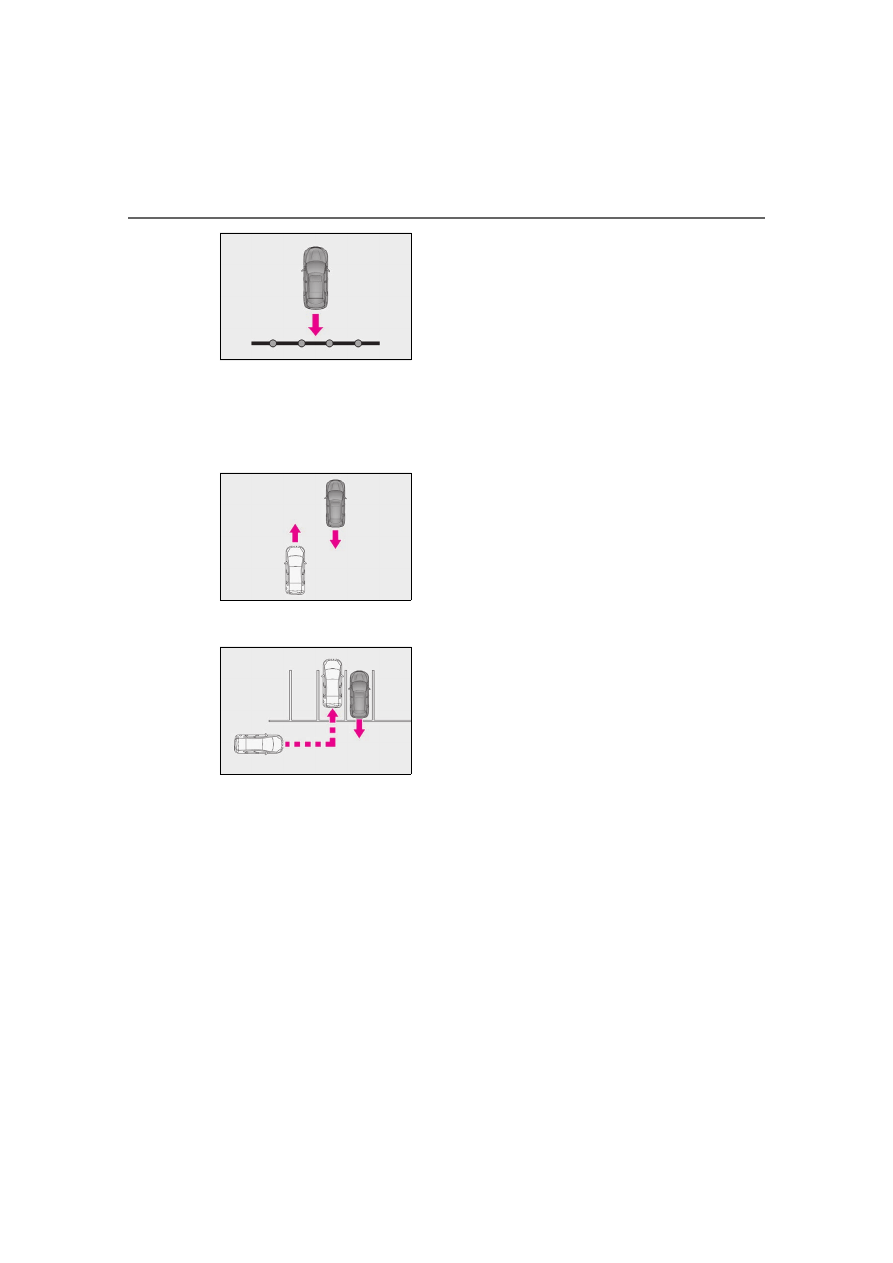
Parking Support Brake function 
(static objects) (if equipped)

Ultrasonic sensors are used to detect 
static objects, such as a wall, in the 
detection area when driving at a low 
speed or backing up. (

P.257)

Parking Support Brake function 
(rear-crossing vehicles) (if 
equipped)

Rear radar sensors are used to detect 
approaching vehicles in the detection 
area behind the vehicle when backing 
up. (

P.260)

PKSB (Parking Support 
Brake)

*

The Parking Support Brake system 
consists of the following functions 
that operate when driving at a low 
speed or backing up, such as when 
parking. When the system deter-
mines that the possibility of a colli-
sion with a detected object is high, a 
warning operates to urge the driver 
to take evasive action. If the system 
determines that the possibility of a 
collision with a detected object is 
extremely high, the brakes are 
automatically applied to help avoid 
the collision or help reduce the 
impact of the collision.

PKSB (Parking Support Brake) 
system

WARNING

Cautions regarding the use of the sys-

tem

Do not overly rely on the system, as 

doing so may lead to an accident.

The driver is solely responsible for safe 

driving. Always drive carefully, taking 

care to observe your surroundings. 

The Parking Support Brake system is 

designed to provide support to lessen 

the severity of collisions. However, it 

may not operate in some situations.

The Parking Support Brake system is 

not designed to stop the vehicle com-

pletely. Additionally, even if the system 

has stopped the vehicle, it is necessary 

to depress the brake pedal immedi-

ately as brake control will be canceled 

after approximately 2 seconds.

It is extremely dangerous to check the 

system operations by intentionally 

driving the vehicle into the direction of 

a wall, etc. Never attempt such actions.

When to disable the Parking Support 

Brake

In the following situations, disable the 

Parking Support Brake as the system 

may operate even though there is no 

possibility of a collision.

When inspecting the vehicle using a 

chassis roller, chassis dynamo or free 

roller

When loading the vehicle onto a boat, 

truck or other transport vessel

If the suspension has been modified or 

tires of a size other than specified are 

installed

If the front of the vehicle is raised or 

lowered due to the carried load

When equipment that may obstruct a 

sensor is installed, such as a towing 

eyelet, bumper protector (an addi-

tional trim strip, etc.), bicycle carrier, or 

snow plow

252

4-5. Using the driving support systems

The Parking Support Brake can be 
enabled/disabled on the multi-informa-
tion display. All of the Parking Support 
Brake functions (static objects and 
rear-crossing vehicles) are 
enabled/disabled simultaneously.
Use the meter control switches to 

enable/disable the parking support 
brake. (

P.80)

1

Press 

 or 

 to select 

.

2

Press 

 or 

 to select 


and then press 

.

When the Parking Support Brake is dis-

abled, the PKSB OFF indicator (

P.70

illuminates on the multi-information dis-

play.
To re-enable the system when it was dis-
abled, select 

 on the multi-information 

display, select 

 and turn it on. If the 

system is disabled, it will remain off even if 

the engine switch is turned to IGNITION 

ON mode after the engine switch has 

been turned off.

If the engine output restriction control or 
brake control operates, a buzzer will sound 
and a message will be displayed on the 
Center Display and multi-information dis-
play, to alert the driver. On vehicles with a 
head-up display, the head-up display (if 
equipped) will display the same message 
as the multi-information display.
Depending on the situation, engine output 
restriction control will operate to either 
limit acceleration or restrict output as 
much as possible.

Engine output restriction control is 
operating (acceleration restriction)

Acceleration greater than a certain 
amount is restricted by the system.
Center Display (Panoramic view monitor) 
(If equipped): No warning displayed
Multi-information display: “Object 
Detected Acceleration Reduced”

WARNING

When using automatic car washing 

devices

If the vehicle cannot be driven in a sta-

ble manner, such as when the vehicle 

has been in an accident or is malfunc-

tioning

When the vehicle is driven in a sporty 

manner or off-road

When the tires are not properly 

inflated

When the tires are very worn

When a tire chains, compact spare tire 

or an emergency tire puncture repair 

kit is used

NOTICE

If “Parking Support Brake Unavail-

able” is displayed on the multi-infor-

mation display and the PKSB OFF 

indicator is flashing

If this message is displayed immediately 

after the engine switch is changed to 

IGNITION ON mode, operate the vehi-

cle carefully, paying attention to your sur-

roundings. It may be necessary to drive 

the vehicle for a certain amount of time 

before the system returns to normal. (If 

the system is not return to normal after 

driving for a while, clean the sensors and 

their surrounding area on the bumpers.)

Enabling/Disabling the Parking 
Support Brake

Displays and buzzers for engine 
output restriction control and 
brake control

253

4-5. Using the driving support systems

4

Driving

PKSB OFF indicator: Not illuminated
Buzzer: Does not sound

Engine output restriction control is 
operating (output restricted as 
much as possible)

The system has determined that stron-
ger-than-normal brake operation is neces-
sary.
Center Display (Panoramic view monitor) 
(If equipped): “BRAKE!”
Multi-information display: “BRAKE!”
PKSB OFF indicator: Not illuminated
Buzzer: Short beep

Brake control is operating

The system determined that emergency 
braking is necessary.

Center Display (Panoramic view monitor) 
(If equipped): “BRAKE!”
Multi-information display: “BRAKE!”
PKSB OFF indicator: Not illuminated
Buzzer: Short beep

Vehicle stopped by system opera-
tion

The vehicle has been stopped by brake 
control operation.
Center Display (Panoramic view monitor) 
(If equipped): “Press Brake Pedal”
Multi-information display: “Switch to 
Brake” (If the accelerator pedal is not 
depressed, “Press Brake Pedal” will be dis-
played.)
PKSB OFF indicator: Illuminated
Buzzer: Short beep

If the Parking Support Brake determines that a collision with a detected object is 
possible, the engine output will be restricted to restrain any increase in the vehicle 
speed. (Engine output restriction control: See figure 2.)
Additionally, if the accelerator pedal continues to be depressed, the brakes will be 
applied automatically to reduce the vehicle speed. (Brake control: See figure 3.)

Figure 1 When the PKSB (Parking Support Brake) is disabled

System overview

254

4-5. Using the driving support systems

Engine output
Braking force
Time

Figure 2 When engine output restriction control operates

Engine output
Braking force
Time
Engine output restriction control begins operating
System determines that possibility of collision with detected object is high
Engine output reduced
Example: Multi-information display: “BRAKE!”

Figure 3 When brake control operates

A
B
C

A
B
C
D

E
F

G

255

4-5. Using the driving support systems

4

Driving

Engine output
Braking force
Time
Engine output restriction control begins operating
System determines that possibility of collision with detected object is high
Engine output reduced
System determines that possibility of collision with detected object is extremely 
high
Brake control begins operating
Brake control strength increased
Example: Multi-information display: “BRAKE!”
Example: Multi-information display: “Switch to Brake”

If the Parking Support Brake has oper-

ated

If the vehicle is stopped due to operation of 

the Parking Support Brake, the Parking 

Support Brake will be disabled and the 

PKSB OFF indicator will illuminate. If the 

Parking Support Brake operates unneces-

sarily, brake control can be canceled by 

depressing the brake pedal or waiting for 

approximately 2 seconds for it to automati-

cally be canceled. Then, the vehicle can be 

operated by depressing the accelerator 

pedal.

Re-enabling the Parking Support Brake

To re-enable the Parking Support Brake 

when it has been disabled due to system 

operation perform any of the following 

operations.
At this time, the PKSB OFF indicator will 

turn off. (

P.72)

Turn the PKSB (Parking Support Brake) 

on (

P.252)

The shift lever is in P.

Drive with no operation targets in the 

traveling direction of the vehicle

Change the traveling direction of the 

vehicle

A
B
C
D

E
F

G

H

I

J

K

256

4-5. Using the driving support systems

If “Parking Support Brake Unavailable” 

is displayed on the multi-information 

display and the PKSB OFF indicator is 

flashing

If this message is displayed only when the 

shift lever is in any position other than R, a 

sensor on the front or rear bumper may be 

dirty. Clean the sensors and their surround-

ing area on the bumpers.

If “Parking Assist Unavailable” and 

“Parking Assist Unavailable Clean 

Parking Assist Sensor” are displayed on 

the multi-information display and the 

PKSB OFF indicator is flashing

A sensor may be covered with ice, snow, 

dirt, etc. Remove the ice, snow, dirt, etc., 

from the sensor to return the system to 

normal.

If this message is shown even after 

removing dirt from the sensor, or shown 

when the sensor was not dirty to begin 

with, have the vehicle inspected by your 

Lexus dealer.

A sensor may be frozen. Once the ice 

melts, the system will return to normal.

Water may be continuously flowing over 

the sensor surface, such as in a heavy 

rain. When the system determines that it 

is normal, the system will return to nor-

mal.

If a battery terminal has been discon-

nected and reconnected

The system needs to be initialized. To initial-

ize the system, drive the vehicle straight 

ahead for 5 seconds or more at a speed of 

approximately 22 mph (35 km/h) or more. 

Additionally, for vehicles with the Parking 

Support Brake function, turn the steering 

wheel fully to the left and right with the vehi-

cle stopped.

257

4-5. Using the driving support systems

4

Driving

*

: If  equipped

This function will operate in situations such as the following if an object is detected 
in the traveling direction of the vehicle.

When traveling at a low speed and the brake pedal is not depressed, or is 
depressed late

Parking Support Brake function (static objects)

*

If the sensors detect a static object, such as a wall, in the travelling direction of 
the vehicle and the system determines that a collision may occur due to the 
vehicle suddenly moving forward due to an accidental accelerator pedal oper-
ation, the vehicle moving the unintended direction due to the wrong shift lever 
position, or while parking or traveling at low speeds, the system will operate to 
lessen the impact with the detected static object and reduce the resulting 
damage.

Examples of function operation

258

4-5. Using the driving support systems

When the accelerator pedal is depressed excessively

When the vehicle moves in the unintended direction due to the wrong shift 
lever position

P.238

The Parking Support Brake function 

(static object) will operate when

The function will operate when the PKSB 

OFF indicator is not illuminated or flashing 

Types of sensors

WARNING

To ensure the system can operate 

properly

P.239

If the Parking Support Brake function 

(static objects) operates unnecessar-

ily, such as at a railroad crossing

P.239

Notes when washing the vehicle

P.240

259

4-5. Using the driving support systems

4

Driving

(

P.71, 72) and all of the following condi-

tions are met:

Engine output restriction control

• The Parking Support Brake is enabled.

• The vehicle speed is approximately 9 

mph (15 km/h) or less.

• There is a static object in the traveling 

direction of the vehicle and approxi-

mately 6 to 13 ft. (2 to 4 m) away.

• The Parking Support Brake determines 

that a stronger-than-normal brake opera-

tion is necessary to avoid a collision.

Brake control

• Engine output restriction control is oper-

ating.

• The Parking Support Brake determines 

that an immediate brake operation is nec-

essary to avoid a collision.

The Parking Support Brake function 

(static objects) will stop operating when

The function will stop operating if any of the 

following conditions are met:

Engine output restriction control

• The Parking Support Brake is disabled.

• The system determines that the collision 

has become avoidable with normal brake 

operation.

• The static object is no longer approxi-

mately 6 to 13 ft. (2 to 4 m) away from the 

vehicle or in the traveling direction of the 

vehicle.

Brake control

• The Parking Support Brake is disabled.

• Approximately 2 seconds have elapsed 

since the vehicle was stopped by brake 

control.

• The brake pedal is depressed after the 

vehicle is stopped by brake control.

• The static object is no longer approxi-

mately 6 to 13 ft. (2 to 4 m) away from the 

vehicle or in the traveling direction of the 

vehicle.

Detection range of the Parking Support 

Brake function (static objects)

The detection range of the Parking Support 

Brake function (static objects) differs from 

the detection range of the intuitive parking 

assist. (

P.242) Therefore, even if the intui-

tive parking assist detects an object and 

provides a warning, the Parking Support 

Brake function (static objects) may not start 

operating.

Situations in which the system may not 

operate properly

P.241

Situations in which the system may 

operate even if there is no possibility of a 

collision

P.241

260

4-5. Using the driving support systems

*

: If equipped

This function will operate in situations such as the following if a vehicle is detected 
in the traveling direction of the vehicle.

When reversing, a vehicle is approaching and the brake pedal is not 
depressed, or is depressed late

P.232

The Parking Support Brake function 

(rear-crossing vehicles) will operate 

when

The function will operate when the PKSB 

OFF indicator is not illuminated or flashing 

(

P.71, 72) and all of the following condi-

tions are met:

Engine output restriction control

• The Parking Support Brake is enabled.

• The vehicle speed is approximately 9 

mph (15 km/h) or less.

• Vehicles which are approaching from the 

right or left at the rear of the vehicle at a 

traveling speed of approximately 5 mph 

Parking Support Brake function (rear-crossing vehicles)

*

If a rear radar sensor detects a vehicle approaching from the right or left at the 
rear of the vehicle and the system determines that the possibility of a collision 
is high, this function will perform brake control to reduce the likelihood of an 
impact with the approaching vehicle.

Examples of function operation

Types of sensors

WARNING

To ensure the system can operate 

properly

P.232

261

4-5. Using the driving support systems

4

Driving

(8 km/h) or more.

• The shift lever is in R.

• The Parking Support Brake determines 

that a stronger than normal brake opera-

tion is necessary to avoid a collision with 

an approaching vehicle.

Brake control

• Engine output restriction control is oper-

ating.

• The Parking Support Brake determines 

that an emergency brake operation is 

necessary to avoid a collision with an 

approaching vehicle.

The Parking Support Brake function 

(rear-crossing vehicles) will stop operat-

ing when

The function will stop operating if any of the 

following conditions are met:

Engine output restriction control

• The Parking Support Brake is disabled.

• The collision becomes avoidable with 

normal brake operation.

• A vehicle is no longer approaching from 

the right or left at the rear of the vehicle.

Brake control

• The Parking Support Brake is disabled.

• Approximately 2 seconds have elapsed 

since the vehicle was stopped by brake 

control.

• The brake pedal is depressed after the 

vehicle is stopped by brake control.

• A vehicle is no longer approaching from 

the right or left at the rear of the vehicle.

Detection area of the Parking Support 

Brake function (rear-crossing vehicles)

The detection area of the Parking Support 

Brake function (rear-crossing vehicles) dif-

fers from the detection area of the RCTA 

function (

P.247). Therefore, even if the 

RCTA function detects a vehicle and pro-

vides an alert, the Parking Support Brake 

function (rear-crossing vehicles) may not 

start operating.

Situations in which the system may not 

operate properly

P.248

Situations in which the system may 

operate even if there is no possibility of a 

collision

P.249

262

4-5. Using the driving support systems

Except F SPORT models

1

Normal mode

Provides an optimal balance of fuel econ-
omy, quietness, and dynamic performance. 
Suitable for city driving.
Press the switch to change the driving 
mode to normal mode when Eco drive 
mode or sport mode is selected.

2

Eco drive mode

Helps the driver accelerate in an 
eco-friendly manner and improve fuel 
economy through moderate throttle char-
acteristics and by controlling the operation 
of the air conditioning system (heat-
ing/cooling).
When not in Eco drive mode, if the driving 

mode select switch is turned to the left, the 
Eco drive mode indicator will come on.

3

Sport mode

Controls the transmission and engine to 
provide quick, powerful acceleration. This 
mode also changes the steering feel, mak-
ing it suitable for when agile driving 
response is desired, such as when driving 
on roads with many curves.
When not in sport mode, if the driving 
mode select switch is turned to the right, 
the “Sport” indicator will comes on.

F SPORT models (vehicles with 
Adaptive Variable Suspension Sys-
tem)

1

Normal mode/Custom mode

Normal mode and custom mode are 
selected by pressing the driving mode 
select switch. Each time the switch is 
pressed, the driving mode changes 
between normal mode and custom mode. 
When custom mode is selected, the “Cus-
tom” indicator will be illuminated.
When Eco drive mode or sport mode is 

Driving mode select switch

The driving modes can be selected 
to suit driving conditions.

Selecting a drive mode

263

4-5. Using the driving support systems

4

Driving

selected, pressing the switch changes the 
driving mode to normal mode.
• Normal  mode
Provides an optimal balance of fuel econ-
omy, quietness, and dynamic performance. 
Suitable for city driving.
• Custom  mode
Allows you to drive with the following func-
tions set to your preferred settings. Cus-
tom mode settings can only be changed on 
the drive mode customization display of 
the Center Display. (

P.280)

2

Eco drive mode

Helps the driver accelerate in an 
eco-friendly manner and improve fuel 
economy through moderate throttle char-
acteristics and by controlling the operation 
of the air conditioning system (heat-
ing/cooling).
When not in Eco drive mode, if the driving 
mode select switch is turned to the left, the 
Eco drive mode indicator will come on.

3

Sport mode

• Sport  S  mode
Controls the transmission and engine to 
provide quick, powerful acceleration. This 
mode is suitable for when agile driving 
response is desired, such as when driving 
on roads with many curves.
When not in Sport S mode, if the driving 

mode select switch is turned to the right, 
the “Sport S” indicator will come on.
• Sport  S+  mode
Helps to ensure steering performance and 
driving stability by simultaneously con-
trolling the steering and suspension in 
addition to the transmission and engine. 
Suitable for sportier driving.
When in Sport S mode, if the driving mode 
select switch is turned to the right, the 
“Sport S+” indicator will come on.

F SPORT models (vehicles without 
Adaptive Variable Suspension Sys-
tem)

1

Normal mode

Provides an optimal balance of fuel econ-
omy, quietness, and dynamic performance. 
Suitable for city driving.
Press the switch to change the driving 
mode to normal mode when Eco drive 
mode or sport mode is selected.

2

Eco drive mode

Helps the driver accelerate in an 
eco-friendly manner and improve fuel 

Function

Setting

Powertrain

Normal

Power

Eco

Chassis

Normal

Sport

Air conditioning sys-
tem

Normal

Eco

264

4-5. Using the driving support systems

economy through moderate throttle char-
acteristics and by controlling the operation 
of the air conditioning system (heat-
ing/cooling).
When not in Eco drive mode, if the driving 
mode select switch is turned to the left, the 
Eco drive mode indicator will come on.

3

Sport mode

Controls the transmission and engine to 
provide quick, powerful acceleration. This 
mode also changes the steering feel, mak-
ing it suitable for when agile driving 
response is desired, such as when driving 
on roads with many curves.
When not in sport mode, if the driving 
mode select switch is turned to the right, 
the “Sport” indicator will comes on.

Operation of the air conditioning sys-

tem in Eco drive mode

Eco drive mode controls the heating/cool-

ing operations and fan speed of the air con-

ditioning system to enhance fuel efficiency. 

To improve air conditioning performance, 

adjust the fan speed or turn off Eco drive 

mode.

Automatic deactivation of sport mode 

and custom mode

If the engine switch is turned off after driv-

ing in sport mode or custom mode, the 

drive mode will be changed to normal 

mode.

Driving mode pop-up display (12.3-inch 

display only)

When the driving mode is changed, the 

selected driving mode will be temporarily 

displayed on the side display. (

P.280)

Press the switch.
The torque of the engine is distributed 
to the rear wheels to the maximum 
extent possible in accordance with 
driving conditions.
Pressing the switch again cancels 
all-wheel drive lock mode and returns 
the Dynamic Torque Control AWD 
system to normal mode. (

P.266)

All-wheel drive lock mode can be oper-

ated when

The engine switch is in IGNITION ON 

mode.

Automatic release for the all-wheel 

drive lock mode

All-wheel drive lock mode is canceled 

when the brakes are applied to ensure 

the ABS and VSC systems operate effec-

tively.

All-wheel drive lock switch 
(AWD models)

All-wheel drive lock mode can be 
used when a large amount of drive 
power needs to be applied to all the 
wheels, such as when the vehicle 
gets stuck in mud and you need to 
free it.

Using All-wheel drive lock mode

265

4-5. Using the driving support systems

4

Driving

All-wheel drive lock mode is canceled 

when the vehicle speed exceeds 25 mph 

(40 km/h).

ABS (Anti-lock Brake System)

Helps to prevent wheel lock when the 
brakes are applied suddenly, or if the 
brakes are applied while driving on a 
slippery road surface

Brake assist

Generates an increased level of brak-
ing force after the brake pedal is 
depressed when the system detects a 
panic stop situation

VSC (Vehicle Stability Control)

Helps the driver to control skidding 
when swerving suddenly or turning on 
slippery road surfaces

Enhanced VSC (Enhanced Vehi-
cle Stability Control)

Provides cooperative control of the 
ABS, TRAC, VSC and EPS.
Helps to maintain directional stability 
when swerving on slippery road sur-
faces by controlling steering perfor-
mance.

Driving assist systems

To keep driving safety and perfor-
mance, the following systems oper-
ate automatically in response to 
various driving situations. Be aware, 
however, that these systems are 
supplementary and should not be 
relied upon too heavily when oper-
ating the vehicle.

Summary of the driving assist 
systems


Content      ..     13      14      15      16     ..