Lexus ES (2022 year). Manual in english - page 15
 

  Index      Manuals     Lexus ES (2022 year). Manual in english


Search            copyright infringement  


Content      ..     13      14      15      16     ..


Lexus ES (2022 year). Manual in english - page 15


259

4

4-5. Using the driving support systems

Dr

ivin
g

Q

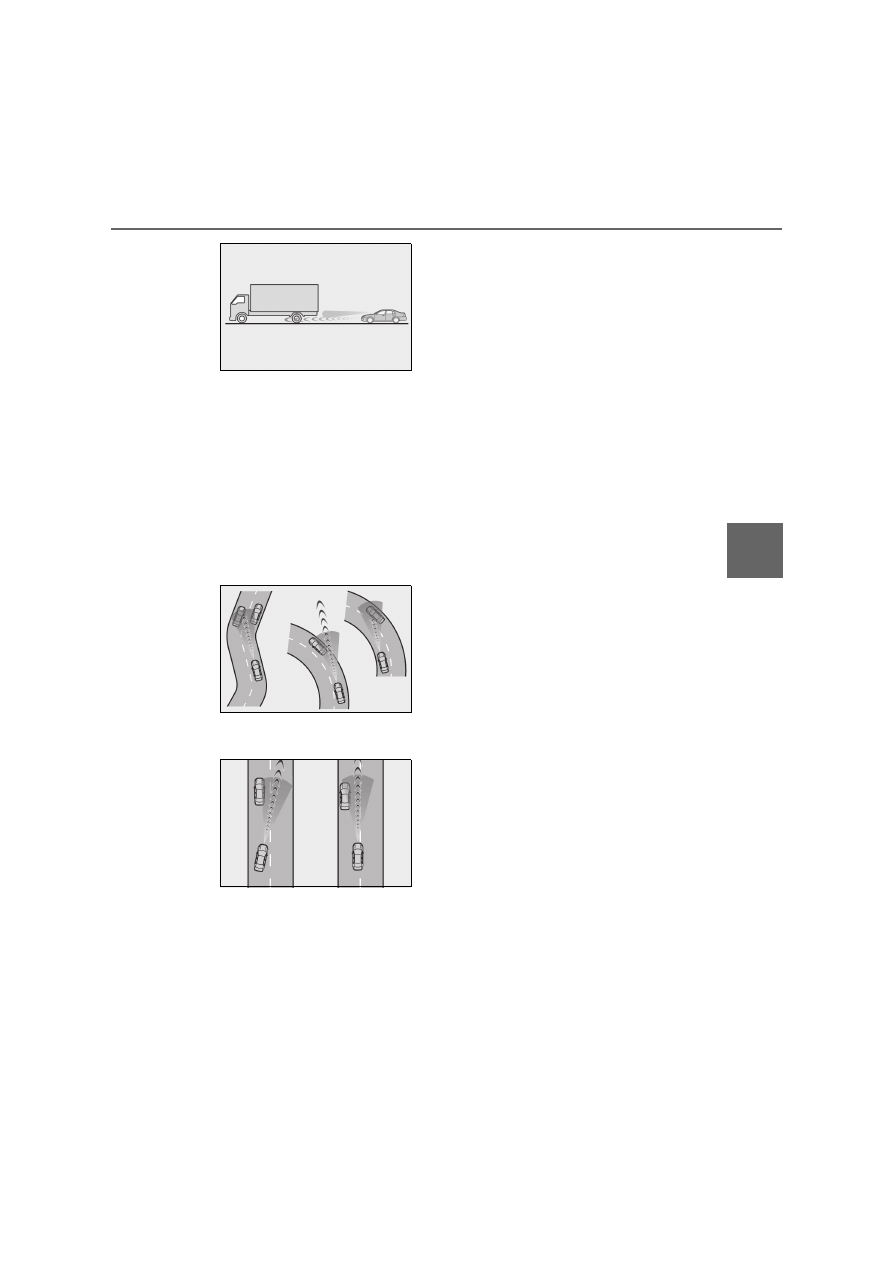
Conditions under which the vehicle-to-

vehicle distance control mode may not 

function correctly

In the case of the following conditions, 

operate the brake pedal (or accelerator 

pedal, depending on the situation) as nec-

essary.
As the sensor may not be able to correctly 

detect vehicles ahead, the system may not 

operate properly.

O

When the road curves or when the lanes 

are narrow

O

When steering wheel operation or your 

position in the lane is unstable

O

When the vehicle ahead of you deceler-

ates suddenly

O

When driving on a road surrounded by a 

structure, such as in a tunnel or on a 

bridge

O

While the vehicle speed is decreasing to 

the set speed after the vehicle acceler-

ates by depressing the accelerator pedal

Q

Situations in which the curve speed 

reduction function may not operate 

properly

In situations such as the following, the curve 

speed reduction function may not operate 

properly:

O

When the vehicle is being driven around 

a curve on an incline/decline

O

When the course of the vehicle differs 

from the shape of the curve

O

When the vehicle speed is excessively 

high when entering a curve

O

When the steering wheel is suddenly 

operated

260

4-5. Using the driving support systems

*

: If equipped

Q

Meter display

Set speed

Indicators

Q

Operation switches

“+RES” switch

Cruise control main switch

“-SET” switch

Cancel switch

1

Press the cruise control main 
switch to activate the cruise con-
trol.

Cruise control indicator will come on.

Press the switch again to deactivate the 

cruise control.

2

Accelerate or decelerate the vehi-
cle to the desired speed, and press 
the “-SET” switch to set the speed.

Cruise control “SET” indicator will come 

on.

The vehicle speed at the moment the 

switch is released becomes the set speed.

To change the set speed, press the 
“+RES” or “-SET” switch until the 
desired set speed is obtained.

Cruise control

*

Use the cruise control to maintain a 
set speed without depressing the 
accelerator pedal.

System components

A
B

A
B
C
D

Setting the vehicle speed

Adjusting the set speed

261

4

4-5. Using the driving support systems

Dr

ivin
g

1

Increases the speed

2

Decreases the speed

Fine adjustment: Press the switch.
Large adjustment: Press and hold the 
switch to change the speed, and release 
when the desired speed is reached.
The set speed will be increased or 
decreased as follows:
Fine adjustment: By approximately 1 km/h 
(0.6 mph)

*1

 or 1 mph (1.6 km/h)

*2

 each 

time the switch is pressed.
Large adjustment: The set speed can be 
increased or decreased continually until 
the switch is released.

*1

: When the set speed is shown in “km/h”

*2

: When the set speed is shown in “MPH”

1

Pressing the cancel switch cancels 
the constant speed control.

The speed setting is also canceled when 
the brakes are applied.

2

Pressing the “+RES” switch 
resumes the constant speed con-
trol.

Resuming is available when the vehicle 
speed is more than approximately 30 
km/h (20 mph).

Q

Cruise control can be set when

O

The shift lever is in D or range 4 or higher 

of S has been selected.

O

Range 4 or higher of D has been selected 

by using the paddle shift switch.

O

Vehicle speed is at or above approxi-

mately 30 km/h (20 mph).

Q

Accelerating after setting the vehicle 

speed

O

The vehicle can be accelerated normally. 

After acceleration, the set speed 

resumes.

O

Even without canceling the cruise con-

trol, the set speed can be increased by 

first accelerating the vehicle to the 

desired speed and then pressing the “-

SET” switch to set the new speed.

Q

Automatic cruise control cancelation

Cruise control will stop maintaining the 

vehicle speed in any of the following situa-

tions.

O

Actual vehicle speed falls more than 

approximately 16 km/h (10 mph) below 

the preset vehicle speed.

O

Actual vehicle speed is below approxi-

mately 30 km/h (20 mph).

O

VSC is activated.

O

TRC is activated for a period of time.

O

When the VSC or TRC system is turned 

off.

Q

If the warning message for the cruise 

control is shown on the multi-informa-

tion display

Press the cruise control main switch once to 

Canceling and resuming the 
constant speed control

262

4-5. Using the driving support systems

deactivate the system, and then press the 

switch again to reactivate the system.

If the cruise control speed cannot be set or 

if the cruise control cancels immediately 

after being activated, there may be a mal-

function in the cruise control system. Have 

the vehicle inspected by any authorized 

Lexus retailer or Lexus authorized repairer, 

or any reliable repairer.

WARNING

Q

To avoid operating the cruise control 

by mistake

Switch the cruise control off using the 

cruise control main switch when not in 

use.

Q

Situations unsuitable for cruise con-

trol

Do not use cruise control in any of the 

following situations.

Doing so may result in loss of control and 

could cause an accident resulting in 

death or serious injury.

O

In heavy traffic

O

On roads with sharp bends

O

On winding roads

O

On slippery roads, such as those cov-

ered with rain, ice or snow

O

On steep downhills

Vehicle speed may exceed the set 

speed when driving down a steep hill.

O

During emergency towing

BSM (Blind Spot Monitor)

The Blind Spot Monitor is a system 
that uses rear side radar sensors 
installed on the inner side of the 
rear bumper on the left and right 
side to assist the driver in confirm-
ing safety when changing lanes.

WARNING

Q

Cautions regarding the use of the 

system

The driver is solely responsible for safe 

driving. Always drive safely, taking care 

to observe your surroundings.
The Blind Spot Monitor is a supplemen-

tary function which alerts the driver that a 

vehicle is in a blind spot of the outside 

rear view mirrors (if equipped) or Digital 

Side-view Monitor cameras (if 

equipped), or is approaching rapidly 

from behind into a blind spot. Do not 

overly rely on the Blind Spot Monitor. As 

the function cannot judge if it is safe to 

change lanes, over reliance could lead to 

an accident resulting in death or serious 

injury.
As the system may not function correctly 

under certain conditions, the driver’s 

own visual confirmation of safety is nec-

essary.

263

4

4-5. Using the driving support systems

Dr

ivin
g

Vehicles with outside rear view mir-
rors

Meter control switches

Turn the Blind Spot Monitor on/off.

Outside rear view mirror indicators

When a vehicle is detected in a blind spot 
of the outside rear view mirrors or 
approaching rapidly from behind into a 
blind spot, the outside rear view mirror 
indicator on the detected side will illumi-
nate. If the turn signal lever is operated 
toward the detected side, the outside rear 
view mirror indicator will flash.

BSM indicator

When the Blind Spot Monitor is turned on, 
the indicator comes on.

Vehicles with Digital Side-view 
Monitor

Meter control switches

Turn the Blind Spot Monitor on/off.

Digital Side-view Monitor indica-
tors

When a vehicle is detected in a blind spot 
of the Digital Side-view Monitor cameras 
or approaching rapidly from behind into a 
blind spot, the Digital Side-view Monitor 
indicator on the detected side will illumi-
nate.
If the turn signal lever is operated toward 
the detected side, the Digital Side-view 
Monitor indicator will flash.

BSM indicator

When the Blind Spot Monitor is turned on, 
the indicator comes on.

1

Press 

 or 

 of the meter con-

trol switches, select 

.

2

Press 

 or 

 of the meter con-

trol switches, select 

, and press 

“OK”.

Q

Outside rear view mirror indicator (if 

equipped) or Digital Side-view Monitor 

indicator (if equipped) visibility

In strong sunlight, the outside rear view mir-

ror indicator or Digital Side-view Monitor 

indicator may be difficult to see.

Q

When “Blind Spot Monitor Unavailable” 

is shown on the multi-information dis-

play

Ice, snow, mud, etc., may be attached to the 

rear bumper around the sensors. 

(

P.264) The system should return to nor-

mal operation after removing the ice, snow, 

mud, etc. from the rear bumper. Addition-

ally, the sensors may not operate normally 

when driving in extremely hot or cold envi-

System components

A

B

C

A

Turning the Blind Spot Monitor 
on/off

B

C

264

4-5. Using the driving support systems

ronments.

Q

Customization

Some functions can be customized. 

(

P.463)

WARNING

Q

To ensure the system can operate 

properly

Blind Spot Monitor sensors are installed 

behind the left and right sides of the rear 

bumper respectively. Observe the fol-

lowing to ensure the Blind Spot Monitor 

can operate correctly.

O

Keep the sensors and the surrounding 

areas on the rear bumper clean at all 

times.

If a sensor or its surrounding area on 

the rear bumper is dirty or covered 

with snow, the Blind Spot Monitor may 

not operate and a warning message 

(

P.263) will be displayed. In this sit-

uation, clear off the dirt or snow and 

drive the vehicle with the operation 

conditions of the BSM function 

(

P.266) satisfied for approximately 

10 minutes. If the warning message 

does not disappear, have the vehicle 

inspected by any authorized Lexus 

retailer or Lexus authorized repairer, 

or any reliable repairer.

O

Do not attach accessories, stickers 

(including transparent stickers), alumi-

num tape, etc. to a sensor or its sur-

rounding area on the rear bumper.

O

Do not subject a sensor or its sur-

rounding area on the rear bumper to a 

strong impact.

If a sensor is moved even slightly off 

position, the system may malfunction 

and vehicles may not be detected cor-

rectly.In the following situations, have 

your vehicle inspected by any autho-

rized Lexus retailer or Lexus autho-

rized repairer, or any reliable repairer.

• A sensor or its surrounding area is 

subject to a strong impact.

• If the surrounding area of a sensor is 

scratched or dented, or part of them 

has become disconnected.

O

Do not disassemble the sensor.

O

Do not modify the sensor or surround-

ing area on the rear bumper.

O

If a sensor or the rear bumper needs to 

be removed/installed or replaced, 

contact any authorized Lexus retailer 

or Lexus authorized repairer, or any 

reliable repairer.

O

Do not paint the rear bumper any 

color other than an official Lexus color.

265

4

4-5. Using the driving support systems

Dr

ivin
g

Q

Vehicles that can be detected by the Blind Spot Monitor

The Blind Spot Monitor uses rear side radar sensors to detect the following vehi-
cles traveling in adjacent lanes and advises the driver of the presence of such vehi-
cles via the indicators on the outside rear view mirrors (if equipped) or Digital Side-
view Monitor displays (if equipped).

Vehicles that are traveling in areas that are not visible using the outside rear 
view mirrors (if equipped) or Digital Side-view Monitor displays (if equipped) 
(the blind spots)

Vehicles that are approaching rapidly from behind in areas that are not visible 
using the outside rear view mirrors (if equipped) or Digital Side-view Monitor 
displays (if equipped) (the blind spots)

Q

The Blind Spot Monitor detection areas

The areas that vehicles can be detected in are outlined below.

The range of each detection area is:

Approximately 0.5 m (1.6 ft.) to 3.5 m (11.5 ft.) from either side of the vehicle

*1

Approximately 1 m (3.3 ft.) forward of the rear bumper

Approximately 3 m (9.8 ft.) from the rear bumper

Blind Spot Monitor operation

A

B

A
B
C

266

4-5. Using the driving support systems

Approximately 3 m (9.8 ft.) to 60 m (197 ft.) from the rear bumper

*2

*1

: The area between the side of the vehicle and 0.5 m (1.6 ft.) from the side of the vehicle 

cannot be detected.

*2

: The greater the difference in speed between your vehicle and the detected vehicle is, 

the farther away the vehicle will be detected, causing the outside rear view mirror indi-
cator to illuminate or flash.

Q

The Blind Spot Monitor is operational 

when

The Blind Spot Monitor is operational when 

all of the following conditions are met:

O

The Blind Spot Monitor is on.

O

The shift lever is in a position other than R.

O

The vehicle speed is greater than 

approximately 16 km/h (10 mph).

Q

The Blind Spot Monitor will detect a 

vehicle when

The Blind Spot Monitor will detect a vehicle 

present in the detection area in the follow-

ing situations:

O

A vehicle in an adjacent lane overtakes 

your vehicle.

O

You overtake a vehicle in adjacent lane 

slowly.

O

Another vehicle enters the detection 

area when it changes lanes.

Q

Conditions under which the system will 

not detect a vehicle

The Blind Spot Monitor is not designed to 

detect the following types of vehicles 

and/or objects:

O

Small motorcycles, bicycles, pedestrians, 
etc.

*

O

Vehicles traveling in the opposite direc-

tion

O

Guardrails, walls, signs, parked vehicles 
and similar stationary objects

*

O

Following vehicles that are in the same 
lane

*

O

Vehicles traveling 2 lanes away from 
your vehicle

*

O

Vehicles which are being overtaken rap-

idly by your vehicle

*

*

: Depending on the conditions, detection 

of a vehicle and/or object may occur.

Q

Conditions under which the system may 

not function correctly

O

The Blind Spot Monitor may not detect 

vehicles correctly in the following situa-

tions:

• When the sensor is misaligned due to a 

strong impact to the sensor or its sur-

rounding area

• When mud, snow, ice, a sticker, etc. is 

covering the sensor or surrounding area 

on the rear bumper

• When driving on a road surface that is 

wet with standing water during bad 

weather, such as heavy rain, snow, or fog

• When multiple vehicles are approaching 

with only a small gap between each vehi-

cle

• When the distance between your vehicle 

and a following vehicle is short

• When there is a significant difference in 

speed between your vehicle and the 

vehicle that enters the detection area

• When the difference in speed between 

your vehicle and another vehicle is 

changing

• When a vehicle enters a detection area 

traveling at about the same speed as your 

vehicle

• As your vehicle starts from a stop, a vehi-

cle remains in the detection area

• When driving up and down consecutive 

steep inclines, such as hills, dips in the 

road, etc.

• When driving on roads with sharp bends, 

consecutive curves, or uneven surfaces

• When vehicle lanes are wide, or when 

driving on the edge of a lane, and the 

vehicle in an adjacent lane is far away 

from your vehicle

D

267

4

4-5. Using the driving support systems

Dr

ivin
g

• When an accessory (such as a bicycle 

carrier) or towing eyelet is installed to the 

rear of the vehicle

• When there is a significant difference in 

height between your vehicle and the 

vehicle that enters the detection area

• Immediately after the Blind Spot Monitor 

is turned on

O

Instances of the Blind Spot Monitor 

unnecessarily detecting a vehicle and/or 

object may increase in the following situ-

ations:

• When the sensor is misaligned due to a 

strong impact to the sensor or its sur-

rounding area

• When the distance between your vehicle 

and a guardrail, wall, etc. that enters the 

detection area is short

• When driving up and down consecutive 

steep inclines, such as hills, dips in the 

road, etc.

• When vehicle lanes are narrow, or when 

driving on the edge of a lane, and a vehi-

cle traveling in a lane other than the adja-

cent lanes enters the detection area

• When driving on roads with sharp bends, 

consecutive curves, or uneven surfaces

• When the tires are slipping or spinning

• When the distance between your vehicle 

and a following vehicle is short

• When an accessory (such as a bicycle 

carrier) or towing eyelet is installed to the 

rear of the vehicle

Vehicles without Adaptive Variable 
Suspension system

1

Normal mode

Provides an optimal balance of fuel econ-
omy, quietness, and dynamic performance.
Suitable for city driving.
Press the switch to change to normal mode 
when not in normal mode.

2

Eco drive mode

Helps the driver accelerate in an eco-
friendly manner and improve fuel economy 
through moderate throttle characteristics 
and by controlling the operation of the air 
conditioning system (heating/cooling).
When not in Eco drive mode, if the Driving 
Mode Select switch is turned toward you, 
the Eco drive mode indicator comes on.

3

Sport mode

Controls the hybrid system to provide 

Driving Mode Select switch

The driving modes can be selected 
to suit driving condition.

Selecting the driving mode

268

4-5. Using the driving support systems

quick, powerful acceleration. This mode is 
suitable for when agile driving response is 
desired, such as when driving on roads 
with many curves.
When not in sport mode, if the Driving 
Mode Select switch is turned away from 
you, the Sport mode indicator comes on.

Vehicles with Adaptive Variable 
Suspension system

1

Normal mode/Custom mode

Normal mode and custom mode are 
selected by pressing the Driving Mode 
Select switch. Each time the switch is 
pressed, the driving mode changes 
between normal mode and custom mode. 
When custom mode is selected, the Cus-
tom mode indicator comes on.
Press the switch to change the normal 
mode when not in normal mode.
• Normal mode
Provides an optimal balance of fuel econ-
omy, quietness, and dynamic performance. 
Suitable for city driving.
• Custom mode
Allows you to drive with the power train, 
chassis and air conditioning system func-
tions set to your preferred settings.

Custom mode settings can only be 
changed on the drive mode customization 
display of Center Display. (

P.316)

2

Eco drive mode

Helps the driver accelerate in an eco-
friendly manner and improve fuel economy 
through moderate throttle characteristics 
and by controlling the operation of the air 
conditioning system (heating/cooling).
When not in Eco drive mode, if the Driving 
Mode Select switch is turned toward you, 
the Eco drive mode indicator comes on.

3

Sport mode

• Sport S mode
Controls the hybrid system to provide 
quick, powerful acceleration. This mode is 
suitable for when agile driving response is 
desired, such as when driving on roads 
with many curves.
When not in Sport S mode, if the Driving 
Mode Select switch is turned away from 
you, the Sport S mode indicator comes on.
• Sport S+ mode
Helps to ensure steering performance and 
driving stability by simultaneously con-
trolling the steering and suspension in 
addition to the transmission and engine. 
Suitable for sportier driving.
When in Sport S mode, if the Driving 
Mode Select switch is turned away from 
you, the Sport S+ mode indicator comes 
on.

Q

Operation of the air conditioning sys-

tem in Eco drive mode

Eco drive mode controls the heating/cool-

ing operations and fan speed of the air con-

ditioning system to enhance fuel efficiency. 

To improve air conditioning performance, 

perform the following operations:

O

Adjust the fan speed (

P.322, 324)

O

Turn off Eco drive mode

269

4

4-5. Using the driving support systems

Dr

ivin
g

Q

Auto Glide Control

O

While driving in Eco drive mode with D 

position selected, releasing the accelera-

tor pedal will activate Auto Glide Con-

trol under certain conditions. (Auto 

Glide Control may activate before the 

accelerator pedal is fully released.) 

When Auto Glide Control operates, the 

electric motor (traction motor) will be 

controlled, reducing the deceleration 

force and allowing the vehicle to coast, 

enhancing fuel economy.

When Auto Glide Control operates, the 

AGC indicator light will illuminate.

O

Auto Glide Control may not operate in 

the following situations:

• When not in Eco drive mode

• When the brake pedal is depressed

• When a shift position other than D is 

selected

• When the vehicle speed is approximately 

15 km/h (10 mph) or lower

• When the vehicle is accelerating on a 

downward slope

• When the PCS (Pre-Collision System) is 

operating (if equipped)

• When the dynamic radar cruise control 

with full-speed range (if equipped) or 

cruise control (if equipped) is operating

• When the PKSB (Parking Support 

Brake) system is operating

• When the TRC or VSC system is operat-

ing

• When the TRC or VSC system is dis-

abled by pressing the VSC OFF switch

Q

Automatic deactivation of sport mode 

and custom mode (if equipped)

If the power switch is turned off after driving 

in sport mode or custom mode, the drive 

mode will be changed to normal mode.

Q

Driving mode pop-up display (12.3-inch 

display model only)

When the driving mode is changed, the 

selected driving mode will be temporarily 

displayed on the side display. (

P.317)

Q

Customization (Vehicles with Adaptive 

Variable Suspension system)

Settings (e.g. custom mode) can be 

changed. (Customizable features: 

P.463)

270

4-5. Using the driving support systems

Q

Lexus parking assist-sensor

Ultrasonic sensors are used to detect 
static objects in the detection area 
when driving at a low speed or backing 
up. (

P.271)

Q

RCTA (Rear Crossing Traffic 
Alert) function

Radar sensors are used to detect 
approaching vehicles in the detection 
areas behind the vehicle when backing 
up. (

P.279)

Q

RCD (Rear Camera Detection) 
function (if equipped)

A rear camera sensor is used to detect 
pedestrians in the detection area 
behind the vehicle when backing up. 
(

P.285)

Q

Adjusting the buzzer volume

The buzzer volume can be adjusted on 
the multi-information display. The vol-
ume of buzzers for the Lexus parking 
assist-sensor, RCTA function and 
RCD function will be adjusted simulta-
neously.
Use the meter control switches to 
change settings. (

P.108)

1

Press 

 or 

 to select 

.

2

Press 

 or 

 to select “PKSA” 

and then press “OK”.

3

Press 

 or 

 to select 

 and 

then press “OK”.

Each time the switch is pressed, the vol-

ume level will change between 1, 2, and 3.

Q

Muting a buzzer temporarily

A mute button will be displayed on the 
multi-information display when an 
object or pedestrian is detected. To 
mute the buzzer, press “OK”. 
The buzzers for the Lexus parking 
assist-sensor, RCTA function and 
RCD function will be muted simultane-
ously.
Mute will be automatically canceled in 
the following situations:

When the shift lever is changed.

When there is a malfunction in a 
sensor or the system is temporarily 
unavailable.

When the function is disabled while 
it is operating.

PKSA (Parking Support 
Alert)

The Parking Support Alert system 
consists of the following functions 
that operate when driving at a low 
speed or backing up, such as when 
parking. When the system deter-
mines that the possibility of a colli-
sion with a detected object, such as 
a wall, or pedestrian is high, a warn-
ing operates to urge the driver to 
take evasive action.

PKSA (Parking Support Alert) 
system

Setting the buzzer volume

271

4

4-5. Using the driving support systems

Dr

ivin
g

When the power switch is turned 
off.

Q

Types of sensors

Front corner sensors

Front center sensors

Rear corner sensors

Rear center sensors

Q

Display

When the sensors detect an object, 
such as a wall, a graphic is shown on 
the multi-information display, head-up 
display (if equipped) and Center Dis-
play depending on the position and dis-
tance to the object.

Lexus parking assist-sensor

The distance from your vehicle to 
objects, such as a wall, when paral-
lel parking or maneuvering into a 
garage is measured by the sensors 
and communicated via the multi-
information display, head-up dis-
play (if equipped), Center Display 
and a buzzer. Always check the sur-
rounding area when using this sys-
tem.

System components

A
B
C
D

272

4-5. Using the driving support systems

Multi-information display and head-
up display (if equipped)

Front corner sensor detection

Front center sensor detection

Rear corner sensor detection

Rear center sensor detection

Center Display

A graphic is shown when the Lexus park-
ing assist monitor (if equipped) is dis-
played.
A simplified image is displayed on the 
Center Display when an object is detected.
• When the shift lever is in R

• When the shift lever is in N, S or D (vehi-

cle moving forward)

When an object is detected, a graphic will 
be displayed on the panoramic view moni-
tor (if equipped).

Use the meter control switches to 
enable/disable the Lexus parking 
assist-sensor. (

P.108)

1

Press 

 or 

 to select 

.

2

Press 

 or 

 to select “PKSA” 

and then press “OK”.

3

Press 

 or 

 to select 

 and 

then press “OK”.

When the Lexus parking assist-sensor 
function is disabled, the Lexus parking 
assist-sensor OFF indicator (

P.92) 

illuminates on the multi-information 
display.

A
B
C
D

Turning Lexus parking assist-
sensor on/off

273

4

4-5. Using the driving support systems

Dr

ivin
g

To re-enable the system, select 

 on 

the multi-information display, select 

 and turn it on. If the system is dis-

abled, it will remain off even if the 
power switch is turned to ON mode 
after the power switch has been turned 
off.

Q

The system can be operated when

O

The power switch is in ON mode.

O

Lexus parking assist-sensor function is 

on.

O

The vehicle speed is less than about 10 

km/h (6 mph).

O

A shift position other than P is selected.

Q

Setting the buzzer volume

The buzzer volume can be adjusted on the 

multi-information display. (

P.270)

Q

If “Parking Assist Unavailable Clean 

Parking Assist Sensor” is displayed on 

the multi-information display

A sensor may be covered with ice, snow, 

dirt, etc. Remove the ice, snow, dirt, etc., 

from the sensor to return the system to nor-

mal.
Also, due to ice forming on a sensor at low 

temperatures, a warning message may be 

WARNING

Q

Cautions regarding the use of the 

system

There is a limit to the degree of recogni-

tion accuracy and control performance 

that this system can provide, do not 

overly rely on this system. The driver is 

always responsible for paying attention 

to the vehicle’s surroundings and driving 

safely.

Q

To ensure the system can operate 

properly

Observe the following precautions. 

Failing to do so may result in the vehicle 

being unable to be driven safely and pos-

sibly cause an accident.

O

Do not damage the sensors, and 

always keep them clean.

O

Do not attach a sticker or install an 

electronic component, such as a 

backlit license plate (especially fluo-

rescent type), fog lights, fender pole or 

wireless antenna near a radar sensor.

O

Do not subject the surrounding area of 

the sensor to a strong impact. If sub-

jected to an impact, have the vehicle 

inspected by any authorized Lexus 

retailer or Lexus authorized repairer, 

or any reliable repairer. If the front or 

rear bumper needs to be 

removed/installed or replaced, con-

tact any authorized Lexus retailer or 

Lexus authorized repairer, or any reli-

able repairer.

O

Do not modify, disassemble or paint 

the sensors.

O

Do not attach a license plate cover.

O

Keep your tires properly inflated.

Q

When to disable the function

In the following situations, disable the 

function as it may operate even though 

there is no possibility of a collision.

O

Failing to observe the warnings above.

O

A non-genuine Lexus suspension 

(lowered suspension, etc.) is installed.

Q

Notes when washing the vehicle

Do not apply intensive bursts of water or 

steam to the sensor area. Doing so may 

result in the sensor malfunctioning.

O

When using a high pressure washer to 

wash the vehicle, do not spray the sen-

sors directly, as doing so may cause a 

sensor to malfunction.

O

When using steam to clean the vehi-

cle, do not direct steam too close to 

the sensors as doing so may cause a 

sensor to malfunction.

274

4-5. Using the driving support systems

displayed or the sensor may not be able to 

detect an object. Once the ice melts, the 

system will return to normal.

Q

If “Parking Assist Unavailable” is dis-

played on the multi-information display

O

Water may be continuously flowing over 

the sensor surface, such as in a heavy 

rain. When the system determines that it 

is normal, the system will return to nor-

mal.

O

Initialization may not have been per-

formed after a 12-volt battery terminal 

was disconnected and reconnected. Ini-

tialize the system. (

P.274)

If this message continues to be displayed 

even after initialization, have the vehicle 

inspected by any authorized Lexus 

retailer or Lexus authorized repairer, or 

any reliable repairer.

Q

If a 12-volt battery terminal has been 

disconnected and reconnected

The system needs to be initialized. To initial-

ize the system, drive the vehicle straight 

ahead for 5 seconds or more at a speed of 

approximately 35 km/h (22 mph) or more.
Additionally, for vehicles with the Parking 

Support Brake function, turn the steering 

wheel fully to the left and right with the vehi-

cle stopped.

Q

Sensor detection information

O

The sensor’s detection areas are limited 

to the areas around the vehicle’s front 

and rear bumpers.

O

The following situations may occur 

during use.

• Depending on the shape of the object 

and other factors, the detection distance 

may shorten, or detection may be impos-

sible.

• There will be a short delay between 

object detection and display. Even at low 

speeds, there is a possibility that the 

object will come within the sensor’s 

detection areas before the display is 

shown and the warning beep sounds.

• It might be difficult to hear the buzzer due 

to the volume of the audio system or air 

flow noise of the air conditioning system.

• It may be difficult to hear the buzzer if 

buzzers for other systems are sounding.

Q

Objects which the system may not prop-

erly detect

The shape of the object may prevent the 

sensor from detecting it. Pay particular 

attention to the following objects:

O

Wires, fences, ropes, etc.

O

Cotton, snow and other materials that 

absorb sound waves

O

Sharply-angled objects

O

Low objects

O

Tall objects with upper sections project-

ing outwards in the direction of your vehi-

cle

People may not be detected if they are 

wearing certain types of clothing.

Q

Situations in which the system may not 

operate properly

Certain vehicle conditions and the sur-

rounding environment may affect the ability 

of a sensor to correctly detect objects. Par-

ticular instances where this may occur are 

listed below.

O

There is dirt, snow or ice on a sensor. 

(Cleaning the sensors will resolve this 

problem.)

O

A sensor is frozen. (Thawing the area will 

resolve this problem.)

In especially cold weather, if a sensor is 

frozen the sensor display may be dis-

played abnormally, or objects, such as a 

wall, may not be detected.

O

When a sensor or the area around a sen-

sor is extremely hot or cold.

O

On an extremely bumpy road, on an 

incline, on gravel, or on grass.

O

When vehicle horns, vehicle detectors, 


Content      ..     13      14      15      16     ..