Lexus GS350 (2020 year). Manual in english - page 18
 

  Index      Manuals     Lexus GS350 (2020 year). Manual in english


Search            copyright infringement  


Content      ..     16      17      18      19     ..


Lexus GS350 (2020 year). Manual in english - page 18


290

4-5. Using the driving support systems

The Blind Spot Monitor function uses radar sensors to detect vehicles that are
traveling in an adjacent lane in the area that is not reflected in the outside rear
view mirror (the blind spot), and advises the driver of the vehicle’s existence via
the outside rear view mirror indicator.

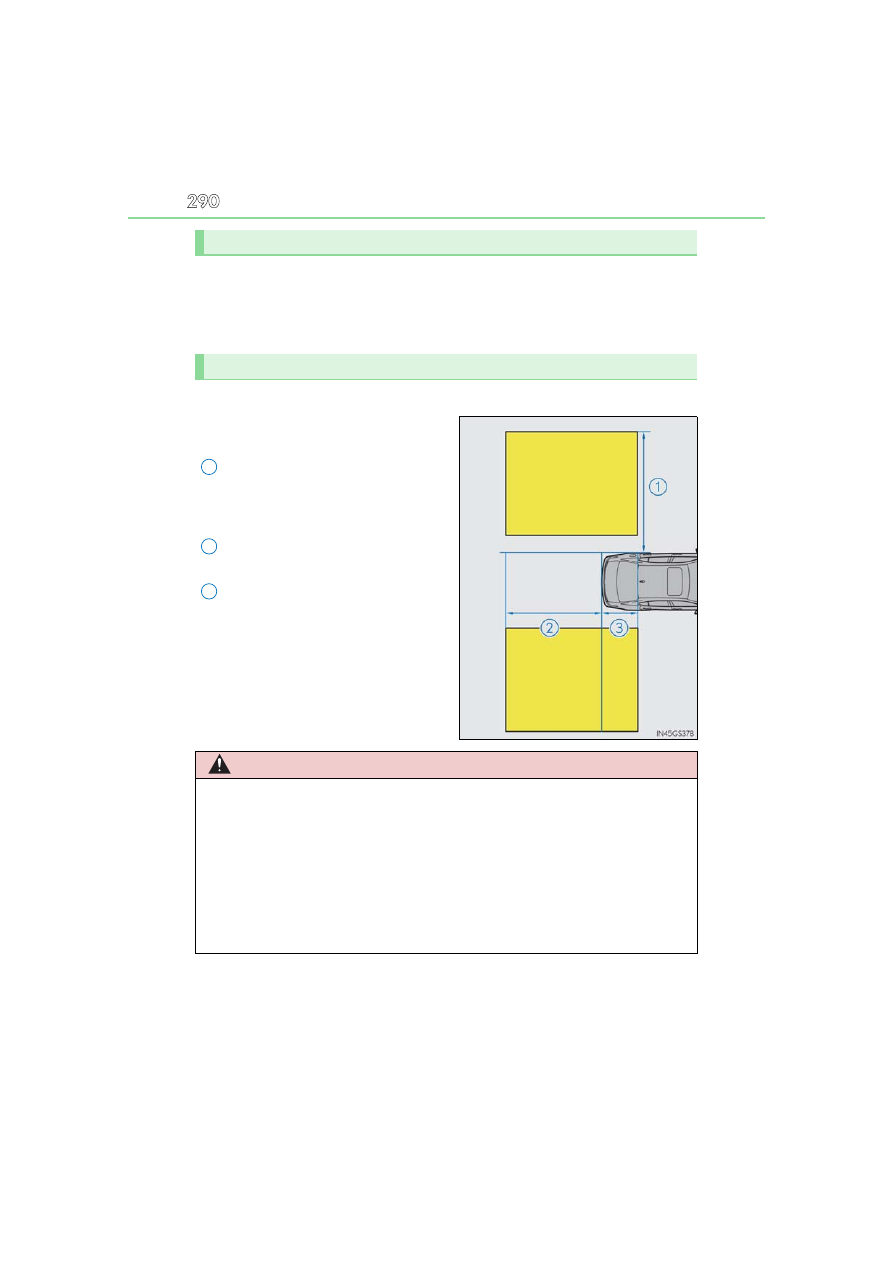
The areas that vehicles can be detected in are outlined below.
The range of the detection area
extends to:

Approximately 11.5 ft. (3.5 m) from
the side of the vehicle

The first 1.6 ft. (0.5 m) from the side of

the vehicle is not in the detection area

Approximately 9.8 ft. (3 m) from the
rear bumper
Approximately 3.3 ft. (1 m) forward
of the rear bumper

The Blind Spot Monitor function

The Blind Spot Monitor function detection areas

1

2

3

WARNING

Cautions regarding the use of the system

The driver is solely responsible for safe driving. Always drive safely, taking care to

observe your surroundings.
The Blind Spot Monitor function is a supplementary function which alerts the driver

that a vehicle is present in the blind spot. Do not overly rely on the Blind Spot Monitor

function. The function cannot judge if it is safe to change lanes, therefore over reliance

could cause an accident resulting in death or serious injury.
According to conditions, the system may not function correctly. Therefore the driver’s

own visual confirmation of safety is necessary.

291

4-5. Using the driving support systems

4

Dr

iving

The Blind Spot Monitor function is operational when

The BSM function is turned on.

Vehicle speed is greater than approximately 10 mph (16 km/h).

The Blind Spot Monitor function will detect a vehicle when

A vehicle in an adjacent lane overtakes your vehicle.

Another vehicle enters the detection area when it changes lanes.

Conditions under which the Blind Spot Monitor function will not detect a vehicle

The Blind Spot Monitor function is not designed to detect the following types of vehicles

and/or objects:

Small motorcycles, bicycles, pedestrians etc.

*

Vehicles traveling in the opposite direction

Guardrails, walls, signs, parked vehicles and similar stationary objects

*

Following vehicles that are in the same lane

*

Vehicles driving 2 lanes across from your vehicle

*

*

: Depending on conditions, detection of a vehicle and/or object may occur.

Conditions under which the Blind Spot Monitor function may not function correctly

The Blind Spot Monitor function may not detect vehicles correctly in the following con-

ditions:
• During bad weather such as heavy rain, fog, snow etc.

• When ice or mud etc. is attached to the rear bumper

• When driving on a road surface that is wet due to rain, standing water etc.

• When there is a significant difference in speed between your vehicle and the vehicle

that enters the detection area

• When a vehicle is in the detection area from a stop and remains in the detection

area as your vehicle accelerates

• When driving up or down consecutive steep inclines, such as hills, a dip in the road

etc.

• When multiple vehicles approach with only a small gap between each vehicle

• When vehicle lanes are wide, and the vehicle in the next lane is too far away from

your vehicle

• When the vehicle that enters the detection area is traveling at about the same speed

as your vehicle

• When there is a significant difference in height between your vehicle and the vehicle

that enters the detection area

• Directly after the BSM function is turned on

Instances of the Blind Spot Monitor function unnecessarily detecting a vehicle and/or

object may increase under the following conditions:
• When there is only a short distance between your vehicle and a guardrail, wall etc.

• When there is only a short distance between your vehicle and a following vehicle

• When vehicle lanes are narrow and a vehicle driving 2 lanes across from your vehi-

cle enters the detection area

• When items such as a bicycle carrier are installed on the rear of the vehicle

292

4-5. Using the driving support systems

The Rear Cross Traffic Alert functions when your vehicle is in reverse. It can
detect other vehicles approaching from the right or left rear of the vehicle. It uses
radar sensors to alert the driver of the other vehicle’s existence through flashing
the outside rear view mirror indicators and sounding a buzzer.

The Rear Cross Traffic Alert function

Approaching vehicles

Detection areas

WARNING

Cautions regarding the use of the system

The driver is solely responsible for safe driving. Always drive safely, taking care to

observe your surroundings.
The Rear Cross Traffic Alert function is only an assist and is not a replacement for care-

ful driving. The driver must be careful when backing up, even when using the Rear

Cross Traffic Alert function. The driver’s own visual confirmation of behind you and

your vehicle is necessary and be sure there are no pedestrians, other vehicles etc.

before backing up. Failure to do so could cause death or serious injury.
According to conditions, the system may not function correctly. Therefore the driver’s

own visual confirmation of safety is necessary.

1

2

293

4-5. Using the driving support systems

4

Dr

iving

The areas that vehicles can be detected in are outlined below.

To give the driver a more consistent time to react, the buzzer can alert for faster
vehicles from farther away.
Example:

The Rear Cross Traffic Alert function is operational when

The BSM function is turned on.

The shift lever is in R.

Vehicle speed is less than approximately 5 mph (8 km/h).

Approaching vehicle speed is between approximately 5 mph (8 km/h) and 18 mph

(28 km/h).

Conditions under which the Rear Cross Traffic Alert function will not detect a vehicle

The Rear Cross Traffic Alert function is not designed to detect the following types of

vehicles and/or objects.

Small motorcycles, bicycles, pedestrians etc.

*

Vehicles approaching from directly behind

Guardrails, walls, signs, parked vehicles and similar stationary objects

*

Vehicles moving away from your vehicle

Vehicles approaching from the parking spaces next to your vehicle

*

Vehicles backing up in the parking space next to your vehicle

*

*

: Depending on conditions, detection of a vehicle and/or object may occur.

The Rear Cross Traffic Alert function detection areas

Approaching vehicle

Speed

Approximate 

alert distance

Fast

18 mph (28 km/h)

65 ft. (20 m)

Slow

5 mph (8 km/h)

18 ft. (5.5 m)

1

294

4-5. Using the driving support systems

Conditions under which the Rear Cross Traffic Alert function may not function cor-

rectly

The Rear Cross Traffic Alert function may not detect vehicles correctly in the following

conditions:

During bad weather such as heavy rain, fog, snow etc.

When ice or mud etc. is attached to the rear bumper

When multiple vehicles approach continuously

Shallow angle parking

When a vehicle is approaching at high speed

When parking on a steep incline, such as hills, a dip in the road etc.

Directly after the BSM function is turned on

When items such as a bicycle carrier are installed on the rear of the vehicle

Directly after the engine is started with the BSM function is turned on

When the sensors cannot detect vehicles

because of obstacles

295

4-5. Using the driving support systems

4

Dr

iving

TVD (Torque Vectoring Differential) (GS F)

With the engine switch in IGNITION
ON mode, pressing the TVD switch
changes the TVD control mode.

The current TVD control mode will be

displayed on the meters.

STANDARD mode

This is the default mode and provides

an optimum balance of driving agility

and stability.

SLALOM mode

This mode emphasizes enhanced

steering response.

TRACK mode

This mode emphasizes stability for

high speed sporty driving.

The multi-information display shows the distribution of driving force between the
right and left rear wheels. (

P. 119)

The TVD system distributes driving force (torque) between the right and left
rear wheels automatically. This system contributes to enhanced steering
response while cornering and increased traction when exiting a corner, pro-
viding an agile driving experience.

Changing TVD control modes

1

2

3

TVD control status on the multi-information display

296

4-5. Using the driving support systems

Automatic cancelation of the selected TVD control mode

SLALOM and TRACK mode are canceled when the engine switch is turned off. When

the engine switch is turned to IGNITION ON mode, the TVD system will be in STAN-

DARD mode.

Automatic disabling of the TVD system

If a malfunction is detected in the TVD system, a warning message will be displayed on

the multi-information display (

P. 442) and the TVD system will be disabled automati-

cally. If the system is disabled, driving force will not be distributed by the TVD but through

normal differential operation.

To protect the system

If the TVD fluid temperature becomes excessively high due to driving for a long time

under extremely high load conditions, a warning message will be displayed on the multi-

information display. (

P. 442)

WARNING

Cautions regarding the use of the system

The driver is solely responsible for safe driving. Do not overly rely on the TVD system.

Always drive safely, taking care to observe your surroundings.

297

4-5. Using the driving support systems

4

Dr

iving

Driving assist systems

ABS (Anti-lock Brake System)

Helps to prevent wheel lock when the brakes are applied suddenly, or if the
brakes are applied while driving on a slippery road surface

Brake assist

Generates an increased level of braking force after the brake pedal is
depressed when the system detects a panic stop situation

VSC (Vehicle Stability Control)

Helps the driver to control skidding when swerving suddenly or turning on
slippery road surfaces

Enhanced VSC (Enhanced Vehicle Stability Control)

Provides cooperative control of the ABS, TRAC, VSC and EPS.
Helps to maintain directional stability when swerving on slippery road sur-
faces by controlling steering performance.

TRAC (Traction Control)

Helps to maintain drive power and prevent the drive wheels from spinning
when starting the vehicle or accelerating on slippery roads

Hill-start assist control

Helps to prevent the vehicle from rolling backward when starting on an
incline.

To help enhance driving safety and performance, the following systems oper-
ate automatically in response to various driving situations. Be aware, however,
that these systems are supplementary and should not be relied upon too heav-
ily when operating the vehicle. 

298

4-5. Using the driving support systems

VGRS (Variable Gear Ratio Steering) (if equipped)

Adjusts the front wheel turning angle in accordance with the vehicle speed
and steering wheel movement

DRS (Dynamic Rear Steering) (if equipped)

Contributes to the turning characteristics and responsiveness of the vehicle
by slightly adjusting the rear wheel angle of the vehicle in accordance with
steering wheel movement

EPS (Electric Power Steering) 

Employs an electric motor to reduce the amount of effort needed to turn the
steering wheel 

AVS (Adaptive Variable Suspension system) (if equipped)

By independently controlling the damping force of the shock absorbers for
each of the 4 wheels according to the road and driving conditions, this system
helps riding comfort with superior a high level of stability, and helps good vehi-
cle posture
When  SPORT  S+  mode  is  selected  by  the driving mode select switch, the
damping force is suitable for sporty driving (

P. 281)

LDH (Lexus Dynamic Handling system) (if equipped)

Provides independent control of the VGRS, DRS and EPS. Contributes to
turning characteristics at low speeds, responsiveness at medium speeds and
safety at high speeds by controlling the steering angle of the front and rear
wheels in accordance with the steering wheel operation and vehicle speed

VDIM (Vehicle Dynamics Integrated Management)

Provides integrated control of the ABS, brake assist, TRAC, VSC, hill-start
assist control, EPS, VGRS (if equipped) and DRS (if equipped) systems
Helps to maintain vehicle stability when swerving on slippery road surfaces by
controlling the brakes, engine output, steering assist, steering ratio and rear
wheel angle

299

4-5. Using the driving support systems

4

Dr

iving

The slip indicator light will flash while
the TRAC/VSC systems are operating.

If the vehicle gets stuck in mud, dirt or snow, the TRAC system may reduce

power from the engine to the wheels. Pressing 

 to turn the system off may

make it easier for rock the vehicle in order to free it.

When the TRAC/VSC systems are operating

Disabling the TRAC system

GS350

GS F

300

4-5. Using the driving support systems

To turn the TRAC system off, quickly press and release 

.

GS350: The “Traction Control Turned Off” will be shown on the multi-information

display. 
GS F: The “TRAC OFF” indicator light will come on.

Press 

 again to turn the system back on.

Turning off both TRAC/VSC systems

GS350

To turn the TRAC/VSC systems off, press and hold 

 for more than 3 seconds while

the vehicle is stopped.

The VSC OFF indicator light will come on and the “Traction Control Turned Off” will

be shown on the multi-information display.

*

1

Press 

 again to turn the systems back on.

GS F

To turn the TRAC and VSC systems off, press and hold 

 for more than 3 seconds.

The “TRAC OFF” indicator light and the VSC OFF indicator light will come on.

*

2

Press 

 again to turn the systems back on.

*

1

: On vehicles with PCS (Pre-Collision System), pre-collision brake assist, pre-collision

braking, and steering control (performed through cooperative control of PCS [Pre-
Collision System] and LDH) (if equipped) will also be disabled. The pre-collision sys-
tem warning light will come on and a message will be displayed on the multi-informa-
tion display. (

P. 442)

*

2

: On vehicles with PCS (Pre-Collision System), pre-collision brake assist and pre-colli-

sion braking will also be disabled. The PCS (Pre-Collision System) warning light will
come on and a message will be displayed on the multi-information display. (

P. 442)

301

4-5. Using the driving support systems

4

Dr

iving

Expert mode (GS F)

When expert mode is selected, it is possible to drive in a more sporty manner than other

drive modes. Expert mode disables the TRAC and VSC systems but the engine and

brakes may be controlled depending on the vehicle behavior.

When the message is displayed on the multi-information display showing that TRAC
has been disabled even if 

 has not been pressed (GS350)

TRAC and hill-start assist control cannot be operated. Contact your Lexus dealer.

When the “TRAC OFF” indicator light comes on even if 

 has not been pressed

(GS F)

TRAC and hill-start assist control cannot be operated. Contact your Lexus dealer.

VGRS is disabled when

VGRS may stop operating in the following situations. 

In this event, the steering wheel may move from its straight forward position, but it will

return when the system restarts.

The steering wheel is operated for an extended period of time while the vehicle is

stopped or is moving very slowly.

When force is continuously applied for a long time with the steering wheel turned as far

as it will go.

The center position of the steering wheel may change when VGRS is disabled. However,

the position will return to normal after VGRS is reactivated.

When the battery is disconnected

The steering wheel may move from its straight forward position, but this will be corrected

automatically when driving. 

To  select  expert  mode, press 

 when in

SPORT S+ mode.
The “EXPERT” indicator will come on together

with the TRAC OFF and VSC OFF indicators.

To cancel expert mode, press 

 or use the

driving mode select switch to select a driving

mode other than SPORT S+ mode.

302

4-5. Using the driving support systems

Sounds and vibrations caused by the ABS, brake assist, VSC, TRAC, Hill-start assist

control and VGRS systems

A sound may be heard from the engine compartment when the brake pedal is

depressed repeatedly, when the engine is started or just after the vehicle begins to

move. This sound does not indicate that a malfunction has occurred in any of these sys-

tems.

Any of the following conditions may occur when the above systems are operating.

None of these indicates that a malfunction has occurred.
• Vibrations may be felt through the vehicle body and steering.

• A motor sound may be heard after the vehicle comes to a stop.

• The brake pedal may pulsate slightly after the ABS is activated.

• The brake pedal may move down slightly after the ABS is activated.

EPS, VGRS and DRS operation sound

When the steering wheel is operated, a motor sound (whirring sound) may be heard.

This does not indicate a malfunction.

Automatic reactivation of TRAC and VSC systems

After turning the TRAC and VSC systems off, the systems will be automatically re-

enabled in the following situations:

When the engine switch is turned off

If only the TRAC system is turned off, the TRAC will turn on when vehicle speed

increases 

If both TRAC and VSC systems are turned off, automatic re-enabling will not occur

when vehicle speed increases.

Reduced effectiveness of the EPS system

The effectiveness of the EPS system is reduced to prevent the system from overheating

when there is frequent steering input over an extended period of time. The steering

wheel may feel heavy as a result. Should this occur, refrain from excessive steering input

or stop the vehicle and turn the engine off. The EPS system should return to normal

within 10 minutes.

Operating conditions of hill-start assist control

When the following four conditions are met, the hill-start assist control will operate;

The shift lever is in a position other than N or P (when starting off forward/backward on

an upward incline).

The vehicle is stopped.

The accelerator pedal is not depressed.

The parking brake is not engaged.

Automatic system cancelation of hill-start assist control

The hill-start assist control will be canceled in any of the following situations;

The shift lever is shifted to N or P.

The accelerator pedal is depressed.

The parking brake is engaged.

Approximately 2 seconds elapse after the brake pedal is released.

303

4-5. Using the driving support systems

4

Dr

iving

WARNING

The ABS does not operate effectively when

The limits of tire gripping performance have been exceeded. (such as excessively

worn tires on a snow covered road).

The vehicle hydroplanes while driving at high speed on wet or slick roads.

Stopping distance when the ABS is operating may exceed that of normal conditions

The ABS is not designed to shorten the vehicle’s stopping distance. Always maintain a

safe distance from the vehicle in front of you, especially in the following situations:

When driving on dirt, gravel or snow-covered roads

When driving with tire chains

When driving over bumps in the road

When driving over roads with potholes or uneven surfaces

TRAC may not operate effectively when

Directional control and power may not be achievable while driving on slippery road

surfaces, even if the TRAC system is operating. 

Drive the vehicle carefully in conditions where stability and power may be lost.

Hill-start assist control does not operate effectively when

Do not overly rely on the hill-start assist control. The hill-start assist control may not

operate effectively on steep inclines and roads covered with ice.

Unlike the parking brake, hill-start assist control is not intended to hold the vehicle

stationary for an extended period of time. Do not attempt to use hill-start assist con-

trol to hold the vehicle on an incline, as doing so may lead to an accident.

When the VSC is activated

The slip indicator light flashes. Always drive carefully. Reckless driving may cause an

accident. Exercise particular care when the indicator light flashes.

304

4-5. Using the driving support systems

WARNING

When the TRAC/VSC systems are turned off

Be especially careful and drive at a speed appropriate to the road conditions. As these

are the systems to help ensure vehicle stability and driving force, do not turn the

TRAC/VSC systems off unless necessary.

Expert mode precautions (GS F)

Do not use on public roads.

Use only when the road conditions and safety of the surrounding area can be

ensured.

Proper use of expert mode requires a professional level of driving skill. When using

expert mode, always check the road conditions and surrounding area and drive more

carefully than usual.

Replacing tires

Make sure that all tires are of the specified size, brand, tread pattern and total load

capacity. In addition, make sure that the tires are inflated to the recommended tire infla-

tion pressure level.
The ABS, TRAC and VSC systems will not function correctly if different tires are

installed on the vehicle.

Contact your Lexus dealer for further information when replacing tires or wheels.

Handling of tires and the suspension

Using tires with any kind of problem or modifying the suspension will affect the driving

assist systems, and may cause a system to malfunction.

305

4-6. Driving tips

4

Dr

iving

Winter driving tips

Use fluids that are appropriate to the prevailing outside temperatures. 

• Engine  oil
• Engine coolant
• Washer fluid

Have a service technician inspect the condition of the battery.

Have the vehicle fitted with four snow tires or purchase a set of tire chains for
the rear tires.

*

Ensure that all tires are the specified size and brand, and that chains match the size of

the tires.

*

: Tire chains cannot be mounted on vehicles with front and rear tires of differing sizes

and vehicles with LDH and 19-inch tires.

Use fluids that are appropriate to the prevailing outside temperatures.

• Engine  oil
• Engine coolant
• Washer fluid

Have a service technician inspect the condition of the battery.

Have the vehicle fitted with four snow tires.

Ensure that all tires are the specified size and brand.

Carry out the necessary preparations and inspections before driving the vehi-
cle in winter. Always drive the vehicle in a manner appropriate to the prevail-
ing weather conditions. 

Preparation for winter (GS350)

Preparation for winter (GS F)


Content      ..     16      17      18      19     ..