Lexus ES300 (1997 year). Manual - part 19
74
CHASSIS — SUSPENSION
2) Function of Electric Modulated Suspension
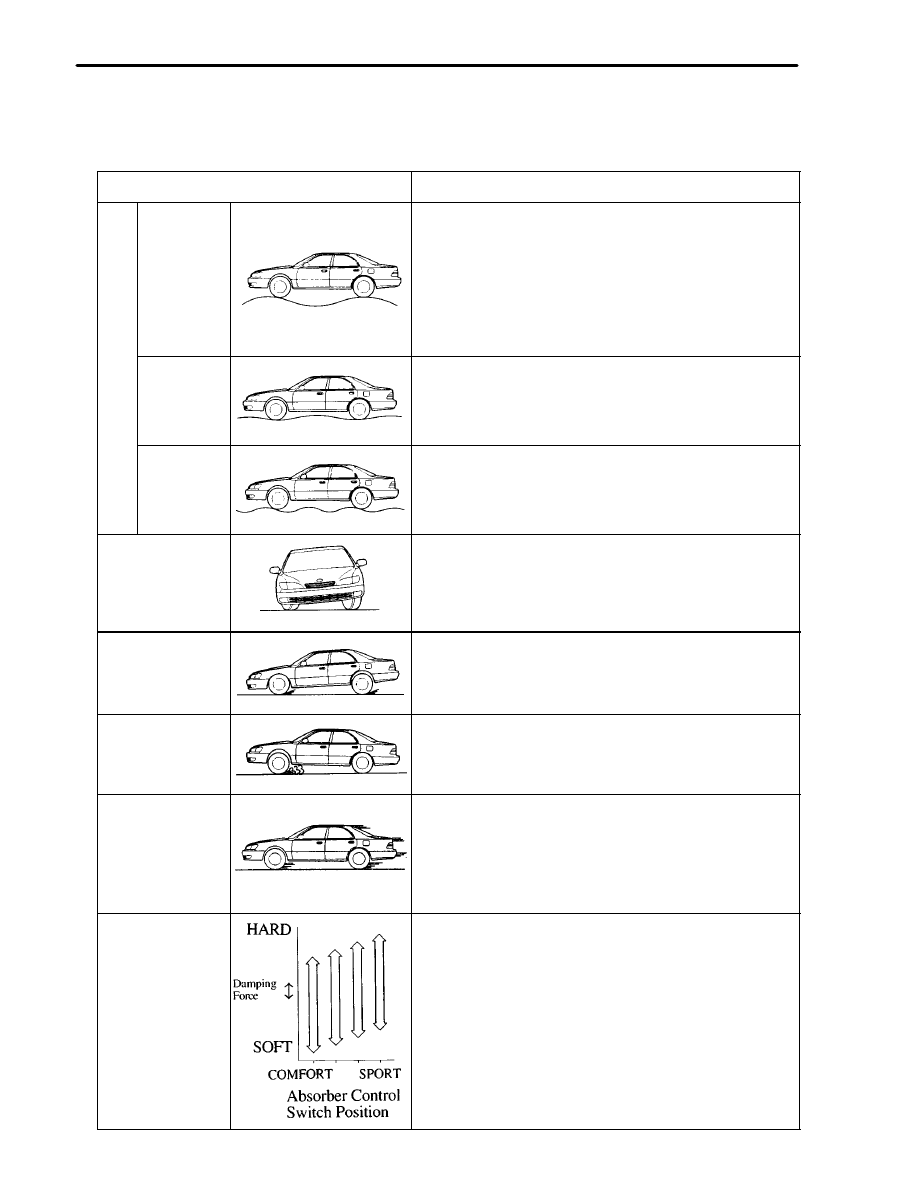
This suspension system performs the controls described below in order to constantly maintain an optimal
vehicle posture, thus realizing excellent riding comfort, stability, and controllability.
Control
Function
e
Control
Float and
Pitch
Control
Estimates the relative speed between the vehicle body
and wheels based on the vehicle body vertical
acceleration rate detected by the acceleration sensor and
performs a (front/rear wheel independent) semi-active
control* of the shock absorbers’ damping force. As a
result, a damping force that is constantly optimal to the
road surface deviation is attained.
*: For details, see the next page.
R
oad-Sensitiv
e
Thumping
Sensitive
Control
When the road surface condition does not require a
damping force, this function controls the shock
absorbers so that their damping force will not increase.
R
Unsprung
Vibration
Control
If unsprung resonance is detected, this function controls
so that the damping force will not decrease below a
certain level, in order to reduce the unsprung resonance.
Anti-Roll
Control
During cornering, this function makes the damping force
firmer, thus restraining the body roll speed in order to
realize excellent stability and controllability.
Anti-Dive
Control
During braking, this function makes the damping force
firmer to restrain the body dive, thus ensuring excellent
stability and controllability.
Anti-Squat
Control
During acceleration, this function makes the damping
force firmer to minimize the changes in the vehicle body
posture.
High Speed
Control
This function varies the variable range of the damping
force according to vehicle speed in order to realize a soft
.and comfortable ride and a stable driving condition.
The damping force is controlled at a softer variable range
at low speeds, and at a firmer variable range at high
speeds.
Control by
Absorber
Control Switch
As shown on the left, the absorber control switch
enables the driver to select a desired damping force from
the 4 modes.