Jeep Wrangler (2022 year). Manual in english - page 26
 

  Index      Manuals     Jeep Wrangler (2022 year). Manual in english


Search            copyright infringement  


Content      ..     24      25      26      27     ..


Jeep Wrangler (2022 year). Manual in english - page 26


SERVICING AND MAINTENANCE

411

(Continued)

INTERIORS 

C

ARPET

 S

AFETY

 I

NFORMATION

Always use carpet designed to fit your vehicle. Only 

use carpet that does not interfere with the 

operation of the pedal assemblies. Only operate 

the vehicle when the carpet is securely attached by 

the grommets so it cannot slip out of position and 

interfere with the pedal assemblies or impair safe 

operation of your vehicle in other ways.

C

ARPET

 R

EMOVAL

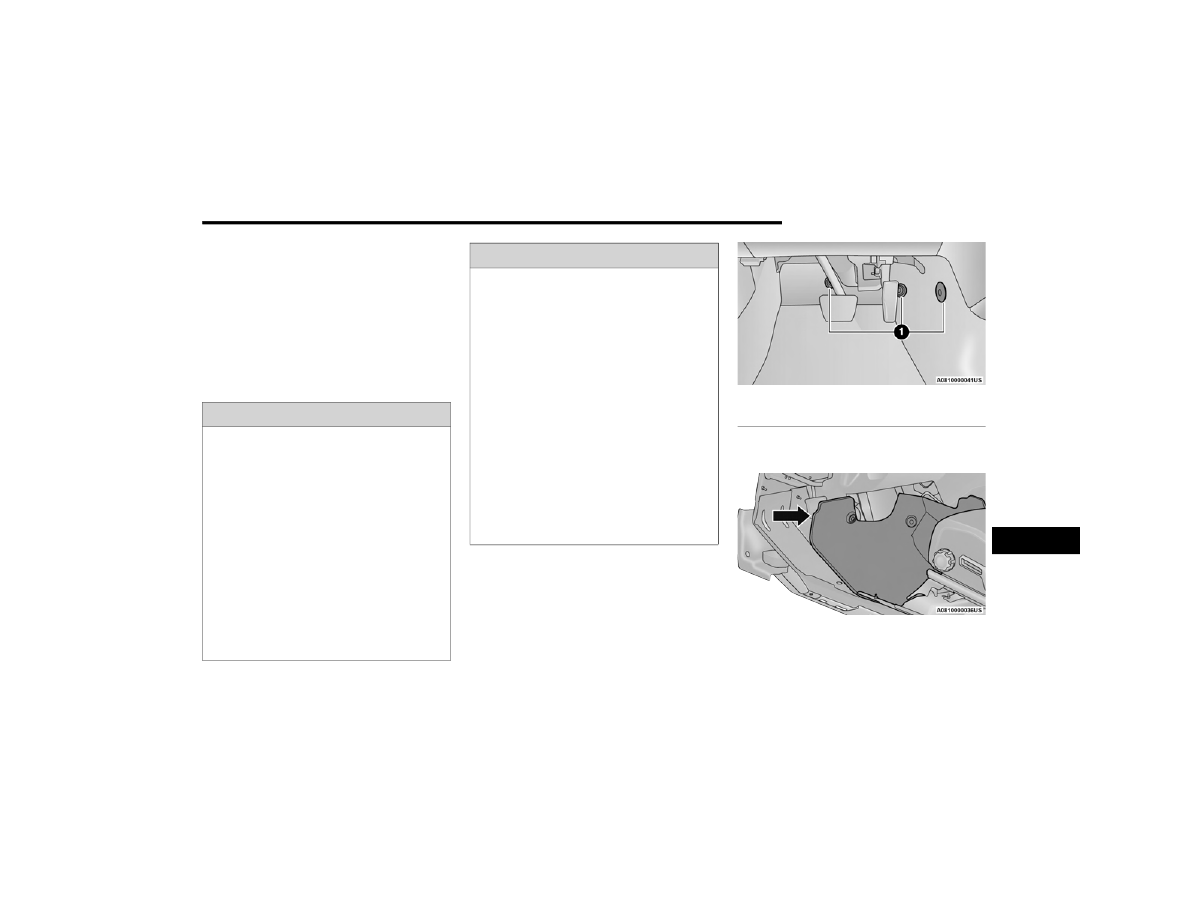
Front Carpets (Two And Four Door Models):
1. Remove the front grommets.

Front Carpet

2. Pull the carpet out from the front to the rear.

Front Carpet Pulled Away

WARNING!

If operating the vehicle without carpet in place 

the floor may become hot, and there is a risk 

of burns.

An improperly attached, damaged, folded, or 

damaged grommets may cause your carpet to 

interfere with the accelerator, brake, or clutch 

pedals and cause a loss of vehicle control. To 

prevent SERIOUS INJURY or DEATH: ALWAYS 

securely attach your carpet using the grom

-

mets.

ALWAYS make sure objects cannot fall or slide 

into the driver’s side floor area when the vehicle 

is moving. Objects can become trapped under 

accelerator, brake, or clutch pedals and could 

cause a loss of vehicle control.

NEVER place any objects under the carpet 

(e.g., towels, keys, etc.). These objects could 

change the position of the carpet and may 

cause interference with the accelerator, 

brake, or clutch pedals.

ONLY install carpet designed to fit your 

vehicle. NEVER install carpet that cannot be 

properly attached and secured to your vehicle. 

If the carpet needs to be replaced, only use 

manufacturer approved carpet for the specific 

make, model, and year of your vehicle.

If the vehicle carpet has been removed and 

re-installed, always properly attach carpet to 

the floor and check that the floor mat 

fasteners are secure to the vehicle carpet. 

Fully depress each pedal to check for interfer

-

ence with the accelerator, brake, or clutch 

pedals then re-install the floor mats.

WARNING!

1 — Grommets

8

412

SERVICING AND MAINTENANCE


3. Remove the grommets under the front seat. 

First for the rear carpet and then the front 

carpet.

Front And Rear Carpet Split

4. Under the back of the front seat, open the 

carpet split and then pull out the rear edge and 

slide the carpet to the front (do not remove the 

harness).

Rear Underside Of Front Seat

5. Finally open the carpet split around seat 

bracket and then remove the last two 

grommets.

Front Seat And Floor

6. When reinstalling carpet please perform these 

steps in reverse order making sure that the 

carpet is tucked under the scuffs, B-pillar, 

console, and refasten grommets.

1 — Harness
2 — Carpet Split

1 — Grommets
2 — Carpet Split

SERVICING AND MAINTENANCE

413

Rear Carpet (Four Door Models):
1. Remove the grommets under the front seat 

(one left and one right).

2. Then pull the carpet out, to the rear and open 

the carpet split around the front seats 

brackets.

Pull Toward The Rear Of Vehicle

3. Remove the grommets under the rear seat 

(one left and one right). First the grommet for 

the cargo carpet and then the rear carpet.

4. Pull the carpet out to the front and open the 

carpet split around the rear seats brackets.

Under Rear Seat

5. When reinstalling carpet please perform these 

steps in reverse order making sure that the 

carpet is tucked under the scuffs, B-pillar, 

console, and refasten grommets.

Rear Carpet (Two Door Models):
1. Remove the rear seats.
2. Remove the side grommets (one left and one 

right). First the grommet from the side carpet 

and then the rear carpet.

Side Carpet

3. Remove the grommets under the front seat 

(one left and one right).

1 — Carpet Split

1 — Carpet Split

1 — Grommet

8

414

SERVICING AND MAINTENANCE


4. Then pull the carpet out to the rear and open 

the carpet split around the front seats 

brackets.

Pull Carpet To The Rear

5. When reinstalling carpet please perform these 

steps in reverse order making sure that the 

carpet is tucked under the scuffs, B-pillar, 

console, and refasten grommets.

Cargo Carpet (Four Door Models):
1. Remove the grommets under the rear seat 

(one left and one right).

2. Pull the carpet out to the rear and open the 

carpet split around the seat belt attachment.

Under Rear Seat

3. Remove the carpet under the load floor and 

the side support and then pull the carpet out.

Rear Load Floor

4. When reinstalling carpet please perform these 

steps in reverse order making sure that the 

carpet is tucked under the scuffs, B-pillar, 

console, and refasten grommets.

1 — Carpet Split
2 — Rear Carpet

1 — Carpet Split
2 — Rear Carpet

1 — Side Supports
2 — Load Floor

SERVICING AND MAINTENANCE

415

Cargo Carpet (Four Door Models) With Gap Hider:
1. Remove the grommets under the rear seat 

(one left and one right).

2. Pull the carpet out to the front and open the 

carpet split around the seat belt attachment 

and under the center seat bracket.

Under Rear Seat

3. When reinstalling carpet please perform these 

steps in reverse order making sure that the 

carpet is tucked under the scuffs, B-pillar, 

console, and refasten grommets.

Side Carpet (Four Door Models):
1. Remove the side grommets (one left and one 

right).

2. Pull the carpet out starting on the top flange, 

then all around the perimeter and open the 

carpet split around the seat belt attachment.

Inside Sidewall

3. When reinstalling carpet please perform these 

steps in reverse order making sure that the 

carpet is tucked under the scuffs, B-pillar, 

console, and refasten grommets.

Side Carpet (Two Door Models):
1. Remove the side grommet and then the lower 

one (left and right).

2. Pull the carpet out starting on the top flange, 

then all around the perimeter and open the 

carpet split around the seat belt attachment.

3. When reinstalling carpet please perform these 

steps in reverse order making sure that the 

carpet is tucked under the scuffs, B-pillar, 

console, and refasten grommets.

S

EATS

 A

ND

 F

ABRIC

 P

ARTS

Use Mopar® Total Clean to clean fabric upholstery 

and carpeting.

Seat Belt Maintenance

Do not bleach, dye or clean the belts with chemical 

solvents or abrasive cleaners. This will weaken the 

fabric. Sun damage can also weaken the fabric.
If the belts need cleaning, use a mild soap solution 

or lukewarm water. Do not remove the belts from 

the vehicle to wash them. Dry with a soft cloth.

1 — Carpet Split
2 — Grommets
3 — Rear Carpet

1 — Top Flange
2 — Grommet
3 — Side Carpet

WARNING!

Do not use volatile solvents for cleaning 

purposes. Many are potentially flammable, and 

if used in closed areas they may cause 

respiratory harm.

8

416

SERVICING AND MAINTENANCE


(Continued)

Replace the belts if they appear frayed or worn or 

if the buckles do not work properly.

P

LASTIC

 A

ND

 C

OATED

 P

ARTS

Use Mopar® Total Clean to clean vinyl upholstery.

Cleaning Plastic Instrument Cluster 

Lenses 

The lenses in front of the instruments in this 

vehicle are molded in clear plastic. When cleaning 

the lenses, care must be taken to avoid scratching 

the plastic.
Clean with a wet soft cloth. A mild soap solution 

may be used, but do not use high alcohol content 

or abrasive cleaners. If soap is used, wipe clean 

with a clean damp cloth. Dry with a soft cloth.

L

EATHER

 S

URFACES

Mopar® Total Clean is specifically recommended 

for leather upholstery.
Your leather upholstery can be best preserved by 

regular cleaning with a damp soft cloth. Small 

particles of dirt can act as an abrasive and damage 

the leather upholstery and should be removed 

promptly with a damp cloth. Stubborn soils can be 

removed easily with a soft cloth and Mopar® Total 

Clean. Care should be taken to avoid soaking your 

leather upholstery with any liquid. Please do not 

use polishes, oils, cleaning fluids, solvents, 

detergents, or ammonia-based cleaners to clean 

your leather upholstery.

NOTE:

If equipped with light colored leather, it tends to 

show any foreign material, dirt, and fabric dye 

transfer more so than darker colors. The leather is 

designed for easy cleaning, and FCA recommends 

Mopar® total care leather cleaner applied on a 

cloth to clean the leather seats as needed.

G

LASS

 S

URFACES


All glass surfaces should be cleaned on a regular 

basis with Mopar® Glass Cleaner, or any 

commercial household-type glass cleaner. Never 

use an abrasive type cleaner. Use caution when 

cleaning the inside rear window equipped with 

electric defrosters or windows equipped with radio 

antennas. Do not use scrapers or other sharp 

instruments that may scratch the elements.
When cleaning the rear view mirror, spray cleaner 

on the towel or cloth that you are using. Do not 

spray cleaner directly on the mirror.

WARNING!

A frayed or torn seat belt could rip apart in a 

collision and leave you with no protection. 

Inspect the seat belt system periodically, 

checking for cuts, frays, or loose parts. 

Damaged parts must be replaced immediately. 

Do not disassemble or modify the seat belt 

system. If your vehicle is involved in a collision, 

or if you have questions regarding seat belt or 

retractor conditions, take your vehicle to an 

authorized FCA dealer or authorized FCA 

Certified Collision Care Program facility for 

inspection.

CAUTION!

Direct contact of air fresheners, insect repel

-

lents, suntan lotions, or hand sanitizers to the 

plastic, painted, or decorated surfaces of the 

interior may cause permanent damage. Wipe 

away immediately.

Damage caused by these type of products 

may not be covered by your New Vehicle 

Limited Warranty.

CAUTION!

CAUTION!

Do not use Alcohol and Alcohol-based and/or 

Ketone based cleaning products to clean leather 

upholstery, as damage to the upholstery may 

result.

417

TECHNICAL SPECIFICATIONS

VEHICLE IDENTIFICATION NUMBER (VIN)

The VIN is found on the left front corner of the 

A-pillar, visible from outside of the vehicle through 

the windshield.

Vehicle Identification Number

NOTE:

It is illegal to remove or alter the VIN plate.

BRAKE SYSTEM

Your vehicle is equipped with dual hydraulic brake 

systems. If either of the two hydraulic systems lose 

normal capability, the remaining system will still 

function. However, there will be some loss of 

overall braking effectiveness. You may notice 

increased pedal travel during application, greater 

pedal force required to slow or stop, and potential 

activation of the Brake Warning Light.
In the event power assist is lost for any reason (i.e., 

repeated brake applications with the engine off) 

the brakes will still function. However, the effort 

required to brake the vehicle will be much greater 

than that required with the power system 

operating.

WHEEL AND TIRE TORQUE SPECIFICATIONS  

Proper lug nut/bolt torque is very important to 

ensure that the wheel is properly mounted to the 

vehicle. Any time a wheel has been removed and 

reinstalled on the vehicle, the lug nuts/bolts 

should be torqued using a properly calibrated 

torque wrench using a six-sided (hex) deep wall 

socket.

T

ORQUE

 S

PECIFICATIONS

**Use only authorized dealer recommended lug nuts/

bolts and clean or remove any dirt or oil before tightening.

Inspect the wheel mounting surface prior to 

mounting the tire and remove any corrosion or 

loose particles.
Spare Tire Torque Specifications

**Use only authorized dealer recommended lug nuts/

bolts and clean or remove any dirt or oil before tightening.

Spare tire torque is for the spare tire carrier 

located on the swing gate.

Wheel Mounting Surface

Lug Nut/Bolt 

Torque

**Lug Nut/

Bolt Size

Lug Nut/Bolt 

Socket Size

130 Ft-Lb 

(176 N·m)

M14 x 1.50

22 mm

Lug Nut/Bolt 

Torque

**Lug Nut/

Bolt Size

Lug Nut/Bolt 

Socket Size

59 Ft-Lb 

(80 N·m)

M14 x 1.50

22 mm

9

418

TECHNICAL SPECIFICATIONS


Tighten the lug nuts/bolts in a star pattern until 

each nut/bolt has been tightened twice. Ensure 

that the socket is fully engaged on the lug nut/bolt 

(do not insert it halfway).

Torque Patterns

After 25 miles (40 km), check the lug nut/bolt 

torque to be sure that all the lug nuts/bolts are 

properly seated against the wheel.

FUEL REQUIREMENTS — GASOLINE ENGINE   

While operating on gasoline with the required 

octane number, hearing a light knocking sound 

from the engine is not a cause for concern. 

However, if the engine is heard making a heavy 

knocking sound, see a dealer immediately. Use of 

gasoline with an octane number lower than 

recommended octane can cause engine failure 

and may void the New Vehicle Limited Warranty.
Poor quality gasoline can cause problems such as 

hard starting, stalling, and hesitations. If you 

experience these symptoms, try another brand of 

gasoline before considering service for the vehicle.

2.0L E

NGINE

This engine is designed to meet all 

emissions requirements, and provide 

satisfactory fuel economy and 

performance, when using high-quality 

unleaded regular gasoline having an octane rating 

of 87, as specified by the (R+M)/2 method. The 

use of 91 or higher octane premium gasoline will 

allow these engines to operate to optimal 

performance. This increase in performance is most 

noticeable in hot weather or other heavier load 

conditions, such as while towing.

3.6L E

NGINE

This engine is designed to meet all 

emissions regulations and provide 

satisfactory fuel economy and 

performance when using high-quality 

unleaded regular gasoline having an octane rating 

of 87 as specified by the (R+M)/2 method. The use 

of higher octane premium gasoline will not provide 

any benefit over regular gasoline in these engines.

R

EFORMULATED

 G

ASOLINE


Many areas of the country require the use of 

cleaner burning gasoline referred to as 

“reformulated gasoline”. Reformulated gasoline 

contains oxygenates and are specifically blended 

to reduce vehicle emissions and improve air 

quality.
The use of reformulated gasoline is recommended. 

Properly blended reformulated gasoline will 

provide improved performance and durability of 

engine and fuel system components.

M

ATERIALS

 A

DDED

 T

O

 F

UEL


Besides using unleaded gasoline with the proper 

octane rating, gasolines that contain detergents, 

corrosion and stability additives are 

recommended. Using gasolines that have these 

additives will help improve fuel economy, reduce 

emissions, and maintain vehicle performance.

WARNING!

To avoid the risk of forcing the vehicle off the 

jack, do not tighten the lug nuts/bolts fully until 

the vehicle has been lowered. Failure to follow 

this warning may result in personal injury.

TECHNICAL SPECIFICATIONS

419

Designated TOP TIER Detergent Gasoline 

contains a higher level of detergents to 

further aide in minimizing engine and 

fuel system deposits. When available, 

the usage of TOP TIER Detergent gasoline is 

recommended. Visit www.toptiergas.com for a list 

of TOP TIER Detergent Gasoline Retailers.
Indiscriminate use of fuel system cleaning agents 

should be avoided. Many of these materials 

intended for gum and varnish removal may contain 

active solvents or similar ingredients. These can 

harm fuel system gasket and diaphragm materials.

G

ASOLINE

/O

XYGENATE

 B

LENDS


Some fuel suppliers blend unleaded gasoline with 

oxygenates such as ethanol.

Problems that result from using gasoline 

containing more than 15% ethanol (E-15) or 

gasoline containing methanol are not the 

responsibility of the manufacturer and may void or 

not be covered under New Vehicle Limited 

Warranty.

D

O

 N

OT

 U

SE

 E-85 I

N

 N

ON

-F

LEX

 F

UEL


V

EHICLES

Non-Flex Fuel Vehicles (FFV) are compatible with 

gasoline containing up to 15% ethanol (E-15). Use 

of gasoline with higher ethanol content may void 

the New Vehicle Limited Warranty.
If a Non-FFV vehicle is inadvertently fueled with 

E-85 fuel, the engine will have some or all of these 

symptoms:

Operate in a lean mode

OBD II Malfunction Indicator Light on

Poor engine performance

Poor cold start and cold drivability

Increased risk for fuel system component corro

-

sion

CNG A

ND

 LP F

UEL

 S

YSTEM


M

ODIFICATIONS

Modifications that allow the engine to run on 

Compressed Natural Gas (CNG) or Liquid Propane 

(LP) may result in damage to the engine, 

emissions, and fuel system components. Problems 

that result from running CNG or LP are not the 

responsibility of the manufacturer and may void or 

not be covered under the New Vehicle Limited 

Warranty.

MMT I

N

 G

ASOLINE

Methylcyclopentadienyl Manganese Tricarbonyl 

(MMT) is a manganese-containing metallic additive 

that is blended into some gasoline to increase 

octane. Gasoline blended with MMT provides no 

performance advantage beyond gasoline of the 

same octane number without MMT. Gasoline 

blended with MMT reduces spark plug life and 

reduces emissions system performance in some 

vehicles. The manufacturer recommends that 

gasoline without MMT be used in your vehicle. The 

MMT content of gasoline may not be indicated on 

the gasoline pump; therefore, you should ask your 

gasoline retailer whether the gasoline contains 

MMT. MMT is prohibited in Federal and California 

reformulated gasoline.

CAUTION!

DO NOT use E-85, gasoline containing methanol, 

or gasoline containing more than 15% ethanol 

(E-15). Use of these blends may result in starting 

and drivability problems, damage critical fuel 

system components, cause emissions to exceed 

the applicable standard, and/or cause the 

Malfunction Indicator Light to illuminate. Please 

observe pump labels as they should clearly 

communicate if a fuel contains greater than 

15% ethanol (E-15).

9

420

TECHNICAL SPECIFICATIONS


F

UEL

 S

YSTEM

 C

AUTIONS

NOTE:

Intentional tampering with the emissions control 

system can result in civil penalties being assessed 

against you.

FUEL REQUIREMENTS – DIESEL ENGINE    

Federal law requires that you must fuel this vehicle 

with Ultra Low Sulfur Highway Diesel fuel (15 ppm 

Sulfur maximum) and prohibits the use of Low 

Sulfur Highway Diesel fuel (500 ppm Sulfur 

maximum) to avoid damage to the emissions 

control system.
Use good quality diesel fuel from a reputable 

supplier in your vehicle. For most year-round 

service, No. 2 diesel fuel meeting ASTM (formerly 

known as the American Society for Testing and 

Materials) specification D-975 Grade S15 will 

provide good performance. If the vehicle is 

exposed to extreme cold (below 20°F or -7°C), or 

is required to operate at colder-than-normal 

conditions for prolonged periods, use climatized 

No. 2 diesel fuel or dilute the No. 2 diesel fuel with 

50% No. 1 diesel fuel. This will provide better 

protection from fuel gelling or wax-plugging of the 

fuel filters.

Diesel fuel is seldom completely free of water. To 

prevent fuel system trouble, drain the 

accumulated water from the fuel/water separator 

using the fuel/water separator drain provided on 

the fuel filter housing. If you buy good quality fuel 

and follow the cold weather advice above, fuel 

conditioners should not be required in your vehicle. 

If available in your area, a high cetane “premium” 

diesel fuel may offer improved cold-starting and 

warm-up performance.

CAUTION!

Follow these guidelines to maintain your 

vehicle’s performance:

The use of leaded gasoline is prohibited by 

Federal law. Using leaded gasoline can impair 

engine performance and damage the emis

-

sions control system.

An out-of-tune engine or certain fuel or ignition 

malfunctions can cause the catalytic 

converter to overheat. If you notice a pungent 

burning odor or some light smoke, your engine 

may be out of tune or malfunctioning and may 

require immediate service. Contact an autho

-

rized dealer for service assistance.

The use of fuel additives, which are now being 

sold as octane enhancers, is not recom

-

mended. Most of these products contain high 

concentrations of methanol. Fuel system 

damage or vehicle performance problems 

resulting from the use of such fuels or addi

-

tives is not the responsibility of the manufac

-

turer and may void or not be covered under 

the New Vehicle Limited Warranty.

WARNING!

Do not use alcohol or gasoline as a fuel blending 

agent. They can be unstable under certain 

conditions and hazardous or explosive when 

mixed with diesel fuel.

CAUTION!

If the Water in Fuel Indicator Light remains on, 

DO NOT START engine before you drain the water 

from the fuel filter(s) to avoid engine damage  

Ú

page 362.

TECHNICAL SPECIFICATIONS

421

D

IESEL

 F

UEL

 S

PECIFICATIONS

This diesel engine has been developed to take 

advantage of the high energy content and 

generally lower cost No. 2 Ultra Low Sulfur diesel 

fuel or No. 2 Ultra Low Sulfur climatized diesel 

fuels.

NOTE:

If you accidentally fill the fuel tank with gasoline 

on your diesel vehicle, do not start the engine. 

Damage to the engine and fuel system could 

occur. Please call an authorized dealer for 

service.

A maximum blend of 5% biodiesel meeting 

ASTM specification D-975 may be used with 

your diesel engine without any adjustments to 

regular service schedules.

Commercially available fuel additives are not 

necessary for the proper operation of your 

diesel engine.

No. 1 Ultra Low Sulfur diesel fuel should only be 

used where extended arctic conditions (-10°F 

or -23°C) exist.

B

IODIESEL

 F

UEL

 R

EQUIREMENTS

A maximum blend of 5% biodiesel meeting ASTM 

specification D975 is recommended for use with 

your diesel engine. If frequent operation with 

Biodiesel blends that are between 6% and 20% 

(B6–B20) is desired, the maintenance schedule is 

subject to shorter intervals.
The oil and filter change along with fuel filter 

replacement is subject to shorter intervals when 

operating your engine on biodiesel greater than 

5%. Do not use biodiesel greater than 20%.
For regular use of biodiesel blends between 6% 

and 20% (B6–B20) it is important that you 

understand and comply with these requirements  

Ú

page 352.

Biodiesel is a fuel produced from renewable 

resources typically derived from animal fat, 

rapeseed oil (Rapeseed Methyl Ester (RME) base), 

or soybean oil (Soy Methyl Ester (SME or SOME) 

base).
Biodiesel fuel has inherent limitations which 

require that you understand and adhere to the 

following requirements if you use blends of 

Biodiesel between 6% and 20% (B6–B20). There 

are no unique restrictions for the use of B5.

Biodiesel Fuel Properties — Low Ambient 

Temperatures

Biodiesel fuel may gel or solidify at low ambient 

temperatures, which may pose problems for both 

storage and operation. Precautions can be 

necessary at low ambient temperatures, such as 

storing the fuel in a heated building or a heated 

storage tank, or using cold temperature additives.

CAUTION!

Failure to comply with Oil Change requirements 

for vehicles operating on biodiesel blends 

between 6% and 20% (B6–B20) will result in 

premature engine wear. Such wear is not 

covered by the New Vehicle Limited Warranty.

CAUTION!

Use of blends greater than 20% is not approved. 

Use of blends greater than 20% can result in 

engine damage. Such damage is not covered by 

the New Vehicle Limited Warranty.

CAUTION!

In the event that the vehicle is filled with 

biodiesel and not used for more than a month, 

the fuel should either be used up by driving (up 

to quarter tank) and filled with standard diesel 

blends with less than 5% that is normally 

available. This will help prevent the fuel filter 

clogging and potential damage to the fuel 

injection system due to degraded biodiesel, 

which is not covered by the New Vehicle Limited 

Warranty.

9

422

TECHNICAL SPECIFICATIONS


Fuel Quality — Must Comply With ASTM 

Standards

The quality of Biodiesel fuel may vary widely. Only 

fuel produced by a BQ9000 supplier to the 

following specifications may be blended to meet 

Biodiesel blend B6 – B20 fuel meeting ASTM 

specification D-7467:

Petrodiesel fuel meeting ASTM specification 

D-975 and Biodiesel fuel (B100) meeting ASTM 

specification D-6751

Fuel Oxidation Stability — Must Use Fuel 

Within Six Months Of Manufacture

Biodiesel fuel has poor oxidation stability which 

can result in long term storage problems. Fuel 

produced to approved ASTM standards, if stored 

properly, provides for protection against fuel 

oxidation for up to six months.

Fuel Water Separation — Must Use 

Mopar® Approved Fuel Filter Elements

Biodiesel fuel has a natural affinity to water and 

water accelerates microbial growth. Your Mopar® 

filtration system is designed to provide adequate 

fuel water separation capabilities.

Fuel In Oil Dilution — Must Adhere To 

Required Oil Change Interval

Fuel dilution of lubricating oil has been observed 

with the use of Biodiesel fuel. Fuel in oil must not 

exceed 5%. To ensure this limit is met your oil 

change interval must be maintained with in the 

suggested schedule. The regular use of biodiesel 

between 6% and 20% requires intervals shorter 

than the outlined 10,000 miles (16,000 km)and 

must not exceed the suggested schedule. When 

routinely operating on biodiesel between 6% and 

20%, oil and filter replacement intervals must not 

exceed 8,000 Miles (12,875 km) or six months, 

which ever comes first.

Biodiesel Fuel Filter Change Intervals

The use of biodiesel requires more frequent fuel 

filter change intervals. When operating on 

biodiesel between 6% and 20%, fuel filter 

replacement intervals should be every second oil 

change, and must not exceed 16,000 miles

(25,750 km).

NOTE:

Under no circumstances should oil change 

intervals exceed 8,000 miles (12,875 km) or 

6 months, if regular operation occurs with 6% - 

20% biodiesel blends. Under no circumstances 

should fuel filter replacement intervals exceed 

every second oil change and must not exceed 

16,000 miles (25,750 km), if regular operation 

occurs with 6% - 20% biodiesel blends. Failure to 

comply with these Oil Change and fuel filter 

requirements for vehicles operating on biodiesel 

blends up to B20 may result in premature engine 

wear. Such wear is not covered by the New Vehicle 

Limited Warranty. The engine may suffer severe 

damage if operated with concentrations of 

biodiesel higher than 20%.

TECHNICAL SPECIFICATIONS

423

FLUID CAPACITIES    

US

Metric

Fuel (Approximate)
Two Door Models

17.5 Gallons

66 Liters

Four Door Models

21.5 Gallons

81 Liters

3.0L Diesel Engine

18.3 Gallons

69 Liters

Diesel Exhaust Fluid Tank

5.1 Gallons

19.3 Liters

Engine Oil with Filter
2.0L Engine

5 Quarts

4.73 Liters

3.6L Engine

5 Quarts

4.73 Liters

3.0L Diesel Engine

9 Quarts

8.5 Liters

Cooling System *
2.0L Engine

12 Quarts

11.4 Liters

2.0L Engine Intercooler

3.7 Quarts

3.5 Liters

3.6L Engine

13.4 Quarts

12.7 Liters

3.6L Motor Generator Unit (MGU)

2.2 Quarts

2.1 Liters

3.6L Power Pack Unit (PPU) Coolant

3.3 Quarts

3.1 Liters

3.0L Diesel Engine

14.8 Quarts

14 Liters

* Includes coolant recovery bottle filled to MAX level.

9

424

TECHNICAL SPECIFICATIONS


ENGINE FLUIDS AND LUBRICANTS           

GASOLINE ENGINES

Component

Fluid, Lubricant, or Genuine Part

Engine Coolant

We recommend using Mopar® Antifreeze/Coolant 10 Year/150,000 Mile 

(240,000 km) Formula OAT (Organic Additive Technology) or equivalent 

meeting the requirements of the manufacturer Material Standard MS.90032.

Intercooler

We recommend using Mopar® Antifreeze/Coolant 10 Year/150,000 Mile 

(240,000 km) Formula OAT (Organic Additive Technology) or equivalent 

meeting the requirements of the manufacturer Material Standard MS.90032.

Engine Oil — 2.0L Engine

We recommend using Mopar® API SP/GF-6A Certified SAE 5W-30 Full 

Synthetic Engine Oil which meets the requirements of the manufacturer 

Material Standard MS-13340. Equivalent full synthetic 5W-30 API SP engine 

oil can be used but must have the API Donut trademark  

Ú

page 360.

CAUTION!

Failure to use the recommended API SP/GF-6A or equivalent oil can cause 

engine damage not covered by the vehicle warranty.

Engine Oil — 3.6L Engine

We recommend using Mopar® SAE 0W-20 Full Synthetic Engine Oil which 

meets the requirements of the manufacturer Material Standard MS-6395. 

Equivalent full synthetic SAE 0W-20 engine oil can be used but must have the 

API Starburst trademark  

Ú

page 360.

Engine Oil Filter

We recommend using a Mopar® Engine Oil Filter. If a Mopar® Engine Oil Filter 

is unavailable only use filters that meet or exceed SAE/USCAR-36 Filter 

Performance Requirements.

Fuel Selection — 2.0L Engine

87 Octane (R+M)/2 Method, 0-15% Ethanol.

Fuel Selection — 3.6L Engine

87 Octane (R+M)/2 Method, 0-15% Ethanol.

TECHNICAL SPECIFICATIONS

425

DIESEL ENGINES

CAUTION!

Mixing of engine coolant (antifreeze) other than specified Organic Additive Technology (OAT) engine coolant (antifreeze), may result in engine damage and 

may decrease corrosion protection. Organic Additive Technology (OAT) engine coolant is different and should not be mixed with Hybrid Organic Additive Tech

-

nology (HOAT) engine coolant (antifreeze) or any “globally compatible” coolant (antifreeze). If a non-OAT engine coolant (antifreeze) is introduced into the 

cooling system in an emergency, the cooling system will need to be drained, flushed, and refilled with fresh OAT coolant (conforming to MS.90032), by an 

authorized dealer as soon as possible.

Do not use water alone or alcohol-based engine coolant (antifreeze) products. Do not use additional rust inhibitors or antirust products, as they may not be 

compatible with the radiator engine coolant and may plug the radiator.

This vehicle has not been designed for use with propylene glycol-based engine coolant (antifreeze). Use of propylene glycol-based engine coolant (antifreeze) 

is not recommended.

Component

Fluid, Lubricant, or Genuine Part

Engine Coolant

We recommend using Mopar® Antifreeze/Coolant 10 Year/150,000 Mile 

(240,000 km) Formula OAT (Organic Additive Technology) or equivalent 

meeting the requirements of the manufacturer Material Standard MS.90032.

Engine Oil — 3.0L Diesel Engine

We recommend using Mopar® API Certified SAE 5W-40 Full Synthetic Engine 

Oil which meets the requirements of the manufacturer Material Standard 

MS-12991. Equivalent full synthetic SAE 5W-40 engine oil can be used but 

must have the API Donut trademark  

Ú

page 360.

Engine Oil Filter

We recommend using a Mopar® Engine Oil Filter. If a Mopar® Engine Oil Filter 

is unavailable only use filters that meet or exceed SAE/USCAR-36 Filter 

Performance Requirements.

Fuel Filters — 3.0L Diesel Engine

We recommend using Mopar® Fuel Filter. Must meet 3 micron rating. Using a 

fuel filter that does not meet the manufacturer filtration and water separating 

requirements can severely impact fuel system life and reliability.

9

426

TECHNICAL SPECIFICATIONS


CHASSIS FLUIDS AND LUBRICANTS       

Fuel Selection — 3.0L Diesel Engine

Use good quality diesel fuel from a reputable supplier in your vehicle. Federal 

law requires that you must fuel this vehicle with Ultra Low Sulfur Highway 

Diesel fuel (15 ppm Sulfur maximum) and prohibits the use of Low Sulfur 

Highway Diesel fuel (500 ppm Sulfur maximum) to avoid damage to the 

emissions control system. For most year-round service, Number 2 diesel fuel 

meeting ASTM specification D-975 Grade S15 will provide good performance. 

We recommend you use a blend of up to 5% biodiesel, meeting ASTM 

specification D-975 with your diesel engine.
This vehicle is compatible with biodiesel blends greater than 5% but no 

greater than 20% biodiesel meeting ASTM specification D-7467 provided the 

shortened maintenance intervals are followed as directed.

Diesel Exhaust Fluid — 3.0L Diesel Engine

Mopar® Diesel Exhaust Fluid (DEF) (API Certified) or equivalent that has been 

API Certified to the ISO 22241 standard. Use of fluids not API Certified to ISO 

22241 may result in system damage.

Component

Fluid, Lubricant, or Genuine Part

 
Automatic Transmission – If Equipped
 

Use only Mopar® ZF 8 & 9 Speed Automatic Transmission Fluid (ATF) or 

equivalent. Failure to use the correct fluid may affect the function or 

performance of your transmission.

Manual Transmission – If Equipped

We recommend using Mopar® ATF+4 Automatic Transmission Fluid.

Transfer Case

We recommend using Mopar® ATF+4 Automatic Transmission Fluid.

Front Axle Differential

We recommend using Mopar® Gear & Axle Lubricant (SAE 75W85) (API GL-5).

Component

Fluid, Lubricant, or Genuine Part


Content      ..     24      25      26      27     ..