Jeep Wrangler TJ. Manual - part 241
INSTALLATION
NOTE: If replacement differential bearings or differ-
ential case are being installed, differential side
bearing shim requirements may change. Refer
Adjustments (Differential Bearing Preload and Gear
Backlash) to determine the proper shim selection.
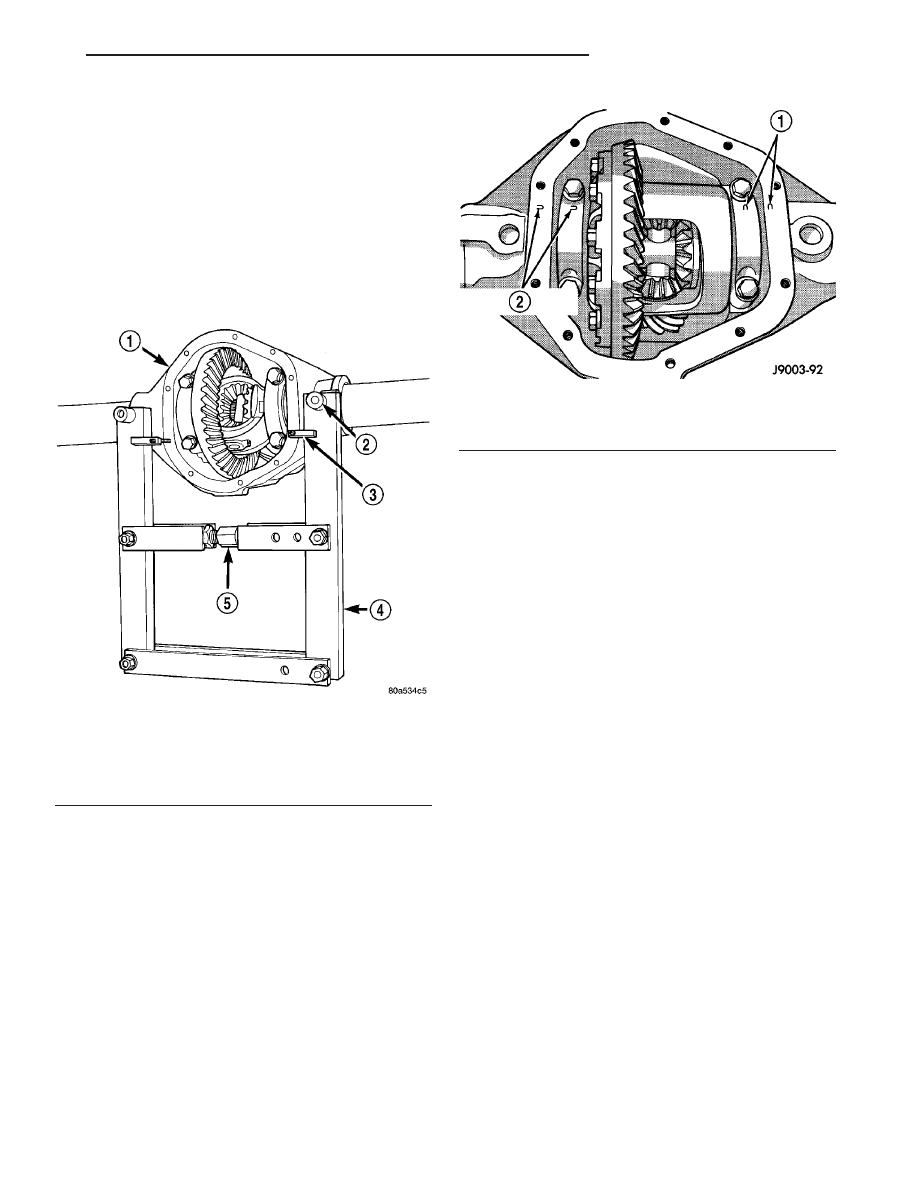
(1) Position Spreader W-129-B and adapters from
Adapter set 6987, with the tool dowel pins seated in
the locating holes (Fig. 46). Install hold-down clamps
and tighten turnbuckle finger-tight.
(2) Install Pilot Stud C-3288-B at the left side of
the differential housing. Attach Dial Indicator C-3339
to pilot stud. Load indicator plunger against the
opposite side of the housing and zero the indicator.
(3) Spread housing while measuring the distance
with the dial indicator.
CAUTION: Never spread over 0.38 mm (0.015 in).
Failure to heed caution may result in damage.
(4) Remove dial indicator.
(5) Install differential case in the housing. Tap dif-
ferential case to seat bearings cups in the housing.
(6) Install bearing caps in their original locations
(Fig. 47).
(7) Loosely install differential bearing cap bolts.
(8) Remove axle housing spreader.
(9) Tighten bearing cap bolts to 108 N·m (80 ft.
lbs.).
(10) Install axle shafts.
(11) Install cover and identification tag.
DIFFERENTIAL -TRAC-LOK
DESCRIPTION
The Trac-Lok
t differential has a one-piece differen-
tial case, and similar internal components as a stan-
dard
differential,
plus
two
clutch
disc
packs.
Differential bearing preload and ring gear backlash
are adjusted with shims located between the differ-
ential case bearing cups and housing. Pinion bearing
preload is set and maintained by the use of a collaps-
ible spacer.
OPERATION
This differentials clutches are engaged by two con-
current forces. The first being the preload force
exerted through Belleville spring washers within the
clutch packs. The second is the separating forces gen-
erated by the side gears as torque is applied through
the ring gear (Fig. 48).
This design provides the differential action needed
for turning corners and for driving straight ahead
during periods of unequal traction. When one wheel
looses traction, the clutch packs transfer additional
torque to the wheel having the most traction. This
differential resist wheel spin on bumpy roads and
provide more pulling power when one wheel looses
traction. Pulling power is provided continuously until
both wheels loose traction. If both wheels slip due to
unequal traction, Trac-lok
t operation is normal. In
extreme cases of differences of traction, the wheel
with the least traction may spin.
Fig. 46 SPREADER LOCATION
1 - DIFFERENTIAL HOUSING
2 - DOWEL
3 - SAFETY HOLD DOWN
4 - SPREADER
5 - TURNBUCKLE
Fig. 47 BEARING CAP REFERENCE
1 - REFERENCE LETTERS
2 - REFERENCE LETTERS
TJ
REAR AXLE - 216RBI
3 - 141
DIFFERENTIAL (Continued)