Engines Iveco C10,C13, Cursor 10, Cursor 13. Manual - part 9
EGR EXHAUST GAS RECIRCULATION SYSTEM
The exhaust gases may be partially conveyed back into the cylinders to reduce the maximum combustion temperature responsi-
ble for producing nitrogen oxides (NOx).
The exhaust gas recirculation (EGR) system, by reducing the combustion temperature, thus represents an effective NOx emis-
sion controlling system.
INTERNAL EGR ACTING ON THE INTAKE VALVES
Through a modification to the design of the intake cams, the internal EGR system enables part of the exhaust gas to be conveyed
back into the engine’s cylinders.
This type of EGR, called internal EGR, has no electronically controlled elements, the system is always active.
Its configuration requires no additional elements such as control valves, pipes or heat exchangers, so the profile of the engine
remains unchanged.
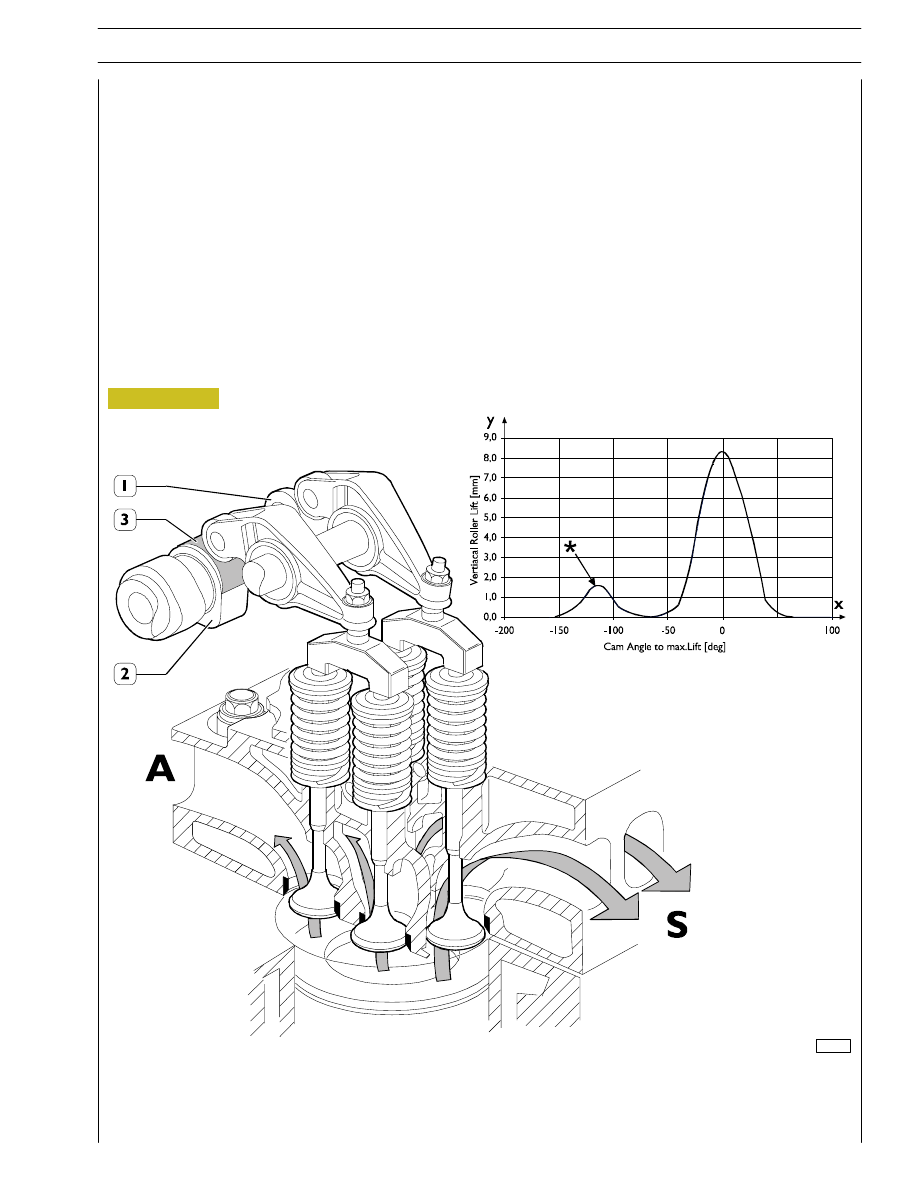
In addition to the main lobe, the intake cam presents an additional lobe (3) with respect to the configuration without EGR.
During the exhaust stroke of the cylinder concerned, this lobe opens the intake valve slightly earlier (*). In this way, part of the
exhaust gas is trapped in the intake pipe and then, during the intake stroke of the cylinder, is returned to the load of the cylinder
for the power stroke.
Figure 38
104761
1. Exhaust cams - 2. Intake cams - 3. EGR lobe - S. Exhaust pipes - A. Intake pipes.
Y: Lift of valves in mm.
Y: Regulation of engine
shaft in degrees
27
CURSOR ENGINES F3A
SECTION 1 - GENERAL SPECIFICATIONS
Base - May 2007