Infiniti QX4 (R50). Manual - part 8
Pilot pressure generated by the operation of shift solenoid valves
A and B is applied to the end face of shift valves A and B.
The drawing above shows the operation of shift valve B. When the
shift solenoid valve is “ON”, pilot pressure applied to the end face
of the shift valve overcomes spring force, moving the valve upward.
LOCK-UP CONTROL
NBAT0180S03
The torque converter clutch piston in the torque converter is locked
to eliminate torque converter slip to increase power transmission
efficiency. The solenoid valve is controlled by an ON-OFF duty
signal sent from the TCM. The signal is converted to oil pressure
signal which controls the torque converter clutch piston.
Conditions for Lock-up Operation
NBAT0180S0301
When vehicle is driven in 4th gear position, vehicle speed and
throttle opening are detected. If the detected values fall within the
lock-up zone memorized in the TCM, lock-up is performed.
Overdrive control switch
ON
OFF
Selector lever
“D” position
Gear position
D
4
D
3
Vehicle speed sensor
More than set value
Throttle position sensor
Less than set opening
Closed throttle position switch
OFF
A/T fluid temperature sensor
More than 40°C (104°F)
SAT010J
Torque Converter Clutch Solenoid Valve Control
NBAT0180S0302
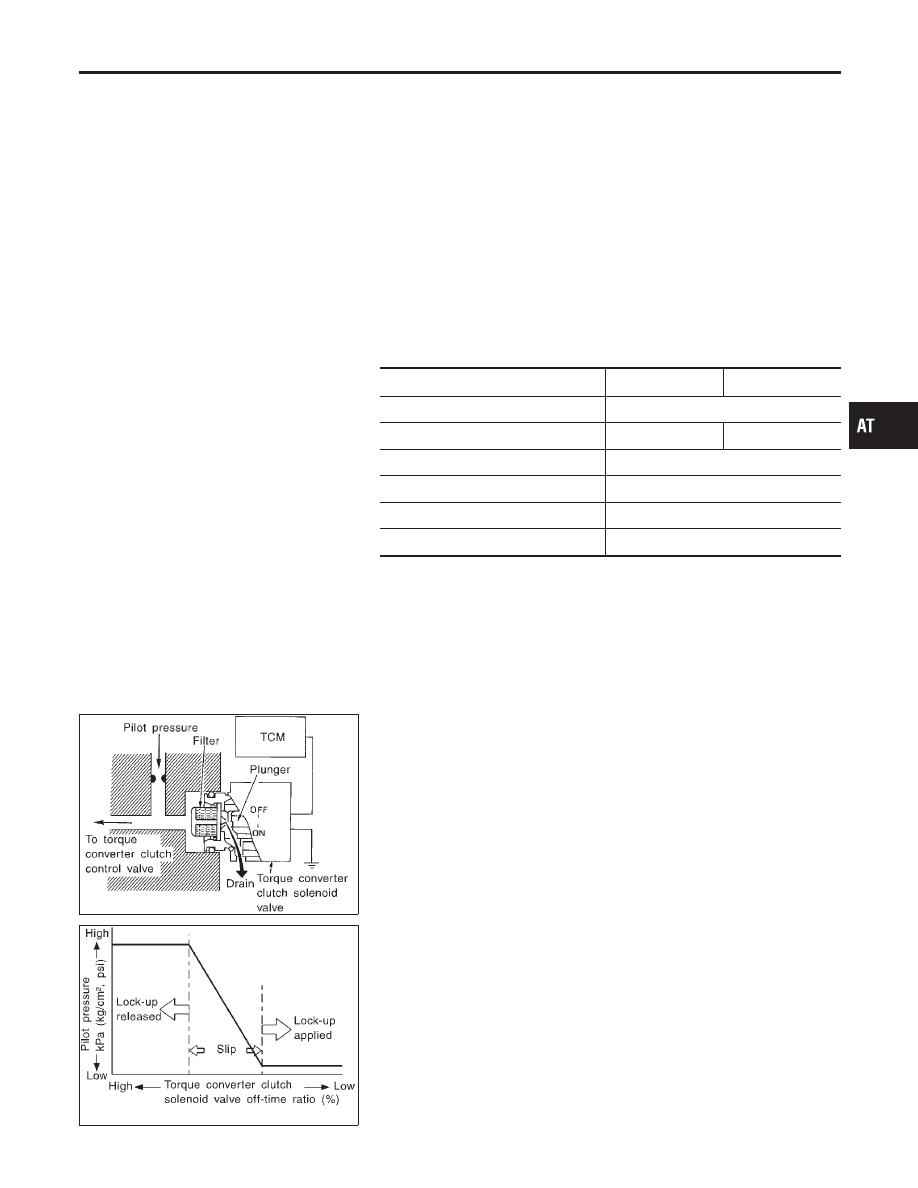
The torque converter clutch solenoid valve is controlled by the
TCM. The plunger closes the drain circuit during the “OFF” period,
and opens the circuit during the “ON” period. If the percentage of
OFF-time increases in one cycle, the pilot pressure drain time is
reduced and pilot pressure remains high.
The torque converter clutch piston is designed to slip to adjust the
ratio of ON-OFF, thereby reducing lock-up shock.
SAT011J
OFF-time INCREASING
"
Amount of drain DECREASING
"
Pilot pressure HIGH
"
Lock-up RELEASING
GI
MA
EM
LC
EC
FE
TF
PD
AX
SU
BR
ST
RS
BT
HA
SC
EL
IDX
OVERALL SYSTEM
Control Mechanism (Cont’d)
AT-29