Hyundai Nexo (2024 year). Manual in english - page 12
 

  Index      Manuals     Hyundai Nexo (2024 year). Manual in english


Search            copyright infringement  


Content      ..     10      11      12      13     ..


Hyundai Nexo (2024 year). Manual in english - page 12


5-34

Driving your vehicle

• State 2

Press and hold the ESC OFF button
continuously for more than 3 sec-
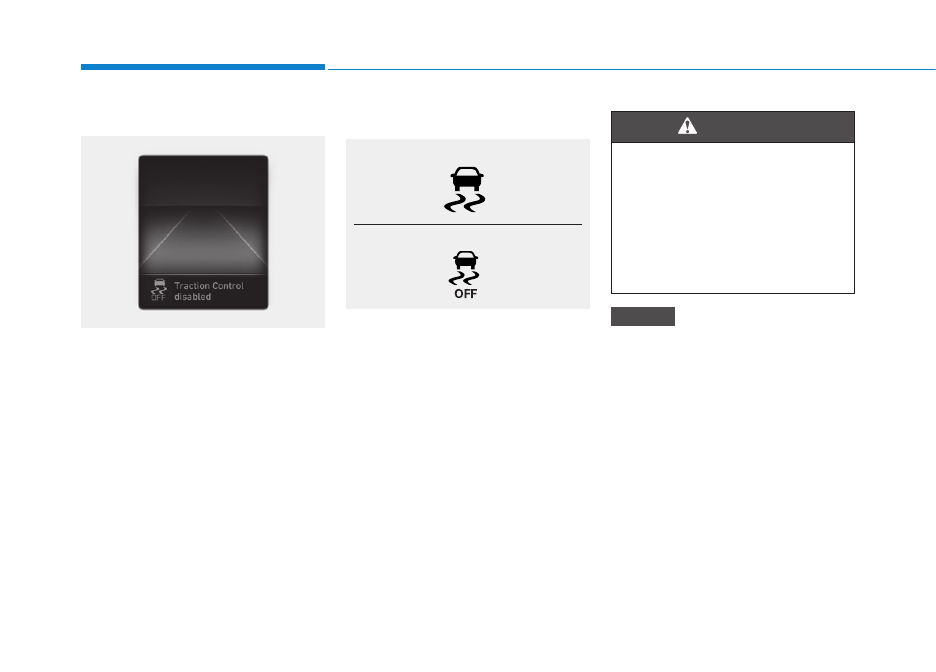
onds. The ESC OFF indicator light
and message "Traction & Stability
Control disabled" illuminates and a
warning chime sounds. In this state,
both the traction control function of
ESC and the brake control function
of ESC are disabled.
If the POWER button is placed to the
OFF position when ESC is off, ESC
remains off. Upon restarting the vehi-
cle, the ESC will automatically turn
on again.

Indicator lights 

When the POWER button is pressed
to the ON position, the ESC indicator
light illuminates, then goes off if the
ESC system is operating normally.
The ESC indicator light blinks when-
ever the ESC is operating.
If the ESC indicator light stays on,
your vehicle may have a malfunction
with the ESC system. When this
warning light illuminates, have the
vehicle checked by an authorized
HYUNDAI dealer as soon as possi-
ble.
The ESC OFF indicator light comes
on when the ESC is turned off with
the button.

Driving with wheels and tires with
different sizes may cause the ESC
system to malfunction. Before
replacing tires, make sure all four
tires and wheels are the same
size. Never drive the vehicle with
different sized wheels and tires
installed.

NOTICE

ESC indicator light (blinks)

■ 

ESC OFF indicator light (comes on)

When the ESC is blinking, this
indicates the ESC is active:
Drive slowly and NEVER attempt
to accelerate. NEVER turn the
ESC off while the ESC indicator
light is blinking or you may lose
control of the vehicle resulting in
an accident.

WARNING  

OFE051032N

5-35

Dri
ving y

our v

ehicle

5

ESC OFF usage

When Driving

The ESC OFF mode should only be
used briefly to help free the vehicle if
stuck in snow or mud, by temporarily
stopping operation of the ESC, to
maintain wheel torque.
To turn ESC off while driving, press
the ESC OFF button while driving on
a flat road surface.

• Do not allow wheel(s) of one

axle to spin excessively while
the ESC, ABS, and parking brake
warning lights are displayed.
The repairs would not be cov-
ered by the vehicle warranty.
Reduce vehicle power and do
not spin the wheel(s) excessive-
ly while these lights are dis-
played.

• When operating the vehicle on a

dynamometer, make sure the
ESC is turned off (ESC OFF light
illuminated).

Information 

Turning the ESC off does not affect
ABS or standard brake system opera-
tion.

Vehicle Stability Management
(VSM)

The Vehicle Stability Management
(VSM) is a function of the Electronic
Stability Control (ESC) system. It
helps ensure the vehicle stays stable
when accelerating or braking sud-
denly on wet, slippery and rough
roads where traction over the four
tires can suddenly become uneven.

i

NOTICE

Take the following precautions
when using the Vehicle Stability
Management (VSM):

ALWAYS check the speed and
the distance to the vehicle
ahead.The VSM is not a substi-
tute for safe driving practices.

Never drive too fast for the
road conditions. The VSM sys-
tem will not prevent acci-
dents. Excessive speed in bad
weather, slippery and uneven
roads can result in severe
accidents.

WARNING  

5-36

Driving your vehicle

VSM operation

VSM ON condition

The VSM operates when:
• The Electronic Stability Control

(ESC) is on.

• Vehicle speed is approximately

above 9 mph (15 km/h) on curve
roads.

• Vehicle speed is approximately

above 18 mph (30 km/h) when the
vehicle is braking on rough roads.

When operating 

When you apply your brakes under
conditions which may activate the
ESC, you may hear sounds from the
brakes, or feel a corresponding sen-
sation in the brake pedal. This is nor-
mal and it means your VSM is active.

Information 

The VSM does not operate when: 

• Driving on a banked road such as a

gradient or incline.

• Driving in reverse.

• The ESC OFF indicator light is on. 

• The  MDPS (Motor power steering)

warning light (

) is on or blinks. 

VSM OFF condition

To cancel VSM operation, press the
ESC OFF button. ESC OFF indicator
light (

) will illuminate.

To turn on VSM, press the ESC OFF
button again. The ESC OFF indicator
light will go out.

Driving with wheels and tires with
different sizes may cause the VSM
system to malfunction. Before
replacing tires, make sure all four
tires and wheels are the same
size. Never drive the vehicle with
different sized tires and wheels
installed.

NOTICE

i

If the ESC indicator light (

) or

MDPS warning light (

) stays

on or blinks, your vehicle may
have a malfunction with the
VSM system. When the warning
light illuminates, have the vehi-
cle checked by an authorized
HYUNDAI dealer as soon as
possible.

WARNING  

5-37

Dri
ving y

our v

ehicle

5

Hill-Start Assist Control (HAC)

The Hill-Start Assist Control (HAC)
helps prevent the vehicle from rolling
backwards when starting a vehicle
from a stop on a hill. The system
operates the brakes automatically for
approximately 5 seconds and releas-
es the brake after 5 seconds or when
the accelerator pedal is depressed.

Information 

• The HAC does not operate when the

gear is in P (Park) or N (Neutral).

• The HAC activates even when the

ESC (Electronic Stability Control) is
off. However, it does not activate,
when the ESC does not operate nor-
mally.

Good Braking Practices

Wet brakes can be dangerous! The
brakes may get wet if the vehicle is
driven through standing water or if it
is washed. Your vehicle will not stop
as quickly if the brakes are wet. Wet
brakes may cause the vehicle to pull
to one side.

To dry the brakes, apply the brakes
lightly until the braking action returns
to normal. If the braking action does
not return to normal, stop as soon as
it is safe to do so and call an author-
ized HYUNDAI dealer for assistance.
DO NOT drive with your foot resting
on the brake pedal. Even light, but
constant pedal pressure can result in
the brakes overheating, brake wear,
and possibly even brake failure.
If a tire goes flat while you are driv-
ing, apply the brakes gently and
keep the vehicle pointed straight
ahead while you slow down. When
you are moving slowly enough for it
to be safe to do so, pull off the road
and stop in a safe location.
Keep your foot firmly on the brake
pedal when the vehicle is stopped to
prevent the vehicle from rolling for-
ward.

i

Whenever leaving the vehicle or
parking, always come to a com-
plete stop and continue to
depress the brake pedal. Shift
to the P (Park) position, then
apply the parking brake, and
place the POWER button in the
OFF position.
Vehicles parked with the park-
ing brake not applied or not
fully engaged may roll inadver-
tently and may cause injury to
the driver and others. ALWAYS
apply the parking brake before
exiting the vehicle.

WARNING  

Always be ready to depress the
accelerator pedal when starting
off on a incline. The HAC acti-
vates only for approximately 5
seconds.

WARNING  

5-38

Driving your vehicle

The drive mode may be selected
according to the driver's preference
or road condition.
The system resets to be in the NOR-
MAL mode (except if it is in ECO
mode), when the vehicle is restarted.

Information 

If there is a problem with the instru-
ment cluster, the drive mode will be in
NORMAL mode and may not change
to ECO mode. 

The mode changes, as below,
whenever the DRIVE MODE button
is pressed.

• Press and hold the DRIVE MODE

button to select ECO+ mode.

ECO mode

ECO mode improves bat-
tery charge use efficiency
for eco-friendly driving.

• When ECO mode is selected by

pressing the DRIVE MODE button,
the ECO indicator (green color) will
illuminate.

• If the vehicle is set to ECO mode,

when the vehicle is turned OFF
and restarted the Drive Mode set-
ting will remain in ECO mode.

Information 

Battery charge use efficiency depends
on the driver's driving habit and road
condition.

When ECO mode is activated:

• The acceleration response may be

slightly reduced as the accelerator
pedal is depressed moderately.

• The air conditioner performance

may be limited.

The above situations are normal
conditions when ECO mode is acti-
vated to improve fuel efficiency.

i

i

D

DR

RIIV

VE

E  M

MO

OD

DE

E  IIN

NT

TE

EG

GR

RA

AT

TE

ED

D  C

CO

ON

NT

TR

RO

OL

L  S

SY

YS

ST

TE

EM

M  ((IIF

F  E

EQ

QU

UIIP

PP

PE

ED

D))

OFE058033

NORMAL                  ECO

5-39

Dri
ving y

our v

ehicle

5

ECO+ mode

ECO+ mode helps
improve fuel efficiency
with ultra power saving
driving mode.

• When ECO+ mode is selected by

pressing and holding the DRIVE
MODE button, the ECO+ indicator
will illuminate.

• Distance to empty may not change

when the air conditioner/heater
system is off. However, actual dis-
tance may be extended.

• Air conditioner/heater system turns

off (except the defroster) but you
may turn it on if necessary.

• When the drive mode is switched

from the ECO+ mode to a different
mode, it is changed to air condi-
tioner/heater operation status of
the ECO mode.

• Whenever the vehicle is restarted,

the Drive Mode will reverse back to
NORMAL mode.

• If ECO + mode is activated, the

maximum vehicle speed is limited
below 60 mph (100 km/h).

Drive mode change alert

The driver can select the Drive mode
change alert on the Infotainment sys-
tem screen.
Go to "Vehicle settings 

Drive

mode 

Drive mode change alert".

The information, which will be shown
whenever the drive mode is
changed.

[Detailed alert] : A  change of the

drive mode is
shown by an image
of the vehicle.

[Simple alert] : A change of the drive

mode is indicated by
a short message on
top of the screen.

[No alert] : A change of the drive

mode is not indicated.

ECO mode climate control

ECO Mode Climate Control helps
extend driving range by reducing the
heating and cooling power of the cli-
mate control.
The driver can activate/deactivate
the system on the Infotainment sys-
tem screen.
Go to "Vehicle settings 

Drive

mode 

Eco mode climate control".

(&2

5-40

Driving your vehicle

Forward Collision-Avoidance Assist
is designed to help detect and moni-
tor the vehicle ahead or detect a
pedestrian or cyclists in the roadway
through radar signals and camera
recognition to warn the driver that a
collision is imminent, and if neces-
sary, apply emergency braking.

Forward Collision-Avoidance
Assist setting and activation

Function setting

• The driver can activate Forward

Collision-Avoidance Assist by plac-
ing the power button to the ON posi-
tion and by selecting:
"Vehicle settings 

Driver assis-

tance 

Forward safety"

- If you select "Active assistance",

Forward Collision-Avoidance
Assist activates. Forward Collision-
Avoidance Assist produces warn-
ing messages and warning alarms
in accordance with the collision
risk levels. Also, it controls the
brakes in accordance with the col-
lision risk levels.

If you select "Warning only",
Forward Collision-Avoidance
Assist activates and produces only
warning alarms in accordance with
the collision risk levels. You should
control the brake directly because
Forward Collision-Avoidance
Assist do not control the brake.

If you select "Off", Forward
Collision-Avoidance Assist deacti-
vates,

F

FO

OR

RW

WA

AR

RD

D  C

CO

OL

LL

LIIS

SIIO

ON

N-

-A

AV

VO

OIID

DA

AN

NC

CE

E  A

AS

SS

SIIS

ST

T  ((F

FC

CA

A))  ((S

SE

EN

NS

SO

OR

R  F

FU

US

SIIO

ON

N))

Take the following precautions
when using Forward Collision-
Avoidance Assist:

This function is only a supple-
mental system and it is not
intended to,

nor does it

replace the need for extreme
care and attention of the driv-
er. The sensing range and
objects detectable by the sen-
sors are limited. Pay attention
to the road conditions at all
times.

NEVER drive too fast in accor-
dance with the road condi-
tions or while cornering.

Always drive cautiously to
prevent unexpected and sud-
den situations from occur-
ring.

Forward Collision-

Avoidance Assist does not
stop the vehicle completely
and is not a collision avoid-
ance function.

WARNING  

5-41

Dri
ving y

our v

ehicle

5

The warning light illumi-
nates on the cluster dis-
play, when you cancel
Forward Collision-

Avoidance Assist. The driver can
monitor the Forward Collision-
Avoidance Assist ON/OFF status on
the infotainment system screen.
Also, the warning light illuminates
when the ESC (Electronic Stability
Control) is turned off. If the warning
light remains ON when Forward
Collision-Avoidance Assist is activat-
ed, we recommend that you have the
function checked by an authorized
HYUNDAI dealer.

• The driver can select the initial warn-

ing activation time on the infotain-
ment system screen.
Go to the "Vehicle settings 

Driver

assistance 

→ 

Warning timing 

Normal/Later"

The options for the initial Forward
Collision Warning includes the fol-
lowing:
- Normal:

When this condition is selected,
the initial Forward Collision
Warning is activated sensitively. If
you feel the warning activates too
early, set the Forward Collision
Warning to 'Later'.
Even though, 'Normal' is selected if
the front vehicle suddenly stops
the initial warning activation time
may not seem fast.

- Later:

When this condition is selected, the
initial Forward Collision Warning is
activated later than normal. This
setting reduces the amount of dis-
tance between the vehicle, pedes-
trian or cyclist (if equipped) ahead
before the initial warning occurs.
Select 'Later' when traffic is light
and when driving speed is slow.

if you change the warning timing,
the warning timing of other func-
tions may change.
Always be aware of warning tim-
ing before changing the warning
timing.

Prerequisite for activation

Forward Collision-Avoidance Assist
gets ready to be activated, when
Forward Collision-Avoidance Assist is
selected on the infotainment system
vehicle settings, and when the following
prerequisites are satisfied.
- The ESC (Electronic Stability

Control) is on.

- Vehicle speed is over 5 mph (8 km/h).

(Forward Collision-Avoidance Assist
is only activated within a certain
speed range.)

- The function detects a pedestrian,

cyclist (if equipped) or a vehicle in
front, which may collide with your
vehicle.

(Forward Collision-

Avoidance Assist may not be activat-
ed or may sound a warning alarm in
accordance with the driving situation
or vehicle condition. If you select
"Warning only", Forward Collision-
Avoidance Assist activates and pro-
duces only warning alarms in accor-
dance with the collision risk levels.)

Forward Collision-Avoidance Assist
may not operate properly according
to the frontal situation, the direction
of pedestrian or cyclist (if equipped)
and speed.

5-42

Driving your vehicle

Forward Collision-Avoidance
Assist warning message and
function control

Forward Collision-Avoidance Assist
produces warning messages and
warning alarms in accordance with
the collision risk levels, such as
abrupt stopping of the vehicle in
front, insufficient braking distance,
pedestrian or cyclist (if equipped)
detection. Also, it controls the brakes
in accordance with the collision risk
levels.
The driver can select the initial warn-
ing activation time in the Vehicle set-
tings in the infotainment system
screen. The options for the initial
Forward Collision Warning include
Normal or Late initial warning time.
If you select "Warning only", Forward
Collision-Avoidance Assist activates
and produces only warning alarms in
accordance with the collision risk lev-
els. You should control the brake
directly because Forward Collision-
Avoidance Assist do not control the
brake.

Collision Warning 

This warning message appears on
the cluster display with a warning
chime. Additionally, some vehicle
system intervention occurs by the
driving management system to help
decelerate the vehicle.

Completely stop the vehicle
on a safe location before
operating the switch on the
steering wheel to activate/
deactivate Forward Collision-
Avoidance Assist.

Forward Collision-Avoidance
Assist automatically activates
upon placing the power but-
ton to the ON position. The
driver can deactivate Forward
Collision-Avoidance Assist by
canceling the function setting
on the infotainment system
screen.

Forward Collision-Avoidance
Assist automatically deacti-
vates upon canceling the ESC
(Electronic Stability Control).
When the ESC is canceled,
Forward Collision-Avoidance
Assist cannot be activated on
the infotainment system
screen. Forward Collision-
Avoidance Assist warning
light will illuminate which is
normal.

WARNING  

OFE058144L

Type A

OFE050035L

Type B

5-43

Dri
ving y

our v

ehicle

5

- Your vehicle speed may deceler-

ate moderately.

- Forward 

Collision-Avoidance

Assist limitedly controls the
brakes to preemptively mitigate
impact in a collision.

- If you select "Warning only",

Forward Collision-Avoidance
Assist activates and produces
only warning alarms in accor-
dance with the collision risk lev-
els. You should control the brake
directly because Forward
Collision-Avoidance Assist do not
control the brake.

Emergency braking 

This warning message appears on
the cluster display with a warning
chime.

Additionally, some vehicle system
intervention occurs by the driving
management system to help decel-
erate the vehicle.

- Forward 

Collision-Avoidance

Assist limitedly controls the
brakes to preemptively mitigate
impact in a collision. The brake
control is maximized just before a
collision.

- If you select "Warning only",

Forward Collision-Avoidance
Assist activates and produces
only warning alarms in accor-
dance with the collision risk lev-
els. You should control the brake
directly because the Forward
Collision-Avoidance Assist do not
control the brake.

OFE058145L

Type A

OFE050036L

Type B

5-44

Driving your vehicle

Brake operation

• In an urgent situation, the braking

system enters into the ready status
for prompt reaction against the dri-
ver's depressing the brake pedal.

• Forward Collision-Avoidance

Assist provides additional braking
power for optimum braking per-
formance, when the driver
depresses the brake pedal.

• The braking control is automatical-

ly deactivated, when the driver
sharply depresses the accelerator
pedal, or when the driver abruptly
operates the steering wheel.

• Forward Collision-Avoidance

Assist brake control is automatical-
ly canceled, when risk factors dis-
appear.

The driver should always use
extreme caution while operating
the vehicle, whether or not there
is a warning message or alarm
from Forward Collision-
Avoidance Assist.

CAUTION

The braking control cannot
completely stop the vehicle nor
avoid all collisions. The driver
should hold the responsibility
to safely drive and control the
vehicle.

WARNING  

Never deliberately drive danger-
ously to activate the system.

WARNING  

Forward Collision-Avoidance
Assist logic operates within
certain parameters, such as the
distance from the vehicle,
pedestrian or cyclist (if
equipped) ahead, the speed of
the vehicle ahead, and the dri-
ver's vehicle speed. Certain
conditions such as inclement
weather and road conditions
may affect the operation of
Forward Collision-Avoidance
Assist.

WARNING  

5-45

Dri
ving y

our v

ehicle

5

Detecting sensor

In order for Forward Collision-
Avoidance Assist to operate properly,
always make sure the sensor cover
or sensor is clean and free of dirt,
snow, and debris.

Dirt, snow, or foreign substances on
the lens may adversely affect the
sensing performance of the sensor.

• Do not apply license plate mold-

ing or foreign objects such as a
bumper sticker or a bumper
guard near the radar sensor.
Doing so may adversely affect
the sensing performance of the
radar.

• Always keep the radar sensor

and cover clean and free of dirt
and debris.

• Use only a soft cloth to wash the

vehicle. Do not spray pressur-
ized water directly on the sensor
or sensor cover.

• Do not place any objects near

the front windshield or install
any accessories on the front
windshield. It can affect the per-
formance of the defogging and
defrosting function of the cli-
mate control system, which may
prevent the Driver Assistance
functions from operating 

• Be careful not to apply unneces-

sary force on the radar sensor or
sensor cover. If the sensor is
forcibly moved out of proper
alignment, Forward Collision-
Avoidance Assist may not oper-
ate correctly. In this case, a
warning message may not be
displayed. We recommend that
you have the vehicle inspected
by authorized HYUNDAI dealer.

• If the front bumper becomes

damaged in the area around the
radar sensor, Forward Collision-
Avoidance Assist may not oper-
ate properly. We recommend that
you have the vehicle inspected
by authorized HYUNDAI dealer.

• Use only genuine parts or the

equivalent specified for your
vehicle to repair or replace a
damaged sensor or sensor
cover. Do not apply paint to the
sensor cover.

NOTICE

OFE058106

OFE053038

■ 

Front radar

■ 

Front view camera 

5-46

Driving your vehicle

• NEVER install any accessories

or stickers on the front wind-
shield, nor tint the front wind-
shield.

• NEVER locate any reflective

objects (for example,

white

paper, mirror) over the dash-
board. Any light reflection may
cause a malfunction of the func-
tion.

• Pay extreme caution to keep the

camera out of water.

• NEVER disassemble the camera

assembly, nor apply any impact
on the camera assembly.

• Playing the vehicle audio sys-

tem at high volume may offset
the warning sounds.

Information

We recommend that you have the
function checked by an authorized
HYUNDAI dealer when:

• The windshield glass is replaced.

• The radar sensor or cover gets dam-

aged or replaced.

Warning message and warning
light

Forward Collision Avoidance Assist
(FCA) system disabled. 
Radar blocked

When the sensor cover is blocked
with dirt, snow, or debris, Forward
Collision-Avoidance Assist operation
may stop temporarily. If this occurs, a
warning message will appear on the
cluster display.
Remove any dirt, snow, or debris and
clean the radar sensor cover before
operating Forward Collision-
Avoidance Assist.
The function will operate normally
when such dirt, snow or debris is
removed.
Forward Collision-Avoidance Assist
may not properly operate in an area
(for example, open terrain), where
any substances are not detected
after turning on the vehicle.

i

NOTICE

OFE058146L

Type A

OTM070095N

Type B

Forward Collision-Avoidance
Assist may not activate accord-
ing to the road conditions,
inclement weather, driving con-
ditions or traffic conditions.

WARNING  

5-47

Dri
ving y

our v

ehicle

5

Forward Collision-Avoidance Assist
(FCA) system disabled. 
Camera obscured

When the camera is blocked with
dirt, snow, or debris, Forward
Collision-Avoidance Assist operation
may stop temporarily. If this occurs, a
warning message will appear on the
cluster display.

Remove any dirt, snow, or debris and
clean the front camera before oper-
ating Forward Collision-Avoidance
Assist.
The function will operate normally
when such dirt, snow or debris is
removed.
Forward Collision-Avoidance Assist
may not properly operate in an area
(e.g. open terrain), where any sub-
stances are not detected after turn-
ing ON the vehicle.

Forward Collision-Avoidance
Assist malfunction

OFE058147L

Type A

OTM070093N

Type B

OFE058148L

Type A

OTM070094N

Type B

5-48

Driving your vehicle

Check Forward Collision Avoidance
Assist system

• When Forward Collision-

Avoidance Assist is not working
properly, Forward Collision-
Avoidance Assist warning light
(

) will illuminate and the warn-

ing message will appear for a few
seconds. After the message disap-
pears, the master warning light
(

) will illuminate. In this case, we

recommend that you have the vehi-
cle inspected by an authorized
HYUNDAI dealer.

• Forward Collision-Avoidance

Assist warning message may
appear along with the illumination
of the ESC (Electronic Stability
Control) warning light.

Forward Collision-Avoidance
Assist is only a supplemental
system for the driver's conven-
ience. The driver should hold
the responsibility to control the
vehicle operation. Do not solely
depend on
Forward Collision-Avoidance
Assist. Rather, maintain a safe
braking distance, and, if neces-
sary, depress the brake pedal to
reduce the driving speed.

In certain instances and under
certain driving conditions,
Forward Collision-Avoidance
Assist may activate uninten-
tionally. This initial warning
message appears on the cluster
display with a warning chime.
Also, in certain instances the
front radar sensor or camera
recognition system may not
detect the vehicle, pedestrian or
cyclist (if equipped) ahead.
Forward Collision-Avoidance
Assist may not activate and the
warning message will not be
displayed.

WARNING  

Even if there is any problem
with the brake control function
of Forward Collision-Avoidance
Assist, the vehicle's basic brak-
ing performance will operate
normally. However, brake con-
trol function for avoiding colli-
sion will not activate.

If the vehicle in front stops
suddenly, you may have less
control of the brake system.
Therefore, always keep a safe
distance between your vehicle
and the vehicle in front of you.

Forward Collision-Avoidance
Assist may activate during
braking and the vehicle may
stop suddenly shifting loose
objects toward the passen-
gers.

Always keep loose

objects secured.

Forward Collision-Avoidance
Assist may not activate if the
driver applies the brake pedal
to avoid a collision.

5-49

Dri
ving y

our v

ehicle

5

Limitations of Forward
Collision-Avoidance Assist

Forward Collision-Avoidance Assist is
designed to monitor the vehicle ahead
or a pedestrian or cyclist (if equipped)
in the roadway through radar signals
and camera recognition to warn the
driver that a collision is imminent, and
if necessary, apply emergency brak-
ing.
In certain situations, the radar sen-
sor or the camera may not be able to
detect the vehicle, pedestrian or
cyclist (if equipped) ahead. In these
cases, Forward Collision-Avoidance
Assist may not operate normally. The
driver must pay careful attention in
the following situations where
Forward Collision-Avoidance Assist
operation may be limited.

The brake control may not
work, possibly causing a colli-
sion, if a vehicle in front
abruptly stops. Always pay
extreme caution.

Occupants may get injured, if
the vehicle abruptly stops by
activated Forward Collision-
Avoidance Assist.

Pay

extreme caution.

Forward Collision-Avoidance
Assist operates only to detect
vehicles, pedestrian or cyclist
(if equipped) in front of the
vehicle.

Forward Collision-Avoidance
Assist does not operate when
the vehicle is in reverse.

Forward Collision-Avoidance
Assist is not designed to detect
other objects on the road such
as animals.

Forward Collision-Avoidance
Assist does not detect vehicles
in the opposite lane.

Forward Collision-Avoidance
Assist does not detect cross traf-
fic vehicles that are approaching.

Forward Collision-Avoidance
Assist cannot detect the driver
approaching the side view of a
parked vehicle (for example on a
dead end street.)

Forward Collision-Avoidance
Assist cannot detect the cross
traffic cyclist that are approach-
ing.

In these cases, you must maintain
a safe braking distance, and if nec-
essary, depress the brake pedal to
reduce the driving speed in order
to maintain a safe distance.

WARNING  

5-50

Driving your vehicle

Detecting vehicles

The sensor may be limited when:
• The radar sensor or camera is

blocked with a foreign object or
debris

• The camera lens is contaminated

due to tinted, filmed or coated
windshield, damaged glass, or
stuck of foreign matter (sticker,
bug, etc.) on the glass 

• Inclement weather such as heavy

rain or snow obscures the field of
view of the radar sensor or camera

• There is interference by electro-

magnetic waves

• There is severe irregular reflection

from the radar sensor

• The radar/camera sensor recogni-

tion is limited

• The vehicle in front is too small to

be detected (for example a motor-
cycle etc.)

• The vehicle in front is an oversize

vehicle or trailer that is too big to
be detected by the camera recog-
nition system (for example a tractor
trailer, etc.)

• The camera's field of view is not

well illuminated (either too dark or
too much reflection or too much
backlight that obscures the field of
view)

• The vehicle in front does not have

their rear lights or their rear lights
does not turned ON or their rear
lights are located unusually.

• The outside brightness changes

suddenly, for example when enter-
ing or exiting a tunnel

• When light coming from a street

light or an oncoming vehicle is
reflected on a wet road surface
such as a puddle in the road

• The field of view in front is obstruct-

ed by sun glare or head light of
oncoming vehicle.

• The windshield glass is fogged up;

a clear view of the road is obstruct-
ed

• The vehicle in front is driving errati-

cally

• The vehicle is on unpaved or

uneven rough surfaces, or road
with sudden gradient changes.

• The vehicle is driven near areas

containing metal substances as a
construction zone, railroad, etc.

• The vehicle drives inside a building,

such as a basement parking lot

• The camera does not recognize

the entire vehicle in front.

• The camera is damaged.
• The brightness outside is too low

such as when the headlights are
not on at night or the vehicle is
going through a tunnel.

• The shadow is on the road by a

median strip, trees, etc.

• The vehicle drives through a toll-

gate.

• The windshield glass is fogged up;

a clear view of the road is obstruct-
ed.

• The rear part of the vehicle in front

is not normally visible. (the vehicle
turns in other direction or the vehi-
cle is overturned.)

• The adverse road conditions cause

excessive vehicle vibrations while
driving

5-51

Dri
ving y

our v

ehicle

5

• The sensor recognition changes

suddenly when passing over a
speed bump

• The vehicle in front is moving verti-

cally to the driving direction 

• The vehicle in front is stopped ver-

tically 

• The vehicle in front is driving

towards your vehicle or reversing

• You are on a roundabout and the

vehicle in front circles

- Driving on a curve
The performance of Forward
Collision-Avoidance Assist may be
limited when driving on a curved
road.
The front camera or radar sensor
recognition system may not detect
the vehicle, pedestrian or cyclist trav-
eling in front on a curved road.
This may result in no alarm and brak-
ing when necessary.
Always pay attention to road and
driving conditions, and if necessary,
depress the brake pedal to reduce
your driving speed in order to main-
tain a safe distance.

Forward Collision-Avoidance Assist
may recognize a vehicle or pedestri-
an or cyclist in the next lane or out-
side the lane when driving on a
curved road.
If this occurs, the function may
unnecessarily alarm the driver and
apply the brake.
Always pay attention to road and
driving conditions, while driving.

OTM058117

OTM058073

5-52

Driving your vehicle

- Driving on a slope
The performance of Forward
Collision-Avoidance Assist may be
decreased while driving upward or
downward on a slope. The front cam-
era or front radar sensor recognition
may not detect the vehicle, pedestrian
or cyclist in front.
This may result in unnecessary alarm
and braking or no alarm and braking
when necessary.
When the function suddenly recog-
nizes the vehicle, pedestrian or cyclist
in front while passing over a slope,
you may experience sharp decelera-
tion.

Always keep your eyes forward while
driving upward or downward on a
slope, and, if necessary, depress the
brake pedal to reduce your driving
speed in order to maintain distance.

- Changing lanes
When a vehicle changes lanes in
front of you, Forward Collision-
Avoidance Assist may not immedi-
ately detect the vehicle, especially if
the vehicle changes lanes abruptly.
In this case, you must maintain a
safe braking distance, and if neces-
sary, depress the brake pedal to
reduce your driving speed in order to
maintain a safe distance.

OTM058074

OFE058041

5-53

Dri
ving y

our v

ehicle

5

When driving in stop-and-go traffic,
and a stopped vehicle in front of you
merges out of the lane, Forward
Collision-Avoidance Assist may not
immediately detect the new vehicle
that is now in front of you. In this
case, you must maintain a safe brak-
ing distance, and if necessary,
depress the brake pedal to reduce
your driving speed in order to main-
tain a safe distance.

- Detecting the vehicle in front of you
If the vehicle in front of you has cargo
that extends rearward from the cab,
or when the vehicle in front of you
has higher ground clearance, addi-
tional special attention is required.
Forward Collision-Avoidance Assist
may not be able to detect the cargo
extending from the vehicle. In these
instances, you must maintain a safe
braking distance from the rearmost
object, and if necessary, depress the
brake pedal to reduce your driving
speed in order to maintain distance.

Detecting pedestrians or
cyclists 

The sensor may be limited when:
• The pedestrian or cyclist is not fully

detected by the camera recogni-
tion system, for example, if the
pedestrian is leaning over or is not
fully walking upright

• The pedestrian or cyclist is moving

very quickly or appears abruptly in
the camera detection area

• The pedestrian or cyclist is wear-

ing clothing that easily blends into
the background, making it difficult
to be detected by the camera
recognition system

• The outside lighting is too bright

(for example, when driving in bright
sunlight or in sun glare) or too dark
(for example, when driving on a
dark rural road at night)

• It is difficult to detect and distin-

guish the pedestrian or cyclist from
other objects in the surroundings,
for example, when there is a group
of pedestrians, cyclists or a large
crowd

OTM058119

OFE053042

5-54

• There is an item similar to a per-

son's body structure

• The pedestrian or cyclist is small
• The pedestrian has impaired

mobility

• The sensor recognition is limited
• The radar sensor or camera is

blocked with a foreign object or
debris

• Inclement weather such as heavy

rain or snow obscures the field of
view of the radar sensor or camera

• When light coming from a street

light or an oncoming vehicle is
reflected on a wet road surface
such as a puddle in the road

• The field of view in front is

obstructed by sun glare

• The windshield glass is fogged up;

a clear view of the road is obstruct-
ed

• The adverse road conditions cause

excessive vehicle vibrations while
driving

• When the pedestrian or cyclist

suddenly interrupts in front of the
vehicle

• When the cyclist in front is riding

intersected with the driving direc-
tion

• When there is any other electro-

magnetic interference

• When the construction area, rail or

other metal object is near the
cyclist

• If the bicycle material is not reflect-

ed well on the radar

Information

This device complies with Part 15 of
the FCC rules. 

Operation is subject to the following
two conditions:

1. This device may not cause harmful

interference.

2. This device must accept any inter-

ference received, including interfer-
ence that may cause undesired
operation.

i

Driving your vehicle

Do not use Forward Collision-
Avoidance Assist when tow-
ing a vehicle.
Application of Forward
Collision-Avoidance Assist
while towing may adversely
affect the safety of your vehi-
cle or the towing vehicle.

Use extreme caution when the
vehicle in front of you has
cargo that extends rearward
from the cab, or when the
vehicle in front of you has
higher ground clearance.

Forward Collision-Avoidance
Assist may operate when an
object,

which has similar

shape or characteristic to a
vehicle, pedestrian or cyclist,
is detected.

WARNING  

5-55

Dri
ving y

our v

ehicle

Information 

In some instances, Forward Collision-
Avoidance Assist may be cancelled
when subjected to electromagnetic
interference.

Lane-Change oncoming func-
tion

The Lane-Change Oncoming func-
tion detects the oncoming vehicle with
a front view camera at the front wind-
shield. And it assists the driver's steer-
ing to help avoiding the collision to
oncoming vehicle and keeping the
vehicle in the lanes, when the vehicle
drives over the centerline.

Warning message and function
control

i

5

Forward Collision-Avoidance
Assist is designed to detect
and monitor the vehicle ahead
or detect a pedestrian or
cyclist (if equipped) in the
roadway through radar sig-
nals and camera recognition.
It is not designed to detect
bicycles,

motorcycles,

or

smaller wheeled objects such
as luggage bags, shopping
carts, or strollers.

Never try to test the operation
of Forward Collision-
Avoidance Assist. Doing so
may cause severe injury or
death.

If the front bumper, front
glass, radar or camera have
been replaced or repaired, we
recommend that you have
your vehicle inspected by an
authorized HYUNDAI dealer.

This function is only a supple-
mental system. So, it does not
replace the need for extreme
care and attention of the driver.
The sensing range of oncom-
ing vehicle is limited. Pay atten-
tion to the road conditions at
all times.

Always drive cautiously to
prevent accidents from any
unexpected and sudden situa-
tions. The function does not
steer the vehicle completely
and is not a collision avoid-
ance system.

WARNING  

OFE058187L

Type A

OFE050458L

Type B

5-56

• With Forward Collision-Avoidance

Assist in activation, the warning
message "Emergency Steering"
appears on the cluster display with
an audible warning when:
- The vehicle speed is over 38 mph

(60 km/h) and the vehicle crosses
the centerline when an oncoming
vehicle approaches.

• Additionally, provides steering

assist to return vehicle back into
lanes.

Information 

The images and colors in the instru-
ment cluster may differ depending on
the cluster type or theme selected
from the instrument cluster. 

Limitations of the function

• Refer to ‘Lane Keeping Assist

(LKA)’ in this chapter.

• Refer to ‘Forward Collision-

Avoidance Assist (FCA)’ in this
chapter.

i

Driving your vehicle

The steering control can not
completely avoid the collision
to oncomimg vehicle. Driver
is reponsible for being aware
of surroundings and steering
the vehicle for safe driving
practices.

The function operated within
certain conditions, such as
the distance and speed from
the oncoming vehicle, the dri-
ver's vehicle speed, etc.
The function can be cancelled
or not work properly accord-
ing to road condition and sur-
roundings.
Always be cautious when
driving.

Never drive deliberately and
dangerously to activate the
function.

WARNING  

5-57

Dri
ving y

our v

ehicle

Lane Keeping Assist with a camera
at the front windshield, helps detect
lane markers and road edge on the
road, and assists the driver's steer-
ing to help keep the vehicle between
lanes.
When Lane Keeping Assist detects
the vehicle straying from its lane (or
road), it alerts the driver with a visu-
al and audible warning, while apply-
ing a counter-steering torque, trying
to prevent the vehicle from moving
out of its lane (or road).

L

LA

AN

NE

E  K

KE

EE

EP

PIIN

NG

G  A

AS

SS

SIIS

ST

T  ((L

LK

KA

A))  

5

OFE053038

Lane Keeping Assist is not a sub-
stitute for safe driving practices,
but a convenience function. It is
the responsibility of the driver to
always be aware of the surround-
ing and steer the vehicle.

WARNING  

Take the following precautions
when using Lane Keeping
Assist:

Do not steer the steering
wheel suddenly when the
steering wheel is being assist-
ed by the function.

Lane Keeping Assist helps to
prevent the driver from mov-
ing out of the lane (or road)
unintentionally by assisting
the driver's steering. However,
the driver should not solely
rely on the function but
always pay attention on the
steering wheel to stay in the
lane.

WARNING  

The operation of Lane
Keeping Assist can be can-
celed or not work properly
according to road condition
and surroundings. Always be
cautious when driving.

Do not disassemble Lane
Keeping Assist camera tem-
porarily to tint the window or
attach any types of coatings
and accessories. If you disas-
semble the camera and
assemble it again, we recom-
mend that you take your vehi-
cle to an authorized HYUNDAI
dealer and have the function
checked for calibration.

When you replace the wind-
shield glass, Lane Keeping
Assist camera or related parts
of the steering wheel, we rec-
ommend that you take your
vehicle to an authorized
HYUNDAI dealer and have the
function checked for calibra-
tion.

5-58

Lane Keeping Assist operation

To activate/deactivate the Lane
Keeping Assist:
With the power button in the ON
position, Lane Keeping Assist turns
on automatically. The indicator in the
cluster display will initially illuminate
white. If you press the Lane Safety
button located on the instrument
panel on the lower left hand side of
the driver, Lane Keeping Assist will
be turned off and the indicator on the
cluster display will go off.

Driving your vehicle

The function detects lane
markers (or road edge) and
controls the steering wheel by
a camera, therefore, if the lane
markers (or road edge) are
hard to detect, the function
may not work properly.
Please refer to "Limitations of
Lane Keeping Assist".

Do not remove or damage the
related parts of Lane Keeping
Assist.

You may not hear a warning
sound of Lane Keeping Assist
because of excessive audio
sound.

Do not place objects on the
dashboard that reflects light
such as mirrors, white paper,
etc. The function may  mal-
function if the sunlight is
reflected.

Always have your hands on
the steering wheel while Lane
Keeping Assist is activated. If
you continue to drive with
your hands off the steering
wheel after the "Keep hands
on steering wheel" warning
message appears, the func-
tion will stop control the
steering wheel.

The steering wheel is not con-
tinuously controlled so if the
vehicle speed is at a higher
rate when leaving a lane (or
road edge) the vehicle may
not be controlled by the func-
tion. The driver must always
follow the speed limit when
using the function.

If you attach objects to the
steering wheel, the function
may not assist steering or the
hands off alarm may not work
properly.

When you tow a trailer, make
sure that you turn off Lane
Keeping Assist.

OFE059189L

5-59

Dri
ving y

our v

ehicle

The color of indicator will
change depending on the
condition of Lane
Keeping Assist.

- White : Sensor does not detect the

lane marker or vehicle
speed is less than 40 mph
(64 km/h).

- Green : Sensor detects the lane

marker (or road edge) and
system is able to control
the steering.

Information 

• Lane Keeping Assist automatically

activates upon placing the switch but-
ton to the ON position. The switch
indicator will be on and the indicator
in the cluster display will initially illu-
minate white. The driver can deacti-
vate Lane Keeping Assist by pushing
Lane Safety button located on the
instrument panel on the left hand side
of the steering wheel or LDW selecting
from the vehicle Settings Mode on the
infotainment system screen. 

• The images and colors in the instru-

ment cluster may differ depending on
the cluster type or theme selected from
the instrument cluster. 

Lane Keeping Assist activation

• After Lane Keeping Assist is acti-

vated, if lane marker (or road edge)
is detected, vehicle speed is over
40 mph (64 km/h) and all the acti-
vation conditions are satisfied,
Lane Keeping Assist indicator will
change to green and the steering
wheel will be controlled.

i

5

OFE058090

Type A

OFE050193

Type B

Lane Keeping Assist is a func-
tion to prevent the driver from
leaving the lane (or road edge).
However, the driver should not
solely rely on the function but
always check the road condi-
tions when driving.

WARNING  

5-60

• If vehicle speed is over 40 mph (64

km/h) and the function detects lane
markers, the color changes from
gray to white.

• If the function detects the left lane

marker, the left lane marker color
will change from gray to white.

• If the function detects the right lane

marker, the right lane marker color
will change from gray to white.

• If your vehicle speed exceeds 40

mph (64 km/h) and the Lane Safety
button is ON, the function is
enabled. If your vehicle departs
from the projected lane in front of
you, Lane Keeping Assist operates
as follows:

Driving your vehicle

OFE058090

Lane marker undetected

• Type A

OFE050193

• Type B

OFE058126

Lane marker detected

• Type A

OFE050126

• Type B

5-61

Dri
ving y

our v

ehicle

• Lane Keeping Assist will control

the vehicle's steering to prevent
the vehicle from crossing the lane
maker in below conditions.
- Vehicle speed is over 40 mph (64

km/h)

- The function detects lanes (or

road edges)

5

A

visual warning appears on the cluster display. Either the left lane marker or
the right lane marker in the cluster display will blink depending on which
direction the vehicle is veering.

OFE058091

Left lane crossing warning

• Type A

OFE050091

• Type B

OFE058092

Right lane crossing warning

• Type A

OFE050092

• Type B

OFE058093

Lane Keeping Assist is enabled

• Type A

OFE050092

• Type B

5-62

- When driving, the vehicle is locat-

ed between both lanes normally.

- The steering wheel is not turned

suddenly.

When lanes (or road edges) are
detected and all the conditions to
activate Lane Keeping Assist are sat-
isfied, a Lane Keeping Assist indica-
tor light will change from white to
green. This indicates that Lane
Keeping Assist is in the ENABLED
state and the steering wheel will be
able to be controlled.

Driving your vehicle

I f

the vehicle leaves the lane while Lane Keeping Assist is operating due to lack
of steering force, either left or right lane marker in cluster display will blink.

OFE058091

Left lane veering

• Type A

OFE050091

• Type B

OFE058092

Right lane veering

• Type A

OFE050092

• Type B

5-63

Dri
ving y

our v

ehicle

Keep hands on steering wheel

If the driver takes their hands off the
steering wheel for several seconds
while Lane Keeping Assist is activat-
ed, the function will warn the driver.

Information 

If the steering wheel is held very light-
ly the message may still appear
because Lane Keeping Assist may not
recognize that the driver has their
hands on the wheel.

Information 

• Even though the steering is assisted

by the function, the driver may con-
trol the steering wheel. 

• The steering wheel may feel heavier

when the steering wheel is assisted
by the function than when it is not. 

i

i

5

OFE058155L

Type A

OFE050439L

Type B

The warning message may
appear late according to road
conditions. Therefore, always
have your hands on the steering
wheel while driving.

WARNING  

The driver is responsible for
accurate steering.

Turn off the function and drive
the vehicle in following situa-
tions.
- In bad weather
- In bad road condition

When the steering wheel

needs to be controlled by the
driver frequently.

WARNING  

5-64

The function will be cancelled
when:

• You change lanes with the turn sig-

nal.
- Using the turn signal to change

lanes.

- If you change lanes without the

turn signal on, the steering wheel
might be controlled.

• Lane Keeping Assist can transit to

steering assist mode when the car
is near to middle of the lane after
system on or the lane was
changed. Lane Keeping Assist can
not assist steering if the vehicle fol-
lows lane marker too close contin-
uously before transition to steering
assist mode.

• The control of ESC (Electronic

Stability Control) or VSM (Vehicle
Stability Management) is activated.

• The steering will not be assisted

when your drive fast on a sharp
curve.

• The steering will not be assisted

when vehicle speed is below 35
mph (56 km/h) and over 110 mph
(177 km/h).

• The steering will not be assisted

when you change lanes(or road
edge) fast.

• The steering will not be assisted

when you brake suddenly.

• The steering will not be assisted

when the lane(or road width) is
very wide or narrow.

• There are more than two lane

markers such as a construction
area.

• Radius of a curve is too small.
• When you turn steering wheel sud-

denly, Lane Keeping Assist will be
disabled temporarily.

• Driving on a steep slope or hill.

Driver's attention

The driver must be cautious in the
below situations may not work prop-
erly when recognition of the lane
marker is poor or limited :

When lane and road condition
is poor

• It is difficult to distinguish the lane

marker (or road edge) from road
when the lane marker (or road
edge) is covered with dust or sand.

• It is difficult to distinguish the color

of the lane marker from road.

• There is something looks like a

lane marker.

• The lane marker (or road edge) is

indistinct or damaged.

• The number of lanes increases/

decreases or the lane lines are
crossing (Driving through a toll
plaza/toll gate, merged/divided
lane).

• There are more than two lane

markers.

• The lane marker is very thick or

thin.

Driving your vehicle

5-65

Dri
ving y

our v

ehicle

• The number of lanes change or the

lanes merge 

• The lane marker (or road edge) is

not visible due to snow, rain, stain,
a puddle or other factors.

• A shadow is on the lane marker (or

road edge) because of a median
strip, guardrail, noise barriers and
others.

• When the lane markers are compli-

cated or a structure substitutes for
the lines such as a construction
area.

• There are crosswalk signs or other

symbols on the road.

• The lane suddenly disappears

such as at the intersection.

• The lane marker (or road edge) in

a tunnel is covered with dirt or oil
and etc.

• The lane (or road width) is very

wide or narrow.

When external condition is
intervened

• The brightness of outside changes

suddenly when entering/existing a
tunnel or passing under a bridge.

• The headlights are not on at night

or in a tunnel, or light level is low.

• There is a boundary structure in

the roadway.

• The light of street, sun, oncoming

vehicle and so on reflects from the
water on the road.

• When light shines brightly in the

reverse direction you drive.

• Road surface is not evenness.
• The distance from the vehicle

ahead is very short or the vehicle
ahead drives hiding the lane line(or
road edge).

• You drive on a steep grade or a

sharp curve.

• The vehicle vibrates heavily.
• The temperature near inside mirror

is very high due to direct sun light
and etc.

5

Lane Keeping Assist is a func-
tion to help prevent the driver
from leaving the lane(or road
edge).

However,

the driver

should not solely rely on the
function but always take the
necessary actions for safe driv-
ing practices.

WARNING  


Content      ..     10      11      12      13     ..