Hyundai Kona (2022 year). Manual in english - page 1
OWNER’S MANUAL
Operation
Maintenance
Specifications
All information in this Owner’s Manual is current at the time
of publication. However, HYUNDAI reserves the right to make
changes at any time so that our policy of continual product
improvement may be carried out.
This manual applies to all models of this vehicle and includes
descriptions and explanations of optional as well as standard
equipment.
As a result, you may find material in this manual that does not
apply to your specific vehicle.
* Trademarks and tradenames owned or licensed in Canada
by HYUNDAI Auto Canada Corp. which carries on business as
“HYUNDAI Auto Canada”.
Introduction
CAUTION: MODIFICATIONS TO YOUR
HYUNDAI
Your HYUNDAI should not be modified in any way. Such modifications may
adversely affect the performance, safety or durability of your HYUNDAI
and may, in addition, violate conditions of the limited warranties covering
the vehicle. Certain modifications may also be in violation of regulations
established by the Department of Transportation and other government
agencies in your country.
TWO-WAY RADIO OR CELLULAR
TELEPHONE INSTALLATION
Your vehicle is equipped with electronic fuel injection and other electronic
components. It is possible for an improperly installed/adjusted two-way radio
or cellular telephone to adversely affect electronic systems. For this reason, we
recommend that you carefully follow the radio manufacturer’s instructions or
consult your authorized HYUNDAI dealer for precautionary measures or special
instructions if you choose to install one of these devices.
F2
SAFETY AND VEHICLE DAMAGE WARNING
This manual includes information titled as DANGER, WARNING, CAUTION and
NOTICE.
These titles indicate the following:
DANGER
DANGER indicates a hazardous situation which, if not avoided, will result in
death or serious injury.
WARNING
WARNING indicates a hazardous situation which, if not avoided, could result
in death or serious injury.
CAUTION
CAUTION indicates a hazardous situation which, if not avoided, could result
in minor or moderate injury.
NOTICE
NOTICE indicates a situation which, if not avoided, could result in vehicle
damage.
F3
Table of contents
Foreword
1
2
Vehicle Information and Reporting Safety Defects
Seats & Safety System
3
Instrument cluster
4
Convenient features
5
Driving your vehicle
6
Driver assistance system
7
Emergency situations
8
Maintenance
9
Index
I
1. Foreword
Foreword
1-2
Hyundai auto canada
1-2
Guide to hyundai genuine parts
1-3
How to use this manual
1-4
1
Safety messages
1-4
Fuel requirements
1-5
Gasoline engine
1-5
Unleaded
1-5
Gasoline containing alcohol and methanol
1-5
Using fuel additives (except detergent fuel additives)
1-6
Gasoline containing MMT
1-6
Detergent fuel additives
1-6
Operation in foreign countries
1-6
Vehicle modifications
1-7
Vehicle break-in process
1-7
Vehicle data collection and event data recorders
1-8
Foreword
FOREWORD
Congratulations, and thank you for choosing HYUNDAI. We are pleased to welcome
you to the growing number of discerning people who drive HYUNDAI. We are very
proud of the advanced engineering and high-quality construction of each HYUNDAI
we build.
Your Owner’s Manual will introduce you to the features and operation of your new
HYUNDAI. To become familiar with your new HYUNDAI, so that you can fully enjoy it,
read this Owner’s Manual carefully before driving your new vehicle.
This manual contains important safety information and instructions intended to
familiarize you with your vehicle’s controls and safety features so you can safely
operate your vehicle.
This manual also contains information on maintenance designed to enhance safe
operation of the vehicle. It is recommended that all service and maintenance on your
car be performed by an authorized HYUNDAI dealer. An authorized HYUNDAI dealer
are prepared to provide high-quality service, maintenance and any other assistance
that may be required.
This Owner’s Manual should be considered a permanent part of your vehicle, and
should be kept in the vehicle so you can refer to it at any time. The manual should stay
with the vehicle if you sell it to provide the next owner with important operating, safety
and maintenance information.
HYUNDAI AUTO CANADA
CAUTION
Severe engine and transmission damage may result from the use of poor quality
fuels and lubricants that do not meet HYUNDAI specifications. You must always use
high quality fuels and lubricants that meet the specifications listed on Page 2-13 in
the Vehicle Specifications section of the Owner’s Manual.
Copyright 2021 HYUNDAI Auto Canada Corp. All rights reserved. No part of this
publication may be reproduced, stored in any retrieval system or transmitted in any
form or by any means without the prior written permission of HYUNDAI Auto Canada
Corp. All trademarks and tradenames owned in Canada by HYUNDAI Auto Canada
Corp.
1-2
01
GUIDE TO HYUNDAI GENUINE PARTs
1. What are HYUNDAI Genuine Parts?
2. Why Hyundai Genuine Parts?
HYUNDAI Genuine Parts are the
HYUNDAI Genuine Parts are
same parts used by HYUNDAI Motor
engineered and built to meet rigid
Company to manufacture vehicles.
manufacturing requirements.
They are designed and tested for the
Damage caused by using imitation,
optimum safety, performance, and
counterfeit or used salvage parts is
reliability for our customers.
not covered under the HYUNDAI New
Vehicle Limited Warranty or any other
HYUNDAI warranty.
In addition, any damage to or failure
of HYUNDAI Genuine Parts caused
by the installation or failure of an
imitation, counterfeit or used salvage
part is not covered by any HYUNDAI
Warranty.
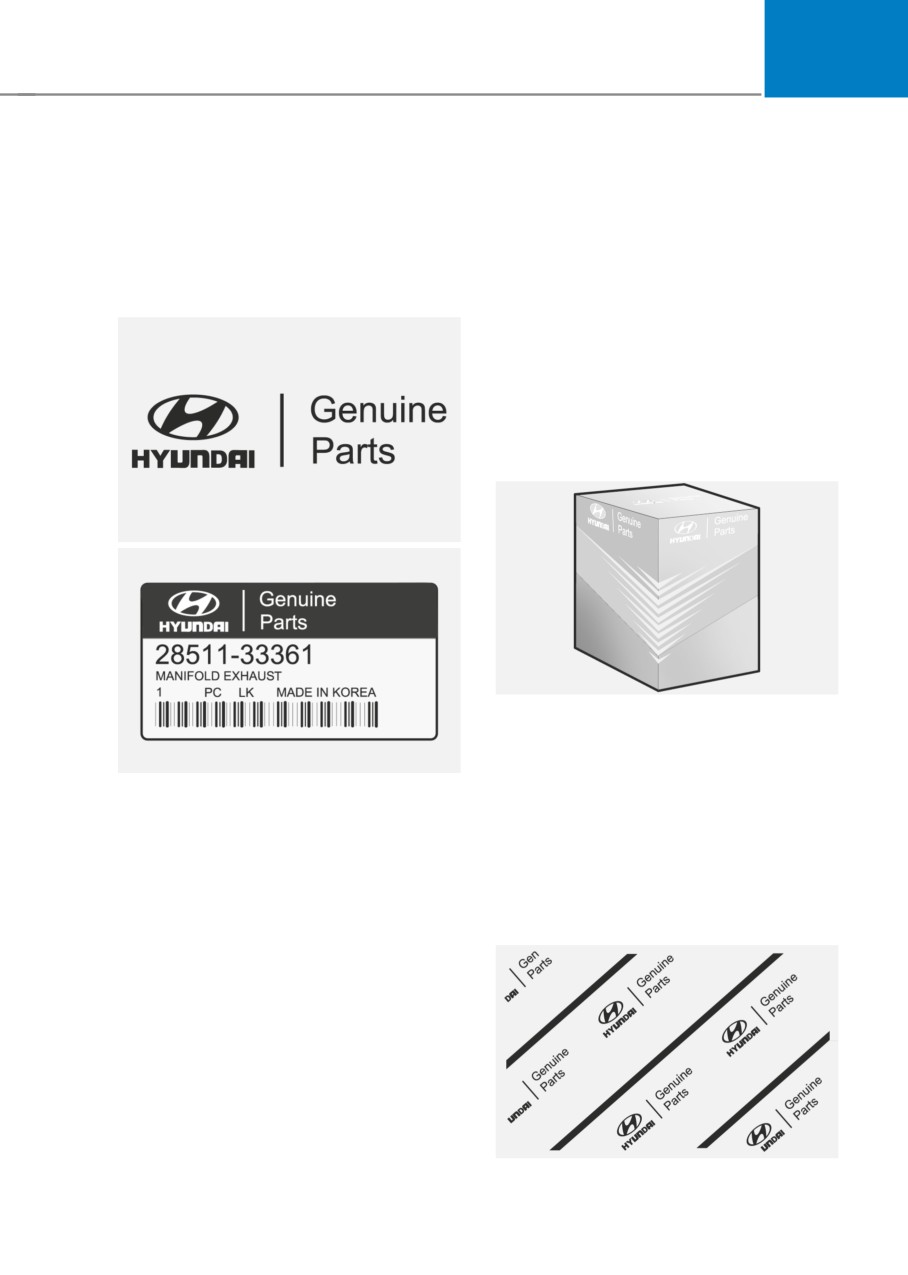
3. How can you tell if you are
purchasing HYUNDAI Genuine Parts?
Look for the HYUNDAI Genuine Parts
Logo on the package (see below).
HYUNDAI Genuine Parts exported are
packaged with labels written only in
English.
HYUNDAI Genuine Parts are only
sold through authorized HYUNDAI
Dealerships.
1-3
Foreword
HOW TO UsE THIs MANUAL
We want to help you get the greatest possible driving pleasure from your vehicle. Your
Owner’s Manual can assist you in many ways. To gain an overview of the contents
of your Owner’s Manual, use the Table of Contents in the front of the manual. The
first page of each Chapter includes a detailed Table of Contents of the topics in that
Chapter.
To quickly locate information about your vehicle, use the Index in the back of the
manual. It is an alphabetical list of what is in this manual and the page number where it
can be found.
For your convenience, we have incorporated tabs on the right-hand page edges.
These tabs are coded with the Chapter titles to assist you with navigating through the
manual.
sAFETY MEssAGEs
Your safety, and the safety of others, is very important. This Owner’s Manual provides
you with many safety precautions and operating procedures. This information alerts
you to potential hazards that may hurt you or others, as well as damage to your vehicle.
Safety messages found on vehicle labels and in this manual describe these hazards
and what to do to avoid or reduce the risks.
Warnings and instructions contained in this manual are for your safety. Failure to follow
safety warnings and instructions can lead to serious injury or death.
Throughout this manual DANGER, WARNING, CAUTION, NOTICE and the SAFETY
ALERT SYMBOL will be used.
This is the safety alert symbol. It is used to alert you to potential physical injury
hazards. Obey all safety messages that follow this symbol to avoid possible
injury or death. The safety alert symbol precedes the signal words DANGER,
WARNING and CAUTION.
DANGER
CAUTION
DANGER indicates a hazardous
CAUTION indicates a hazardous
situation which, if not avoided, will
situation which, if not avoided, could
result in death or serious injury.
result in minor or moderate injury.
NOTICE
WARNING
WARNING indicates a hazardous
NOTICE indicates a situation which,
if not avoided, could result in vehicle
situation which, if not avoided, could
result in death or serious injury.
damage.
1-4
01
FUEL REQUIREMENTs
Gasoline engine
Unleaded
Your new vehicle is designed to use only unleaded fuel having an octane number
((R+M)/2) of 87 (Research Octane Number 91) or higher. (Do not use methanol blended
fuels.)
Your new vehicle is designed to obtain maximum performance with UNLEADED FUEL,
as well as minimize exhaust emissions and spark plug fouling.
NOTICE
To prevent damage to the engine and engine components, never add any fuel
system cleaning agents to the fuel tank other than what has been specified.
Consult an authorized HYUNDAI dealer for additional information.
WARNING
• Do not “top off” after the nozzle automatically shuts off when refueling.
• Always check that the fuel cap is installed securely to prevent fuel spillage in the
event of an accident.
Gasoline containing alcohol and methanol
Gasohol, a mixture of gasoline and ethanol (also known as grain alcohol) are being
marketed along with or instead of leaded or unleaded gasoline. For example, “E15” is a
gasohol comprised of 15% ethanol and 85% gasoline.
Do not use gasohol containing more than 15% ethanol, and do not use gasoline or
gasohol containing any methanol. Either of these fuels may cause drivability problems
and damage to the fuel system, engine control system and emission control system.
Discontinue using gasohol of any kind if drivability problems occur.
“E85” fuel is an alternative fuel comprised of 85 percent ethanol and 15 percent
gasoline, and is manufactured exclusively for use in Flexible Fuel Vehicles. “E85” is
not compatible with your vehicle. Use of “E85” may result in poor engine performance
and damage to your vehicle’s engine and fuel system. HYUNDAI recommends that
customers do not use fuel with an ethanol content exceeding 15 percent.
NOTICE
To prevent damage to your vehicle’s engine and fuel system:
• Never use gasohol which contains methanol.
• Never use gasohol containing more than 15% ethanol.
• Never use leaded fuel or leaded gasohol.
• Never use “E85” fuel.
Your New Vehicle Limited Warranty does not cover damage to the fuel system or any
performance problems caused by the use of “E85” fuel.
1-5
Foreword
Using Fuel Additives (except Detergent Fuel Additives)
Using fuel additives such as:
- Silicone fuel additive
- Ferrocene (iron-based) fuel additive
- Other metallic-based fuel additives
May result in cylinder misfire, poor acceleration, engine stalling, damage to the
catalyst, or abnormal corrosion, and may cause damage to the engine resulting in a
reduction in the overall life of the powertrain.
- The Malfunction Indicator Lamp (MIL) may illuminate.
NOTICE
Damage to the fuel system or performance problem caused by the use of these fuels
may not be covered by your New Vehicle Limited Warranty.
Gasoline containing MMT
Some gasoline contains harmful manganese-based fuel additives such as MMT
(Methylcyclopentadienyl Manganese Tricarbonyl).
HYUNDAI does not recommend the use of gasoline containing MMT.
This type of fuel can reduce vehicle performance and affect your emission control
system.
The malfunction indicator lamp on the cluster may come on.
Detergent Fuel Additives
HYUNDAI recommends that you use good quality gasolines treated with detergent
additives such as TOP TIER Detergent Gasoline, which help prevent deposit formation
in the engine. These gasolines will help the engine run cleaner and enhance
performance of the Emission Control System. For more information on TOP TIER
Detergent Gasoline, please go to the website (www. toptiergas.com).
For customers who do not use TOP Tier Detergent Gasoline regularly, and have
problems starting or the engine does not run smoothly, detergent-based fuel additives
that you can purchase separately may be added to the gasoline. If TOP TIER Detergent
Gasoline is not available, one bottle of additive added to the fuel tank according to the
maintenance schedule is recommended (refer to the Maintenance Schedule in chapter
9).
Additives are available from your authorized HYUNDAI dealer along with information
on how to use them. Do not mix other additives.
Operation in foreign countries
If you are going to drive your vehicle in another country, be sure to:
• Observe all regulations regarding registration and insurance.
• Determine that acceptable fuel is available.
1-6
01
VEHICLE MODIFICATIONs
• This vehicle should not be modified. Modification of your vehicle could affect its
performance, safety or durability and may even violate governmental safety and
emissions regulations.
In addition, damage or performance problems resulting from any modification may
not be covered under warranty.
• If you use unauthorized electronic devices, it may cause the vehicle to operate
abnormally, wire damage, battery discharge and fire. For your safety, we
recommend that you do not use unauthorized electronic devices.
Vehicle break-in process
By following a few simple precautions for the first 1,000km (600 miles) you may add to
the performance, economy and life of your vehicle.
• Do not race the engine.
• While driving, keep your engine speed (rpm, or revolutions per minute) between
2,000 rpm and 4,000 rpm.
• Do not maintain a single speed for long periods of time, either fast or slow. Varying
engine speed is needed to properly break-in the engine.
• Avoid hard stops, except in emergencies, to allow the brakes to seat properly.
• Fuel economy and engine performance may vary depending on vehicle break-in
process and be stabilized after 6,000 km (3,700 miles). New engines may consume
more oil during the vehicle break-in period.
1-7
Foreword
VEHICLE DATA COLLECTION AND EVENT DATA RECORDERs
This vehicle is equipped with an event data recorder (EDR). The main purpose of
an EDR is to record, in certain crash or near crash-like situations, such as an air bag
deployment or hitting a road obstacle, data that will assist in understanding how a
vehicle’s systems performed. The EDR is designed to record data related to vehicle
dynamics and safety systems for a short period of time, typically 30 seconds or less.
The EDR in this vehicle is designed to record such data as:
• How various systems in your vehicle were operating;
• Whether or not the driver and passenger safety belts were buckled/fastened;
• How far (if at all) the driver was depressing the accelerator and/or brake pedal; and,
• How fast the vehicle was traveling.
These data can help provide a better understanding of the circumstances in which
crashes and injuries occur. NOTE: EDR data are recorded by your vehicle only if a
non-trivial crash situation occurs; no data are recorded by the EDR under normal
driving conditions and no personal data (e.g., name, gender, age, and crash location)
are recorded. However, other parties, such as law enforcement, could combine the
EDR data with the type of personally identifying data routinely acquired during a crash
investigation.
To read data recorded by an EDR, special equipment is required, and access to the
vehicle or the EDR is needed. In addition to the vehicle manufacturer, other parties,
such as law enforcement, that have the special equipment, can read the information if
they have access to the vehicle or the EDR.
1-8
2. Vehicle Information and
Reporting Safety Defects
Exterior overview (I)
2-2
Exterior overview (II)
2-4
Interior overview (I)
2-6
Interior overview (II)
2-7
Engine compartment
2-8
Dimensions
2-9
Engine
2-9
2
Bulb wattage
2-10
Tires and wheels
2-11
Air conditioning system
2-12
Volume and weight
2-12
Recommended lubricants and capacities
2-13
Recommended SAE viscosity number
2-14
Vehicle Identification Number (VIN)
2-15
Vehicle certification label
2-15
Tire specification and pressure label
2-15
Engine number
2-16
Refrigerant label
2-16
Reporting safety defects
2-17
Vehicle Information and Reporting Safety Defects
ExtErior ovErviEw (i)
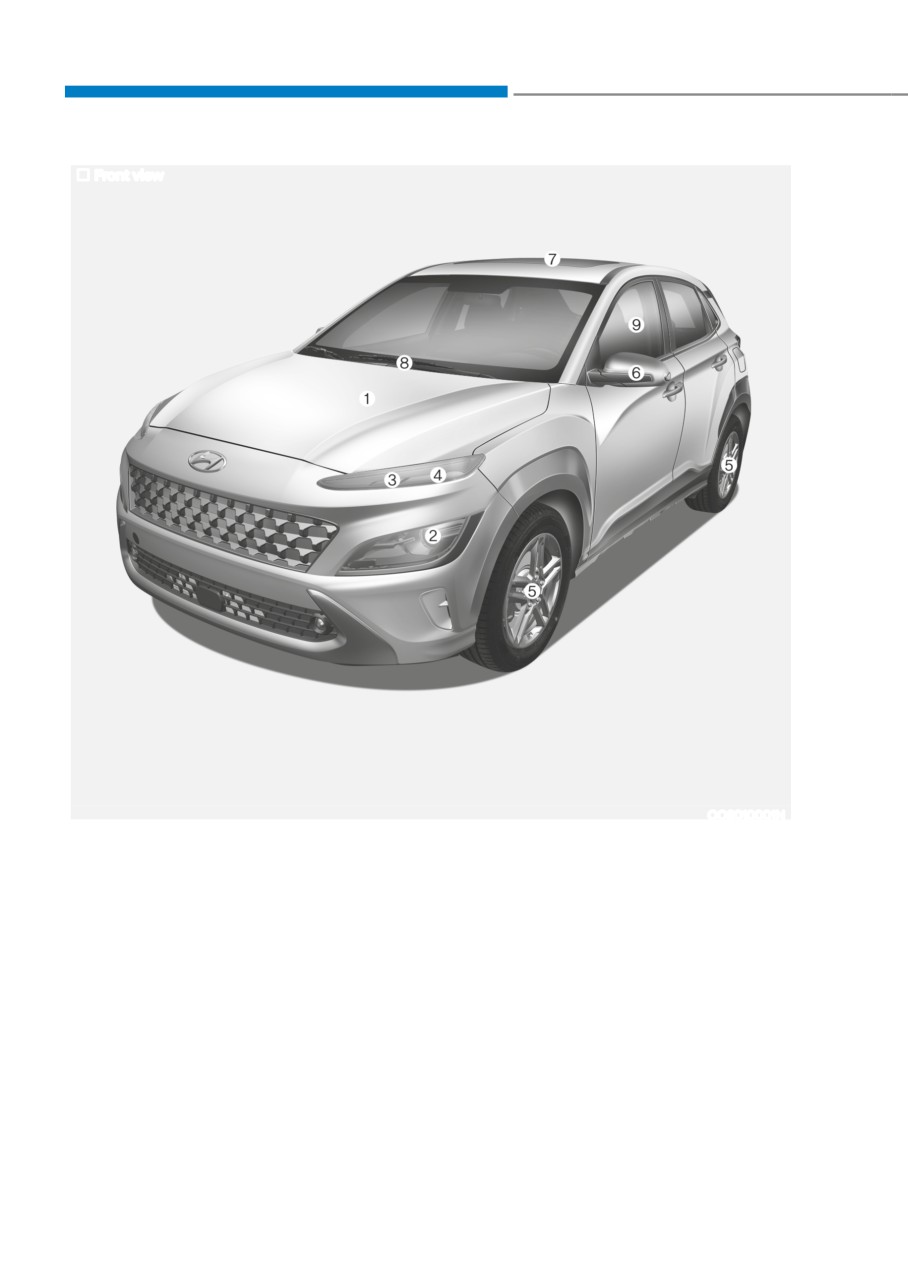
Front view
The actual shape may differ from the illustration.
OOS010001N
1. Hood
5-46
6. Side view mirror
5-35
2. Head lamp
9-60
7. Sunroof
5-42
3. DRL (Daytime Running Light)
9-60
8. Front windshield wiper blades
9-28
4. Turn signal lamp
9-60
9. Windows
5-38
5. Tires and wheels
9-34
2-2
02
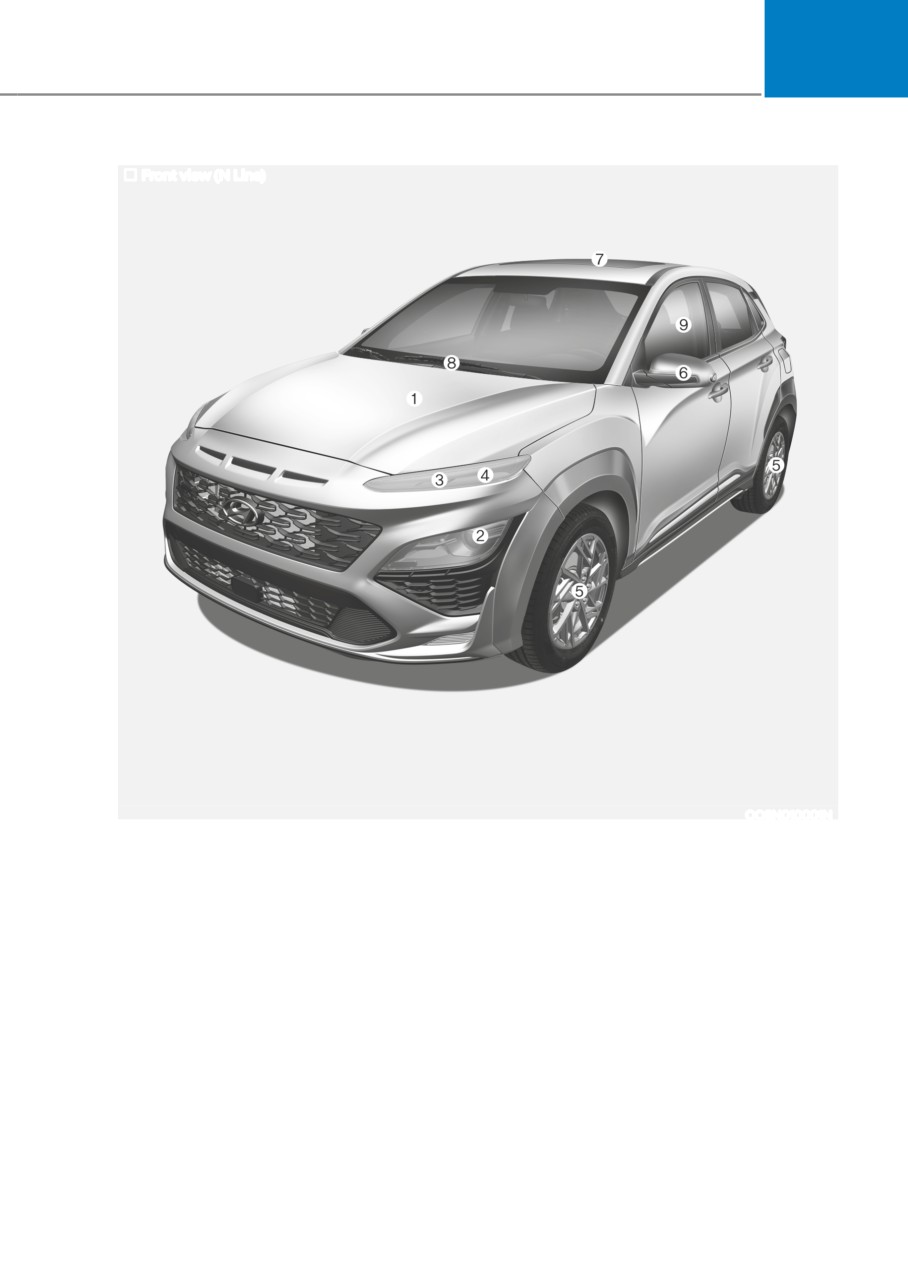
Front view (N Line)
The actual shape may differ from the illustration.
OOSN010001N
1. Hood
5-46
6. Side view mirror
5-35
2. Head lamp
9-60
7. Sunroof
5-42
3. DRL (Daytime Running Light)
9-60
8. Front windshield wiper blades
9-28
4. Turn signal lamp
9-60
9. Windows
5-38
5. Tires and wheels
9-34
2-3
Vehicle Information and Reporting Safety Defects
ExtErior ovErviEw (ii)
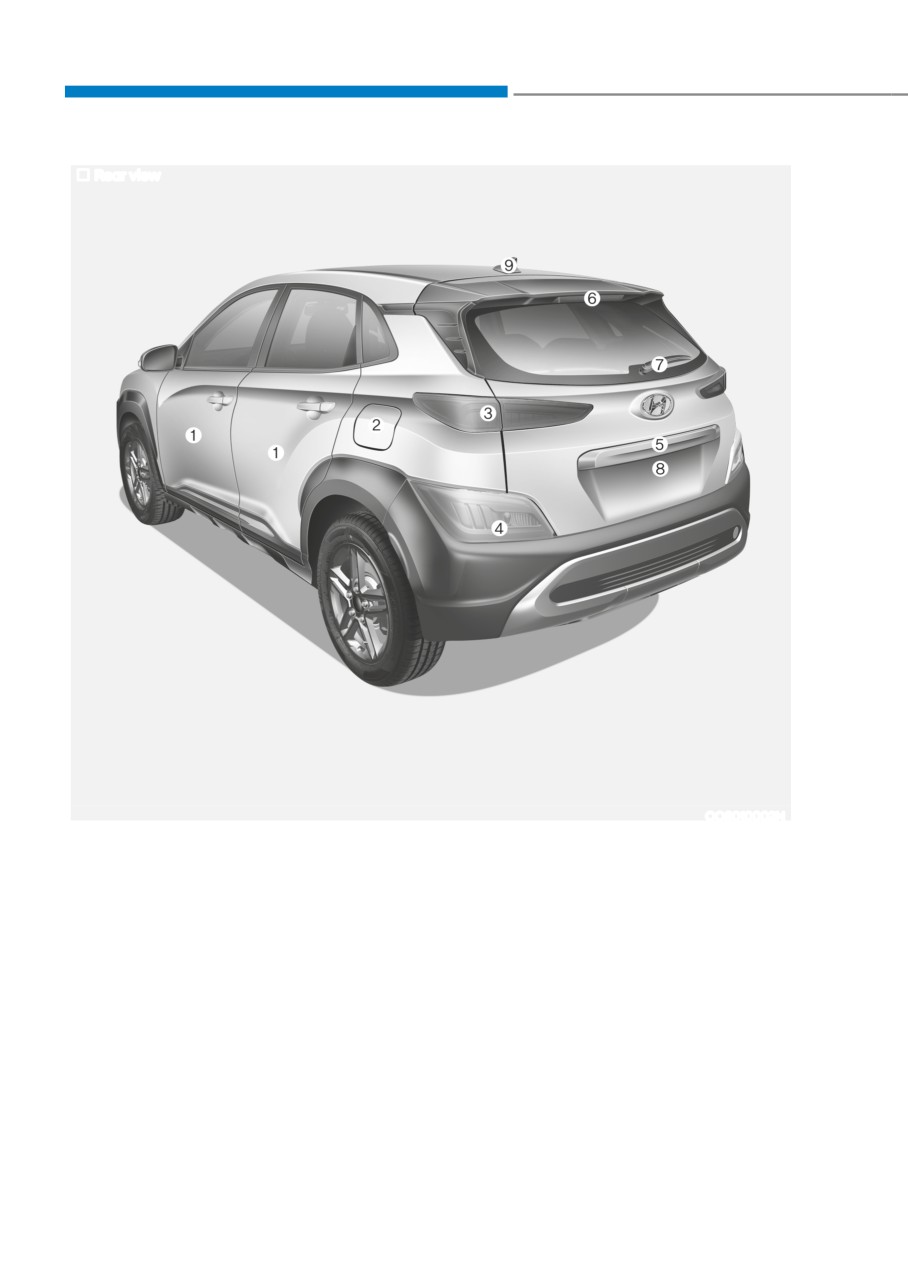
Rear view
The actual shape may differ from the illustration.
OOS010002N
1. Door
5-15
6. High mounted stop lamp
9-66
2. Fuel filler door
5-50
7. Rear window wiper blade
9-29
3. Rear combination lamp
9-64
8. Rear view camera
7-96
4. Turn signal lamp, Reverse lamp
9-64
9. Antenna
5-102
5. Liftgate
5-47
2-4
02
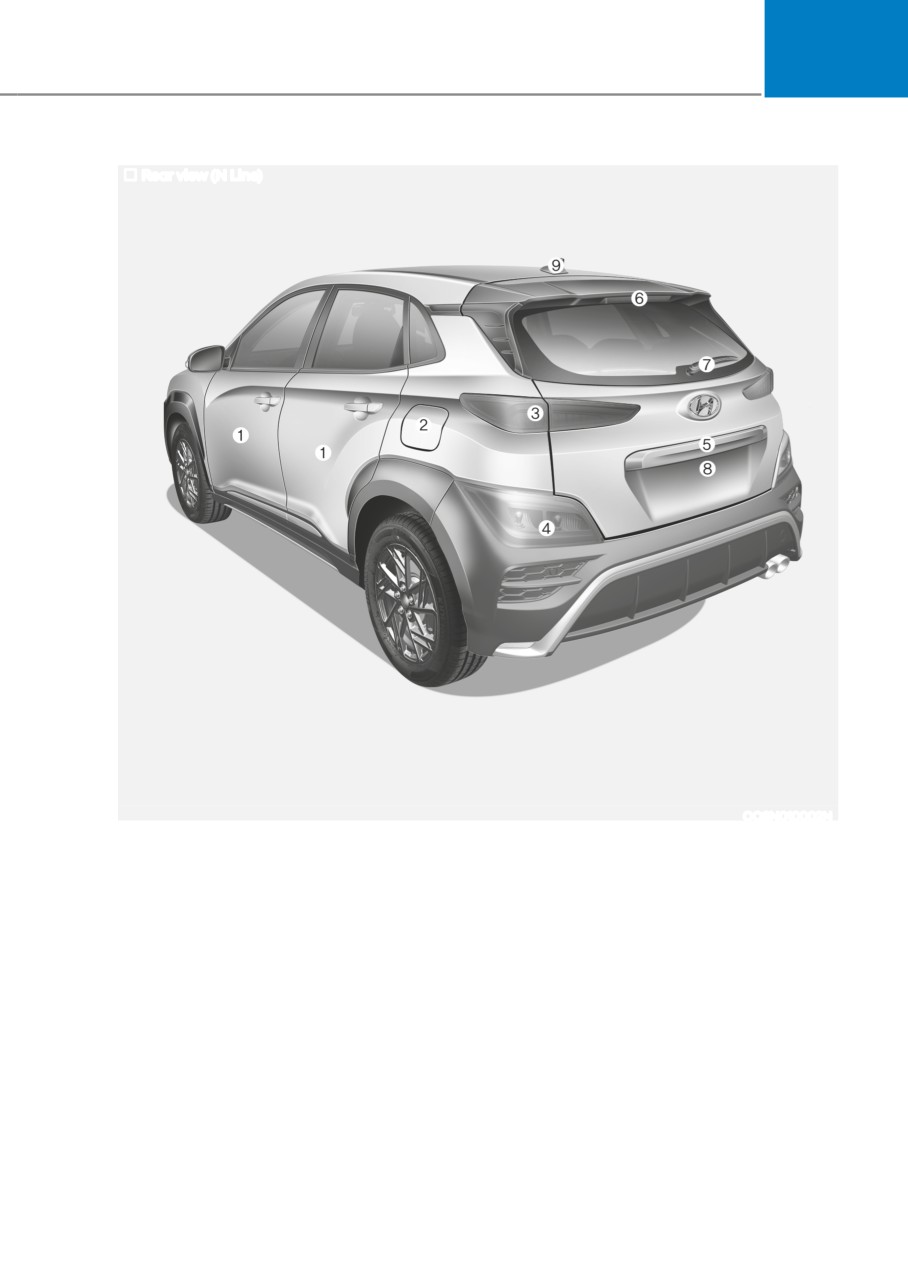
Rear view (N Line)
The actual shape may differ from the illustration.
OOSN010002N
1. Door
5-15
6. High mounted stop lamp
9-66
2. Fuel filler door
5-50
7. Rear window wiper blade
9-29
3. Rear combination lamp
9-64
8. Rear view camera
7-96
4. Turn signal lamp, Reverse lamp
9-64
9. Antenna
5-102
5. Liftgate
5-47
2-5
Vehicle Information and Reporting Safety Defects
intErior ovErviEw (i)
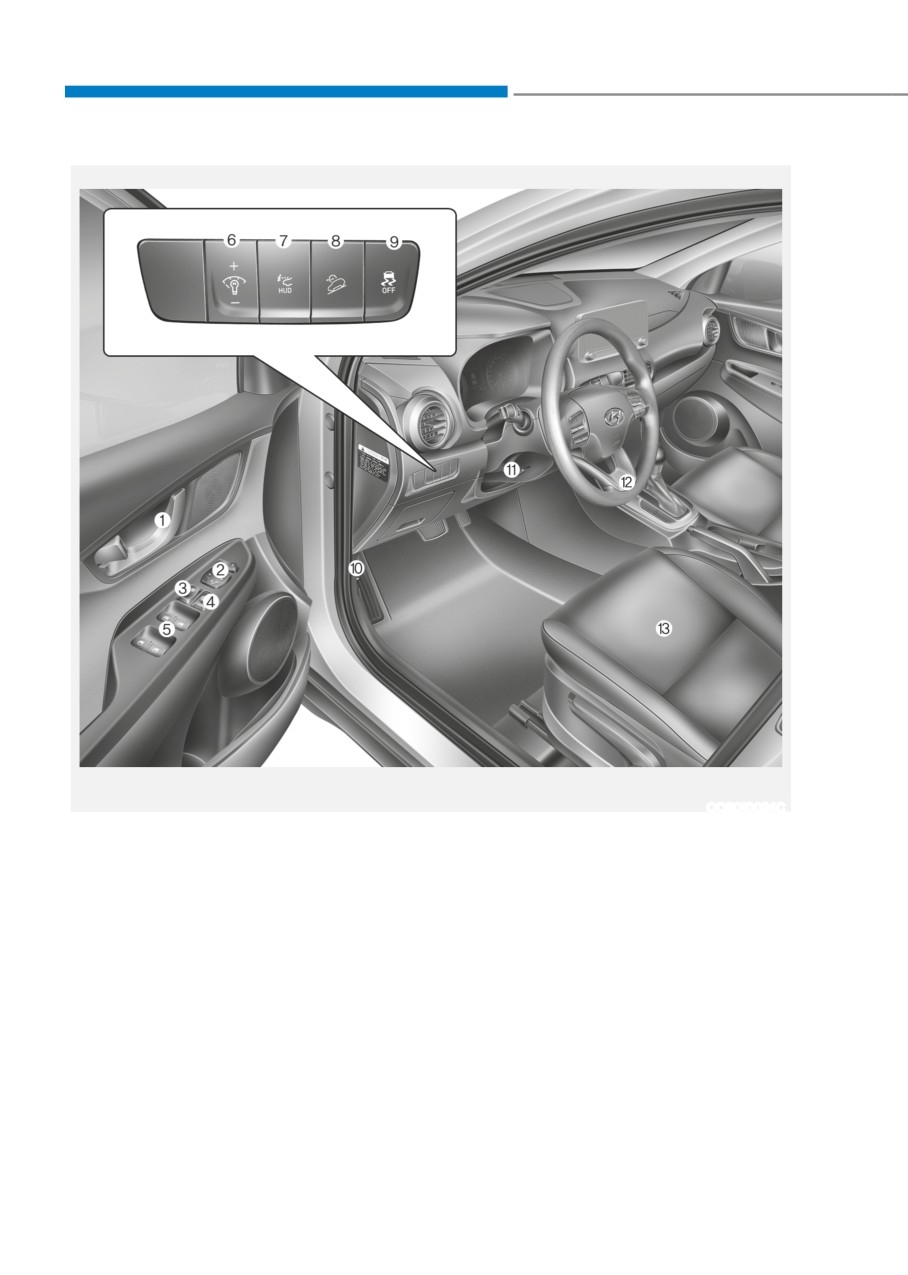
The actual shape may differ from the illustration.
OOS010024C
1. Inside door handle
5-16
7. Head-up display button
5-52
2. Side view mirror control
5-37
8. DBC button
6-42
3. Central door lock switch
5-17
9. ESC OFF button
6-38
4. Power window lock switch
5-41
10. Hood release lever…
5-46
5. Power window switches
5-38
11. Steering wheel tilt/telescopic lever
5-22
6. Instrument panel illumination
12. Steering wheel
5-21
control switch
4-5
13. Seat
3-3
2-6
02
intErior ovErviEw (ii)
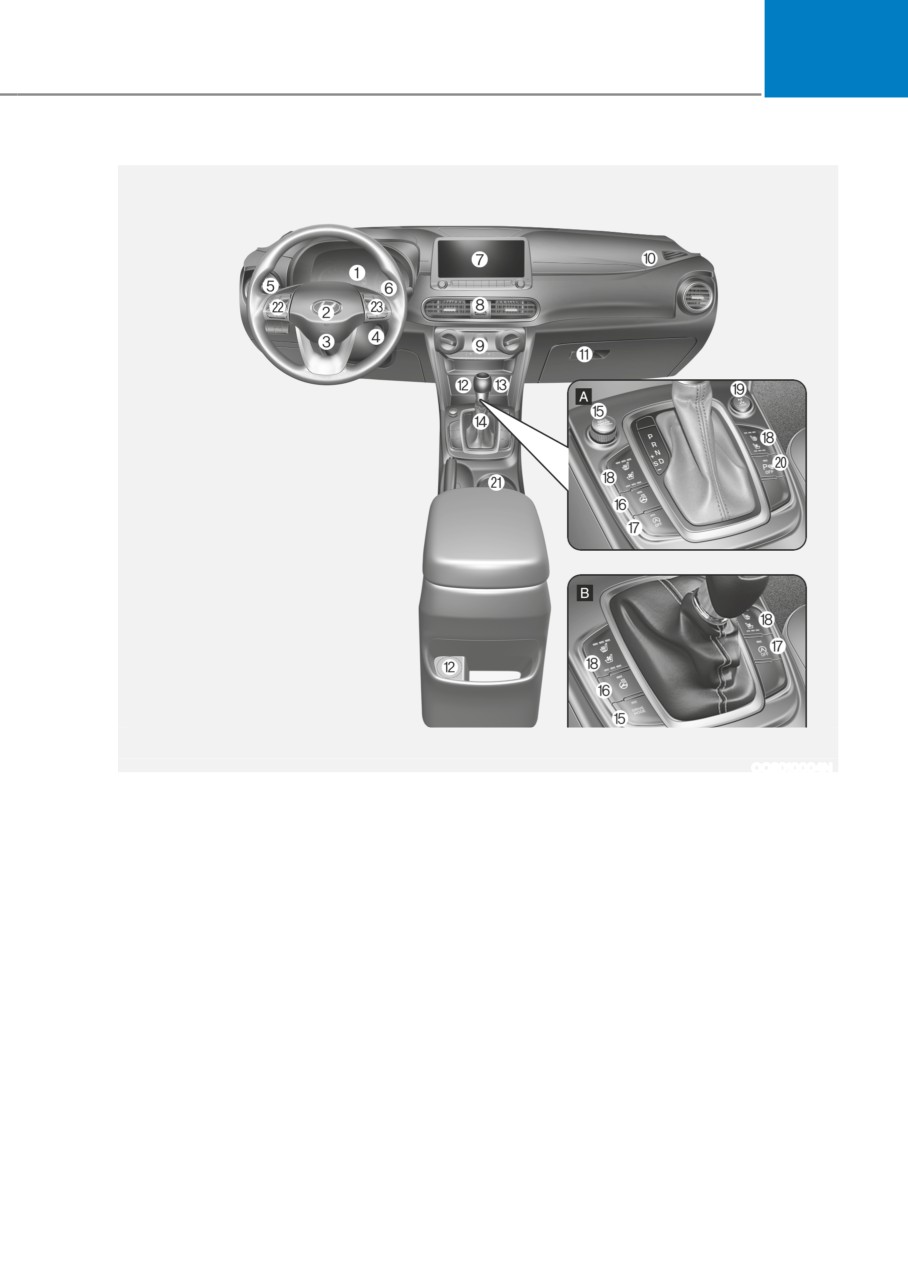
The actual shape may differ from the illustration.
OOS010004N
1. Instrument cluster
4-4
15. Drive mode button
6-58
2. Horn
5-23
16. Heated steering wheel
5-23
3. Driver’s front air bag
3-42
17. Idle stop and go (ISG) OFF button
6-53
4. Engine Start/Stop button
6-8
18. Seat warmer/Air ventilation seat
3-16
5. Light control/Turn signals
5-54
19. 4WD lock button
6-46
6. Wiper/Washer
5-64
20.Parking Safety button…………
7-108
7. Infotainment system
5-103
21. Cup holder
5-93
8. Hazard warning flasher switch
8-2
22. Steering wheel audio controls/
5-103
9. Manual climate control system
5-68
Bluetooth® wireless technology hands-free
Automatic climate control system
5-76
controls
5-104
10. Passenger’s front air bag
3-42
23. Driving Assist button/
7-62
11. Glove box
5-90
Lane Driving Assist button/
7-28
12. USB port
5-102
Headway
7-62
13. Power outlet
5-94
14. Dual clutch transmission shift lever
6-18
Intelligent variable transmission shift
lever
6-12
2-7
Vehicle Information and Reporting Safety Defects
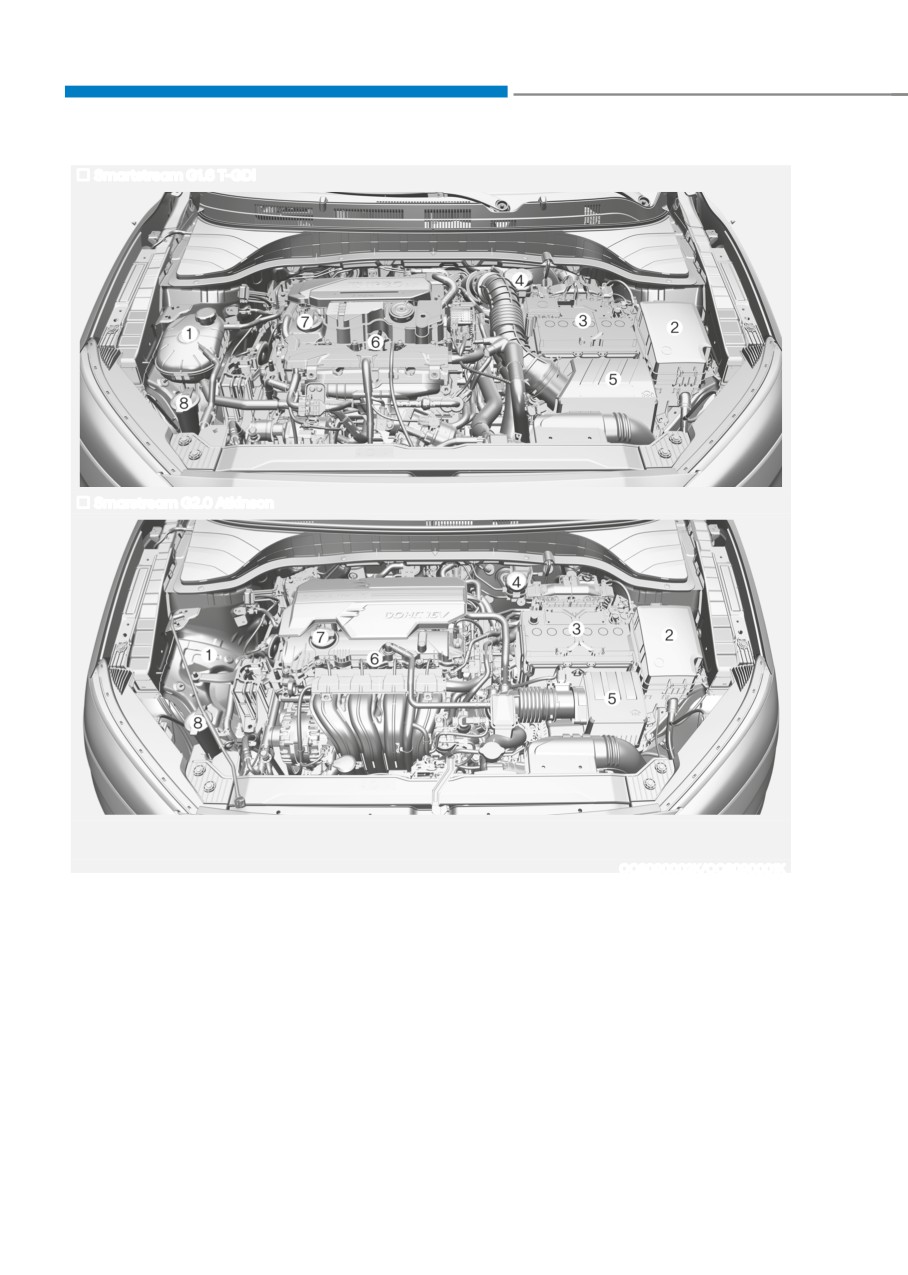
EnginE compartmEnt
Smartstream G1.6 T-GDi
Smarstream G2.0 Atkinson
The actual engine compartment in the vehicle may differ from the illustration.
OOS090002K/OOS090001K
1. Engine coolant reservoir
9-20
5. Air cleaner
9-25
Engine coolant cap
9-20
6. Engine oil dipstick
9-17
2. Fuse box
9-48
7. Engine oil filler cap
9-18
3. Battery
9-30
8. Windshield washer fluid reservoir
9-24
4. Brake fluid reservoir
9-23
2-8
02
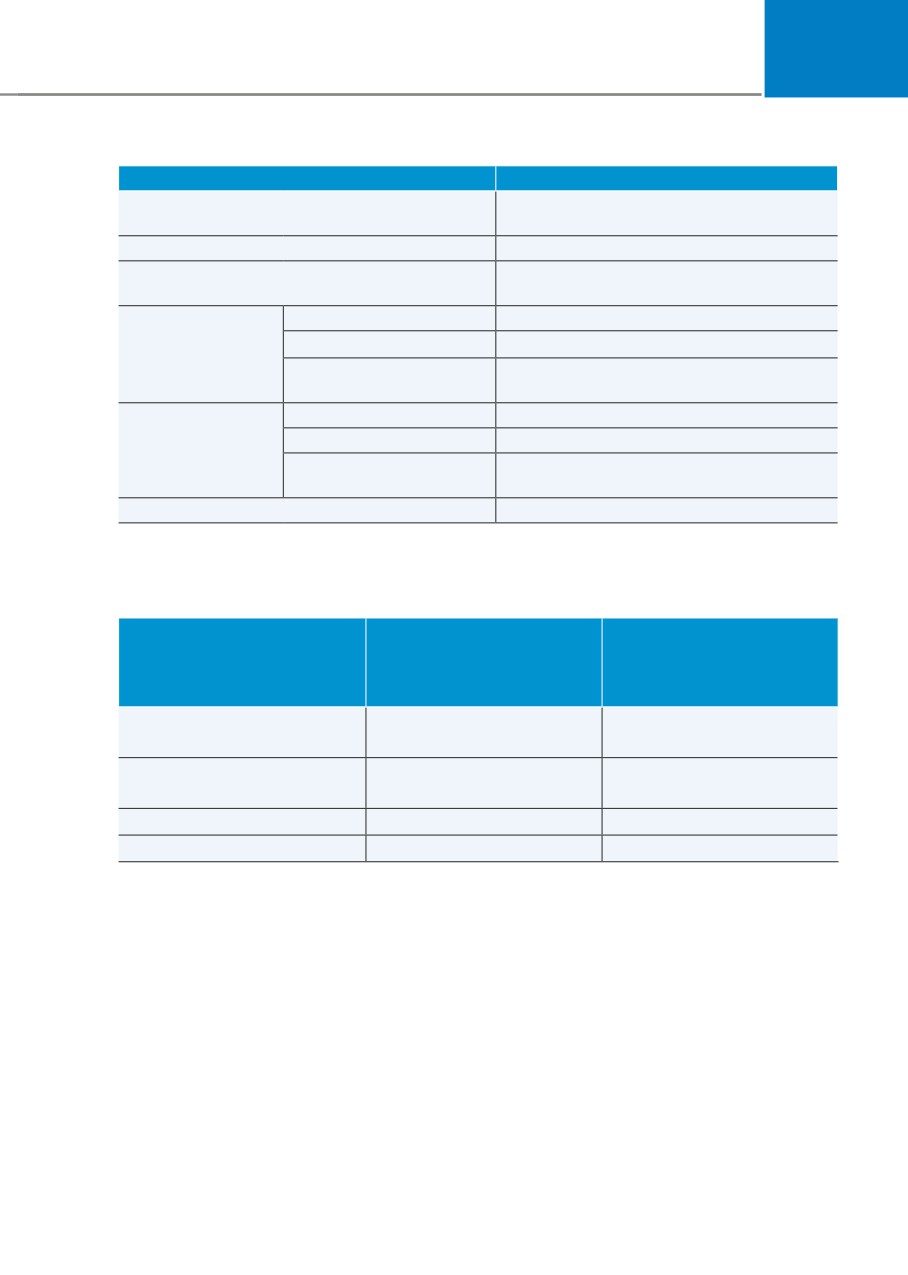
DimEnsions
Items
mm (in)
4,205 (165.55)
Overall length
N Line: 4,215 (165.94)
Overall width
1800 (70.86)
1550 (61.02) / 1565 (61.61)*1
Overall height
N Line: 1,560 (61.42 ) / 1,570 (61.81)*1
205/60 R16
1575 (62.0)
215/55 R17
1563 (61.53)
Front tread
1559 (61.37)
235/45 R18
N Line: 1,559 (61.73)
205/60 R16
1584 (62.36)
215/55 R17
1572 (61.88)
Rear tread
1568 (61.73)
235/45 R18
N Line: 1,568 (61.73)
Wheelbase
2600 (102.36)
*1 : with roof rack
EnginE
Engine
Smartstream G1.6 T-GDi
Smartstrem G2.0 Atkinson
Displacement
1598 (97.5)
1999 (121.9)
cc (cu. in)
Bore x Stroke
2.98 X 3.5 (75.6 X 89.0)
81.0 x 97.0 (3.18 x 3.81)
mm (in.)
Firing order
1-3-4-2
1-3-4-2
No. of cylinders
In-line 4 cylinder
In-line 4 cylinder
2-9
Vehicle Information and Reporting Safety Defects
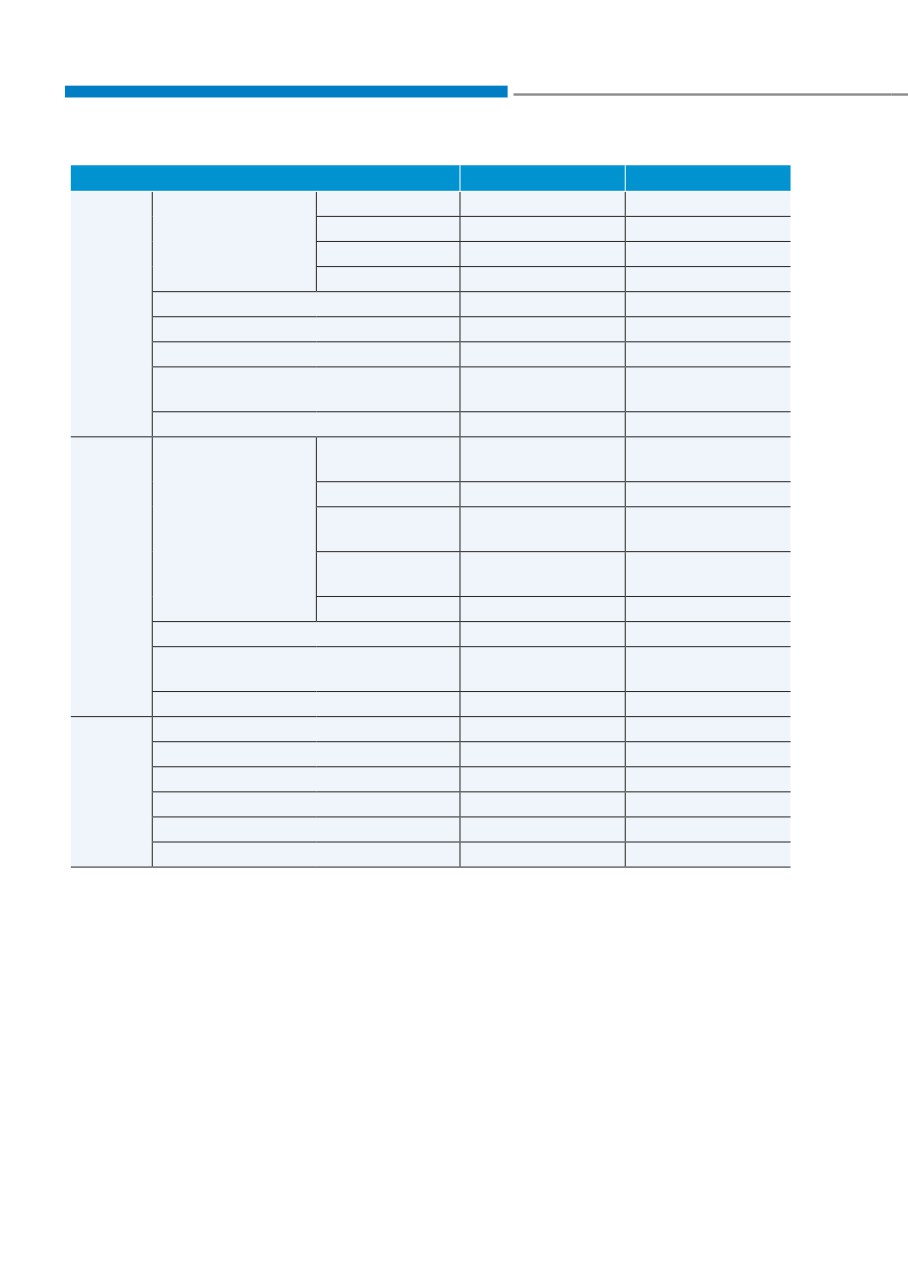
BulB wattagE
Light Bulb
Bulb Type
Wattage
Low (Type A)
9005HL+
60W
High (Type A)
9005HL+
60W
Headlamp
Low (Type B)
LED
LED
High (Type B)
LED
LED
Turn signal lamp
P28/8W
28W
Front
Side marker
LED
LED
Turn signal lamp (Outside mirror)
LED
LED
Daytime running lamp (DRL) /
LED
LED
position lamp
Fog lamp
HB4
55W
Stop/Tail
P21/5W
STOP : 21, TAIL : 5
(Type A)
Tail (Type A)
W5W
5W
Rear combination
Stop/Tail
LED
LED
lamp
(Type B)
TYPE A:PY21W,
TYPE A:21W,
Rear
Turn signal
TYPE B:LED
TYPE B:LED
Reverse lamp
P21W
21
High mounted stop lamp
LED
LED
TYPE A:W5W,
TYPE A:5W,
Side marker
TYPE B:LED
TYPE B:LED
License plate lamp
W5W
5
Map lamp
W10W
10
Room lamp (with sunroof)
FESTOON
8
Room lamp (without sunroof)
FESTOON
10
Interior
Sunvisor lamp
FESTOON
5
Tailgate room lamp
FESTOON
10
Glove box lamp
FESTOON
5
2-10
02
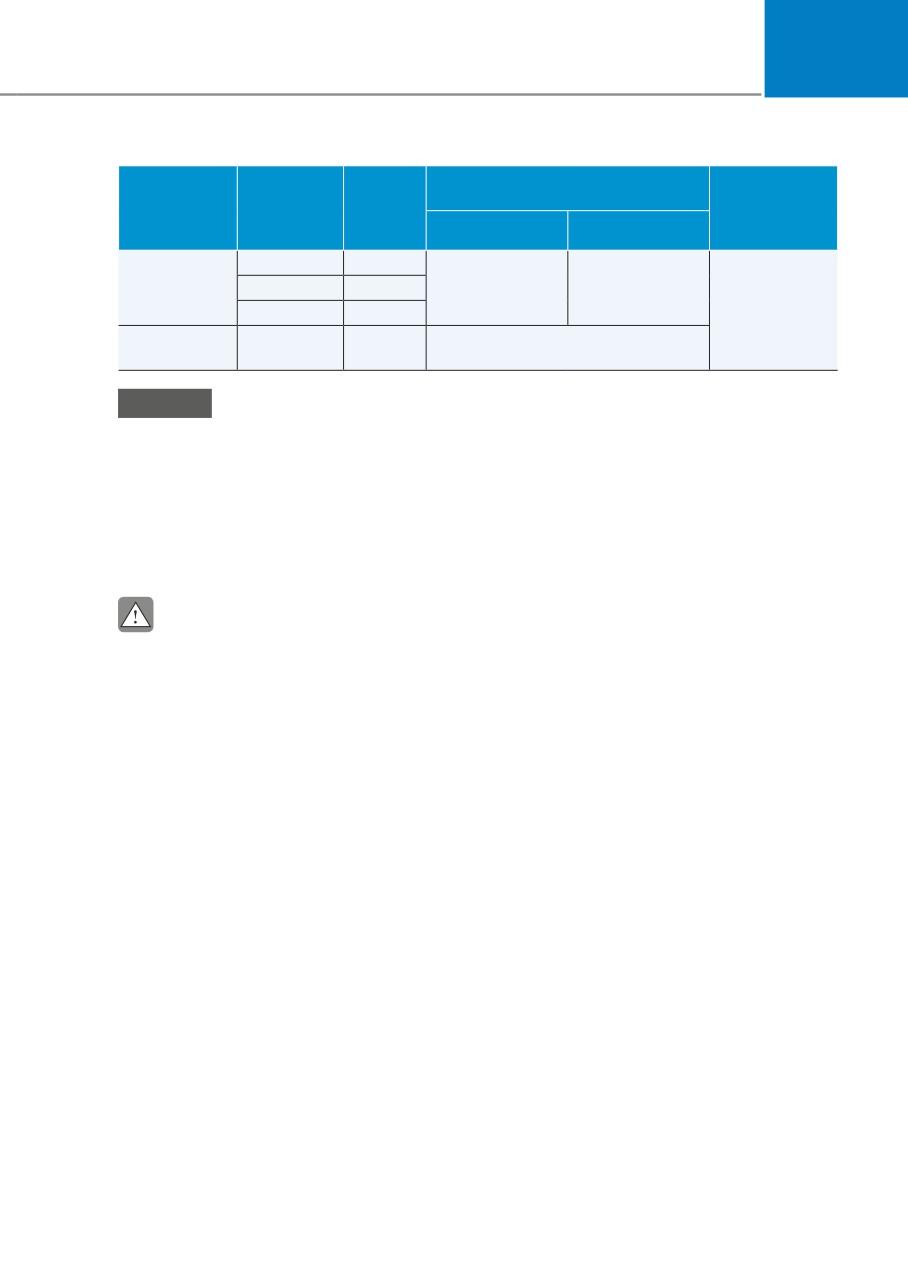
tirEs anD whEEls
Cold tire inflation pressure
Wheel bolt
Wheel
kPa (psi)
torque
Items
Tire size
size
kgf·m (lbf·ft,
Front
Rear
N·m)
205/60 R16
6.5J x 16
Full size tire
215/55 R17
7.0J x 17
230 (33)
230 (33)
11~13
235/45 R18
7.5J x 18
(79~94,
107~127)
Compact
T125/80 D16
4.0T x 16
420 (60)
spare tire
NOTICE
• It is permissible to add 3 psi to the standard tire pressure specification if colder
temperatures are expected soon.
Tires typically lose 1psi (7kPa) for every 7°C temperature drop. If extreme
temperature variations are expected, recheck your tire pressure as necessary to
keep them properly inflated.
• Tire inflation pressures will vary with changes in elevation. If driving in areas of
higher or lower elevation, be sure to check and adjust for proper tire inflation.
CAUTION
• When replacing tires, use the same size originally supplied with the vehicle.
Using tires of a different size can damage the related parts or not work properly.
• When replacing tires, ALWAYS use the same size, type, construction and tread
pattern supplied with the vehicle for all tires.
2-11
Vehicle Information and Reporting Safety Defects
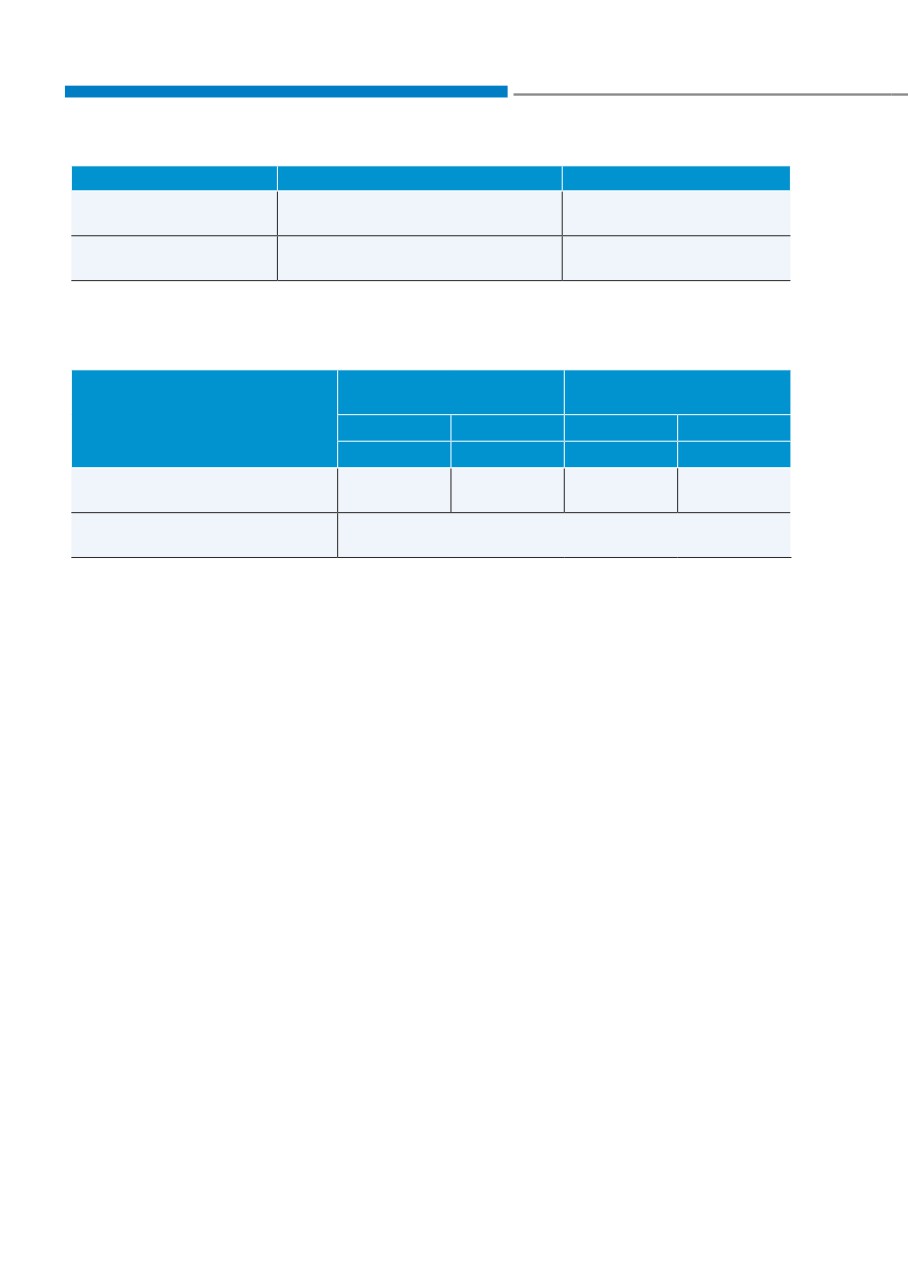
air conDitioning systEm
Items
Weight of volume
Classification
Refrigerant
450 (15.87) ± 25 (0.88)
R-1234yf
g (oz.)
Compressor lubricant
120 (4.23) ± 10 (0.35)
PAG
g (oz.)
Contact an authorized HYUNDAI dealer for more details.
VolumE anD wEight
Smart-stream G2.0
Smartstream G 1.6T-GDi
Atkinson
Items
2WD
4WD
2WD
4WD
DCT
DCT
IVT
IVT
Gross vehicle weight
1,855
1,915
1,800
1,875
kg (lbs.)
(4,090)
(4,222)
(3,968)
(4,134)
Luggage volume (VDA)
MIN : 361 (12.75)
ℓ (cu ft.)
MAX : 1,143 (40.36)
DCT : Dual clutch transmission
IVT : Intelligent variable transmission
MIN : Behind rear seat to upper edge of the seat back.
MAX : Behind front seat to roof.
2-12
02
rEcommEnDED luBricants anD capacitiEs
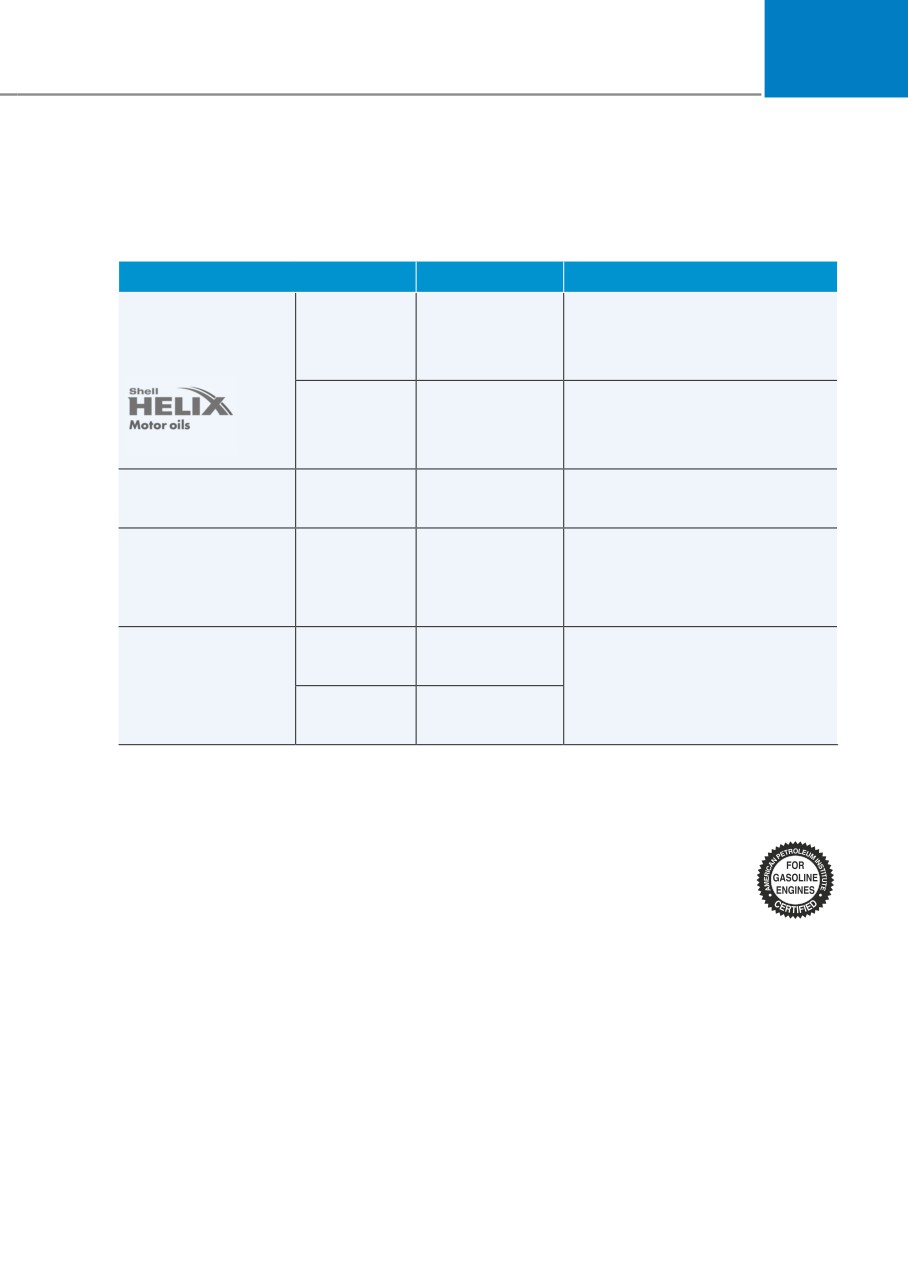
To help achieve proper engine and powertrain performance and durability, use only
lubricants of the proper quality. The correct lubricants also help promote engine
efficiency that results in improved fuel economy.
These lubricants and fluids are recommended for use in your vehicle.
Lubricant
Volume
Classification
Engine oil *1 *3
(drain and refill)
Smartstream
4.8 ℓ
SAE 0W-20, API SN PLUS/SP or
G1.6 T-GDi
(5.1 US qt.)
ILSAC GF-6 *2
Recommends
Smartstream
4.3 ℓ
SAE 0W-20, API SN PLUS/SP or
G2.0 Atkinson
(4.5 US qt.)
ILSAC GF-6 *2
Intelligent variable
Smartstream
6.7 ℓ
SP-CVT1
transmission fluid
G2.0 Atkinson
(7.1 US qt.)
API GL-4, SAE 70W
HK D DCTF TGO-10 (SK)
Dual clutch
Smartstream
1.6~1.7 ℓ
SPIRAX S6 GHDE 70W
transmission fluid
G1.6 T-GDi
(1.7~1.8 US qt. )
DCTF (H.K.SHELL)
7 DCTF HKM (S-OIL)
Smartstream
6.9 ℓ
Mixture of antifreeze and distilled
G1.6 T-GDi
(7.3 US qt.)
water (Ethylene-glycol with
Coolant
phosphate based coolant for
Smartstream
6.0 ℓ
aluminum radiator)
G2.0 Atkinson
(6.3 US qt.)
*1 : Refer to the recommended SAE viscosity numbers on the next page.
*2 : Requires < API SN PLUS (or above) Full synthetic> grade engine oil. If a lower grade
engine oil (mineral oil including Semi-synthetic) is used, then the engine oil and engine
oil filter must be replaced as indicated severe maintenance condition.
*3 : An engine oil displaying this American Petroleum Institute(API) Certification
Mark conforms to the International Lubricant Specification Advisory
Committee (ILSAC). It is recommended to only use engine oils that uphold
this API Certification Mark.
2-13
Vehicle Information and Reporting Safety Defects
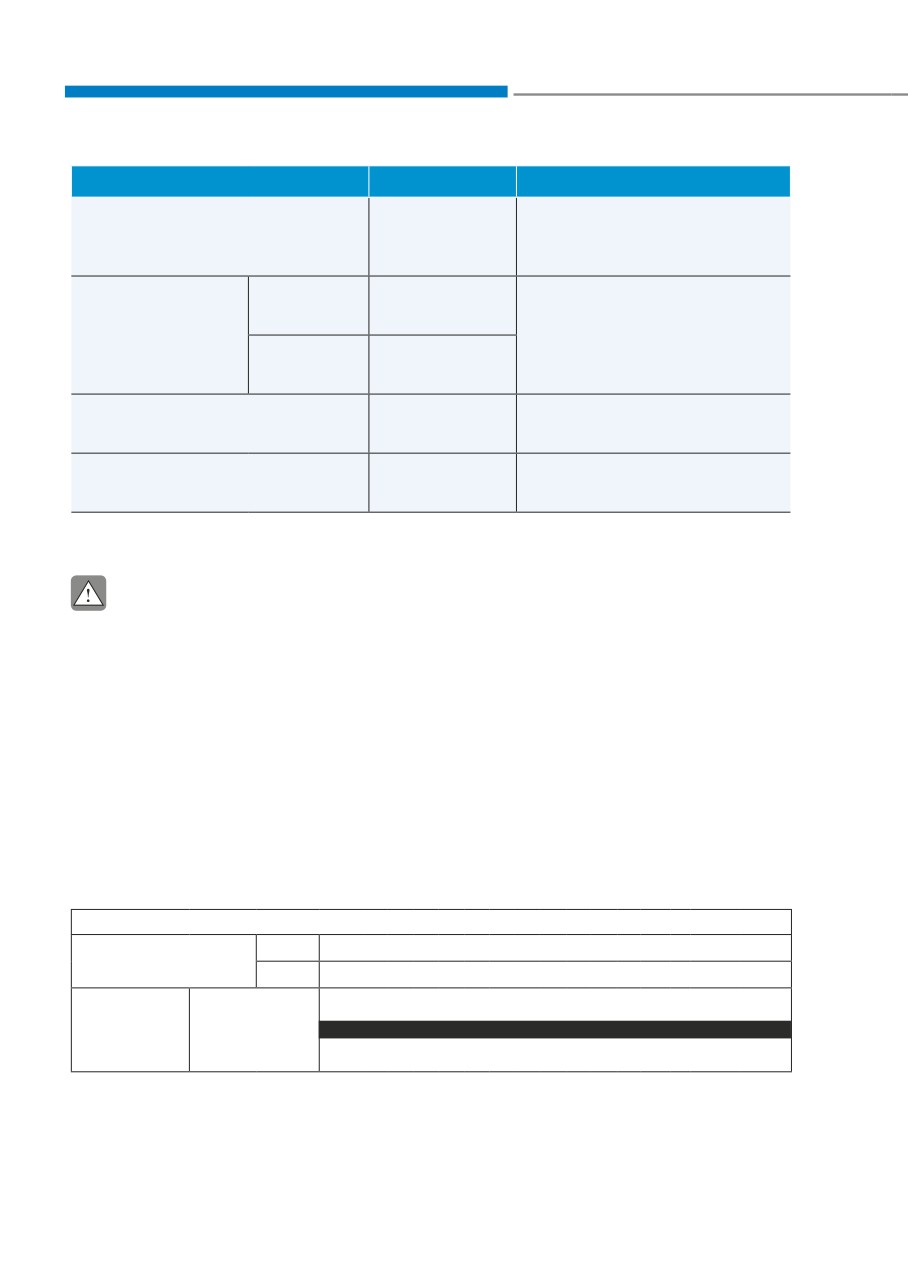
Lubricant
Volume
Classification
HYPOID GEAR OIL API GL-5,
0.47 ~ 0.52 ℓ
SAE75W/90
Rear differential oil (4WD)
(0.5 ~ 0.55 US qt.)
(SHELL HD AXLE OIL 75W90 or
equivalent)
Smartstream
0.47~0.52 ℓ
G1.6 T-GDi
(0.49~0.55 US qt.)
HYPOID GEAR OIL API GL-5,
Transfer case oil
SAE 75W85(SK HCT-5 GEAR OIL
(4WD)
Smartstream
0.38 ~ 0.42 ℓ
75W85 or EQUIVALENT)
G2.0 Atkinson
(0.4 ~ 0.44 US qt.)
SAE J1704 DOT-4 LV,
0.7 ~ 0.8 ℓ
Brake fluid
FMVSS 116 DOT-4,
(0.5 ~ 0.6 US qt.)
ISO4925 CLASS-6
50 ℓ
Refer to “Fuel Requirements” in
Fuel
(13.21 US gal.)
the Introduction chapter.
Recommended SAE viscosity number
CAUTION
Always be sure to clean the area around any filler plug, drain plug, or dipstick before
checking or draining any lubricant. This is especially important in dusty or sandy
areas and when the vehicle is used on unpaved roads. Cleaning the plug and dipstick
areas will prevent dirt and grit from entering the engine and other mechanisms that
could be damaged.
Engine oil viscosity (thickness) has an effect on fuel economy and cold weather
operating (engine start and engine oil flowability). Lower viscosity engine oils can
provide better fuel economy and cold weather performance, however, higher viscosity
engine oils are required for satisfactory lubrication in hot weather. Using oils of any
viscosity other than those recommended could result in engine damage.
When choosing an oil, consider the range of temperature your vehicle will be operated
in before the next oil change. Proceed to select the recommended oil viscosity from
the chart.
Temperature Range for SAE Viscosity Numbers
°C
-30
-20
-10
0
10
20
30
40
50
Temperature
(°F)
-10
0
20
40
60
80
100
120
Smartstream
G1.6 T-GDI
Engine Oil
0W-20
/Smartstream
G2.0 Atkinson
2-14
02
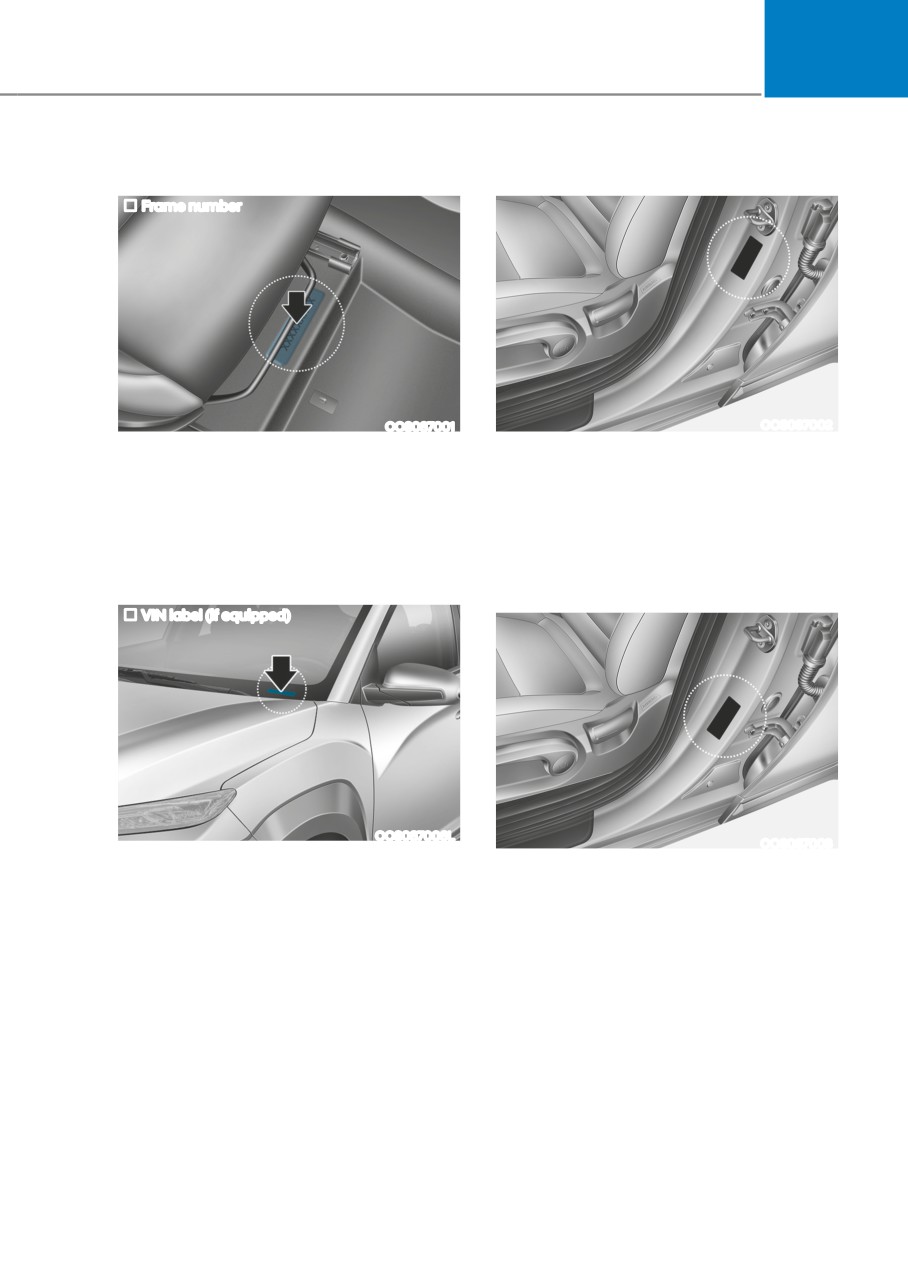
VEhiclE iDEntification
VEhiclE cErtification
numbEr (vin)
laBEl
Frame number
OOS087001
OOS087002
The vehicle identification number (VIN)
The vehicle certification label attached
is the number used in registering your
on the driver’s (or front passenger’s)
vehicle and in all legal matters pertaining
side center pillar gives the vehicle
to its ownership, etc.
identification number (VIN).
The number is punched on the floor
under the passenger seat. To check the
tirE spEcification anD
number, open the cover.
prEssurE laBEl
VIN label (if equipped)
OOS087006L
OOS087003
The VIN is also on a plate attached to
The tires supplied on your new
the top of the left side dashboard. The
vehicle are chosen to provide the best
number on the plate can easily be seen
performance for normal driving.
through the windshield from outside.
The tire label located on the driver’s
side center pillar gives the tire pressures
recommended for your vehicle.
2-15
Vehicle Information and Reporting Safety Defects
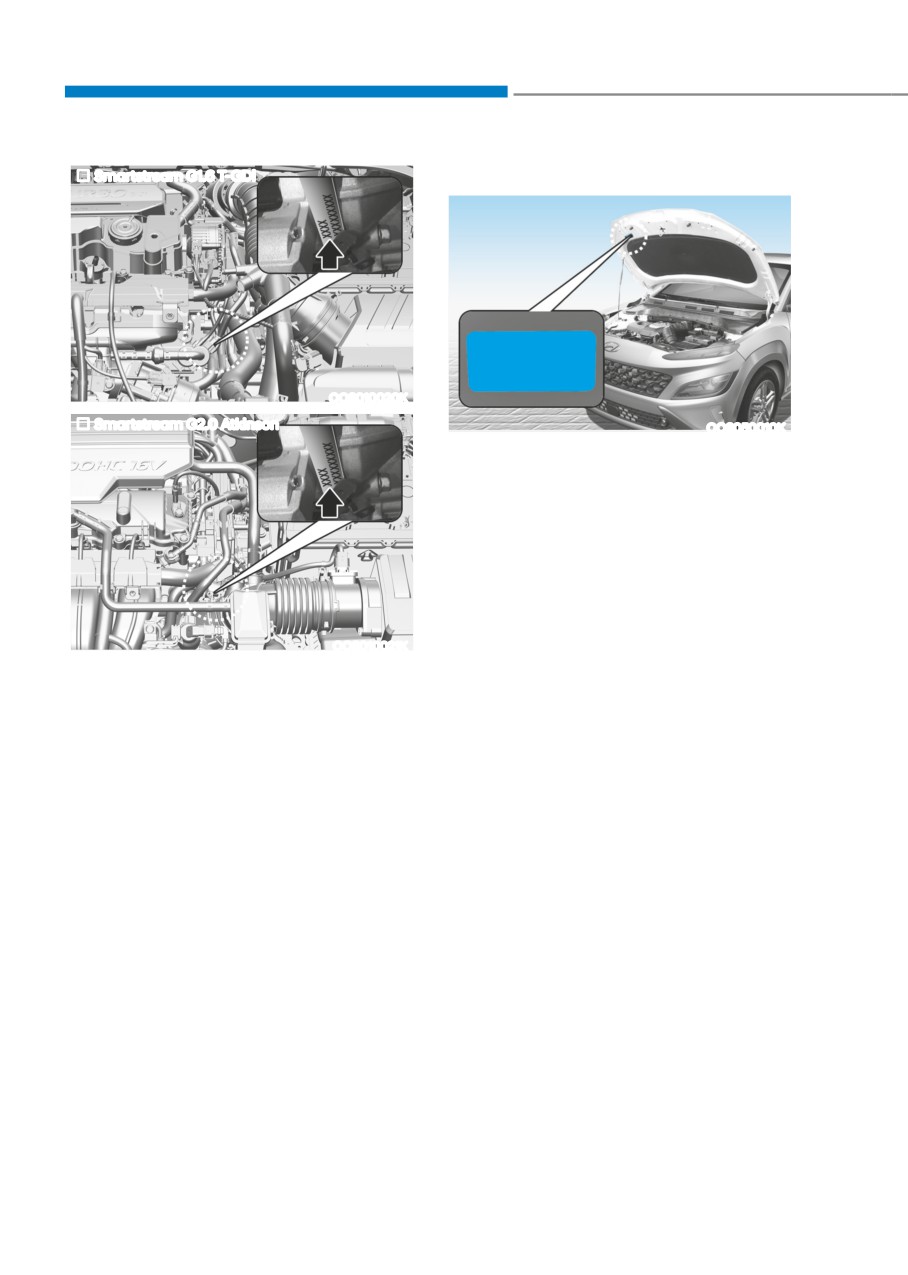
EnginE numBEr
rEfrigErant laBEl
Smartstream G1.6 T-GDi
(iF EQuiPPED)
OOS010020K
Smartstream G2.0 Atkinson
OOS050010K
The refrigerant label provides
information such as refrigerant type and
amount. (R-1234yf)
OOS010021K
The engine number is stamped on the
engine block as shown in the drawing.
2-16
///////////////////////////////////////