Hyundai Santa Fe (2023 year). Manual in english - page 2
Vehicle Information, Consumer Information and Reporting Safety Defects
REPORTING SAFETY DEFECTS
If you believe that your vehicle has a defect which could cause a crash or
could cause injury or death, you should immediately inform the National
Highway Traffic Safety Administration (NHTSA) in addition to notifying
HYUNDAI MOTOR AMERICA.
To contact NHTSA, you may call the Vehicle Safety Hotline toll-free at 1-888-
327-4236 (TTY: 1-800-424-9153);
go to http://www.safercar.gov;
download the SaferCar mobile application;
or write to: Administrator, NHTSA
1200 New Jersey Ave, SE,
West Building Washington, D.C. 20590.
You can also obtain other information about motor vehicle safety from
If NHTSA receives similar complaints, it may open an investigation, and if it
finds that a safety defect exists in a group of vehicles, it may order a recall and
remedy campaign. However, NHTSA cannot become involved in individual
problems between you, your dealer, or HYUNDAI MOTOR AMERICA.
2-18
3. Seats & Safety System
This chapter provides you with important information about how to protect yourself and your
passengers. It explains how to properly use your seats and seat belts, and how your air bags work.
Additionally, this chapter explains how to properly restrain infants and children in your vehicle.
Important safety precautions
3-2
Always wear your seat belt
3-2
Restrain all children
3-2
Air bag hazards
3-2
Driver distraction
3-2
Control your speed
3-2
Keep your vehicle in safe condition
3-2
Seats
3-3
Safety precautions
3-4
Front seats
3-5
3
Rear seats
3-10
Head Restraints
3-14
Seat warmers
3-18
Air ventilation seat
3-20
Rear Occupant Alert (ROA)
3-21
Seat belts
3-23
Seat belt safety precautions
3-23
Seat belt warning light
3-24
Seat belt restraint system
3-25
Additional seat belt safety precautions
3-31
Care of seat belts
3-33
Child Restraint System (CRS)
3-34
Children Always in the Rear
3-34
Selecting a Child Restraint System (CRS)
3-35
Installing a Child Restraint System (CRS)
3-37
Air bag - supplemental restraint system
3-45
Where are the air bags?
3-47
How does the air bags system operate?
3-50
What to expect after an air bag inflates
3-53
Occupant Classification System (OCS)
3-54
Why didn’t my air bag go off in a collision?
3-60
SRS care
3-65
Additional safety precautions
3-66
Air bag warning labels
3-66
Seats & Safety System
IMPORTANT SAFETY PRECAUTIONS
You will find many safety precautions
Drivers can become distracted when
and recommendations throughout this
they take their eyes and attention off
section, and throughout this manual.
the road or their hands off the wheel to
The safety precautions in this section are
focus on activities other than driving.
among the most important.
To reduce your risk of distraction and an
accident:
Always wear your seat belt
ś ALWAYS set up your mobile devices
A seat belt is your best protection in all
(for example, MP3 players, phones,
types of accidents. Air bags are designed
navigation units, etc.) when your
to supplement seat belts, not replace
vehicle is parked or safely stopped.
them. So even though your vehicle is
ś ONLY use your mobile device when
equipped with air bags, ALWAYS make
allowed by laws and conditions permit
sure you and your passengers wear your
safe use. NEVER text or email while
seat belts, and wear them properly.
driving. Most countries have laws
prohibiting drivers from texting. Some
Restrain all children
countries and cities also prohibit
drivers from using handheld phones.
All children under age 13 should ride
in your vehicle properly restrained in a
ś NEVER let the use of a mobile device
rear seat, not the front seat. Infants and
distract you from driving. You have a
small children should be restrained in
responsibility to your passengers and
an appropriate Child Restraint System.
others on the road to always drive
Larger children should use a booster
safely, with your hands on the wheel
seat with the lap/shoulder belt until they
as well as your eyes and attention on
can use the seat belt properly without a
the road.
booster seat.
Control your speed
Air bag hazards
Excessive speed is a major factor in crash
While air bags can save lives, they can
injuries and deaths. Generally, the higher
also cause serious or fatal injuries to
the speed, the greater the risk, but
occupants who sit too close to them, or
serious injuries can also occur at lower
who are not properly restrained. Infants,
speeds. Never drive faster than is safe
young children, and short adults are at
for current conditions, regardless of the
the greatest risk of being injured by an
maximum speed posted.
inflating air bag. Follow all instructions
and warnings in this manual.
Keep your vehicle in safe
condition
Driver distraction
Having a tire blowout or a mechanical
Driver distraction presents a serious and
failure can be extremely hazardous. To
potentially deadly danger, especially for
reduce the possibility of such problems,
inexperienced drivers. Safety should be
check your tire pressures and condition
the first concern when behind the wheel
frequently, and perform all regularly
and drivers need to be aware of the wide
scheduled maintenance.
array of potential distractions, such as
drowsiness, reaching for objects, eating,
personal grooming, other passengers,
and using mobile phones.
3-2
03
SEATS
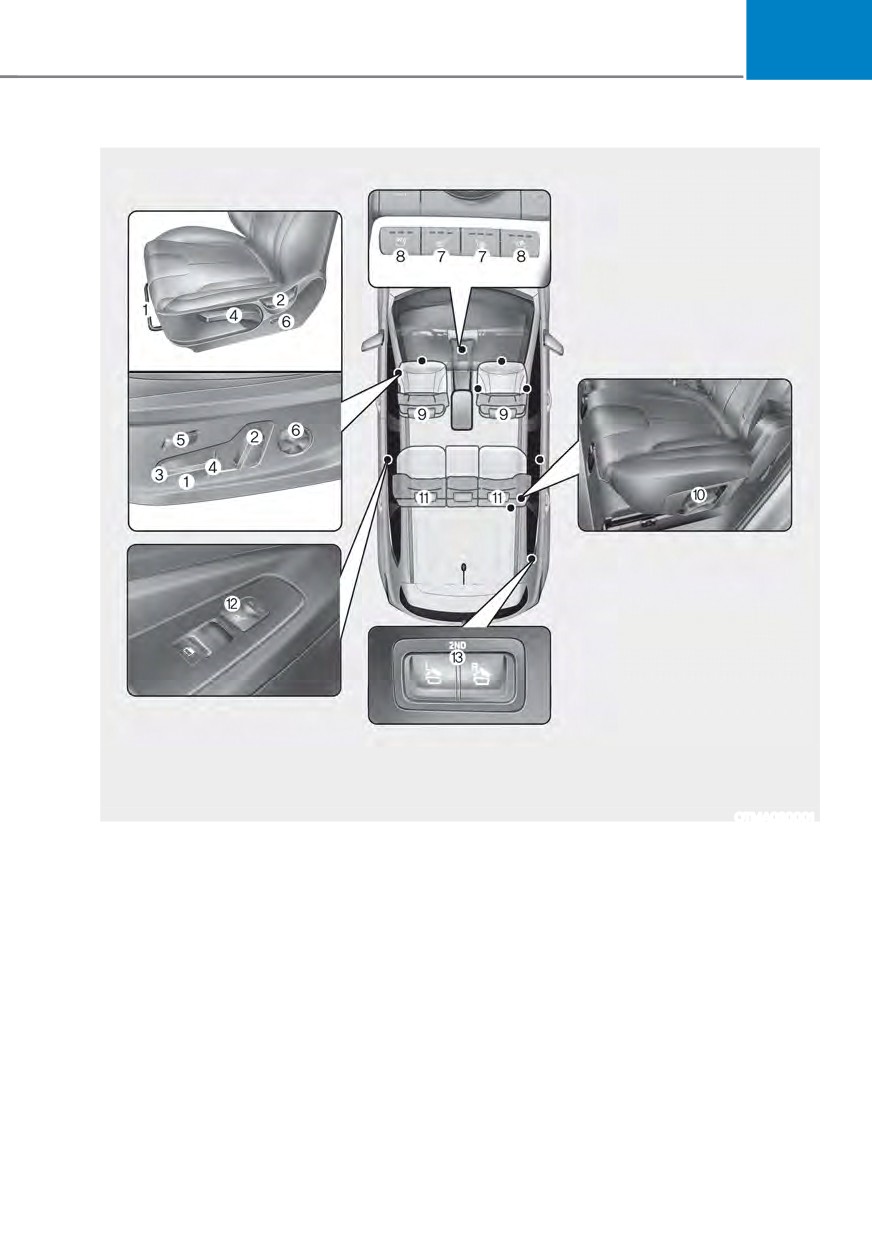
The information provided may differ depending on which functions are
applicable to your vehicle.
OTMA030001
Front seat
2nd row seat
(1) Forward and rearward
(10) Seatback angle
(2) Seatback angle
(11) Head restraints
(3) Seat cushion angle
(12) Seat warmer*
(4) Seat cushion height
(13) 2nd row seat remote folding switch*
(5) Seat cushion length*
(6) Lumbar support (Driver’s seat)*
*: if equipped
(7) Seat warmer*
(8) Air ventilation seat*
(9) Head restraints
3-3

Seats & Safety System
Safety precautions
WARNING
Adjusting the seats so that you are sitting
To reduce the risk of serious injury or
in a safe and comfortable position plays
death from an inflating air bag, take the
an important role for the safety of the
following precautions:
driver and passengers, along with seat
ś Adjust the driver’s seat as far to the
belts and air bags when in an accident.
rear as possible while maintaining
the ability to control the vehicle.
WARNING
ś Adjust the front passenger seat as far
Do not use a cushion that reduces
to the rear as possible.
friction between the seat and the
ś Hold the steering wheel by the rim
passenger. The passenger’s hips may
with your hands at the 9 o’clock and
slide under the lap portion of the seat
3 o’clock positions to minimize the
belt during an accident or a sudden
risk of injuries to your hands and
stop.
arms.
Serious or fatal internal injuries could
ś NEVER place anything or anyone
result because the seat belt cannot
between you and the air bag.
operate properly.
ś Do not allow the front passenger to
place feet or legs on the dashboard
Air bags
to minimize the risk of leg injuries.
You can take steps to reduce the risk
of being injured by an inflating air bag.
Seat belts
Sitting too close to an air bag greatly
Always fasten your seat belt before
increases the risk of injury in the event
starting any trip. At all times, passengers
the air bag inflates.
should sit upright and be properly
The National Highway Traffic Safety
restrained. Infants and small children
Administration (NHTSA) recommends
must be restrained in appropriate Child
that drivers allow at least 10 inches
Restraint Systems. Children who have
(25cm) between the center of the
outgrown a booster seat and adults must
steering wheel and their chest.
be restrained using the seat belts.
WARNING
Take the following precautions when
adjusting your seat belt:
ś NEVER use one seat belt for more
than one occupant.
ś Always position the seatback upright
with the lap portion of the seat belt
snug and low across the hips.
ś NEVER allow children or small infants
to ride on a passenger’s lap.
ś Do not route the seat belt across your
neck, across sharp edges, or reroute
the shoulder strap away from your
body.
ś Do not allow the seat belt to become
caught or jammed.
3-4
03
Front seats
CAUTION
To prevent injury:
WARNING
ś
Do not adjust your seat while
Take the following precautions when
wearing your seat belt. Moving the
adjusting your seat:
seat cushion forward may cause
strong pressure on your abdomen.
ś
NEVER attempt to adjust the seat
while the vehicle is moving. The seat
ś
Do not allow your hands or fingers to
could respond with unexpected
get caught in the seat mechanisms
movement and may cause loss
while the seat is moving.
of vehicle control resulting in an
accident.
ś
Do not place anything under the
front seats. Loose objects in the
driver’s foot area could interfere
with the operation of the foot pedals,
causing an accident.
ś
Do not allow anything to interfere
with the normal position and proper
locking of the seatback.
ś
Do not place a cigarette lighter on
the floor or seat. When you operate
the seat, gas may exit out of the
lighter causing a fire.
ś
Use extreme caution when picking
up small objects trapped under the
seats or between the seat and the
center console. Your hands might be
cut or injured by the sharp edges of
the seat mechanism.
ś
If there are occupants in the rear
seats, be careful while adjusting the
front seat position.
ś
Make sure that the seat is locked in
place after the adjustment. If not,
the seat might move unexpectedly
resulting in an accident.
3-5
Seats & Safety System
Manual adjustment
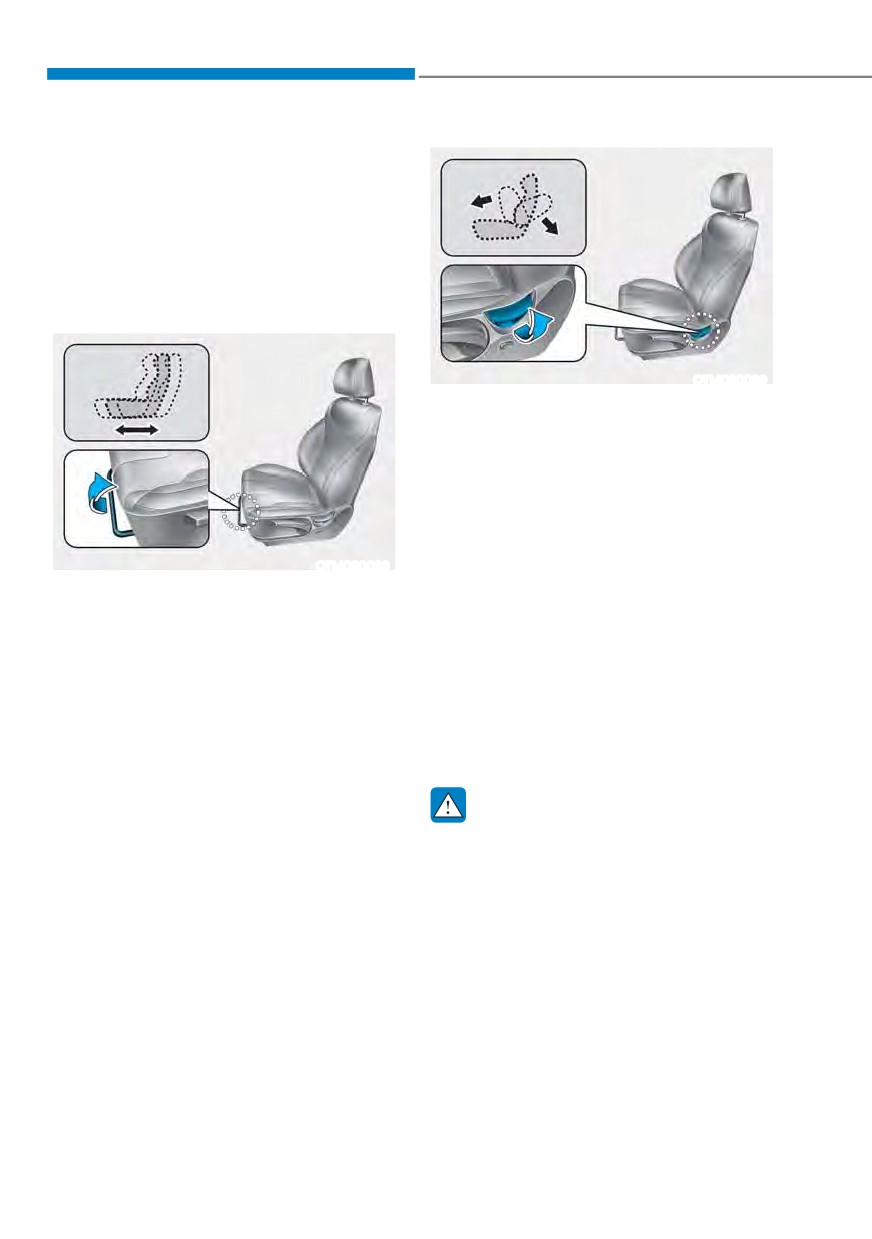
The front seat can be adjusted by using
the levers located on the outside of
the seat cushion. Before driving, adjust
the seat to the proper position so that
you can easily control the steering
wheel, foot pedals and controls on the
instrument panel.
OTM030039
Seatback angle
To recline the seatback:
1. Lean forward slightly and lift up the
seatback lever.
2. Carefully lean back on the seat and
adjust the seatback to the position
you desire.
OTM030038
3. Release the knob and make sure the
Forward and rearward adjustment
seatback is locked in place.
To move the seat forward or rearward:
Reclining seatback
1. Pull up the seat slide adjustment lever
and hold it.
Sitting in a reclined position when the
vehicle is in motion can be dangerous.
2. Slide the seat to the position you
Even when buckled up, the protections
desire.
of your restraint system (seat belts
3. Release the lever and make sure the
and/or air bags) is greatly reduced by
seat is locked in place. Move forward
reclining your seatback.
and rearward without using the lever.
If the seat moves, it is not locked
properly.
WARNING
NEVER ride with a reclined seatback
when the vehicle is moving.
Riding with a reclined seatback
increases your chance of serious or fatal
injuries in the event of a collision or
sudden stop.
Drivers and passengers should ALWAYS
sit well back in their seats, properly
belted, and with the seatbacks upright.
3-6
03
Seat belts must be snug against your
Power adjustment (if equipped)
hips and chest to work properly. When
The front seat can be adjusted by using
the seatback is reclined, the shoulder
belt cannot do its job because it will not
the control switches located on the
outside of the seat cushion. Before
be snug against your chest. Instead,
it will be in front of you. During an
driving, adjust the seat to the proper
position so that you can easily control
accident, you could be thrown into the
seat belt, causing neck or other injuries.
the steering wheel, foot pedals and
controls on the instrument panel.
The more the seatback is reclined,
the greater chance the passenger’s
hips will slide under the lap belt or the
WARNING
passenger’s neck will strike the shoulder
NEVER allow children in the vehicle
belt.
unattended. The power seats are
operable when the vehicle is turned off.
NOTICE
To prevent damage to the seats:
ś Always stop adjusting the seats when
the seat has been adjusted as far
forward or rearward as possible.
ś Do not adjust the seats longer than
necessary when the vehicle is turned
off. This may result in unnecessary
battery drain.
OTM030040
ś Do not operate two or more seats at
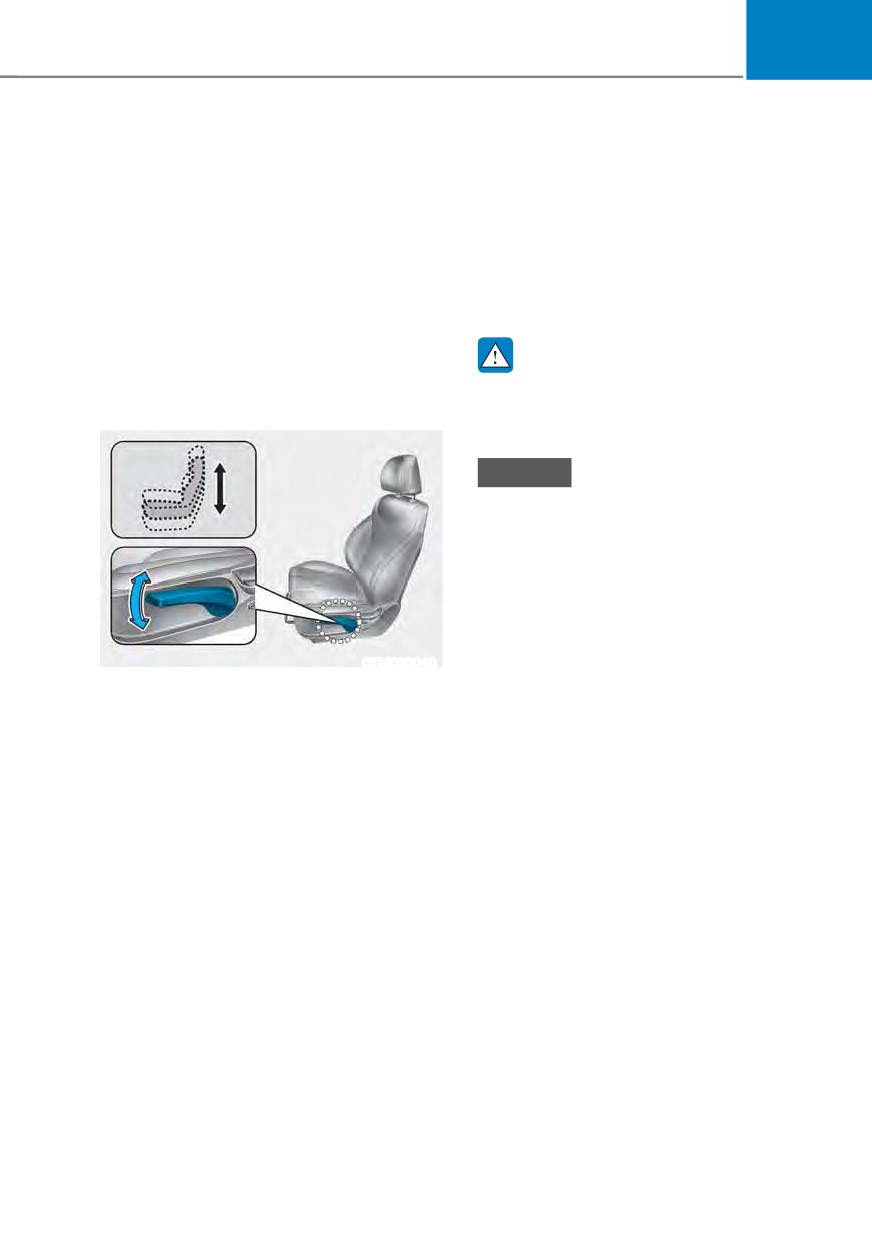
Seat cushion height
the same time. This may result in an
To change the height of the seat cushion:
electrical malfunction.
ś Push down the lever several times, to
lower the seat cushion.
ś Pull up the lever several times, to raise
the seat cushion.
3-7
Seats & Safety System
OTM030047
OTM030050
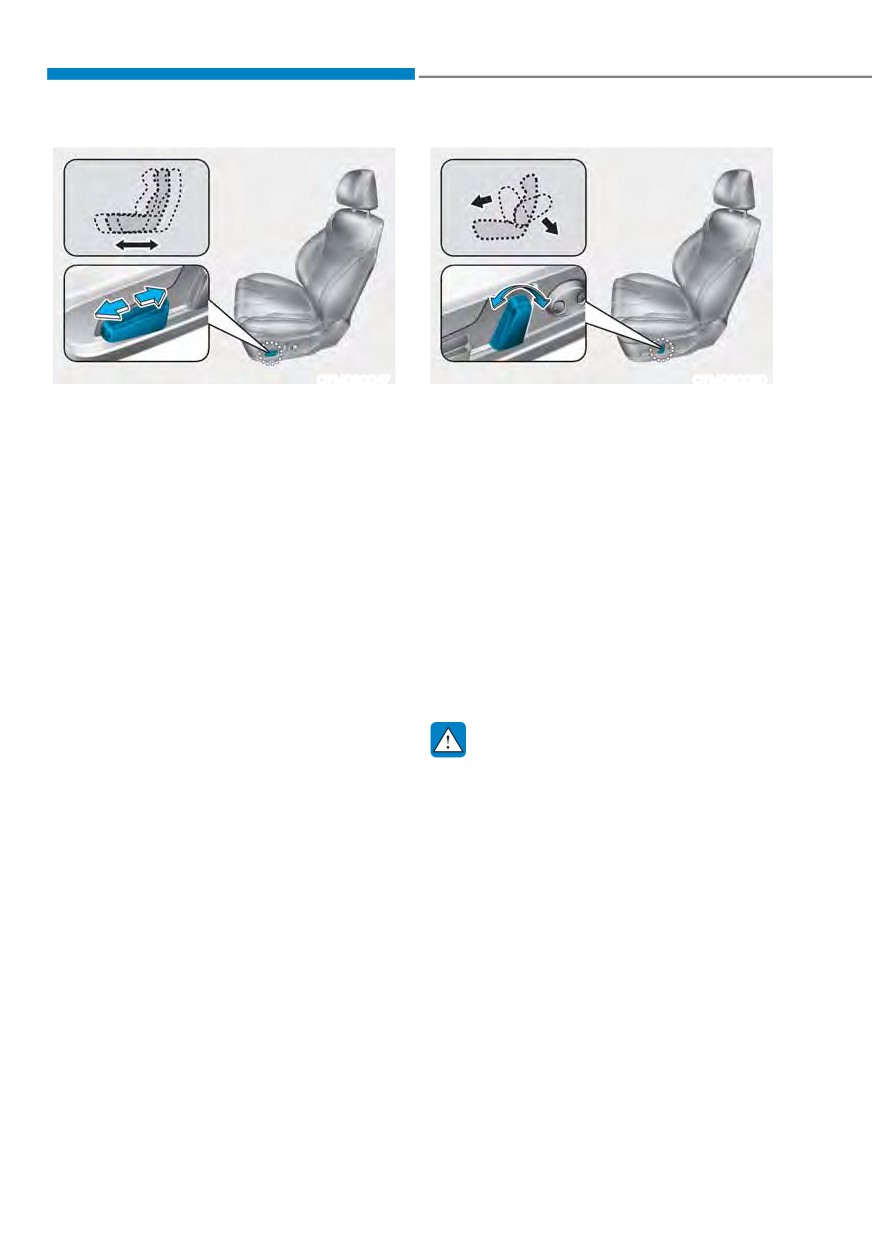
Forward and rearward adjustment
Seatback angle
To move the seat forward or rearward:
To recline the seatback:
1. Push the control switch forward or
1. Push the control switch forward or
rearward.
rearward.
2. Release the switch once the seat
2. Release the switch once the seatback
reaches the desired position.
reaches the desired position.
Reclining seatback
Sitting in a reclined position when the
vehicle is in motion can be dangerous.
Even when buckled up, the protections
of your restraint system (seat belts and
air bags) is greatly reduced by reclining
your seatback.
WARNING
NEVER ride with a reclined seatback
when the vehicle is moving.
Riding with a reclined seatback
increases your chance of serious or fatal
injuries in the event of a collision or
sudden stop.
Driver and passengers should ALWAYS
sit well back in their seats, properly
belted, and with the seatbacks upright.
3-8
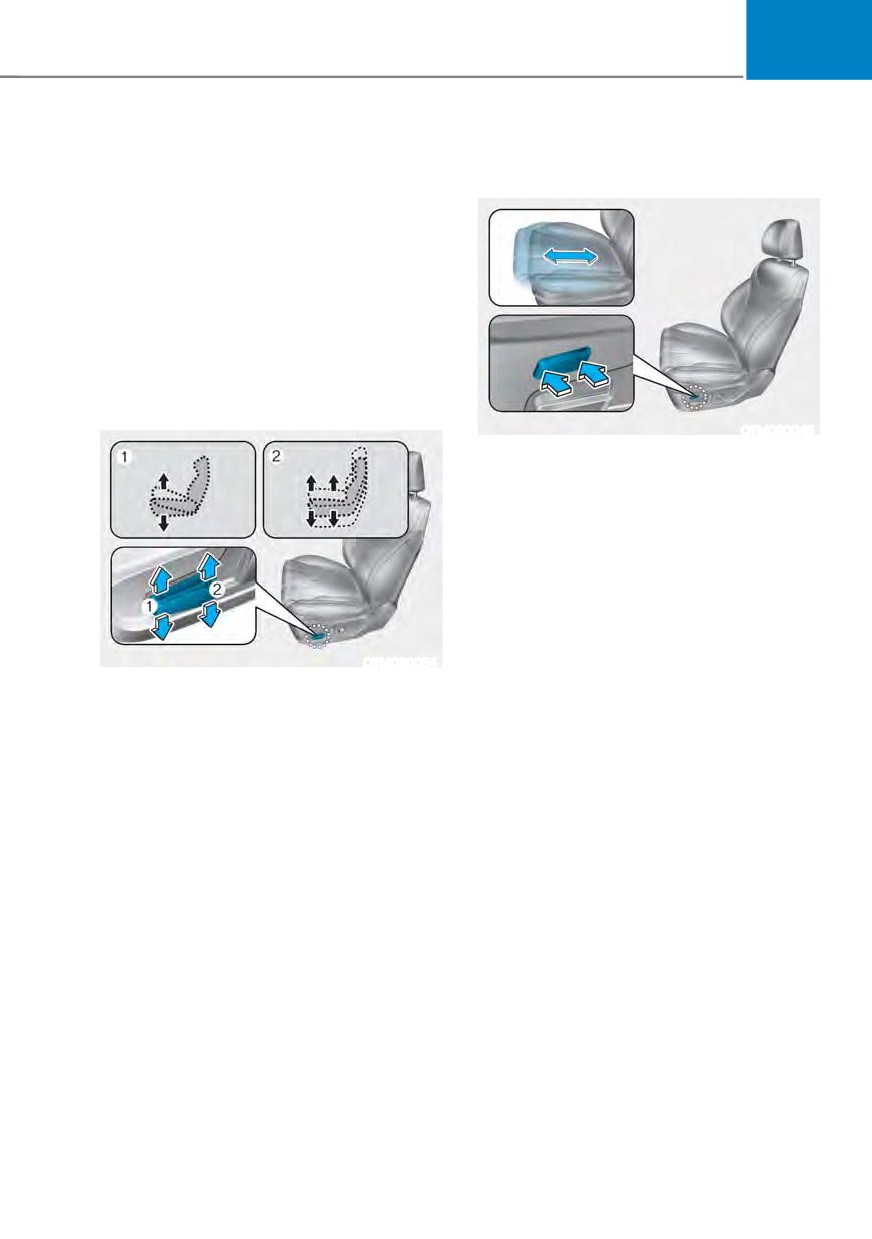
03
Seat belts must be snug against your
Seat cushion extension adjustment
hips and chest to work properly. When
(for driver's seat) (if equipped)
the seatback is reclined, the shoulder
belt cannot do its job because it will not
be snug against your chest. Instead,
it will be in front of you. During an
accident, you could be thrown into the
seat belt, causing neck or other injuries.
The more the seatback is reclined,
the greater chance the passenger’s
hips will slide under the lap belt or the
passenger’s neck will strike the shoulder
belt.
OTM030045
To move the front part of cushion
forward:
1. Push the front part of control switch
to move the seat cushion to the
desired length.
2. Release the switch once the seat
cushion reaches the desired length.
To move the front part of cushion
rearward:
OTM030054
1. Push the rear part of control switch to
Seat cushion tilt (1)
move the seat cushion to the desired
To change the angle of the front part of
length.
the seat cushion:
2. Release the switch once the seat
Push the front portion of the control
cushion reaches the desired length.
switch up to raise or down to lower the
front part of the seat cushion.
Release the switch once the seat reaches
the desired position.
Seat cushion height (2)
To change the height of the seat cushion:
Push the rear portion of the control
switch up to raise or down to lower the
height of the seat cushion.
Release the switch once the seat reaches
the desired position.
3-9
Seats & Safety System
Rear seats
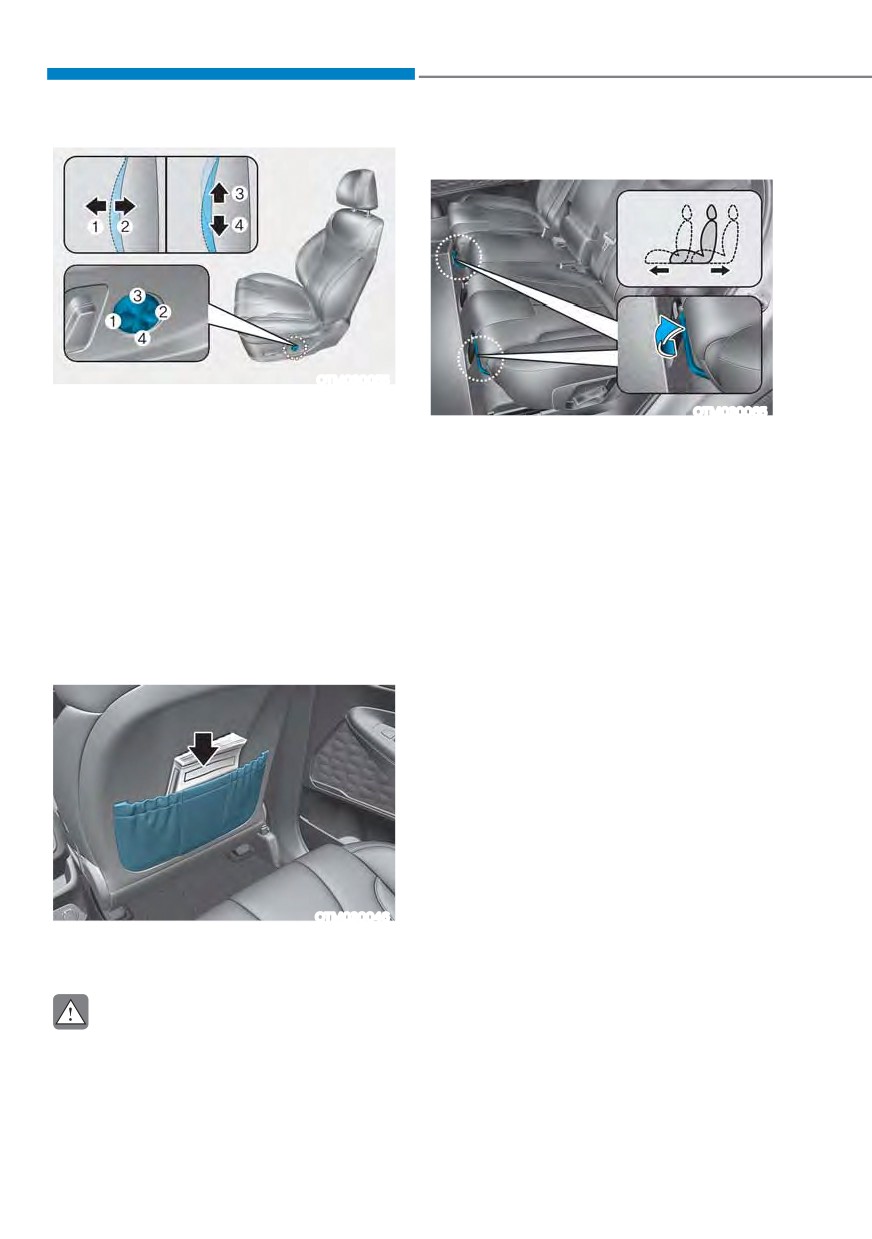
OTM030055
Lumbar support (for driver’s seat, if
OTM030065
equipped)
Forward and backward (2nd row seat)
To adjust the lumbar support:
To move the seat forward or backward:
1. Press the front portion of the switch
1. Pull the seat slide adjustment lever up
(1) to increase support or the rear
and hold it.
portion of the switch (2) to decrease
support.
2. Slide the seat to the position you
desire.
2. Press switch (3) or (4) to move the
support position up or down.
3. Release the lever and make sure the
seat is locked in place.
3. Release the switch once the lumbar
support reaches the desired position.
Adjust the seat before driving, and make
sure the seat is locked securely by trying
Seatback pocket
to move forward and backward without
using the lever. If the seat moves, it is not
locked properly.
OTM030046
The seatback pocket is provided on the
back of the front seatbacks.
CAUTION
Do not put heavy or sharp objects in the
seatback pockets. In an accident they
could come loose from the pocket and
injure occupants.
3-10
03
To fold down the rear seatback:
1. Set the front seatback to the upright
position and if necessary, slide the
front seat forward.
2. Lower the rear head restraints to the
lowest position.
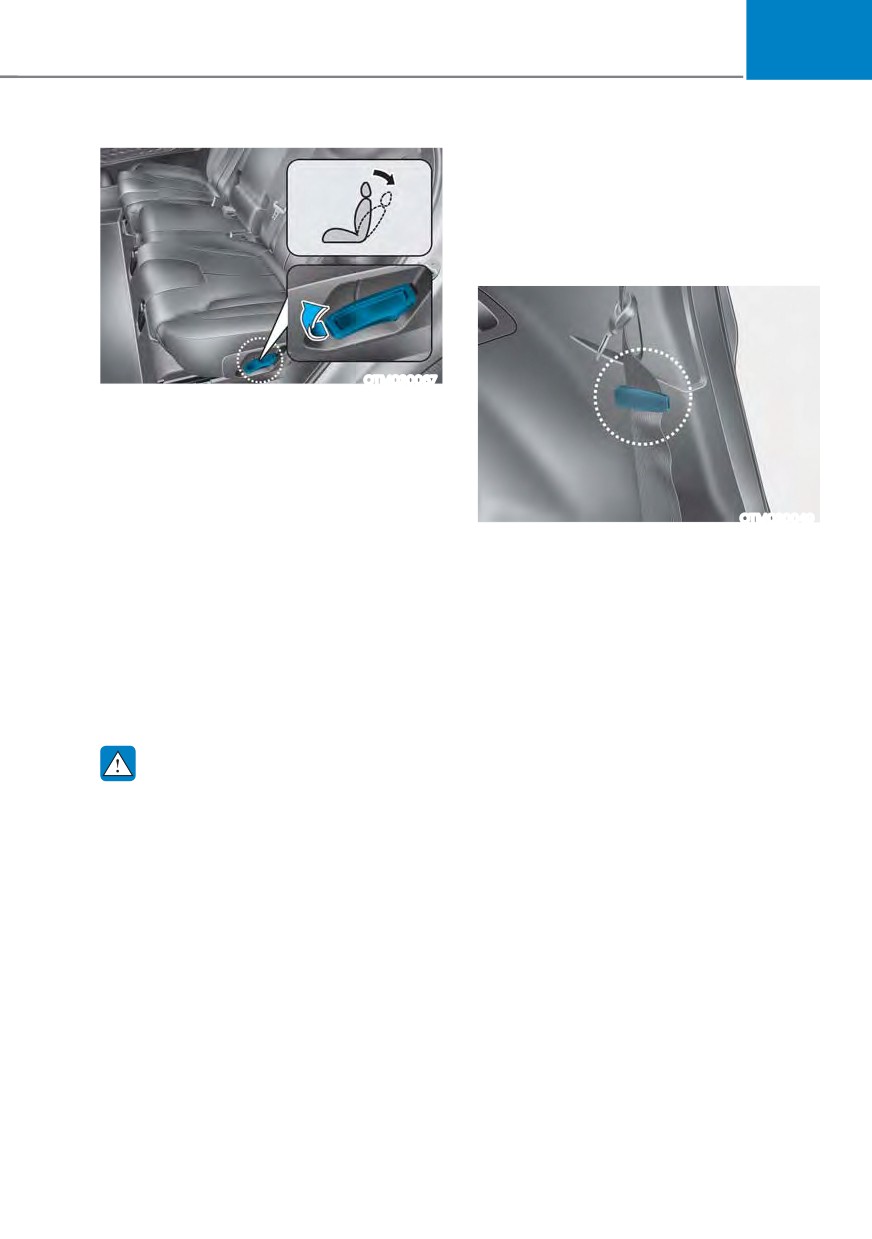
OTM030067
Seatback angle (2nd row seat)
To recline the seatback:
1. Pull up the seatback recline lever.
2. Hold the lever and adjust the seatback
of the seat to the position you desire.
OTM030049
3. Release the lever and make sure the
seatback is locked in place. (The lever
3. Route the seat belt webbing through
MUST return to its original position for
the rear seat belt guides to prevent
the seatback to lock.)
the belts from being trapped behind
or under the seats.
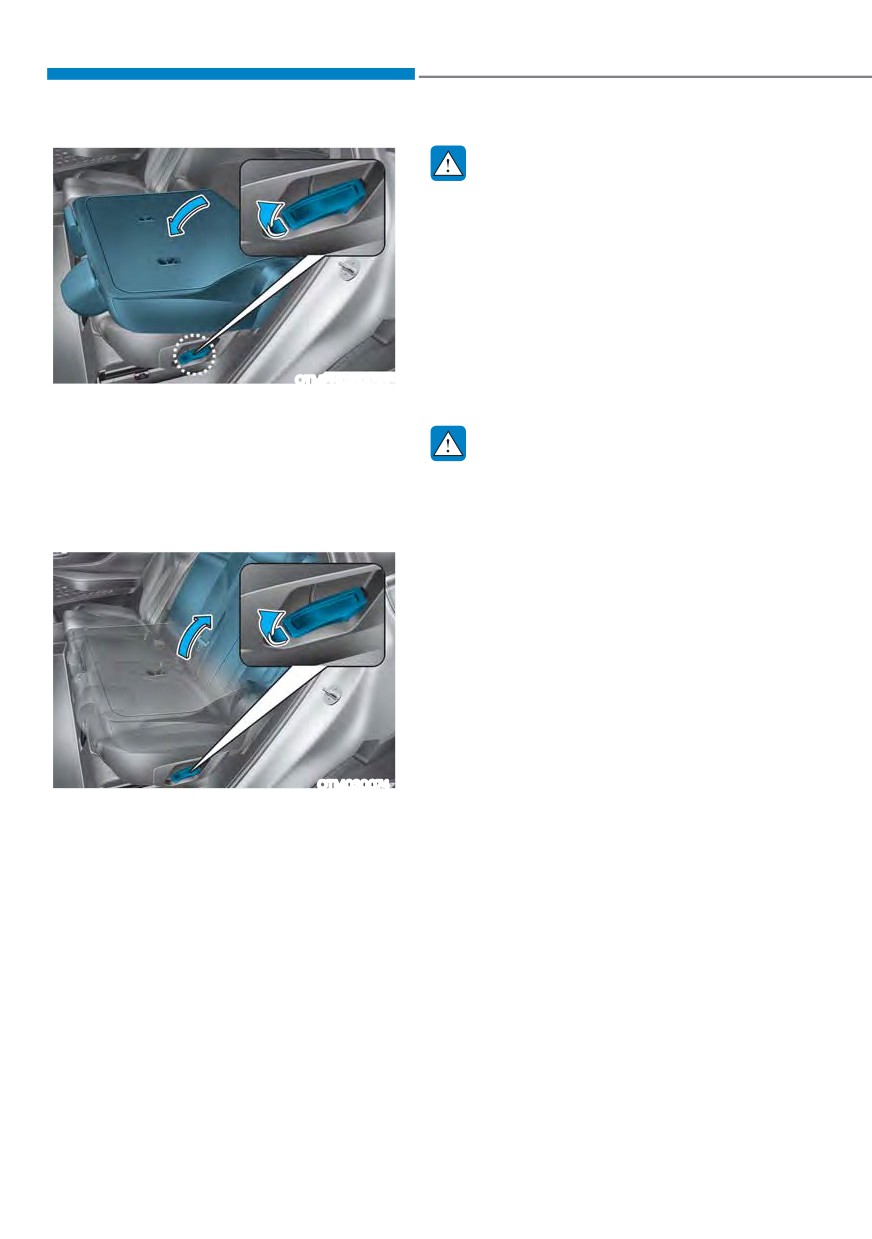
Folding the rear seat
The rear seatbacks can be folded to
facilitate carrying long items or to
increase the luggage capacity of the
vehicle.
WARNING
ś Never allow passengers to sit on top
of the folded down seatback while
the vehicle is moving. This is not a
proper seating position and no seat
belts are available for use. This could
result in serious injury or death in
case of an accident or sudden stop.
ś Objects carried on the folded down
seatback should not extend higher
than the top of the front seatbacks.
This could allow cargo to slide
forward and cause injury or damage
during sudden stops.
3-11
Seats & Safety System
WARNING
When returning the rear seatback from
a folded to an upright position, hold the
seatback and return it slowly. Ensure
that the seatback is completely locked
into its upright position by pushing on
the top of the seatback. In an accident
or sudden stop, the unlocked seatback
could allow cargo to move forward with
great force and enter the passenger
compartment, which could result in
OTMPH031001N
serious injury or death.
4. Pull on the seatback folding lever (2nd
row seat), then fold the seat toward
the front of the vehicle. When you
WARNING
return the seatback to its upright
Do not place objects in the rear seats,
position, always be sure it has locked
since they cannot be properly secured
into position by pushing on the top of
and may hit vehicle occupants in a
the seatback.
collision causing serious injury or death.
OTM030074
5. To use the rear seat, lift and pull the
seatback backward by pulling the
folding lever or the strap. Pull the
seatback firmly until it clicks into
place. Make sure the seatback is
locked in place.
6. Return the rear seat belt to the proper
position.
3-12
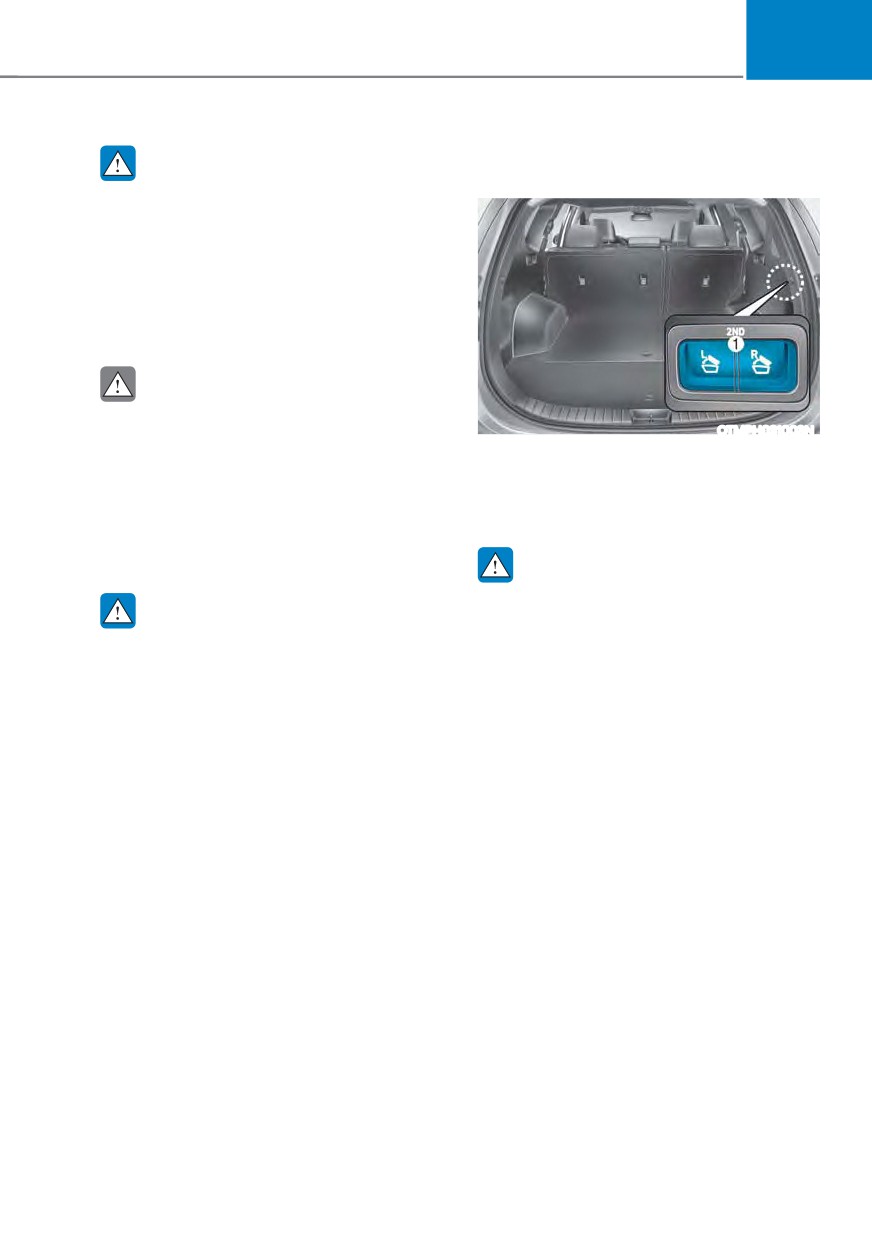
03
2nd row seat folding (if equipped)
WARNING
(from outside)
Make sure the engine is off, the shift
button is in P (Park), and the parking
brake is securely applied whenever
loading or unloading cargo. Failure
to take these steps may allow the
vehicle to move if the shift button
is inadvertently moved to another
position.
CAUTION
ś Be careful when loading cargo
OTMPH031003N
through the rear passenger seats
to prevent damage to the vehicle
Push the 2nd row seat back folding
interior.
switch (1) located in the right side in the
liftgate. (L : Left seatback folding,
ś When cargo is loaded through the
R : Right seatback folding)
rear passenger seats, ensure the
cargo is properly secured to prevent
it from moving while driving.
WARNING
Rear seat folding
WARNING
Do not fold the rear seats, if passengers,
Cargo should always be secured to
pets or luggage are in the rear seats.
prevent it from being thrown about the
It may cause injury or damage to
vehicle in a collision and causing injury
passengers, pets, luggage.
to the vehicle occupants. Do not place
objects in the rear seats, since they
cannot be properly secured and may hit
the front seat occupants in a collision.
3-13
Seats & Safety System
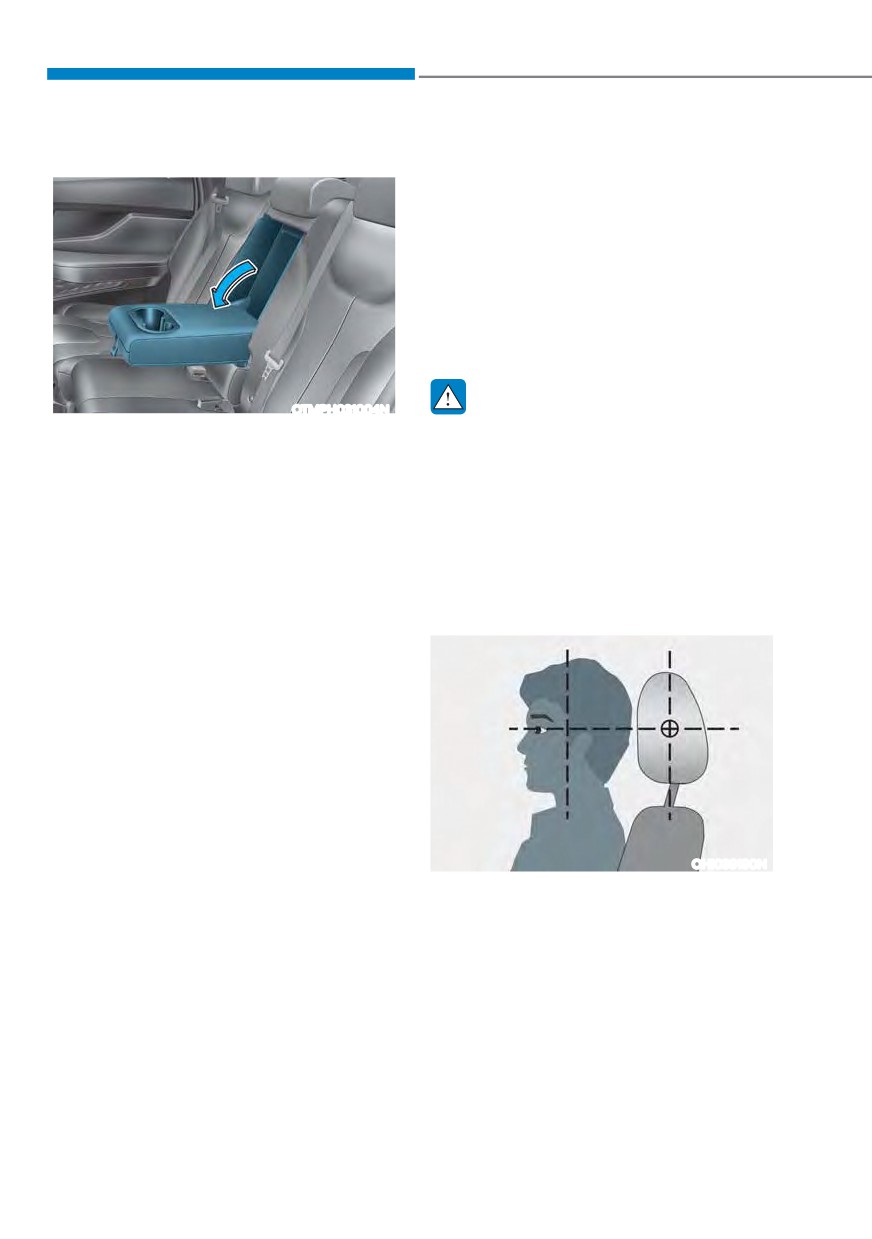
Armrest
Head Restraints
The vehicle’s front and rear (second row
and/or third row) seats have adjustable
head restraints. The head restraints
provide comfort for passengers, but
more importantly they are designed to
help protect passengers from whiplash
and other neck and spinal injuries during
an accident, especially in a rear impact
collision.
WARNING
OTMPH031004N
The armrest is located in the center of
To reduce the risk of serious injury or
death in an accident, take the following
the rear seat. Pull the armrest down from
the seatback to use it.
precautions when adjusting your head
restraints:
Rear occupant alert system (2nd
ś
Always properly adjust the head
seat)
restraints for all passengers BEFORE
starting the vehicle.
This function alerts driver when you get
out of a car while the passengers remain
ś
NEVER let anyone ride in a seat
in the 2nd row seat.
with the head restraints removed or
reversed.
If the front door is opened with
passengers in the 2nd row seats, A
warning message will appear in the
instrument cluster. After the 1st warning
if movement is detected in the 2nd row
seat after all doors are locked, a second
audible warning will be triggered.
Even if your vehicle is equipped with
Rear Occupant Alert, always make sure
to check the rear seat before you leave
the vehicle.
For more information, refer to the “Rear
OHI039190N
occupant alert system” in chapter 3.
ś
Adjust the head restraints so the
middle of the head restraints is at the
same height as the height of the top
of the eyes.
ś
NEVER adjust the head restraints
position of the driver’s seat when the
vehicle is in motion.
ś
Adjust the head restraints as close to
the passenger’s head as possible. Do
not use a seat cushion that holds the
body away from the seatback.
ś
Make sure the head restraints locks
into position after adjusting it.
3-14
03
Front seat head restraints
WARNING
OTL035061
When sitting on the rear seat, do not
adjust the height of the head restraints
to the lowest position.
OOSEV038012L
The driver’s and front passenger’s seats
CAUTION
are equipped with adjustable head
When there is no occupant in the rear
restraint for the passengers safety and
seats, adjust the height of the head
comfort.
restraints to the lowest position. The
rear seat head restraints can reduce the
visibility of the rear area.
NOTICE
To prevent damage, NEVER hit or pull
on the head restraints.
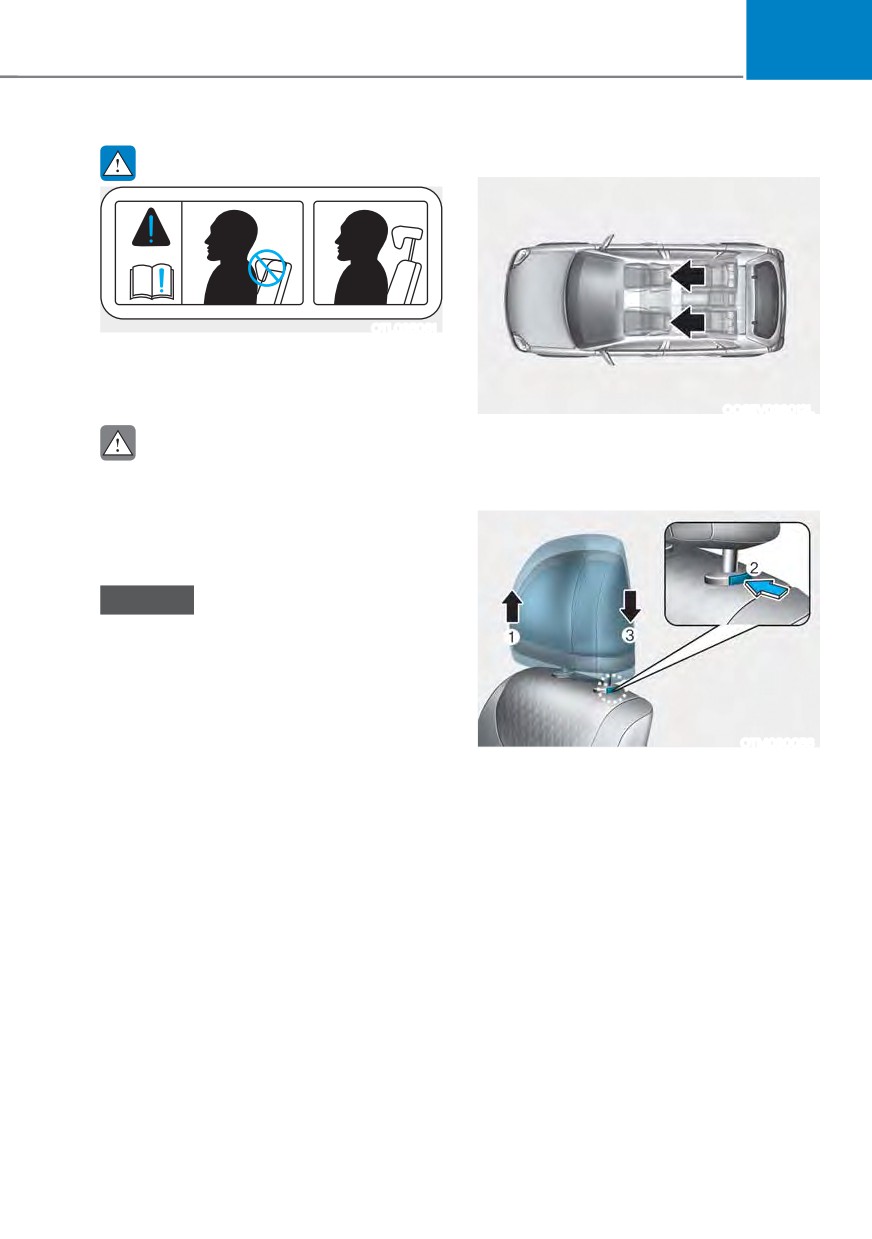
OTM030056
Adjusting the height up and down
To raise the head restraint:
1. Pull it up to the desired position (1).
To lower the head restraint:
1. Push and hold the release button (2)
on the head restraint support.
2. Lower the head restraint to the
desired position (3).
3-15
Seats & Safety System
NOTICE
Type A
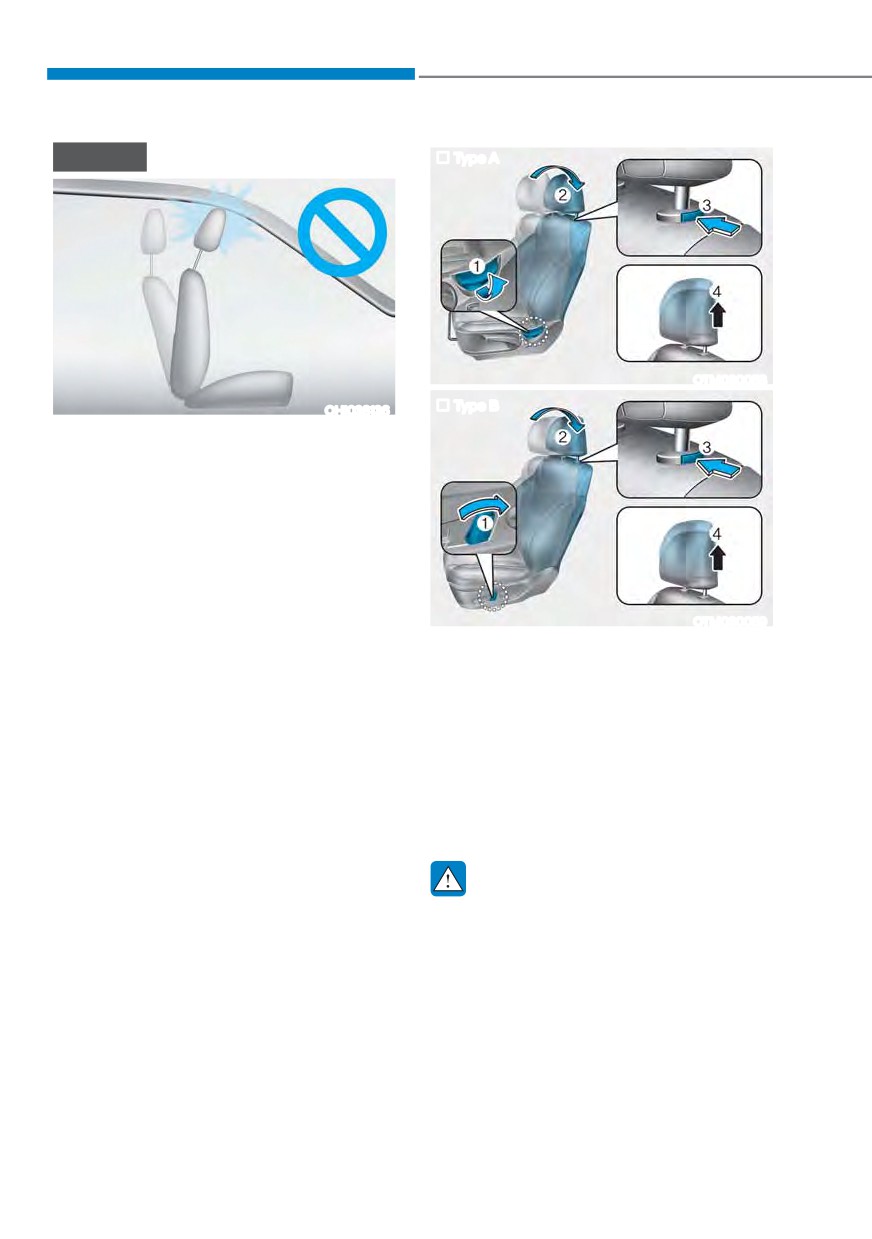
OTM030058
OHI038136
Type B
If you recline the seatback towards the
front with the head restraint and seat
cushion raised, the head restraint may
come in contact with the sunvisor or
other parts of the vehicle.
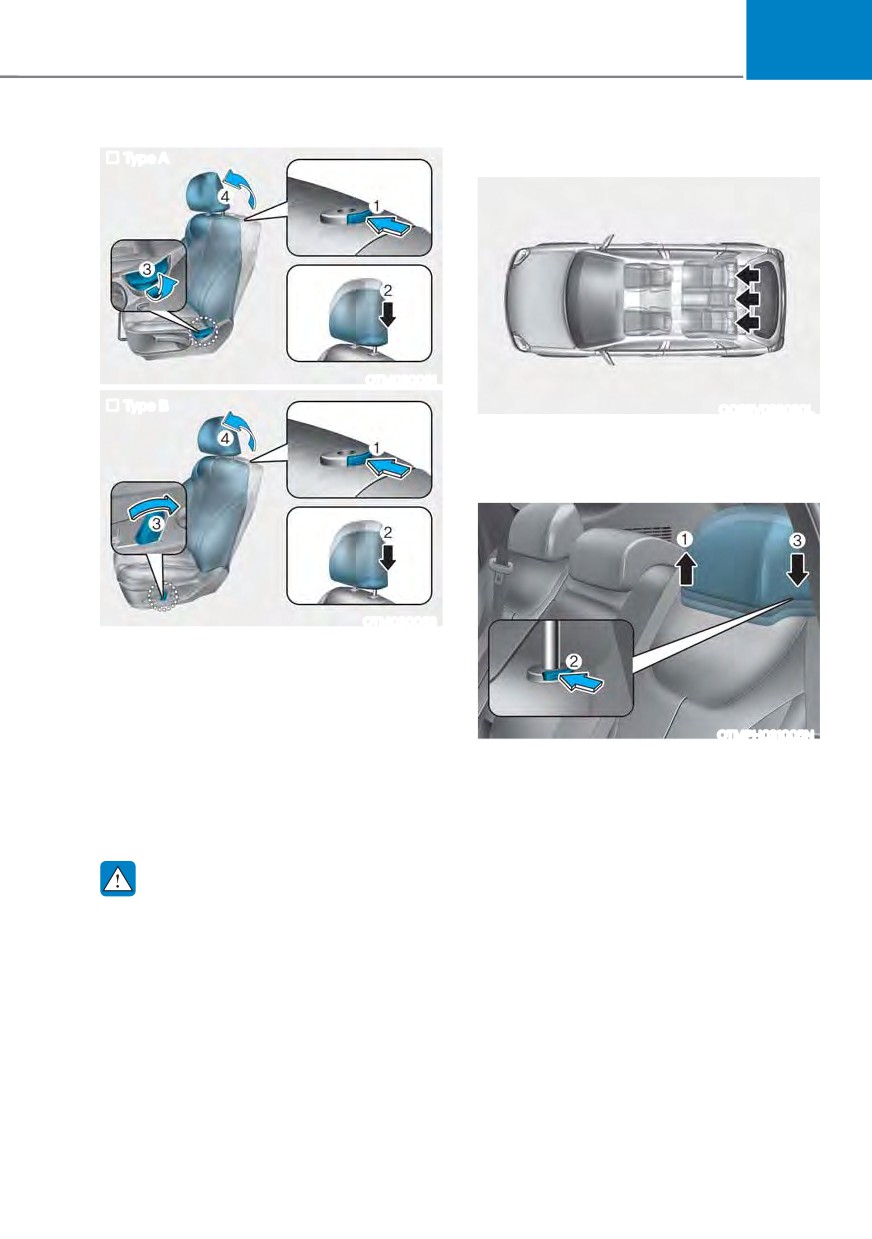
OTM030059
Removal/Reinstall
To remove the head restraint:
1. Recline the seatback (2) with the
seatback angle lever (1).
2. Raise the head restraint as far as it can
go.
3. Press the head restraint release button
(3) while pulling the head restraint up
(4).
WARNING
NEVER allow anyone to travel in a seat
with the head restraint removed.
3-16
03
Type A
Rear seat head restraint
OTM030061
Type B
OOSEV038030L
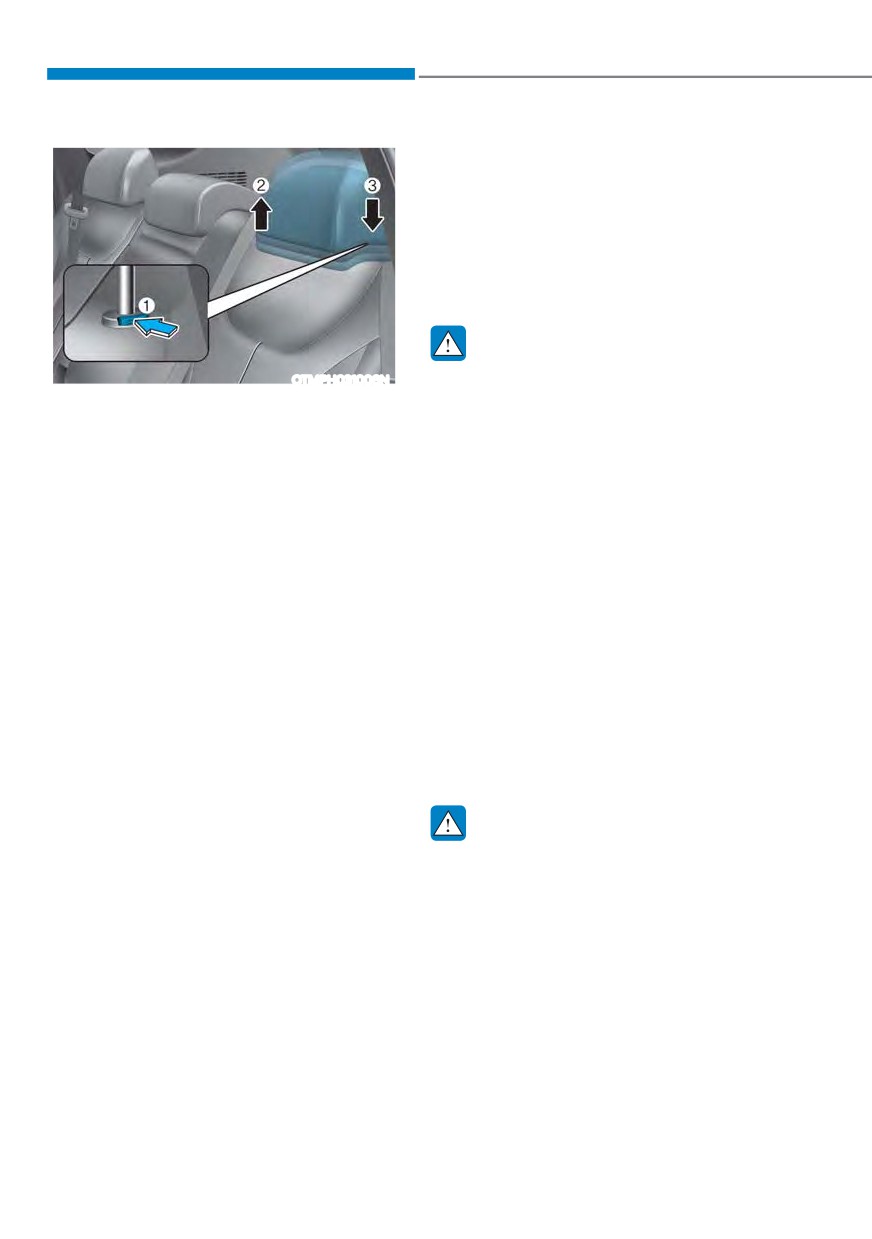
The rear seats are equipped with head
restraint in all the seating positions for
the passenger’s safety and comfort.
OTM030063
To reinstall the head restraint :
1. Recline the seatback.
2. Put the head restraint poles (2) into
the holes while pressing the release
button (1).
OTMPH031005N
3. Adjust the head restraint to the
Adjusting the height up and down
appropriate height.
To raise the head restraint:
4. Recline the seatback (4) with the
1. Pull it up to the desired position (1).
seatback angle lever (3).
To lower the head restraint:
WARNING
1. Push and hold the release button (2)
on the head restraint support.
Always make sure the head restraint
locks into position after reinstalling and
2. Lower the head restraint to the
adjusting it properly.
desired position (3).
3-17
Seats & Safety System
Seat warmers (if equipped)
Seat warmers are provided to warm the
seats during cold weather.
During mild weather or under conditions
where the operation of the seat warmer
is not needed, keep the seat warmers
OFF.
WARNING
OTMPH031006N
The seat warmers can cause a SERIOUS
BURN, even at low temperatures and
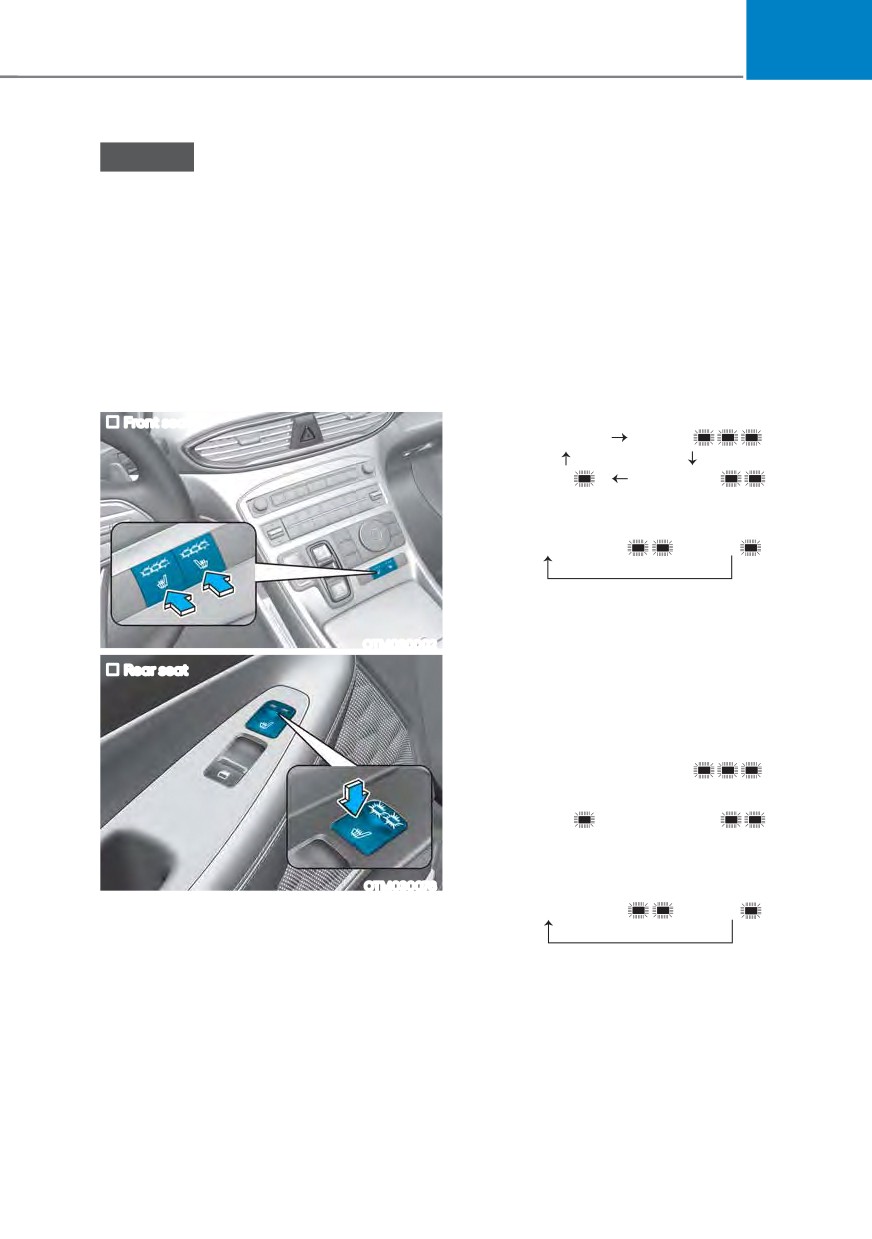
Removal/Reinstallation
especially if used for long periods of
To remove the head restraint:
time.
1. Raise the head restraint as far as it can
Passengers must be able to feel if the
go.
seat is becoming too warm so they can
2. Press the head restraint release button
turn it off, if needed.
(1) while pulling the headrest up (2).
People who cannot detect temperature
change or pain to the skin should
To reinstall the head restraint:
use extreme caution, especially the
1. Put the head restraint poles into the
following types of passengers:
holes (3) while pressing the release
ś Infants, children, elderly or disabled
button (1).
persons, or hospital outpatients.
2. Adjust the head restraint to the
ś People with sensitive skin or who
appropriate height.
burn easily.
ś Fatigued individuals.
ś Intoxicated individuals.
ś People taking medication that can
cause drowsiness or sleepiness.
WARNING
NEVER place anything on the seat
that insulates against heat when the
seat warmer is in operation, such as a
blanket or seat cushion. This may cause
the seat warmer to overheat, causing a
burn or damage to the seat.
3-18
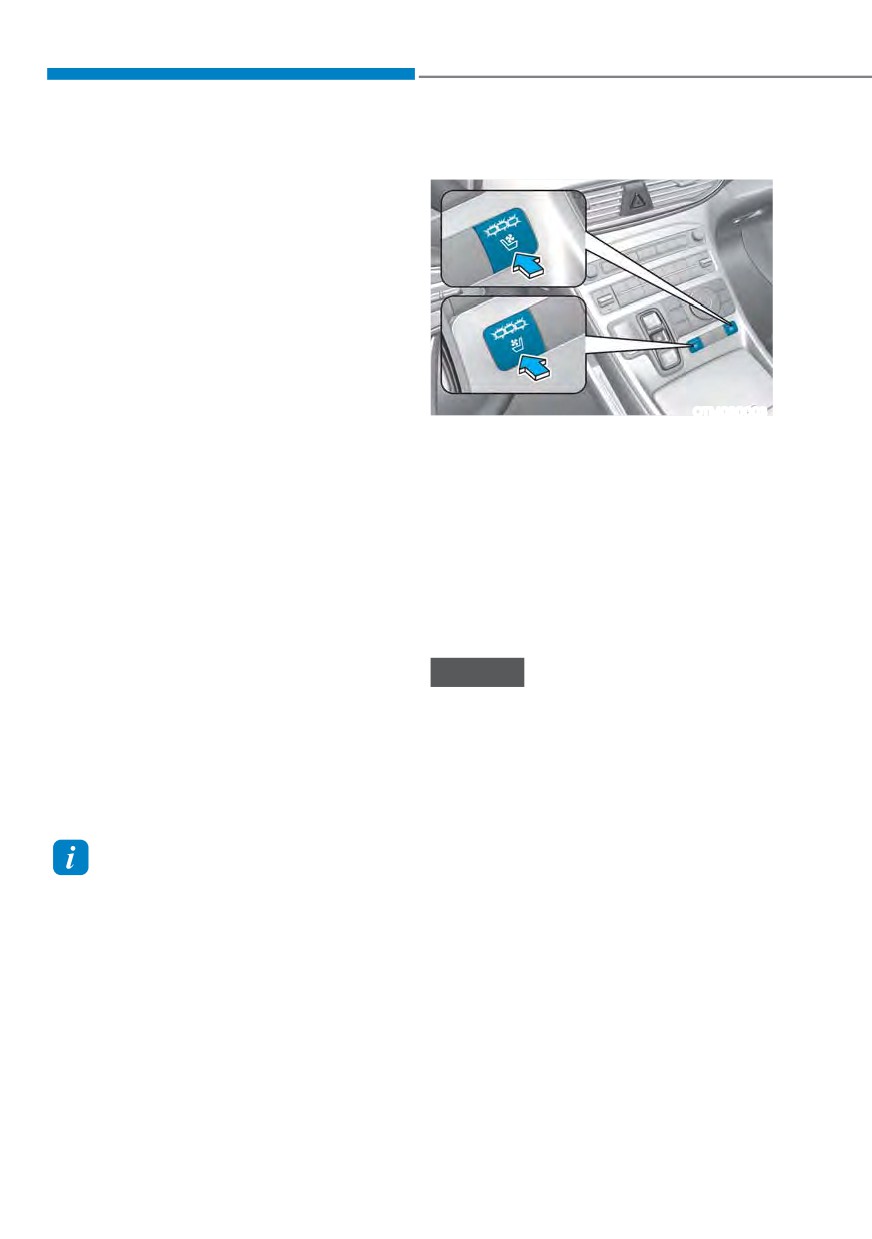
03
NOTICE
While the engine is running, push either
of the switches to warm the driver's seat
To prevent damage to the seat warmers
or front passenger's seat.
and seats:
During mild weather or under conditions
ś Never use a solvent such as paint
where the operation of the seat warmer
thinner, benzene, alcohol or gasoline
is not needed, keep the switches in the
to clean the seats.
OFF position.
ś Do not place heavy or sharp objects
ś
Manual temperature control
on seats equipped with seat
warmers.
Each time you push the switch, the
temperature setting of the seat is
ś Do not change the seat cover. It may
changed as follows:
damage the seat warmer.
- Front seat
Front seat
OFF
HIGH (
)
LOW (
)
MEDIUM (
)
- Rear seat
OFF Ɵ HIGH (
) Ɵ LOW (
)
ś
Automatic temperature control
The seat warmer starts to
OTM030002
automatically control the seat
Rear seat
temperature in order to prevent
low-temperature burns after being
manually turned ON.
- Front seat
OFF
Ɵ
+,*+
ơ
Ƣ
0,1
LOW (
)
Ơ
0(',80
0,1
- Rear seat
OTM030078
OFF Ɵ HIGH (
) Ɵ LOW (
)
30 MIN
If HIGH temperature is manually
selected again, the temperature will
be controlled automatically.
3-19
Seats & Safety System
ś
When pressing the switch for more
Air ventilation seat (if equipped)
than 1.5 seconds with the seat warmer
operating, the seat warmer will turn
OFF.
ś
The seat warmer defaults to the OFF
position whenever the ignition switch
is ON.
ś
Auto Comfort Control (for driver’s
seat) (if equipped)
- The seat warmer automatically
controls the seat temperature
depending on the ambient
temperature and the set climate
OTM030003
control temperature when the
The air ventilation seats are provided
engine is running. If the seat
to cool the front seats by blowing air
warmer switch is pushed, the seat
through small vent holes on the surface
warmer will have to be controlled
of the seat cushions and seatbacks.
manually.
When the operation of the air ventilation
To use this function, it must be
seat is not needed, keep the switches in
activated from the Settings menu in
the OFF position.
the AV/AVN system screen.
While the engine is running, push the
- The seat warmer defaults to the
switch to cool the driver's seat or the
OFF position whenever the ignition
front passenger's seat (if equipped).
switch is ON. However, if the Auto
Comfort Control function is ON, the
NOTICE
driver’s seat warmer will turn on
and off depending on the ambient
To prevent damage to the air ventilation
temperature and the set climate
seats:
control temperature.
ś Never use a solvent such as paint
For more details, refer to the separately
thinner, benzene, alcohol or gasoline
supplied Infotainment manual with
to clean the seats.
your vehicle.
ś Avoid spilling liquids on the surface
of the front seats and seatbacks;
this may cause the air vent holes
Information
to become blocked and not work
With the seat warmer switch in the ON
properly.
position, the heating system in the seat
ś Do not place materials such as
turns off or on automatically depending on
plastic bags or newspapers under
the seat temperature.
the seats. They may block the air
intake causing the air vents to not
work properly.
ś Do not change the seat covers. It may
damage the air ventilation seat.
ś If the air vents do not operate, restart
the vehicle. If there is no change,
have your vehicle inspected by an
authorized HYUNDAI dealer.
3-20
03
ś
Each time you push the switch, the
Rear Occupant Alert (ROA) (if
airflow changes as follows:
equipped)
OFF
HIGH (
)
Rear Occupant Alert is provided to help
prevent the driver from leaving the
vehicle with the rear passenger left in the
LOW (
)
MEDIUM (
)
vehicle.
ś
When pressing the switch for
more than 1.5 seconds with the
System setting
air ventilation seat operating, the
To use Rear Occupant Alert, it must be
operation will turn OFF.
enabled from the Settings menu in the
ś
The air ventilation seats defaults
infotainment system screen. Select:
to the OFF position whenever the
-
6HWXS Ɵ 9HKLFOH 6HWWLQJV Ɵ
ignition switch is placed to the ON
&RQYHQLHQFH Ɵ 5HDU 2FFXSDQW $OHUW
position.
ś
Auto Comfort Control (for driver’s
For detailed information, scan the QR
seat) (if equipped)
code in the separately supplied simple
- The air ventilation seats
manual.
automatically controls the seat
temperature depending on the
System operation
ambient temperature and the set
ś
First alert
climate control temperature when
the engine is running. If the air
When you open the front door after
ventilation seats switch is pushed,
opening and closing the rear door and
the air ventilation seats will have to
turning off the engine, the ‘Check rear
be controlled manually.
seats’ warning message appears on
the cluster.
To use this function, it must be
activated from the Settings menu in
ś
Second alert
the AV/AVN system screen.
After the first alert, the second alert
- The air ventilation seats defaults
operates when any movement is
to the OFF position whenever the
detected in the vehicle after the
ignition switch is ON. However, if
driver’s door is closed and all the
the Auto Comfort Control function
doors are locked. The horn will sound
is ON, the air ventilation seats will
for approximately 25 seconds. If
turn on and off depending on the
the system continues to detect a
ambient temperature and the set
movement, the alert operates up to 8
climate control temperature.
times.
For more details, refer to the separately
Unlock the doors with the smart key
supplied Infotainment manual with
to stop the alert.
your vehicle.
ś
The system detects movement in the
vehicle for 8 hours after the door is
locked.
ś
The second alert is activated only after
the prior activation of the first alert.
3-21
Seats & Safety System
System precautions
WARNING
ś
Make sure that all the windows are
Even if your vehicle is equipped with
closed. If the window is open, the
Rear Occupant Alert, always make sure
alert may operate by the sensor
to check the rear seat before you leave
detecting an unintended movement
the vehicle.
(for example, wind or bugs).
Rear Occupant Alert may not operate
ś
Cluster
Steering wheel
when:
ś
Movement does not continue for
a certain period of time or the
movement is small.
ś
The rear passenger is covered with
an object such as a blanket.
ś
Always be cautious of the
passenger’s safety as the detection
function and second alert may
not operate depending on the
OTM048165L
OTM050216
surrounding environment and
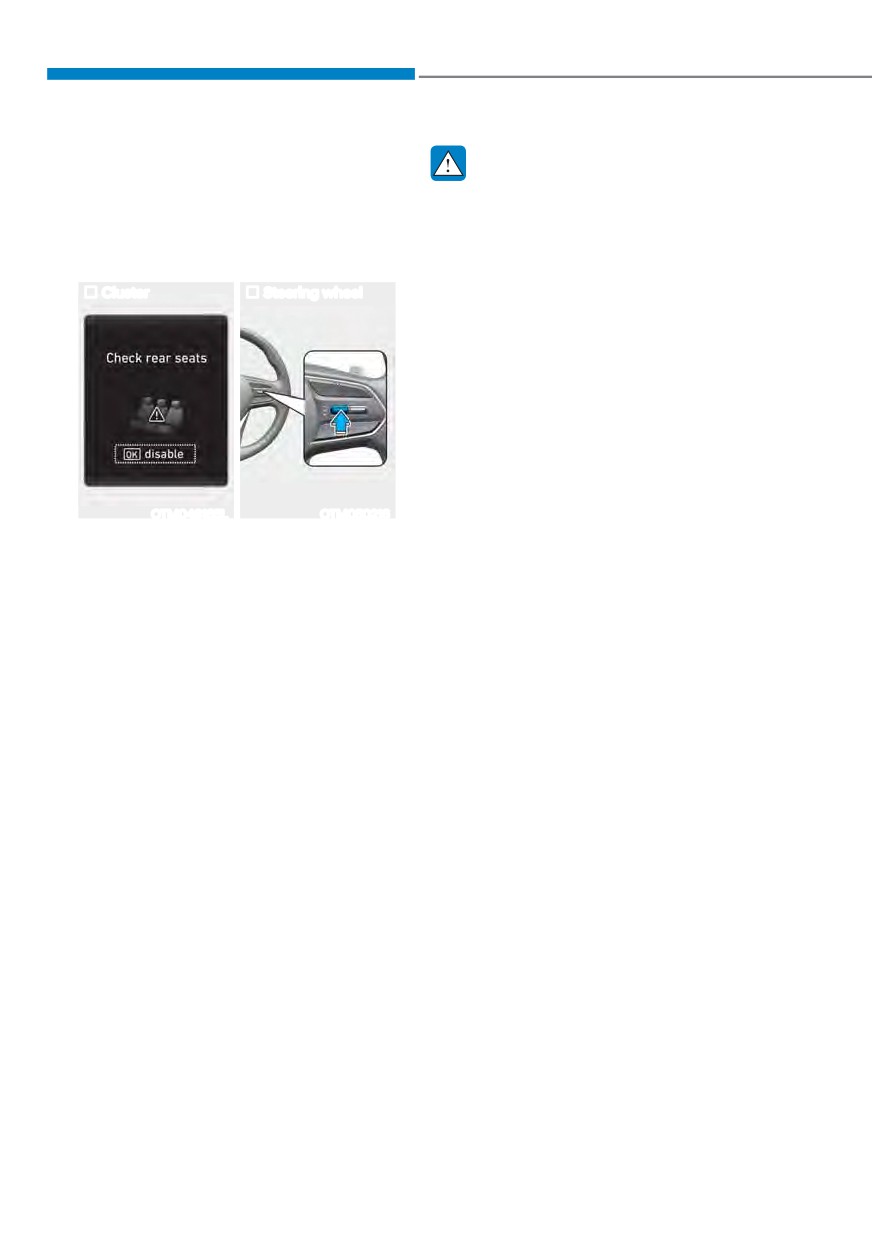
If you do not want to use Rear
certain conditions.
Occupant Alert, press the OK button
on the steering wheel when the first
alert is displayed on the cluster. Doing
so will deactivate the second alert one
time.
ś
An alert can occur if the there is an
impact on the roof.
ś
If boxes or objects are stacked in the
vehicle, the system may not detect
the boxes or objects. Or, the alert may
operate if the boxes or objects fall off.
ś
The sensor may not operate normally
if the senor is obscured by foreign
substances.
ś
The alert may operate if movement
in the driver or passenger seat is
detected.
ś
The alert may operate with the doors
locked due to car wash or surrounding
vibration or noise.
ś
If the vehicle is started remotely (if
equipped with Remote Start), inside
movement detection will stop.
3-22
03
SEAT BELTS
This section describes how to use the
ś
Never wear a seat belt over fragile
seat belts properly. It also describes
objects. If there is a sudden stop or
some of the things not to do when using
impact, the seat belt can damage it.
seat belts.
ś
Do not use the seat belt if it is
twisted. A twisted seat belt will not
Seat belt safety precautions
protect you properly in an accident.
Always fasten your seat belt and make
ś
Do not use a seat belt if the webbing
sure all passengers have fastened their
or hardware is damaged.
seat belts before starting any trip. Air
ś
Do not latch the seat belt into the
bags are designed to supplement the
buckles of other seats.
seat belt as an additional safety device,
ś
NEVER unfasten the seat belt
but they are not a substitute. Most states
require all occupants of a vehicle to wear
while driving. This may cause loss
of vehicle control resulting in an
seat belts.
accident.
ś
Make sure there is nothing in the
WARNING
buckle interfering with the seat
Seat belts must be used by ALL
belt latch mechanism, because any
passengers whenever the vehicle is
materials in the buckle can cause the
moving. Take the following precautions
seat belt not to be fastened securely.
when adjusting and wearing seat belts:
ś
No modifications or additions
ś Children under the age of 13 should
should be made by the user which
be properly restrained in the rear
will either prevent the seat belt
seats.
adjusting devices from operating to
remove slack, or prevent the seat
ś Never allow children to ride in the
belt assembly from being adjusted to
front passenger seat, unless the air
remove slack.
bag is deactivated. If a child is seated
in the front passenger seat, move the
seat as far back as possible. And the
WARNING
child must always be restrained in
Damaged seat belts and seat belt
the seat properly.
assemblies will not operate properly.
ś NEVER allow an infant or child to be
Always replace:
carried on an occupant’s lap.
ś Frayed, contaminated, or damaged
ś NEVER ride with the seatback
webbing.
reclined when the vehicle is moving.
ś Damaged hardware.
ś Do not allow children to share a seat
ś The entire seat belt assembly after it
or seat belt.
has been worn in an accident, even
ś Do not wear the shoulder belt under
if damage to webbing or assembly is
your arm or behind your back.
not apparent.
3-23
Seats & Safety System
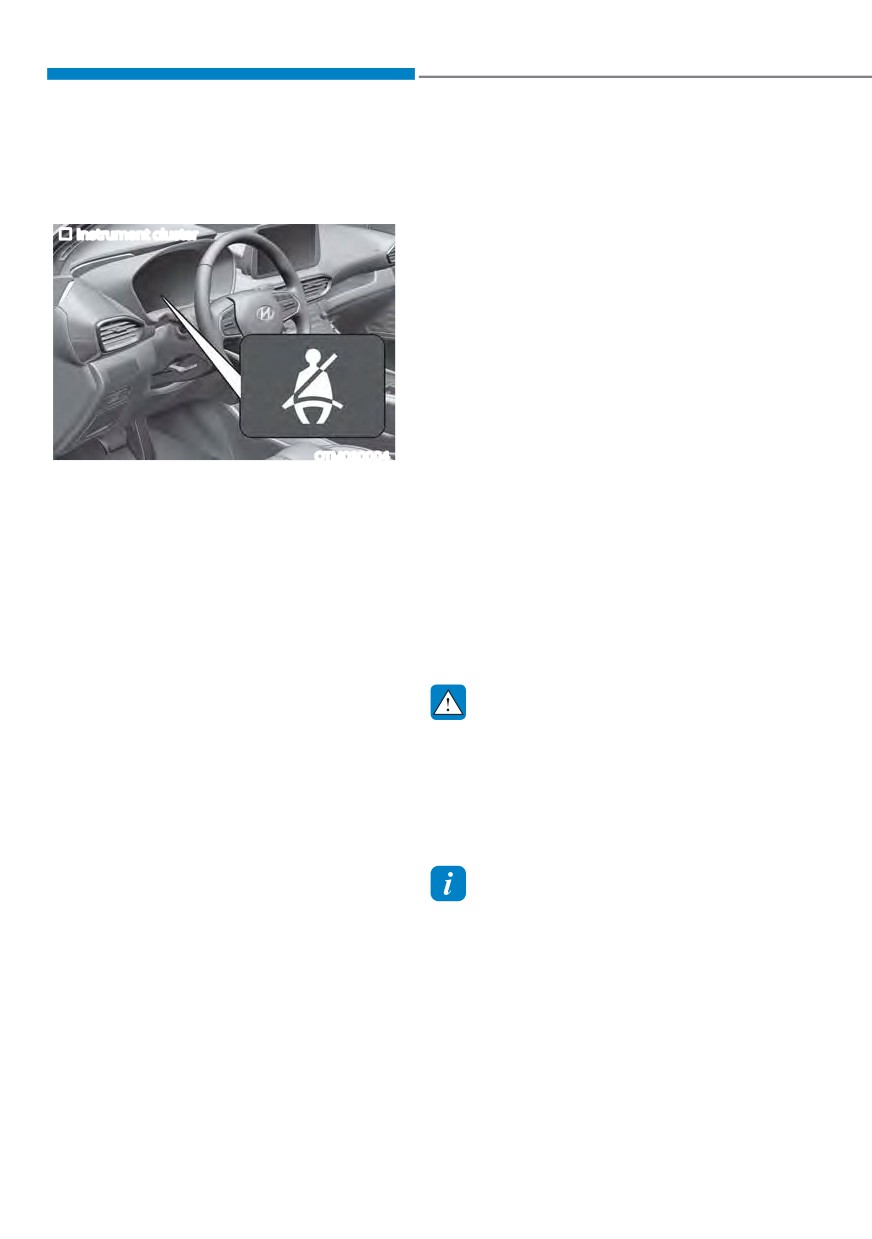
Seat belt warning light
Seat belt warning light (for front
passenger’s seat)
Seat belt warning light (for driver’s
seat)
As a reminder to the front passenger,
the front passenger’s seat belt warning
Instrument cluster
lights will illuminate for approximately 6
seconds each time you place the ignition
switch to the ON position regardless of
belt fastening.
If you continue not to fasten the seat belt
and you drive over 12 mph (20 km/h),
the seat belt warning chime will sound
for approximately 100 seconds and the
corresponding warning light will blink.
OTM030004
As a reminder to the driver, the seat
If you unfasten the seat belt while driving
belt warning light will illuminate for
under 12 mph (20 km/h), the seat belt
approximately 6 seconds each time
warning light will illuminate until the seat
you place the ignition switch to the ON
belt is fastened.
position regardless of belt fastening. At
If you unfasten the seat belt while
this time, if the seat belt is not fastened a
driving over 12 mph (20 km/h), the
warning chime will sound for 6 seconds.
seat belt warning chime will sound for
approximately 100 seconds and the
If you continue not to fasten the seat belt
corresponding warning light will blink.
and you drive over 6 mph (9 km/h), the
warning light will stay illuminated.
WARNING
If you continue not to fasten the seat belt
and you drive over 12 mph (20 km/h),
Riding in an improper position
the seat belt warning chime will sound
adversely affects the front passenger’s
for approximately 100 seconds and the
seat belt warning system. It is important
corresponding warning light will blink.
for the driver to instruct the passenger
to be seated properly as instructed in
this manual.
If you unfasten the seat belt while driving
under 12 mph (20 km/h), the seat belt
warning light will illuminate until the seat
Information
belt is fastened.
ś Although the front passenger seat is not
If you unfasten the seat belt while
occupied, the seat belt warning light
driving over 12 mph (20 km/h), the
will blink or illuminate for 6 seconds.
seat belt warning chime will sound for
ś The front passenger’s seat belt warning
approximately 100 seconds and the
may operate when luggage is placed on
corresponding warning light will blink.
the front passenger seat.
3-24
03
Seat belt restraint system
Front Seat Belt - Driver’s 3point
system with emergency locking
retractor
WARNING
OHI038140
OHI038182L
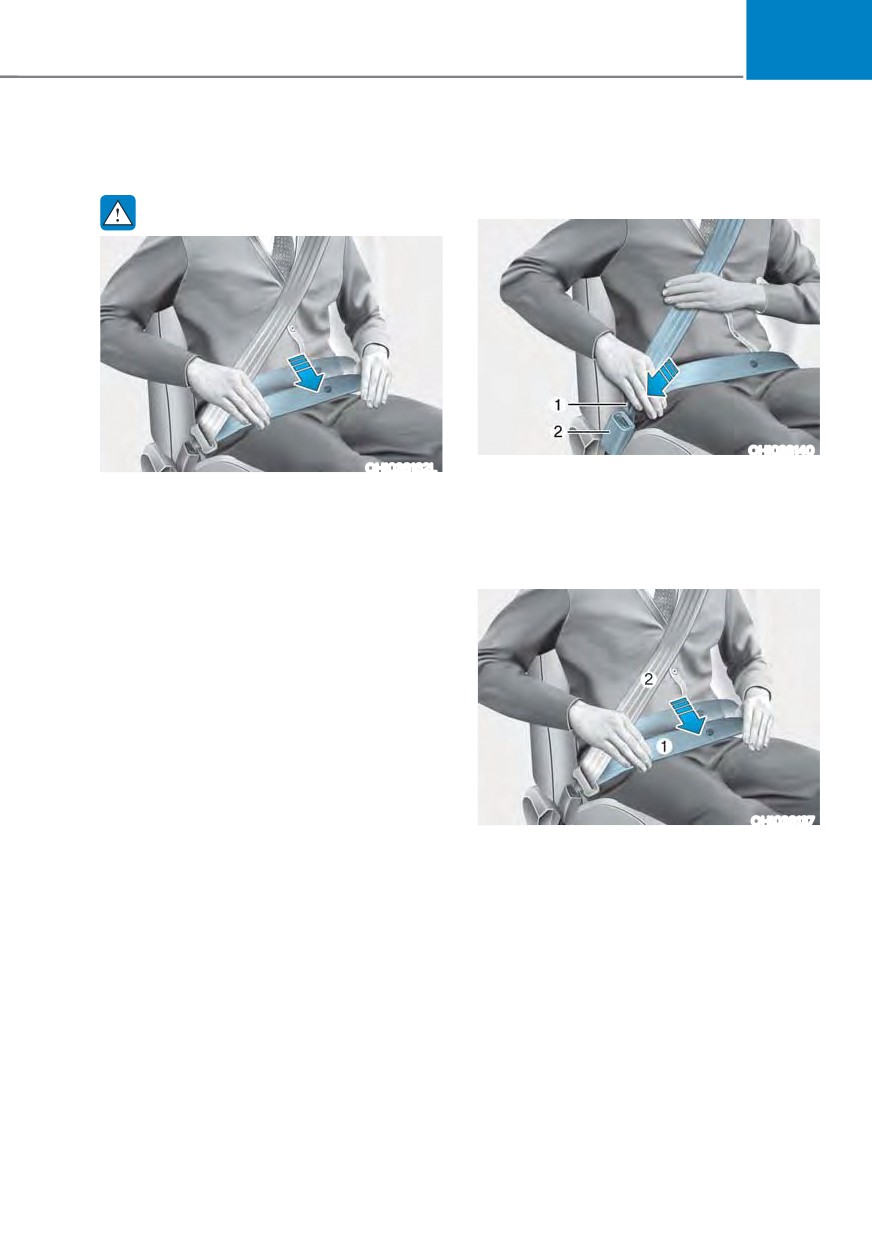
To fasten your seat belt:
Improperly positioned seat belts may
Pull it out of the retractor and insert the
increase the risk of serious injury
metal tab (1) into the buckle (2). There
in an accident. Take the following
will be an audible “click” when the tab
precautions when adjusting the seat
locks into the buckle.
belt:
ś
Position the lap portion of the seat
belt as low as possible across your
hips, not on your waist, so that it
fits snugly. This allows your strong
pelvic bones to absorb the force of
the crash, reducing the chance of
internal injuries.
ś
Position one arm under the shoulder
belt and the other over the belt, as
shown in the illustration.
ś
Always position the shoulder belt
OHI038137
anchor into the locked position at the
appropriate height.
You should place the lap belt (1) portion
across your hips and the shoulder belt (2)
ś
Never position the shoulder belt
portion across your chest.
across your neck or face.
The seat belt automatically adjusts to the
proper length after the lap belt portion
is adjusted manually so that it fits snugly
around your hips. If you lean forward in
a slow, easy motion, the belt will extend
and move with you.
If there is a sudden stop or impact, the
belt will lock into position. It will also lock
if you try to lean forward too quickly.
3-25
Seats & Safety System
Information
If you are not able to smoothly pull
enough of the seat belt out from the
retractor, firmly pull the seat belt out and
release it. After release, you will be able to
pull the belt out smoothly.
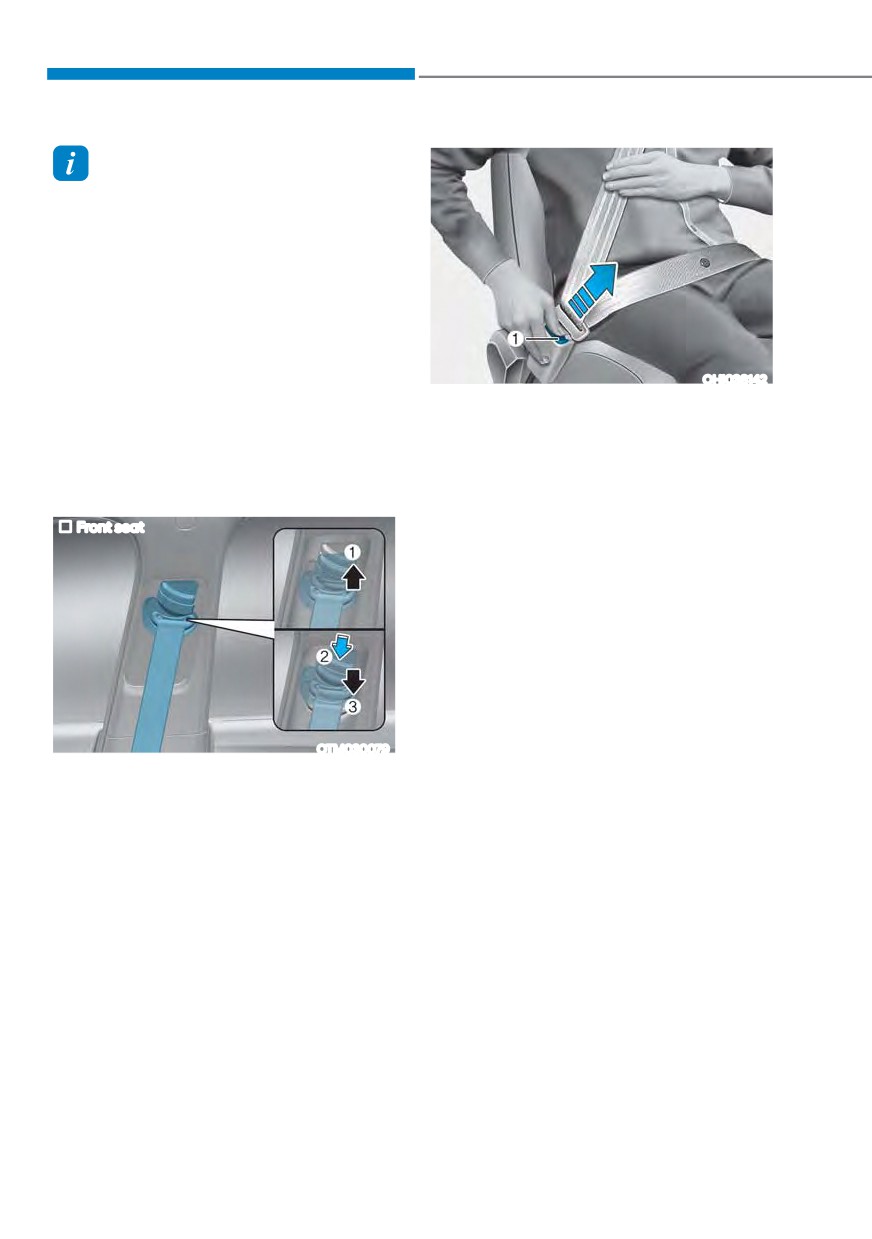
Height adjustment
You can adjust the height of the shoulder
belt anchor to one of the four different
OHI038142
positions for maximum comfort and
safety.
To release your seat belt:
The shoulder portion should be adjusted
Press the release button (1) in the locking
so it lies across your chest and midway
buckle.
over your shoulder nearest the door, not
When it is released, the belt should
over your neck.
automatically draw back into the
retractor. If this does not happen, check
Front seat
the belt to be sure it is not twisted, then
try again.
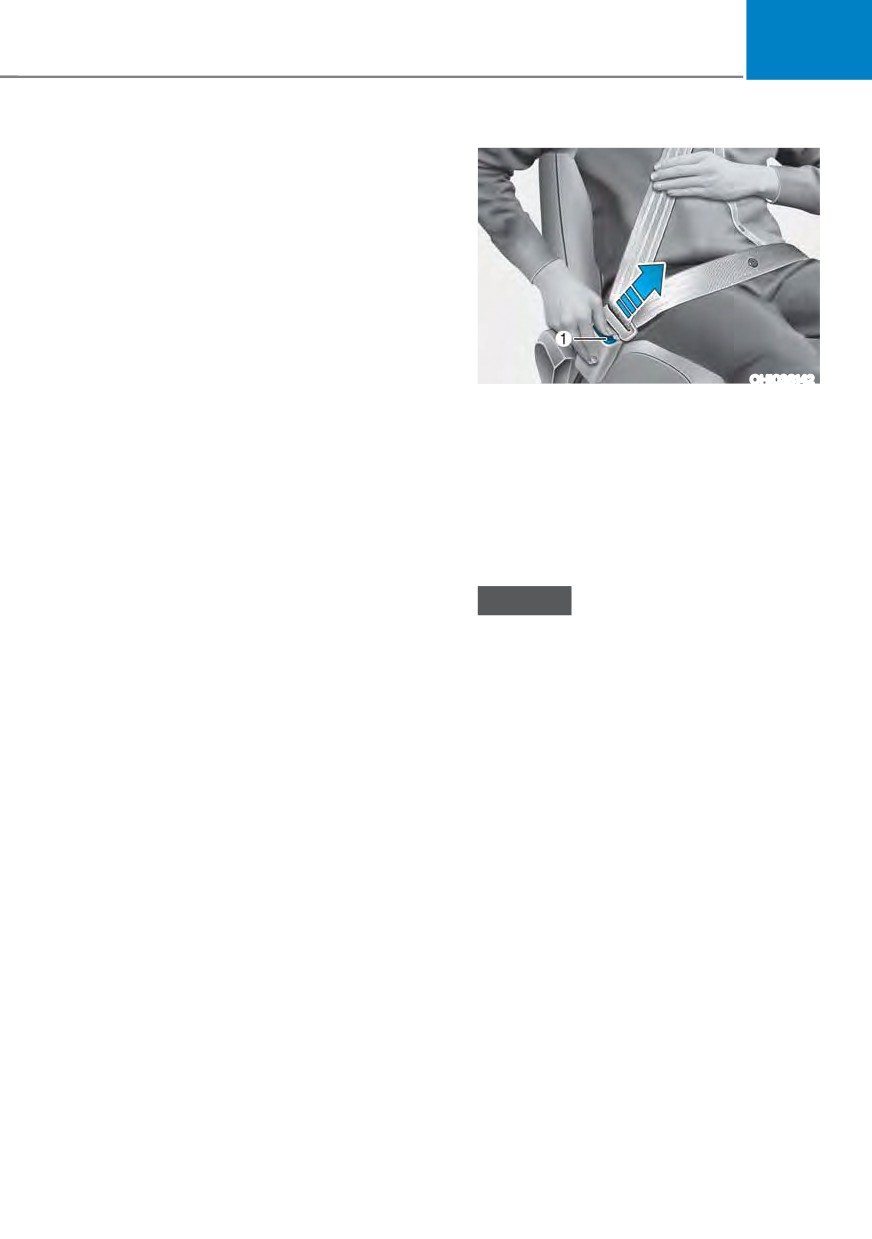
OTM030079
To adjust the height of the seat belt
anchor, lower or raise the height adjuster
into an appropriate position.
To raise the height adjuster, pull it up
(1). To lower it, push it down (3) while
pressing the height adjuster button (2).
Release the button to lock the anchor
into position. Try sliding the height
adjuster to make sure that it has locked
into position.
3-26
03
Rear Seat Belt - Passenger’s 3point
system with convertible locking
retractor
This type of seat belt combines the
features of both an emergency locking
retractor seat belt and an automatic
locking retractor seat belt. Convertible
retractor type seat belts are installed
in the rear seat positions to help
accommodate the installation of child
restraint systems. Although a convertible
OHI038142
retractor is also installed in the front
passenger seat position, NEVER place
To release your seat belt:
any infant/child restraint system in the
Press the release button (1) in the locking
front seat of the vehicle.
buckle.
When it is released, the belt should
To fasten your seat belt:
automatically draw back into the
Pull the seat belt out of the retractor
retractor. If this does not happen, check
and insert the metal tab into the buckle.
the belt to be sure it is not twisted, then
There will be an audible “click” when
try again.
the tab locks into the buckle. When
not securing a child restraint, the seat
NOTICE
belt operates in the same way as the
driver’s seat belt (Emergency Locking
Although the seat belt retractor provides
Retractor Type). It automatically adjusts
the same level of protection for seated
to the proper length only after the lap
passengers in either emergency
belt portion of the seat belt is adjusted
or automatic locking modes, the
manually so that it fits snugly across your
emergency locking mode allows seated
hips.
passengers to move freely in their seat
while keeping some tension on the belt.
When the seat belt is fully extended from
During a collision or sudden stop, the
the retractor to allow the installation of
retractor automatically locks the belt to
a child restraint system, the seat belt
help restrain your body.
operation changes to allow the belt to
retract, but not to extend (Automatic
To deactivate the automatic locking
Locking Retractor Type). Refer to the
mode, unbuckle the seat belt and allow
“Using a Child Restraint System” section
the belt to fully retract.
in this chapter.
3-27
Seats & Safety System
Second row center seatbelt
Stowing the rear seat belt
(3-point rear center seat belt)
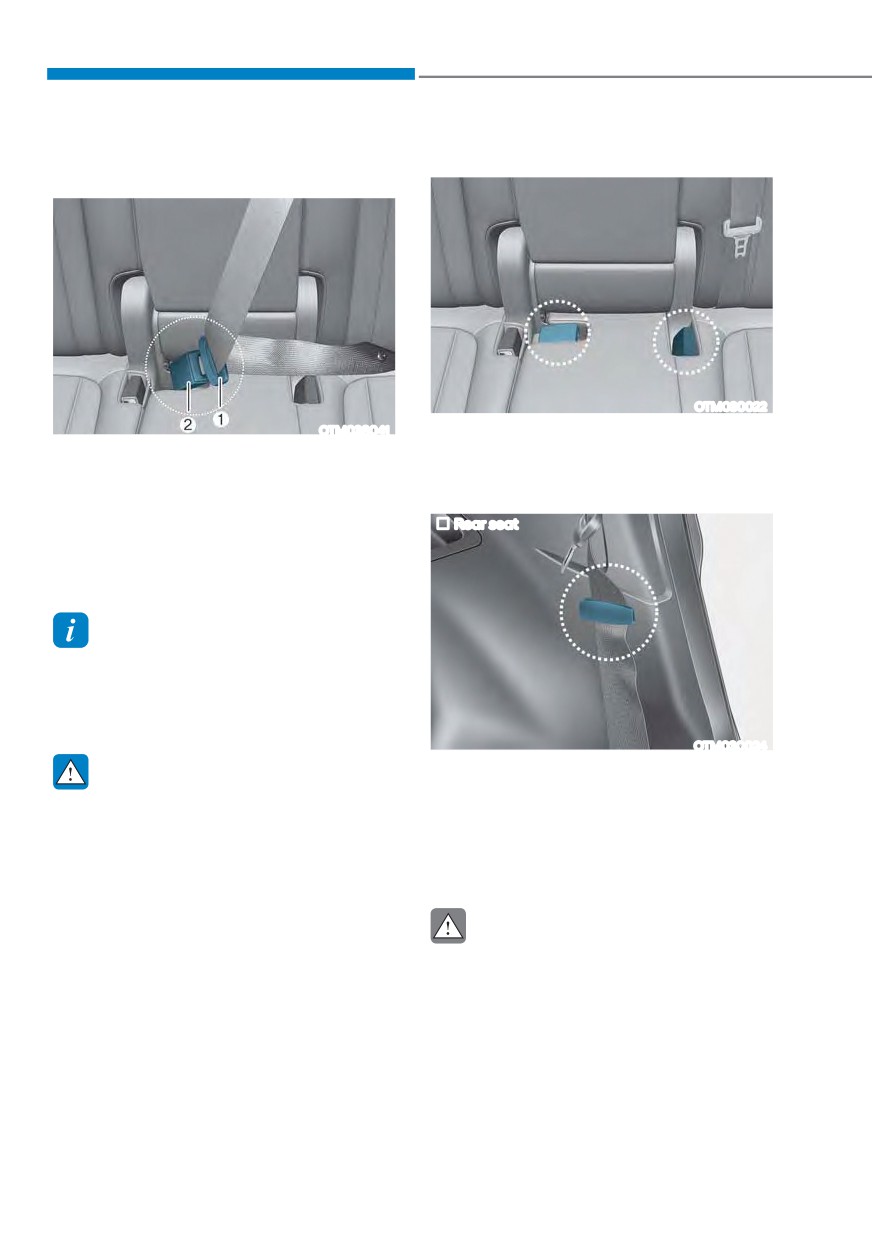
OTM030022
OTM038041
ś
The rear seat belt buckles can be
stowed in the pocket between the
1. Insert the tongue plate (1) into the
rear seatback and cushion when not
buckle (2) until an audible “click" is
in use.
heard, indicating the latch is locked.
Make sure the belt is not twisted.
Rear seat
When using the rear center seat belt, the
buckle with the “CENTER” mark must be
used.
Information
If you are not able to pull out the safety
belt from the retractor, firmly pull the belt
out and release it. After release, you will be
able to pull the belt out smoothly.
OTM030024
WARNING
ś
Routing the seat belt webbing through
the rear seat belt guides will help keep
Make sure that the seatback is locked in
the belts from being trapped behind
place when using the rear center seat
or under the seats.
belt.
After inserting the seat belt, tighten
If not, the seatback may move when
the belt webbing by pulling it up.
there is a sudden stop or collision,
which could result in serious injury.
CAUTION
When using the seat belt, use it after
taking it out of the guides.
If you pull the seat belt when it is stored
in the guides, it may damage the guides
and/or belt webbing.
3-28
03
Pre-tensioner seat belt
(1) Retractor Pretensioner
The purpose of the retractor pre-
tensioner is to make sure that the
shoulder belts fit in tightly against the
occupant’s upper body in certain frontal
or side collision(s).
(2) Emergency Fastening Device System
The purpose of the Emergency Fastening
Device System is to make sure that
the pelvis belts fit in tightly against the
occupant’s lower body in certain frontal
collision(s).
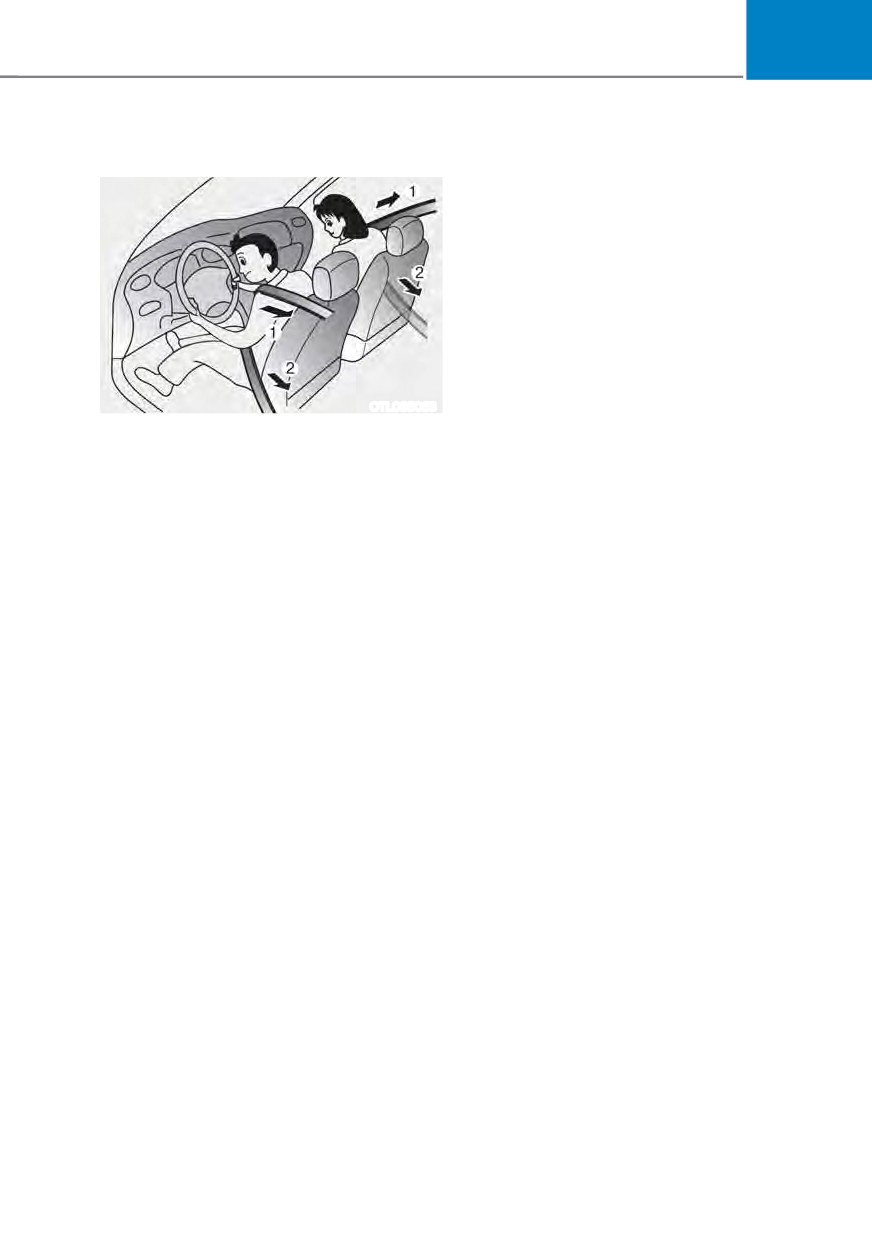
OTL035053
Your vehicle is equipped with driver’s
If the system senses excessive tension
and front passenger’s Pre-tensioner
on the driver or passenger’s seat belt
Seat Belts(Retractor Pretensioner and
when the pre-tensioner system activates,
Emergency Fastening Device System).
the load limiter inside the retractor
The purpose of the pre-tensioner is
pre-tensioner will release some of the
to make sure the seat belts fit tightly
pressure on the affected seat belt.
against the occupant’s body in
certain frontal or side collision(s). The
Emergency Fastening Device System
may be activated in certain crashes
where the frontal collision(s) is severe
enough, together with the air bags.
When the vehicle stops suddenly, or
if the occupant tries to lean forward
too quickly, the seat belt retractor will
lock into position. In certain frontal or
side collision(s), the pre-tensioner will
activate and pull the seat belt into tighter
contact against the occupant’s body.
3-29
Seats & Safety System
WARNING
ś Always wear your seat belt and sit
properly in your seat.
ś Do not use the seat belt if it is loose
or twisted. A loose or twisted seat
belt will not protect you properly in
an accident.
ś Do not place anything near the
buckle. This may adversely affect
the buckle and cause it to function
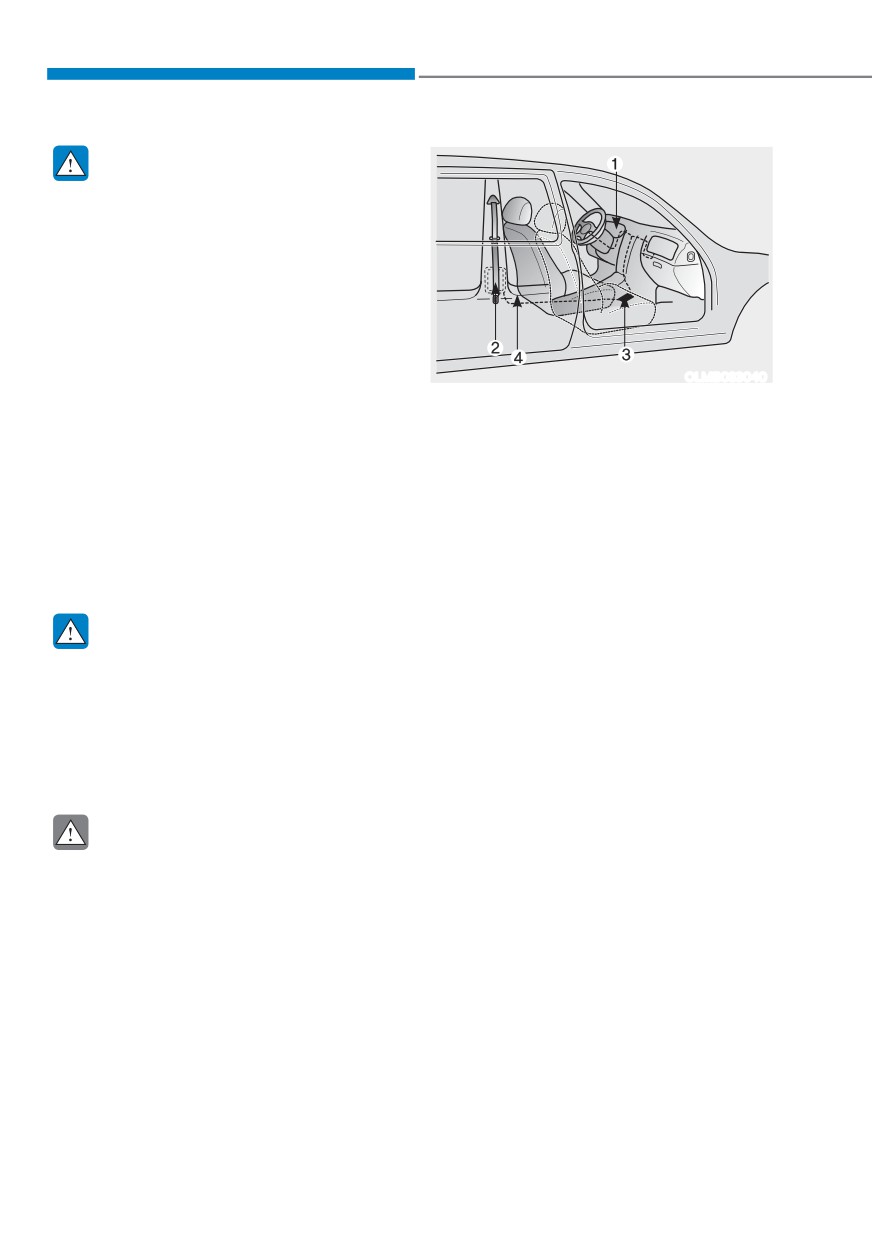
OLMB033040
improperly.
The Pre-Tensioner Seat Belt System
ś Always replace your pre-tensioners
consists mainly of the following
after activation or an accident.
components. Their locations are shown
ś NEVER inspect, service, repair
in the illustration above:
or replace the pre-tensioners by
(1) SRS air bag warning light
yourself. Have the pre-tensioners
inspected, serviced, repaired or
(2) Retractor pre-tensioner
replaced by an authorized HYUNDAI
(3) SRS control module
dealer.
(4) Emergency fastening device
ś Do not hit the seat belt assemblies.
WARNING
Do not touch the pre-tensioner seat
belt assemblies for several minutes
after they have been activated. When
the pre-tensioner seat belt mechanism
deploys during a collision, the pre-
tensioner can become hot and can burn
you.
CAUTION
Body work on the front area of the
vehicle may damage the pre-tensioner
seat belt system. Therefore, have the
system to be serviced by an authorized
HYUNDAI dealer.
3-30