Hummer H1 (2006+). Manual - part 73
OBD-136
On-Board Diagnostics
_____________________________________________
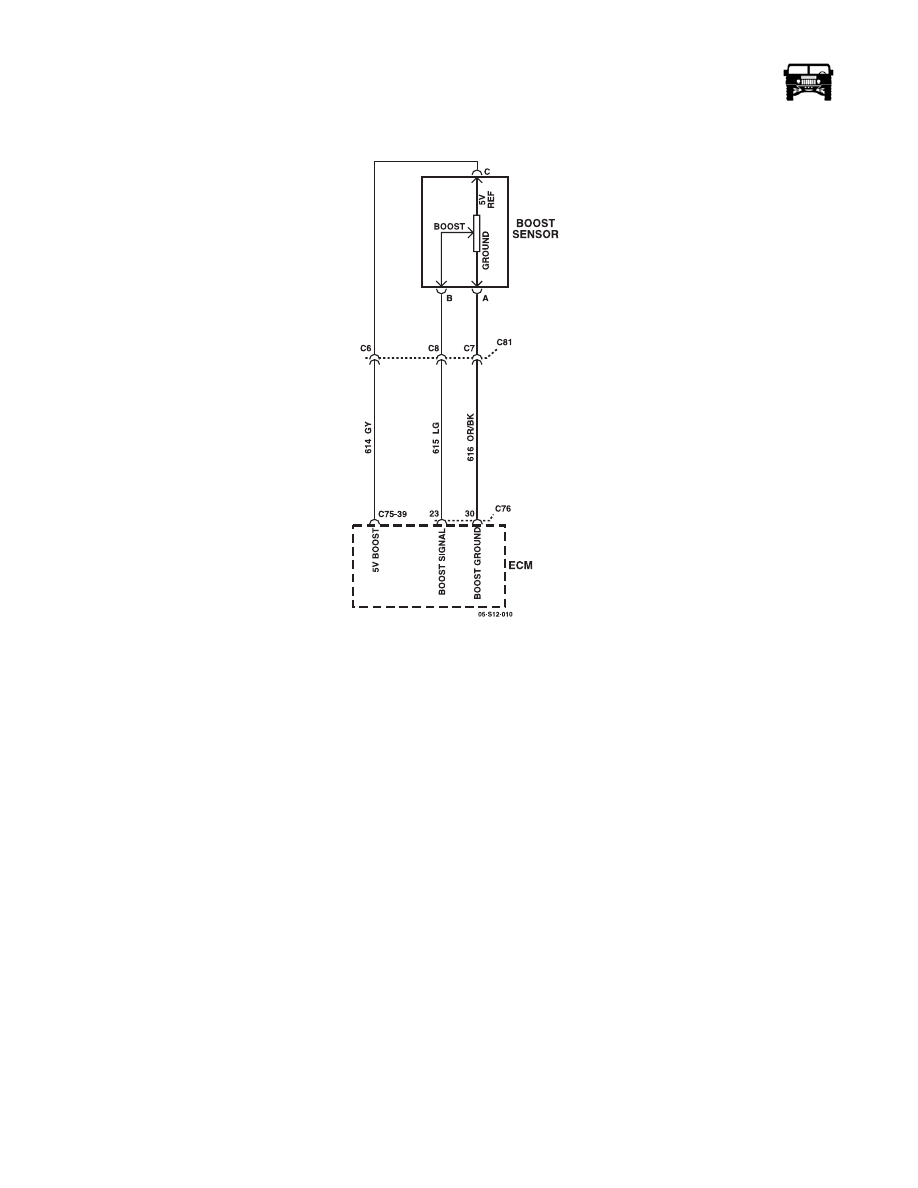
DTC P0238 Turbo Charger Boost Sensor Circuit High Voltage (Figure OBD-40)
Figure OBD-40: Turbocharger Boost Sensor Circuit
Circuit Description
The boost pressure sensor measures the pressure inside the intake manifold. Pressure in the intake manifold is affected by turbo-
charger output, engine speed, accelerator pedal input, air temperature, and barometric pressure (BARO). A diaphragm within the
boost pressure sensor is displaced by the pressure changes that occur from the varying load and operating conditions of the engine.
The sensor translates this action into electrical resistance. The boost pressure sensor wiring includes 3 circuits. The engine control
module (ECM) supplies a regulated 5 volts to the sensor on a 5-volt reference circuit. The ECM supplies a ground on a low refer-
ence circuit. The boost pressure sensor provides a signal voltage to the ECM, relative to the pressure changes, on the boost pressure
sensor signal circuit. The ECM converts the signal voltage input to a pressure value.
Under normal operation the lowest pressure that can exist in the intake manifold is equal to the BARO. This occurs when the vehi-
cle is operated at idle or when the ignition is ON while the engine is OFF. Under these conditions, the ECM uses the boost pressure
sensor to aid in the diagnosis of the BARO sensor. The highest manifold pressure occur when the turbo charger output is high.
Manifold pressure can range from 58 kPa (8 psi) when pressure are low, to more than 240 kPa (34 psi) when pressure are high, de-
pending on the BARO. The boost pressure sensor has a range of 33-255 kPa (4-36 psi). The ECM also uses the boost pressure sen-
sor to provide engine overboost protection.
The ECM monitors the boost pressure sensor signal for pressure outside of the normal range. If the ECM detects a boost pressure
that is excessively high, DTC P0238 sets.
Conditions for Setting the DTC
The ECM detects that the boost pressure is more than 254 kPa (36 psi) for 2 seconds.