Honda Civic (2022 year). Manual in english - page 32
 

  Index      Manuals     Honda Civic (2022 year). Manual in english


Search            copyright infringement  


Content      ..     30      31      32      33     ..


Honda Civic (2022 year). Manual in english - page 32


515

uu

Honda Sensing

®

u

Adaptive Cruise Control (ACC) with Low Speed Follow

Driving

1

To Cancel

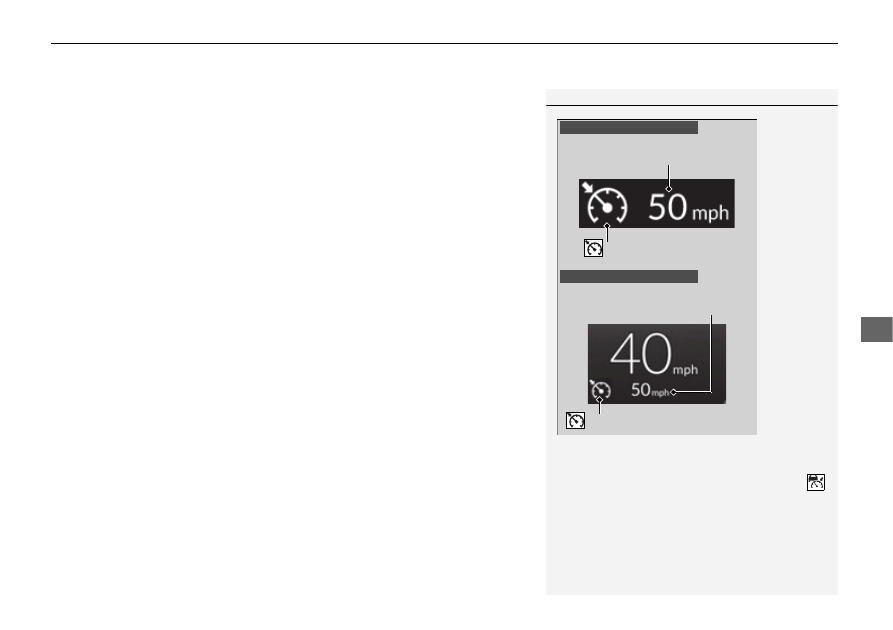
You cannot set or resume in the following situations:

When vehicle speed is less than 25 mph (40 km/h)

When cruise control is canceled by pressing the 


button.

At vehicle speeds of 22 mph (35 km/h) or less, cruise 
control canceled automatically.

Models with A-type meter

Prior Set Speed (gray)

 (white)

Models with B-type meter

Prior Set Speed (gray)

 (white)

516

uu

Honda Sensing

®

u

Lane Keeping Assist System (LKAS)

Driving

Lane Keeping Assist System (LKAS)

Provides steering input to help keep the vehicle in the middle of a detected lane and 
provides tactile and visual alerts if the vehicle is detected drifting out of its lane.

1

Lane Keeping Assist System (LKAS)

Important Safety Reminders

The LKAS is for your convenience only. It is not an 
autonomous driving system and always requires 
driver attention and control. The system does not 
work if you take your hands off the steering wheel or 
fail to steer the vehicle.

The LKAS is convenient when it is used on 
expressways or freeways.

Do not place objects on the instrument panel. 
Objects may reflect on the windshield and prevent 
correct detection of the traffic lanes.

The LKAS only alerts you when lane drift is detected 
without a turn signal in use. The LKAS may not detect 
all lane markings or lane departures; accuracy will 
vary based on weather, speed, and lane marker 
condition.
It is always your responsibility to safely operate the 
vehicle and avoid collisions.

The LKAS may not work properly or may work 
improperly under the certain conditions:

2

LKAS Conditions and Limitations

 P. 524

You can read about handling information for the 
camera equipped with this system.

2

Front Wide View Camera

 P. 551

When you operate the turn signals to change lanes, the system is suspended, and 
resumes after the signals are off.
If you make a lane change without operating the turn signals, the LKAS alerts 
activate, and torque is applied to the steering.

Front Wide 

View Camera

Monitors the 
lane lines

Tactile and visual alerts

Rapid vibrations on the steering wheel 
and a warning display alert you that 
the vehicle is drifting out of a detected 
lane.

Steering input assist

The system applies torque to the steering to keep the vehicle between the left 
and right lane lines. The applied torque becomes stronger as the vehicle gets 
closer to either of the lane lines.

Continued

517

uu

Honda Sensing

®

u

Lane Keeping Assist System (LKAS)

Driving

Provides assistance to keep the vehicle in the center of the lane. When the vehicle 
nears a white or yellow line, steering force of the electric power steering will become 
stronger.

Lane Keep Support Function

1

Lane Keeping Assist System (LKAS)

When it fails to detect lanes, the system will 
temporarily be canceled. When a lane is detected, the 
system will recover automatically.

The LKAS may not function as designed while driving 
in frequent stop and go traffic, or on roads with 
sharp curves.

518

uu

Honda Sensing

®

u

Lane Keeping Assist System (LKAS)

Driving

When the vehicle enters the warning area, the LKAS alerts you with slight steering 
wheel vibration as well as a warning display.

*1 : Models with A-type meter
*2 : Models with B-type meter

Lane Departure Warning Function

LKAS indicator (green)

Amber line

Warning Area

Warning Area

*1

*2

Continued

519

uu

Honda Sensing

®

u

Lane Keeping Assist System (LKAS)

Driving

The system can be used when the following conditions are met.

The lane in which you are driving has detectable lane markers on both sides, and 
your vehicle is in the center of the lane.

The vehicle is traveling between about 45 and 90 mph (72 and 145 km/h).

You are driving on a straight or slightly curved road.

The turn signals are off.

The brake pedal is not depressed.

How to activate the system

1.

Press the LKAS button.

u

LKAS indicator (white) appears on the 
gauge.
The system is standby.

u

If traffic lane lines are detected, white 
lines appear on the gauge.

*1 : Models with A-type meter
*2 : Models with B-type meter

When the System can be Used

1

When the System can be Used

If the vehicle drifts toward either left or right lane line 
due to the system applying torque, turn off the LKAS 
and have your vehicle checked by a dealer.

Be sure to keep the following below to activate the 
system properly;

Always keep the windshield around the camera 
clean.

When cleaning the windshield, be careful not to 
apply windshield cleanser to the camera lens.

Do not touch the camera lens.

Do not attach a sticker to the area around the 
camera.

If LKAS button is pressed when the system can be 
used, LKAS is on without standby.

LKAS indicator 
(white)

White lines

White lines

LKAS indicator 
(white)

*1

*2

LKAS Button

520

uu

Honda Sensing

®

u

Lane Keeping Assist System (LKAS)

Driving

2.

Keep your vehicle near the center of the 
lane while driving.

u

The LKAS indicator changes from white 
to green, and white lines change to 
green once the system starts operating 
after detecting the left and right lane 
markings.

Models with A-type meter

Models with B-type meter

LKAS indicator (green)

Green lines

Green lines

LKAS indicator (green)

521

uu

Honda Sensing

®

u

Lane Keeping Assist System (LKAS)

Continued

Driving

Press the LKAS button.

The LKAS is turned off every time you stop the 
engine, even if you turned it on the last time 
you drove the vehicle.

To Cancel

LKAS Button

uu

Honda Sensing

®

u

Lane Keeping Assist System (LKAS)

522

Driving

The system operation is suspended if 
you:

Decrease the vehicle speed to about 40 mph 
(64 km/h) or less.

u

Increasing the vehicle speed to about 45 
mph (72 km/h) or more resumes the 
LKAS.

Depress the brake pedal.

u

The LKAS resumes and starts detecting 
the lane lines again once you release the 
brake pedal.

Your vehicle is driving to the right or the left 
of the lane.

1

To Cancel

You can change the setting for the LKAS.
LKAS suspended beep on and off can be selected.

2

Settings

 P. 126

2

Customized Features

 P. 363

When the LKAS is suspended, 
green lines on the gauge change 
to white lines or dissapear, and 
the beeper sounds (if activated).

Models with A-type meter

Models with B-type meter

LKAS indicator (white)

White lines

LKAS indicator (white)

White lines

523

uu

Honda Sensing

®

u

Lane Keeping Assist System (LKAS)

Continued

Driving

The LKAS may be automatically suspended when:

The system fails to detect lane lines.

The steering wheel is turned quickly.

You fail to steer the vehicle.

Driving through a sharp curve.

Driving at a speed in excess of approximately 90 mph (145 km/h).

The brake pedal is depressed.

Once these conditions no longer exist, the LKAS automatically resumes.

The LKAS may be automatically canceled when:

In the following cases, traffic lane lines may dissapear on the gauge, the beeper may 
sound, and the LKAS may automatically be canceled:

The camera temperature gets extremely high.

The camera behind the rearview mirror, or the area around the camera, including 
the windshield, gets dirty.

The ABS or VSA

®

 system engages.

A beeper sounds if the LKAS is automatically canceled.

524

uu

Honda Sensing

®

u

Lane Keeping Assist System (LKAS)

Driving

The system may not detect lane markings and therefore may not keep the vehicle in 
the middle of the lane under certain conditions, including the following:

Environmental conditions

There is little contrast between lane lines and the roadway surface.

Driving in bad weather (rain, fog, snow, etc.).

Driving on a snowy or wet roadway.

Driving into low sunlight (e.g., at dawn or dusk).

Shadows of adjacent objects (trees, buildings, guard rails, vehicles, etc.) are 
parallel to white (or yellow) lines.

Sudden changes between light and dark, such as the entrance or exit of a tunnel 
or the shadows of trees, buildings, etc.

Driving at night or in a dark place such as a tunnel (due to low-light conditions, 
lane lines or the road surface may not be illuminated).

When the lane lines or road surface are not visible, such as when the distance to 
the vehicle in front of you is extremely short or when at an intersection.

Strong light is reflected onto the roadway.

LKAS Conditions and Limitations

525

uu

Honda Sensing

®

u

Lane Keeping Assist System (LKAS)

Continued

Driving

Roadway conditions

Driving on a road with temporary lane markings.

Faint, multiple, or varied lane markings are visible on the roadway due to road 
repairs or old lane markings.

The roadway has merging, split, or crossing lines, such as at an intersection or 
crosswalk.

The lane markings are extremely narrow, wide, or changing.

Part of the lane markings are hidden by an object, such as a vehicle.

The road is hilly or the vehicle is approaching the crest of a hill.

Your vehicle is strongly shaken on uneven road surfaces.

Faded lines

Duplicate lines

Tire tracks

Very wide or narrow traffic lane

526

uu

Honda Sensing

®

u

Lane Keeping Assist System (LKAS)

Driving

When objects on the road (curb, guard rail, pylons, etc.) are recognized as white 
(or yellow) lines.

Driving on rough or unpaved roads, or over bumpy surfaces.

Driving on roads with double lane lines.

Driving on snowy or slippery roads.

The pavement is only partially visible due to snow or puddles on the road.

There is a film of water or puddles on the road surface.

White (or yellow) lines are not recognized correctly due to road conditions such as 
curves, twists, or hills.

Driving on unpaved or rutted roads.

Passing through an exit or an intersection.

Lane void of lines at exit or 
intersection

527

uu

Honda Sensing

®

u

Lane Keeping Assist System (LKAS)

Driving

Vehicle conditions

When lighting is weak due to dirt covering the headlight lenses, or there is poor 
visibility in a dark place due to the headlights being improperly adjusted.

The front of the camera is covered by dirt, fog, rain, mud, wet snow, seals, 
accessories, stickers, or film on the windshield.

Driving at night or in a dark place (e.g., a tunnel) with the headlights off.

There is residue on the windshield from the windshield wipers.

An abnormal tire or wheel condition (incorrect sizes, varied sizes or construction, 
improperly inflated, compact spare tire, etc.).

The vehicle is tilted due to a heavy load in the trunk or rear seats.

The suspension has been modified.

Tire chains are installed.

528

uu

Honda Sensing

®

u

Traffic Jam Assist

Driving

Traffic Jam Assist

The traffic jam assist system uses a camera mounted to the upper portion of the 
windshield to detect and monitor left and right white (or yellow) traffic lane lines. 
Based on inputs from the camera, the system can apply steering torque to keep your 
vehicle in the center of the detected lane.

How Traffic Jam Assist works

When you are in heavy traffic and LKAS is active, the traffic jam assist system, upon 
detecting the traffic lane lines, will apply steering torque to help keep your vehicle in 
the center of the lane.

When the driver takes full control of the steering, the steering assist function is 
temporarily canceled.
The torque applied to the steering may not be noticeable when the driver has full 
control of the steering, or when the surface of the road is rough or uneven.

1

Traffic Jam Assist

Important Safety Reminders

Traffic Jam Assist is for your convenience only. It is 
not an autonomous driving system and always 
requires driver attention and control. The system 
does not work if you take your hands off the steering 
wheel or fail to steer the vehicle.

Traffic Jam Assist is convenient when it is used on 
expressways or freeways.

You can read about handling information for the 
camera equipped with this system.

2

Front Wide View Camera

 P. 551

The Traffic Jam Assist only alerts you when lane drift 
is detected without a turn signal in use. The Traffic 
Jam Assist may not detect all lane markings or lane 
departures; accuracy will vary based on weather, 
speed, and lane marker condition.
It is always your responsibility to safely operate the 
vehicle and avoid collisions.

Traffic Jam Assist may not work properly under 
certain conditions:

2

Traffic Jam Assist: Conditions and 
Limitations

 P. 533

Front Wide View Camera

When you use the turn signal to indicate a lane change, Traffic Jam Assist is 
temporarily deactivated. It is reactivated once the vehicle is traveling in the 
center of the lane and the system has detected the traffic lane lines.

Detects left and right white 
(or yellow) traffic lane lines

529

uu

Honda Sensing

®

u

Traffic Jam Assist

Continued

Driving

When the vehicle enters the warning area, Traffic Jam Assist alerts you with slight 
steering wheel vibration or an audible alert as well as a warning display.

*1 : Models with A-type meter
*2 : Models with B-type meter

Lane Departure Warning Function

LKAS indicator (green)

Amber line

Warning Area

Warning Area

*1

*2

uu

Honda Sensing

®

u

Traffic Jam Assist

530

Driving

Traffic Jam Assist is activated when all of the following conditions exist:

LKAS is activated.

The lane in which you are driving has detectable lane markers on both sides, and 
your vehicle is in the center of the lane.

The vehicle is traveling between about 0 and 45mph (0 and 72km/h).

You are driving on a straight or slightly curved road.

The driver is gripping the steering wheel.

The shift position is in 

(

D

.

Do not use Traffic Jam Assist in any of the following situations:

You are traveling on a road with sharp curves.

u

The system may not allow your vehicle to respond in a manner best suited for 
the road conditions.

You are entering a toll booth, interchange, service area, or parking area.

You are driving in adverse weather (rain, fog, snow, etc.).

The surface of the road is slippery; for example, it is icy or covered with snow.

u

The tires may slip, causing you to lose control of the vehicle.

Traffic Jam Assist Activation

1

Traffic Jam Assist Activation

Refer to the following page for proper handling of 
the Lane Keeping Assist System (LKAS):

2

Lane Keeping Assist System (LKAS)

 P. 516

Refer to the following page for steering buttons and 
displays:

2

Operation Switches for the Adaptive 
Cruise Control (ACC) with Low Speed 
Follow/Lane Keeping Assist System 
(LKAS)/Traffic Jam Assist

 P. 474


Content      ..     30      31      32      33     ..