Honda Civic (2022 year). Manual in english - page 5
 

  Index      Manuals     Honda Civic (2022 year). Manual in english


Search            copyright infringement  


Content      ..     3      4      5      6     ..


Honda Civic (2022 year). Manual in english - page 5


Continued

79

uu

Child Safety

u

Safety of Infants and Small Children

Safe Driving

5.

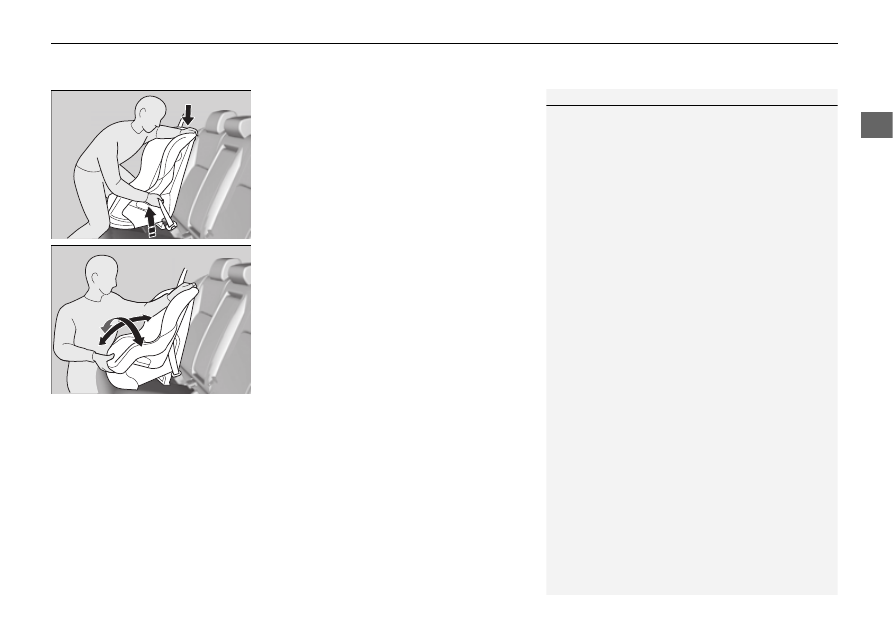
Grab the shoulder part of the seat belt near 
the buckle, and pull up to remove any slack 
from the lap part of the belt.

u

When doing this, place your weight on 
the child seat and push it into the vehicle 
seat.

6.

Make sure the child seat is firmly secured by 
rocking it forward and back and side to 
side; less than one inch of movement 
should occur near the seat belt.

7.

Make sure any unused seat belt that a child 
can reach is buckled, the lockable retractor 
is activated, and the belt is fully retracted 
and locked.

1

Installing a Child Seat with a Lap/Shoulder Seat Belt

To deactivate a lockable retractor, release the buckle 
and allow the seat belt to wind up all the way.

uu

Child Safety

u

Safety of Infants and Small Children

80

Safe Driving

A tether anchor point is provided behind each 
rear seating position. If you have a child seat 
that comes with a tether but can be installed 
with a seat belt, the tether may be used for 
additional security.

1.

Locate the appropriate tether anchor point 
and lift the cover.

2.

Route the tether strap over the head 
restraint. Make sure the strap is not twisted.

Adding Security with a Tether

1

Adding Security with a Tether

Always use a tether for forward-facing child seats 
whether using the seat belt or lower anchors.

Tether Anchor Points

Cover

Anchor

Straight Top Tether Type in Outer 
Position

Tether Strap 
Hook

Anchor

Other Top Tether Type in Outer 
Position

Tether Strap 
Hook

Anchor

81

uu

Child Safety

u

Safety of Infants and Small Children

Safe Driving

3.

Secure the tether strap hook to the anchor.

4.

Tighten the tether strap as instructed by the 
child seat manufacturer.

Tether Strap 
Hook

Anchor

Straight Top Tether Type in Center 
Position

Other Top Tether Type in Center 
Position

Tether Strap 
Hook

Anchor

82

uu

Child Safety

u

Safety of Larger Children

Safe Driving

Safety of Larger Children

The following pages give instructions on how to check proper seat belt fit, what kind 
of booster seat to use if one is needed, and important precautions for a child who 
must sit in front.

When a child is too big for a child seat, secure the child in a rear seat using the lap/
shoulder seat belt. Have the child sit upright and all the way back, then answer the 
following questions.

Checklist

Do the child’s knees bend comfortably over 
the edge of the seat?

Does the shoulder belt cross between the 
child’s neck and arm?

Is the lap part of the seat belt as low as 
possible, touching the child’s thighs?

Will the child be able to stay seated like this 
for the whole trip?

If you answer yes to all these questions, the child is ready to wear the lap/shoulder 
seat belt correctly. If you answer no to any question, the child needs to ride on a 
booster seat until the seat belt fits properly without a booster seat.

Protecting Larger Children

Checking Seat Belt Fit

1

Safety of Larger Children

3

WARNING

Allowing a child age 12 or under to sit in 
front can result in injury or death if the 
passenger’s front airbag inflates.

If a larger child must ride in front, move the 
vehicle seat as far to the rear as possible, 
have the child sit up properly and wear the 
seat belt properly, using a booster seat if 
needed.

83

uu

Child Safety

u

Safety of Larger Children

Safe Driving

If a lap/shoulder seat belt cannot be used 
properly, position the child in a booster seat in 
the rear seat. For the child’s safety, check that 
the child meets the booster seat 
manufacturer’s recommendations.

Your vehicle has a rear seat where children can be properly restrained. If you ever 
have to carry a group of children, and a child must ride in front:

Make sure you read and fully understand the instructions and safety information 
in this manual.

Move the front passenger seat as far back as possible.

Have the child sit upright and well back in the seat.

Check that the seat belt is properly positioned so that the child is secure in the 
seat.

Monitoring child passengers

We strongly recommend that you keep an eye on child passengers. Even older, more 
mature children sometimes need to be reminded to fasten their seat belts and sit up 
properly.

Booster Seats

1

Booster Seats

When installing a booster seat, make sure to read the 
instructions that came with it, and install the seat 
accordingly.
There are high- and low-type booster seats. Choose a 
booster seat that allows the child to wear the seat 
belt correctly.

Some U.S. states, and Canadian provinces and 
territories require children to use a booster seat until 
they reach a given age or weight (e.g. 6 years or 60 
lbs). Be sure to check current laws in the state or 
province, or territory where you intend to drive.

Protecting Larger Children - Final Checks

84

Safe Driving

Exhaust Gas Hazard

Carbon Monoxide Gas

The engine exhaust from this vehicle contains carbon monoxide, a colorless, 
odorless, and highly toxic gas. As long as you properly maintain your vehicle, carbon 
monoxide gas will not get into the interior.

Have the exhaust system inspected for leaks whenever

The exhaust system is making an unusual noise.

The exhaust system may have been damaged.

The vehicle is raised for an oil change.

When you operate a vehicle with the trunk open, airflow can pull exhaust gas into 
the interior and create a hazardous condition. If you must drive with the trunk open, 
open all the windows and set the climate control system as shown below.

1.

Select the fresh air mode.

2.

Select the 

 mode.

3.

Set the fan speed to high.

4.

Set the temperature control to a comfortable setting.

Adjust the climate control system in the same manner if you sit in your parked 
vehicle with the engine running.

1

Carbon Monoxide Gas

An enclosed area such as a garage can quickly fill up 
with carbon monoxide gas.
Do not run the engine with the garage door closed. 
Even when the garage door is open, drive out of the 
garage immediately after starting the engine.

3

WARNING

Carbon monoxide gas is toxic.

Breathing it can cause unconsciousness and 
even kill you.

Avoid any enclosed areas or activities that 
expose you to carbon monoxide.

85

Safe Driving

Safety Labels

Label Locations

These labels are in the locations shown. They warn you of potential hazards that can cause serious injury or death. Read these labels 
carefully.

If a label comes off or becomes hard to read (except for the U.S. dashboard label which may be removed by the owner), contact a dealer 
for a replacement.

Sun Visor

U.S. models

Canadian models

Reserve Tank Cap

U.S. models only

Dashboard

Canadian models

Air Conditioner System

2.0 L engine models for U.S.

1.5 L engine models for U.S.

88

In

strum

e

nt Pa

nel

Indicators

Indicators come on/blink depending on the condition of the vehicle. Messages may 
display on the driver information interface at the same time. Please take the 
appropriate action outlined in the message, such as contacting a dealer.

M

 (7-speed manual 

shift mode) Indicator/
Shift Indicator

*

 P. 93

Parking Brake and 
Brake System 
Indicator (Red)

Parking Brake and 
Brake System 
Indicator (Amber)

U.S.

Canada

U.S.

Canada

Automatic Brake 
Hold System 
Indicator

Automatic Brake 
Hold Indicator

U.S.

Canada

*1 : When you set the power mode to ON, these indicators come on to indicate that system checks are being performed. They go off a few seconds later or after the engine 

has started. If an indicator does not come on or turn off, there may be a malfunction in the corresponding system. To resolve the issue, follow the instructions in the 
owner's manual. 

 P. 90

*1

Malfunction 
Indicator Lamp

Charging System 
Indicator

Seat Belt Reminder 
Indicator

Low Fuel Indicator

 P. 92

 P. 92

 P. 92

 P. 93

 P. 93

*1

*1

*1

Shift Position Indicator

 P. 93

Transmission System 
Indicator

 P. 94

 P. 94

 P. 95

*1

*1

Anti-lock Brake System 
(

ABS

) Indicator

Vehicle Stability Assist

TM


(VSA

®

) System Indicator

Vehicle Stability Assist

TM


(VSA

®

OFF

 Indicator

Supplemental 
Restraint System 
Indicator

Electric Power Steering 
(EPS) System Indicator

*1

 P. 95

 P. 95

 P. 96

*1

*1

*1

 P. 96

*1

 P. 96

* Not available on all models

89

uu

Indicators

u

Continued

In

strum

e

nt Pa

nel

*1 : When you set the power mode to ON, these indicators come on to indicate that system checks are being performed. They go off a few seconds later or after the engine 

has started. If an indicator does not come on or turn off, there may be a malfunction in the corresponding system. To resolve the issue, follow the instructions in the 
owner's manual. 

*2 : Models without drive mode switch
*3 : Models with drive mode switch

Auto High-Beam 
Indicator

Low Tire Pressure/
TPMS Indicator

*

Turn Signal and 
Hazard Warning 
Indicators

Lights On 
Indicator

High Beam 
Indicator

Fog Light 
Indicator

*

System Message 
Indicator

Adaptive Cruise Control 
(ACC) with Low Speed 
Follow Indicator (Amber)

Lane Keeping Assist 
System (LKAS) Indicator 
(Amber)

Safety Support 
Indicator (Green/Gray)

 P. 97

Auto Idle Stop System 
Indicator (Amber)

 P. 102

 P. 98

 P. 98

 P. 104

*1

 P. 98

 P. 98

 P. 98

Immobilizer System 
Indicator

 P. 101

Security System Alarm 
Indicator

 P. 101

 P. 99

 P. 105

 P. 108

*1

Adaptive Cruise Control 
(ACC) with Low Speed 
Follow Indicator 
(White/Green)

 P. 104

*1

Lane Keeping Assist 
System (LKAS) Indicator 
(White/Green)

 P. 105

*1

*1

Safety Support 
Indicator (Amber)

 P. 106

*1

NORMAL

 Mode 

Indicator

*

 P. 100

Auto Idle Stop Off 
Indicator

 P. 102

Auto Idle Stop 
Suspend Indicator

 P. 103

ECON

 Mode 

Indicator

 P. 100

*3

SPORT

 Mode 

Indicator

*

 P. 100

Low Temperature 
Indicator

*

 P. 100

Cruise Mode Indicator 
(White/Green)

 P. 105

Adaptive Cruise Control 
(ACC) with Low Speed 
Follow Interval 
Indicator

*

 P. 105

*2

*1

Auto Idle Stop 
Indicator (Green)

 P. 102

* Not available on all models

90

uu

Indicators

u

In

strum

e

nt Pa

nel

Indicator

Name

On/Blinking

Explanation

Parking Brake and 
Brake System 
Indicator (Red)

Comes on when the parking brake is 
applied, and goes off when it is released.

The beeper sounds and the indicator comes on if 
you drive with the parking brake applied.

Comes on for about 30 seconds when you apply 
the electric parking brake while the power mode is 
in ACCESSORY or VEHICLE OFF, then goes off.

Stays on for about 30 seconds when you set the 
power mode to VEHICLE OFF while the electric 
parking brake is applied, then goes off.

Comes on when the brake fluid level is 
low.

Comes on while driving

 - Make sure the parking 

brake is released. Stop in a safe place and check 
the brake fluid level.

2

What to do when the indicator comes on 
while driving P
.

660

U.S.

Canada

(Red)

91

uu

Indicators

u

Continued

In

strum

e

nt Pa

nel

Indicator

Name

On/Blinking

Explanation

Parking Brake and 
Brake System 
Indicator (Red)

Comes on if there is a problem with the 
brake system.

Comes on along with the Parking Brake and 
Brake System Indicator (amber)

 - Immediately 

stop in a safe place. Contact a dealer for repair. The 
brake pedal becomes harder to operate.
Depress the pedal further than you normally do.

2

If the Brake System Indicator (Red) Comes On 
or Blinks at the Same Time When the Brake 
System Indicator (Amber) Comes On

 P. 661

Comes on along with the ABS indicator

 - Have 

your vehicle checked by a dealer.

2

If the Brake System Indicator (Red) Comes On 
or Blinks

 P. 660

Blinks and the Parking Brake and Brake System 
Indicator (amber) comes on at the same time

 - 

There is a problem with the electric parking brake 
system. The parking brake may not be set.
Avoid using the parking brake and have your 
vehicle checked by a dealer immediately.

2

If the Brake System Indicator (Red) Comes On 
or Blinks at the Same Time When the Brake 
System Indicator (Amber) Comes On

 P. 661

U.S.

Canada

(Red)

1.5 L engine models

All models

92

uu

Indicators

u

In

strum

e

nt Pa

nel

Indicator

Name

On/Blinking

Explanation

Parking Brake and 
Brake System 
Indicator (Amber)

Comes on if there is a problem with a 
system related to braking other than the 
conventional brake system.

Comes on while driving

 - Have your vehicle 

checked by a dealer.

With this indicator on, your vehicle still has normal 
braking ability.

Comes on if there is a problem with the 
electric parking brake system and/or the 
automatic brake hold system.

Stays on constantly

 - Avoid using the parking 

brake and have your vehicle checked by a dealer 
immediately.

Automatic Brake 
Hold System 
Indicator

Comes on when the automatic brake hold 
system is on.

2

Automatic Brake Hold

 P. 558

Automatic Brake 
Hold Indicator

Comes on when the automatic brake hold 
is activated.

2

Automatic Brake Hold

 P. 558

U.S.

Canada

(Amber)

U.S.

Canada

93

uu

Indicators

u

Continued

In

strum

e

nt Pa

nel

Indicator

Name

On/Blinking

Explanation

Malfunction 
Indicator Lamp

After you have set the power mode to ON, 
the vehicle performs system checks.
However, if the readiness codes have not 
been set by that time, this indicator will 
blink five times and then go off.

Readiness codes are part of the on board 
diagnostics for the emissions control systems.

2

Testing of Readiness Codes

 P. 683

Comes on if there is a problem with the 
emissions control systems.

Blinks when a misfire in the engine’s 
cylinders is detected.

2

If the Malfunction Indicator Lamp Comes On 
or Blinks

 P. 659

Charging System 
Indicator

Comes on when there is a problem with 
the charging system.

Stop in a safe place and contact a dealer 
immediately.

2

Checking the Battery

 P. 627

2

If the Charging System Indicator Comes On


P. 659

Shift Position 
Indicator

Indicates the current shift position.

2

Shifting

 P. 443, 445

M

 (7-speed 

manual shift mode) 
Indicator/Shift 
Indicator

*

Comes on when the 7-speed manual shift 
mode is applied.

2

7-Speed Manual Shift Mode

 P. 447

* Not available on all models

94

uu

Indicators

u

In

strum

e

nt Pa

nel

Indicator

Name

On/Blinking

Explanation

Transmission 
System Indicator

Blinks if the transmission system has a 
problem.

Blinks while driving 

- Avoid sudden starts and 

acceleration and have your vehicle checked by a 
dealer immediately.

Blinks if the transmission system has a 
problem and the performance of the 
vehicle is reduced.

Avoid sudden starts, sudden acceleration and high 
speed, and have your vehicle checked by a dealer 
immediately.

Blinks if the transmission system has a 
problem and the paddle shifters cannot be 
used.

Have your vehicle checked by a dealer immediately.

Seat Belt Reminder 
Indicator

Blinks and the beeper sounds for a few 
seconds if you are not wearing a seat belt 
when you set the power mode to ON, then 
the indicator comes on.

If the front passenger is not wearing a seat 
belt, the indicator comes on a few seconds 
later.

Comes on for a while when the rear seat 
belt is unfastened while the power mode in 
ON.

Blinks while driving if you and/or any 
passenger has not fastened a seat belt. The 
beeper sounds and the indicator blinks at 
regular intervals.

The beeper stops and the indicator goes off when 
you and the passengers fasten their seat belts.

Stays on after you and/or the passengers have 
fastened the seat belt(s) 

- A detection error may 

have occurred in the sensor. Have your vehicle 
checked by a dealer.

2

Seat Belt Reminder

 P. 44

Models with paddle shifter

95

uu

Indicators

u

Continued

In

strum

e

nt Pa

nel

Indicator

Name

On/Blinking

Explanation

Low Fuel Indicator

Comes on when the fuel reserve is running 
low (approximately 1.8 U.S. gal/7.0 Liter 
left).

Comes on 

- Refuel your vehicle as soon as possible.

Blinks if there is a problem with the fuel 
gauge.

Blinks 

- Have your vehicle checked by a dealer.

Anti-lock Brake 
System (

ABS

Indicator

Comes on if there is a problem with the 
ABS.

Stays on constantly 

- Have your vehicle checked 

by a dealer. With this indicator on, your vehicle still 
has normal braking ability but no anti-lock 
function.

2

Anti-lock Brake System (ABS)

 P. 560

Supplemental 
Restraint System 
Indicator

Comes on if a problem with any of the 
following is detected:

-

Supplemental restraint system

-

Side airbag system

-

Side curtain airbag system

-

Seat belt tensioner

Stays on constantly 

- Have your vehicle checked 

by a dealer.

96

uu

Indicators

u

In

strum

e

nt Pa

nel

Indicator

Name

On/Blinking

Explanation

Electric Power 
Steering (EPS) 
System Indicator

Comes on if there is a problem with the 
EPS system.

Stays on constantly 

- Have your vehicle checked 

by a dealer.

Do not drive displays on the driver 
information interface

 - Immediately stop in a 

safe place and contact a dealer.

2

If the Electric Power Steering (EPS) System 
Indicator Comes On

 P. 662

Vehicle Stability 
Assist

TM

 (VSA

®

System Indicator

Blinks when VSA

®

 is active.

Comes on if there is a problem with the 
VSA

®

 system, brake assist system or hill 

start assist system.

Stays on constantly 

- Have your vehicle checked 

by a dealer.

2

Vehicle Stability Assist

TM

 (VSA

®

), aka 

Electronic Stability Control (ESC), System


P. 459

Comes on if the VSA

®

 system is deactivated 

temporarily after the battery has been 
disconnected, then re-connected.

Drive a short distance at more than 12 mph (20 km/h). 
The indicator should go off. If it does not, have your 
vehicle checked by a dealer.

Vehicle Stability 
Assist

TM

 (VSA

®

OFF

 Indicator

Comes on when you partially disable VSA

®

.

2

VSA

®

 On and Off

 P. 460

Comes on if the VSA

®

 system is deactivated 

temporarily after the battery has been 
disconnected, then re-connected.

Drive a short distance at more than 12 mph (20 km/h). 
The indicator should go off. If it does not, have your 
vehicle checked by a dealer.


Content      ..     3      4      5      6     ..