Honda Civic (2022 year). Manual in english - page 2
 

  Index      Manuals     Honda Civic (2022 year). Manual in english


Search            copyright infringement  


Content      ..      1      2      3      ..


Honda Civic (2022 year). Manual in english - page 2


29

Quick

 Referenc

e Guide

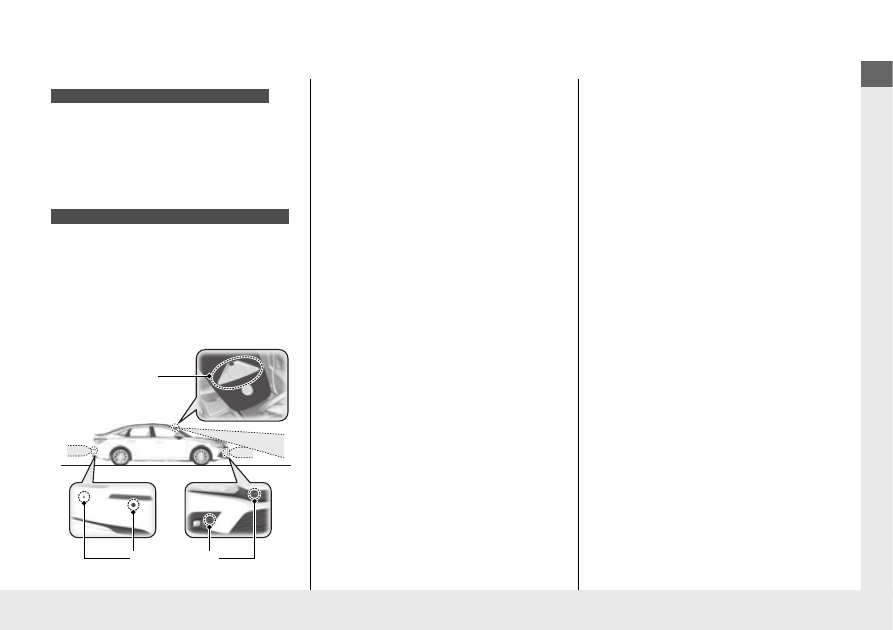
Honda Sensing

®


(P 473)

Honda Sensing

®

 is a driver support system 

which employs the use of two distinctly 
different kinds of sensors: the sonar sensors 
located in the front and rear bumper and a 
front wide view camera mounted to the 
interior side of the windshield, behind the 
rearview mirror.

Honda Sensing

®

 is a driver support system 

which employs the use of a front wide view 
camera mounted to the interior side of the 
windshield, behind the rearview mirror.

Models with Low Speed Braking Control

Models without Low Speed Braking Control

Front Wide View 
Camera

The camera is located 
behind the rearview 
mirror.

Sonar Sensors

*

Collision Mitigation 
Braking System

TM


(CMBS

TM

(P 476)

The system can assist you when it 
determines there is a possibility of your 
vehicle colliding with a vehicle ahead from 
behind, an oncoming vehicle in front, a 
pedestrian, or someone riding a bicycle 
(moving bicycle). The CMBS

TM

 is designed to 

alert you when the potential for a collision 
is determined, as well as assist in reducing 
speed, avoiding collisions, and reducing 
collision severity.

Low Speed Braking 
Control

*


(P488)

Using sonar sensors located on the front and 
rear bumpers, this system detects if there is 
danger of a potential collision with a wall or 
other obstacle during normal driving or 
when the accelerator pedal is depressed 
with too much force. The system then assists 
in avoiding collisions and reducing damage 
from impact through assistive braking and/
or assistive driving power suppression.

Adaptive Cruise Control 
(ACC) with Low Speed 
Follow 

(P494)

Helps maintain a constant vehicle speed and 
a set following-interval behind a vehicle 
detected ahead of yours and, if the detected 
vehicle comes to a stop, can decelerate and 
stop your vehicle, without you having to 
keep your foot on the brake or the 
accelerator.

Lane Keeping Assist 
System (LKAS) 

(P 516)

Provides steering input to help keep the 
vehicle in the middle of a detected lane and 
provides tactile and visual alerts if the 
vehicle is detected drifting out of its lane.

*

 Not available on all models

30

Quick

 Referenc

e Guide

Traffic Jam Assist 

(P528)

The traffic jam assist system uses a camera 
mounted to the upper portion of the 
windshield to detect and monitor left and 
right white (or yellow) traffic lane lines.
Based on inputs from the camera, the 
system can apply steering torque to keep 
your vehicle in the center of the detected 
lane.

Road Departure 
Mitigation System 

(P 537)

Alerts and helps assist you when the system 
detects a possibility of your vehicle crossing 
over detected lane markings, or 
approaching the outer edge of the 
pavement (into grass or gravel border) or a 
detected oncoming vehicle.

Traffic Sign Recognition 
System 

(P545 )

Reminds you of road sign information, such 
as the current speed limit your vehicle has 
just passed through, showing it on the 
gauge.

31

Quick

 Referenc

e Guide

Maintenance 

(P 581)

Under the Hood 

(P 595)

Check engine oil, engine coolant, and windshield washer fluid. Add 
when necessary.

Check brake fluid.

Check the battery condition monthly.

a

Pull the hood release handle under the driver's side lower corner 
of the dashboard.

b

Locate the hood latch lever, push it to the side, and then raise the 
hood. Once you have raised the hood slightly, you can release the 
lever.

c

When finished, close the hood and make sure it is firmly locked in 
place.

Lights 

(P 610)

Inspect all lights regularly.

Wiper Blades 

(P 615)

Replace blades if they leave streaks 
across the windshield or become 
noisy.

Tires 

(P 617)

Inspect tires and wheels 
regularly.

Check tire pressures regularly.

Install snow tires for winter 
driving.

32

Quick

 Referenc

e Guide

Handling the Unexpected 

(P 639)

Flat Tire 

(P 641)

Park in a safe location and replace the 
flat tire with the compact spare tire in the 
trunk.

Indicators Come On 

(P 658)

Identify the indicator and consult the 
owner's manual.

Engine Won’t Start 

(P 648)

If the battery is dead, jump start using a 
booster battery.

Blown Fuse 

(P 664)

Check for a blown fuse if an electrical 
device does not operate.

Overheating 

(P 656)

Park in a safe location. If you do not see 
steam under the hood, open the hood, 
and let the engine cool down.

Emergency Towing 

(P 670)

Call a professional towing service if you 
need to tow your vehicle.

33

Quick

 Referenc

e Guide

What to Do If

The power mode does not 
change from ACCESSORY 
to VEHICLE OFF (LOCK). 
Why?

The shift lever should be moved to 

(

P

.

Why does the brake pedal 
pulsate slightly when 
applying the brakes?

This can occur when the ABS activates and does not indicate a 
problem. Apply firm, steady pressure on the brake pedal. Never 
pump the brake pedal.

2

Anti-lock Brake System (ABS) 

(P 560)

The rear door cannot be 
opened from inside the 
vehicle. Why?

Check if the childproof lock is in 
the lock position. If so, open the 
rear door with the outside door 
handle.
To cancel this function, slide the 
lever up to the unlock position.

Why do the doors lock 
after I unlocked the doors?

If you do not open the doors within 30 seconds, the doors are 
relocked automatically for security.

34

Quick

 Referenc

e Guide

Why does the beeper 
sound when I open the 
driver's door?

The beeper sounds when:

The power mode is in ACCESSORY.

The exterior lights are left on.

The Auto Idle Stop is in operation.

Why does a beeper sound 
when I walk away from the 
vehicle after I close the 
door?

The beeper sounds if the remote key has moved outside the 
walk away auto lock operating range before all doors 
completely close.

2

Locking the doors and trunk (Walk away auto lock

®

(P 161)

Why does the beeper 
sound when I start driving?

The beeper sounds when the driver and/or front passenger are 
not wearing their seat belts.

Pressing the electric 
parking brake switch does 
not release the parking 
brake. Why?

Press the electric parking brake switch with the brake pedal 
depressed.

I’m seeing an amber 
indicator of a tire with an 
exclamation point. What is 
that?

The Tire Pressure Monitoring System (TPMS) needs attention. If 
you recently inflated or changed a tire, you have to recalibrate 
the system.

2

Tire Pressure Monitoring System (TPMS) 

(P 462)

Models with keyless access system

U.S. models

35

Quick

 Referenc

e Guide

Depressing the accelerator 
pedal does not release the 
parking brake 
automatically. Why?

Fasten the driver’s seat belt.

Check if the transmission is in 

(

P

 or 

(

N

. If so, select any other 

position.

Why do I hear a screeching 
sound when I apply the 
brake pedal?

The brake pads may need to be replaced. Have your vehicle 
inspected by a dealer.

38

Safe Driving

For Safe Driving

The following pages explain your vehicle's safety features and how to use them 
properly. The safety precautions below are ones that we consider to be among the 
most important.

Important Safety Precautions

Always wear your seat belt

A seat belt is your best protection in all types of collisions. Airbags are designed to 
supplement seat belts, not replace them. So even though your vehicle is equipped 
with airbags, make sure you and your passengers always wear your seat belts, and 
wear them properly.

Restrain all children

Children ages 12 and under should ride properly restrained in a back seat, not the 
front seat. Infants and small children should be restrained in a child seat. Larger 
children should use a booster seat and a lap/shoulder seat belt until they can use the 
belt properly without a booster seat.

Be aware of airbag hazards

While airbags can save lives, they can cause serious or fatal injuries to occupants 
who sit too close to them, or are not properly restrained. Infants, young children, 
and short adults are at the greatest risk. Be sure to follow all instructions and 
warnings in this manual.

Don't drink and drive

Alcohol and driving don't mix. Even one drink can reduce your ability to respond to 
changing conditions, and your reaction time gets worse with every additional drink. 
So don't drink and drive, and don't let your friends drink and drive, either.

1

Important Safety Precautions

Some states, provinces and territories prohibit the use 
of cell phones other than hands-free devices by the 
driver while driving.

39

uu

For Safe Driving

u

Important Safety Precautions

Safe Driving

Pay appropriate attention to the task of driving safely

Engaging in cell phone conversation or other activities that keep you from paying 
close attention to the road, other vehicles, and pedestrians could lead to a crash. 
Remember, situations can change quickly, and only you can decide when it is safe to 
divert some attention away from driving.

Control your speed

Excessive speed is a major factor in crash injuries and deaths. Generally, the higher 
the speed, the greater the risk, but serious injuries can also occur at lower speeds. 
Never drive faster than is safe for current conditions, regardless of the maximum 
speed posted.

Keep your vehicle in safe condition

Having a tire blowout or a mechanical failure can be extremely hazardous.
To reduce the possibility of such problems, check your tire pressures and condition 
frequently, and perform all regularly scheduled maintenance.

Do not leave children unattended in the vehicle

Children, pets and people needing assistance left unattended in the vehicle may be 
injured if they activate one or more of the vehicle controls. They may also cause the 
vehicle to move, resulting in a crash in which they and/or another person(s) can be 
injured or killed. Also, depending on the ambient temperature, the temperature of 
the interior may reach extreme levels, which can result in harm or death. Even if the 
climate control system is on, never leave them in the vehicle unattended as the 
climate control system can shut off at any time.

40

uu

For Safe Driving

u

Your Vehicle’s Safety Features

Safe Driving

Your Vehicle’s Safety Features

The following checklist will help you take an active role in protecting yourself and 
your passengers.

1

Your Vehicle’s Safety Features

Your vehicle is equipped with many features that 
work together to help protect you and your 
passengers during a crash.

Some features do not require any action on your part. 
These include a strong steel framework that forms a 
safety cage around the passenger compartment, 
front and rear crush zones, a collapsible steering 
column, and tensioners that tighten the front and 
rear outer seat belts in a sufficient crash.

However, you and your passengers cannot take full 
advantage of these features unless you remain seated 
in the correct position and always wear your seat 
belts. In fact, some safety features can contribute to 
injuries if they are not used properly.

6
7
8
9

10
11

Safety Cage
Crush Zones
Seats and Seat-Backs
Head Restraints
Collapsible Steering Column
Seat Belts
Front Airbags

Side Curtain Airbags
Door Locks

Side Airbags

Seat Belt Tensioners

7

7

9

9

8

10

6

11

Outer Lap Pretensioners

Knee Airbags

12
13

10

12

13

9

11

12

8

41

uu

For Safe Driving

u

Safety Checklist

Safe Driving

Safety Checklist

For the safety of you and your passengers, make a habit of checking these items 
each time before you drive.

After everyone has entered the vehicle, be sure all doors are closed and locked. 
Locking the doors helps prevent an occupant from being ejected and an outsider 
from unexpectedly opening a door.

2

Locking/Unlocking the Doors from the Inside

 P. 166

Adjust your seat to a position suitable for driving. Be sure the front seats are 
adjusted as far to the rear as possible while allowing the driver to control the 
vehicle. Sitting too close to a front airbag can result in serious or fatal injury in a 
crash.

2

Seats

 P. 198

Adjust head restraints to the proper position. Head restraints are most effective 
when the center of the head restraint aligns with the center of your head. Taller 
persons should adjust their head restraint to the highest position.

2

Adjusting the Front Head Restraints

 P. 204

Always wear your seat belt, and make sure you wear it properly. Confirm that any 
passengers are properly belted as well.

2

Fastening a Seat Belt

 P. 47

Protect children by using seat belts or child seats according to a child’s age, height 
and weight.

2

Child Safety

 P. 71

1

Safety Checklist

If the door and/or trunk open message appears on 
the driver information interface, a door and/or the 
trunk is not completely closed. Close all doors and 
the trunk tightly until the message disappears.

2

Warnings

 P. 125, 150

42

Safe Driving

Seat Belts

About Your Seat Belts

Seat belts are the single most effective safety device because they keep you 
connected to the vehicle so that you can take advantage of many built-in safety 
features. They also help keep you from being thrown against the inside of the 
vehicle, against any passengers, or out of the vehicle. When worn properly, seat 
belts also keep your body properly positioned in a crash so that you can take full 
advantage of the additional protection provided by the airbags.

In addition, seat belts help protect you in almost every type of crash, including:

-

frontal impacts

-

side impacts

-

rear impacts

-

rollovers

Lap/shoulder seat belts

All five seating positions are equipped with lap/shoulder seat belts with emergency 
locking retractors. In normal driving the retractor lets you move freely while keeping 
some tension on the belt. During a collision or sudden stop the retractor locks to 
restrain your body.

The front passenger’s and rear seat belts also have a lockable retractor for use with 
child seats.

2

Installing a Child Seat with a Lap/Shoulder Seat Belt

 P. 78

1

About Your Seat Belts

If you extend the seat belt too quickly, it will lock in 
place. If this happens, slightly retract the seat belt, 
then extend it slowly.

Seat belts cannot completely protect you in every 
crash. But in most cases, seat belts can reduce your 
risk of serious injury.

Most states and all Canadian provinces and territories 
require you to wear seat belts.

3

WARNING

Not wearing a seat belt properly increases 
the chance of serious injury or death in a 
crash, even though your vehicle has 
airbags.

Be sure you and your passengers always 
wear seat belts and wear them properly.

Continued

43

uu

Seat Belts

u

About Your Seat Belts

Safe Driving

Proper use of seat belts

Follow these guidelines for proper use:

All occupants should sit upright, well back in the seat, and remain in that position 
for the duration of the trip. Slouching and leaning reduce the effectiveness of the 
belt and can increase the chance of serious injury in a crash.

Never place the shoulder part of a lap/shoulder seat belt under your arm or 
behind your back. This could cause very serious injuries in a crash.

Two people should never use the same seat belt. If they do, they could be very 
seriously injured in a crash.

Do not put any accessories on the seat belts. Devices intended to improve comfort 
or reposition the shoulder part of a seat belt can reduce the protective capability 
and increase the chance of serious injury in a crash.

1

About Your Seat Belts

If a front or rear seat passenger moves around and 
extends the seat belt, the lockable retractor may 
activate. If this happens, release the retractor by 
unfastening the seat belt and allow the belt to retract 
completely. Then, refasten the belt.

uu

Seat Belts

u

About Your Seat Belts

44

Safe Driving

Front seats

The seat belt system includes an indicator on 
the instrument panel to remind the driver or a 
front passenger or both to fasten their seat 
belts.
If you set the power mode to ON and a seat 
belt is not fastened, a beeper will sound and 
the indicator will blink. After a few seconds, 
the beeper will stop and the indicator will 
come on and remain illuminated until the seat 
belt is fastened.

The beeper will periodically sound and the 
indicator will blink while the vehicle is moving 
until the seat belt is fastened.

Seat Belt Reminder

1

Seat Belt Reminder

The indicator will also come on if a front passenger 
does not fasten their seat belt within six seconds after 
the power mode is set to ON.
When no one is sitting in the front passenger’s seat, 
the indicator will not come on and the beeper will not 
sound. The indicator also may not come on and the 
beeper may not sound when the occupant is not 
heavy enough to trigger the weight sensor. Such 
occupants (e.g., infants and smaller children) should 
be moved to the rear seat as a deploying front airbag 
likely will injure or kill them.

2

Protecting Child Passengers

 P. 71

45

uu

Seat Belts

u

About Your Seat Belts

Continued

Safe Driving

Rear seats

Your vehicle monitors rear seat belt use.
A driver information interface and indicator 
notify you if any of the rear seat belts are 
unlatched.

The display appears when:

A rear door is opened or closed.

Any of the rear passengers latches or 
unlatches their seat belt.

The beeper sounds and indicator blinks if any 
rear passenger’s seat belt is unlatched while 
driving.

To see the display:

2

Switching the Display

 P. 113, 139

: Latched

: Unlatched

uu

Seat Belts

u

About Your Seat Belts

46

Safe Driving

The front seats and the outer rear seats are equipped with automatic seat belt 
tensioners to enhance safety.

The tensioners automatically tighten the front seat belts and the outer rear seat belts 
during a moderate-to-severe frontal collision, sometimes even if the collision is not 
severe enough to inflate the front airbags or the front knee airbags.

Automatic Seat Belt Tensioners

1

Automatic Seat Belt Tensioners

The seat belt tensioners can only operate once.
If a tensioner is activated, the SRS indicator will come 
on. Have a dealer replace the tensioner and 
thoroughly inspect the seat belt system as it may not 
offer protection in a subsequent crash.

During a moderate-to-severe side impact, the 
tensioner on both sides of the vehicle also activates.

Front seats

Outer rear seats


Content      ..      1      2      3      ..