Honda CR-V Hybrid (2022 year). Manual in english - page 2
 

  Index      Manuals     Honda CR-V Hybrid (2022 year). Manual in english


Search            copyright infringement  


Content      ..      1      2      3      ..


Honda CR-V Hybrid (2022 year). Manual in english - page 2


27

Quick

 Referenc

e Guide

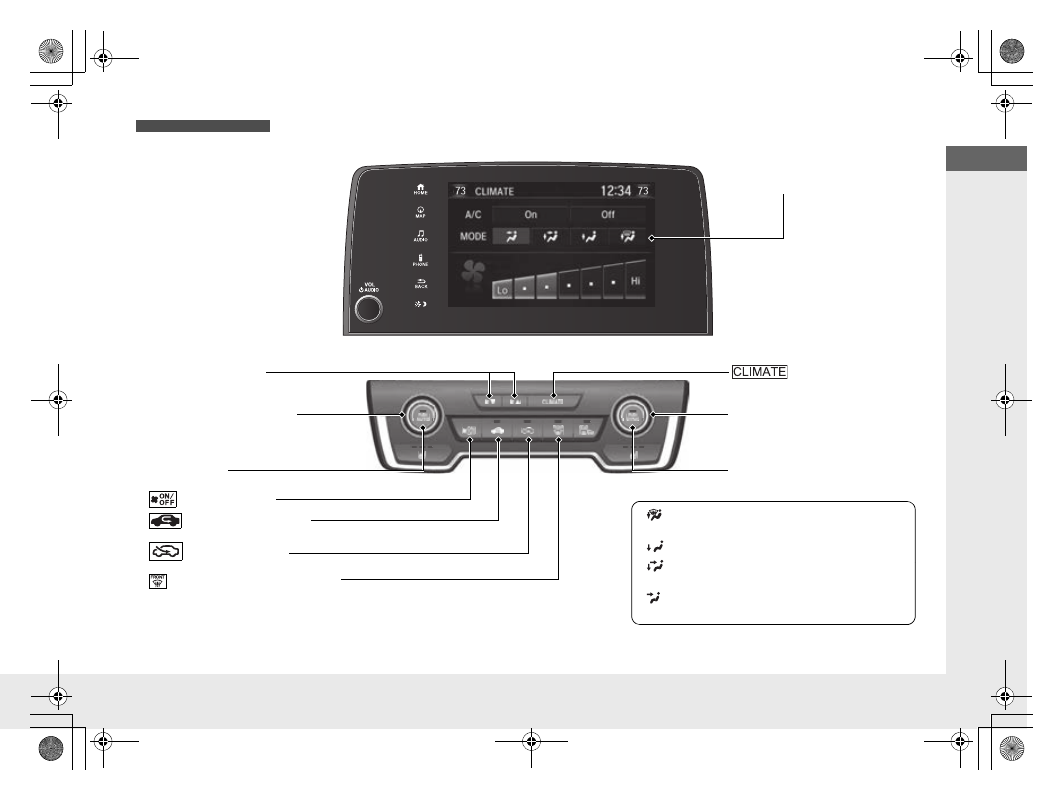
Models with SYNC button

Passenger’s side Temperature 
Control Dial

 (Windshield Defroster) Button

Driver’s side Temperature 

Control Dial

 (Recirculation) Button

 (CLIMATE) Button

 (ON/OFF) Button

AUTO

 Button

Audio/Information Screen

SYNC

 (Synchronization) Button

Air flows from floor and 

windshield defroster vents.
Air flows from floor vents.
Air flows from floor and dashboard vents, 

and back of the center console.
Air flows from dashboard vents, 

and back of the center console.

 (Fresh Air) Button

Fan Control Buttons

28

Quick

 Referenc

e Guide

Features 

(P243)

Audio Remote Controls 

(P248)

(

+

 / 

(

-

 Bar

Press to adjust the volume up/down.

 / 

 Button

Press 

 or 

 to cycle through the audio 

mode as follows:

FM1/FM2/AM/USB or iPod/Pandora

®

/

Bluetooth

®

Audio

FM/AM/SiriusXM

®

/USB/iPod/

Bluetooth

®

Audio/Pandora

®

/Apps/

Audio Apps

ENTER

 Button

 / 

 /   /   Button

3

4

(

+

 / 

(

-

 Bar

 Button

3

4

3

4

Models with color audio system

Models with Display Audio

ENTER

 Button

When listening to a USB flash drive

a

Press 

ENTER

 to display the folder list.

b

Press 

 or 

 to select a folder.

c

Press 

ENTER

 to display a list of tracks in 

that folder.

d

Press 

 or 

 to select a track, then 

press 

ENTER

.

When listening to an iPod

a

Press 

ENTER

 to display the iPod music 

list.

b

Press 

 or 

 to select a category.

c

Press 

ENTER

 to display a list of items in 

the category.

d

Press 

 or 

 to select an item, then 

press 

ENTER

.

u

Press 

ENTER

 and press 

 or 


repeatedly until a desired item you 
want to listen is displayed.

Models with Display Audio

3

4

3

4

3

4

3

4

3

4

When listening to Pandora

®

a

Press 

ENTER

 to display the station list.

b

Press 

 or 

 to select an item, then 

press 

ENTER

.

When listening to 

Bluetooth

®

Audio

a

Press 

ENTER

 to display the track list.

b

Press 

 or 

 to select a track, then 

press 

ENTER

.

3

4

3

4

29

Quick

 Referenc

e Guide

 / 

 Button

 (Display/Information) Button:

Press to change contents.

2

Driver Information Interface 

(P128)

Radio: Press to change the preset station.

Press and hold to select the next or 
previous strong station.

USB device:

Press to skip to the beginning of 
the next song or return to the 
beginning of the current song.
Press and hold to change a folder.

Pandora

®

:

Press to skip to the next track.
Press and hold to select the next or 
previous station.

30

Quick

 Referenc

e Guide

Audio System 

(P244)


(P251)

Models with color audio system

 (Seek/Skip) Button

RADIO

 Button

 (Day/Night) Button

MEDIA

 Button

Preset Buttons (1-6)

 (Seek/Skip) Button

VOL

/

 (Volume/Power) Knob

Audio/Information Screen

 (Back) Button

 (Sound) Button

MENU/CLOCK

 Button

Selector Knob

 (Phone) Button

31

Quick

 Referenc

e Guide


(P272)

For navigation system operation 

()

 See the Navigation System Manual

Models with Display Audio

 (Audio) Icon

 (Back) Icon

Audio/Information Screen

 (Instrument Panel) Icon

 (Day/Night) Icon

*

VOL

/


AUDIO

 (Volume/

Power Audio) Knob

 (Home) Icon

 (Map) Icon

*

 (Phone) Icon

Compass Icon

*

*

 Not available on all models

32

Quick

 Referenc

e Guide

Driving 

(P459)

Park

Press the 

(

P

 button.

Used when parking or before turning 
off or starting the power system.
Transmission is locked.

Reverse

Press back the 

(

R

 button.

Used when reversing.

Neutral

Press the 

(

N

 button.

Transmission is not locked.

Drive

Press the 

(

D

 button.

Used for normal driving.
The deceleration paddle selector can 
be used temporarily.
The deceleration paddle selector can 
be used when SPORT mode is on.

Shift Position Indicator

The shift position indicator 
and the shift button 
indicator indicate the 
current shift selection.

Transmission 

(P476)

Select 

(

P

 and depress the brake pedal when turning on the power.

Shift selection

Shift Button 
Indicator

Shift Position Indicator

READY Indicator

On: You can start to drive.

33

Quick

 Referenc

e Guide

Deceleration Paddle Selector 

(P484)

When you release the accelerator pedal, you can control the rate of deceleration 
without releasing your hands from the steering wheel. Using the deceleration 
paddle selector situated on the steering wheel, you can sequentially shift through 
four stages of deceleration.
Pull the 

(

+

 selector for a few seconds when you want to cancel the deceleration 

paddle selector.

When SPORT mode is OFF

If you pull back the paddle selector, the rate of deceleration will change 
temporarily, and the stage will appear in the instrument panel.

When SPORT mode is ON

If you pull back the paddle selector, the rate of deceleration will change and the 
stage along with 

M

 will appear in the instrument panel.

(

-

 Paddle 

Selector

(

+

 Paddle 

Selector

Deceleration 
stage

When SPORT 
mode is OFF, the 
deceleration 
stage appears.

When SPORT mode is 
ON, the deceleration 
stage and 

M

 appear.

34

Quick

 Referenc

e Guide

VSA

®

 On and Off 

(P490)

The Vehicle Stability Assist

TM

 (VSA

®

system helps stabilize the vehicle during 
cornering and helps maintain traction 
while accelerating on loose or slippery 
road surfaces.

VSA

®

 comes on automatically every time 

you turn on the power system.

To partially disable VSA

®

 functionality/ 

features, press and hold it until you hear 
a beep.

Tire Pressure Monitoring 
System (TPMS) 

(P493)

Detects a change in tire conditions and 
overall dimensions due to decrease in tire 
pressures.

The TPMS is turned on automatically 
every time you turn on the power system.

A calibration procedure must be 
performed when certain conditions arise.

CMBS

TM

 On and Off 

(P510)

When a possible frontal collision is likely 
unavoidable, the CMBS

TM

 can help you to 

reduce the vehicle speed and the severity 
of the collision.

The CMBS

TM

 is turned on every time you 

turn on the power system.

To turn the CMBS

TM

 on or off, press and 

hold the button until you hear a beep.

Refueling 

(P572)

Fuel recommendation: Unleaded gasoline, pump octane number 87 or higher

Fuel tank capacity:14 US gal (53 L)

a

Pull the fuel fill door 
release handle.

b

After refueling, wait 
for about five 
seconds before 
removing the filler 
nozzle.

35

Quick

 Referenc

e Guide

Honda Sensing

®


(P503)

Honda Sensing

®

 is a driver support system 

which employs the use of two distinctly 
different kinds of sensors, a radar sensor 
located in the front grille and a front sensor 
camera mounted to the interior side of the 
windshield, behind the rear view mirror.

The camera is located 

behind the rearview 

mirror.

Front Sensor 

Camera

Radar Sensor

The radar sensor is 

inside the front grille.

Collision Mitigation 
Braking System

TM


(CMBS

TM

(P506)

The system can assist you when it 
determines there is a possibility of your 
vehicle colliding with a vehicle or a 
pedestrian detected in front of your vehicle. 
The CMBS

TM

 is designed to alert you when 

the potential for a collision is determined, as 
well as to reduce your vehicle speed to help 
minimize collision severity when a collision is 
deemed unavoidable.

Adaptive Cruise Control 
(ACC) with Low Speed 
Follow 

(P517)

Helps maintain a constant vehicle speed and 
a set following-interval behind a vehicle 
detected ahead of yours and, if the detected 
vehicle comes to a stop, can decelerate and 
stop your vehicle, without you having to 
keep your foot on the brake or the 
accelerator.

Lane Keeping Assist 
System (LKAS) 

(P534)

Provides steering input to help keep the 
vehicle in the middle of a detected lane and 
provides tactile and visual alerts if the 
vehicle is detected drifting out of its lane.

Road Departure 
Mitigation (RDM) System 

(P543)

Alerts and helps to assist you when the 
system detects a possibility of your vehicle 
unintentionally crossing over detected lane 
markings and/or leaving the roadway 
altogether.

36

Quick

 Referenc

e Guide

Maintenance 

(P577)

Under the Hood 

(P586)

Check engine oil, engine coolant, and windshield washer 
fluid. Add when necessary.

Check brake fluid.

Check the 12-volt battery condition monthly.

a

Pull the hood release handle under the corner of the dashboard.

b

Locate the hood latch lever, push it to the side, and then 
raise the hood. Once you have raised the hood slightly, you 
can release the lever.

c

When finished, close the hood and make sure it is firmly 
locked in place.

Lights 

(P598)

Inspect all lights regularly.

Wiper Blades 

(P601)

Replace blades if they leave streaks 
across the windshield or become noisy.

Tires 

(P606)

Inspect tires and wheels regularly.

Check tire pressures regularly.

Install snow tires for winter 
driving.

Quick

 Referenc

e Guide

37

Handling the Unexpected 

(P627)

Flat Tire 

(P629)

Park in a safe location and repair the flat 
tire using the tire repair kit in the cargo 
area.

Indicators Come On 

(P652)

Identify the indicator and consult the 
owner's manual.

Power System Won't 
Start 

(P644)

If the 12-volt battery is dead, jump start 
using a booster battery.

Blown Fuse 

(P659)

Check for a blown fuse if an electrical 
device does not operate.

Overheating 

(P649)

Park in a safe location. If you do not see 
steam under the hood, open the hood, 
and let the power system cool down.

Emergency Towing 

(P664)

Call a professional towing service if you 
need to tow your vehicle.

38

Quick

 Referenc

e Guide

What to Do If

Why does the brake pedal 
pulsate slightly when 
applying the brakes?

This can occur when the ABS activates and does not indicate a 
problem. Apply firm, steady pressure on the brake pedal. Never 
pump the brake pedal.

2

Anti-lock Brake System (ABS) 

(P557)

The rear door cannot be 
opened from inside the 
vehicle. Why?

Check if the childproof lock is in 
the lock position. If so, open the 
rear door with the outside door 
handle.
To cancel this function, slide the 
lever up to the unlock position.

Why do the doors lock 
after I unlocked the doors?

If you do not open the doors within 30 seconds, the doors are 
relocked automatically for security.

Why does the beeper 
sound when I open the 
driver’s door?

The beeper sounds when:

The exterior lights are left on.

The power mode is in ACCESSORY.

39

Quick

 Referenc

e Guide

Why does a beeper sound 
when I walk away from the 
vehicle after I close the 
door?

The beeper sounds if you move outside the walk away auto lock 
operating range before the door completely closes.

2

Locking the doors and tailgate (Walk away auto lock

®

(P158)

Why does the beeper 
sound when I start driving?

The beeper sounds when the driver and/or front passenger are 
not wearing their seat belts.

Pressing the electric 
parking brake switch does 
not release the parking 
brake. Why?

Press the electric parking brake switch with the brake pedal 
depressed.

Depressing the accelerator 
pedal does not release the 
parking brake 
automatically. Why?

Fasten the driver’s seat belt.

Check if the transmission is in 

(

P

 or 

(

N

. If so, select any other 

position.

Why do I hear a screeching 
sound when I apply the 
brake pedal?

The brake pads may need to be replaced. Have your vehicle 
inspected by a dealer.

40

Quick

 Referenc

e Guide

I'm seeing an amber 
indicator of a tire with an 
exclamation point. What is 
that?

The Tire Pressure Monitoring System (TPMS) needs attention. If 
you recently inflated or changed a tire, you have to recalibrate 
the system.

2

Tire Pressure Monitoring System (TPMS) 

(P493)

Why does the shift position 
automatically change to 

(

P


when I open the driver’s 
door to check for parking 
space lines when 
reversing?

Fasten the driver’s seat belt.

Close the driver’s door and manually change the shift 
position.

2

When opening the driver’s door 

(P480)

42

Safe 

Driving

For Safe Driving

The following pages explain your vehicle’s safety features and how to use them 
properly. The safety precautions below are ones that we consider to be among the 
most important.

Important Safety Precautions

Always wear your seat belt

A seat belt is your best protection in all types of collisions. Airbags are designed to 
supplement seat belts, not replace them. So even though your vehicle is equipped 
with airbags, make sure you and your passengers always wear your seat belts, and 
wear them properly.

Restrain all children

Children ages 12 and under should ride properly restrained in a back seat, not the 
front seat. Infants and small children should be restrained in a child seat. Larger 
children should use a booster seat and a lap/shoulder seat belt until they can use the 
belt properly without a booster seat.

Be aware of airbag hazards

While airbags can save lives, they can cause serious or fatal injuries to occupants 
who sit too close to them, or are not properly restrained. Infants, young children, 
and short adults are at the greatest risk. Be sure to follow all instructions and 
warnings in this manual.

Don’t drink and drive

Alcohol and driving don’t mix. Even one drink can reduce your ability to respond to 
changing conditions, and your reaction time gets worse with every additional drink. 
So don’t drink and drive, and don’t let your friends drink and drive, either.

1

Important Safety Precautions

Some states prohibit the use of cell phones other 
than hands-free devices by the driver while driving.


Content      ..      1      2      3      ..