Harley Davidson Model WLA (motorcycle, solo). Service manual (October, 1943) - page 4
Section XIV
TRANSMISSION
Description.......................................... ... 53
Control linkage............................................... 5-
Replacement of foot starter crank................ .. . .... 55
Replacement of starter crank spring
............................................56
Remove transmission........... ...................... . 57
Install transmission
..........................................................................58
53. DESCRIPTION.
a. Transmission has three speeds: low. second, and high, and is of the
constant-mesh, non-selective type. High gear is direct drive. Since
“dogs” on gear shifter clutches are used to engage transmission gears,
it is of great importance that vehicle clutch is correctly adjusted.
Clutch must be fully disengaged when shifting gears, to prevent clashing
of gears, and possible damage to the shifter clutch “dogs” and
transmission gears. It is also important that gear shifter control
linkage be kept in correct adjustment to ensure full engagement of
shifter clutch driving dogs in all positions, thus preventing possible
damage caused by dogs jumping out of engagement under driving load.
Close fitting and needle roller bearings, within the transmission,
necessitate use of engine oil (seasonal grade) in transmission case for
adequate lubrication.
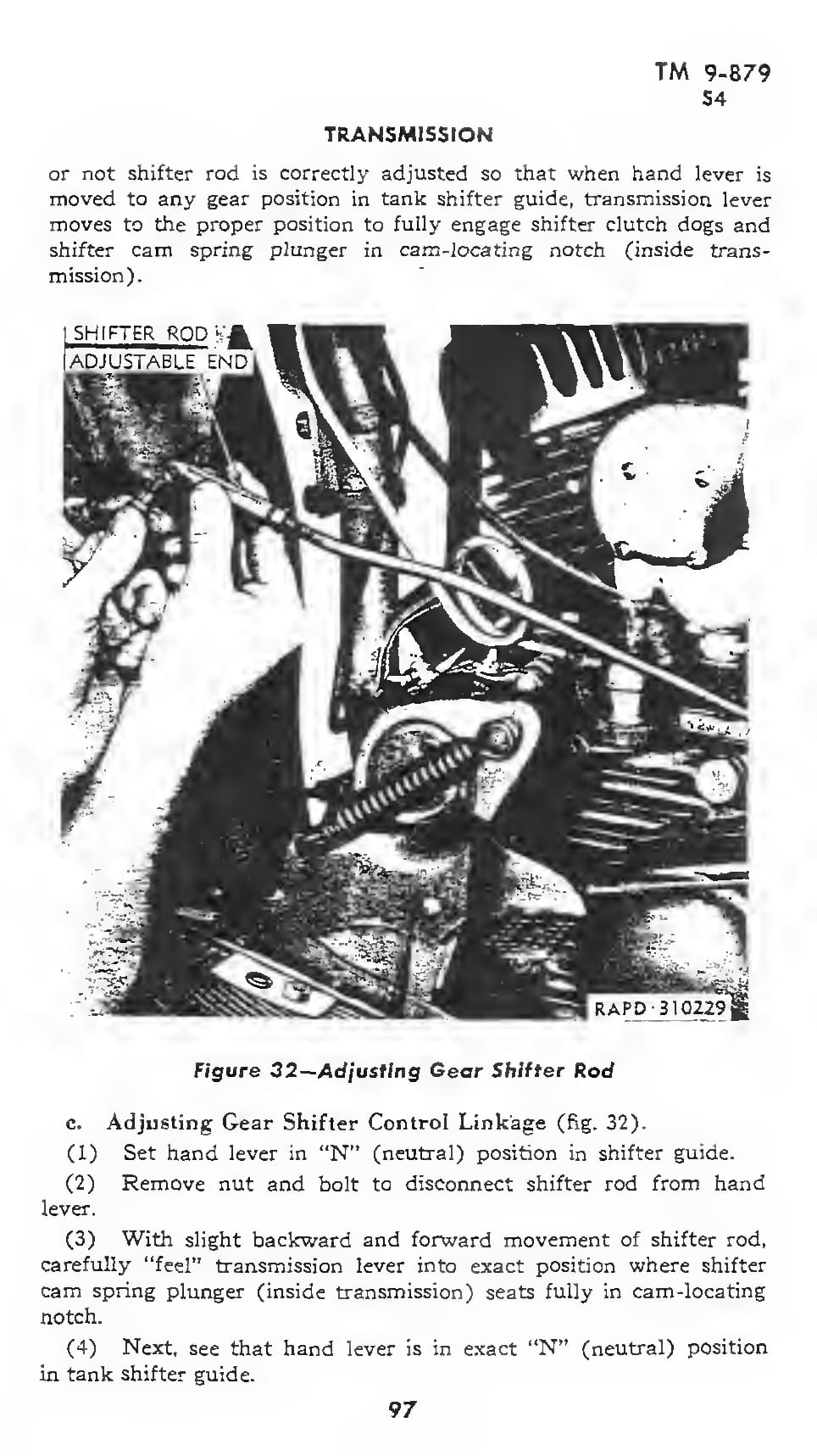
54. CONTROL LINKAGE (fig. 32).
a. Transmission Shifted to Adjust Front Drive Chain. The transmission is
located to receive power from front (engine) drive chain and transmit
power through rear drive chain to rear wheel, and is movable on its
mounting for adjustment of the front (engine) drive chain. When front
(engine) drive chain is adjusted, transmission gear shifter control
linkage is affected. Therefore, after each front drive chain adjustment,
gear shifter control linkage must be checked, and. if necessary,
correctly adjusted to ensure proper gear shifting with full engagement
of the gear shifter clutch driving “dogs” as well as prevent
transmission from jumping out of gear under load.
h. Checking Gear Shifter Control Linkage. Before making adjustment to
gear shifter control linkage, make the following checks: See that all
linkage points from transmission gear shifter lever to gear shifter hand
lever are well oiled and free-working. Check hand lever pivot bolt nut
for tightness. Observe whether there is binding or interference with
shifter rod at any point in the shifting range; this sometimes results
from a bent shifter rod. Check whether