Harley Davidson motorcycles 1940 to 1947 inclusive O.H.V. engine / side valve engine. Service Manual - page 4
a file or other hardened tool that will scratch or
nick valve. Polish valve stem with very fine emery cloth or steel wool.
Check the valve stem for excessive wear; standard valve stem diameter
is:
OM.V. Engine: .374" to .375"; Side Valve Engine: .370" to .371". If
valve is warped, this will be indicated when face is reground.
All Models: Valve face angle is 45° for both intake and exhaust valves,
and valve refacing grinder must be adjusted exactly to this angle. It is
important not to remove any more metal than is necessary to clean up and
true valve face. If grinding leaves the edge of valve very thin or
sharp, install a new valve. A valve in this condition does not seat
normally, will burn easily and may cause pre-ignition. There is also
danger of cracking.
If end of valve stem shows uneven wear, true end of stem on a valve
refacing grinder eguipped with suitable attachment.
Intake and exhaust valves are made of different materials and must not
be interchanged. Intake valves are marked "IN" on head; exhaust valves
are marked "EX."
Valve Seats
Valve seats, like valves, are subject to wear, pitting and burning and
should be refaced each time valves are refaced. Be careful that no more
metal is
removed than absolutely necessary to completely
clean up and true valve seats.
O.H.V. Engine: Has valve seat inserts so hard that a seat cutter will
not work—they must be refaced with grinder. Inserts should be checked
for leakage and looseness in cylinder heads, and any found defective
must be replaced. A leaky insert may cause overheating to the extent
that piston may be seriously damaged.
Side Valve Engine: Seats can be refaced with either cutter or grinder,
however, a seat refaced with cutter will not be as smooth as when
refaced with grinder and a greater amount of lapping will be necessary
to attain a perfect seat.
As valves and seats are refaced from time to time, valve seats widen and
valves seat in lower position when fully closed. Also, passage around
valve when fully open would be somewhat restricted. O.H.V. Engine: To
correct this condition, will require replacing valve seat insert. Side
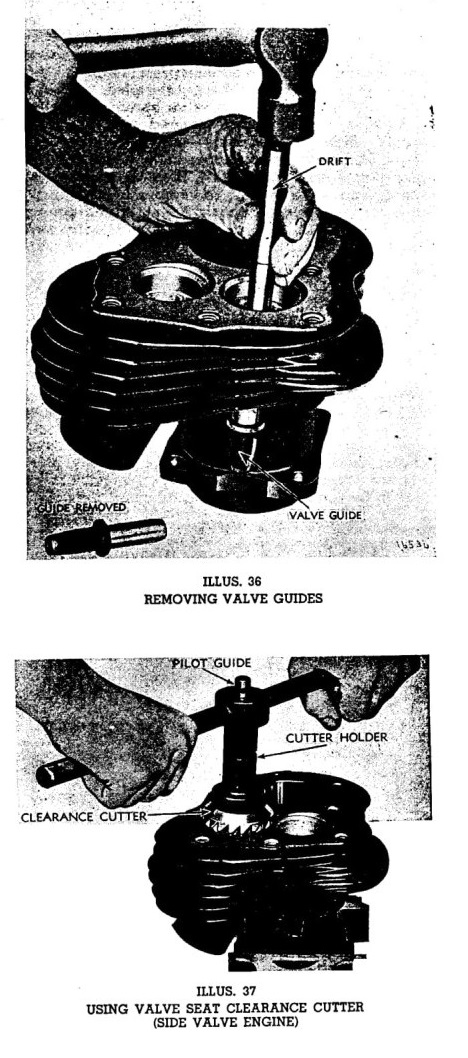
Valve Engine: To correct this condition, additional clearance will need
to be cut above seat so top edges of angular valve face and seat match
exactly. Use Harley-Davidson special clearance cutter. Part No. 11890-47
(see Illus. 37 and Illus. 61).
When a valve guide is removed for any reason and replaced or a new guide
installed, it is not likely to be concentric with valve seat. If a valve
guide is not concentric or true with seat, leakage and burning of valve
may result, or valve may break due to cocked seating and deflection of
valve stem. Therefore it is especially important after installing new
guides that seats be carefully refaced. to make them concentric with
guides and assure perfect alignment and matching of valve face and valve
seat. See "Valve Guides (O.H.V. Engine)/' or "Valve Guides (Side Valve
Engine)," Page 46.
Grinding and Testing Valves and Valve Seats
If valve seats and valve faces have been smoothly and accurately refaced
with grinders available