Ford Galaxy / Ford S-MAX. Manual - part 1013


  Index      Ford     Ford Galaxy / Ford S-MAX - service repair manual 2006 year


Search            


Content   ..  1011  1012  1013  1014   ..


Ford Galaxy / Ford S-MAX. Manual - part 1013
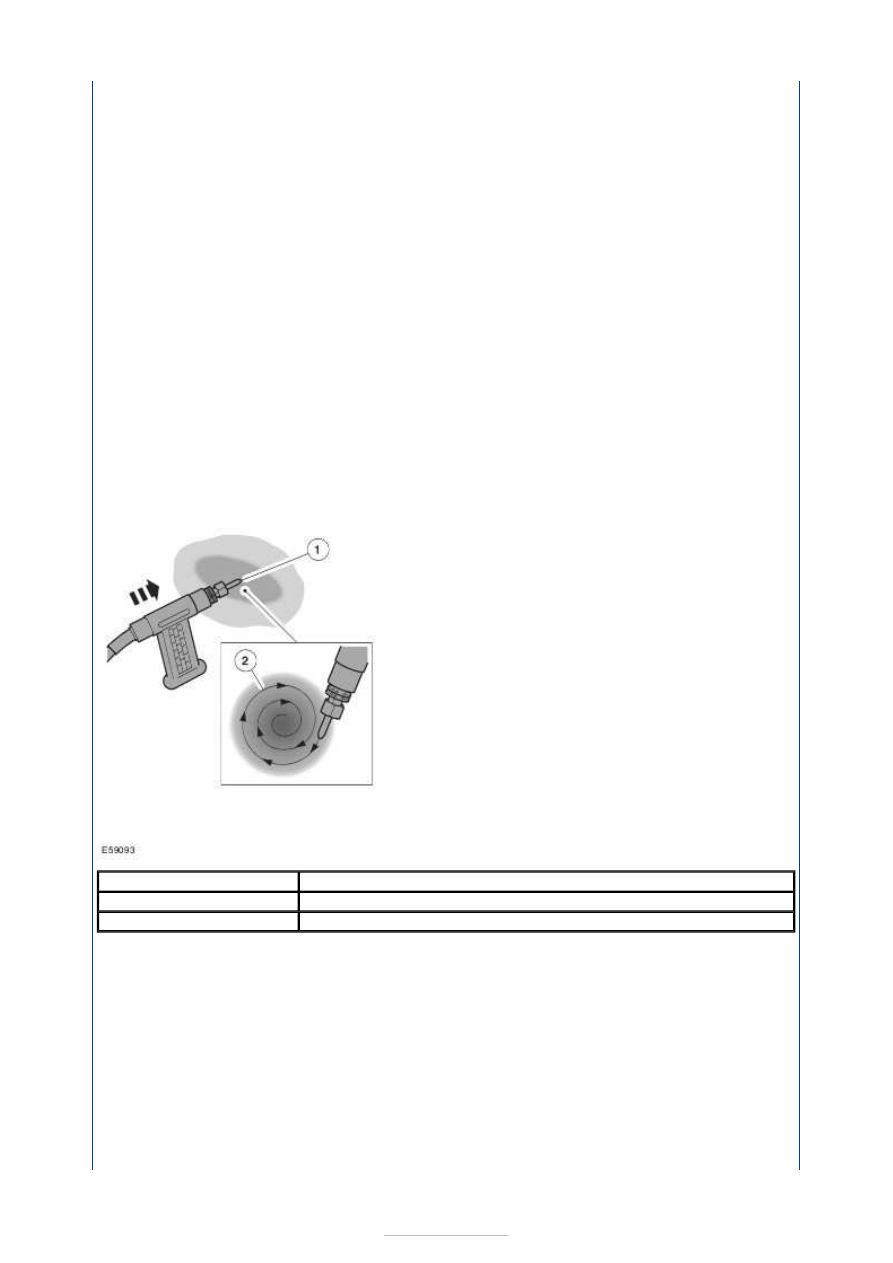


Heat-induced material shrinking 

Material shrinking, also called settling in, can be performed in a variety of ways depending 
on the extent of the damage and the access to the repair area. 

These repair processes differ depending on the type of heating and subsequent working of 
the heated surface. They sub-divide into two basic processes: 

Heating using a carbon electrode.  
Heating using the oxy-acetylene torch. 

In the carbon electrode process the working is done exclusively by warming. In this case 
the access to the repair position is only from the outside.  

If the damage is concentrated in a spot and is in the form of a more rigid raised area, then 
the carbon electrode must be replaced by a copper electrode. As heat is applied, slightly 
more pressure is applied to the raised area. 

In the method using heating by the oxy-acetylene torch, material shrinking is achieved by a 
combination of heat and mechanical working of the damaged area. 

Description

Description

1

Carbon electrode

2

Spiral shaped heating pattern


The repair area must always be accessible from both sides, so that the heated area can be 
properly worked mechanically. 

The combination of heating and mechanical working is very effective. 

As soon as the warm point is established, hammering is immediately started using the 
aluminum hammer together with a suitable dolly on the inside of the repair surface, 
working in spiral movements towards the warm point. This causes material to build up in 
the center of the warmed area. 

Lead loading 

Despite good external panel beating techniques, it is not always possible to rectify every 
surface unevenness. For this reason, application of lead loading is an important part of 
panel beating. 

CAUTION: Poisonous gases and dust can be produced when working solder. Use an 

extraction unit and, if required, a protective mask. 
NOTE: Since 07/2003, lead compounds have been ruled out for production. Appropriate 
lead-free tin solders and pastes must also be used in the workshop. 

Typical application areas: 

Body components with limited or no access from the rear.  
Body components with very narrow cross-section.  
Body components which are particularly exposed or which can move.  
Weld seams of partial repairs.  
Rocker panel areas, wheel arch edges, side panel areas.  
Doors, hood, luggage compartment lid.  
Swage lines and joint areas. 

Tin has the following advantages: 

Excellent bonding on bare metal surfaces.  

Description

Description

1

Overstretched area

2

Point heating using the oxy-acetylene torch

3

Spiral shaped knocking back with dolly


Good moulding properties.  
Good properties for the production of shapes and contours.  
Permanent shape.  
Heat expansion is the same as steel. 

To create a basis for the actual lead loading process, a lead loading paste is first applied to 
the panel. The paste is then heated and wiped away with a cloth. Now the tin can be 
applied and moulded with a brazing block. 

After the repair site has cooled down, it is worked using for example the body plane until 
the surface is smooth and has no transitions. 

Body Repairs - General Information - 
Paintless Dent Removal

S-MAX/Galaxy 2006.5 (02/2006-)


Print


Description and Operation 

NOTE: Basic and in-depth training is offered on the following topics. You will find an 
overview of the complete range listed in the Training brochure published by the Ford 
Service Organization. 

General 

Application is restricted to body surfaces which are accessible from both sides. This repair 
technique is seldom feasible on double-skinned body components or closed body profiles. 
The same applies to edge areas, swage lines and seams on body components, which are 
very dimensionally stable. 

The following characteristics must be present for a dent to be removed: 

The diameter must be no more than 50 mm.  
No material stretching in the centre of the dent.  
Repair area must be accessible  

Furthermore, sufficient experience in the use of special tools and knowledge of materials 
are also requirements for a successful repair. 

Mild dent 

Item

Description

1

Deflection by a hook arrangement

2

Pressure tool


Content   ..  1011  1012  1013  1014   ..