Ford Galaxy / Ford S-MAX. Manual - part 1004


  Index      Ford     Ford Galaxy / Ford S-MAX - service repair manual 2006 year


Search            


Content   ..  1002  1003  1004  1005   ..


Ford Galaxy / Ford S-MAX. Manual - part 1004


Special constructional changes within the bodywork structure: 

Reinforcing or increase in the thickness of the sheet steel in the pillar area.  
Reinforcing or increase in the thickness of the sheet steel in the floor pan structure 
(rocker panel area).  
Use of heavily structured reinforcing panels in the rocker panel and pillar area.  
In the area of the windshield frame and A-pillars, thick-walled reinforcing tubes are used 
(roll-over protection).  
Because there is no roof, the bridge construction principle cannot be used as it is on the 
saloon for example. Flexural and torsional rigidity must be ensured by other components. 

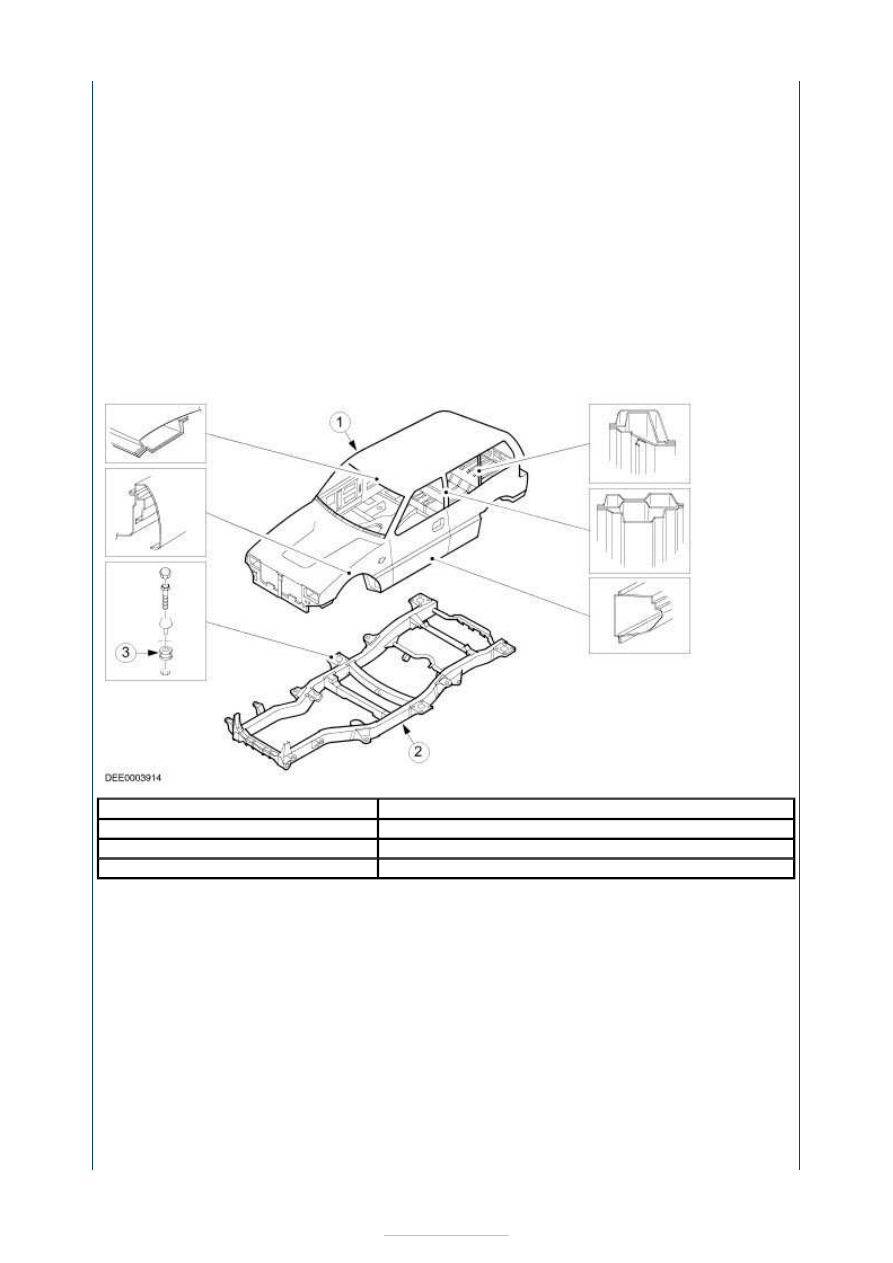
Non-monocoque bodywork 

Non-monocoque bodywork is built onto a frame or a chassis. Frames used for this have 
various construction forms, e.g. the ladder frame or tube frame. Non-monocoque bodywork 
is the original way of constructing vehicles. 

The ladder frame is still commonly used today for truck and off-road vehicles. The 
bodywork is placed on the frame or chassis. The total load which occurs while driving is 
transferred to the chassis.  

More sporting vehicles can be built with non-monocoque bodywork, mostly using a lattice 
tube frame. Limitations in the design are accepted for the benefit of low weight. The outer 
skin here is usually made of plastic or alloy. This type of construction is also common in 
touring car racing for instance.  

Special features of non-monocoque bodywork construction: 

Partly large surface panels and high volume shaped parts.  
Thicker materials and greater reinforcements in the frame area.  
Floor pan as frame structure with high torsional rigidity and flexural strength.  
Side panels only make a small contribution to the overall stability of the body. 

Description

Description

1

Vehicle body.

2

Frame Assembly

3

Bolted connection


Instructions for repair: 

A different repair technique is necessary during repairs. A deformed frame structure 
requires high suction power during straightening repairs. Frequently, the body also has to 
be detached from the frame structure in order to carry out separate repair. 

Due to the very stable frame structure, please note that the straightening behavior is 
completely different to that of a passenger vehicle. The frame and the attached body must 
be repaired independently of each other. 

Further information can be found in the respective body repair manual. 

Special points: 

Tailored blanks 

Blue: Tailored blank 

Arrows: Laser weld seam 

The term "tailored blanks" describes the connection of two different panel thicknesses 
and/or strengths in the bodywork carcass. This connection is done using laser weld seams. 
Cut locations exactly on the laser weld seams are not permitted, as at present no joining 
techniques are approved for use in repair procedures that would re-create joins of the same 
quality. 

NOTE: No cutting, no welding and therefore no sectional repairs are permitted in the 
immediate area of the laser weld seams. The model specific requirements are 
documented in the respective Body Repair Manuals. 

Typical application areas are: 

Side member  
Door inner reinforcement/door frames  
Wheelhouses  
Rocker panel inner reinforcement  
Roof rail inner reinforcement 

Deformation behavior 


Different materials and design features lead to staged deformation of the front and rear of 
the vehicle in an accident. 

Crash element: 

At the front of the vehicle there is a crash element which is connected to the side member 
by threaded connections. This crash element can absorb light impacts of up to about 15 
km/hr. Because of the threaded connections, the crash element can be changed very 
quickly. 

NOTE: Deformed crash elements must not be straightened or repaired. 

Heavier impacts which can no longer be absorbed by the crash element must be absorbed 
by the side members or the floor pan structure. Depending on the extent of the damage, a 
part or complete replacement can be performed on the side member. 

The rear of the vehicle, like the front of the vehicle, has structures which protect the 
passenger cell through staged deformation in the event of an accident. The design layouts, 
however, are adapted to the requirements of the rear area. 

Description

Description

1

Bolted crash element

2

Front side member

3

Rear side member


Body Repairs - General Information - 
Diagnosis and Damage Evaluation

S-MAX/Galaxy 2006.5 (02/2006-)


Print


Description and Operation 

Assessment of the extent of the damage includes visual inspection and dimensional 
inspection of the vehicle. In order to correctly determine the extent of the damage caused 
by an accident, in-depth technical knowledge, practical experience with the technical 
equipment and the testing and measuring devices is required. 

Noticeable damage to the bodywork structure 

Positive accidental damage assessment can only be achieved if the service technician is 
able to reconstruct the effect of an impact on the body structure. 

For example: 

If the impact occurs on the front left-hand side member, the right-hand side member will 
usually also have been damaged. Often the length of this side member will not have 
changed, but because of the rigid body design, it may have become deformed. This damage 
can be detected through the size of the gap between the door and fender or by measuring 
the vehicle. 

In the case of more severe impacts, in which the front part of the vehicle cannot absorb all 
of the impact energy, the passenger cell is also used to absorb the energy. Here, the 
energy is transferred via the A pillar and distributed there. This results in deformations in 
the roof and the door sill. 

NOTE: Because of existing damage to the bodywork structure, damage diagnosis on a 
vehicle lift may give extra incorrect diagnosis results. 
NOTE: Training courses are offered on this subject. For an overview, please refer to the 
Ford Service Organisation's training course brochure. 

If for instance the Ford Focus Coupé/Cabriolet is raised on a vehicle lift, the dead weight of 
the vehicle will cause the front end to drop by approx. 2 to 3 mm. 

The altered door position is clearly recognizable by stiffness of the lock; the door moves 
upwards. This causes the lock pin to contact the guide element of the door lock. 

It is possible to draw conclusions about the extent of the damage through a visual 
inspection of the external damage. In general, the following areas are to be checked during 
the visual inspection: 

Outer panel including seam seals for cracks or flakes in the paint caused by the accident.  
Size of the gap on doors and hoods for evenness.  
Freedom of movement of door and hood/tailgate locks.  
The vehicle roof for folds (gap measurement on vehicles with sunroof)  
Dotted flange in door section for deformation and cracked weld spots.  
The side members and crash components for crumpling and folding.  
Trunk floor and floor pan from above and below for crumpling. 

No noticeable damage to the bodywork structure 

In addition to external indicators such as flaking paintwork or cracks in the underbody 
protection, it is vital to check for damage to the body structure that is not visible from the 
outside (hidden body damage) during a damage assessment. Unless ancillary components 
are removed, it is often impossible to achieve accurate diagnosis of the underlying body 
parts. 

NOTE: In order to determine the damage as accurately as possible, it may be necessary 
to remove ancillary components in the area of the damage. 

Particular attention must be paid to the following components: 


Content   ..  1002  1003  1004  1005   ..