Ford Galaxy / Ford S-MAX. Manual - part 8
 

  Index      Ford     Ford Galaxy / Ford S-MAX - service repair manual 2006 year


Search            


Content   ..  6  7  8  9   ..


Ford Galaxy / Ford S-MAX. Manual - part 8


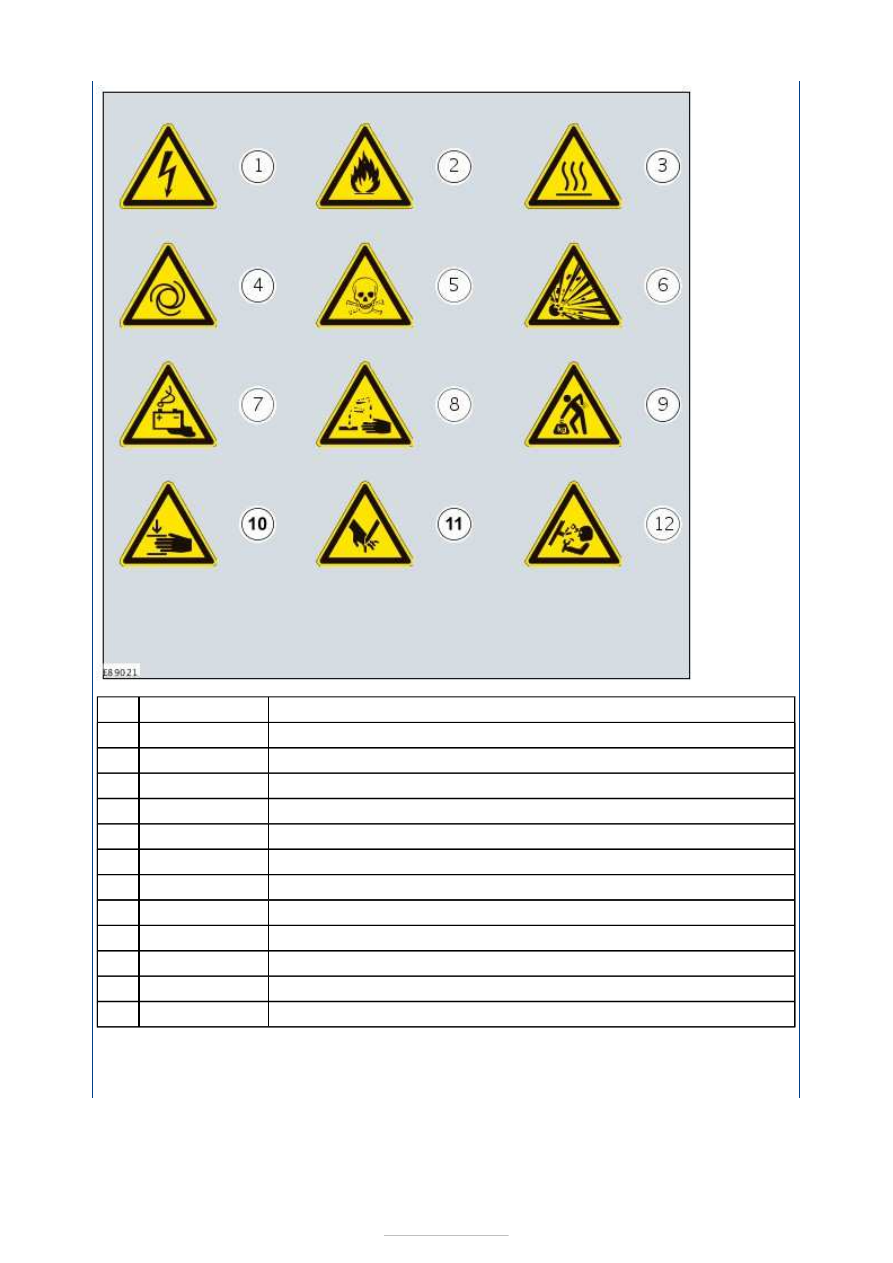
Description 

Hazardous voltage/Electrical shock/Electrocution 

Fire Hazard/Highly flammable 

Burn hazard/Hot surface 

Automatic start-up 

Toxic 

Explosive material 

Battery hazard 

Corrosive material 

Lifting hazard 

Hand crush/Force from above 

Cutting of fingers or hand 

Pressure hazard 

Control Diagram symbols - Description and Operation procedures 

These symbols provide further information on the type of connectivity, direction of flow or 
type of data bus of a system. 

Item

1

2

3

4

5

6

7

8

9

10

11

12


Part Number

-

-

-

-

-

-

-

-

-

-

-

-


Description 

Mid-speed Controller Area Network (CAN) 

High-speed Controller Area Network (CAN) 

Local Interconnect Network (LIN) 

Wires crossing not connected 

Item

1

2

3

4


Part Number

-

-

-

-

General Information - Health and Safety 
Precautions

S-MAX/Galaxy 2006.5 (02/2006-)


Print


Description and Operation 

Introduction 

Many of the procedures associated with vehicle maintenance and repair involve physical 
hazards or other risks to health. This subsection lists, alphabetically, some of these 
hazardous operations and the materials and equipment associated with them. Precautions 
necessary to avoid these hazards are identified. 

The list is not exhaustive and all operations and procedures, and the handling of materials, 
should be carried out with health and safety in mind. 

Before using any product the Materials Safety Data Sheet supplied by the manufacturer or 
supplier should be consulted. 

Acids and Alkalis 

See also Battery Acids. 

For example caustic soda, sulphuric acid. 

Used in batteries and cleaning materials. 

Irritant and corrosive to the skin, eyes, nose and throat. Cause burns. Can destroy ordinary 
protective clothing. 

Avoid splashes to the skin, eyes and clothing. Wear suitable protective impervious apron, 
gloves and goggles. Do not breath mists. 

Make sure access to eye wash bottles, shower and soap are readily available for splashing 
accidents. 

Display Eye Hazard sign. 

Air Bags 

See also Fire, Chemical Materials. 

Highly flammable, explosive – observe No Smoking policy. 

Used as a safety restraint system mounted in the steering wheel and passenger side of the 
instrument panel. 

The inflator contains a high-energetic propellant which, when ignited, produces a VERY HOT 
GAS (2500°C). 

The gas generant used in air bags is Sodium Azide. This material is hermetically sealed in 
the module and is completely consumed during deployment. No attempt should be made to 
open an air bag inflator as this will lead to the risk of exposure to Sodium Azide. If a gas 
generator is ruptured, full protective clothing should be worn when dealing with the 
spillage. 

After normal deployment, gloves and safety goggles must be worn during the handling 
process. 

Deployed air bags should be disposed of in a plastic bag in accordance with local 
regulations at an approved chemical waste site. 

For additional information, refer to: 

Supplemental Restraint System (SRS) Health and 

Safety Precautions

 (100-00 General Information, Description and Operation). 

Air Conditioning Refrigerant 

See also Chlorofluorocarbon, Chemical Materials 

Highly flammable, combustible – observe No Smoking policy. 

Skin contact may result in frostbite. 

Instructions given by the manufacturer must be followed. Avoid naked lights, wear suitable 
protective gloves and goggles. 

If refrigerant comes into contact with the skin or eyes, immediately rinse the affected areas 
with water. Eyes should also be rinsed with an appropriate irrigation solution and should 
not be rubbed. SEEK MEDICAL ASSISTANCE IF NECESSARY. 

For additional information, refer to: 

Air Conditioning (A/C) System Health and Safety 

Precautions

 (100-00 General Information, Description and Operation). 

Adhesives and Sealers 

See also Fire, Chemical Materials. 

Highly flammable, flammable, combustible – observe No Smoking policy. 

Generally should be stored in No Smoking areas. Cleanliness and tidiness in use should be 
observed, for example disposable paper covering benches; should be dispensed from 
applicators where possible; containers, including secondary containers, should be labeled 
appropriately. 

Solvent-based Adhesives/Sealers - See Solvents 

Follow manufacturers instructions. 

Water-based Adhesives/Sealers 

Those based on polymer emulsions and rubber latexes may contain small amounts of 
volatile toxic and harmful chemicals. Skin and eye contact should be avoided and adequate 
ventilation provided during use. 

Hot Melt Adhesives 

In the solid state, they are safe. In the molten state they may cause burns and health 
hazards may arise from the inhalation of toxic fumes. 

Use appropriate protective clothing and a thermostatically controlled heater with a thermal 
cut-out and adequate extraction. 

Resin-based Adhesives/Sealers, for example Epoxide and Formaldehyde Resin-based 

Mixing should be carried out in well ventilated areas, as harmful or toxic volatile chemicals 
may be released. 

Skin contact with uncured resins and hardeners can result in irritation, dermatitis, and 
absorption of toxic or harmful chemicals through the skin. Splashes can damage the eyes. 

Provide adequate ventilation and avoid skin and eye contact. 

Anaerobic, Cyanoacrylate (super-glues) and other Acrylic Adhesives 

Many are irritant, sensitizing or harmful to the skin and respiratory tract. Some are eye 
irritants. 

Skin and eye contact should be avoided and the manufacturers instructions followed. 

Cyanoacrylate adhesives (super-glues) MUST NOT contact the skin or eyes. If skin or eye 
tissue is bonded, cover with a clean moist pad and SEEK IMMEDIATE MEDICAL ATTENTION. 
Do not attempt to pull tissue apart. Use in well ventilated areas as vapors can cause 
irritation to the nose and eyes. 

For two-pack systems see Resin-based and Isocyanate Adhesives/Sealers. 

Isocyanate (Polyurethane) Adhesives/Sealers 

See also Resin-based Adhesives. 


Content   ..  6  7  8  9   ..