Ford Falcon. Manual - part 79
206-09-5
Anti Lock Control
206-09-5
DESCRIPTION AND OPERATION (Continued)
NOTE: LPG (Liquefied Petroleum Gas) conversions
ABS
are not compatible with traction control. If an LPG
If a system defect is detected, the ABS will switch
conversion is performed it must conform with Ford
itself OFF. The driver can still use the base brake
recommendations and must be performed by an
system without the anti-lock feature. This change over
approved LPG installer. The traction control will not
is indicated by means of illuminating the ABS warning
operate whilst LPG is the selected fuel. If the
light on the instrument panel.
conversion does not meet Ford recommendations the
rear brakes may overheat.
TCS
If a system defect is detected in the traction control
Electronic Brake-Force Distribution (EBD)
only, the traction control part of the TCS will switch
The Brake-Force Distribution is controlled by omitting
itself OFF. The ABS will remain functional. If some
the currently used mechanical proportional valve(s)
other fault occurs in the TCS the complete system
and controlling the pressure to the rear wheels via the (ABS and traction control) will switch itself OFF. The
current Anti-Lock Brake System (ABS).
driver can still use the base brake system without the
The information as to when and how much the master anti-lock feature, and can still accelerate and drive
cylinder pressure is to be proportioned, is received
normally without the traction control feature. This
from the rear and front Wheel Speed Sensors (WSS). change over is indicated by means of illuminating both
This difference in slip between the front and rear
the ABS and the traction control warning lights on the
wheel speeds, is calculated and then reacted upon by instrument panel.
the ABS assembly.
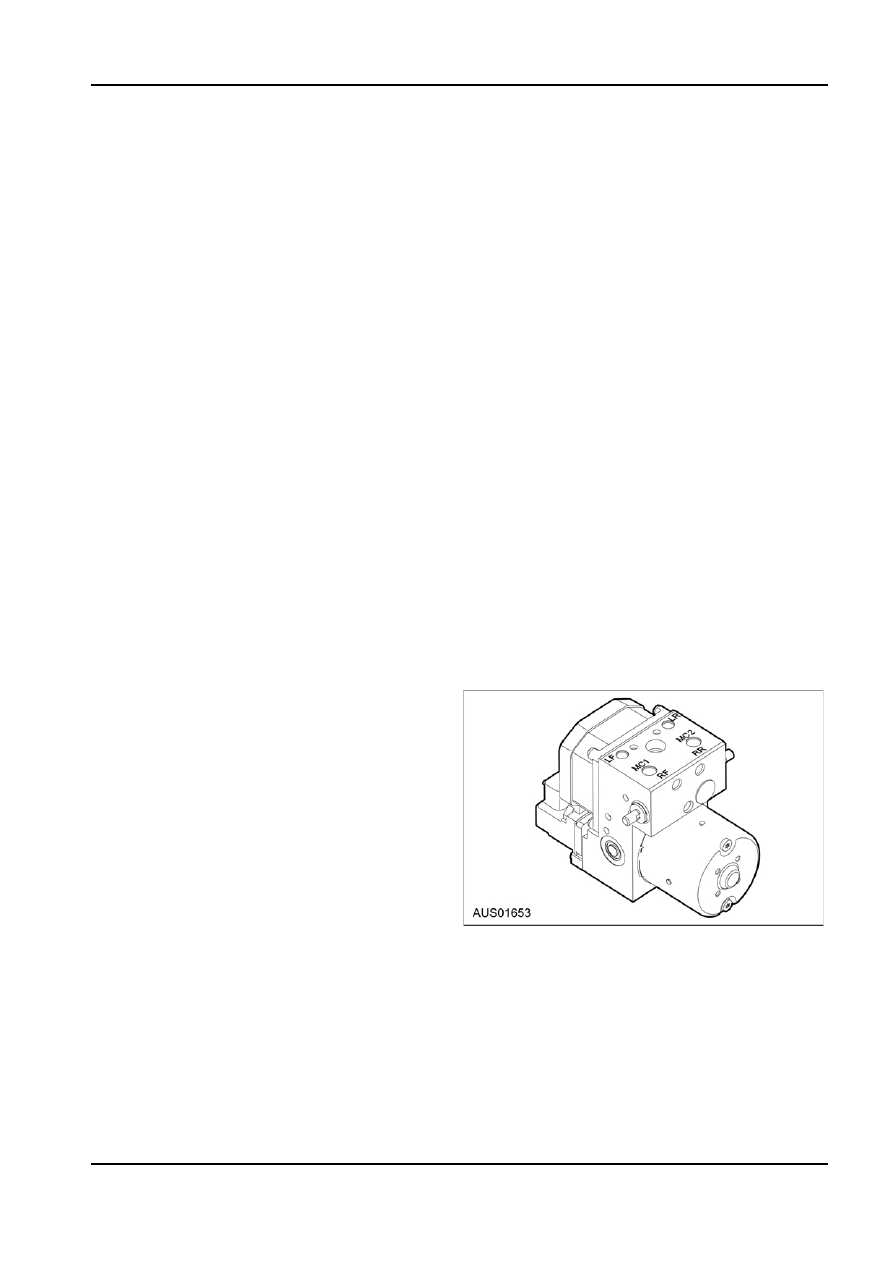
Modulator and ECU
The EBD operation takes effect prior to the increased
slip rate required for ABS intervention.
The ECU uses the inputs from the wheel speed
sensors to determine if ABS [or traction control]
The ABS unit has additional software that will, in the
operation is necessary, and if so, energises the
case of an EBD operation, operate the rear inlet
solenoids to control hydraulic brake pressure [and
valves of the ABS Hydraulic Modulator Assembly.
communicates the desired wheel torque to the EEC].
These inlet valves will open and close as required, to
The ECU controls all diagnostic functions and
control the amount of pressure that can be applied to
monitors all external inputs and outputs.
the rear wheels before ABS is required.
NOTE: The ABS modulator and ECU is serviced only
If the restriction of the pressure, by closing the rear
as a complete assembly. The ECU should not be
inlet valves, does not prevent the slip from continuing
removed from the modulator body.
to increase at the rear axle, the outlet valve will open
and allow a reduction of the pressure to be transferred
to the accumulator of the ABS unit. The pump motor
does not operate at this stage and is therefore not in
ABS mode.
If then the pressure reduction is not sufficient to
reduce the rear wheel slip, a normal ABS operation
will take place.
The EBD uses a select low logic on the rear wheels,
that is, the condition of the rear wheel with the least
amount of traction is duplicated on the opposing
wheel.
Self-Monitoring
When the vehicle is started, the system automatically
carries out a static system analysis. Wheel speed
sensors are checked for continuity, solenoid valves
Sensors and Tone Wheels
and the pump motor are operated, feedback signals
Each wheel is fitted with a sensor and tone wheel.
from the valves and motor are monitored [and
The front sensors are attached to the steering spindle
communication with the EEC is acknowledged].
and the tone wheels are pressed onto the hub
As the vehicle is driven the system monitors itself by
assembly. At the rear, sensors are attached to the
comparing the input and output signals of the valves
differential housing for (IRS) or the parkbrake back
with memorised limit values, in addition to monitoring
plate (for beam axle), whilst the tone wheels are
the voltage supply. It also continuously compares the
attached to the drive shafts. Each tone wheel
wheel speed signals with each other [and
incorporates teeth which generate pulses in the wheel
continuously exchanges information with the EEC].
sensor. These pulses are used by the ECU to
calculate wheel speeds and acceleration rates.
G23420 en