Ford Transit (2018 year). Manual - part 12
 

  Index      Ford     Ford Transit - service manual 2018 year in english


Search            


Content   ..  10  11  12  13   ..


Ford Transit (2018 year). Manual - part 12


WARNINGS

Do not lean your head on the door.
The curtain airbag could injure you
as it deploys from the headliner.

Do not attempt to service, repair, or
modify the supplementary restraint
system or associated components.

Failure to follow this instruction could
result in personal injury or death.

All occupants of your vehicle,
including the driver, should always
properly wear their seatbelts, even

when an airbag supplemental restraint
system is provided. Failure to properly wear
your seatbelt could seriously increase the
risk of injury or death.

To reduce risk of injury, do not
obstruct or place objects in the
deployment path of the airbag.

If a supplementary restraint system
component has deployed, it will not
function again. Have the system and

associated components inspected as soon
as possible. Failure to follow this
instruction could result in personal injury
or death.

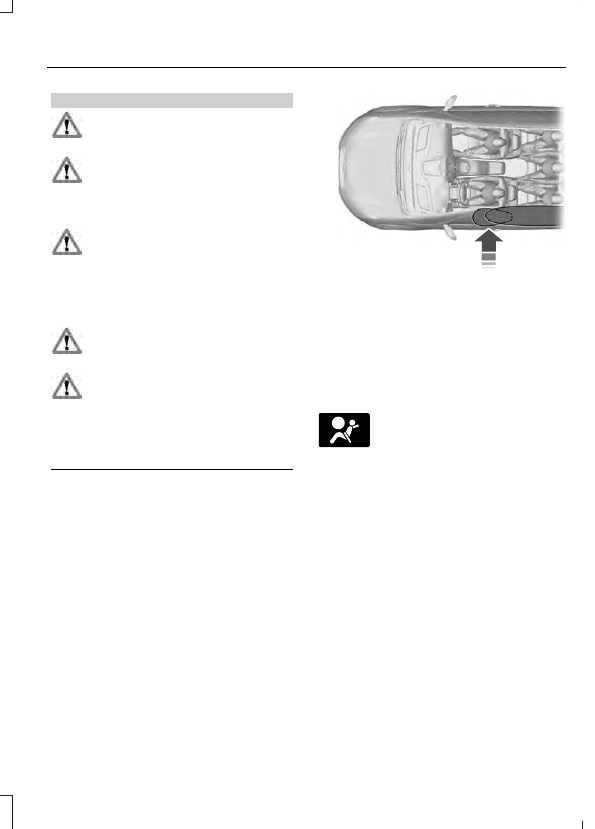
The Safety Canopy deploys during
significant side crashes or when a certain
likelihood of a rollover event is detected
by the rollover sensor. The Safety Canopy
is mounted to the roof side rail sheet metal,
behind the headliner, above each row of
seats. In certain sideways crashes or
rollover events, the Safety Canopy will be
activated, regardless of which seats are
occupied. The Safety Canopy is designed
to inflate between the side window area
and occupants to further enhance
protection provided in side impact crashes
and rollover events.

E75004

The system consists of the following:

Safety Canopy curtain airbags above
the trim panels over the front and rear
side windows identified by a label or
wording on the headliner or roof-pillar
trim.

A flexible headliner which opens above
the side doors to allow air curtain
deployment

E67017

· Crash sensors and monitoring
system with a readiness
indicator.  See Crash Sensors

and Airbag Indicator (page 52).

Properly restrain children 12 years old and
under in the rear seats. The Safety Canopy
will not interfere with children restrained
using a properly installed child or booster
seat because it is designed to inflate
downward from the headliner above the
doors along the side window opening.

The design and development of the Safety
Canopy included recommended testing
procedures that were developed by a
group of automotive safety experts known
as the Side Airbag Technical Working
Group. These recommended testing
procedures help reduce the risk of injuries
related to the deployment of side airbags
(including the Safety Canopy).

CRASH SENSORS AND
AIRBAG INDICATOR

WARNING

Modifying or adding equipment to
the front end of your vehicle
(including hood, bumper system,

frame, front end body structure, tow hooks
and hood pins) may affect the
performance of the airbag system,
increasing the risk of injury. Do not modify
or add equipment to the front end of your
vehicle.

The vehicle has a collection of crash
sensors which provide information to the
supplemental restraint system control
module. The system will deploy the front
seatbelt pretensioners, driver airbag,
passenger airbag, seat mounted side
airbags or safety canopy based on the type
of crash, for example frontal impact or side
impact. The supplemental restraint system
control module will deploy the appropriate
safety devices.

The supplemental restraint system control
module also monitors the readiness of the
above safety devices plus the crash
sensors. The readiness of the
supplemental restraint system is indicated
by a warning lamp in the instrument cluster
or by a backup tone if the warning lamp is
not working. Routine maintenance of the
airbags is not required.

If a fault is present in the supplemental
restraint system it is indicated by one or
more of the following:

E67017

The warning lamp will not
illuminate when you switch the
ignition on.

The warning lamp will either flash or
stay illuminated.

A series of five beeps will be heard. The
tone pattern will repeat periodically
until the fault, the warning lamp or
both are repaired.

If the above occurs, even intermittently,
have the system checked by an authorized
dealer immediately. Unless repaired, the
system may not operate correctly in the
event of a crash.

The seatbelt pretensioners and the front
airbags are designed to deploy when the
vehicle sustains longitudinal deceleration
sufficient to cause the supplemental
restraint system control module to deploy
a safety device.

The fact that the seatbelt pretensioners
or front airbags did not deploy for all front
seat occupants in a crash does not mean
there is a fault with the system. The
supplemental restraint system control
module determines crash conditions,
severity and seatbelt usage to deploy the
appropriate safety devices.

The design of the front airbags is to
deploy only in frontal and near-frontal
crashes, for example not rollovers, side
impacts or rear impacts, unless the
crash causes sufficient longitudinal
deceleration.

The design of the seatbelt
pretensioners is to deploy only in
frontal and near-frontal crashes, and
may also deploy if a safety canopy
deploys.

The design of the side airbags is to
deploy only in certain side impact
crashes. Side airbags may deploy in
other types of crashes if your vehicle
experiences sufficient sideways motion
or deformation.

The design of the safety canopy is to
deploy only in certain side impact
crashes or rollover events. The safety
canopy may deploy in other types of
crashes if your vehicle experiences
sufficient sideways motion or
deformation, or the likelihood of a
rollover event.

AIRBAG DISPOSAL

Contact your authorized dealer as soon as
possible. Airbags must be disposed of by
qualified personnel.

PRINCIPLE OF OPERATION

The remote control allows you to:

remotely lock or unlock the vehicle
doors

unlock the doors without actively using
a key or remote control (intelligent
access only)

remotely open the power liftgate (if
equipped)

remotely start or stop the engine (if
equipped)

arm and disarm the anti-theft system

activate the panic alarm.

GENERAL INFORMATION ON
RADIO FREQUENCIES

This device complies with Part 15 of the
FCC Rules and with Licence exempt RSS
Standards of Industry Canada. Operation
is subject to the following two conditions:

This device may not cause harmful
interference, and

This device must accept any
interference received, including
interference that may cause undesired
operation.

WARNING

Changes or modifications not
expressively approved by the party
responsible for compliance could

void the user's authority to operate the
equipment. The term "IC:" before the radio
certification number only signifies that
Industry Canada technical specifications
were met.

The typical operating range for your
transmitter is approximately 33 ft (10 m).
Vehicles with the remote start feature will
have a greater range. One of the following
could cause a decrease in operating range:

Weather conditions.

Nearby radio towers.

Structures around the vehicle.

Other vehicles parked next to your
vehicle.

Other short distance radio transmissions,
for example amateur radios, medical
equipment, wireless headphones, remote
controls and alarm systems can also use
the radio frequency used by your remote
control. If the frequencies are jammed, you
will not be able to use your remote control.
You can lock and unlock the doors with the
key.

Note: Make sure to lock your vehicle before
leaving it unattended.

Note: If you are in range, the remote control
will operate if you press any button
unintentionally.

Note: The remote control contains sensitive
electrical components. Exposure to moisture
or impact may cause permanent damage.


Content   ..  10  11  12  13   ..