Ford Transit Connect (2018 year). Manual - part 6
 

  Index      Ford     Ford Transit Connect - service manual 2018 year in english


Search            


Content   ..  4  5  6  7   ..


Ford Transit Connect (2018 year). Manual - part 6


WARNINGS

manufacturer. A safety seat that is
improperly installed or utilized, is
inappropriate for your child's height, age,
or weight or does not properly fit the child
may increase the risk of serious injury or
death.

Never let a passenger hold a child on
his or her lap while your vehicle is
moving. The passenger cannot

protect the child from injury in a crash,
which may result in serious injury or death.

Never use pillows, books, or towels
to boost a child. They can slide
around and increase the likelihood

of injury or death in a crash.

WARNINGS

Always restrain an unoccupied child
seat or booster seat. These objects
may become projectiles in a crash or

sudden stop, which may increase the risk
of serious injury.

Never place, or allow a child to place,
the shoulder belt under a child's arm
or behind the back because it

reduces the protection for the upper part
of the body and may increase the risk of
injury or death in a crash.

To avoid risk of injury, do not leave
children or pets unattended in your
vehicle.

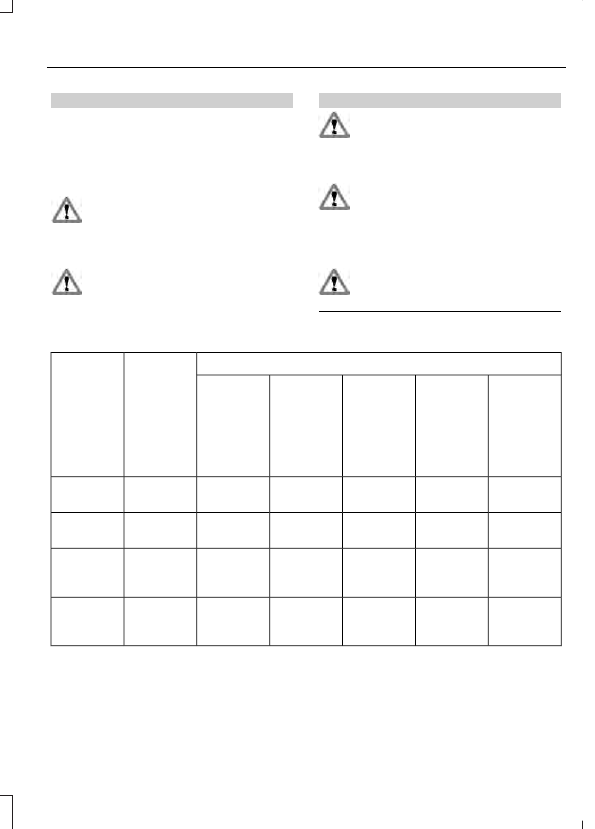
Recommendations for attaching child safety restraints for children

Use any attachment method as indicated below by X

Combined

weight of

child and

child seat

Restraint

Type

Safety belt

only

Safety belt
and LATCH

(lower

anchors

and top

tether

anchor)

Safety belt

and top

tether

anchor

LATCH

(lower

anchors

only)

LATCH

(lower

anchors

and top

tether

anchor)

X

X

Up to 65 lb

(29.5 kg)

Rear facing

child seat

X

Over 65 lb

(29.5 kg)

Rear facing

child seat

X

X

X

Up to 65 lb

(29.5 kg)

Forward

facing

child seat

X

X

Over 65 lb

(29.5 kg)

Forward

facing

child seat

Note: The child seat must rest tightly
against the vehicle seat upon which it is
installed. It may be necessary to lift or
remove the head restraint.  See Seats (page
103).

CHILD SAFETY LOCKS

WARNING

You cannot open the doors from
inside if you have put the child safety
locks on.

E189148

The childproof locks are located on the
rear edge of each rear door and must be
set separately for each door.

Left-Hand Side

Turn counterclockwise to lock and
clockwise to unlock.

Right-Hand Side

Turn clockwise to lock and
counterclockwise to unlock.

PRINCIPLE OF OPERATION

WARNINGS

Always drive and ride with your
seatback upright and the lap belt
snug and low across the hips.

To reduce the risk of injury, make
sure children sit where they can be
properly restrained.

Never let a passenger hold a child on
his or her lap while your vehicle is
moving. The passenger cannot

protect the child from injury in a crash.

All occupants of your vehicle,
including the driver, should always
properly wear their safety belts, even

when an airbag supplemental restraint
system is provided. Failure to properly wear
your safety belt could seriously increase
the risk of injury or death.

It is extremely dangerous to ride in a
cargo area, inside or outside of a
vehicle. In a crash, people riding in

these areas are more likely to be seriously
injured or killed. Do not allow people to ride
in any area of your vehicle that is not
equipped with seats and safety belts. Be
sure everyone in your vehicle is in a seat
and using a safety belt properly.

In a rollover crash, an unbelted
person is significantly more likely to
die than a person wearing a safety

belt.

Each seating position in your vehicle
has a specific safety belt assembly
which is made up of one buckle and

one tongue that are designed to be used
as a pair. 1) Use the shoulder belt on the
outside shoulder only. Never wear the
shoulder belt under the arm. 2) Never
swing the safety belt around your neck over
the inside shoulder. 3) Never use a single
belt for more than one person.

WARNINGS

When possible, all children 12 years
old and under should be properly
restrained in a rear seating position.

Failure to follow this could seriously
increase the risk of injury or death.

Safety belts and seats can become
hot in a vehicle that has been closed
up in sunny weather; they could burn

a small child. Check seat covers and
buckles before you place a child anywhere
near them.

Front and rear seat occupants,
including pregnant women, should
wear safety belts for optimum

protection in an accident.

All seating positions in your vehicle have
lap and shoulder safety belts. All
occupants of the vehicle should always
properly wear their safety belts, even when
an airbag supplemental restraint system
is provided.

The safety belt system consists of:

Lap and shoulder safety belts.

Shoulder safety belt with automatic
locking mode, (except driver safety
belt).

Height adjuster at the front outboard
seating positions.

Safety belt pretensioner at the front
outboard seating positions.

Belt tension sensor at the front
outboard passenger seating position.

E71880

Safety belt warning light and chime.

E67017

Crash sensors and monitoring system
with readiness indicator.

The safety belt pretensioners at the front
seating positions are designed to tighten
the safety belts when activated. In frontal
and near-frontal crashes, the safety belt
pretensioners may be activated alone or,
if the crash is of sufficient severity, together
with the front airbags. The pretensioners
may also activate when the Safety Canopy
is deployed.

FASTENING THE SEATBELTS

The front outermost and rear safety
restraints in your vehicle are combination
lap and shoulder belts.

E142587

1.

Insert the seatbelt tongue into the
proper buckle (the buckle closest to
the direction the tongue is coming
from) until you hear a snap and feel it
latch.

Note: Make sure that the seatbelt tongue
is properly fastened in the seatbelt buckle.

E142588

2. Press the button to release the seatbelt

tongue.

Using Seatbelts During Pregnancy

WARNING

Always ride and drive with your
seatback upright and properly fasten
your seatbelt. Fit the lap portion of

the seatbelt snugly and low across the
hips. Position the shoulder portion of the
seatbelt across your chest. Pregnant
women must follow this practice. See the
following figure.

E170730


Content   ..  4  5  6  7   ..